
Program Development and Problem Solving Program Development and
Program Development and Problem Solving
Program Development and Problem Solving ® Program – sequence of instructions that must be followed to solve a particular problem ® Computer programming – enables us to use the computer as a problem solving tool
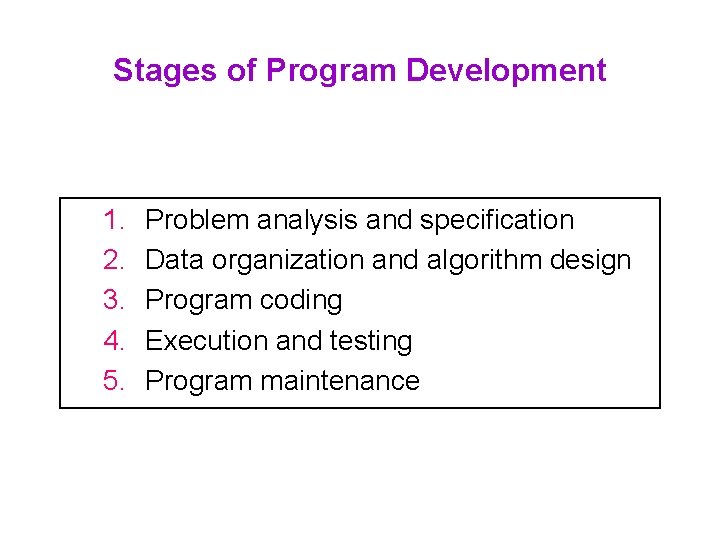
Stages of Program Development 1. 2. 3. 4. 5. Problem analysis and specification Data organization and algorithm design Program coding Execution and testing Program maintenance
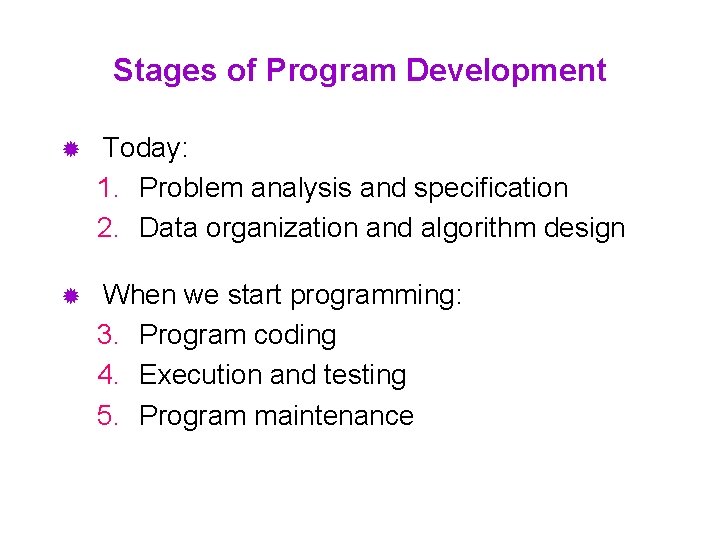
Stages of Program Development ® Today: 1. Problem analysis and specification 2. Data organization and algorithm design ® When we start programming: 3. Program coding 4. Execution and testing 5. Program maintenance
Problem Analysis and Specification ® Specification – description of the problem’s input • what information is given and which items are important in solving the problem – description of the problem’s output • what information must be produced to solve the problem ® Analysis – generalize specification to solve given problem + related problems of same kind
Data Organization and Algorithm Design ® Data organization – representation of the input and output – variables • assignment of names to various quantities, which may assume different values ® Algorithm design – development of procedures or algorithms to process the input and produce the required output
Algorithm Design and Refinement ® Basic description of an algorithm – get input values – compute output values for the given input – return output values ® Algorithm refinement – adding problem specific details – for example, computation of output values – a formula or equation may be required
Example – Adding two numbers Problem: Calculate 13+23 ® Generalization of problem – Calculate the sum of two numbers
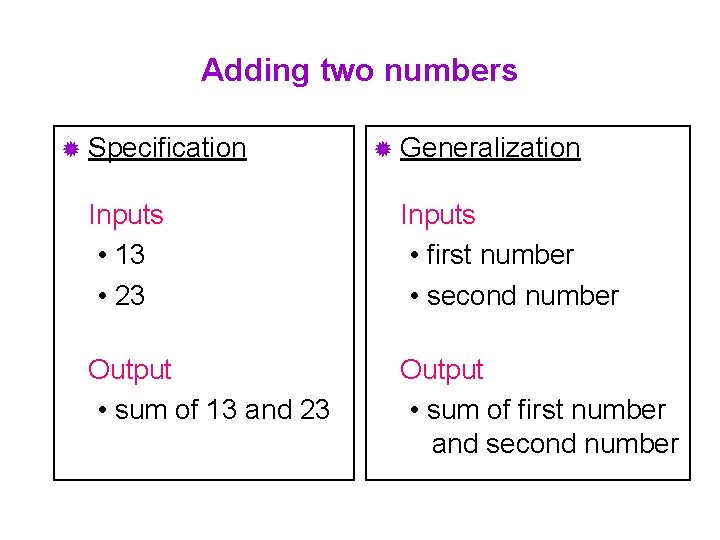
Adding two numbers ® Specification ® Generalization Inputs • 13 • 23 Inputs • first number • second number Output • sum of 13 and 23 Output • sum of first number and second number
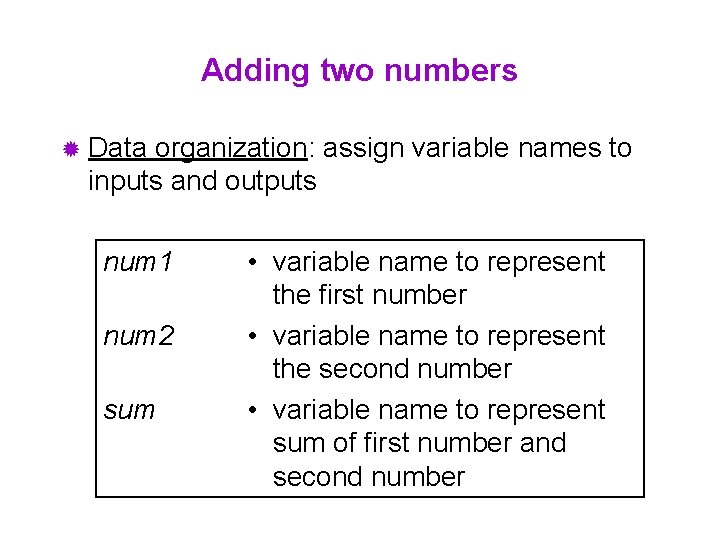
Adding two numbers ® Data organization: assign variable names to inputs and outputs num 1 num 2 sum • variable name to represent • the first number • variable name to represent • the second number • variable name to represent • sum of first number and • second number
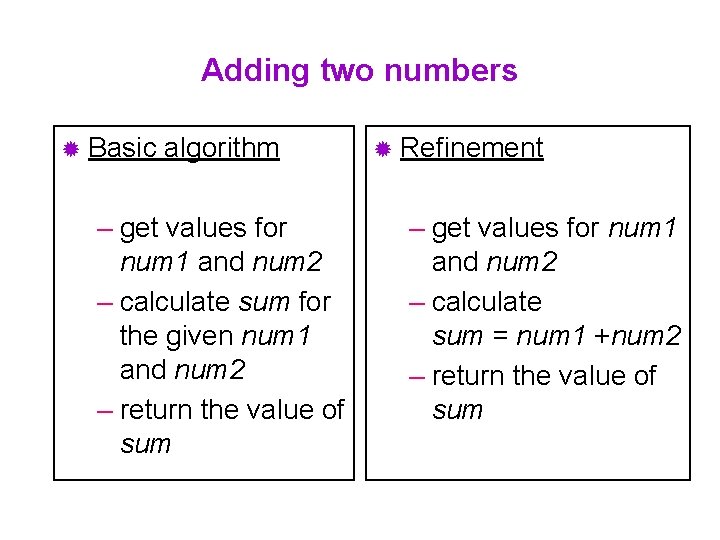
Adding two numbers ® Basic algorithm – get values for num 1 and num 2 – calculate sum for the given num 1 and num 2 – return the value of sum ® Refinement – get values for num 1 and num 2 – calculate sum = num 1 +num 2 – return the value of sum
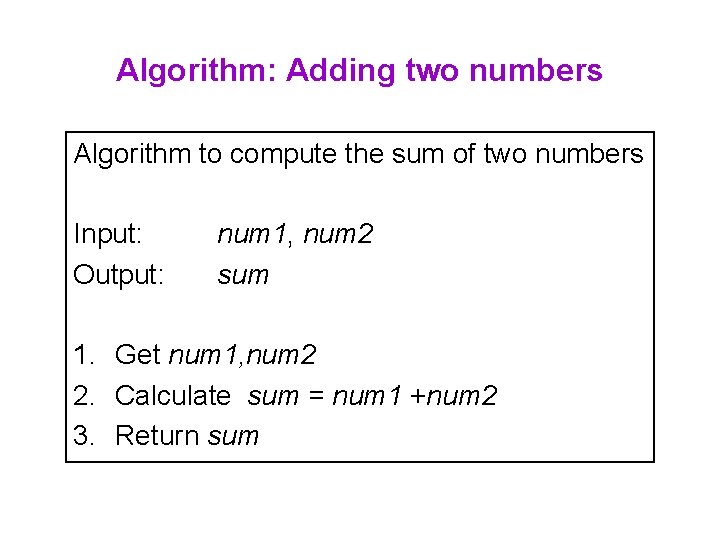
Algorithm: Adding two numbers Algorithm to compute the sum of two numbers Input: Output: num 1, num 2 sum 1. Get num 1, num 2 2. Calculate sum = num 1 +num 2 3. Return sum
Control Structures ® Determine the sequence of execution of the program’s instructions – Sequential execution: Steps are performed in order, each step being executed once – Selective execution: One of a number of alternative actions is selected and executed – Repetitive execution: One or more steps are performed repeatedly
Minimum of two numbers Problem: Find the minimum of two numbers ® Selective execution – either the first number is less than the second number or the second number is less than the first
Minimum of two numbers ® Inputs – num 1 • first number – num 2 • second number ® Output – min • minimum of first, second numbers ® How do we find the minimum? ? – if the first number is smaller than the second number, then the first number is the minimum – else, the second number is the minimum
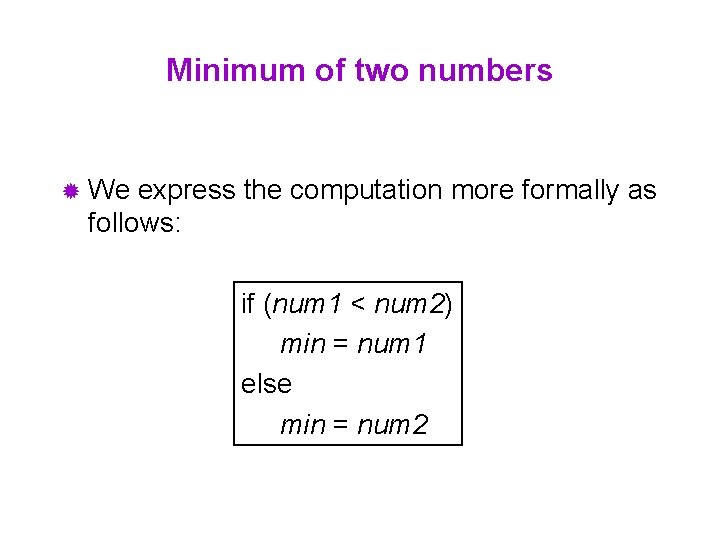
Minimum of two numbers ® We express the computation more formally as follows: if (num 1 < num 2) min = num 1 else min = num 2
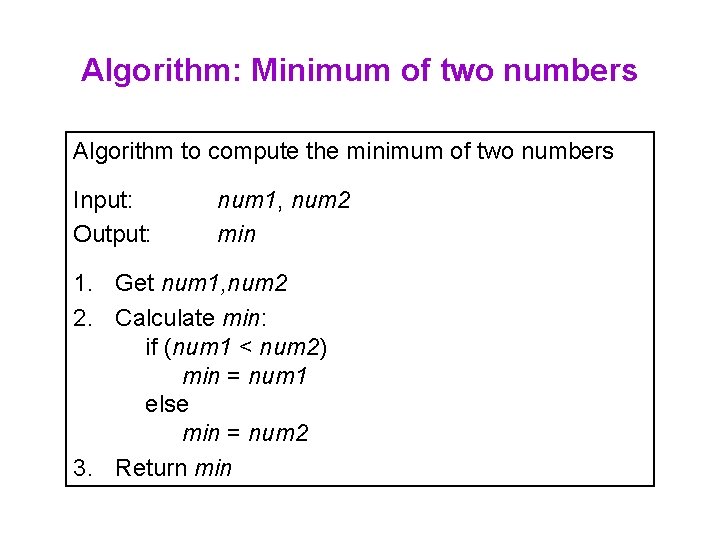
Algorithm: Minimum of two numbers Algorithm to compute the minimum of two numbers Input: Output: num 1, num 2 min 1. Get num 1, num 2 2. Calculate min: if (num 1 < num 2) min = num 1 else min = num 2 3. Return min
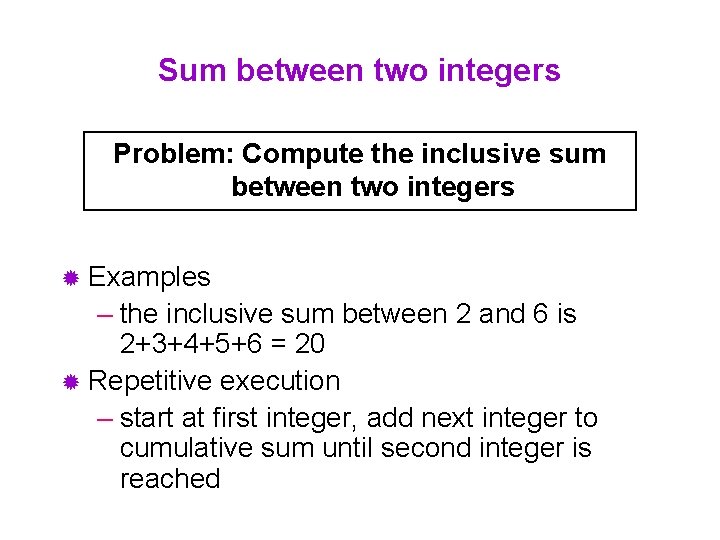
Sum between two integers Problem: Compute the inclusive sum between two integers ® Examples – the inclusive sum between 2 and 6 is 2+3+4+5+6 = 20 ® Repetitive execution – start at first integer, add next integer to cumulative sum until second integer is reached
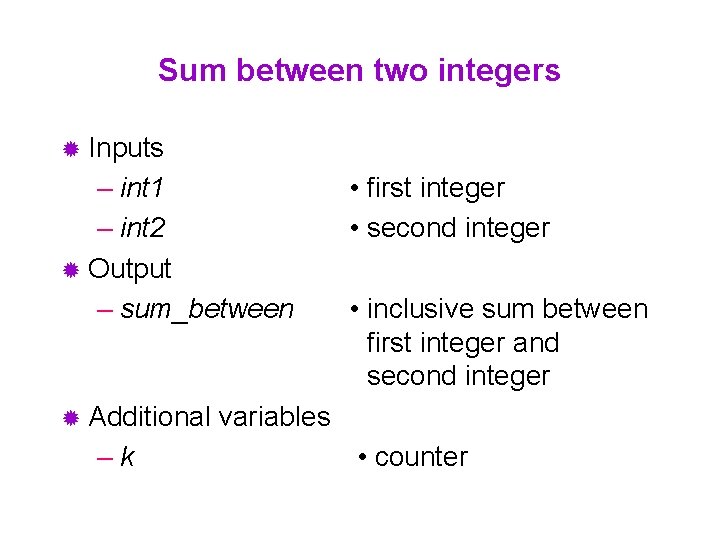
Sum between two integers ® Inputs – int 1 – int 2 ® Output – sum_between ® Additional –k • first integer • second integer • inclusive sum between • first integer and • second integer variables • counter
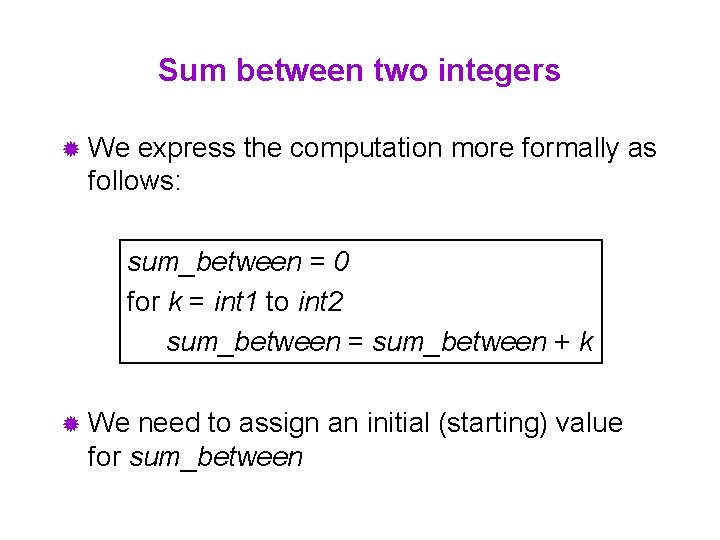
Sum between two integers ® We express the computation more formally as follows: sum_between = 0 for k = int 1 to int 2 sum_between = sum_between + k ® We need to assign an initial (starting) value for sum_between
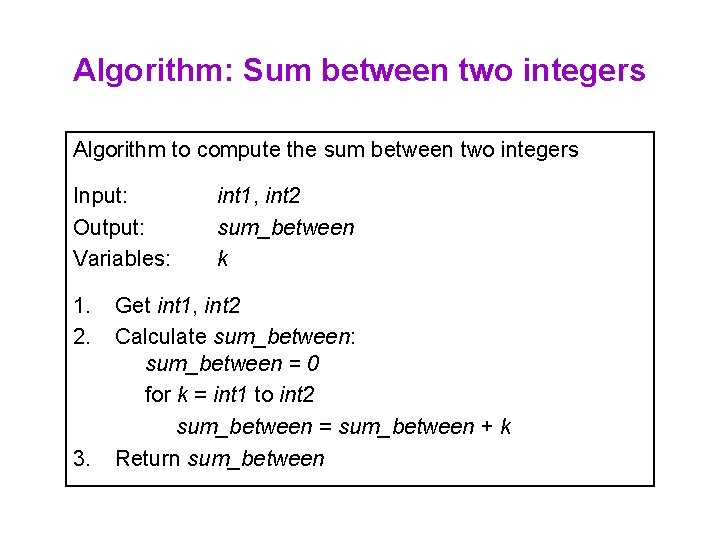
Algorithm: Sum between two integers Algorithm to compute the sum between two integers Input: Output: Variables: 1. 2. 3. int 1, int 2 sum_between k Get int 1, int 2 Calculate sum_between: sum_between = 0 for k = int 1 to int 2 sum_between = sum_between + k Return sum_between
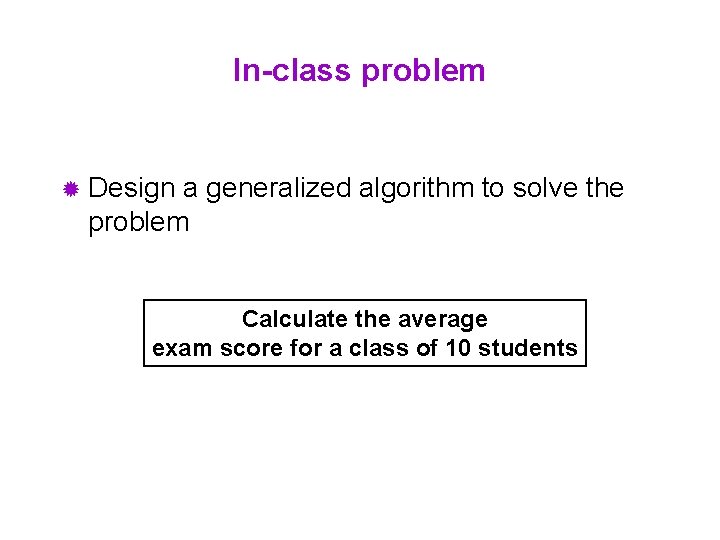
In-class problem ® Design a generalized algorithm to solve the problem Calculate the average exam score for a class of 10 students
- Slides: 22