
Program Cost and Schedule Integrated with Systems Engineering
- Slides: 29
Program Cost and Schedule Integrated with Systems Engineering Models Charlie Stirk Harold P. Frisch David Price Cost. Vision NASA GSFC emeritus Eurostep NASA ESA Product Data Exchange Workshop, April 29 -May 1, 2009
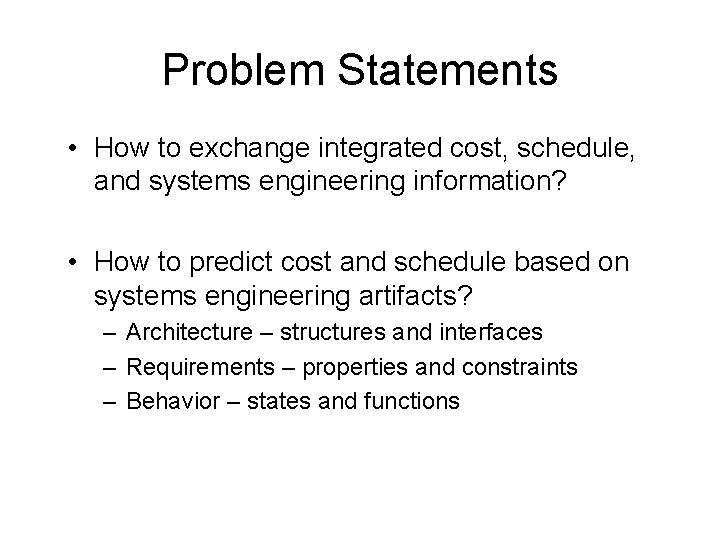
Problem Statements • How to exchange integrated cost, schedule, and systems engineering information? • How to predict cost and schedule based on systems engineering artifacts? – Architecture – structures and interfaces – Requirements – properties and constraints – Behavior – states and functions
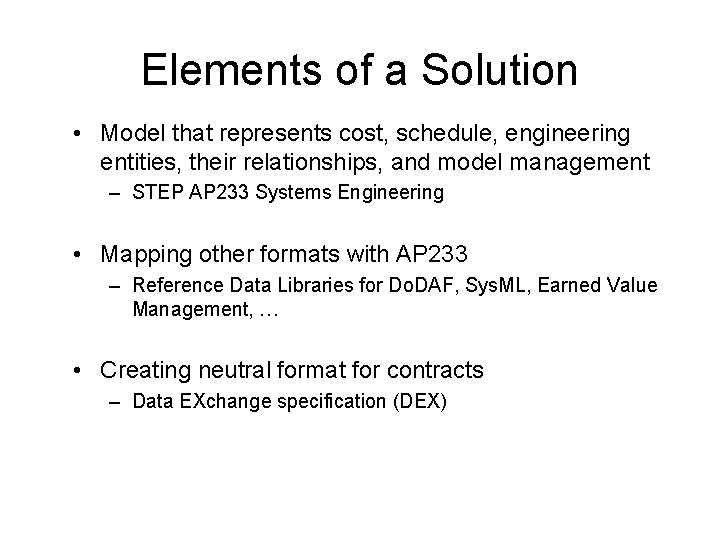
Elements of a Solution • Model that represents cost, schedule, engineering entities, their relationships, and model management – STEP AP 233 Systems Engineering • Mapping other formats with AP 233 – Reference Data Libraries for Do. DAF, Sys. ML, Earned Value Management, … • Creating neutral format for contracts – Data EXchange specification (DEX)
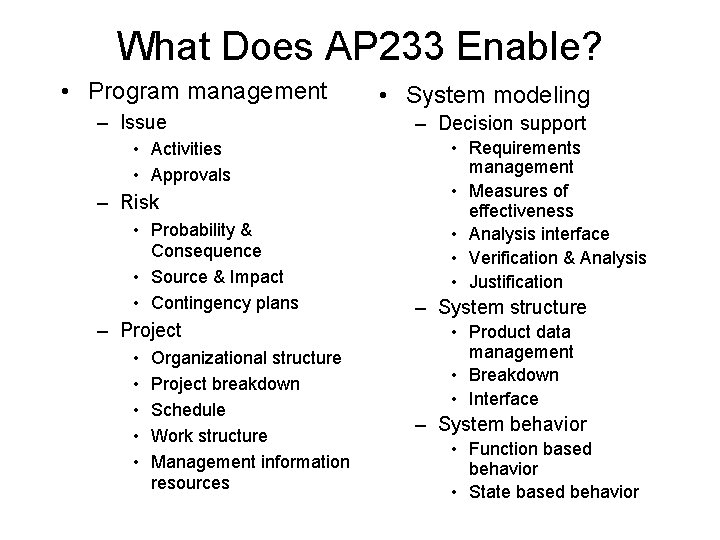
What Does AP 233 Enable? • Program management – Issue • Activities • Approvals – Risk • Probability & Consequence • Source & Impact • Contingency plans – Project • • • Organizational structure Project breakdown Schedule Work structure Management information resources • System modeling – Decision support • Requirements management • Measures of effectiveness • Analysis interface • Verification & Analysis • Justification – System structure • Product data management • Breakdown • Interface – System behavior • Function based behavior • State based behavior
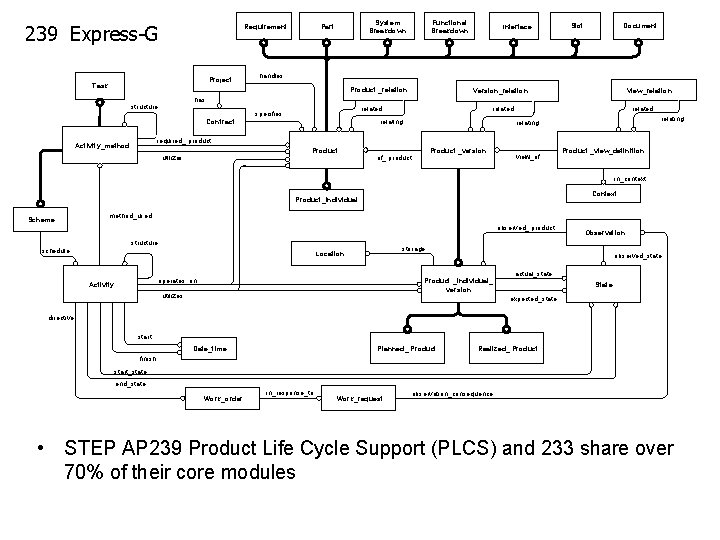
239 Express-G Requirement Project Task System Breakdown Part Functional Breakdown Interface Document Slot handles Product _relation View_relation Version_relation has structure related specifies related relating Contract related relating required_ product Activity_method Product utilizes Product _version of_ product view_of Product _view_definition in_context Context Product_individual Scheme method_used observed_ product structure schedule storage Location operates_on Activity Observation observed_state Product _individual_ version utilizes actual_state State expected_state directive start Planned_ Product Date_time Realized_ Product finish start_state end_state Work_order in_response_to Work_request observation_consequence • STEP AP 239 Product Life Cycle Support (PLCS) and 233 share over 70% of their core modules
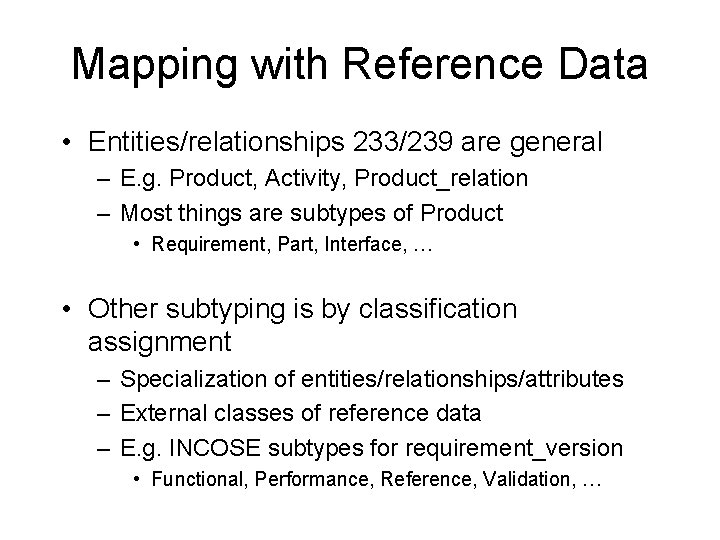
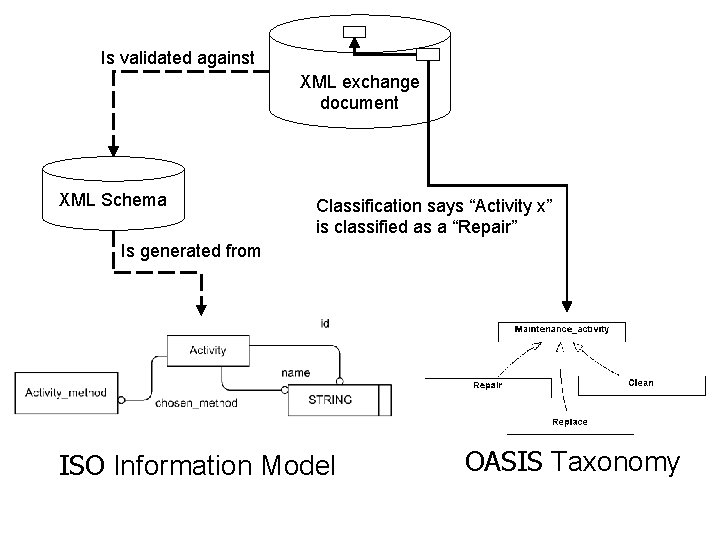
Mapping with Reference Data • Entities/relationships 233/239 are general – E. g. Product, Activity, Product_relation – Most things are subtypes of Product • Requirement, Part, Interface, … • Other subtyping is by classification assignment – Specialization of entities/relationships/attributes – External classes of reference data – E. g. INCOSE subtypes for requirement_version • Functional, Performance, Reference, Validation, …
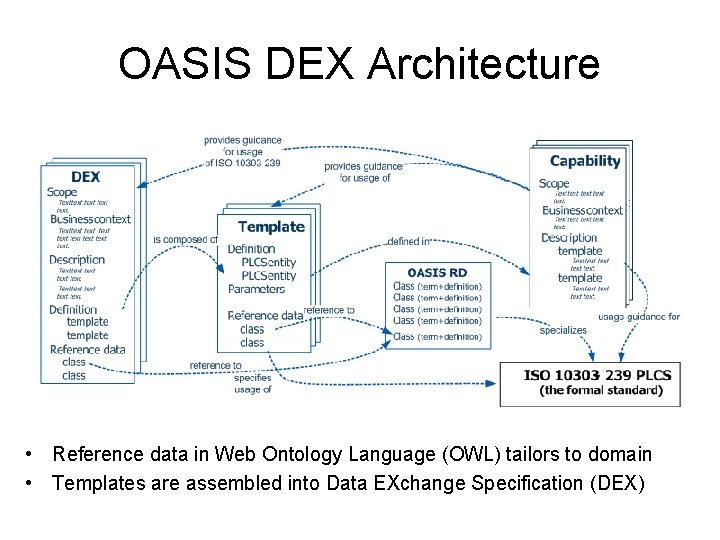
OASIS DEX Architecture • Reference data in Web Ontology Language (OWL) tailors to domain • Templates are assembled into Data EXchange Specification (DEX)
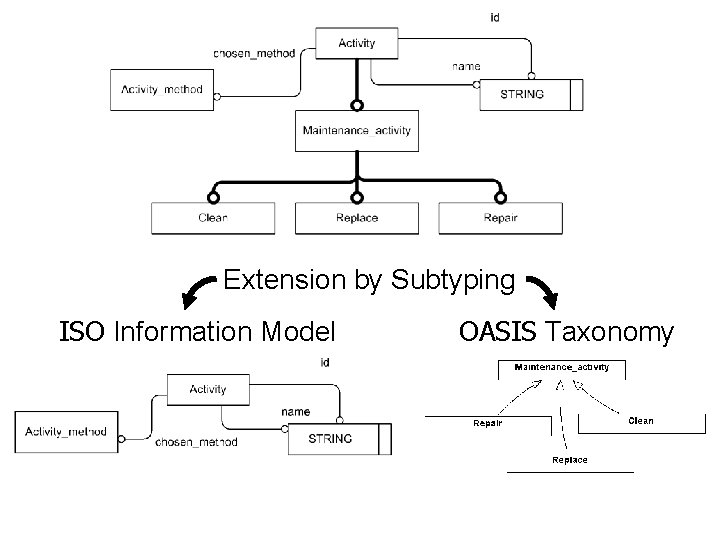
Extension by Subtyping ISO Information Model OASIS Taxonomy
Solid box is an instance of Activity named “Activity x” Is validated against XML exchange document XML Schema Empty box is an instance of Classification says “Activity x” is classified as a “Repair” Is generated from ISO Information Model OASIS Taxonomy
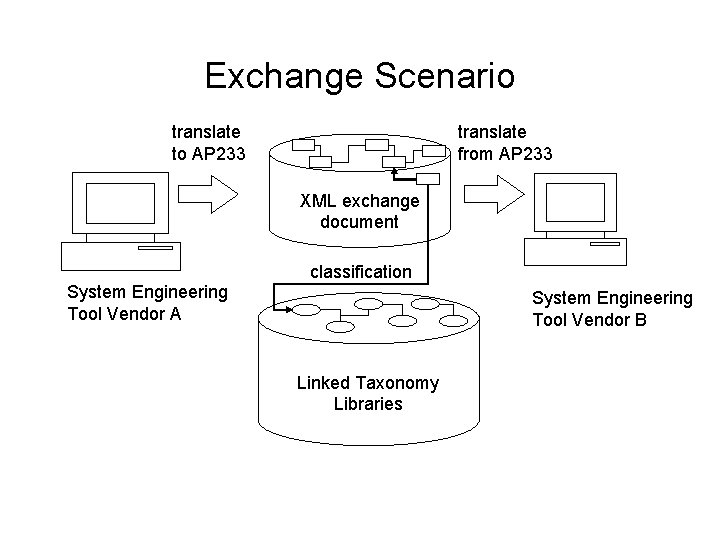
Exchange Scenario translate to AP 233 translate from AP 233 XML exchange document classification System Engineering Tool Vendor A System Engineering Tool Vendor B Linked Taxonomy Libraries
Reference Data Issues • Need expert knowledge of STEP information models to properly subtype with reference data • Many potential sources of reference data from different domains (need domain experts involved) • Basic set theory used to classify reference data • Potential for other uses of OWL e. g. semantic reasoning
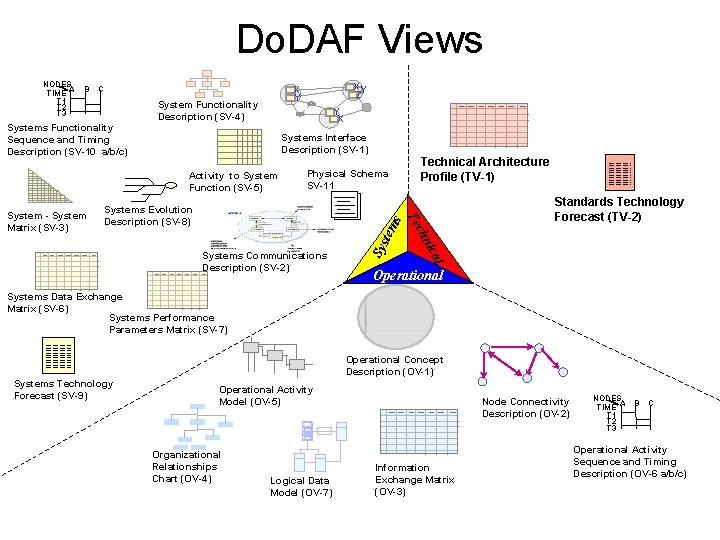
Do. DAF • Do. DAF - Department of Defense Architecture Framework – Views of systems engineering data • CADM - Core Architecture Data Model – Standardized database schema for Do. DAF • DARS – Do. D Architecture Repository System • Stores Do. DAF artifacts for program analysis • UPDM – Unified (formerly UML) Profile for Do. DAF and Mo. DAF • Support for Sys. ML and UML
Do. DAF Views B System Functionality Description (SV-4) Y X Systems Functionality Sequence and Timing Description (SV-10 a/b/c) Systems Interface Description (SV-1) Activity to System Function (SV-5) Physical Schema SV-11 l ica Systems Communications Description (SV-2) Standards Technology Forecast (TV-2) chn tem s Systems Evolution Description (SV-8) Technical Architecture Profile (TV-1) Te System - System Matrix (SV-3) XY Z X Y C Sys NODES TIME A T 1 T 2 T 3 Operational Systems Data Exchange Matrix (SV-6) Systems Performance Parameters Matrix (SV-7) Operational Concept Description (OV-1) Systems Technology Forecast (SV-9) Operational Activity Model (OV-5) • . . . Organizational Relationships Chart (OV-4) Logical Data Model (OV-7) Node Connectivity Description (OV-2) • - Information Exchange Matrix (OV-3) NODES TIME A T 1 T 2 T 3 B C Operational Activity Sequence and Timing Description (OV-6 a/b/c)
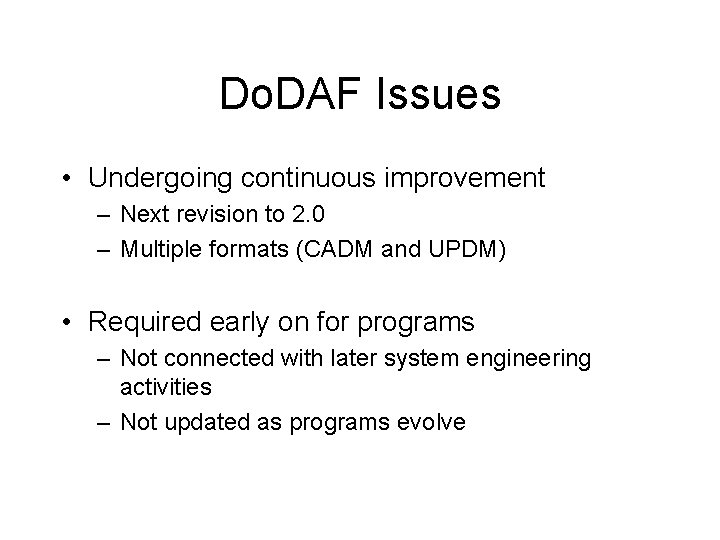
Do. DAF Issues • Undergoing continuous improvement – Next revision to 2. 0 – Multiple formats (CADM and UPDM) • Required early on for programs – Not connected with later system engineering activities – Not updated as programs evolve
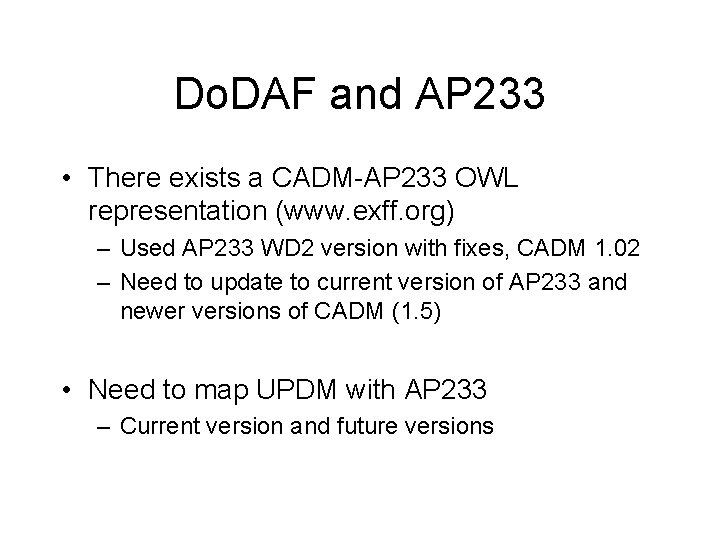
Do. DAF and AP 233 • There exists a CADM-AP 233 OWL representation (www. exff. org) – Used AP 233 WD 2 version with fixes, CADM 1. 02 – Need to update to current version of AP 233 and newer versions of CADM (1. 5) • Need to map UPDM with AP 233 – Current version and future versions
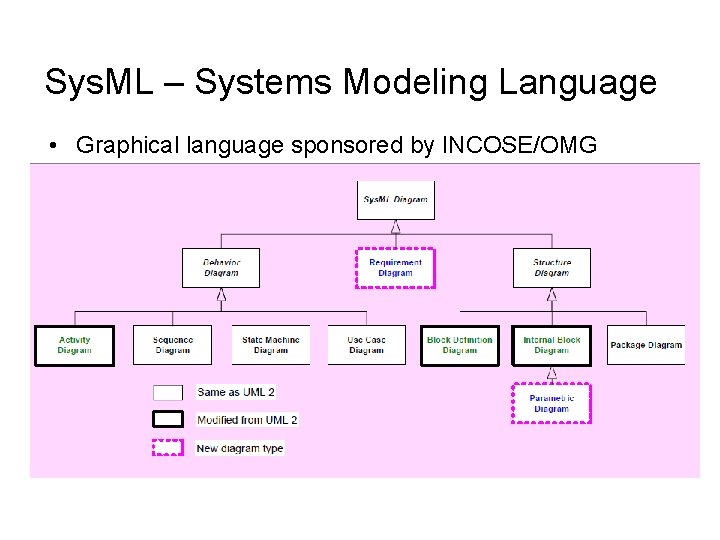
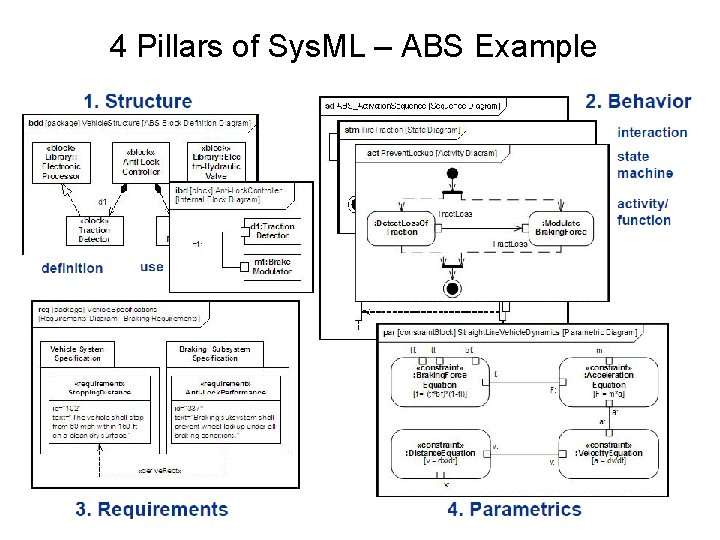
Sys. ML – Systems Modeling Language • Graphical language sponsored by INCOSE/OMG
4 Pillars of Sys. ML – ABS Example
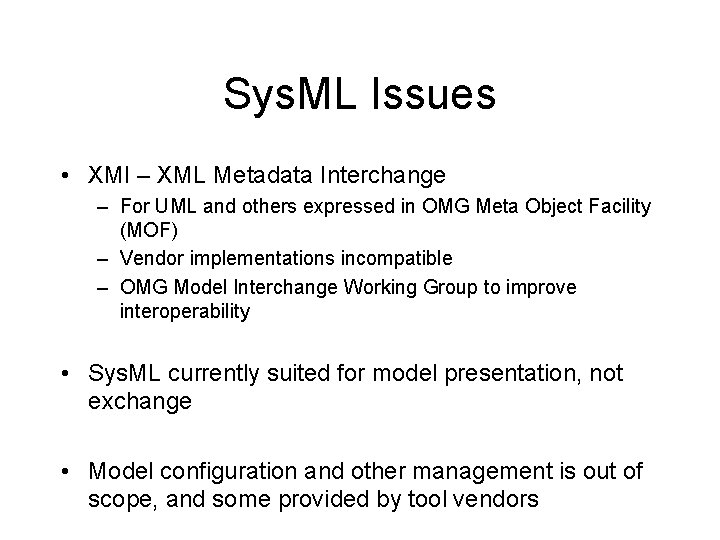
Sys. ML Issues • XMI – XML Metadata Interchange – For UML and others expressed in OMG Meta Object Facility (MOF) – Vendor implementations incompatible – OMG Model Interchange Working Group to improve interoperability • Sys. ML currently suited for model presentation, not exchange • Model configuration and other management is out of scope, and some provided by tool vendors
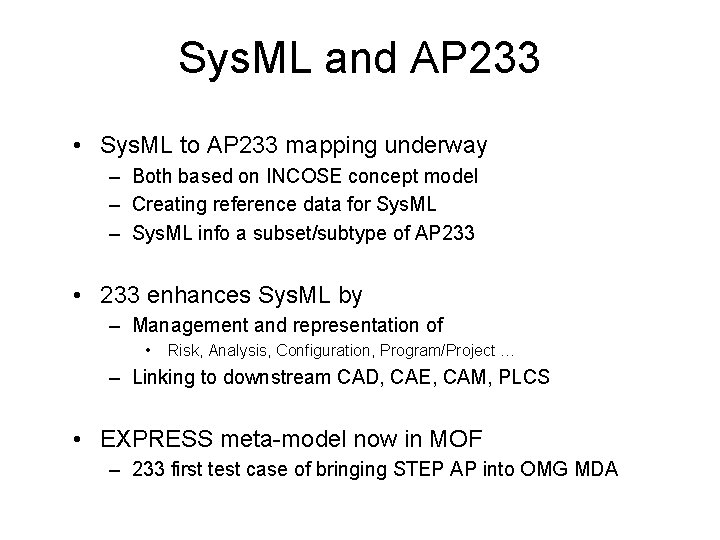
Sys. ML and AP 233 • Sys. ML to AP 233 mapping underway – Both based on INCOSE concept model – Creating reference data for Sys. ML – Sys. ML info a subset/subtype of AP 233 • 233 enhances Sys. ML by – Management and representation of • Risk, Analysis, Configuration, Program/Project … – Linking to downstream CAD, CAE, CAM, PLCS • EXPRESS meta-model now in MOF – 233 first test case of bringing STEP AP into OMG MDA
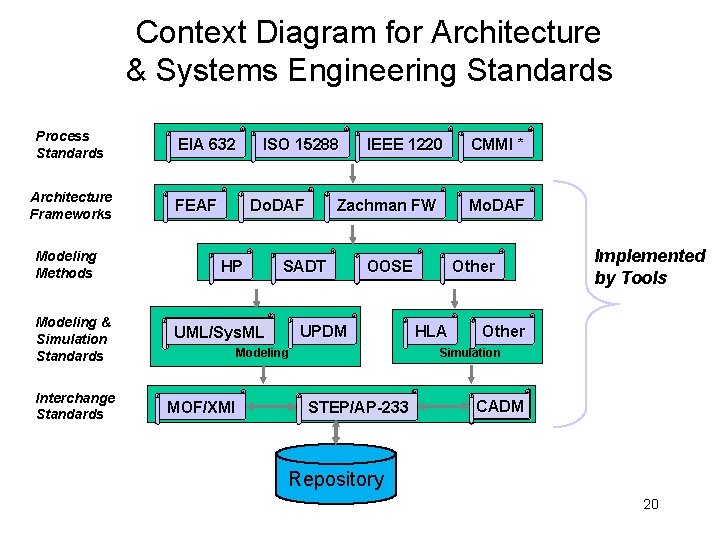
Context Diagram for Architecture & Systems Engineering Standards Process Standards Architecture Frameworks Modeling Methods Modeling & Simulation Standards Interchange Standards EIA 632 FEAF ISO 15288 Do. DAF HP Zachman FW SADT UML/Sys. ML IEEE 1220 Modeling MOF/XMI Mo. DAF OOSE UPDM CMMI * Other HLA Implemented by Tools Other Simulation STEP/AP-233 CADM Other Repository 20
Earned Value Management • Government contract cost and schedule performance reporting • Standards for EVM Systems – ANSI/EIA-748 -A EVMS Guidelines – XML Schema based on ANSI X. 12 806 & 839 • NDIA Program Management Systems Committee XML Working Group • Defense Contract Management Agency
Standard Reports • Integrated Master Plan (IMP) • Integrated Master Schedule (IMS) • Contract Performance Report (CPR) • Contract Funds Status Report (CFSR)
Work Breakdown Structure (WBS) • MIL-HDBK-881 standard 3 -level for weapon systems – – E. g. Missile System/Air Vehicle/Propulsion Allows trade-space Contractor tailors to deeper levels for program Some contractors standardizing lower WBS levels • New Operations & Support WBS
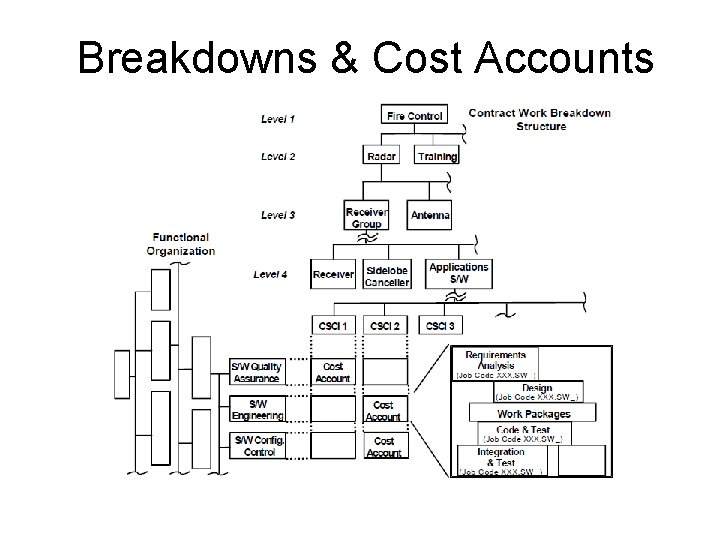
Breakdowns & Cost Accounts
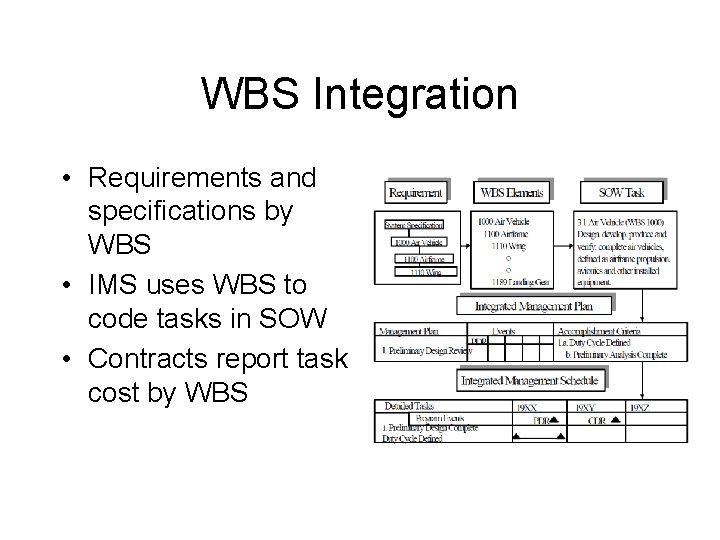
WBS Integration • Requirements and specifications by WBS • IMS uses WBS to code tasks in SOW • Contracts report task cost by WBS
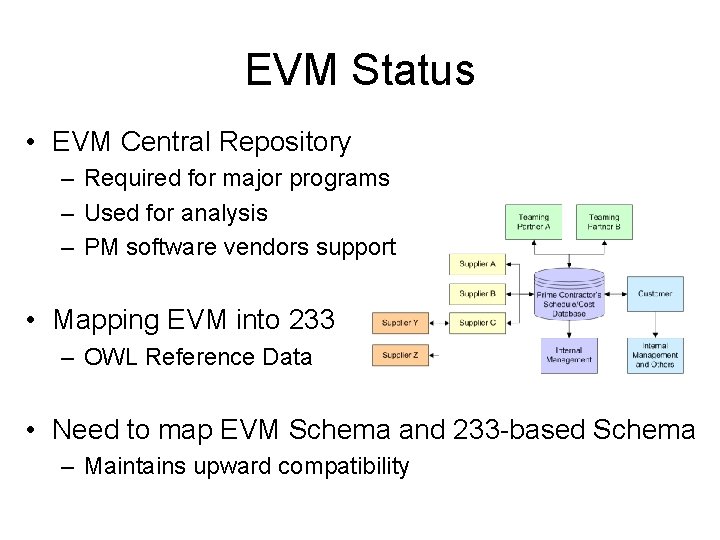
EVM Status • EVM Central Repository – Required for major programs – Used for analysis – PM software vendors support • Mapping EVM into 233 – OWL Reference Data • Need to map EVM Schema and 233 -based Schema – Maintains upward compatibility
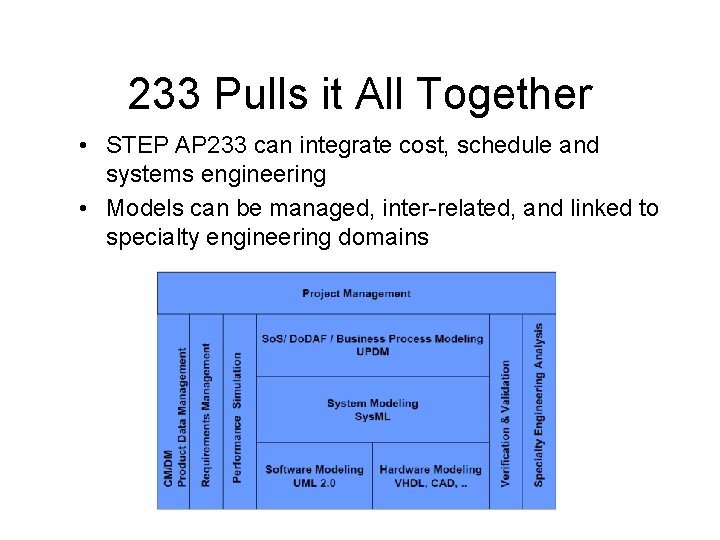
233 Pulls it All Together • STEP AP 233 can integrate cost, schedule and systems engineering • Models can be managed, inter-related, and linked to specialty engineering domains
Analysis from Repositories • Regression of Cost Estimating Relationships (CER) from past programs – Early work shows that the number of Do. DAF interfaces correlated to cost & schedule (and growth) – Need to automate extraction and expand to other metrics and Sys. ML • Causal Activity Based Cost Models (ABC, a. k. a. detailed engineering, bottoms-up) – Driven from requirements, system structure, behavior – Linked to IMS
Summary • STEP AP 233 Systems Engineering can – Input and integrate cost, schedule, and engineering models – Manage models through changes, lifecycle, and supply chain – Provide a basis for program baseline, reporting, and analysis