
PROGNOSIS Definition Difference between prognosis and risk Types
PROGNOSIS
• • • Definition Difference between prognosis and risk Types of prognosis Overall prognosis vs individual prognosis Prognostic factors
• Prognosis is a prediction of the probable course, duration, and outcome of a disease based on a general knowledge of the pathogenesis of the disease and the presence of risk factors for the disease.
• It is established after the diagnosis is made and before the treatment plan is established. • The prognosis is based on specific information about the disease and the manner in which it can be treated, but it also can be influenced by the clinician's previous experience with treatment outcomes (successes and failures) as they relate to the particular case.
• Prognosis is often confused with the term risk. • Risk generally deals with the likelihood that an individual will get a disease in a specified period. • Risk factors are those characteristics of an individual that put them at increased risk for getting a disease.
• In contrast, prognosis is the prediction of the course or outcome of a disease. • Prognostic factors are characteristics that predict the outcome of disease once the disease is present. • In some cases, risk factors and prognostic factors are the same
TYPES OF PROGNOSIS • Excellent prognosis: No bone loss, excellent gingival condition, good patient cooperation, no systemic/ environmental factors. • Good prognosis: One or more of the following: adequate remaining bone support, adequate possibilities to control etiologic factors and establish a maintainable dentition, adequate patient cooperation, no systemic/ environmental factors or if systemic factors are present, they are well controlled.
• Fair prognosis: One or more of the following: lessthanadequate remaining bone support, some tooth mobility, grade I furcation involvement, adequate maintenance possible, acceptable patient cooperation, presence of limited systemic/environmental factors. • Poor prognosis: One or more of the following: moderate to-advanced bone loss, tooth mobility, grade I and II furcation involvements, difficult-to-maintain areas and/or doubtful patient cooperation, presence of systemic/environmental factors.
• Questionable prognosis: One or more of the following: advanced bone loss, grade II and III furcation involvements, tooth mobility, inaccessible areas, presence of systemic/environmental factors. • Hopeless prognosis: One or more of the following: advanced bone loss, non maintainable areas, extraction(s) indicated, presence of uncontrolled systemic/environmental factors.
Overall versus Individual Tooth Prognosis • The overall prognosis is concerned with the dentition as a whole. • The overall prognosis answers the following questions: • Should treatment be undertaken? • Is it likely to succeed? • When prosthetic replacements are needed, are the remaining teeth able to support the added burden of the prosthesis?
• The prognosis for individual teeth is determined after the overall prognosis and is affected by it
Factors to be Considered When Determining a Prognosis • • • Overall Clinical factors Patient age Disease severity Plaque control Patient compliance
• • • Systemic/Environmental Factors Smoking Systemic disease/condition Genetic factors Stress
• Local Factors • • • Plaque/calculus Subgingival restorations Anatomic factors: Short, tapered roots Cervical enamel projections Enamel pearls Bifurcation ridges Root concavities Developmental grooves Root proximity Furcation involvement Tooth mobility
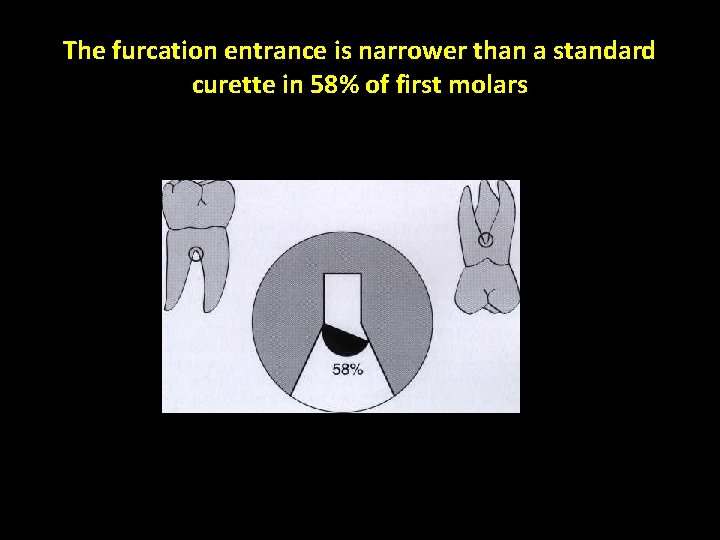
The furcation entrance is narrower than a standard curette in 58% of first molars
• • • Prosthetic/Restorative Factors Abutment selection Caries Nonvital teeth Root resorption
- Slides: 16