
ProgestinOnly Injectable Contraceptives Session III Providing ProgestinOnly Injectables
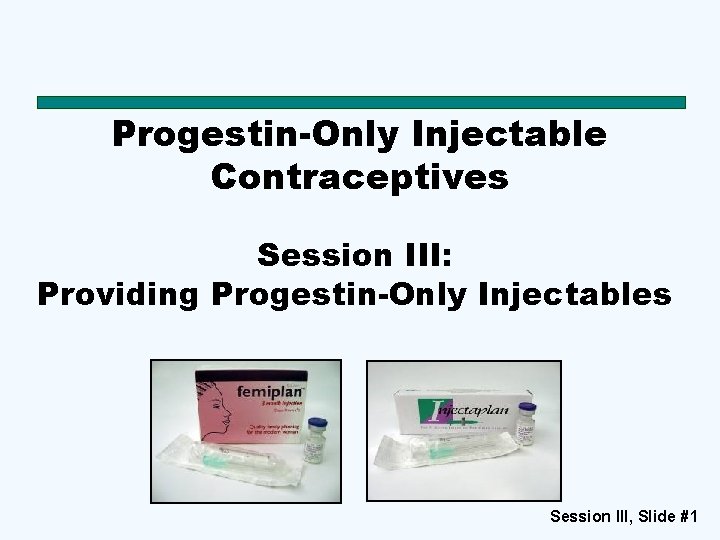
Progestin-Only Injectable Contraceptives Session III: Providing Progestin-Only Injectables Session III, Slide #1
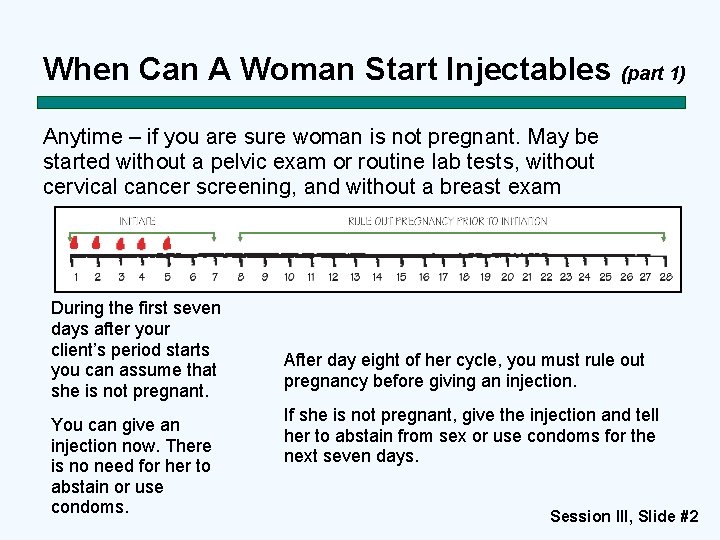
When Can A Woman Start Injectables (part 1) Anytime – if you are sure woman is not pregnant. May be started without a pelvic exam or routine lab tests, without cervical cancer screening, and without a breast exam During the first seven days after your client’s period starts you can assume that she is not pregnant. You can give an injection now. There is no need for her to abstain or use condoms. After day eight of her cycle, you must rule out pregnancy before giving an injection. If she is not pregnant, give the injection and tell her to abstain from sex or use condoms for the next seven days. Session III, Slide #2
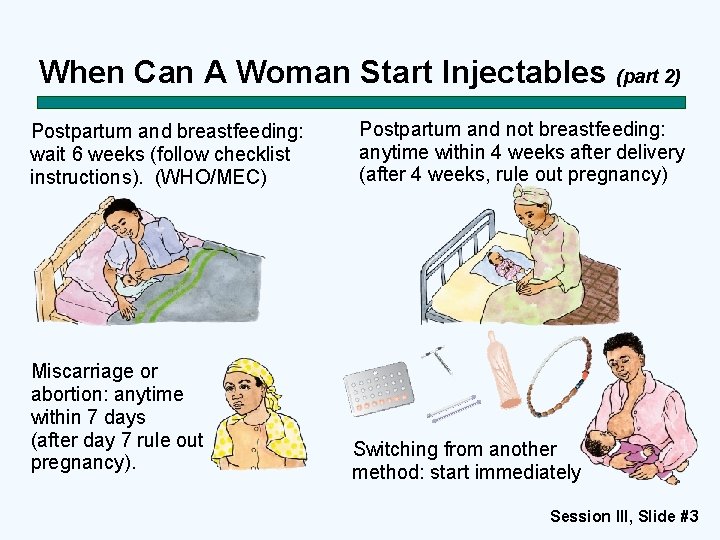
When Can A Woman Start Injectables (part 2) Postpartum and breastfeeding: wait 6 weeks (follow checklist instructions). (WHO/MEC) Miscarriage or abortion: anytime within 7 days (after day 7 rule out pregnancy). Postpartum and not breastfeeding: anytime within 4 weeks after delivery (after 4 weeks, rule out pregnancy) Switching from another method: start immediately Session III, Slide #3
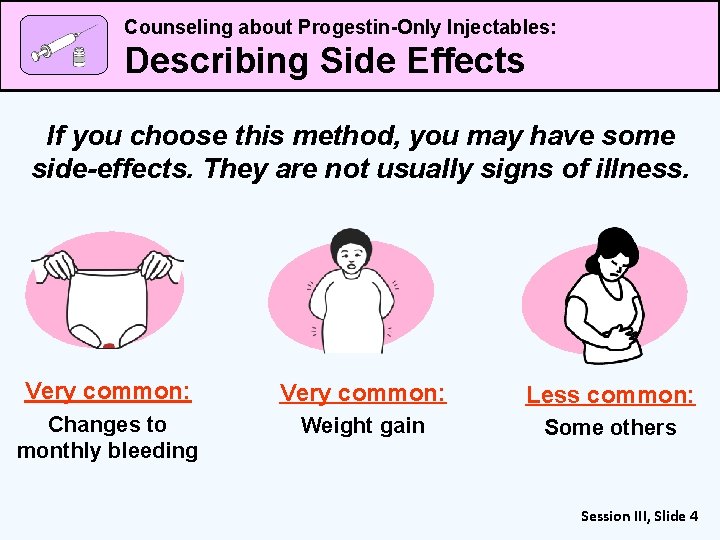
Counseling about Progestin-Only Injectables: Describing Side Effects If you choose this method, you may have some side-effects. They are not usually signs of illness. Very common: Less common: Changes to monthly bleeding Weight gain Some others Session III, Slide 4
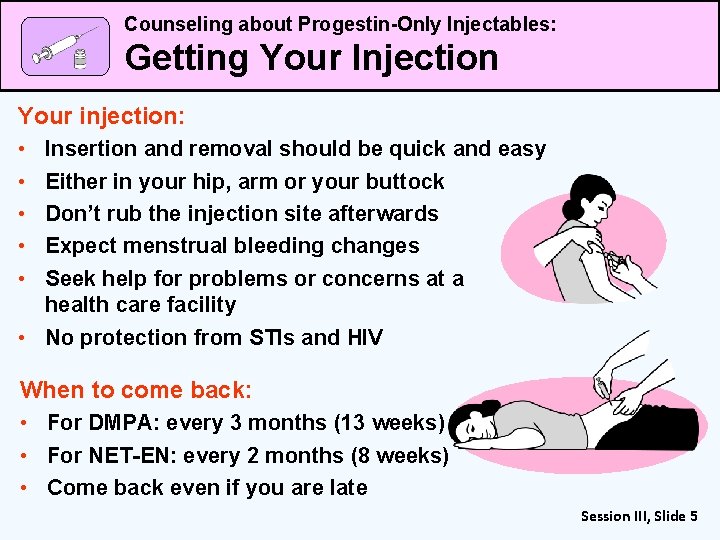
Counseling about Progestin-Only Injectables: Getting Your Injection Your injection: • • • Insertion and removal should be quick and easy Either in your hip, arm or your buttock Don’t rub the injection site afterwards Expect menstrual bleeding changes Seek help for problems or concerns at a health care facility • No protection from STIs and HIV When to come back: • For DMPA: every 3 months (13 weeks) • For NET-EN: every 2 months (8 weeks) • Come back even if you are late Session III, Slide 5
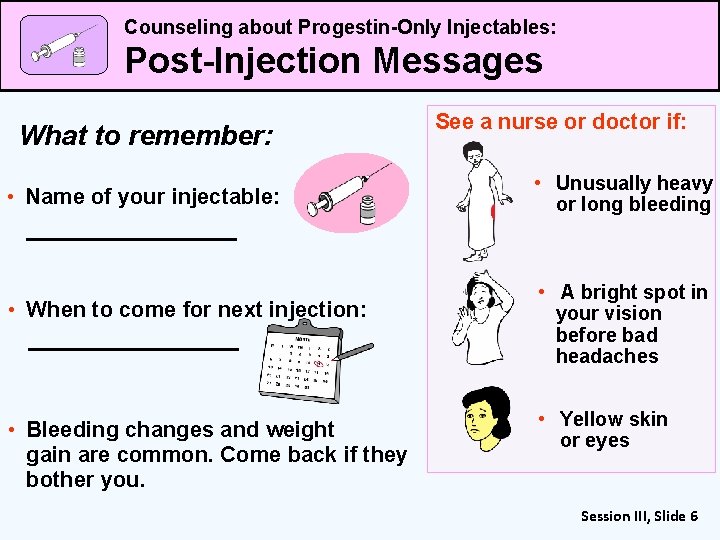
Counseling about Progestin-Only Injectables: Post-Injection Messages What to remember: • Name of your injectable: • When to come for next injection: • Bleeding changes and weight gain are common. Come back if they bother you. See a nurse or doctor if: • Unusually heavy or long bleeding • A bright spot in your vision before bad headaches • Yellow skin or eyes Session III, Slide 6
Counseling Reduces Discontinuation • Women who receive appropriate counseling more likely to continue using injectables. • After injections begin, counseling and reassurance should be provided as needed. • Providers must be sure that the woman has made an informed choice to use injectables and carefully considered these factors: – Safety and effectiveness of injectables and how it helps her achieve her reproductive goals – Anticipated menstrual bleeding and other potential side effects – The timing of return to fertility after injections are discontinued – The need for regular, timely injections – Need for STI protection (use of condoms for dual protection) – Characteristics of the injectable and how its use might affect her lifestyle, including her relationship with her partner Session III, Slide #7
Correcting Rumors and Misunderstandings Progestin-only injectables: • Can stop monthly bleeding, but this is not harmful – Blood is not building up inside the woman – It is similar to not having menses during pregnancy – Usually not a sign of pregnancy • Does not cause an abortion/disrupt an existing pregnancy. • Do not make women infertile Session III, Slide #8
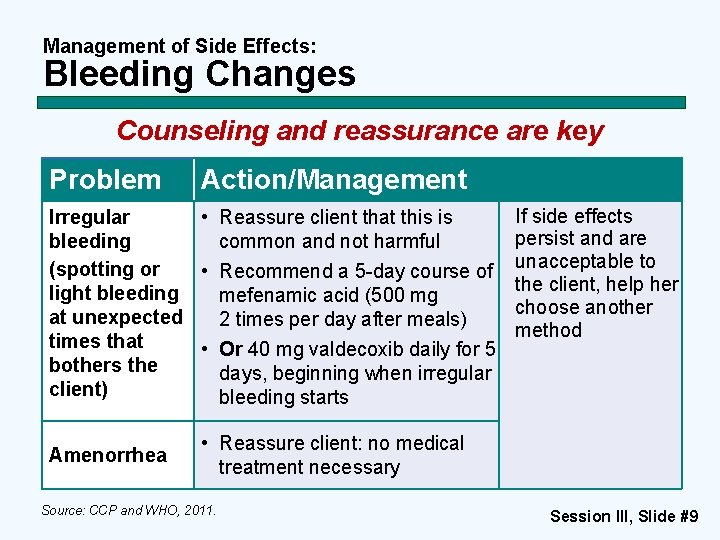
Management of Side Effects: Bleeding Changes Counseling and reassurance are key Problem Action/Management Irregular • Reassure client that this is bleeding common and not harmful (spotting or • Recommend a 5 -day course of light bleeding mefenamic acid (500 mg at unexpected 2 times per day after meals) times that • Or 40 mg valdecoxib daily for 5 bothers the days, beginning when irregular client) bleeding starts Amenorrhea If side effects persist and are unacceptable to the client, help her choose another method • Reassure client: no medical treatment necessary Source: CCP and WHO, 2011. Session III, Slide #9
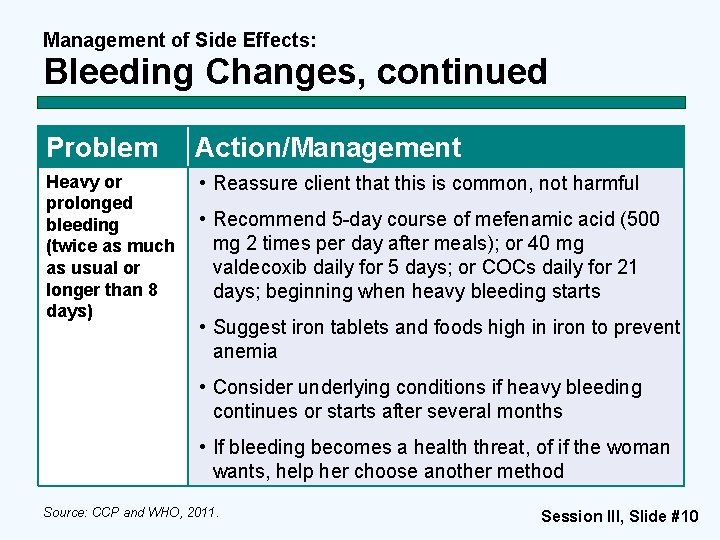
Management of Side Effects: Bleeding Changes, continued Problem Action/Management Heavy or prolonged bleeding (twice as much as usual or longer than 8 days) • Reassure client that this is common, not harmful • Recommend 5 -day course of mefenamic acid (500 mg 2 times per day after meals); or 40 mg valdecoxib daily for 5 days; or COCs daily for 21 days; beginning when heavy bleeding starts • Suggest iron tablets and foods high in iron to prevent anemia • Consider underlying conditions if heavy bleeding continues or starts after several months • If bleeding becomes a health threat, of if the woman wants, help her choose another method Source: CCP and WHO, 2011. Session III, Slide #10
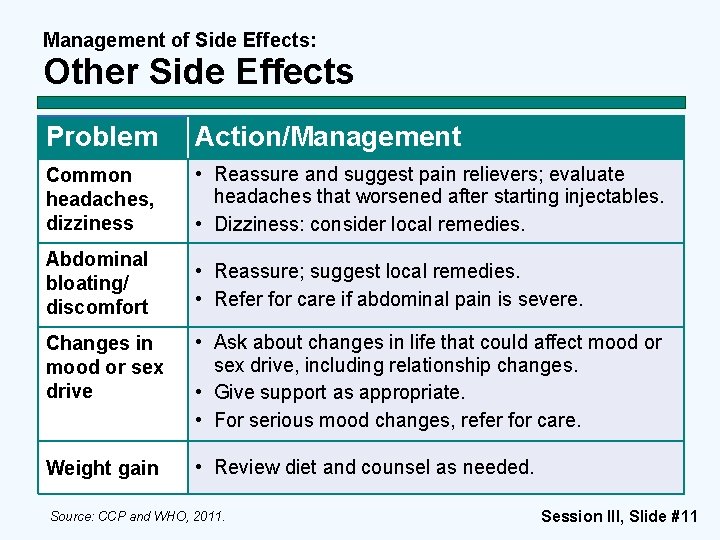
Management of Side Effects: Other Side Effects Problem Action/Management Common headaches, dizziness • Reassure and suggest pain relievers; evaluate headaches that worsened after starting injectables. • Dizziness: consider local remedies. Abdominal bloating/ discomfort • Reassure; suggest local remedies. • Refer for care if abdominal pain is severe. Changes in mood or sex drive • Ask about changes in life that could affect mood or sex drive, including relationship changes. • Give support as appropriate. • For serious mood changes, refer for care. Weight gain • Review diet and counsel as needed. Source: CCP and WHO, 2011. Session III, Slide #11
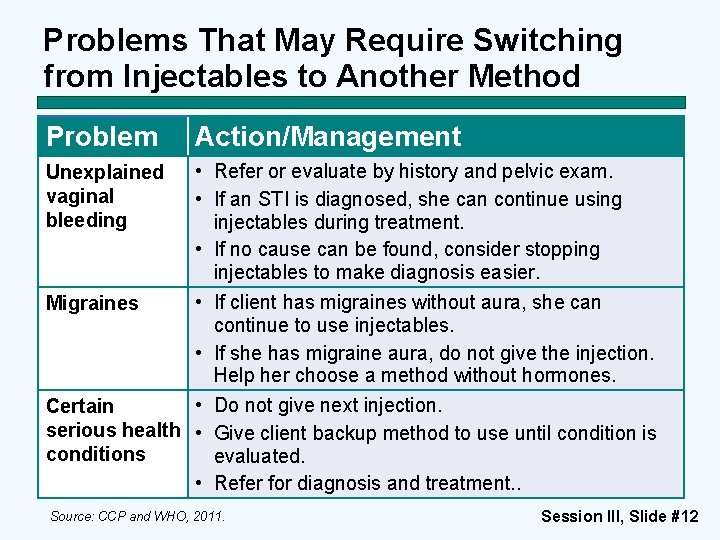
Problems That May Require Switching from Injectables to Another Method Problem Action/Management • Refer or evaluate by history and pelvic exam. • If an STI is diagnosed, she can continue using injectables during treatment. • If no cause can be found, consider stopping injectables to make diagnosis easier. • If client has migraines without aura, she can Migraines continue to use injectables. • If she has migraine aura, do not give the injection. Help her choose a method without hormones. • Do not give next injection. Certain serious health • Give client backup method to use until condition is conditions evaluated. • Refer for diagnosis and treatment. . Unexplained vaginal bleeding Source: CCP and WHO, 2011. Session III, Slide #12
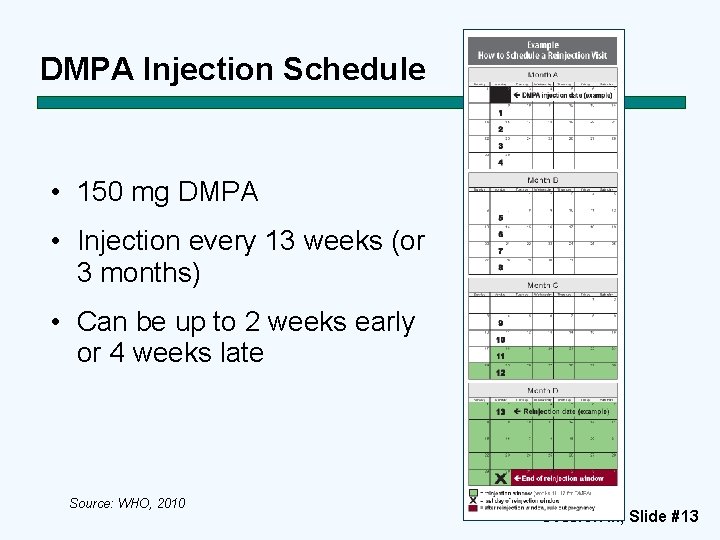
DMPA Injection Schedule • 150 mg DMPA • Injection every 13 weeks (or 3 months) • Can be up to 2 weeks early or 4 weeks late Source: WHO, 2010 Session III, Slide #13
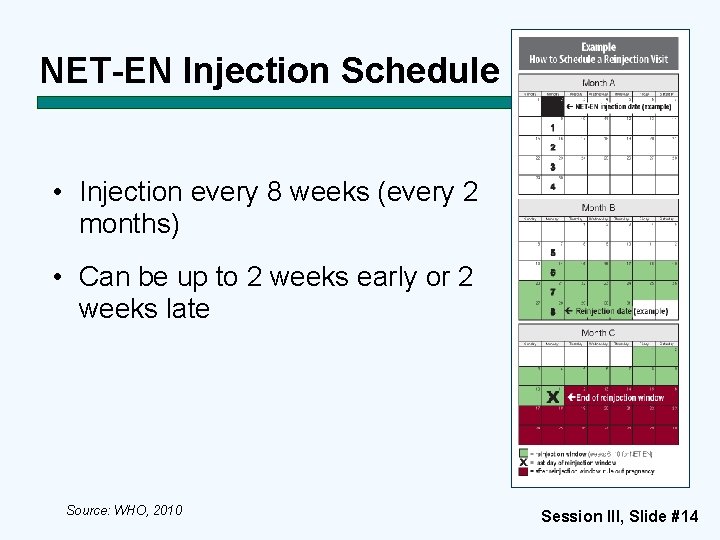
NET-EN Injection Schedule • Injection every 8 weeks (every 2 months) • Can be up to 2 weeks early or 2 weeks late Source: WHO, 2010 Session III, Slide #14
Managing Late Injections • Rule out pregnancy using one of following: – Option 1: Modified pregnancy checklist – Option 2: Pregnancy test – Option 3: Bimanual pelvic exam for comparison at follow-up – Option 4: Abdominal exam • Assess if returning within reinjection window may remain a problem, if yes, discuss other method options Session III, Slide #15
Injectables: Summary • Safe and highly effective • Easy to use • Most women can use • Bleeding changes may be a concern for some women • Can be provided in both clinical and non-clinical settings • Need appropriate counseling Session III, Slide #16
- Slides: 16