
Profits Different types of profit Profit Maximisation Effects

- Slides: 15
Profits Different types of profit Profit Maximisation Effects of changes in revenues and costs The functions of profit in a market economy
Perspectives on profit ¢ “What is a man if he is not a thief who openly charges as much as he can for the goods he sells? ” l ¢ Gandhi “Civilization and profits go hand in hand” l Calvin Coolidge
Economists have different profit concepts
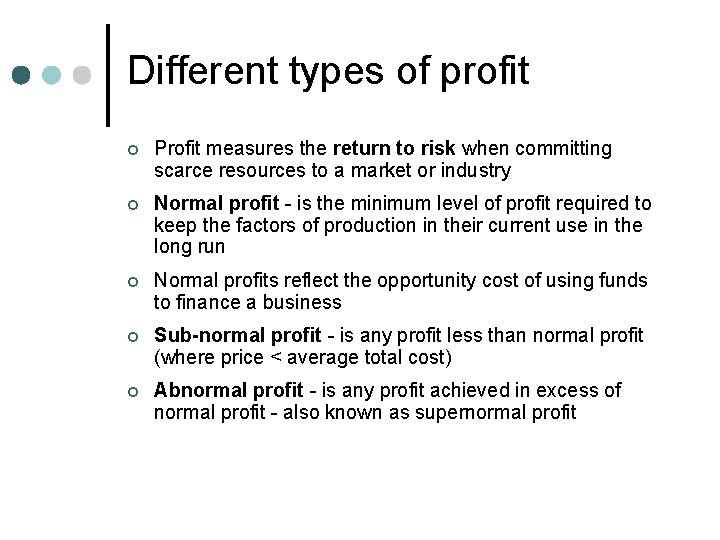
Different types of profit ¢ Profit measures the return to risk when committing scarce resources to a market or industry ¢ Normal profit - is the minimum level of profit required to keep the factors of production in their current use in the long run ¢ Normal profits reflect the opportunity cost of using funds to finance a business ¢ Sub-normal profit - is any profit less than normal profit (where price < average total cost) ¢ Abnormal profit - is any profit achieved in excess of normal profit - also known as supernormal profit
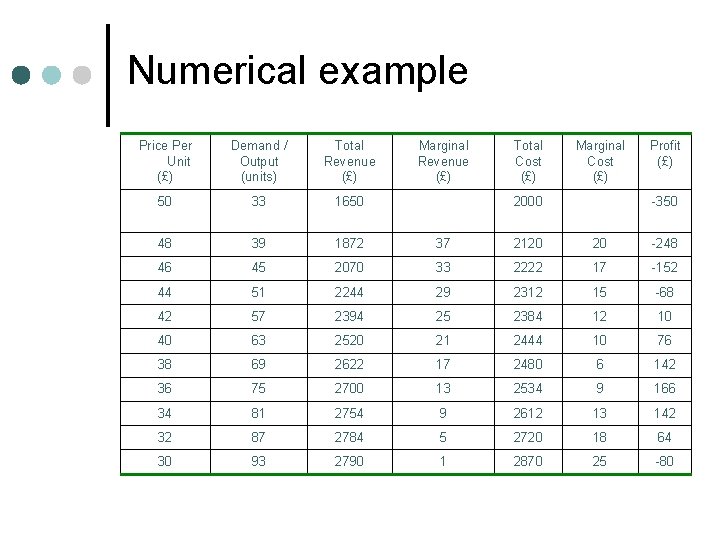
Numerical example Price Per Unit (£) Demand / Output (units) Total Revenue (£) Marginal Revenue (£) Total Cost (£) Marginal Cost (£) 50 33 1650 48 39 1872 37 2120 20 -248 46 45 2070 33 2222 17 -152 44 51 2244 29 2312 15 -68 42 57 2394 25 2384 12 10 40 63 2520 21 2444 10 76 38 69 2622 17 2480 6 142 36 75 2700 13 2534 9 166 34 81 2754 9 2612 13 142 32 87 2784 5 2720 18 64 30 93 2790 1 2870 25 -80 2000 Profit (£) -350
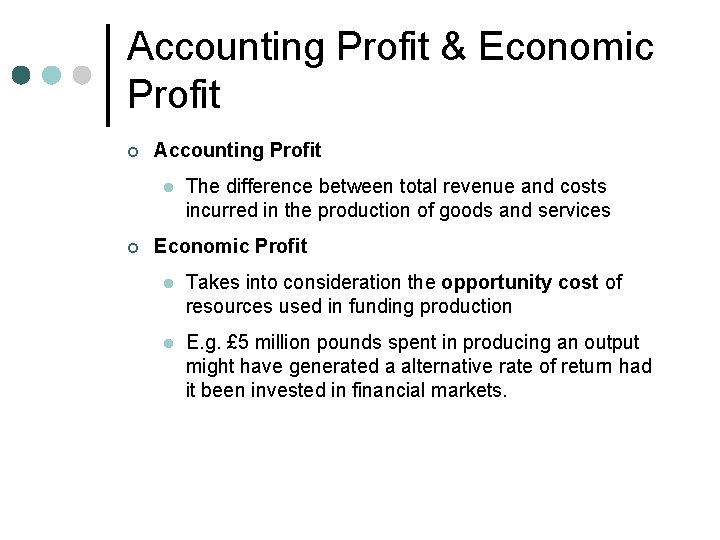
Accounting Profit & Economic Profit ¢ Accounting Profit l ¢ The difference between total revenue and costs incurred in the production of goods and services Economic Profit l Takes into consideration the opportunity cost of resources used in funding production l E. g. £ 5 million pounds spent in producing an output might have generated a alternative rate of return had it been invested in financial markets.
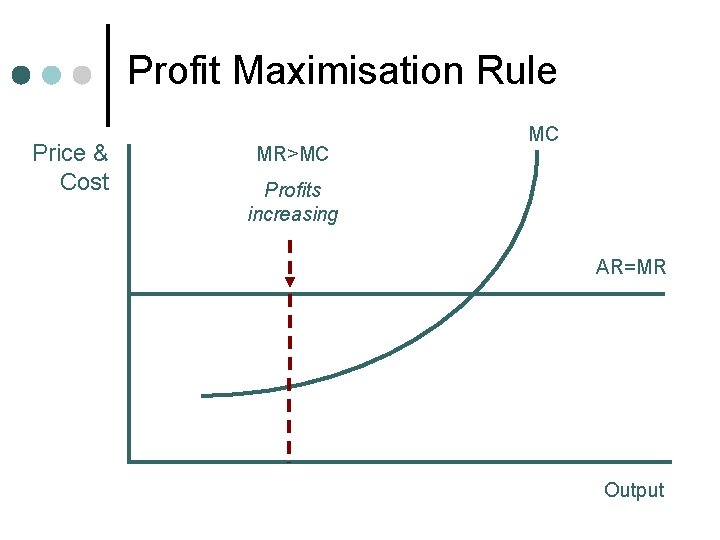
Profit Maximisation Rule Price & Cost MR>MC MC Profits increasing AR=MR Output
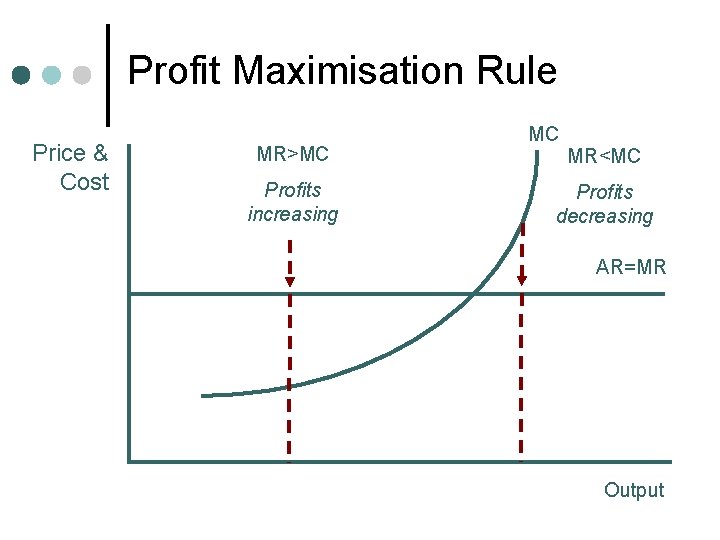
Profit Maximisation Rule Price & Cost MR>MC Profits increasing MC MR<MC Profits decreasing AR=MR Output
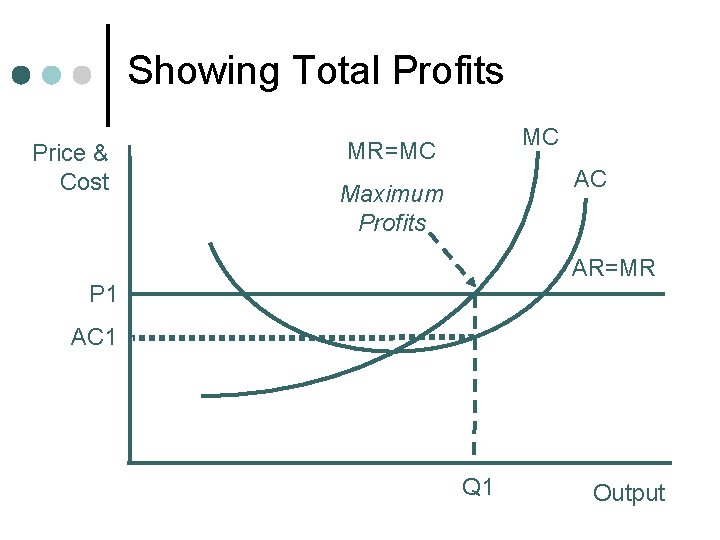
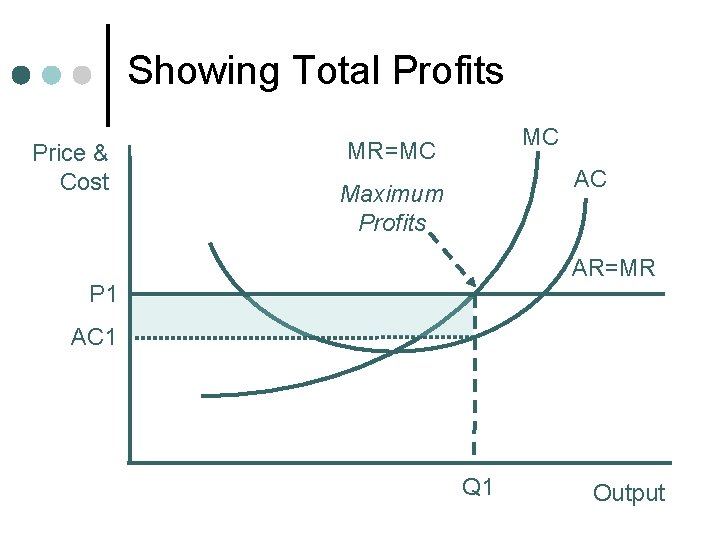
Showing Total Profits Price & Cost MC MR=MC AC Maximum Profits AR=MR P 1 AC 1 Q 1 Output
Showing Total Profits Price & Cost MC MR=MC AC Maximum Profits AR=MR P 1 AC 1 Q 1 Output
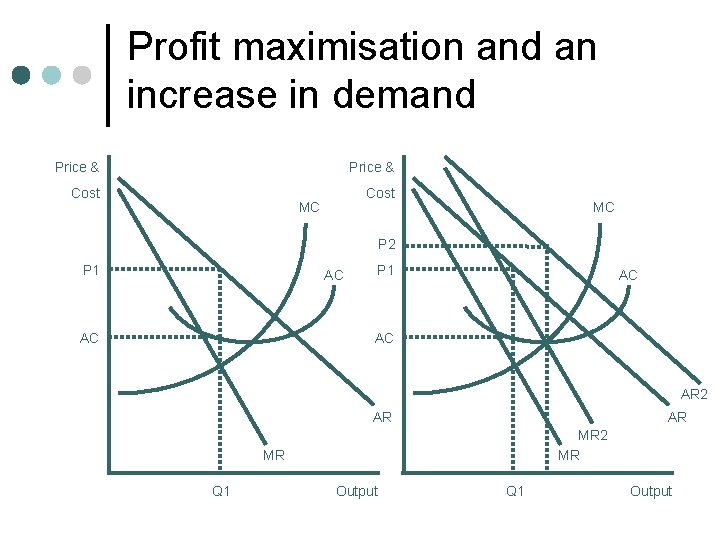
Profit maximisation and an increase in demand Price & Cost MC MC P 2 P 1 AC AC AR 2 AR AR MR 2 MR MR Q 1 Output
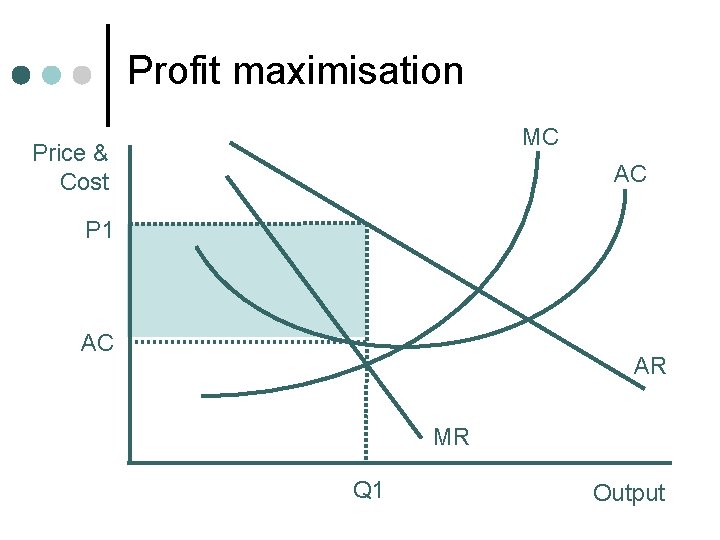
Profit maximisation MC Price & Cost AC P 1 AC AR MR Q 1 Output
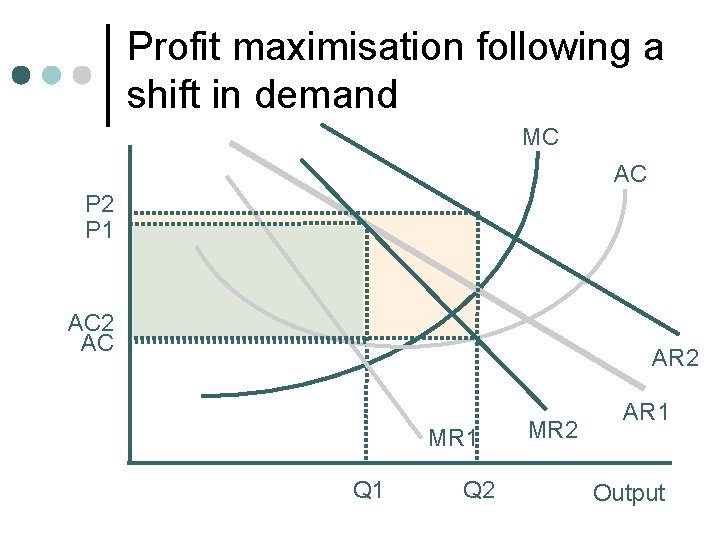
Profit maximisation following a shift in demand MC AC P 2 P 1 AC 2 AC AR 2 MR 1 Q 2 MR 2 AR 1 Output
Significance of profits ¢ In a market based system profits influence the allocation of resources: ¢ (1) Finance for investment: Retained profits remain the most important source of finance for capital investment ¢ (2) Market entry: Rising profits send signals to other producers within a market ¢ l Supernormal profits – market entry l Subnormal profits – pressure for market exit Demand for factor resources: Resources flow where the expected rate of return is highest
Route maps to higher profits ¢ ¢ Grow the business – achieve higher sales l Margins: High gross profit margin - every extra sale is highly profitable l Economies of scale: As a business grows, unit costs reduced through economies of scale. l Consumer loyalty and replacement demand the value of each new customer lays not just in the immediate sale, but in future sales as well l Defending a high market share against competitors is easier than defending high profit margins But close control of costs is also important