
Profit Maximization Profits The objectives of the firm
Profit Maximization Profits The objectives of the firm Fixed and variable factors Profit maximization in the short and in the long run Returns to scale and profits
Competitive Markets In a competitive market firms take input and output prices as given Firms are “small” relatively to the market, so that their decisions do not affect market prices Q: When is this assumption reasonable?

Product Homogeneity A: In markets where firms produce (almost) identical products When products are homogeneous (agricultural products, raw materials, etc. ) no firm can raise its price without losing most of its customers Differentiated products: a firm can set its price without losing all customers
The Objective of the Firm Q: What is the objective of the firm? A: The maximization of profits Q: How are profits defined?

Defining Economic Profits are defined as revenues minus costs E. g. a firm produces light bulbs using labor and capital
Defining Economic Profits Labor: suppose that the owner of the firm works in the firm Q: Should costs take the owner’s labor into account? A: Yes, we need to take into account the opportunity cost for the owner of not employing his/her labor somewhere else
Defining Economic Profits Q: How should you take into account the cost of using physical capital? A: Since factor inputs are measured in flows (e. g. labor and machine hours per week), the unit cost of using physical capital should be its rental rate
Fixed and Variable Factors Short run: there are fixed factors that the firm is obliged to employ. E. g. : firm has signed a contract to lease space in a building for certain number of months. Even if the firm decides not to produce it still has to pay lease.
Fixed and Variable Factors Long run: all factors of production are variable. Variable factors are factors that the firm employs and pays for only if it decides to produce something. E. g. : labor In the long run all factors are variable: firm can always decide to use zero inputs and produce zero output, i. e. , go out of business.

Short Run Profit Maximization Let’s consider the problem of a consulting firm that has rented 3000 sq feet in a building (fixed factor) It has to decide how many consultants to hire Production function (output in a year):
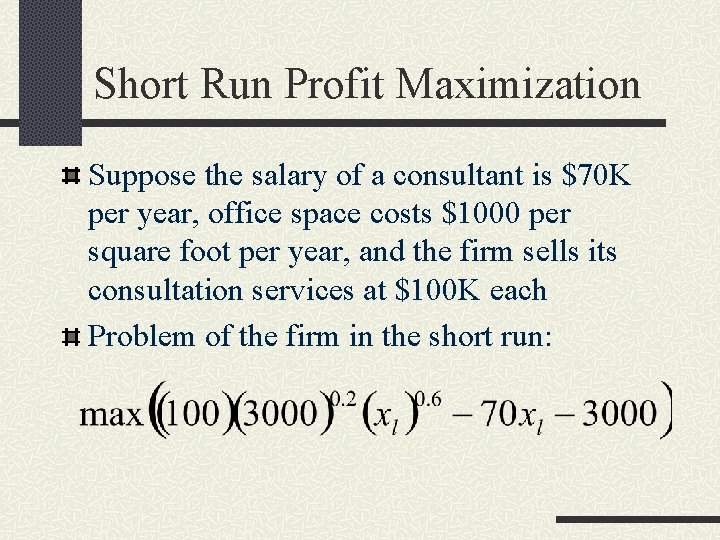
Short Run Profit Maximization Suppose the salary of a consultant is $70 K per year, office space costs $1000 per square foot per year, and the firm sells its consultation services at $100 K each Problem of the firm in the short run:
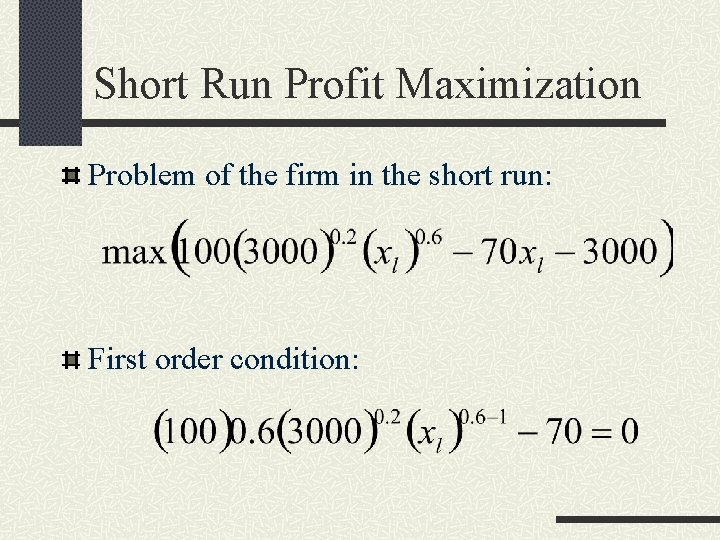
Short Run Profit Maximization Problem of the firm in the short run: First order condition:

Short Run Profit Maximization First order condition: Interpretation:
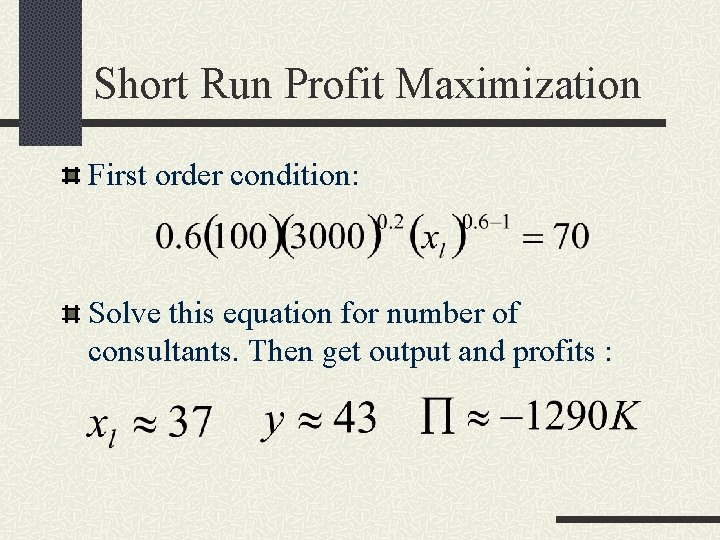
Short Run Profit Maximization First order condition: Solve this equation for number of consultants. Then get output and profits :
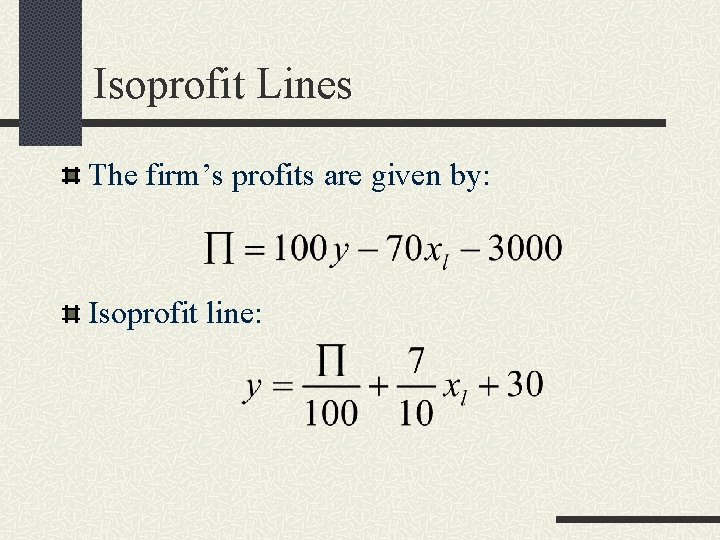
Isoprofit Lines The firm’s profits are given by: Isoprofit line:
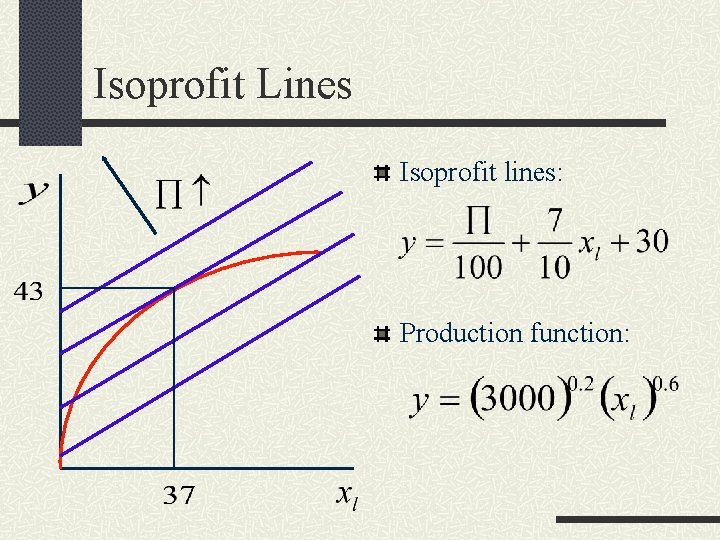
Isoprofit Lines Isoprofit lines: Production function:
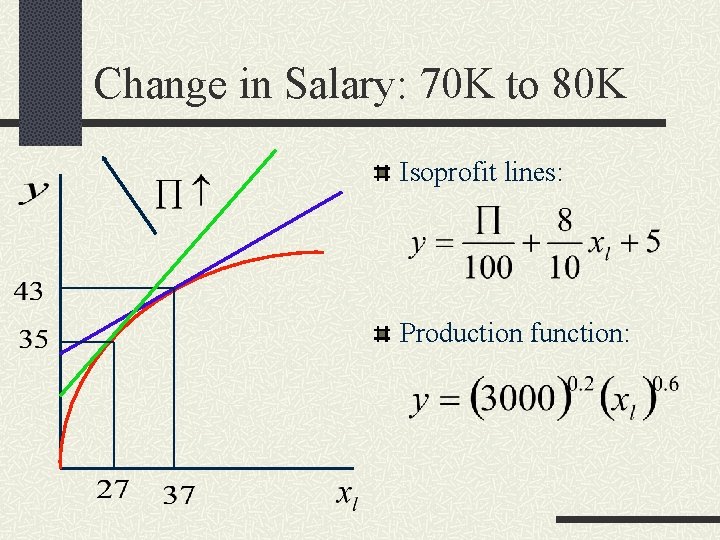
Change in Salary: 70 K to 80 K Isoprofit lines: Production function:
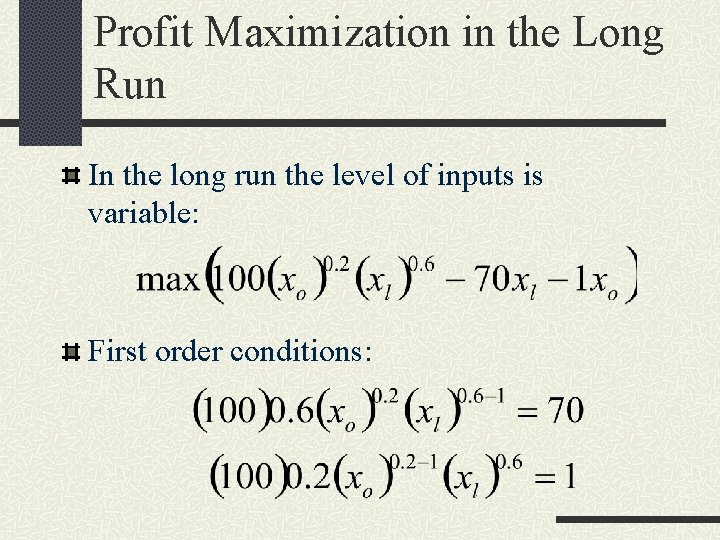
Profit Maximization in the Long Run In the long run the level of inputs is variable: First order conditions:
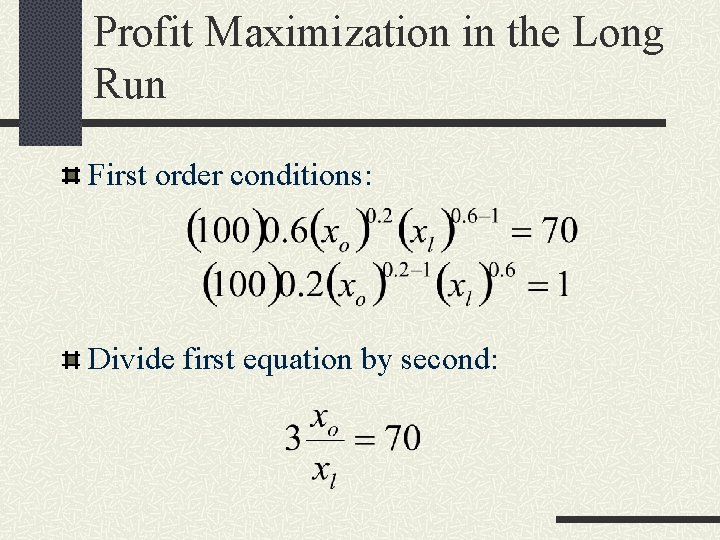
Profit Maximization in the Long Run First order conditions: Divide first equation by second:
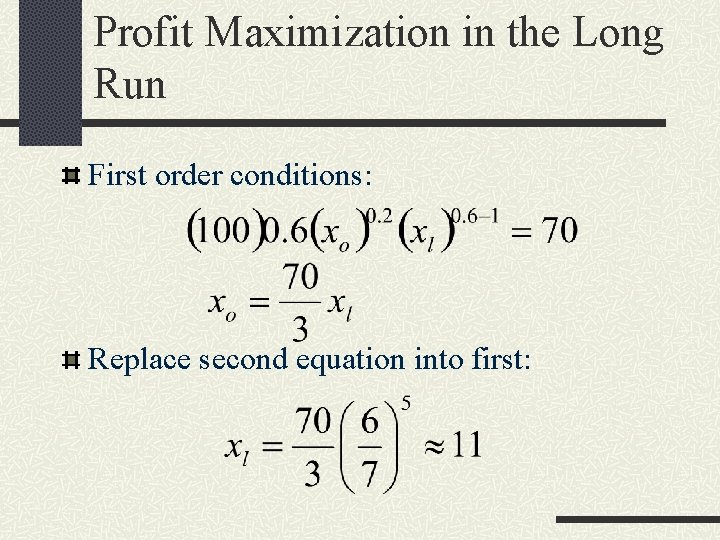
Profit Maximization in the Long Run First order conditions: Replace second equation into first:
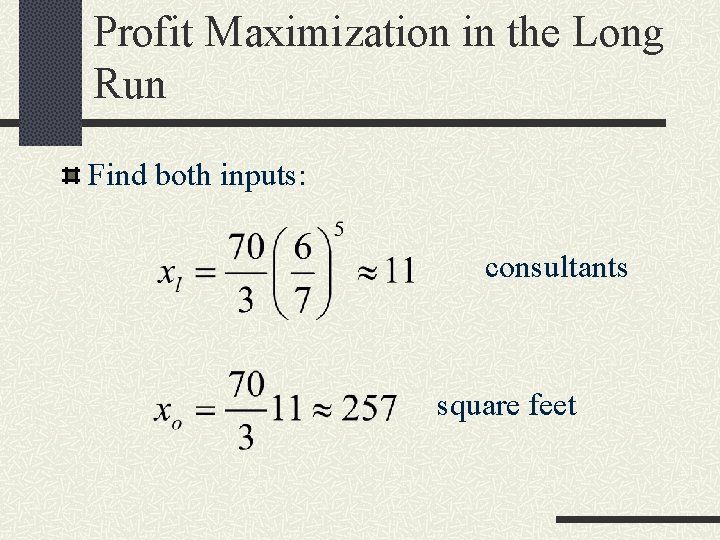
Profit Maximization in the Long Run Find both inputs: consultants square feet
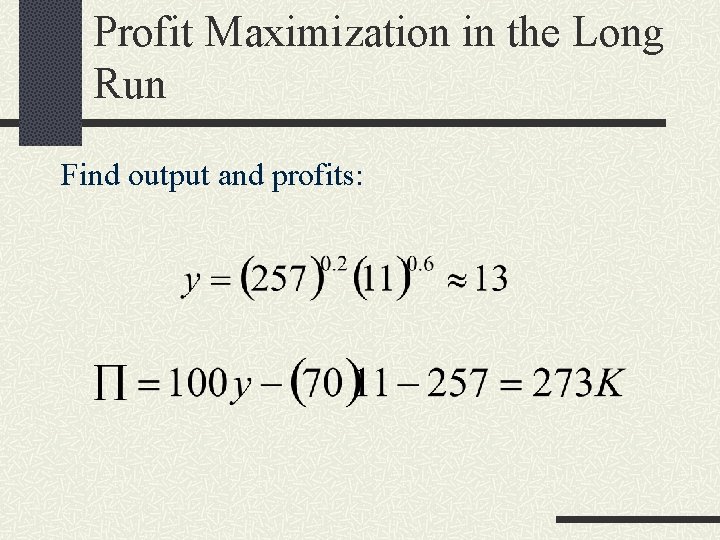
Profit Maximization in the Long Run Find output and profits:
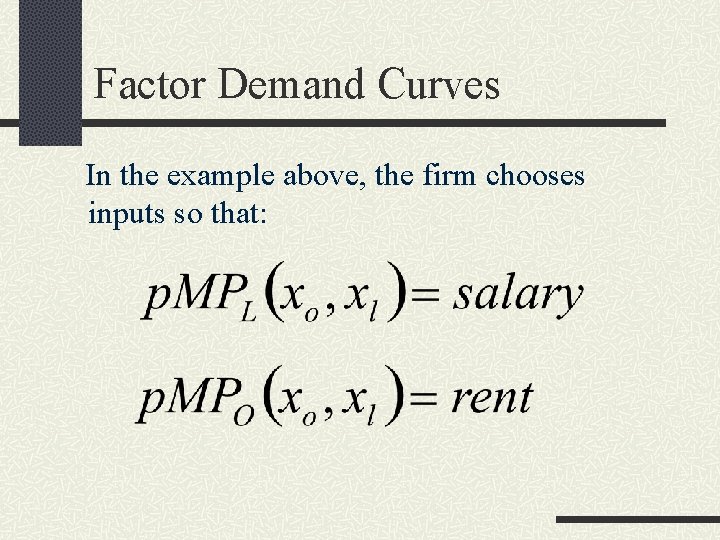
Factor Demand Curves In the example above, the firm chooses inputs so that:
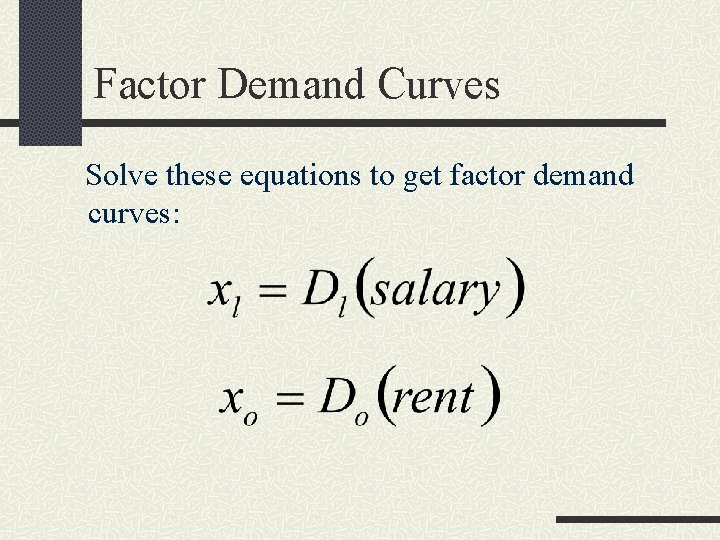
Factor Demand Curves Solve these equations to get factor demand curves:
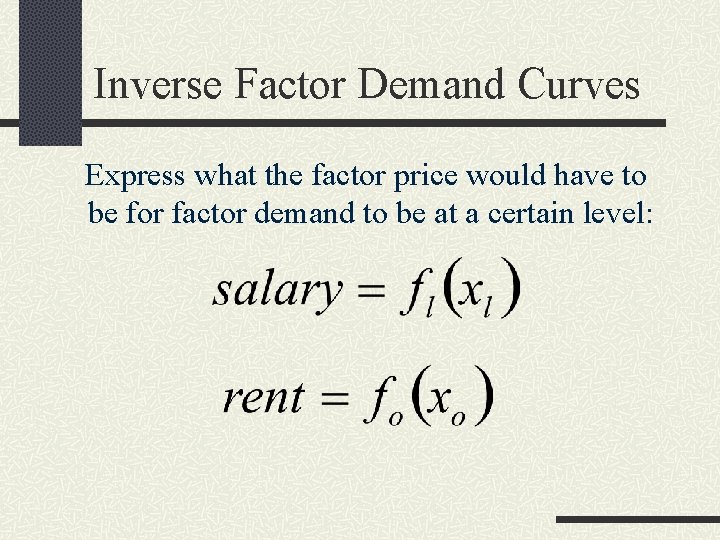
Inverse Factor Demand Curves Express what the factor price would have to be for factor demand to be at a certain level:
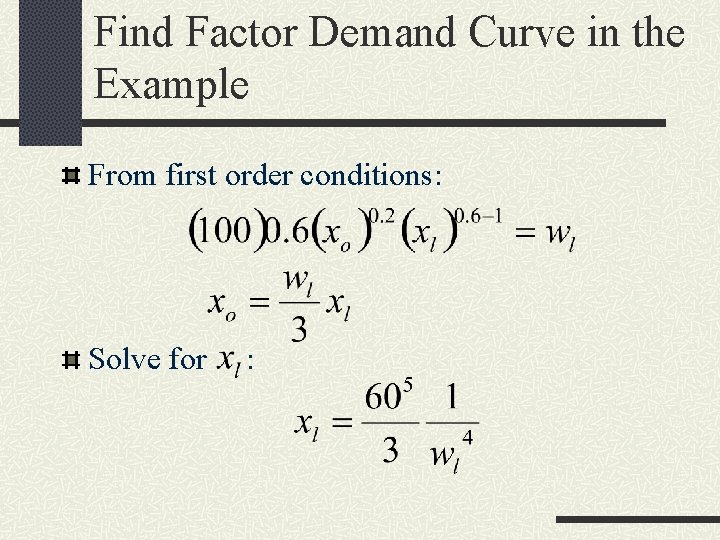
Find Factor Demand Curve in the Example From first order conditions: Solve for :
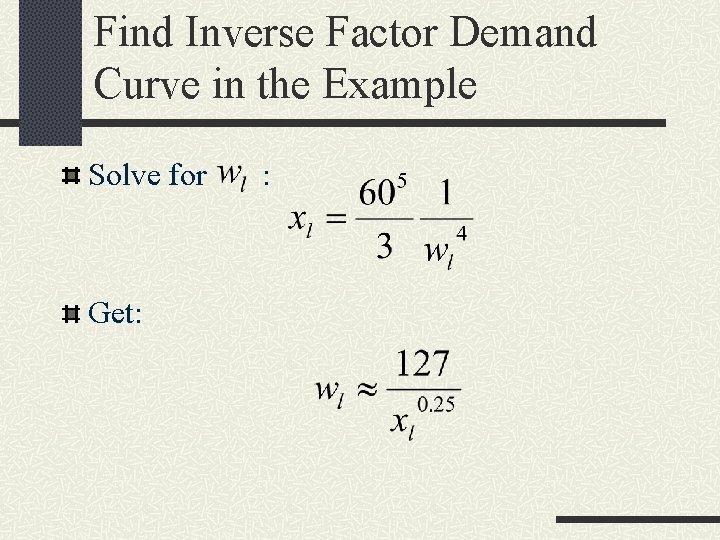
Find Inverse Factor Demand Curve in the Example Solve for Get: :
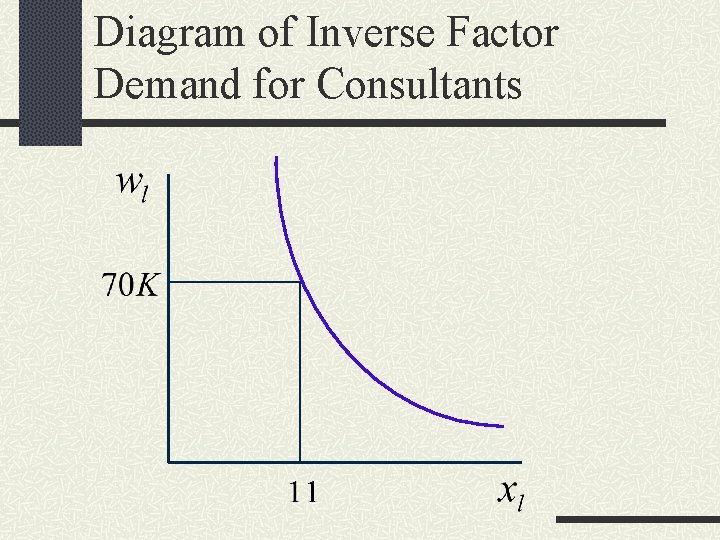
Diagram of Inverse Factor Demand for Consultants
- Slides: 28