
Profile of a Leader Definition of a Leader
- Slides: 22
Profile of a Leader
Definition of a Leader • Leadership is about articulating visions, embodying values, and creating the environment within which things can be accomplished. - Richards & Engle • When the effective leader is finished with his work, the people say it happened naturally. - Lao Tse • The task of the leader is to get his people from where they are to where they have not been. - Henry Kissinger
Characteristics of a Leader • Leaders are willing to take risks. • Leaders think in terms of do’s, not don’ts. • Leaders see change as a constant, not an event. • Leaders have a vision of the future. • Leaders overcome adversity. • Leaders value teamwork and bridge diversity.
Function of the Leader • Create a vision. • Affirm and articulate values. • Inspire trust. • Integrate diverse views. • Appreciate dialog. • Help others exert their influence. • Foster commitment. • Involve others in decision making. • Listen and explain. • Facilitate, energize and sustain action. • Serve as role models. • Maintain community support.
Most Effective Leaders • Know the interests of the • Know how to establish members. communication between members. • Understand the hopes & limitations of community. • Know how to conduct meetings. • Know concerns of members. • Know how to assess • Know how to motivate effectiveness. members. – Without motivation, no action will take place. – This can become a powerful motivating force for further action and commitment.
LEADERSHIP vs. MANAGEMENT • A person can be a leader without being a manager. • A person can be a manager without being a leader. • What are the difference between leadership and management?
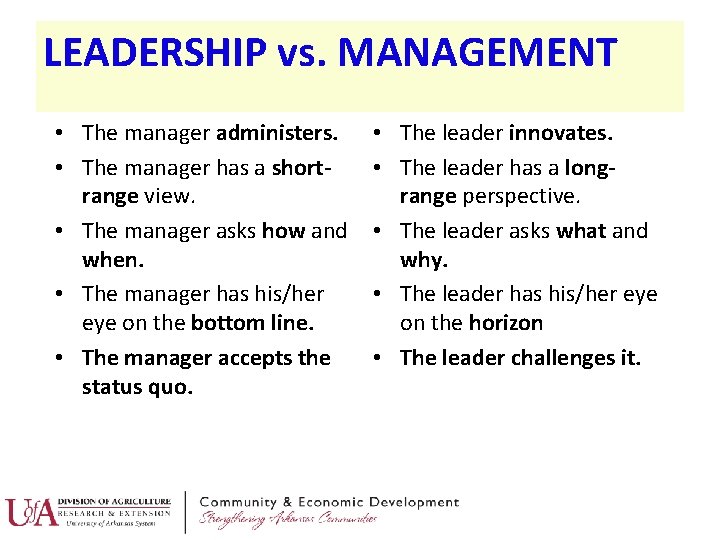
LEADERSHIP vs. MANAGEMENT • The manager administers. • The manager has a shortrange view. • The manager asks how and when. • The manager has his/her eye on the bottom line. • The manager accepts the status quo. • The leader innovates. • The leader has a longrange perspective. • The leader asks what and why. • The leader has his/her eye on the horizon • The leader challenges it.
Shared Leadership • Shared leadership is leadership that directs; it does not dictate. • When shared leadership occurs, people approach problems in collaborative ways. They engage each other in defining: – What is important – What is to be done – How best to do it
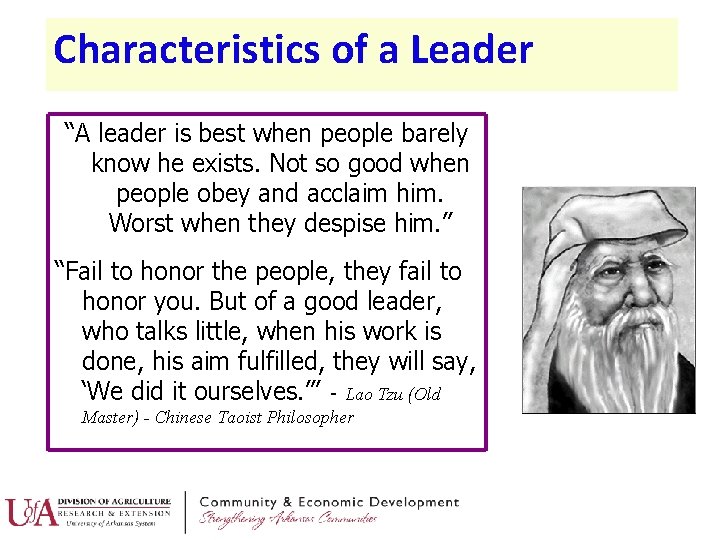
Characteristics of a Leader “A leader is best when people barely know he exists. Not so good when people obey and acclaim him. Worst when they despise him. ” “Fail to honor the people, they fail to honor you. But of a good leader, who talks little, when his work is done, his aim fulfilled, they will say, ‘We did it ourselves. ’” - Lao Tzu (Old Master) - Chinese Taoist Philosopher
What do leaders do? • They talk… – They talk about what’s important. – They talk about where we’re headed. – They talk about what we stand for. – They talk about falling in love with risk. – And they get people motivated.
Lewin’s Leadership Study • Conducted in 1939 • Used Schoolchildren in arts and crafts project • Used three different leadership groups – Leader dictated everything – Leader allowed group input – Leader let group do as they please • Study established three Leadership styles – Authoritarian Leadership (Autocratic) – Participative Leadership (Democratic) – Delegative Leadership (Laissez-Faire)
Lewin’s Leadership Styles • Authoritarian Leadership (Autocratic) – Found decision-making was less creative – Sometimes viewed as controlling, bossy and dictatorial • Participative Leadership (Democratic) – Most effective style – Less productive, but contributions were higher quality – More motivated and creative • Delegative Leadership (Laissez-Faire) – Little cooperation among each other and unable to work independently – Effective when members are highly qualified in an area of expertise – Leads to poorly defined roles and lack of motivation
Taking Stock: What is your primary leadership style?
Coercive Style Good or Bad? Now referred to by Goleman as “Commanding” “Do what I say” Manipulative and Forceful Effective in a turnaround situation or in dealing with a problem employee • Overall, is counter productive in most situations • • •
Authoritative Style • Good or Bad? • Now referred to by Goleman as “Visionary” • “Come with Me” or “Here is where we are going” • Gives people freedom to choose from a range of options or to apply creativity • Overall is very productive in all climates
Affiliative Style • Good or Bad? • “People come first” • Builds Team Harmony and increases overall morale • Emphasis on people and their feelings over accomplishing tasks & goals • Overall is good in most climates, rarely offers advice leaving many people perpetually confused or undirected
Democratic Style • Good or Bad? • “What do you guys think we should do? ” • Can build flexibility and give people responsibility • Works best when leader is uncertain about what direction to take • Overall good in most climates, but often leads to a leaderless organization
Pacesetting Style Good or Bad? “Follow Me!” Sets high performance standards Is effective with the self-motivated and competent • Leaves others overwhelmed and scared • Overall not good in any climate, should be used sparingly • •
Coaching Style • Good or Bad? • “Let me show you how” • A focus on conversations—helps those willing to or even desiring change • Little or no focus on task related accomplishments • Overall good, but not seen as a “bottom-line” approach
Steps to Becoming a L-E-A-D-E-R • Listen – Don’t assume - ask • Enthusiastic – Be positive and optimistic • Action – Be creative and take risks • Dependability – Be ethical and with communities best interest at heart • Educated – Understand dynamics of community and lead by example • Results – Getting positive things accomplished
Commonality of Great Leaders • Magnitude of their impact • Duration of their impact • The number of followers
Questions?