
Proficiency Testing as a quality improvement tool James

- Slides: 17
Proficiency Testing as a quality improvement tool James Mwangi
Objectives § § § Define Proficiency Testing (PT) Describe PT process Detail the benefits of participating in PT schemes Outline the role of each arm of the laboratory to ensure maximum utility of PT Discuss the limitations of PT
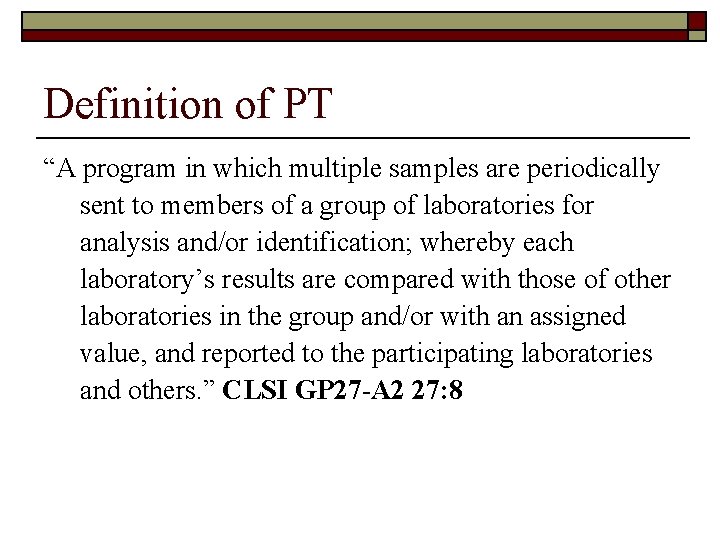
Definition of PT “A program in which multiple samples are periodically sent to members of a group of laboratories for analysis and/or identification; whereby each laboratory’s results are compared with those of other laboratories in the group and/or with an assigned value, and reported to the participating laboratories and others. ” CLSI GP 27 -A 2 27: 8
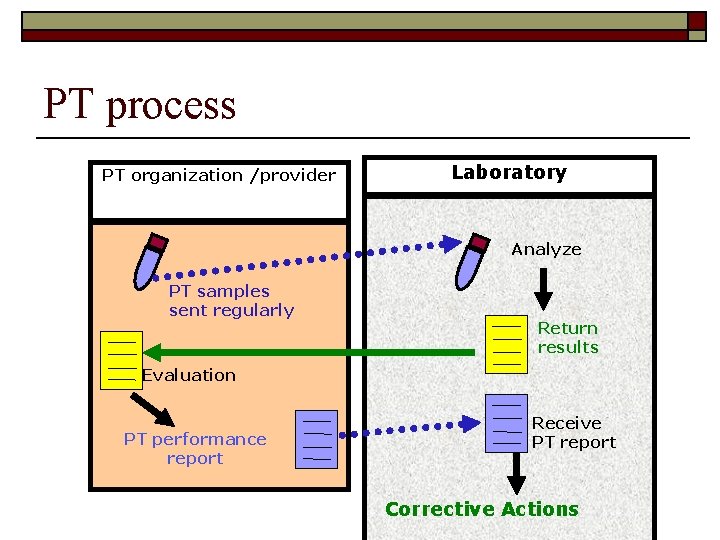
PT process PT organization /provider Laboratory Analyze PT samples sent regularly Return results Evaluation PT performance report Receive PT report Corrective Actions
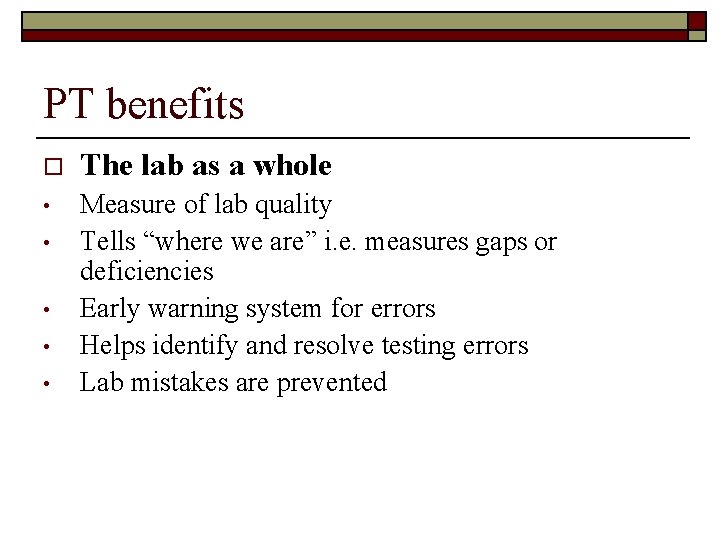
PT benefits o The lab as a whole • Measure of lab quality Tells “where we are” i. e. measures gaps or deficiencies Early warning system for errors Helps identify and resolve testing errors Lab mistakes are prevented • •
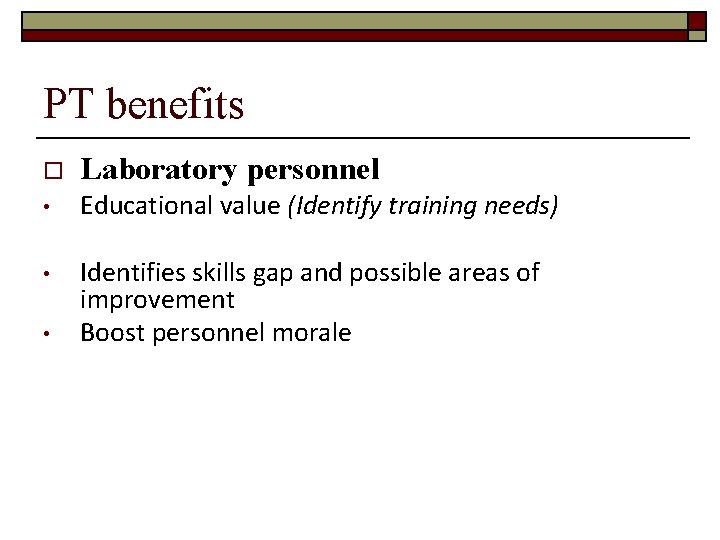
PT benefits o Laboratory personnel • Educational value (Identify training needs) • Identifies skills gap and possible areas of improvement Boost personnel morale •
PT benefits o Physician • No repeat testing • Increases confidence in the lab’s results
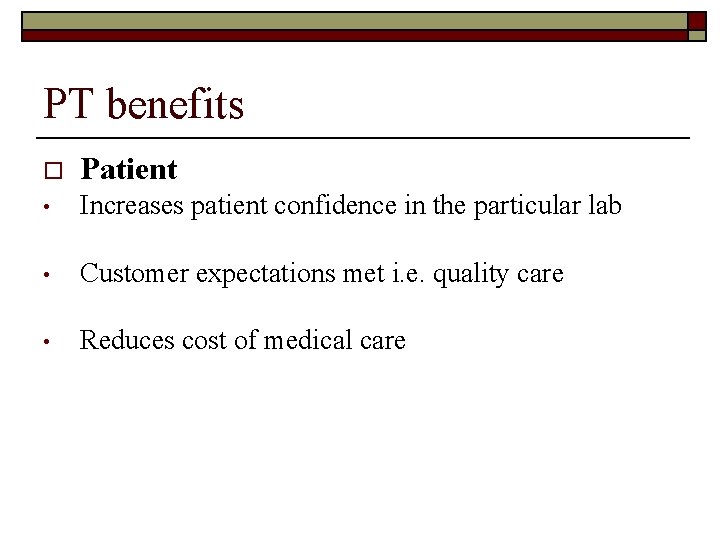
PT benefits o Patient • Increases patient confidence in the particular lab • Customer expectations met i. e. quality care • Reduces cost of medical care
PT benefits o Hospital Director • Enhanced confidence in the institution • Reduce wastage in repeated tests • Reduced external pressure to meet client expectations • Reduce cost and increase revenue
Determinants of an effective PT Program o Commitment of the three major players • PT Provider Laboratory Personnel Hospital or Laboratory Management • •
PT Provider • • • Provide suitable PT materials Use of appropriate statistical procedures, Appropriate criteria for performance evaluation, Providing useful summary reports to laboratories in a timely manner Create education and training opportunities for participating laboratory staff
Laboratory personnel • • • Run PT samples on time and submit results before set deadline Openly discuss PT reports with laboratory management Take corrective actions and monitor their effectiveness Maintain PT records Advice management on programs of interest to the institution
Management • • • Determine policies for PT (WHO, WHAT, WHEN, HOW) Provide required resources Monitor and discuss PT results and reports with laboratory staff Supports corrective action measures Communicates outcomes
Insights from PT reports • • Accuracy of the test results Personnel competency, equipment maintenance, condition of reagents, pipette calibration, cold chain maintenance, interpretation skills turn-around time
PT Limitations/ challenges • • • Correct Pear Grouping Negative influence of the consensus mean by poor performing but dominant group. Inadequate numbers in a pear group Preferential treatment of PT samples by participants Frequency of distribution of PT material Choice of assigned values to use
Key Messages • • PT should help direct improvement efforts PT is a responsibility of everyone in the laboratory PT has to be carried out within the context of a complete system for appropriate quality in the lab PT is a regulatory requirement for laboratories seeking accreditation
Q&A