
Professor Mark Krotec Professor Juel L Smith Pittsburgh
Professor Mark Krotec Professor Juel L. Smith Pittsburgh Tissue Engineering Initiative

• What do the letters D-N-A stand for? Deoxyribonucleic acid • What is the function of DNA? Provides the instructions for our biological traits • Where is it located in the human body? In the cells within the nucleus • Who were the scientist that identified DNA structure? Watson & Crick DNA
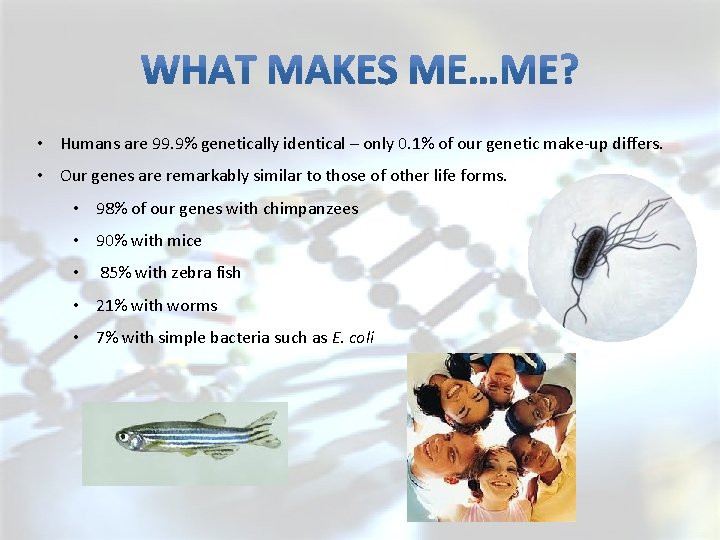
• Humans are 99. 9% genetically identical – only 0. 1% of our genetic make-up differs. • Our genes are remarkably similar to those of other life forms. • 98% of our genes with chimpanzees • 90% with mice • 85% with zebra fish • 21% with worms • 7% with simple bacteria such as E. coli
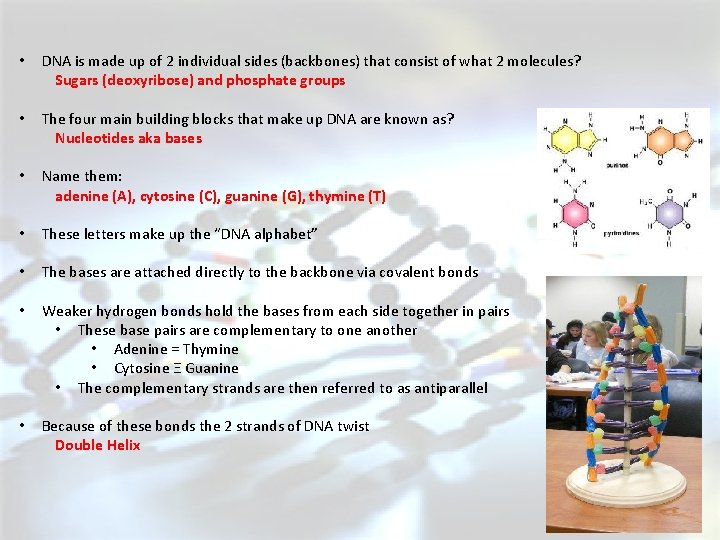
• DNA is made up of 2 individual sides (backbones) that consist of what 2 molecules? Sugars (deoxyribose) and phosphate groups • The four main building blocks that make up DNA are known as? Nucleotides aka bases • Name them: adenine (A), cytosine (C), guanine (G), thymine (T) • These letters make up the “DNA alphabet” • The bases are attached directly to the backbone via covalent bonds • Weaker hydrogen bonds hold the bases from each side together in pairs • These base pairs are complementary to one another • Adenine = Thymine • Cytosine Ξ Guanine • The complementary strands are then referred to as antiparallel • Because of these bonds the 2 strands of DNA twist Double Helix
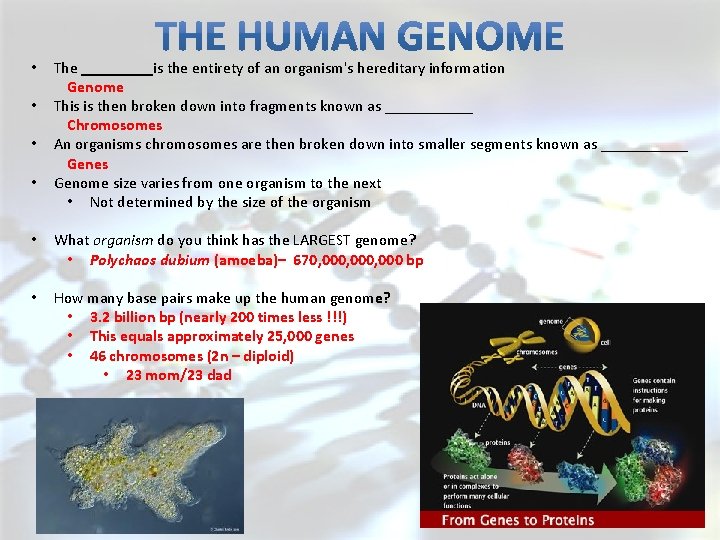
• • The _____is the entirety of an organism's hereditary information Genome This is then broken down into fragments known as ______ Chromosomes An organisms chromosomes are then broken down into smaller segments known as ______ Genes Genome size varies from one organism to the next • Not determined by the size of the organism • What organism do you think has the LARGEST genome? • Polychaos dubium (amoeba)– 670, 000, 000 bp • How many base pairs make up the human genome? • 3. 2 billion bp (nearly 200 times less !!!) • This equals approximately 25, 000 genes • 46 chromosomes (2 n – diploid) • 23 mom/23 dad

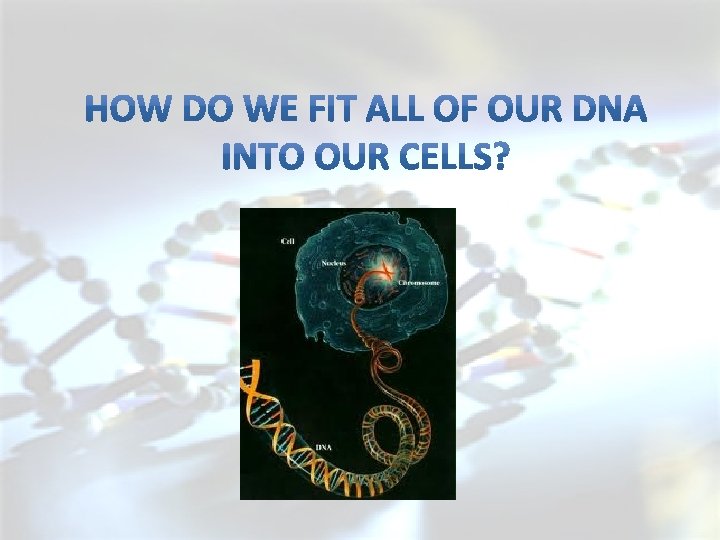
2. 4 nm The Human Genome Project is involved in determining the exact order of the DNA bases of the entire human genome. Est. 1990 and finished in 2003. • • • 6 feet (2 meters) of DNA/human cell 10 trillion cells/human body (50 -70 trillion contain DNA) So what is the total length of DNA … 3. 4 nm/10 bp (2 m of DNA/cell )(1 x 10¹³ cells/body) = 2 x 10¹³ m DNA • That equals ~ ? trips to the sun and back: 1 Astronomical Unit = 1. 5 x 10¹¹ m 2. 0 x 1013 m DNA/1. 5 x 10¹¹ m = 133. 7 A U • That means… The DNA in your body could stretch to the sun 133 times!!! • It would take "about 9. 5 years to read out loud (without stopping) the more than three billion pairs of bases in one person's genome sequence". [Source: Human Genome Projects Information].
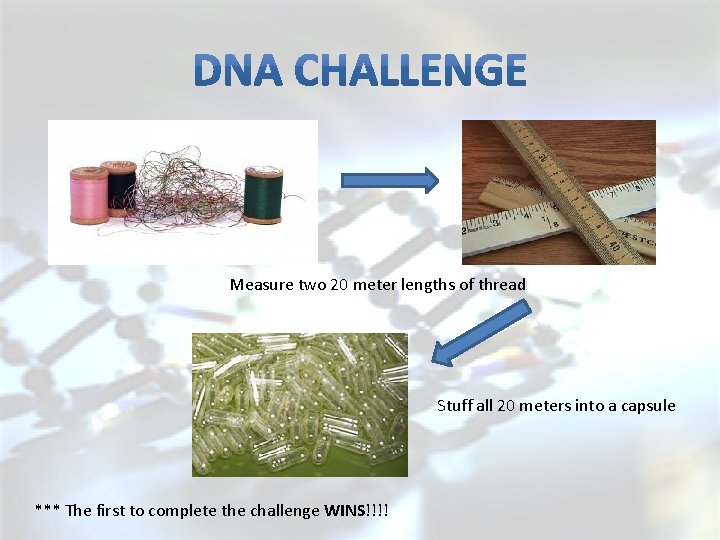
Measure two 20 meter lengths of thread Stuff all 20 meters into a capsule *** The first to complete the challenge WINS!!!!
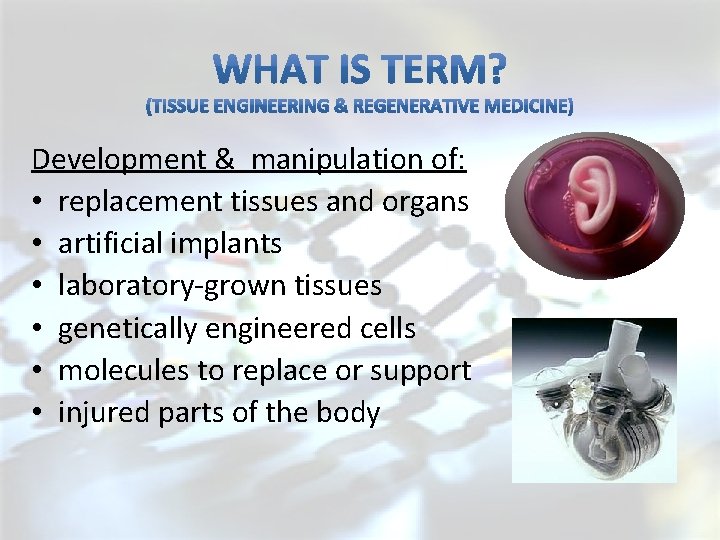
Development & manipulation of: • replacement tissues and organs • artificial implants • laboratory-grown tissues • genetically engineered cells • molecules to replace or support • injured parts of the body
Why TERM? 1. It’s HOT! 2. It’s Relevant! • Everybody is a potential candidate for its application • It’s multidisciplinary, a new trend in science and education 3.
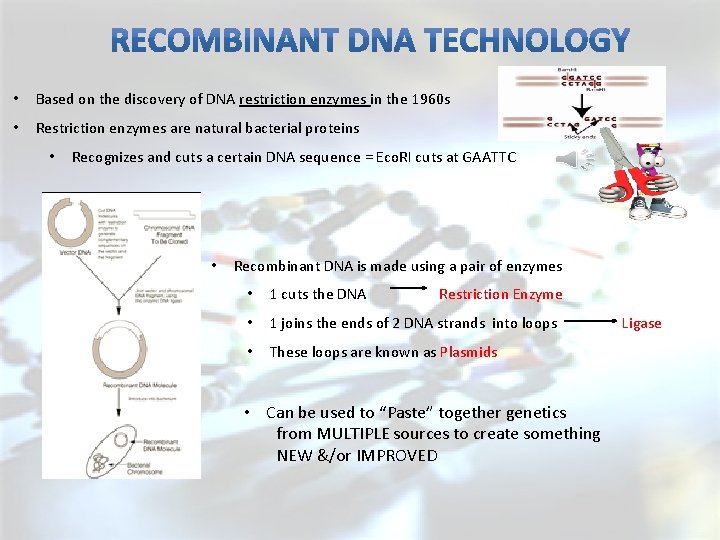
• Based on the discovery of DNA restriction enzymes in the 1960 s • Restriction enzymes are natural bacterial proteins • Recognizes and cuts a certain DNA sequence = Eco. RI cuts at GAATTC • Recombinant DNA is made using a pair of enzymes • 1 cuts the DNA Restriction Enzyme • 1 joins the ends of 2 DNA strands into loops • These loops are known as Plasmids • Can be used to “Paste” together genetics from MULTIPLE sources to create something NEW &/or IMPROVED Ligase
• Agriculture • Super Crops - corn, rice, soy • Medical • Disease diagnosis • Prescription medicine generation • Stem Cell Production • Gene therapy • Treat or remove to make better
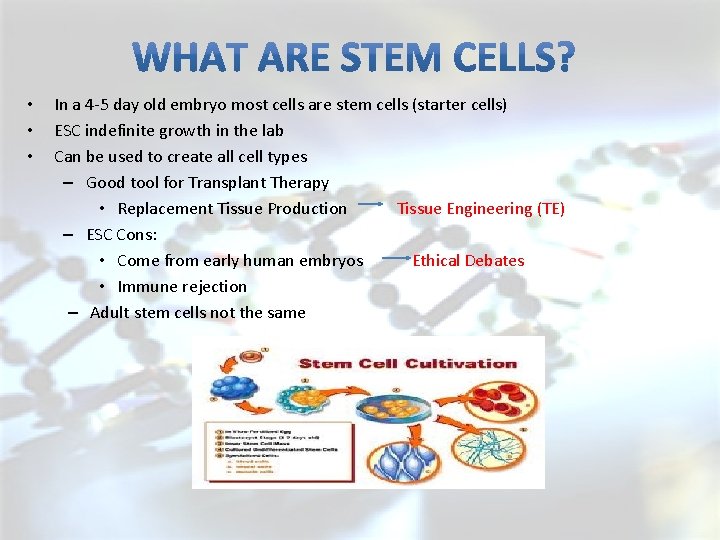
• • • In a 4 -5 day old embryo most cells are stem cells (starter cells) ESC indefinite growth in the lab Can be used to create all cell types – Good tool for Transplant Therapy • Replacement Tissue Production Tissue Engineering (TE) – ESC Cons: • Come from early human embryos Ethical Debates • Immune rejection – Adult stem cells not the same
• With the help of recombinant DNA technology, Induced Pluripotent Stem Cells (i. PSC) were produced • Almost identical to embryonic stem cells, but adult based • Indefinite growth in lab • Can differentiate into any cell type • Eliminate adverse immune reaction • Gene Therapy • Gene replacement and repair via stem cells • Healthy = replace • Patient = repair
**CBS News – “A ‘Holy Grail’ of Healing”
- Slides: 16