
PROFESSIONS AND SUBFIELDS IN PSYCHOLOGY Subfields in Psychology
PROFESSIONS AND SUBFIELDS IN PSYCHOLOGY
Subfields in Psychology Clinical psychologists �Assess and mental, emotional, and behavioral disorders ○ Examples: Depression, Personality disorders, Schizophrenia �Work in: ○ Mental hospitals ○ Prisons ○ Clinics ○ Private practices
Subfields in Psychology Counseling Psychologists �Interested in treatment of mental disorders �Concerned with “normal” problems of adjustment or challenge ○ Problems that emerge in everyday life �Academic stress, choosing a career, marital problems �Work in: ○ Academic settings �Schools ○ Community health centers ○ Private clinics Focus on… • Qualities of individual • Surrounding environment • Life span • Gender • Race
Subfields in Psychology cont’d � Developmental psychologists �Study how people change over time �Interested in: ○ Physical changes ○ Emotional development ○ Cognitive processes �Work in: ○ Academic settings � Public schools ○ Clinics ○ Hospitals � Educational psychologists �Study processes of learning, remembering, and thinking �Topics related to teaching children and young adults ○ Intelligence, memory, problem solving �Work in: ○ Universities ○ Schools ○ Education companies
Subfields in Psychology cont’d � Industrial/Organizational psychologists �Concerned with relationship between people and organizational structures ○ Study of people in the workforce �Employed by businesses and government agencies �Study and develop methods to boost production, improve working conditions, place job applicants, and train people �Work in: ○ Government ○ Industry ○ Businesses ○ Colleges and Universities
Subfields in Psychology cont’d � Experimental psychologists �Perform research to understand how humans operate physically and psychologically ○ Learning, memory, sensation, perception, cognition, motivation, emotion �Supply information and research used in psychology �Work in: ○ Research institutions ○ Businesses ○ Industries ○ Government agencies ○ Academic settings
Additional Subfields � Community psychologist � Strengthen communities/organizations � Environmental psychologist � Person-environment interactions � Forensic psychologist � Applied to legal issues � Social psychologist � Interactions shape person’s mental life and behavior � Sports psychologist � Focus on goals, motivation, dealing with failure
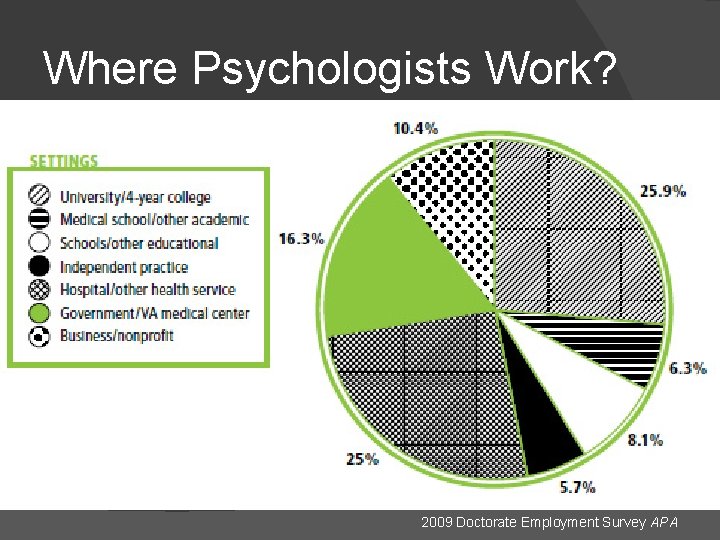
Where Psychologists Work? 2009 Doctorate Employment Survey APA
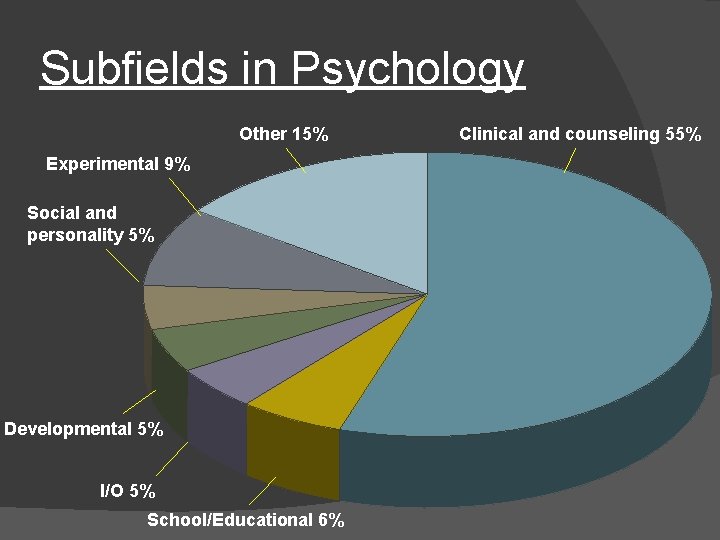
Subfields in Psychology Other 15% Experimental 9% Social and personality 5% Developmental 5% I/O 5% School/Educational 6% Clinical and counseling 55%
Research and Ethics in Psychology
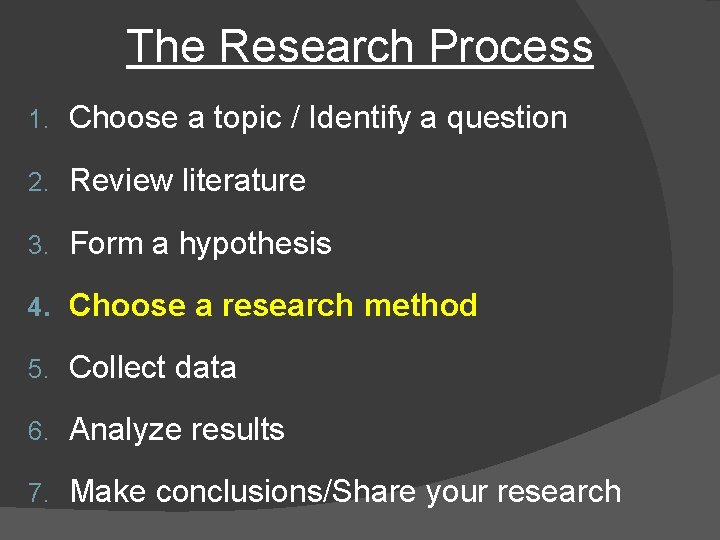
The Research Process 1. Choose a topic / Identify a question 2. Review literature 3. Form a hypothesis 4. Choose a research method 5. Collect data 6. Analyze results 7. Make conclusions/Share your research
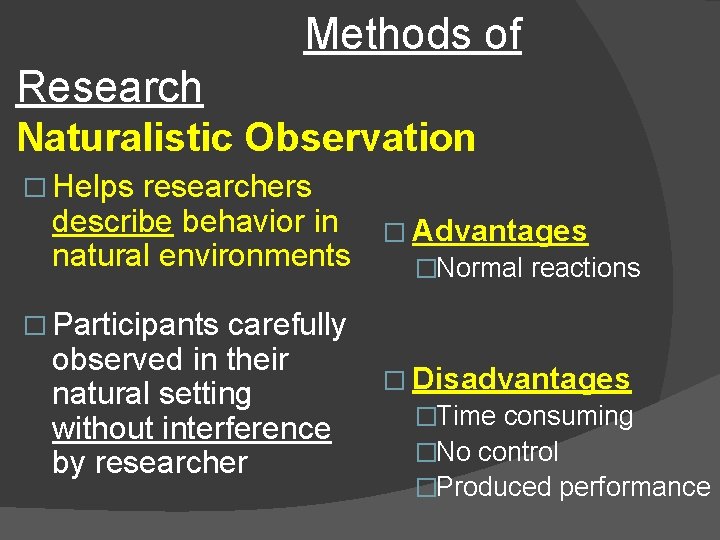
Methods of Research Naturalistic Observation � Helps researchers describe behavior in natural environments carefully observed in their natural setting without interference by researcher � Advantages �Normal reactions � Participants � Disadvantages �Time consuming �No control �Produced performance
Methods of Research Naturalistic Observation � Examples: �Recording racial differences in student’s self- seating patterns in the lunchroom �Researcher sitting in Mc. Donalds observing eating habits of men vs. women � Previous study revealed: �We humans laugh 30 times more often in social situations than in solitary situations
Surveys Methods of Research Advantages � Quick and efficient � Interviews allow researcher to further control situation �Adjust questions if needed (clarify) Disadvantages � Difficult to get in-depth information � Question � Interview of honesty can result in leading participant
Surveys Research Methods of � Questioning a large group of people about their attitudes, beliefs, opinions, etc. �Consist of interviews or questionnaires � Requires representative sample �Who will take your survey? ○ Population �Reflects major characteristics of population you wish to represent �Random sample – all persons have equal chance of participating IT IS NOT ALL ABOUT THE NUMBERS
If I wanted you to find the average height of the student population who attend this school, give two ways that your sample for the survey might be selected. � The first must be an example of a biased sample second must be an example of an unbiased sample.
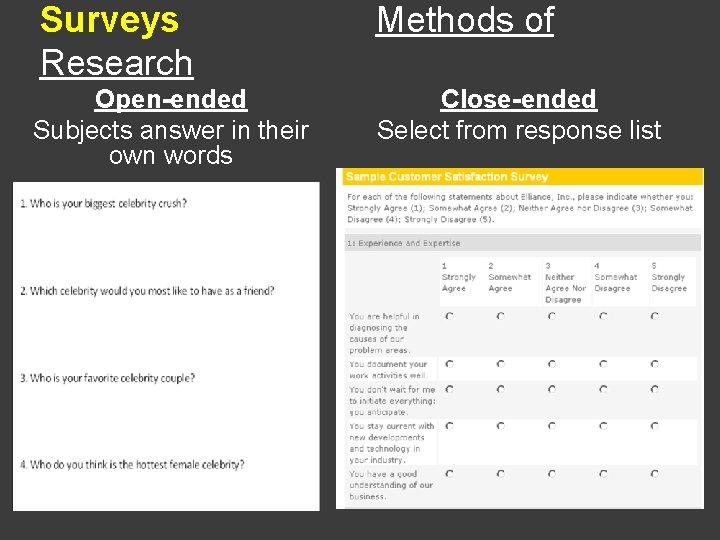
Surveys Research Methods of Open-ended Subjects answer in their own words Close-ended Select from response list
Surveys � Methods of Research Neutral questions to avoid bias �Biased questions: ○ “Many people have said that there is a need for stricter laws on dangerous weapons. Do you agree? ” ○ Asking a group of soccer players “What is your favorite sport? ” � Wording Effects �Changes in order or wording of questions can have major effect �People are more approving of ○ “aid to the needy” than of “welfare” ○ “revenue enhancers” than of “taxes”
Survey/Questionnaire Introductions � What type of information is included in the example introductory statements used for surveys/questionnaires?
Survey/Questionnaire Introductions � Purpose of research � Voluntary participation � Confidentiality �Information kept in confidence, in secret � Anonymity �Participation remains anonymous, or unknown
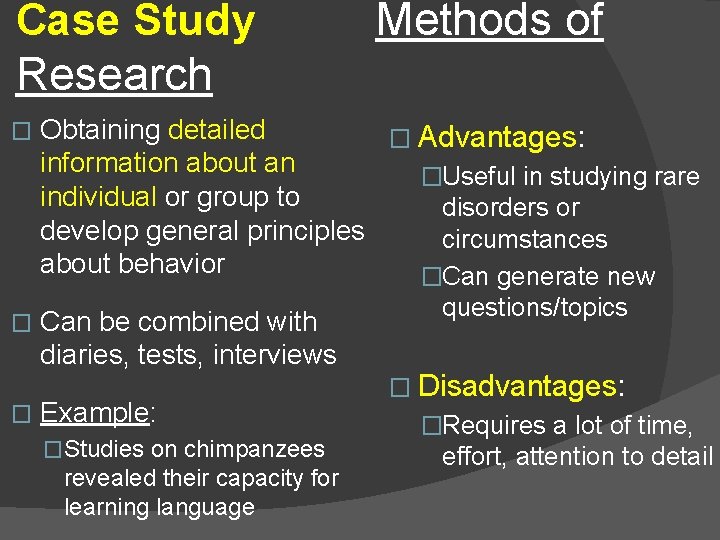
Case Study Research Methods of � Obtaining detailed � Advantages: information about an �Useful in studying rare individual or group to disorders or develop general principles circumstances about behavior �Can generate new � Can be combined with diaries, tests, interviews � Example: �Studies on chimpanzees revealed their capacity for learning language questions/topics � Disadvantages: �Requires a lot of time, effort, attention to detail
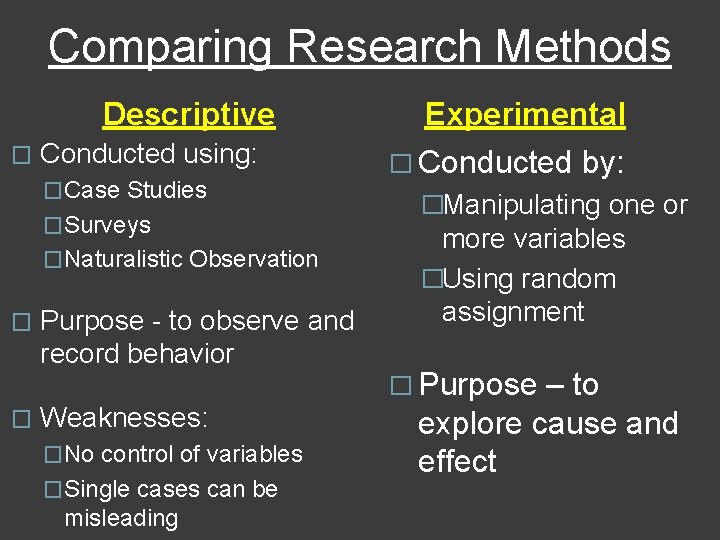
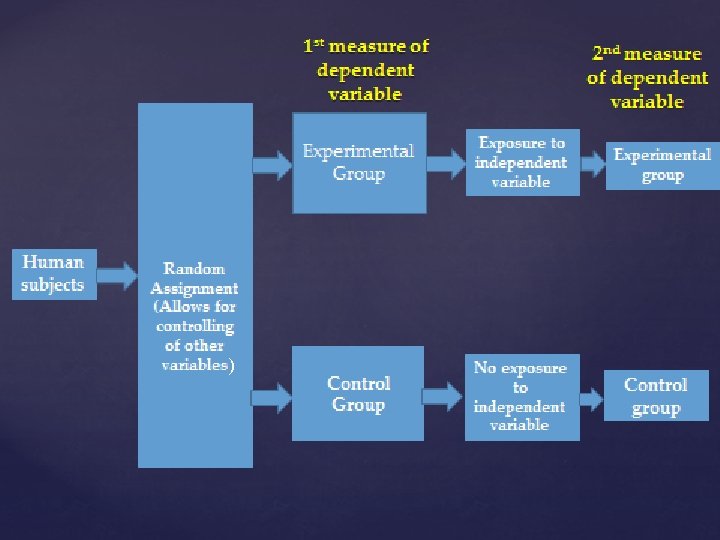
Comparing Research Methods Descriptive � Conducted using: �Case Studies �Surveys �Naturalistic Observation � � Purpose - to observe and record behavior Weaknesses: �No control of variables �Single cases can be misleading Experimental � Conducted by: �Manipulating one or more variables �Using random assignment � Purpose – to explore cause and effect
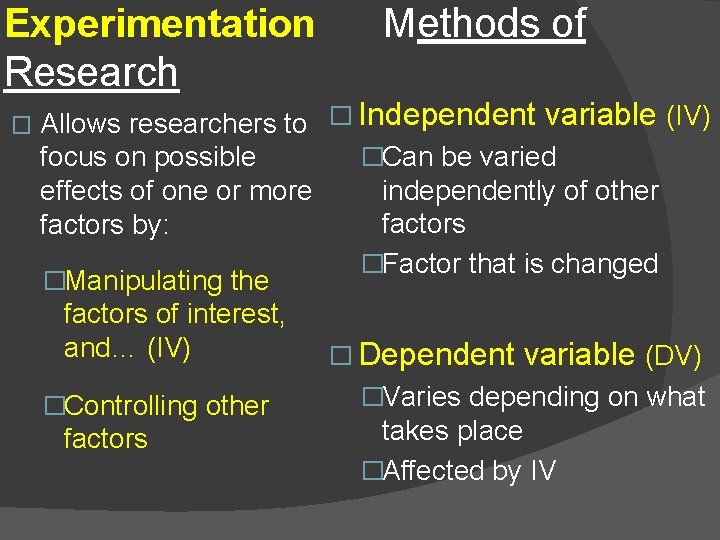
Experimentation Research � Methods of Allows researchers to � Independent variable (IV) �Can be varied focus on possible independently of other effects of one or more factors by: �Factor that is changed �Manipulating the factors of interest, and… (IV) � Dependent variable (DV) �Varies depending on what �Controlling other takes place factors �Affected by IV
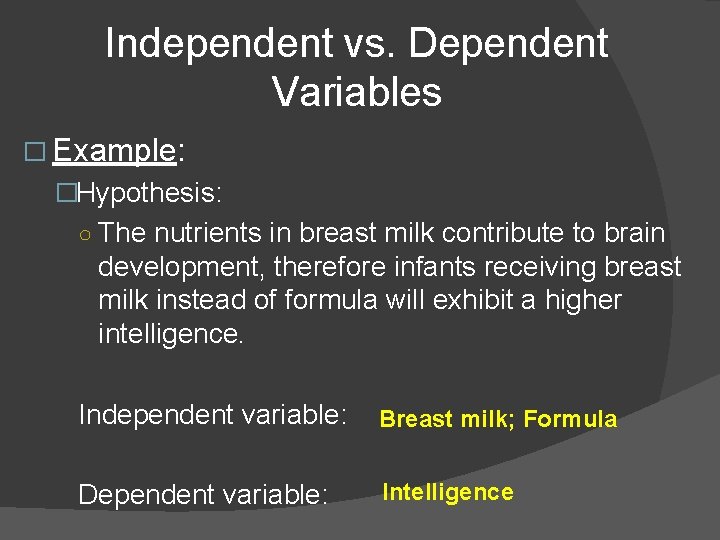
Independent vs. Dependent Variables � Example: �Hypothesis: ○ The nutrients in breast milk contribute to brain development, therefore infants receiving breast milk instead of formula will exhibit a higher intelligence. Independent variable: Breast milk; Formula Dependent variable: Intelligence
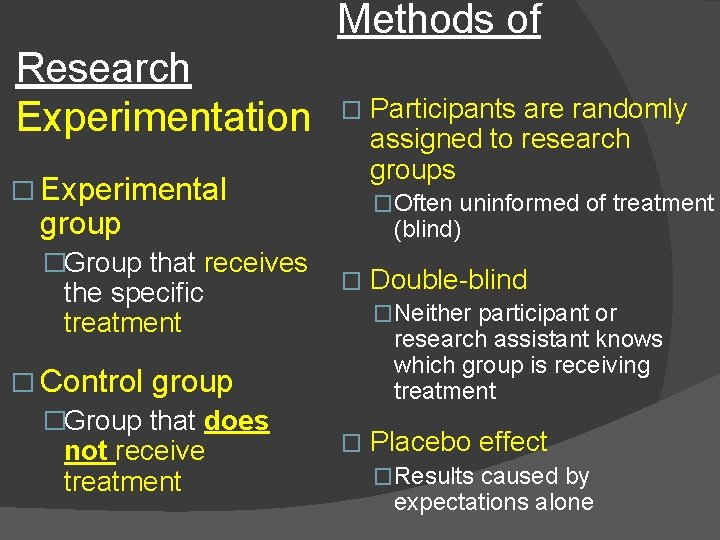
Methods of Research Experimentation � � Experimental �Often uninformed of treatment group �Group that receives the specific treatment � Control group �Group that does not receive treatment Participants are randomly assigned to research groups (blind) � Double-blind �Neither participant or research assistant knows which group is receiving treatment � Placebo effect �Results caused by expectations alone
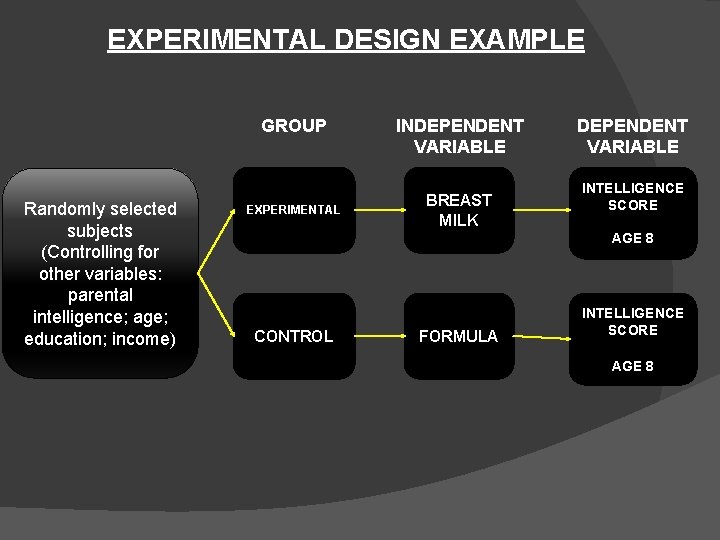
EXPERIMENTAL DESIGN EXAMPLE GROUP Randomly selected subjects (Controlling for other variables: parental intelligence; age; education; income) EXPERIMENTAL INDEPENDENT VARIABLE BREAST MILK DEPENDENT VARIABLE INTELLIGENCE SCORE AGE 8 CONTROL FORMULA INTELLIGENCE SCORE AGE 8
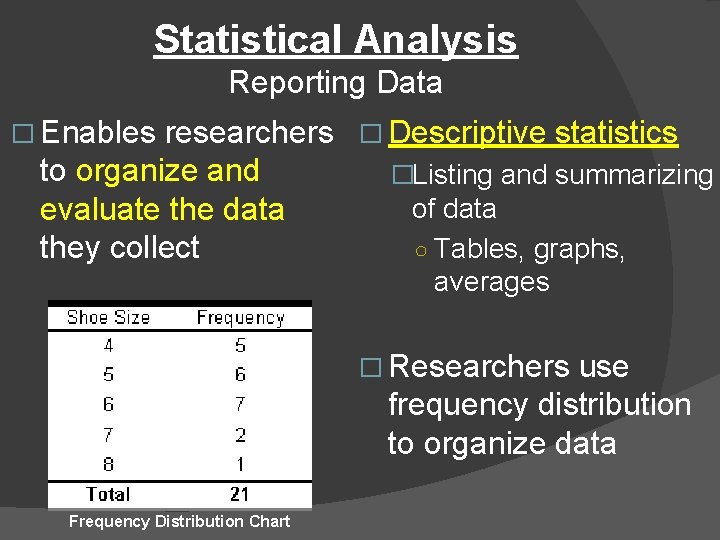
Statistical Analysis Reporting Data � Enables researchers � Descriptive statistics to organize and �Listing and summarizing of data evaluate the data ○ Tables, graphs, they collect averages � Researchers use frequency distribution to organize data Frequency Distribution Chart
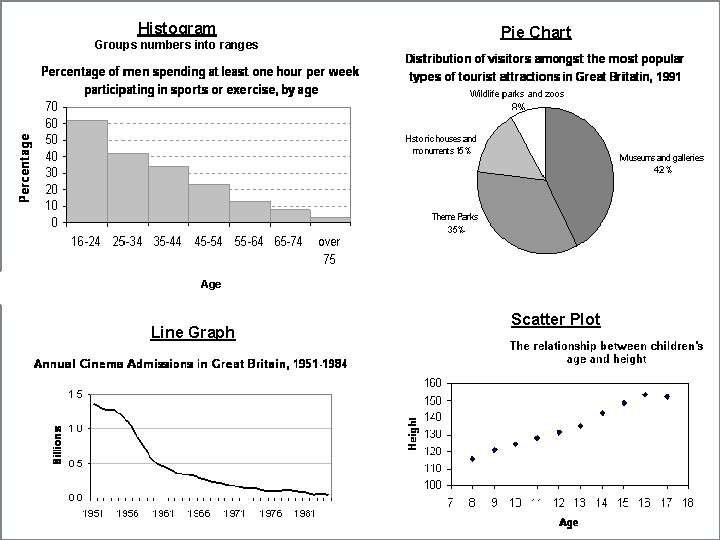
Histogram Groups numbers into ranges Line Graph Pie Chart Scatter Plot
Correlational Design � Measuring the � Stated as either: relation between two �Positive: as value of variable A goes up, value variables �How well one predicts the other � Helps researchers: �Make predictions DOES NOT determine causeeffect of variable B goes up �Negative: as value of variable A goes up, value of variable B goes down Does not relate to strength/weakness
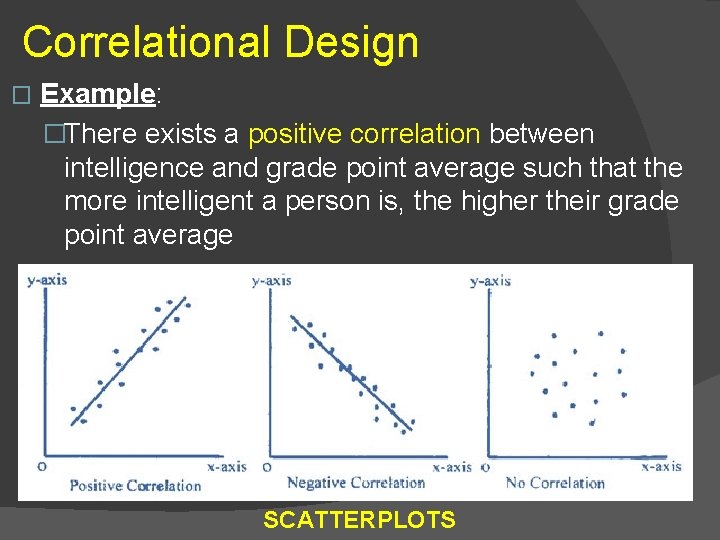
Correlational Design � Example: �There exists a positive correlation between intelligence and grade point average such that the more intelligent a person is, the higher their grade point average SCATTERPLOTS
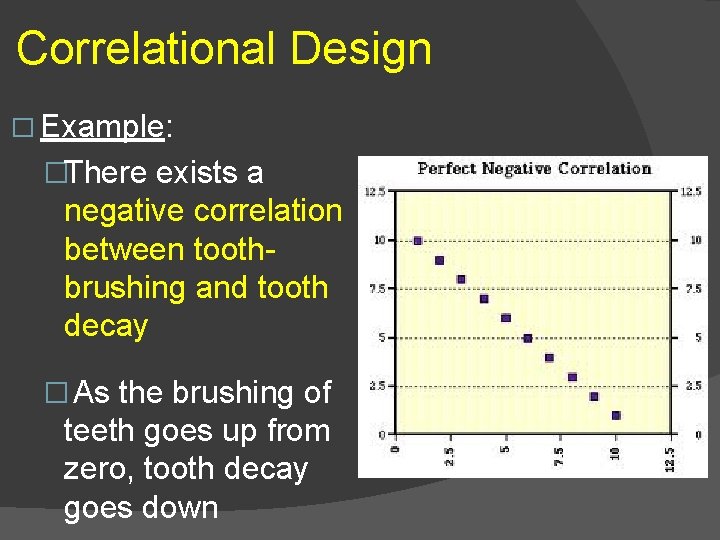
Correlational Design � Example: �There exists a negative correlation between toothbrushing and tooth decay � As the brushing of teeth goes up from zero, tooth decay goes down
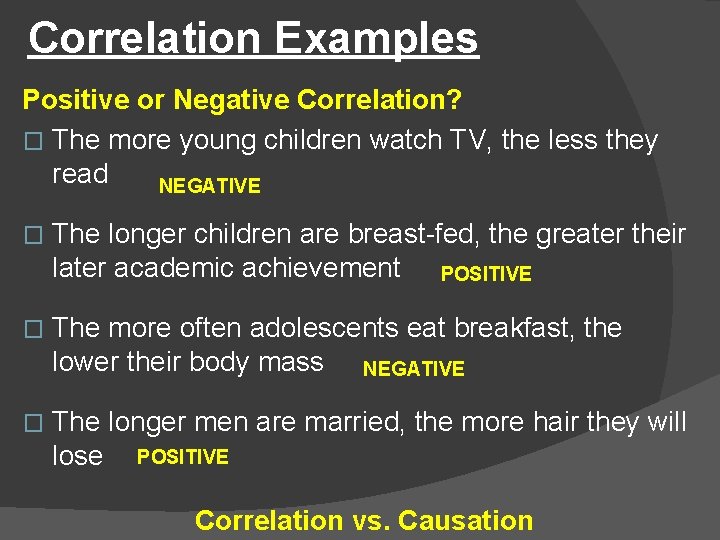
Correlation Examples Positive or Negative Correlation? � The more young children watch TV, the less they read NEGATIVE � The longer children are breast-fed, the greater their later academic achievement POSITIVE � The more often adolescents eat breakfast, the lower their body mass NEGATIVE � The longer men are married, the more hair they will lose POSITIVE Correlation vs. Causation
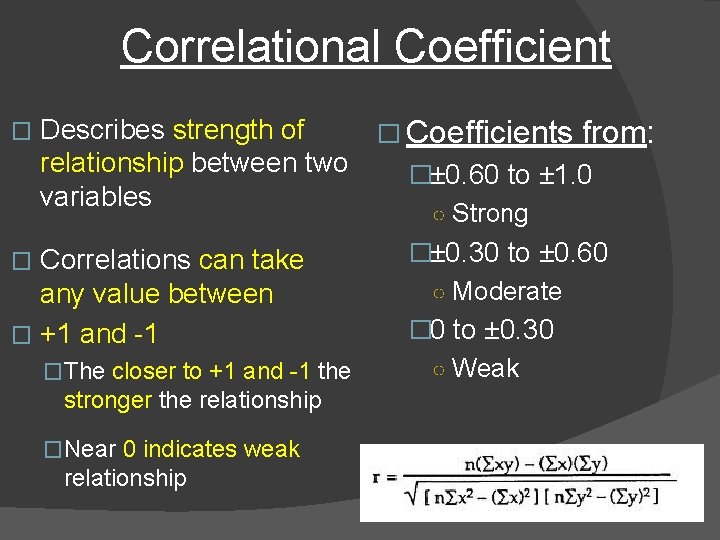
Correlational Coefficient � Describes strength of � Coefficients from: relationship between two �± 0. 60 to ± 1. 0 variables ○ Strong Correlations can take any value between � +1 and -1 � �The closer to +1 and -1 the stronger the relationship �Near 0 indicates weak relationship �± 0. 30 to ± 0. 60 ○ Moderate � 0 to ± 0. 30 ○ Weak
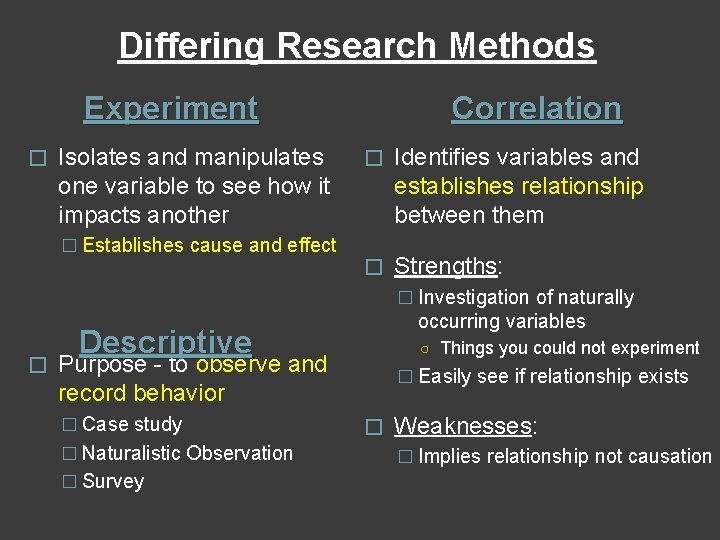
Differing Research Methods Experiment � Isolates and manipulates one variable to see how it impacts another Correlation � Identifies variables and establishes relationship between them � Strengths: � Establishes cause and effect � Investigation of naturally � occurring variables Descriptive ○ Things you could not experiment Purpose - to observe and record behavior � Case study � Naturalistic Observation � Survey � Easily see if relationship exists � Weaknesses: � Implies relationship not causation
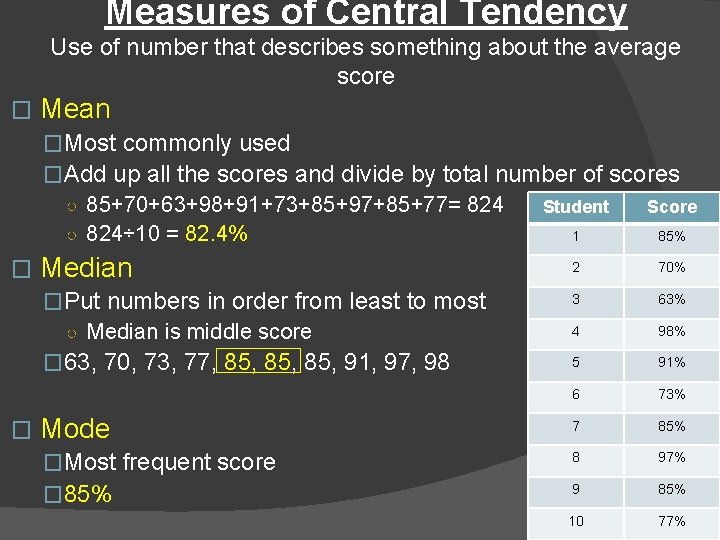
Measures of Central Tendency Use of number that describes something about the average score � Mean �Most commonly used �Add up all the scores and divide by total number of scores ○ 85+70+63+98+91+73+85+97+85+77= 824 Student Score 1 85% ○ 824÷ 10 = 82. 4% � Median 2 70% 3 63% 4 98% 5 91% 6 73% Mode 7 85% �Most frequent score � 85% 8 97% 9 85% 10 77% �Put numbers in order from least to most ○ Median is middle score � 63, 70, 73, 77, 85, 85, 91, 97, 98 �
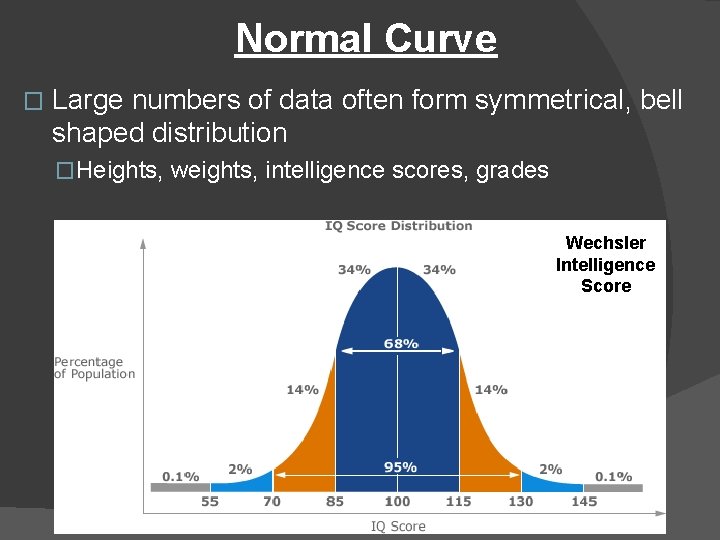
Normal Curve � Large numbers of data often form symmetrical, bell shaped distribution �Heights, weights, intelligence scores, grades Wechsler Intelligence Score
Animal Experimentation and Ethics � Psychologists study animals to learn about people �Animal experiments have led to effective methods of: ○ Training children with mental disorders ○ Understanding aging ○ Relieving fear or depression � APA Guidelines �Ensure the “comfort, health, and humane treatment” of animals �Minimizing “infection, illness, and pain of animal subjects”
Research Benefits Animals � Research and experimentation has led to: �Handling and stroking methods to reduce stress in dogs transitioning to shelters or adoptive homes �Zoo animals avoiding boredom by working for their food…as they would in the wild �Improved care and management of animals’ natural habitats. �Empathy and protection for chimpanzees and gorillas based on their remarkable intelligence levels
Ethical Principles in Human Research � Obtain the informed consent of potential participants � Protect them from harm or discomfort � Treat information about individual participation confidentially � Fully explain the research afterward
- Slides: 40