
Professionalism One Students Perception l Professionalismin a word

- Slides: 24
Professionalism
One Student’s Perception. . . l Professionalism…in a word - it’s an attitude. Also, the way in which an individual conducts oneself in certain situations …the way you speak, the way you dress, the way you are organized, etc. It is setting standards and complying with them.
Business Success is a Matter of Principle l l Values are the most effective way to differentiate an individual or organization. Professionalism is an attitude.
Workplace ‘rudeness’ is on the rise. . . l l l workplace civility has fallen in the past 10 years technology allows workers to “zap people anonymously” men are 7 times more likely to be rude or insensitive to underlings than to superiors • Source: Christine Pearson (1999) “Workplace Incivility: The Target’s Eye View”, University of North Carolina.
Dynamos, Cruisers & Losers. . . l Cruisers (65 -85%)live off existing skills not working to expand ability have a ‘job’ not a ‘career’
Dynamos, Cruisers & Losers. . . l Losers (5 -15%)do not meet basic standards avoid responsibility unproductive
When I’m Bored at Work, I. . . l l l chat with co-workers surf the web, aimlessly make personal calls plan next vacation go home “sick” other AOL Workplace Channel, Aug. 16, 1999 31. 4% 29. 3% 19. 8% 3. 2% 12. 5%
Professionalism is key to career success l l professionals agree to organizationwide shared values teamwork is a mandatory part of the organizational culture focus on relationship building trust is the glue that holds the organization together • Adapted from: David H. Maister (1997) True Professionalism, New York: The Free Press.
Investing in Professionalism. . . l l l l explore new technologies ask for assignments take charge of your own learning enhance your communication skills master people skills use downtime to acquire knowledge pursue work that builds your assets
Professionalism in Teamwork. . . l take responsibility rather than making excuses or blaming each other
Professionalism in Teamwork. . . l openly share information
Professionalism in Teamwork. . . l collaborate on important issues
Professionalism in Teamwork. . . l focus on a common purposedon’t get sidetracked by details
Professionalism in Teamwork. . . l value each other’s background
Professionalism in Teamwork. . . l openly voice concerns & criticismsreturn communications
Professionalism in Teamwork. . . l be positive about the team members and their work
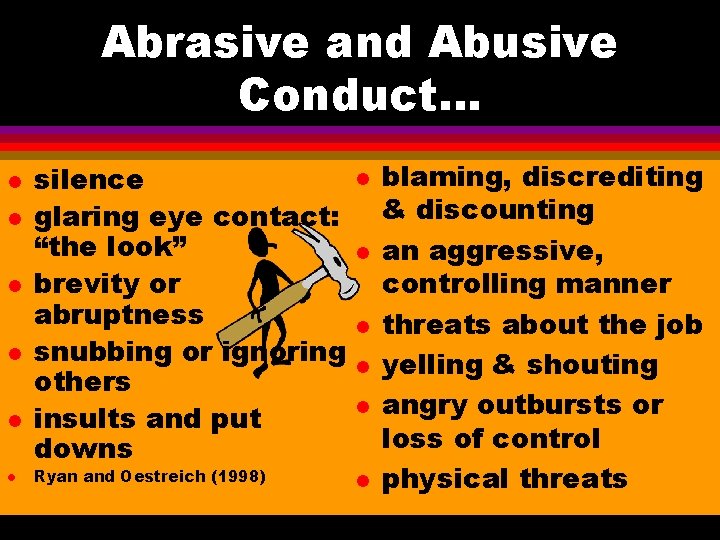
Abrasive and Abusive Conduct. . . l l l silence glaring eye contact: “the look” brevity or abruptness snubbing or ignoring others insults and put downs Ryan and Oestreich (1998) l l l blaming, discrediting & discounting an aggressive, controlling manner threats about the job yelling & shouting angry outbursts or loss of control physical threats
Workplace Anger. . . l l l 25% at least somewhat angry at work 856 work-related murders in 1997 ( a 7% drop from ‘ 96) most common cause of workplace anger: actions of supervisors & managers
What is Individual Professionalism? l l l an attitude pride responsibility being a team player honesty, trustworthiness, and loyalty Adapted: David H. Maister, True Professionalism. l l openness to critiques care about people & goals accountability investment
What is professionalism as a student? l l l l enjoying the total experience building your entire career developing ‘ownership’ of your program managing your time accepting responsibility having nonnegotiable values personal enthusiasm & style
Individual Professionalism Values. . . l l l tolerance passion for excellence team cooperation & leadership competence respect and trust
Professionalism Issues in the Classroom. . . l l l proper language tardiness & absenteeism excessive talking working on other assignments keeping oncampus appointments l l l reading outside materials in class sleeping in class desiring special treatment redesigning course teamwork concerns
Student-Professor Interaction. . . l In teams of 3, develop a set of criteria for professional interaction (for both students and faculty) for professional interaction including classroom office and informal situations.
Questions & Discussion l l What is the relationship between professionalism & business ethics? How does professionalism relate to the culture of the organization? What are the long term benefits of professionalism to you & the organization? Why is it important to improve your professionalism while at CSU? Copyright O. C. Ferrell, 1999