
Professionalism in the Workplace PROFESSIONAL DEVELOPMENT TRAINING AMANDA
- Slides: 20
Professionalism in the Workplace PROFESSIONAL DEVELOPMENT TRAINING AMANDA TOMCZAK ROWAN UNIVERSITY
Professionalism by the Books PROFESSIONALISM DEFINED the conduct or qualities that characterize or mark an individual holding an occupation the skill level, of course, but also good judgment and polite behavior that is expected from a person who is trained to do a job well (Quantitative vs Qualitative)
Agenda ü Customer Service ü The Importance of First Impressions ü Listening Skills Concepts ü Positive and Effective Communication ü The Importance of Effective and Efficient E-mail Communication ü Action Plan and Follow-up ü Evaluation Forms
“It takes years to build a reputation and five minutes to ruin it. If you think about that, you’ll do things differently. ” - Warren Buffett, CEO of Berkshire Hathaway
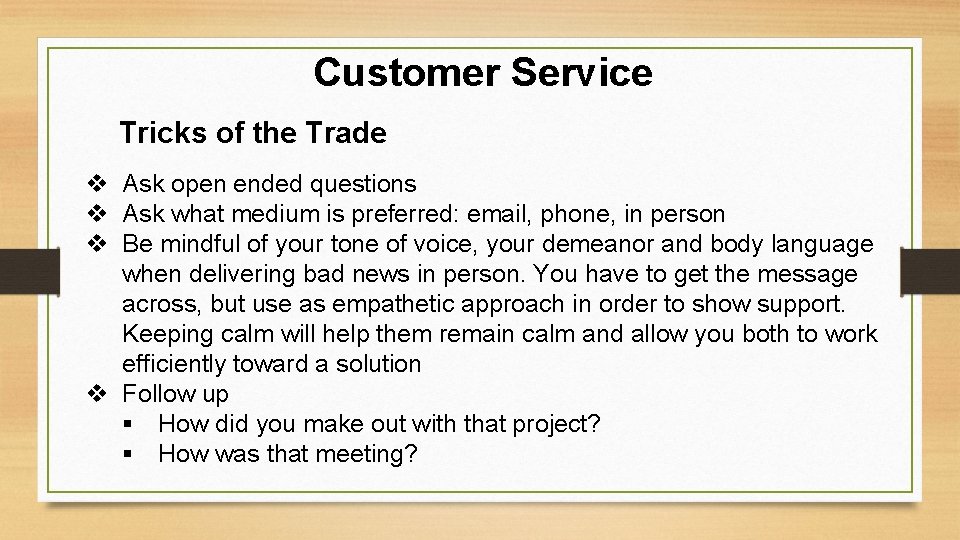
Customer Service Tricks of the Trade v Ask open ended questions v Ask what medium is preferred: email, phone, in person v Be mindful of your tone of voice, your demeanor and body language when delivering bad news in person. You have to get the message across, but use as empathetic approach in order to show support. Keeping calm will help them remain calm and allow you both to work efficiently toward a solution v Follow up § How did you make out with that project? § How was that meeting?
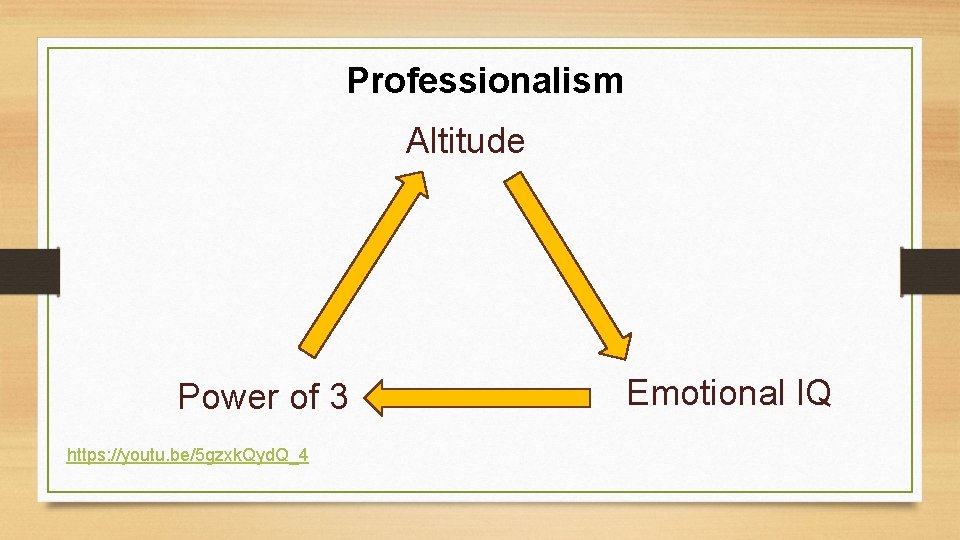
Professionalism Altitude Power of 3 https: //youtu. be/5 gzxk. Qyd. Q_4 Emotional IQ
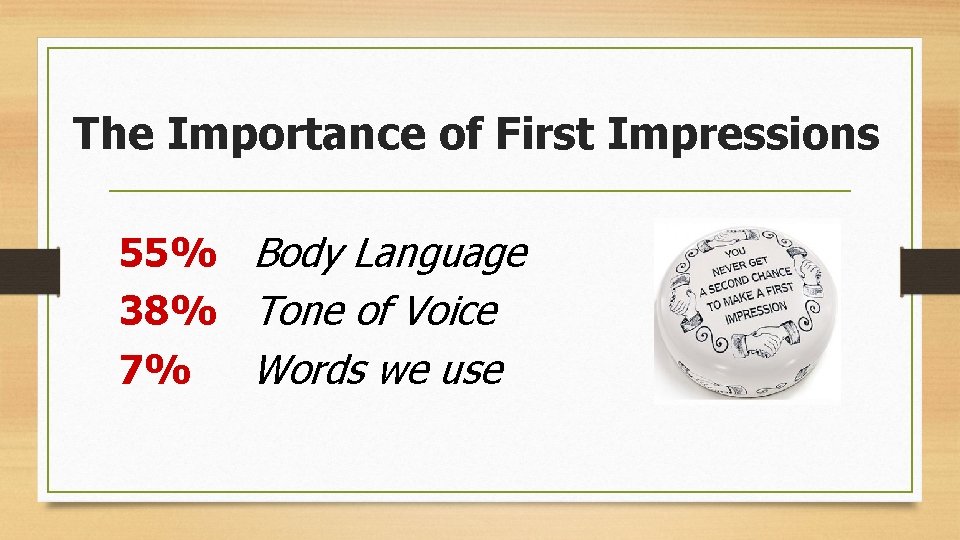
The Importance of First Impressions 55% Body Language 38% Tone of Voice 7% Words we use
First up: Body Language Most people are familiar with the typical tips including maintain eye contact, don’t cross your arms, don’t fidget, etc. • Lesser known tip: The Hand Jive • Did you know people remember twice as much information due to gestures? It’s true. Effective use of gestures makes a big impact. Don’t use random wasted gestures. • For example: Take a look at the palms of your hands. Did you know that the palm immediately relaxes your eyes? It’s true. Be sure to keep your palms open when gesturing, don’t show the back of your hands. This shows you are open to the discussion.
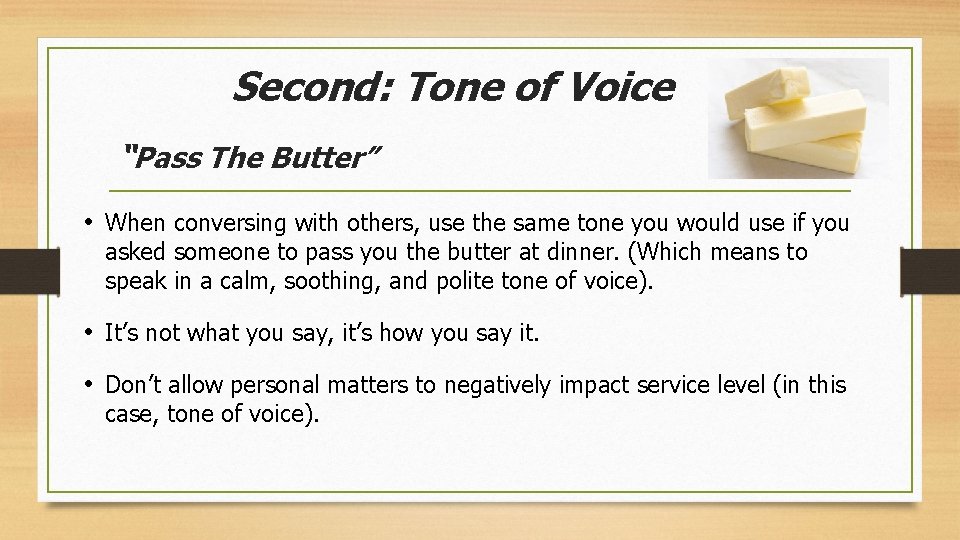
Second: Tone of Voice “Pass The Butter” • When conversing with others, use the same tone you would use if you asked someone to pass you the butter at dinner. (Which means to speak in a calm, soothing, and polite tone of voice). • It’s not what you say, it’s how you say it. • Don’t allow personal matters to negatively impact service level (in this case, tone of voice).
Third: Words we use “Did I say that? ” • Try to avoid Industry Lingo (Examples: CWA, IFPTE, e. PAR, etc. ) • Extreme words like “never” or “always” are usually better left unsaid. • Use positive messaging (using words that are laced with optimism – more impactful) • Communicating in this way will change the way your listeners receive your feedback • It should be personal, encouraging, passionate, and empowering.
What do you think are the keys to a strong first impression?
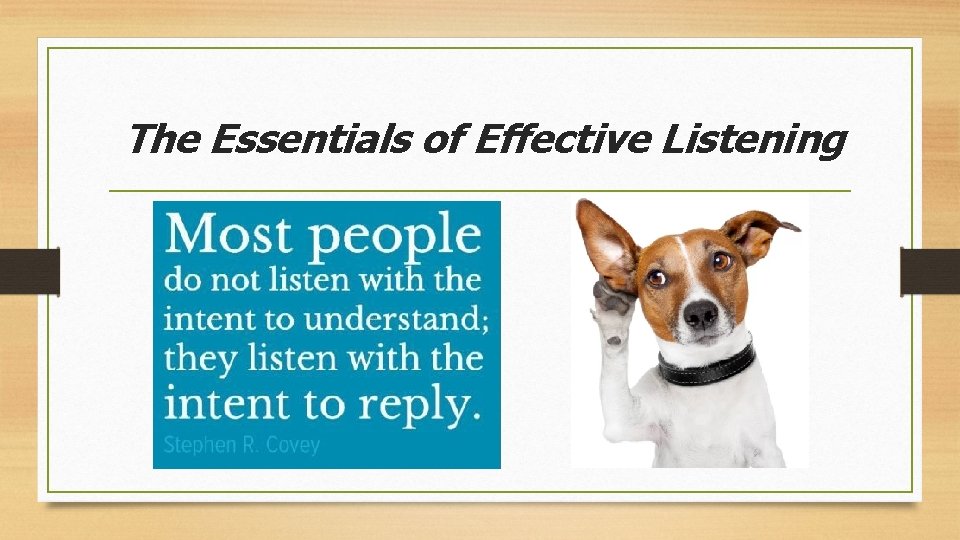
The Essentials of Effective Listening
Negative Listening Habits to Avoid • The Faker – All the outward signs are there: nodding, making eye contact, and giving the occasional “uh huh” • The Interrupter – Doesn’t allow the speaker to finish, ask clarifying questions, or seek more information from the speaker; too anxious to talk him or herself • The Quick Switch – Favorite lines are, “Oh, that’s nothing, here’s what happened to me…” “I remember when I was…” • The Rebuttal Maker – Only listens long enough to form a rebuttal; at their worst, they are argumentative and want to prove you wrong; at minimum, the person wants to make the speaker see the other point of view. • The Advice Giver – Giving advice is sometimes helpful; however, at other times, this interferes with good listening because it does not allow the speaker to fully articulate their feelings or thoughts; it doesn’t help the speaker solve their own problems; it prohibits venting; it could also belittle the speaker by minimizing his/her concern with a quick solution.
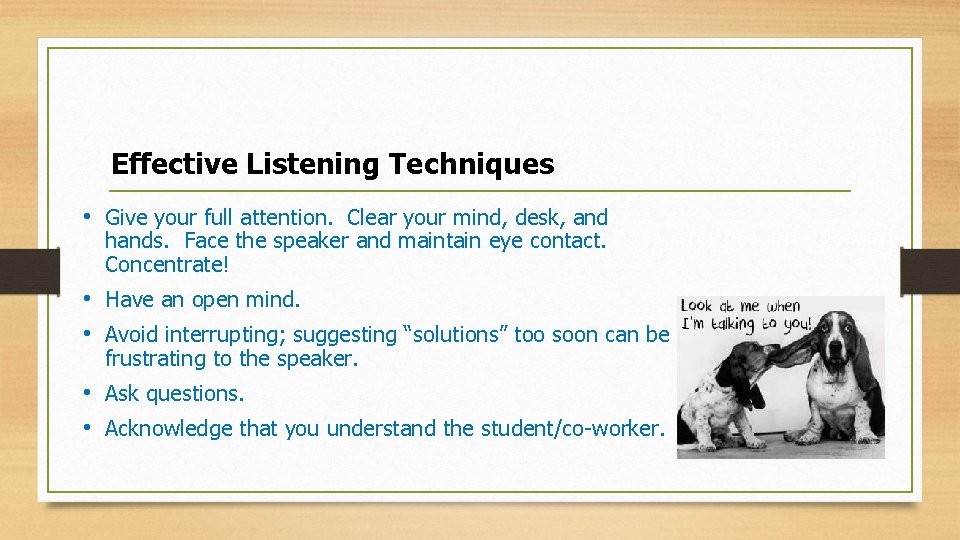
Effective Listening Techniques • Give your full attention. Clear your mind, desk, and hands. Face the speaker and maintain eye contact. Concentrate! • Have an open mind. • Avoid interrupting; suggesting “solutions” too soon can be frustrating to the speaker. • Ask questions. • Acknowledge that you understand the student/co-worker.
Effective Listening Techniques • Wait for the speaker to pause to ask clarifying questions. • Ask questions only to ensure understanding. Asking questions for other reasons often leads to getting off topic and an inefficient use of time. • Try to feel what the speaker is feeling (joy, sadness, fearful, etc. ) – facilitates empathy and better communication. • Give the speaker regular feedback (i. e. “You must be thrilled” or “I can see how that could be confusing”) • Pay attention to what isn’t said – to nonverbal cues (body language)
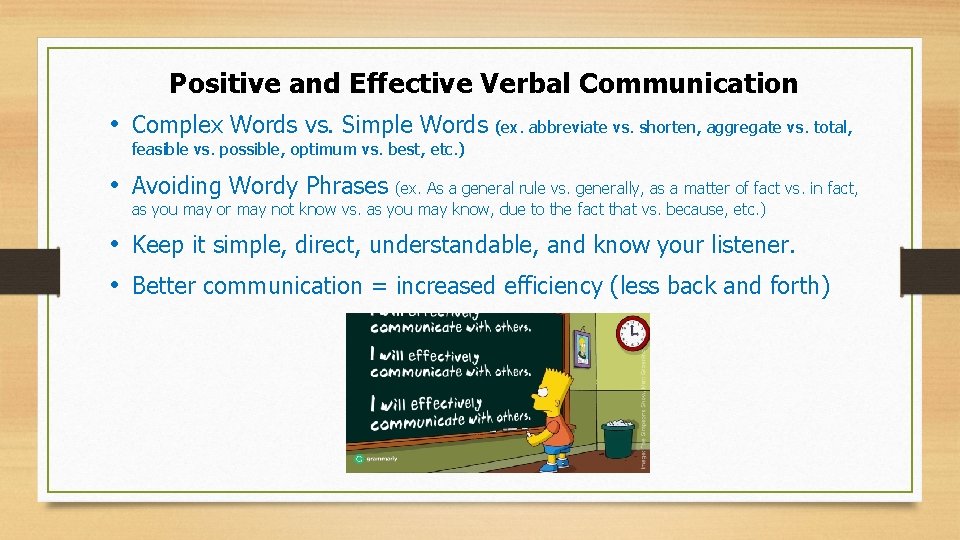
Positive and Effective Verbal Communication • Complex Words vs. Simple Words (ex. abbreviate vs. shorten, aggregate vs. total, feasible vs. possible, optimum vs. best, etc. ) • Avoiding Wordy Phrases (ex. As a general rule vs. generally, as a matter of fact vs. in fact, as you may or may not know vs. as you may know, due to the fact that vs. because, etc. ) • Keep it simple, direct, understandable, and know your listener. • Better communication = increased efficiency (less back and forth)
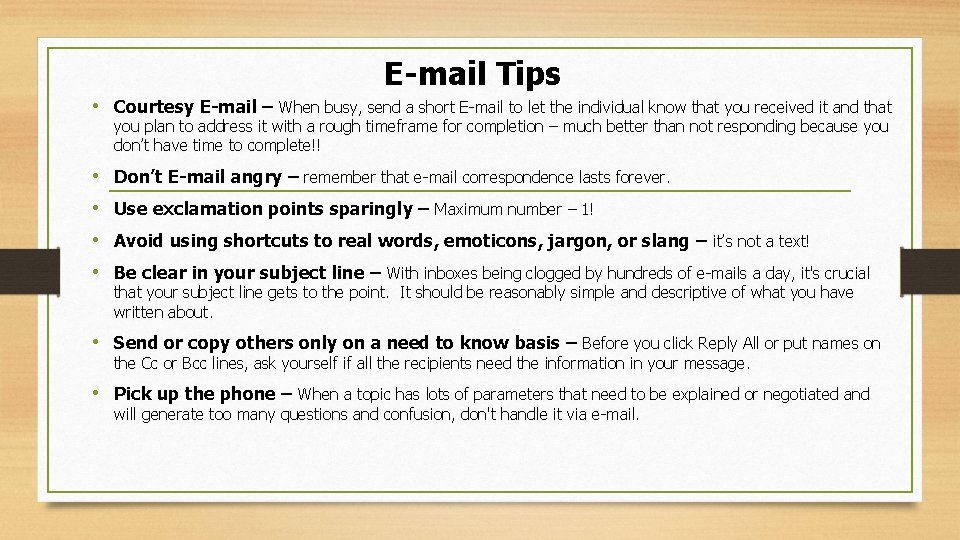
E-mail Tips • Courtesy E-mail – When busy, send a short E-mail to let the individual know that you received it and that you plan to address it with a rough timeframe for completion – much better than not responding because you don’t have time to complete!! • Don’t E-mail angry – remember that e-mail correspondence lasts forever. • Use exclamation points sparingly – Maximum number – 1! • Avoid using shortcuts to real words, emoticons, jargon, or slang – it’s not a text! • Be clear in your subject line – With inboxes being clogged by hundreds of e-mails a day, it's crucial that your subject line gets to the point. It should be reasonably simple and descriptive of what you have written about. • Send or copy others only on a need to know basis – Before you click Reply All or put names on the Cc or Bcc lines, ask yourself if all the recipients need the information in your message. • Pick up the phone – When a topic has lots of parameters that need to be explained or negotiated and will generate too many questions and confusion, don't handle it via e-mail.
E-Mail Tips • Maintain privacy – If you're sending a message to a group of people and you need to protect the privacy of your list, you should use "Bcc”. Additionally, avoid giving out e-mail addresses to a third party. • Know your audience – Your e-mail greeting and sign-off should be consistent with the level of respect and formality of the person you're communicating with. • Keep it short and get to the point – Long e-mails are typically inefficient. Write concisely so as to not overwhelm the recipient. Make sure when you look at what you're sending it doesn't look like a burden to read – feel free to use bullet points. • Your e-mail is a reflection of you – Every e-mail you send adds to, or detracts from your reputation. If your e-mail is scattered, disorganized, and filled with mistakes, the recipient will be inclined to think of you as a scattered, careless, and disorganized person. • The message is as unique as the recipient – The message should be tailored to best fit your target audience or addressee. Take the time to personalize a mass email message based on the recipient(s).
Action Plan • What will you do to implement a concept from today’s session? • When will you do this? • What results do you expect and how will they be measured? • What assistance will you need to implement your plan?
Thank You