
Professional Writing Understanding Audience Tone and Structure Presented
- Slides: 16
Professional Writing: Understanding Audience, Tone, and Structure Presented by the UT Writing Center
The “Universal” Traits of Writing ▪ All writing tasks, whether academic, professional, or personal are governed by certain shared traits ▪ Think “SAPO”: Subject, Audience, Purpose, Outcome ▪ Writing for the workplace, in particular, typically succeeds or fails based on the degree to which the writer has considered these traits
Well-Defined Subjects are “Manageable” for the Writing Task ▪ Assess the content needs of the writing task, and then develop your subject accordingly ▪ Be concise: ineffective professional writing can often be caused by the inclusion of subject material that is irrelevant to the core writing task
Know Your Audience, Know Success! ▪ An awareness of one’s audience is perhaps the most critical trait in Professional Writing ▪ The identity of your audience significantly influences your word choice, tone and phrasing; different audiences dictate different choices in these areas ▪ In the age of social media and text messaging, writers (particularly recent graduates) are significantly more likely to inadvertently merge personal, informal language with professional tasks; a constant awareness of audience is the solution to this problem
Effective Persuasion=Audience Awareness + Relevant Evidence ▪ Whether using appeals to logic (logos), appeals to emotion (pathos), or appeals to one’s own credibility (ethos), evidence is only effective if it fulfills the needs of the reader ▪ Effective document design and the inclusion of engaging visual elements can also have a persuasive effect
Tone in Professional Communications: WHAT you say and HOW you say it MATTERS! Consider this email message recently sent to all staff members on a large university campus: ▪ “It is time to renew your faculty/staff parking permit. New permits are required by Nov. 1. Parking Rules and Regulations require that all vehicles driven on campus must display the current permit. ” Now, a revised version with a different tone: § “Please renew your faculty/staff parking permit by November 1. ” An enhanced version would also do the following: ▪ Guide the recipient on how and where to renew the parking permit
Consider the Difference in Tone INFORMAL TONE PROFESSIONAL TONE ▪ You must agree that I am ▪ My qualifications in the areas of qualified for the position. ▪ You didn't read the instructions carefully, thus your system has shut down. ▪ "I hope that you will contact me. . . I know that my qualifications are not very impressive, but. . . " accounting and customer service meet your job requirements. ▪ The system may automatically shut down if any installation errors occur. ▪ "You can reach me at 555 -2233; I look forward to hearing from you…. My qualifications make me an excellent applicant for this position. . . "
Establishing Your Tone: Ask Yourself… ▪ Why am I writing this document? ▪ Who am I writing to and what do I want them to understand? ▪ What kind of tone should I use? What impression do I want my reader to have upon receiving my communication?
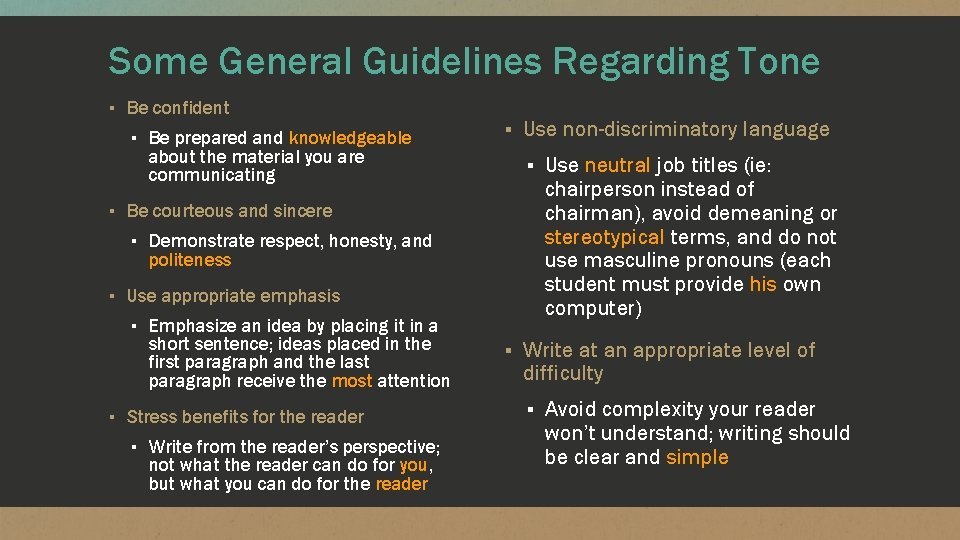
Some General Guidelines Regarding Tone ▪ Be confident ▪ Be prepared and knowledgeable about the material you are communicating ▪ Be courteous and sincere ▪ Demonstrate respect, honesty, and politeness ▪ Use appropriate emphasis ▪ Emphasize an idea by placing it in a short sentence; ideas placed in the first paragraph and the last paragraph receive the most attention ▪ Stress benefits for the reader ▪ Write from the reader’s perspective; not what the reader can do for you, but what you can do for the reader ▪ Use non-discriminatory language ▪ Use neutral job titles (ie: chairperson instead of chairman), avoid demeaning or stereotypical terms, and do not use masculine pronouns (each student must provide his own computer) ▪ Write at an appropriate level of difficulty ▪ Avoid complexity your reader won’t understand; writing should be clear and simple
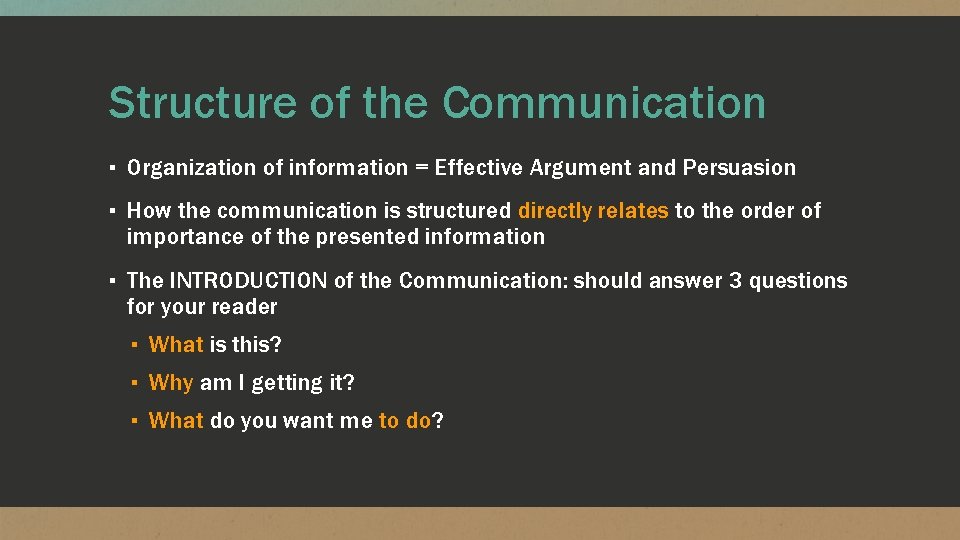
Structure of the Communication ▪ Organization of information = Effective Argument and Persuasion ▪ How the communication is structured directly relates to the order of importance of the presented information ▪ The INTRODUCTION of the Communication: should answer 3 questions for your reader ▪ What is this? ▪ Why am I getting it? ▪ What do you want me to do?
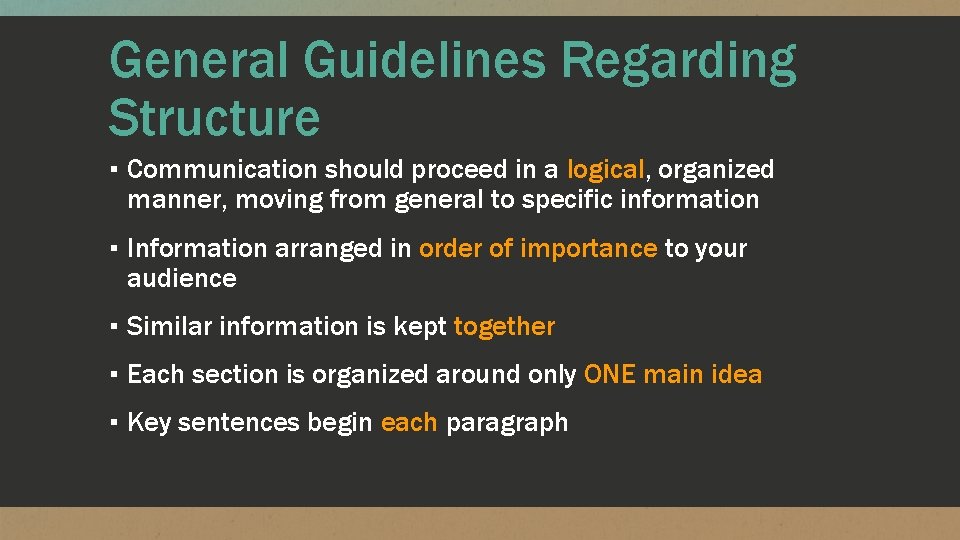
General Guidelines Regarding Structure ▪ Communication should proceed in a logical, organized manner, moving from general to specific information ▪ Information arranged in order of importance to your audience ▪ Similar information is kept together ▪ Each section is organized around only ONE main idea ▪ Key sentences begin each paragraph
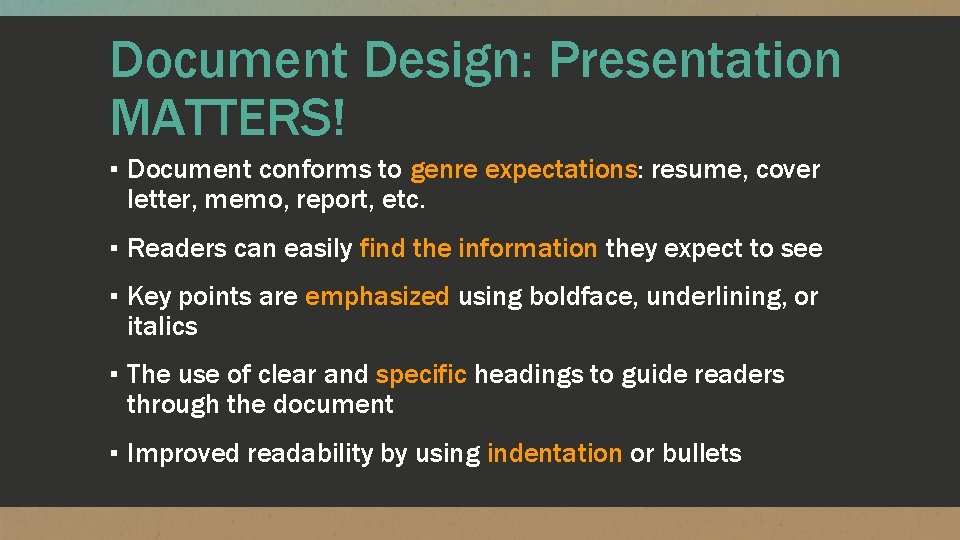
Document Design: Presentation MATTERS! ▪ Document conforms to genre expectations: resume, cover letter, memo, report, etc. ▪ Readers can easily find the information they expect to see ▪ Key points are emphasized using boldface, underlining, or italics ▪ The use of clear and specific headings to guide readers through the document ▪ Improved readability by using indentation or bullets
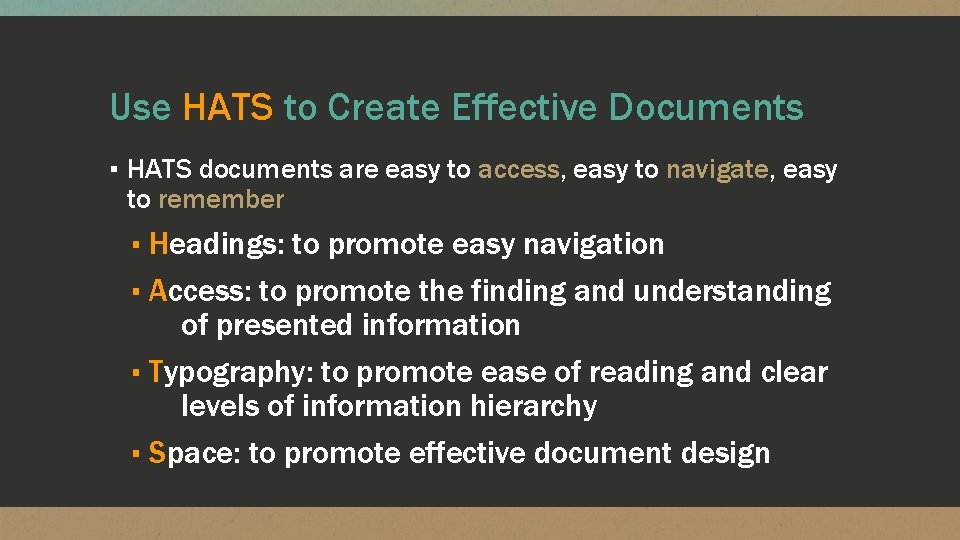
Use HATS to Create Effective Documents ▪ HATS documents are easy to access, easy to navigate, easy to remember ▪ Headings: to promote easy navigation ▪ Access: to promote the finding and understanding of presented information ▪ Typography: to promote ease of reading and clear levels of information hierarchy ▪ Space: to promote effective document design
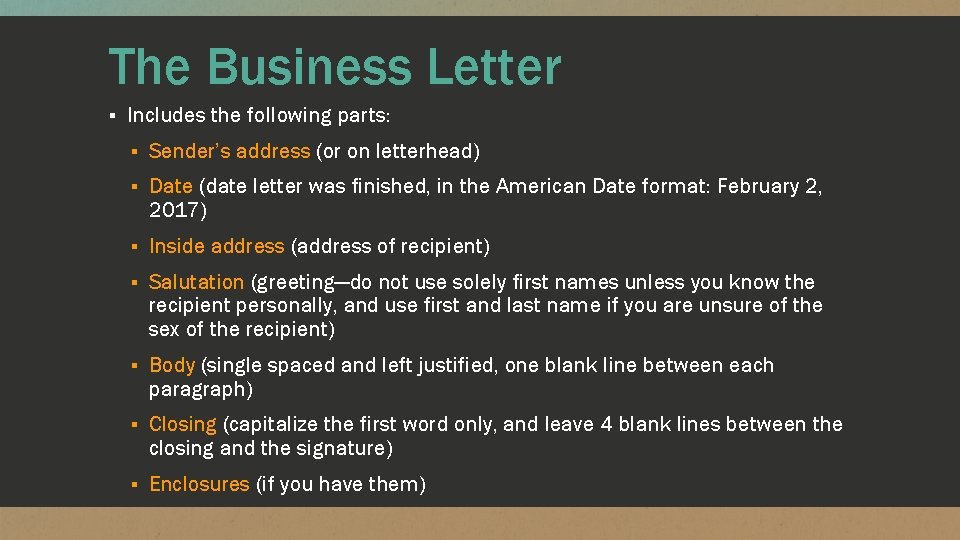
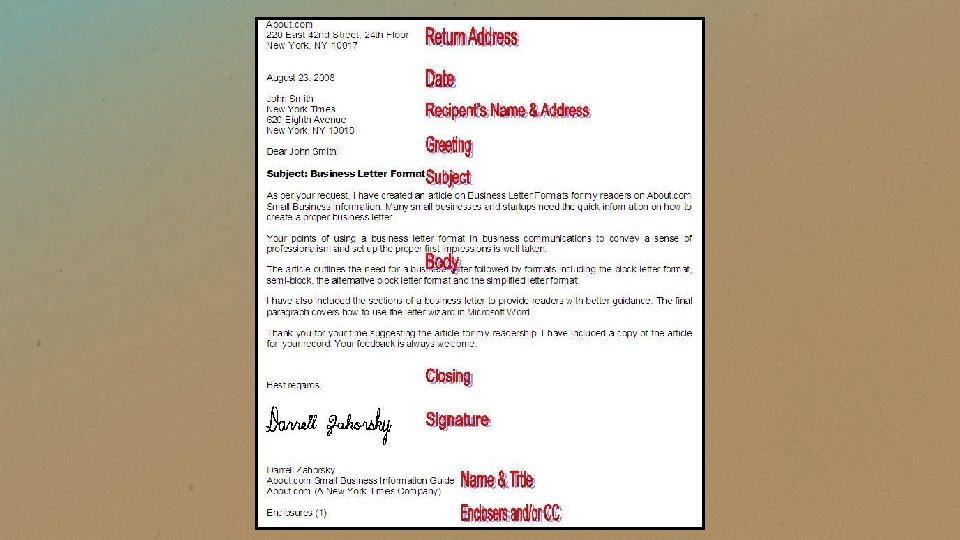
The Business Letter ▪ Includes the following parts: ▪ Sender’s address (or on letterhead) ▪ Date (date letter was finished, in the American Date format: February 2, 2017) ▪ Inside address (address of recipient) ▪ Salutation (greeting—do not use solely first names unless you know the recipient personally, and use first and last name if you are unsure of the sex of the recipient) ▪ Body (single spaced and left justified, one blank line between each paragraph) ▪ Closing (capitalize the first word only, and leave 4 blank lines between the closing and the signature) ▪ Enclosures (if you have them)
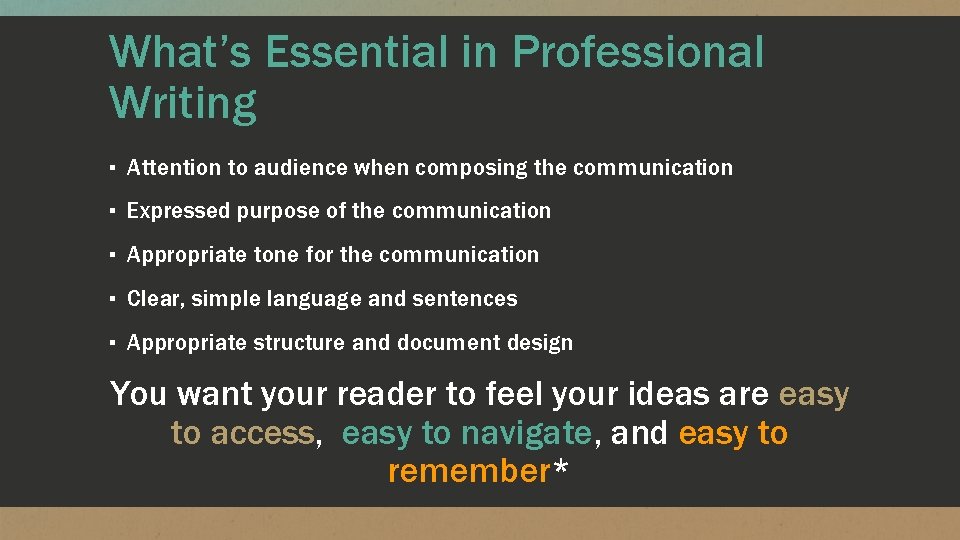
What’s Essential in Professional Writing ▪ Attention to audience when composing the communication ▪ Expressed purpose of the communication ▪ Appropriate tone for the communication ▪ Clear, simple language and sentences ▪ Appropriate structure and document design You want your reader to feel your ideas are easy to access, easy to navigate, and easy to remember*