
Professional Standards for Educational Leaders 2015 Introduction and


- Slides: 38
Professional Standards for Educational Leaders 2015: Introduction and Implications Hosted By: Janice Case NASSP Consultant
Twitter: @NASSP #nasspwebinar Follow NASSP: facebook. com/principals Website: www. nassp. org/Webinar. Videos
Technical Problems: Call Go. To. Webinar Attendee Support Toll Free (855) 352 -9002 Long Distance: +1 805 617 7000 Provide the webinar ID when calling support: (111 -083 -163)
Professional Standards for Educational Leaders 2015: Introduction and Implications NASSP Webinar January 20, 2016 Beverly Hutton, NASSP Mark A. Smylie, University of Illinois at Chicago
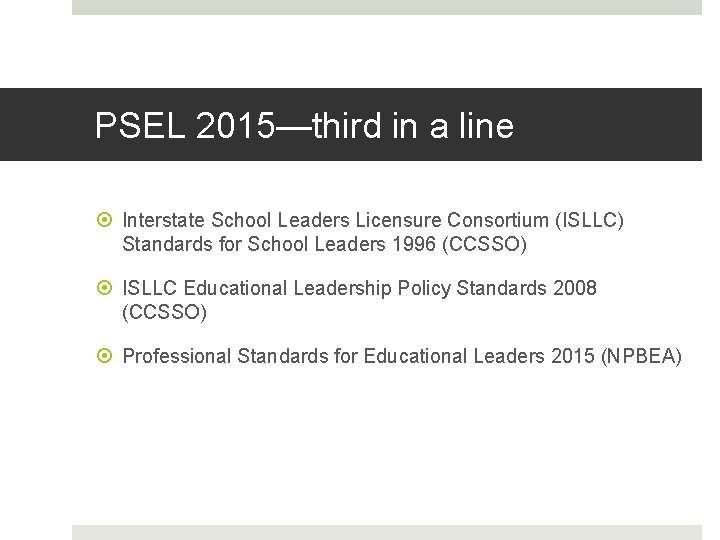
PSEL 2015—third in a line Interstate School Leaders Licensure Consortium (ISLLC) Standards for School Leaders 1996 (CCSSO) ISLLC Educational Leadership Policy Standards 2008 (CCSSO) Professional Standards for Educational Leaders 2015 (NPBEA)
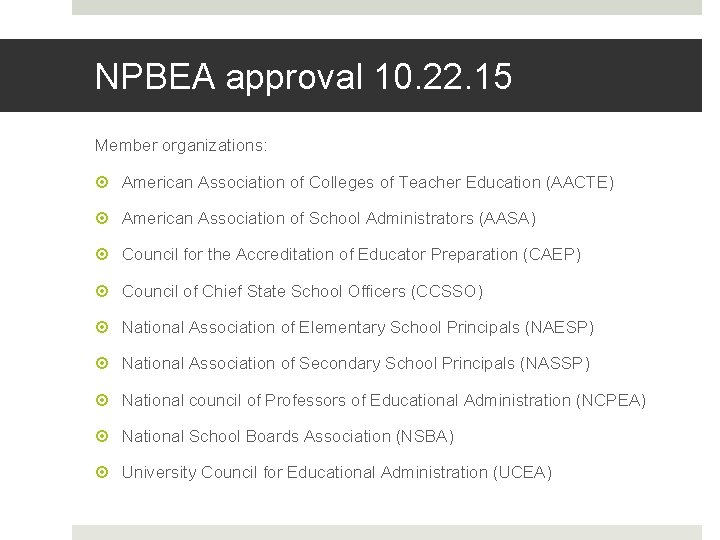
NPBEA approval 10. 22. 15 Member organizations: American Association of Colleges of Teacher Education (AACTE) American Association of School Administrators (AASA) Council for the Accreditation of Educator Preparation (CAEP) Council of Chief State School Officers (CCSSO) National Association of Elementary School Principals (NAESP) National Association of Secondary School Principals (NASSP) National council of Professors of Educational Administration (NCPEA) National School Boards Association (NSBA) University Council for Educational Administration (UCEA)
Outline A. Background. B. Introducing PSEL 2015. C. Implications for practice. D. Questions and answers. E. Resources and further information.
A. Background Why standards? Why new standards now? How were PSEL 2015 developed?
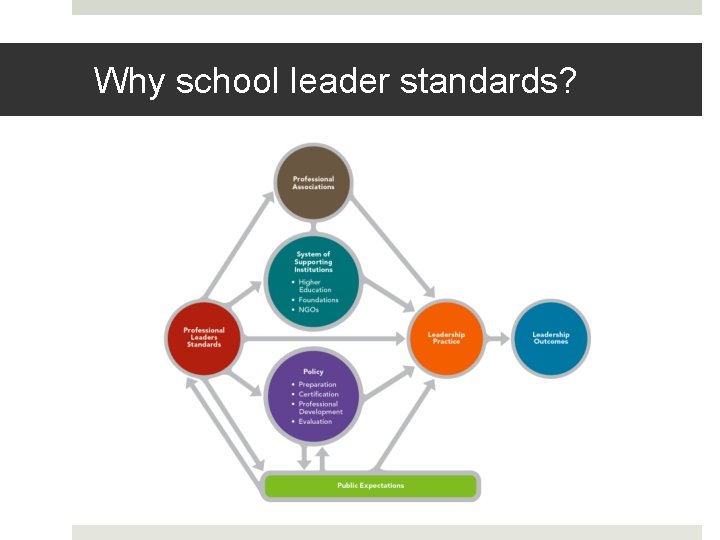
Why school leader standards?
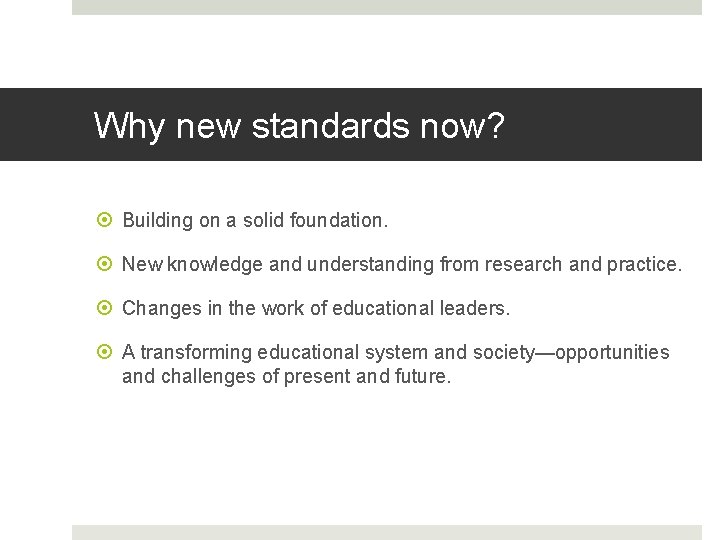
Why new standards now? Building on a solid foundation. New knowledge and understanding from research and practice. Changes in the work of educational leaders. A transforming educational system and society—opportunities and challenges of present and future.
How were the new Standards developed? Two-year process. Substantial involvement of the profession. > 1, 000 practicing educational leaders. AASA, NAESP, NASSP contributions. Extensive review of research. Multiple committees. Vetting and public comment.
B. Introducing PSEL 2015 Defining features. What’s new and different? How to read the standards. The standards: drivers, core, supports.
Defining features A strong foundation of research and practice wisdom. “Theory” of leadership-to-learning. Central domains of leadership work. Applicability to leadership across levels and roles. Aspirational focus—a vision for leadership for the future.
What is new and different? The name (where’s ISLLC? ). A pivot to “professional”. Stronger, clearer emphasis on students and student learning and well-being. A more systemic view of leadership work. Elevation and elaboration of key areas of leadership work.
Focus on students and learning The importance of “each” student. Academic success AND broader learning and development, student well-being All domains of leadership work focused on students. A logic of leadership-to-learning connection.
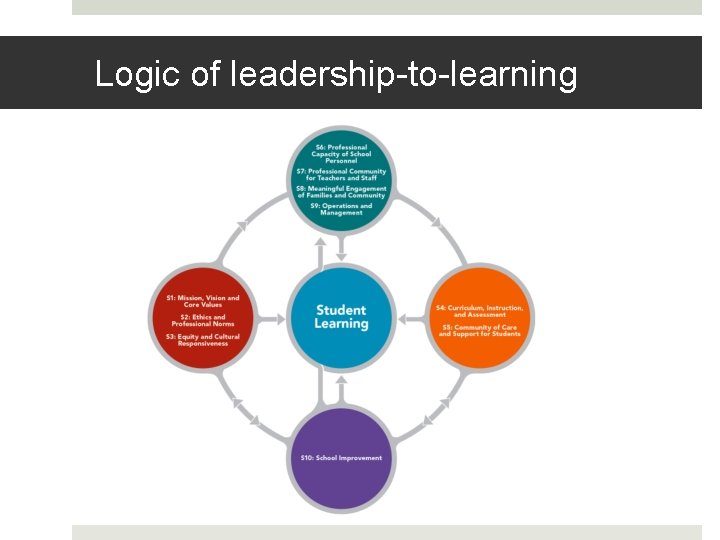
Logic of leadership-to-learning
A systemic view of leadership Across domains and elements of leadership work. Across roles (e. g. , administrative leadership and leadership work of others such as teachers). Across levels of the educational system (e. g. , school and district). Across contexts (e. g. , school and community).
Areas of elevation, elaboration Mission, vision, core values. Ethics, equity, and cultural responsiveness. Academic press/rigor AND community of care and support of students. Development of teachers and professional staff, AND professional community and working conditions. Meaningful engagement of families and communities. Leadership for school improvement.
Reading the standards Three elements: Title Statement of the standard Components of the standard (“Effective leaders…”)
An example: Standard 4. Curriculum, Instruction, and Assessment Effective educational leaders develop and support intellectually rigorous and coherent systems of curriculum, instruction, and assessment to promote each student’s academic success and well-being. Effective leaders: a) Implement coherent systems of curriculum, instruction, and assessment that promote the mission, vision, and core values of the school, embody high expectations for student learning, align with academic standards, and are culturally responsive. b) Align and focus systems of curriculum, instruction, and assessment within and across grade levels to promote student academic success, love of learning, the identities and habits of learners, and healthy sense of self. c) Promote instructional practice that is consistent with knowledge of child learning and development, effective pedagogy, and the needs of each student. d) Ensure instructional practice that is intellectually challenging, authentic to student experiences, recognizes student strengths, and is differentiated and personalized. e) Promote the effective use of technology in the service of teaching and learning. f) Employ valid assessments that are consistent with knowledge of child learning and development and technical standards of measurement. g) Use assessment data appropriately and within technical limitations to monitor student progress and improve instruction.
PSEL 2015: The drivers Standard 1. Mission, Vision, and Core Values Effective educational leaders develop, advocate, and enact a shared mission, vision, and core values of high-quality education and academic success and well-being of each student. Standard 2. Ethics and Professional Norms Effective educational leaders act ethically and according to professional norms to promote each student’s academic success and well-being. Standard 3. Equity and Cultural Responsiveness Effective educational leaders strive for equity of educational opportunity and culturally responsive practices to promote each student’s academic success and well-being. Standard 10. School Improvement Effective educational leaders act as agents of continuous improvement to promote each student’s academic success and well-being.
PSEL 2015: The core Standard 4. Curriculum, Instruction, and Assessment Effective educational leaders develop and support intellectually rigorous and coherent systems of curriculum, instruction, and assessment to promote each student’s academic success and well-being. Standard 5. Community of Care and Support for Students Effective educational leaders cultivate an inclusive, caring, and supportive school community that promotes the academic success and well-being of each student.
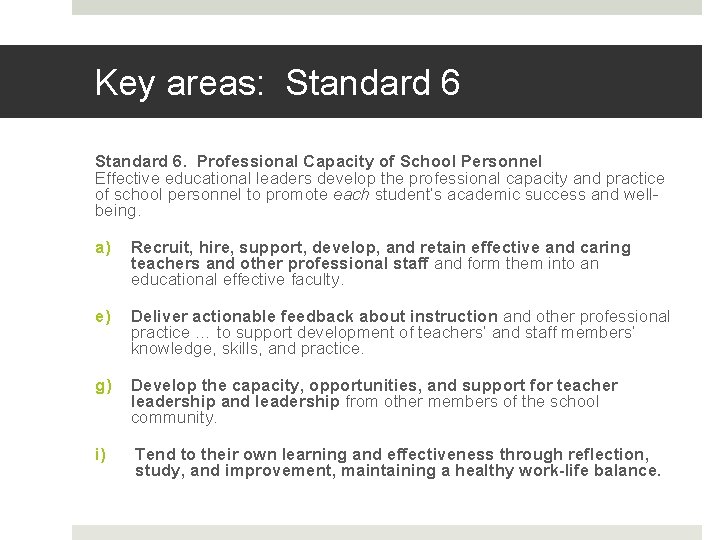
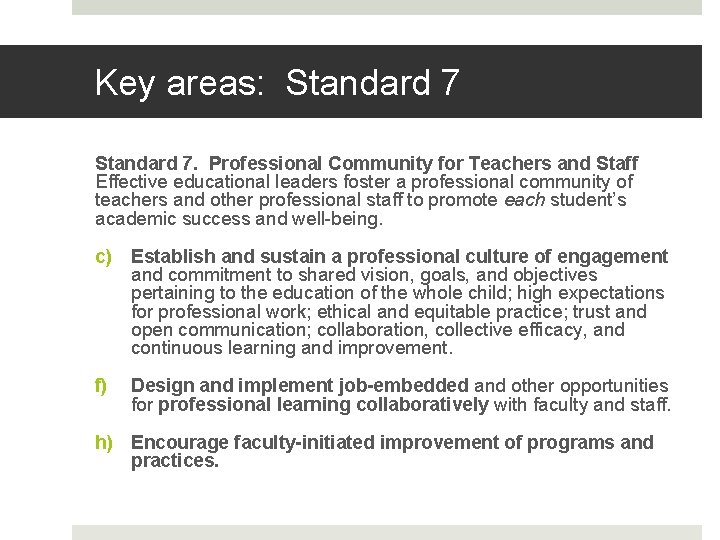
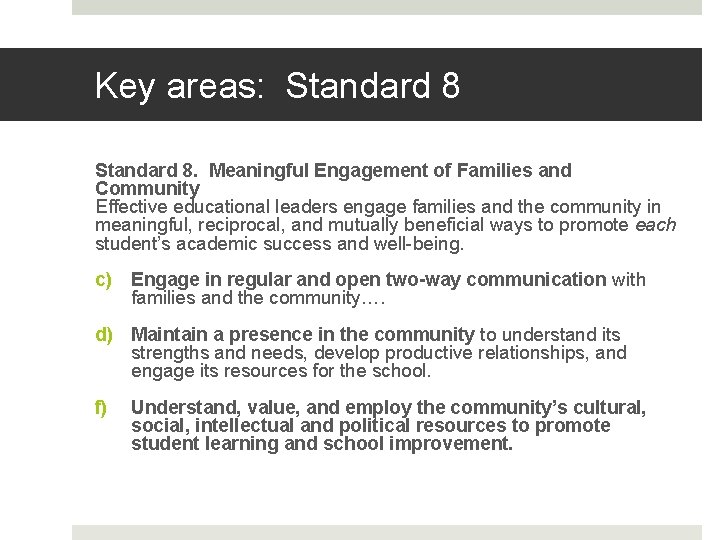
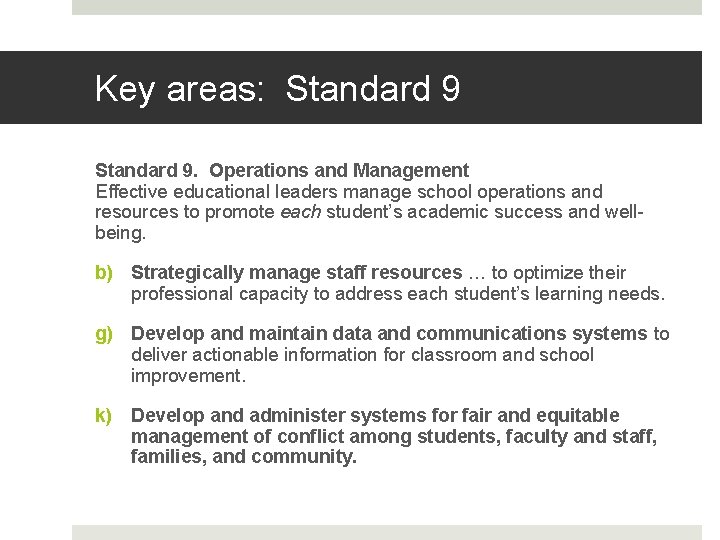
PSEL 2015: The supports Standard 6. Professional Capacity of School Personnel Effective educational leaders develop the professional capacity and practice of school personnel to promote each student’s academic success and wellbeing. Standard 7. Professional Community for Teachers and Staff Effective educational leaders foster a professional community of teachers and other professional staff to promote each student’s academic success and well -being. Standard 8. Meaningful Engagement of Families and Community Effective educational leaders engage families and the community in meaningful, reciprocal, and mutually beneficial ways to promote each student’s academic success and well-being. Standard 9. Operations and Management Effective educational leaders manage school operations and resources to promote each student’s academic success and well-being.
C. Implications for practice General implications. Key areas of practice in each standard.
General implications for practice Principles and priorities for practice, not a script or checklist. Helps principals focus on things most important to student success. Encourages practice that “fits” situation and need. Orientation toward students and their success. Promotes clarity and understanding of leadership most helpful to students—promoting press and support, rigor and care. Focus on capacity development. Directs attention to personnel and organization development to serve students effectively. Leading with moral purpose. Places vision, values, ethics, service, and improvement at the core.
Key areas: Standard 1. Mission, Vision, and Core Values Effective educational leaders develop, advocate, and enact a shared mission, vision, and core values of high-quality education and academic success and well-being of each student. a) Develop an educational mission for the school to promote the academic success and well-being of each student. c) Articulate, advocate, and cultivate core values of childcentered education, high expectations and student support, equity, inclusiveness, social justice, caring and trust, continuous improvement. d) Strategically develop, implement, and evaluate actions to achieve the vision for the school. g) Model and pursue the school’s mission, vision, and values in all aspects of leadership.
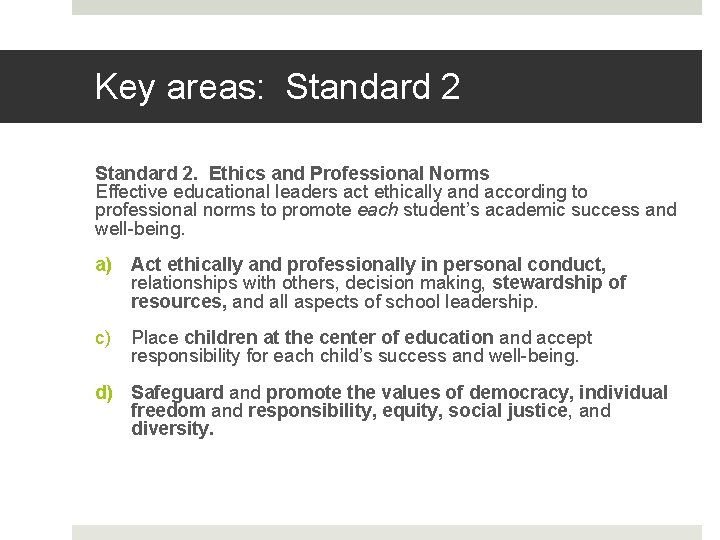
Key areas: Standard 2. Ethics and Professional Norms Effective educational leaders act ethically and according to professional norms to promote each student’s academic success and well-being. a) Act ethically and professionally in personal conduct, relationships with others, decision making, stewardship of resources, and all aspects of school leadership. c) Place children at the center of education and accept responsibility for each child’s success and well-being. d) Safeguard and promote the values of democracy, individual freedom and responsibility, equity, social justice, and diversity.
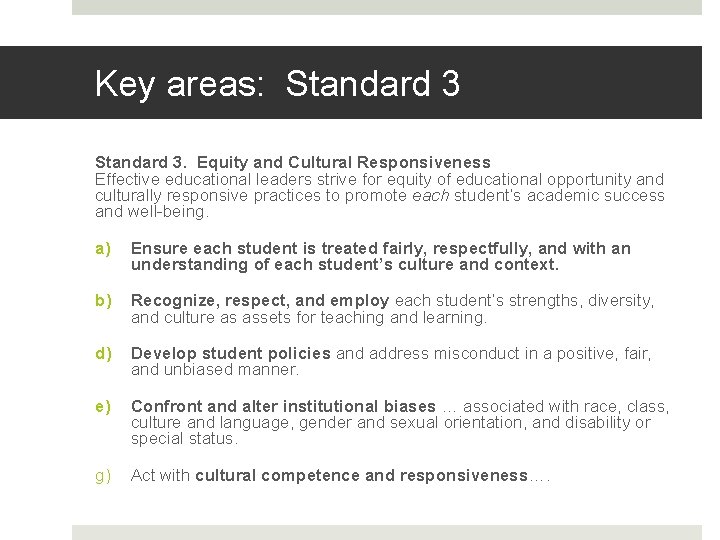
Key areas: Standard 3. Equity and Cultural Responsiveness Effective educational leaders strive for equity of educational opportunity and culturally responsive practices to promote each student’s academic success and well-being. a) Ensure each student is treated fairly, respectfully, and with an understanding of each student’s culture and context. b) Recognize, respect, and employ each student’s strengths, diversity, and culture as assets for teaching and learning. d) Develop student policies and address misconduct in a positive, fair, and unbiased manner. e) Confront and alter institutional biases … associated with race, class, culture and language, gender and sexual orientation, and disability or special status. g) Act with cultural competence and responsiveness….
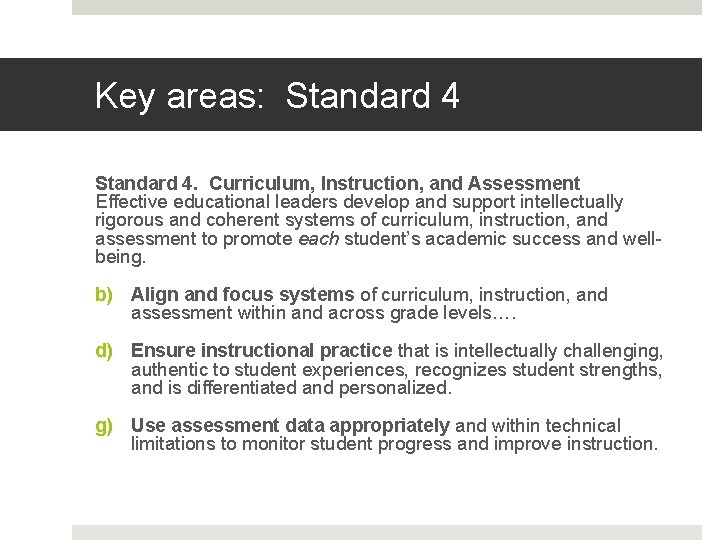
Key areas: Standard 4. Curriculum, Instruction, and Assessment Effective educational leaders develop and support intellectually rigorous and coherent systems of curriculum, instruction, and assessment to promote each student’s academic success and wellbeing. b) Align and focus systems of curriculum, instruction, and assessment within and across grade levels…. d) Ensure instructional practice that is intellectually challenging, authentic to student experiences, recognizes student strengths, and is differentiated and personalized. g) Use assessment data appropriately and within technical limitations to monitor student progress and improve instruction.
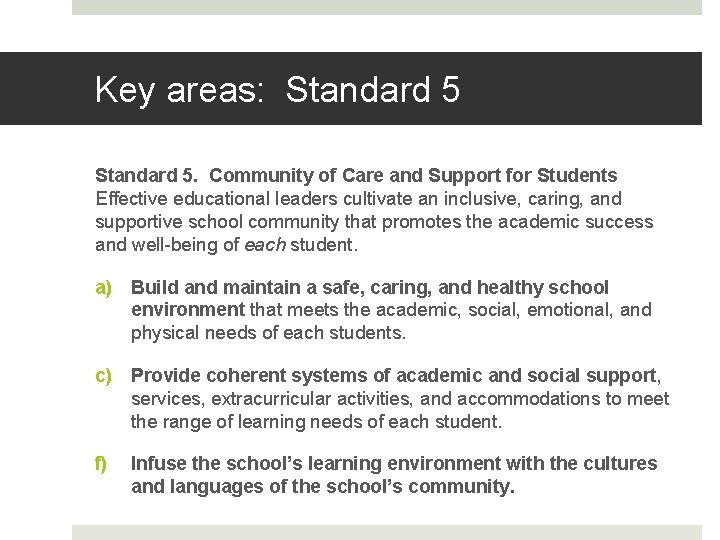
Key areas: Standard 5. Community of Care and Support for Students Effective educational leaders cultivate an inclusive, caring, and supportive school community that promotes the academic success and well-being of each student. a) Build and maintain a safe, caring, and healthy school environment that meets the academic, social, emotional, and physical needs of each students. c) Provide coherent systems of academic and social support, services, extracurricular activities, and accommodations to meet the range of learning needs of each student. f) Infuse the school’s learning environment with the cultures and languages of the school’s community.
Key areas: Standard 6. Professional Capacity of School Personnel Effective educational leaders develop the professional capacity and practice of school personnel to promote each student’s academic success and wellbeing. a) Recruit, hire, support, develop, and retain effective and caring teachers and other professional staff and form them into an educational effective faculty. e) Deliver actionable feedback about instruction and other professional practice … to support development of teachers’ and staff members’ knowledge, skills, and practice. g) Develop the capacity, opportunities, and support for teacher leadership and leadership from other members of the school community. i) Tend to their own learning and effectiveness through reflection, study, and improvement, maintaining a healthy work-life balance.
Key areas: Standard 7. Professional Community for Teachers and Staff Effective educational leaders foster a professional community of teachers and other professional staff to promote each student’s academic success and well-being. c) Establish and sustain a professional culture of engagement and commitment to shared vision, goals, and objectives pertaining to the education of the whole child; high expectations for professional work; ethical and equitable practice; trust and open communication; collaboration, collective efficacy, and continuous learning and improvement. f) Design and implement job-embedded and other opportunities for professional learning collaboratively with faculty and staff. h) Encourage faculty-initiated improvement of programs and practices.
Key areas: Standard 8. Meaningful Engagement of Families and Community Effective educational leaders engage families and the community in meaningful, reciprocal, and mutually beneficial ways to promote each student’s academic success and well-being. c) Engage in regular and open two-way communication with families and the community…. d) Maintain a presence in the community to understand its strengths and needs, develop productive relationships, and engage its resources for the school. f) Understand, value, and employ the community’s cultural, social, intellectual and political resources to promote student learning and school improvement.
Key areas: Standard 9. Operations and Management Effective educational leaders manage school operations and resources to promote each student’s academic success and wellbeing. b) Strategically manage staff resources … to optimize their professional capacity to address each student’s learning needs. g) Develop and maintain data and communications systems to deliver actionable information for classroom and school improvement. k) Develop and administer systems for fair and equitable management of conflict among students, faculty and staff, families, and community.
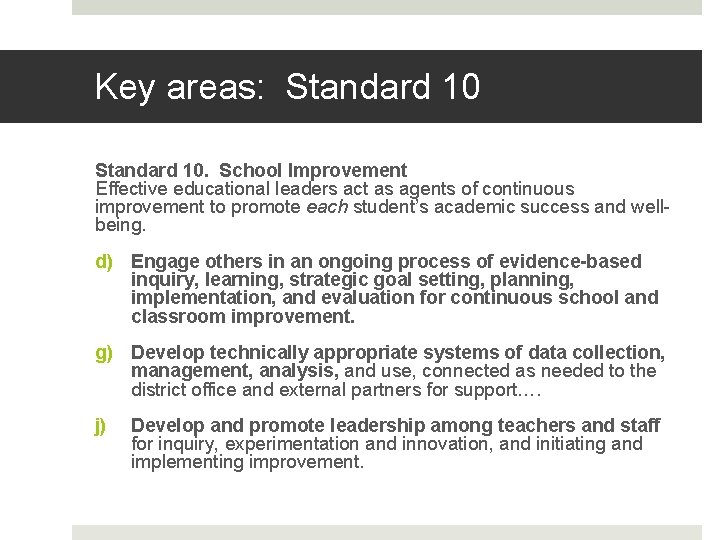
Key areas: Standard 10. School Improvement Effective educational leaders act as agents of continuous improvement to promote each student’s academic success and wellbeing. d) Engage others in an ongoing process of evidence-based inquiry, learning, strategic goal setting, planning, implementation, and evaluation for continuous school and classroom improvement. g) Develop technically appropriate systems of data collection, management, analysis, and use, connected as needed to the district office and external partners for support…. j) Develop and promote leadership among teachers and staff for inquiry, experimentation and innovation, and initiating and implementing improvement.
D. Question and answer
E. Resources and further information http: //blog. nassp. org/wpcontent/uploads/2016/01/Professional_Standards_for_Educational_Lea ders_2015. pdf Beverly Hutton, huttonb@nassp. org Mark Smylie, smylie@uic. edu
Thank you