
Professional Practice Concepts for Infusion Therapy Infusion Related


- Slides: 60
Professional Practice Concepts for Infusion Therapy Infusion Related Infection Control and Occupational Risks
Infusion Nursing l Infusion nursing is defined as the nursing process relating to technical and clinical application of fluids, electrolytes, infection control, oncology pediatrics, pharmacology, quality assurance, technology and clinical application, parenteral nutrition, and transfusion therapy
Evidenced Based Nursing Practice Evidence-based nursing practice (EBNP) Conscientious use of current best evidence in making decisions about patient care (Source: Sackett, Straus, & Richardson, 2000)
Components of Evidence-based Practice l Evidence from research/evidence-based theories and opinion of leaders/expert panels l Evidence from assessment of patient’s history, physical exam, and availability of health-care resources l Clinical expertise l Information about patient preferences and values
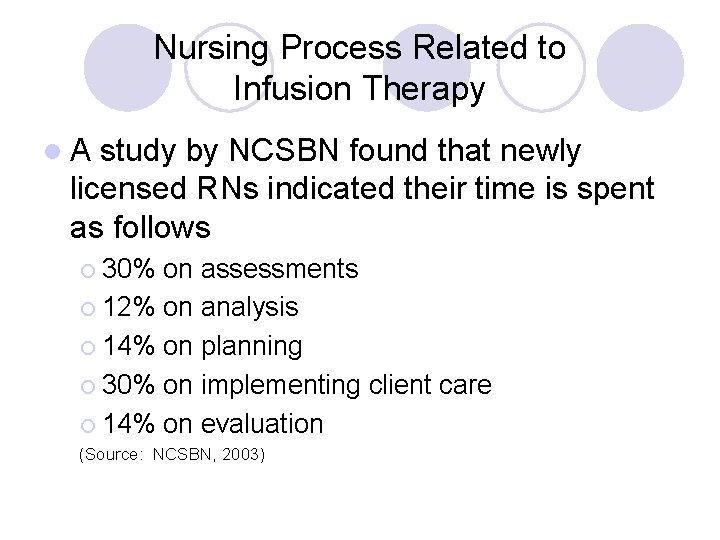
Nursing Process Related to Infusion Therapy l. A study by NCSBN found that newly licensed RNs indicated their time is spent as follows ¡ 30% on assessments ¡ 12% on analysis ¡ 14% on planning ¡ 30% on implementing client care ¡ 14% on evaluation (Source: NCSBN, 2003)
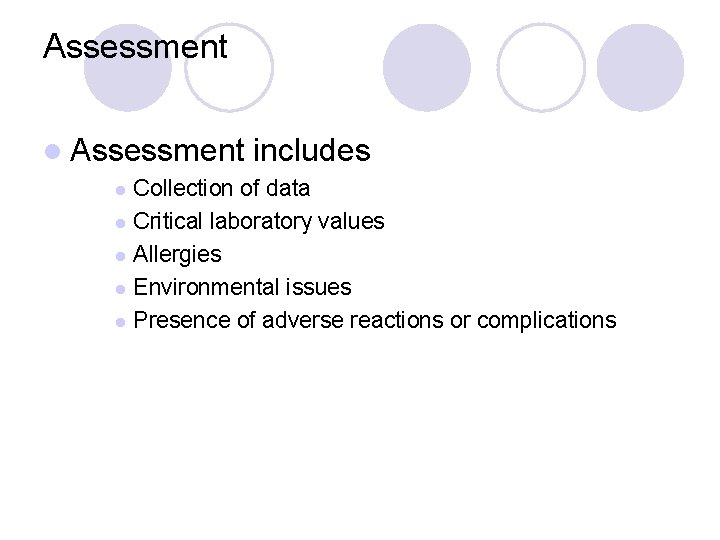
Assessment l Assessment includes Collection of data l Critical laboratory values l Allergies l Environmental issues l Presence of adverse reactions or complications l
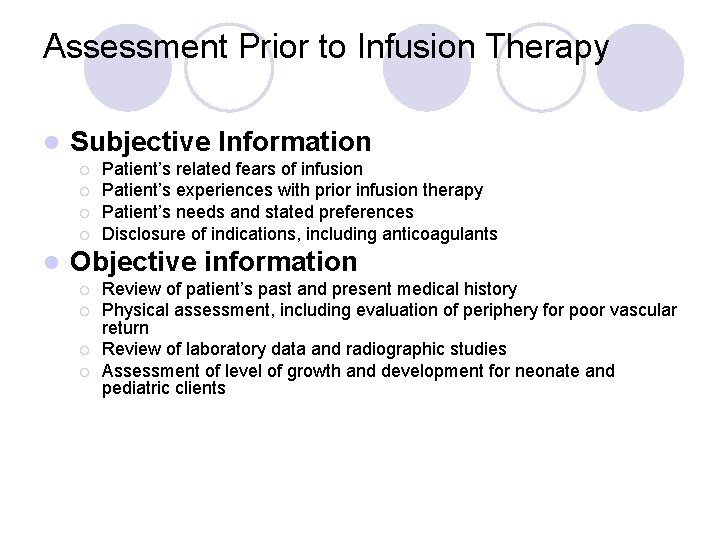
Assessment Prior to Infusion Therapy l Subjective Information ¡ ¡ l Patient’s related fears of infusion Patient’s experiences with prior infusion therapy Patient’s needs and stated preferences Disclosure of indications, including anticoagulants Objective information ¡ ¡ Review of patient’s past and present medical history Physical assessment, including evaluation of periphery for poor vascular return Review of laboratory data and radiographic studies Assessment of level of growth and development for neonate and pediatric clients
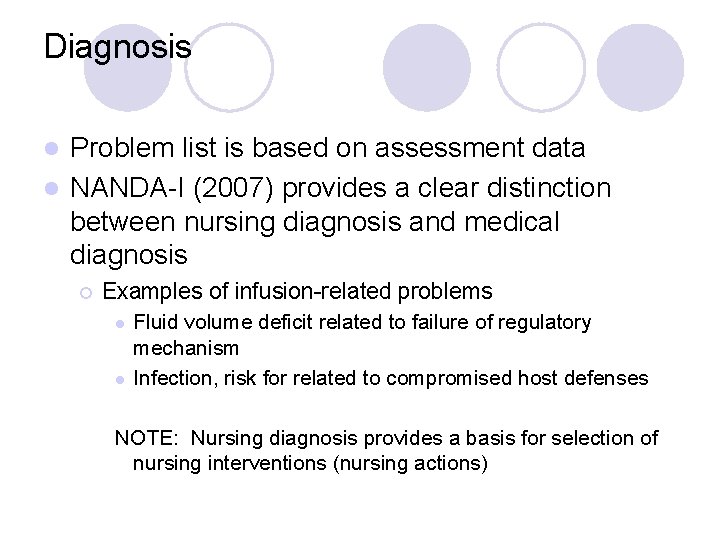
Diagnosis Problem list is based on assessment data l NANDA-I (2007) provides a clear distinction between nursing diagnosis and medical diagnosis l ¡ Examples of infusion-related problems l l Fluid volume deficit related to failure of regulatory mechanism Infection, risk for related to compromised host defenses NOTE: Nursing diagnosis provides a basis for selection of nursing interventions (nursing actions)
Planning l Planning ¡ Setting involves three components priorities ¡ Writing expected outcomes ¡ Establishing appropriate interventions
Implementation of Interventions l Nursing actions ¡ ¡ ¡ Interventions are the concepts that link specific nursing activities and actions to expected outcomes Independent activities are those actions that the nurse performs using his or her own discretionary judgment Collaborative activities are those actions that involve mutual decision making between two or more healthcare practitioners
Evaluation loops back to assessment ¡ Once new data is collected a nursing judgment is made on what modification in the plan of care is needed l Three judgments can be made • The evaluation data indicates that the health-care problem has been resolved • Revise the plan of care; outcomes have not been met • Continue the plan of care based on progress toward goal
Note …. . l If an act of malpractice does not create harm, legal action cannot be initiated l However: Coercion of a rational adult patient to place an intravenous catheter constitutes assault and battery
Legal Terms CRIMINAL LAW: an offense against the general public caused by the potential harmful effect to society as a whole l CIVIL LAW: effect the legal rights of private persons and corporations. Contract Law and Tort law are most applicable to nursing practice l NEGLIGENCE: Failure to do something that a reasonable person would do l MALPRACTICE; Subset of negligence, committed by a person in a professional capacity. (nonadherence to the accepted standard of care) l
Legal Practice l Breach of duty l Legal perils related to infusion therapy practice ¡ Failure to monitor and assess clinical status ¡ Failure to prevent infection ¡ Failure to use equipment properly ¡ Failure to protect the patient from avoidable injury
Legal Terms Four components needed to prove liability for malpractice ¡ It must be established that the nurse had a duty to the patient ¡ A breach of standards of care or failure to carry out that duty must be proven ¡ The patient must suffer actual harm or injury ¡ There must be a causal relationship between the breach of duty and the injury suffered (O’Keefe, 2000)
Rule of Personal Libility The rule of personal liability is “every person is liable for his own tortuous conduct” (his own wrong doing. )
Legal Action Two most common causes for legal action in nursing ¡ Unprofessional practice: conduct that is a departure from or failure to conform to the minimal standards of care ¡ Professional malpractice: professional misconduct or unreasonable lack of skill that results in harm
Legal Issues Breach of duty: Failure to observe, failure to intervene, and verbal rather than written orders are potential risks for all nursing areas ¡ A breach of application of standards of care can be the basis for negligence. Always ask what a reasonable and prudent nurse would do. ¡
Legal Perils of IV Therapy Not enough IV experience to become comfortable or proficient l Entering the blood stream with a foreign object l Litigation for nurses can result from l ¡ ¡ ¡ Infiltration and phlebitis Fractured central venous catheters Nerve injury, infiltration and Extravasation Administering the wrong drug Failure to document appropriately
Ethics A code of ethics acknowledges the acceptance by a profession of the responsibilities and trust that society has conferred and recognizes the duties and obligations in that trust.
Infusion Nursing Code of Ethics l Autonomy (right to self determination, independence l Beneficence (doing good for patients) l Nonmaleficence (doing no harm to patients) l Veracity (truthfulness) l Fidelity (obligation to be faithful) l Justice (obligation to be fair to all people)
Risk Management l Standards of Practice for Infusion Therapy come from the Infusion Nursing Society ¡ New standards published in 2006 l Association of Vascular Access l Oncology Nursing Forum
Standards of Care l Standards of care describe the results or outcomes of care and focus on the patient l Standards of care developed within organizations to measure quality based on expectations l Standards of care can be voluntary or mandated by legislation
Standards of Practice l Focus on the provider of care l Represent acceptable levels of practice in patient care delivery l Define nursing accountability l Provide a framework for evaluating professional competency
Risk Management The Revised Infusion Nursing Standards of Practice define Risk Management as “a process that centers on identification, analysis, treatment, and evaluation of real and potential hazards” It is the process of collecting and analyzing scientific data “to describe the form, dimension, and characteristics of risk”
Medication Safety NOTE ¡ Medication error is the most common type of error affecting patient safety. Preventable adverse drug events (ADEs) are associated with one of every five injuries or deaths occurring in the health-care health care system (Source: Rozich, et al, 2004)
Medication Errors l Lack of awareness: ¡ Between 44, 000 and 98, 000 deaths annually ¡ Approximately 2. 5 million nurses and 900, 000 Physicians practicing in 7500 Hospitals across the United States l Complex environment: making clear communication even more important.
Risk Management involves all medical and facility staff. It provides for the review and analysis of risk and liability sources involving patients, visitors, staff and facility property
Risk Management Components l Identification and management of clinical areas of actual and high risk l Identification and management of nonclinical (e. g. visitor, staff areas of actual and high risk) l Identification and management of probable claims events l Management of property loss occurrences
Risk Management Components (cont) l Review and analysis of customer surveys and patient complaints l Review and analysis of risk assessment surveys l Operational linkages with hospital Quality management, safety, and performance improvement programs
Risk Management Components (cont) l Provision of risk management education l Compliance with state risk management and applicable federal statutes, including the Safe Medical Devices Act
Clinician and Patient Safety Barriers to Improvement l Two types of errors as identified by James Reason ¡ Active errors: “errors at the sharp end of healthcare” Occur at the point of interaction between the person (nurse) and a larger system (medication cart) ¡ Latent errors: “errors at the blunt end of health care” error that gives rise to the active error and is not necessarily apparent when it happens.
Clinician and Patient Safety Barriers to Improvement l Culture of Blame
Clinician and Patient Safety Pathophysiology of error l l l l l Reliance on weak aspects of cognition Interruptions Fatigue Time Pressure Hand-offs Medication terminology Standardization Knowledge Base Paradigm Shifts
Risk Management Strategies l Informed consent l Unusual occurrence reports l Sentinel events l Documentation l Professional Liability insurance l Patient relations l Quality Management
Risk Management Strategies l Informed consent ¡ To provide patients with enough information to enable them to make a rational decision regarding whether to undergo treatment l Unusual occurrence reports ¡ Should be filed every time there is a deviation from the standard. Record of the event ¡ Unusual occurrence reports are meant to be nonjudgmental, factual reports of the problem and its consequences.
Risk Management Strategies l Documentation ¡ Accurate, timely, and complete written account of the care rendered to the patient. l Professional liability insurance l Patient relations l Quality management
Dimensions of Performance Doing the right things includes: ¡ The efficacy of the procedure or treatment in relation to the client’s condition ¡ The appropriateness of a specific test, procedure, or service to meet the client’s need
Dimensions of Performance Doing the right thing well includes: ¡ The availability of a needed test, procedure, treatment, or service to the client who needs it ¡ The timeliness with which a needed test, procedure, treatment or service is provided to the client ¡ The effectiveness with which tests, procedures, treatments, and services are provided
Quality Patient Management l Quality management is the systematic process to ensure desired patient outcomes l Continuous quality improvement (CQI) ¡ Goal to create outcome monitoring and evaluation processes to assist organization in improving the quality of care. ¡ Is continuous; outcomes are never optimized but may be constantly improved.
INFECTION CONTROL
Basic Principles of Epidemiology Colonization: the presence of a microorganism in or on a host, with growth and multiplication of the microorganisms with no clinical symptoms or detected immune response l Dissemination: the shedding of microorganisms into the immediate environment from a person carrying them. l Nosocomial Infections: developed within a hospital of are produced by organisms acquired during hospitalization. Now call HAC l
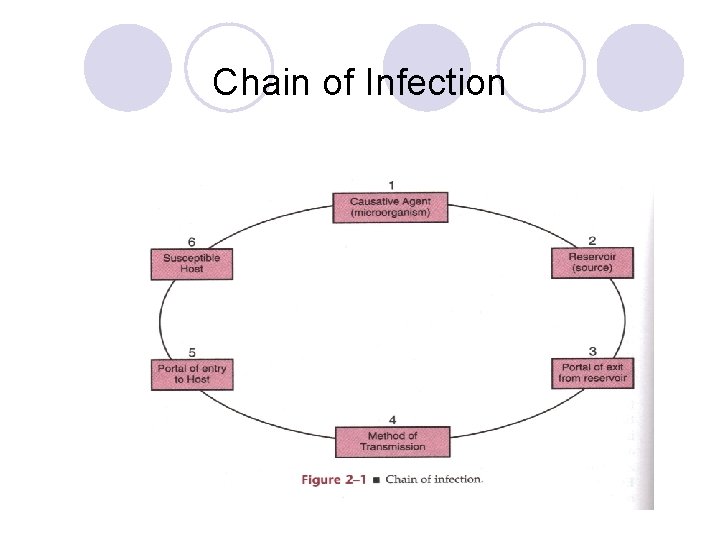
Chain of Infection l First Link: Causative Agent ¡ The ability of an organism to induce disease is called its virulence. l Second ¡ The Link: Reservoir source of microorganisms. Other humans l Clients own microorganisms, plants, animals, or the general environment l The place where the organism maintains the presence, metabolizes and replicates. l
Chain of Infection l Third Link: Portal of Exit from Reservoir ¡ l Major portals of exit: respiratory tract, GI tract, skin, blood. Fourth Link: Method of Transmission ¡ Direct transmission l ¡ From person to person, touching, kissing, biting, sexual intercourse Indirect transmission l l Vehicle-born: toys, handkerchiefs, soiled linens, clothes Vector-born: animal or flying or crawling insect
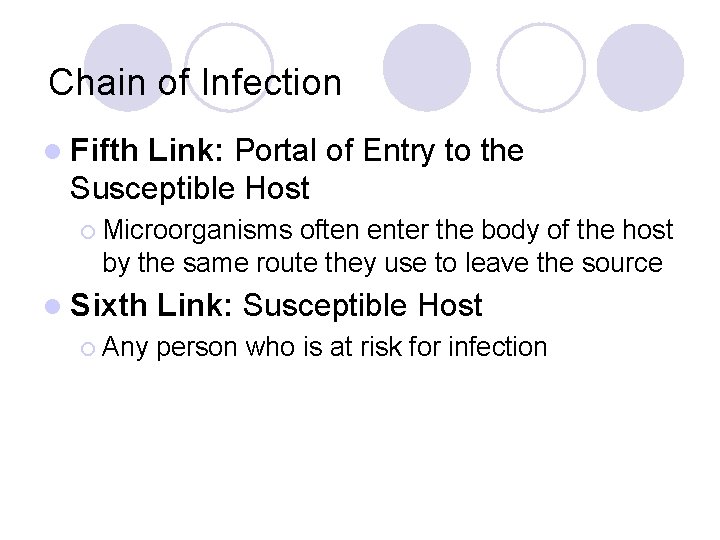
Chain of Infection l Fifth Link: Portal of Entry to the Susceptible Host ¡ Microorganisms often enter the body of the host by the same route they use to leave the source l Sixth ¡ Any Link: Susceptible Host person who is at risk for infection
Chain of Infection
Breaking the Chain of Infection l New microbiologic methods l Advancement of Epidemiologic Methods l Continuous Quality Improvement Programs l Risk Management l Antibiotic Use l Pharmacoepidemiology l Emporiatrics (study of disease in travelers)
Infusion-Relate Infections l 150 million intravascular devices are purchased each year. l 7 -8 million central venous catheters placed each year l More that 200, 000 noscomial bloodstream infections occur each year, 90% are related to CVAD
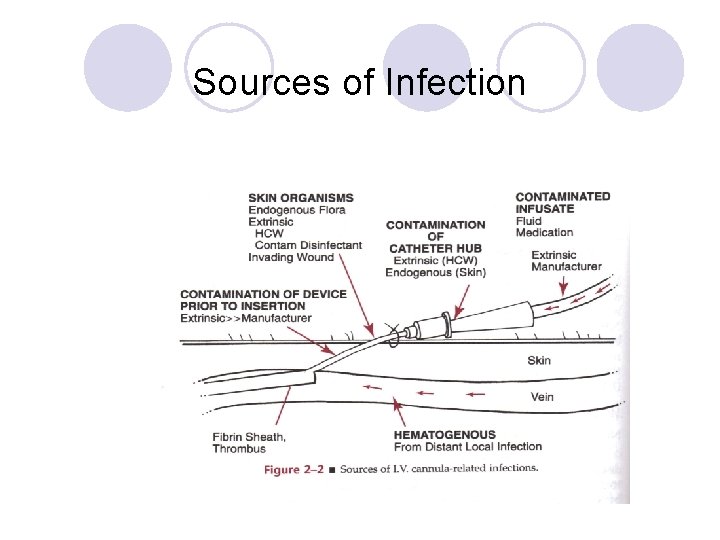
Catheter Related Blood Steam Infections CRBSI l Microorganisms that colonize the skin of hospitalized patients cause the majority of CRBSI l Biofilm “Slime” : extracellular polysaccharide which helps bacteria to adhere to surfaces
Organizations That Set Standards of Practice for Infection Control l l l APIC: Association of Practitioners in Infection Control and Epidemiology CDC: Centers for Disease Control and Prevention CMS: Centers for Medicare and Medicaid Services INS: Infusion Nurses Society TJC: The Joint Commission OSHA: U. S. Occupational Safety and Health Administration
BIOFILM l THE STUFF YOU SEE IN YOUR DOGS WATER,
Catheter Related Blood Steam Infections CRBSI l Primary risk factors include ¡ Duration of catheterization (number of catheter days) ¡ Multiple lines ¡ Colonization of catheter insertion site by skin organisms ¡ Location of catheter; Subclavin vein, groin ¡ Aseptic dressing change ¡ Aseptic insertion technique: Total Barrier Precautions
CRBSI l Secondary ¡ Secondary Risk Factors: bacteremia ¡ Host defense status ¡ Contaminated infusate, ¡ Number of catheter lumens
CRBSI l Predisposing ¡ Duration factors of placement ¡ Multiple lumens ¡ Catheters made of polyvinyl chloride ¡ Catheters that develop fibrin sheaths ¡ Port systems that develop sludge in reservoir ¡ Compromised immune status ¡ Phlebitis
Strategies for Preventing/Treating Infections l Follow CDC Standard Precautions Guidelines ¡ ¡ Tier One: Standard Precautions: universal precautions and body substance isolation Tier Two: Transmission-Based Precautions l l l Airborn precautions Droplet precautions Contact precautions
Notes l Nursing Fast Fact: Implementation of standard precautions has implications for infusion therapy nurses: Use of I. V. therapy carts and trays may be limited for patients who are on contact transmission precautions.
Strategies for Prevention/Treatment l Follow Hand Hygiene Procedure ¡ ¡ Nursing Fast Fact: Studies have documented contamination of HCW’s hands with potential healthcare-associated pathogens. Serial cultures revealed that 100 % of HCW’s carried gram-negative bacilli at least once, and 64% carried S. aureus at least once. 60% of Infections come from the patient, 35% from other sources, and 5% from our hands
Strategies for Prevention/Treatment l Use Appropriate Skin Antisepsis l Use Catheter Site Dressing Regimens ¡ Transparent, semi permeable polyurethane dressing l Use Catheter Securement Devices l Use Anticoagulants l Use Antibiotic Locks
Sources of Infection
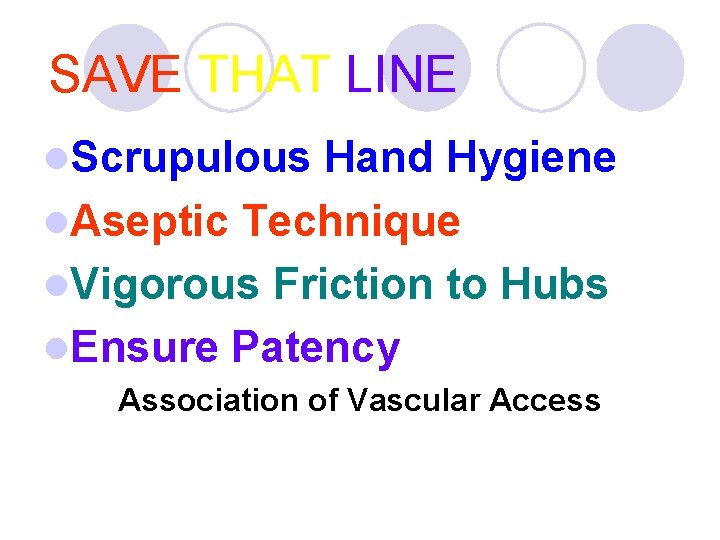
SAVE THAT LINE l. Scrupulous Hand Hygiene l. Aseptic Technique l. Vigorous Friction to Hubs l. Ensure Patency Association of Vascular Access