
Professional practice and scholarly research Professor Judith Mottram
- Slides: 15
Professional practice and scholarly research Professor Judith Mottram, Nottingham Trent University
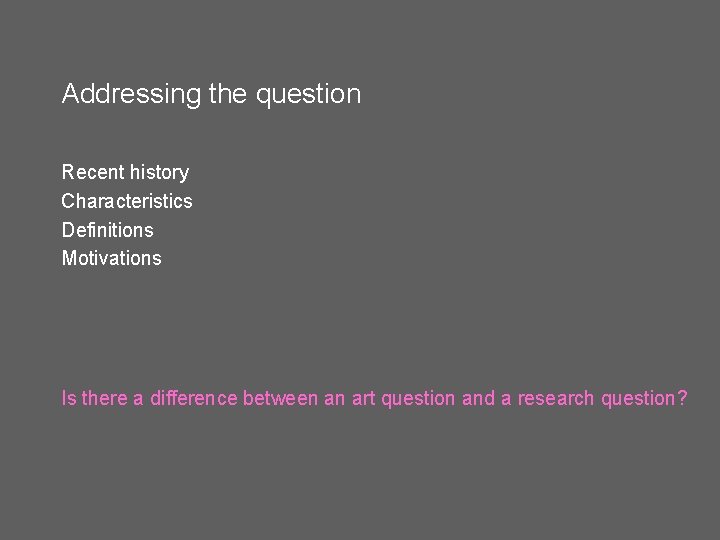
Addressing the question Recent history Characteristics Definitions Motivations Is there a difference between an art question and a research question?
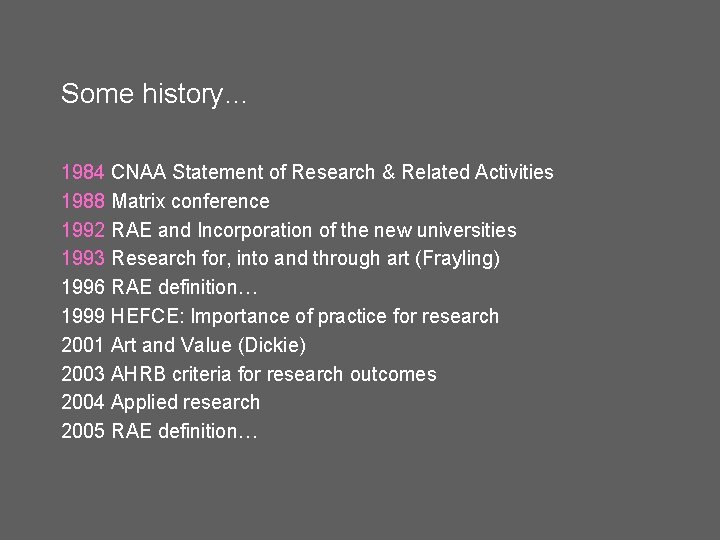
Some history… 1984 CNAA Statement of Research & Related Activities 1988 Matrix conference 1992 RAE and Incorporation of the new universities 1993 Research for, into and through art (Frayling) 1996 RAE definition… 1999 HEFCE: Importance of practice for research 2001 Art and Value (Dickie) 2003 AHRB criteria for research outcomes 2004 Applied research 2005 RAE definition…
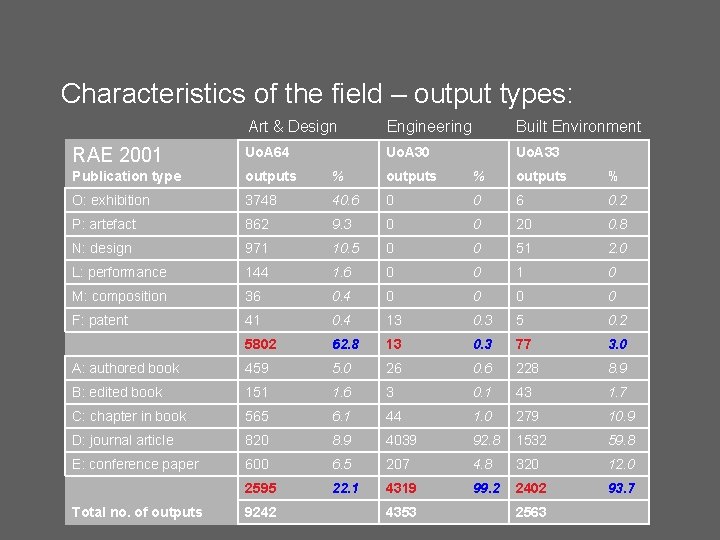
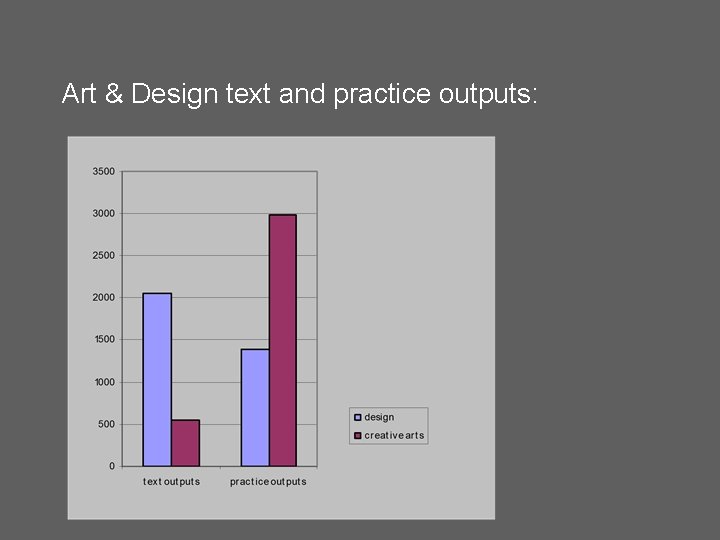
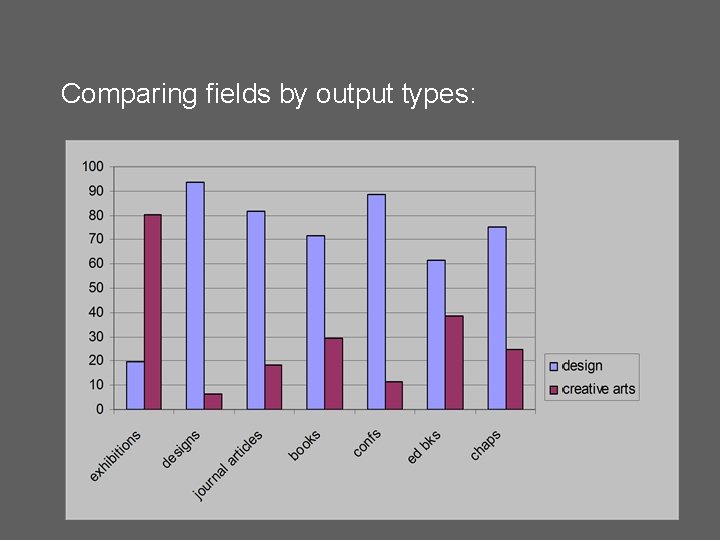
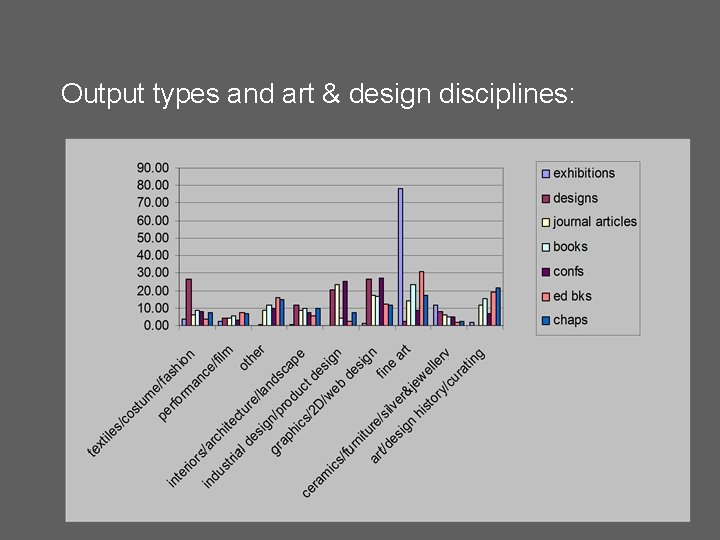
Characteristics of the field – output types: Art & Design Engineering Built Environment RAE 2001 Uo. A 64 Uo. A 30 Uo. A 33 Publication type outputs % O: exhibition 3748 40. 6 0 0 6 0. 2 P: artefact 862 9. 3 0 0 20 0. 8 N: design 971 10. 5 0 0 51 2. 0 L: performance 144 1. 6 0 0 1 0 M: composition 36 0. 4 0 0 F: patent 41 0. 4 13 0. 3 5 0. 2 5802 62. 8 13 0. 3 77 3. 0 A: authored book 459 5. 0 26 0. 6 228 8. 9 B: edited book 151 1. 6 3 0. 1 43 1. 7 C: chapter in book 565 6. 1 44 1. 0 279 10. 9 D: journal article 820 8. 9 4039 92. 8 1532 59. 8 E: conference paper 600 6. 5 207 4. 8 320 12. 0 2595 22. 1 4319 99. 2 2402 93. 7 Total no. of outputs 9242 4353 2563
Art & Design text and practice outputs:
Comparing fields by output types:
Output types and art & design disciplines:
RAE 2008 research definition ‘Research’ for the purpose of the RAE is to be understood as original investigation undertaken in order to gain knowledge and understanding. It includes work of direct relevance to the needs of commerce, industry, and to the public and voluntary sectors; scholarship*; the invention and generation of ideas, images, performances, artefacts including design, where these lead to new or substantially improved insights; and the use of existing knowledge in experimental development to produce new or substantially improved materials, devices, products and processes, including design and construction. It excludes routine testing and routine analysis of materials, components and processes such as for the maintenance of national standards, as distinct from the development of new analytical techniques. It also excludes the development of teaching materials that do not embody original research.
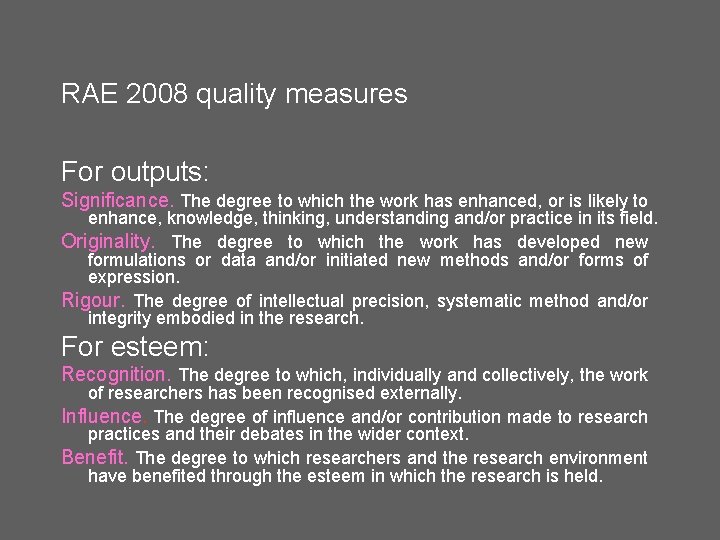
RAE 2008 quality measures For outputs: Significance. The degree to which the work has enhanced, or is likely to enhance, knowledge, thinking, understanding and/or practice in its field. Originality. The degree to which the work has developed new formulations or data and/or initiated new methods and/or forms of expression. Rigour. The degree of intellectual precision, systematic method and/or integrity embodied in the research. For esteem: Recognition. The degree to which, individually and collectively, the work of researchers has been recognised externally. Influence. The degree of influence and/or contribution made to research practices and their debates in the wider context. Benefit. The degree to which researchers and the research environment have benefited through the esteem in which the research is held.
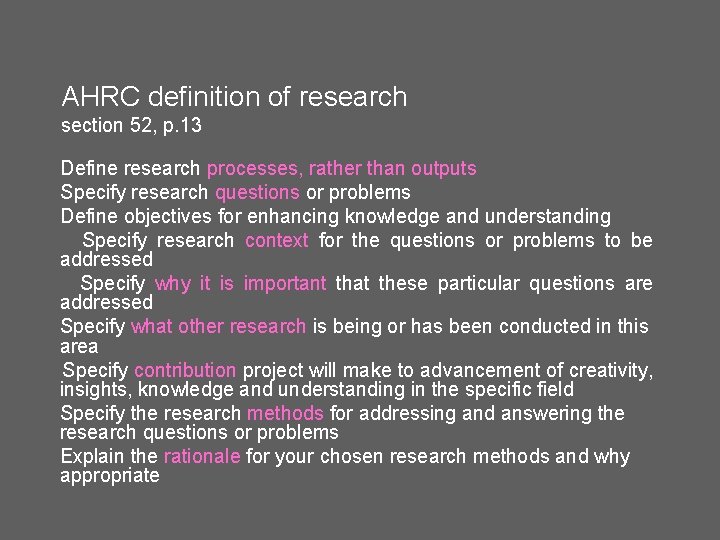
AHRC definition of research section 52, p. 13 Define research processes, rather than outputs Specify research questions or problems Define objectives for enhancing knowledge and understanding Specify research context for the questions or problems to be addressed Specify why it is important that these particular questions are addressed Specify what other research is being or has been conducted in this area Specify contribution project will make to advancement of creativity, insights, knowledge and understanding in the specific field Specify the research methods for addressing and answering the research questions or problems Explain the rationale for your chosen research methods and why appropriate
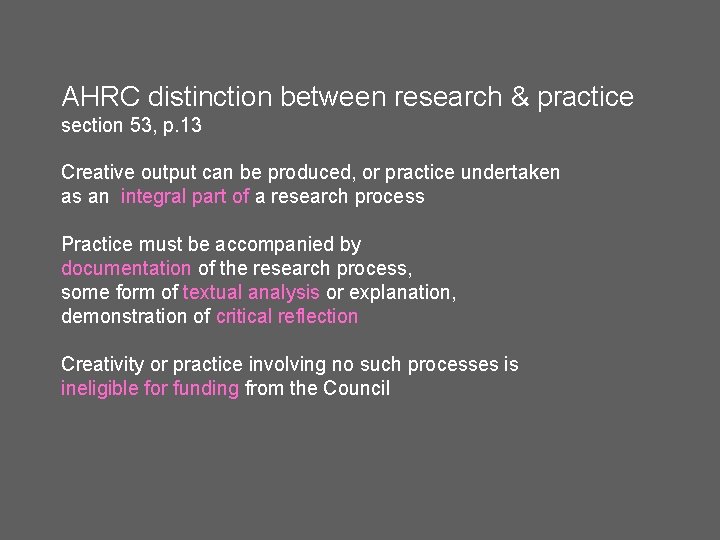
AHRC distinction between research & practice section 53, p. 13 Creative output can be produced, or practice undertaken as an integral part of a research process Practice must be accompanied by documentation of the research process, some form of textual analysis or explanation, demonstration of critical reflection Creativity or practice involving no such processes is ineligible for funding from the Council
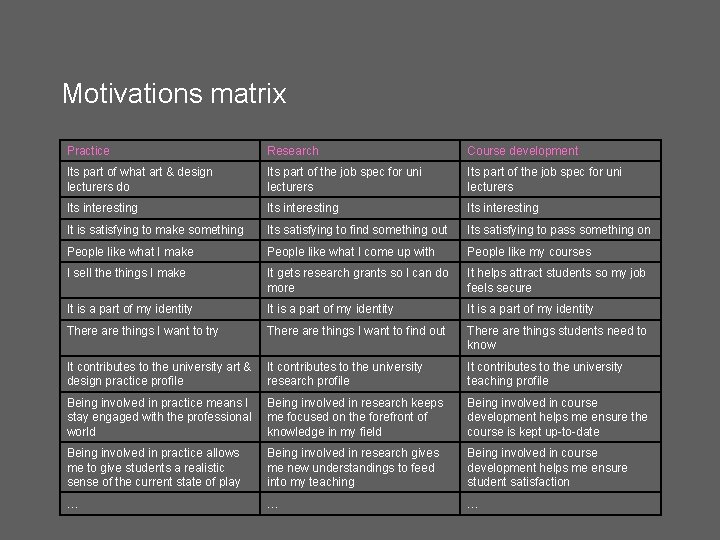
Motivations matrix Practice Research Course development Its part of what art & design lecturers do Its part of the job spec for uni lecturers Its interesting It is satisfying to make something Its satisfying to find something out Its satisfying to pass something on People like what I make People like what I come up with People like my courses I sell the things I make It gets research grants so I can do more It helps attract students so my job feels secure It is a part of my identity There are things I want to try There are things I want to find out There are things students need to know It contributes to the university art & design practice profile It contributes to the university research profile It contributes to the university teaching profile Being involved in practice means I stay engaged with the professional world Being involved in research keeps me focused on the forefront of knowledge in my field Being involved in course development helps me ensure the course is kept up-to-date Being involved in practice allows me to give students a realistic sense of the current state of play Being involved in research gives me new understandings to feed into my teaching Being involved in course development helps me ensure student satisfaction … … …
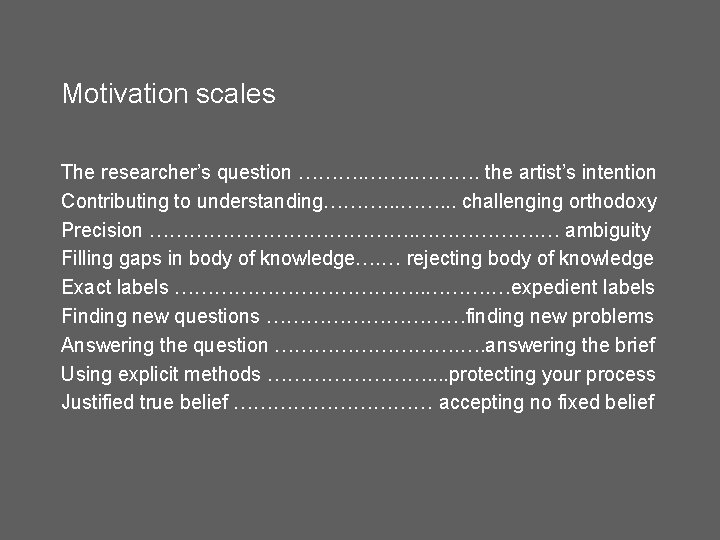
Motivation scales The researcher’s question ………. the artist’s intention Contributing to understanding………. . . challenging orthodoxy Precision …………………. … ambiguity Filling gaps in body of knowledge…. … rejecting body of knowledge Exact labels ………………. …expedient labels Finding new questions ……………finding new problems Answering the question ……………. …. answering the brief Using explicit methods …………. . protecting your process Justified true belief …………… accepting no fixed belief
Closing questions Why do research? Why differentiate between the artist/designer and the academic? Who gets money for what? Does the work speaks for itself? Is visual evidence the same as visual knowledge? What are the established means of deposit and exchange? Which is most important, intentionality or ambiguity? Can we raise the quality of evidence, records and archives?
Closing thoughts… ‘art as a form of knowledge in which purposeful execution is guided by genuine understanding of the principle underlying that activity’ (Harris, 2003, The Necessity of Artspeak) ‘the aim of academic research is the production of expert knowledge; the aim of art is the expression of understanding as an account of experience’ (Buchler, 2000, in The Artist as Researcher) ‘History would seem to indicate that artists have been consistently misguided about what they do’ (Elkins, 2001, Why Art Cannot be Taught)