
Professional Orientation Business Etiquette What you should know
Professional Orientation Business Etiquette What you should know: • Business UNIVERSITY OF dress FLORIDA • Handshakes, greetings and introductions • Social interactions at dinners and golf outings • Meeting structure and format • Written, verbal and non-verbal communication in the workplace • Treatment of common areas and personal offices • Customer interaction • Interview format • Cultural awareness and sensitivity in a foreign country 1
Professional Orientation “Over half of all business is finalized at the dining table. Never assume that others will notice or will be understanding of poor manners and lack of dining skills. ” First Impression Management UNIVERSITY OF Do you know the following? FLORIDA • your responsibilities as a host • your responsibilities as a guest • when and how to sit down at the table • how to properly use your napkin • when, how and what to order • holding your flatware properly • maneuvering your way at the table • how to indicate you are pausing at your meal • how to indicate you have finished your meal • where to put your hands and briefcase • how to eat difficult food • when to discuss business • etc 2
Professional Orientation Business Etiquette Napkin Use UNIVERSITY OF • The meal begins when the host unfolds his or her napkin FLORIDA • It is your turn now to unfold your napkin!! • Place the completely unfolded napkin in your lap if a small luncheon napkin. Place napkin folded in half if a large dinner napkin. • Keep it in your lap during the meal except to gently blot your mouth when needed • If you have to leave the table during the meal, place the napkin on your chair as a signal that you will be returning. 3
Professional Orientation Business Etiquette Napkin Use UNIVERSITY OF • The host will signal the end of the meal by placing his or her FLORIDA napkin on the table. • When the meal is over, place your napkin neatly on the table to the right of your dinner plate. Don’t refold the napkin or wad it up!! 4
Professional Orientation Business Etiquette Ordering UNIVERSITY OF • Look over the menu FLORIDA • Ask server questions about items you are uncertain about • An employer will generally suggest that your order be taken first • Sometimes the server decides and takes women’s orders before men’s • Do not order the most expensive items on the menu • Your host may help you with adding additional items, by suggesting dessert, etc. 5
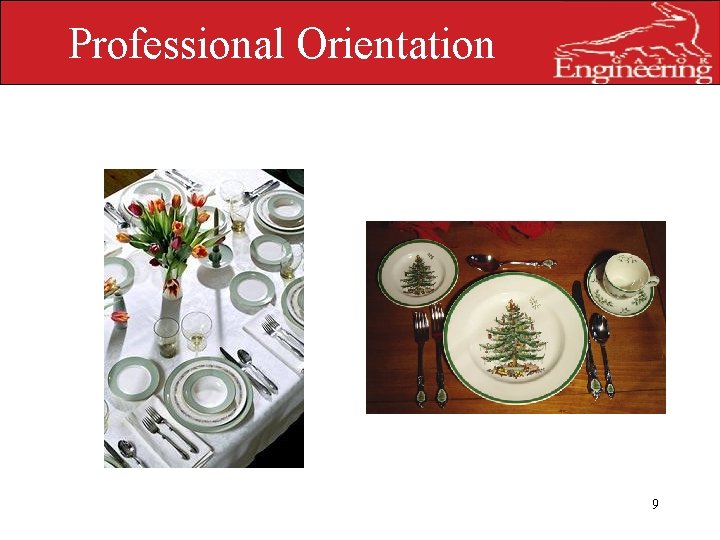
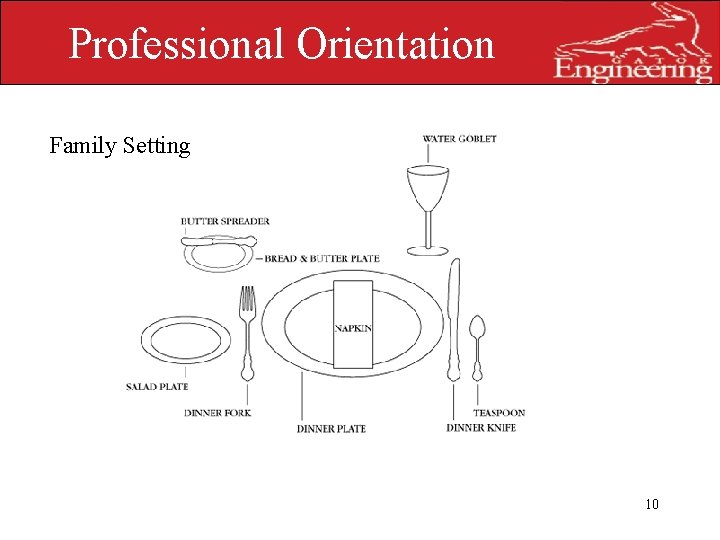
Professional Orientation Business Etiquette Reading the Table Setting UNIVERSITY OF • There are clues to what is coming when you are seated with a FLORIDA formal or banquet pre-set table setting • To the right of the centerline of the dinner plate: glassware, cup, saucer, knives, spoons, oyster fork (return glassware to original position) • To the left: bread and butter plate (butter knife across plate), salad plate, napkin and forks. “Liquids on the right, solids on the left. ” Exception is oyster fork. 6
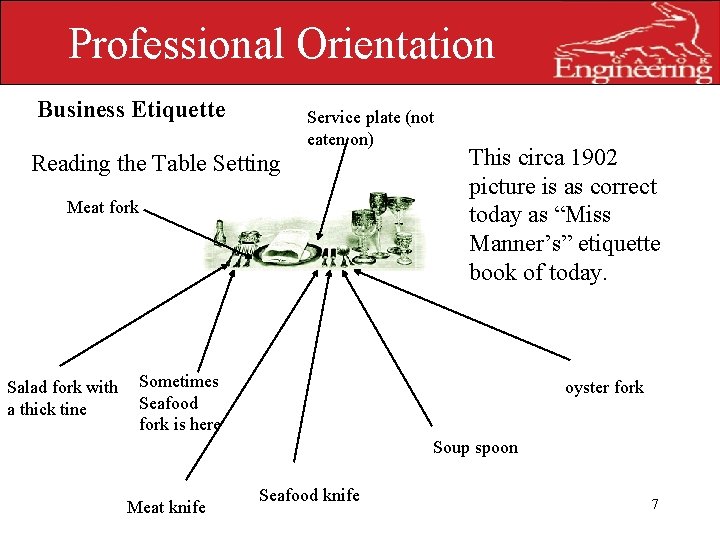
Professional Orientation Business Etiquette Service plate (not eaten on) Reading the Table Setting UNIVERSITY OF Meat fork FLORIDA Salad fork with a thick tine This circa 1902 picture is as correct today as “Miss Manner’s” etiquette book of today. Sometimes Seafood fork is here oyster fork Soup spoon Meat knife Seafood knife 7
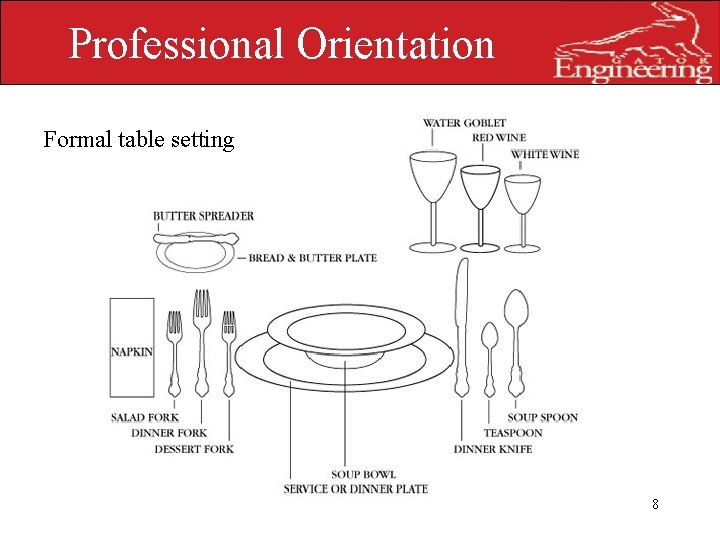
Professional Orientation Formal table setting UNIVERSITY OF FLORIDA 8
Professional Orientation UNIVERSITY OF FLORIDA 9
Professional Orientation Family Setting UNIVERSITY OF FLORIDA 10
Professional Orientation Business Etiquette Use of Silverware UNIVERSITY OF • Usually work from “out to in” FLORIDA • On left: salad fork, dinner fork • On right: soupspoon, beverage spoon, salad knife, dinner knife • Above your plate: dessert spoon and fork (or brought out with dessert) 11
Professional Orientation Business Etiquette Use of Silverware • American style: cut food holding knife in the right hand FLORIDA fork in left with the fork tines piercing food to secure it. Cut a bite of food, lay your knife across the top edge of your plate with the sharp edge of the blade facing in. Change fork to right hand with tines facing up (if left handed keep fork in left hand) UNIVERSITY OF • European style: same as the American style except that you keep your fork in your left hand with tines facing down. Eat the cut pieces of food by picking them up with the fork still in your left hand. Note: position of blades and tines, holding silverware with fingers 12 symbolizes lack of hostility toward each other
Professional Orientation Business Etiquette Peas: American style indicates that no matter how difficult it may UNIVERSITY OF to use a fork to capture “awkward and contrary” foods. be, you are FLORIDA In Europe you can use the knife or a small bit of bread to ease the item onto the fork. 13
Professional Orientation Business Etiquette When you are done UNIVERSITY OF • Do not push your plate away from you, leave it where it is. FLORIDA • Lay your fork and knife diagonally across your plate as a signal you are done • Place the knife and fork side by side with the knife blade facing toward you (avoiding implications of aggression!) and the fork tines down to the left of the knife. Run them from 10 to 4 o’clock positions on the clock. • Never put a piece of silverware back on the table once you have used it. • Leave unused silverware on the table. (don’t leave the silverware on any dish that is not flat) 14
Professional Orientation Business Etiquette When you want to pause in eating: UNIVERSITY OF • For a short pause between bites, place the silverware down on a FLORIDA plate. No specific pattern is required. • For longer waits, place the fork on the left and the knife on the right so that they cross over the center of the plate. • If passing a plate for an additional serving, place the knife and fork on the right side of the plate parallel to each other to leave room for the food. 15
Professional Orientation Business Etiquette Table Manners • Don’t ask for a doggy (or cat) bag UNIVERSITY OF • Order foods that can be eaten with a knife or fork (stay away from finger foods) FLORIDA • Do not order alcoholic beverages • Do not smoke when dining out • Sit up straight at the table • When not eating, keep hands on your lap or resting on the table (with wrists on the edge of the table). Elbows on the table are acceptable between courses. • Do not season your food before you have tasted it. • Never chew with our mouth open or make loud noises while you eat. Try not to talk with food in your mouth. • Do not slurp soup from a spoon. Spoon the soup away from you when you take it out of the bowl and sip it from the side of the spoon. Do not blow on the spoon 16 of soup if it is too hot!!
Professional Orientation Business Etiquette Table Manners • If bouillon is served, it is usually served in a cup with a handle. You can sip from the cup after you have removed any vegetables or meat with the spoon UNIVERSITY OF FLORIDA • Finger bowls: not used very often today. Usually presented before or after dessert. Delicately dip your fingertips in the water and dry them off with your napikin and set the bowl to the side of your plate • When you are the host and want to offer a second or third helping, phrase the offer as if the dish has just been brought out for the first time • When asked to “pass the salt” it is proper for you to pick up both the salt and pepper shakers and set them on the table next to the person beside you. They in turn repeat the movement to the next person until the person requesting the salt receives the shakers. You do not pass them hand-to-hand. 17
Professional Orientation Business Etiquette • If food gets caught between your teeth, leave the table and go to a mirror to remove the food in private UNIVERSITY OF • Eat rolls or bread by tearing off small bite size pieces and buttering only the piece you FLORIDA have prepared • Engage in table conversations that are pleasant and not controversial • Do not leave the table during a meal except in an emergency • If you cannot easily reach something on the table, ask the person closest to the item to pass it on to you • If a piece of silverware falls onto the floor, pick it up if you can reach it and let the server know that you dropped it and need a clean one • Let left handed people sit at the left end of the table or head of the table • If food spills off your plate, you may pick it up with a piece of your silverware and place it on the edge of your plate 18
Professional Orientation Business Etiquette Never spit a piece of bad food or tough gristle into your UNIVERSITY OF napkin!!!! Remove the food from your mouth using the same FLORIDA utensil it went in with and place it on the edge of your plate. If possible, cover it with some other food on your plate. Exceptions are olive pits that can be dropped in your hand small fish bones which can be removed by your fingers. ALSO if the piece of food is extremely ugly (like a big piece of fat), you may place this in your napkin to keep it out of sight. • Note: Some servers are not well prepared to respond to good table manners and may not respond to your needs or signals. 19
Professional Orientation Interviewing Business Etiquette • Turn off your cell phone long before you enter the restaurant UNIVERSITY OF FLORIDA • Before the meal arrives, be sure to actively listen to the interviewer. Paraphrase the content of what is being said. Stay away from sensitive topics such as politics or religion • Do your best to relax and maintain good posture and body language • Go with harmless, moderately priced foods. Stay away from spaghetti, peas. Use that “please” and “thank you” you have been taught!! 20
Professional Orientation Interviewing Business Etiquette • Be sure to thank the interviewers for the meal and obtain their business cards UNIVERSITY OF FLORIDA • Send a thank-you note See this web site for Miss Manners take on interview tips: http: //www. graduatingengineer. com/articles/feature/05 -28 -01 b. html 21
Professional Orientation Business Etiquette—Tips on Making a Good First Impression (From Emily Post Institute) Make sure your first impression is a good one. Whether you are a teen applying for an after school job or a OF college grad applying for your first "full-time" job, the following tips can help you UNIVERSITY make the best first impression. FLORIDA Pre-Interview Checklist • Your shoes are clean and/or polished. • Your clothes are pressed and stain-free. • Your nails are clean and neat. • Your hair is neat. • You have removed all extra jewelry. • You have clean copies of your resume. • You have the address and phone number of the meeting place. • You know how to get there and how long it will take. (BEING ON TIME IS CRITICAL) 22
Professional Orientation • You know the names of everyone you are meeting and how to pronounce them. • You have a notebook and pen (that works!) • UNIVERSITY Your bag. OFhas essentials only - nothing bulky or extra. FLORIDA • You are prepared for rain, sleet or snow, and your coat is in good condition. • Ladies - you have a lipstick, powder compact and an extra pair of pantyhose. Do the next five things with everyone you meet and you are well on your way to success! • Look them in the eye. • Give a firm handshake. • Greet them - "How do you do? " or "How do you do, Mrs. ____" • When saying your name, say it slowly and clearly. 23 • Smile!
Professional Orientation Here are some basic guidelines for tipping. The amount can vary by city, region, or country: • Airport: Skycaps, $1 per bag; electric cart drivers, $1 or $2; wheelchair assistants, $3 to $5. FLORIDA • Transportation: Taxi or limousine, 15 percent of fare; tour guide, $10 for a day or 15 percent on a longer trip. • Hotel: Doorman, $1 or $2; parking valet, $1 to $3; bellhop, $1 or $2 per bag; maid, $2 or $3 per night person; room service, 15 percent of the bill (but check first to see if it is included in the charge); concierge, $5 to $10 for exceptional service; spa services, 15 percent to 20 percent. • Dining: Wine steward, 15 percent to 20 percent of wine bill, in cash; wait staff, 15 percent to 20 percent; coat checks, $1 per coat; wash room attendant, 50 cents or more if extra help is provided (needle and thread for a loose button, for example). From “Ask Miss Whozit” UNIVERSITY OF 24
- Slides: 24