
Professional Helpers Parents with Cognitive Disabilities Kimberly Sampson
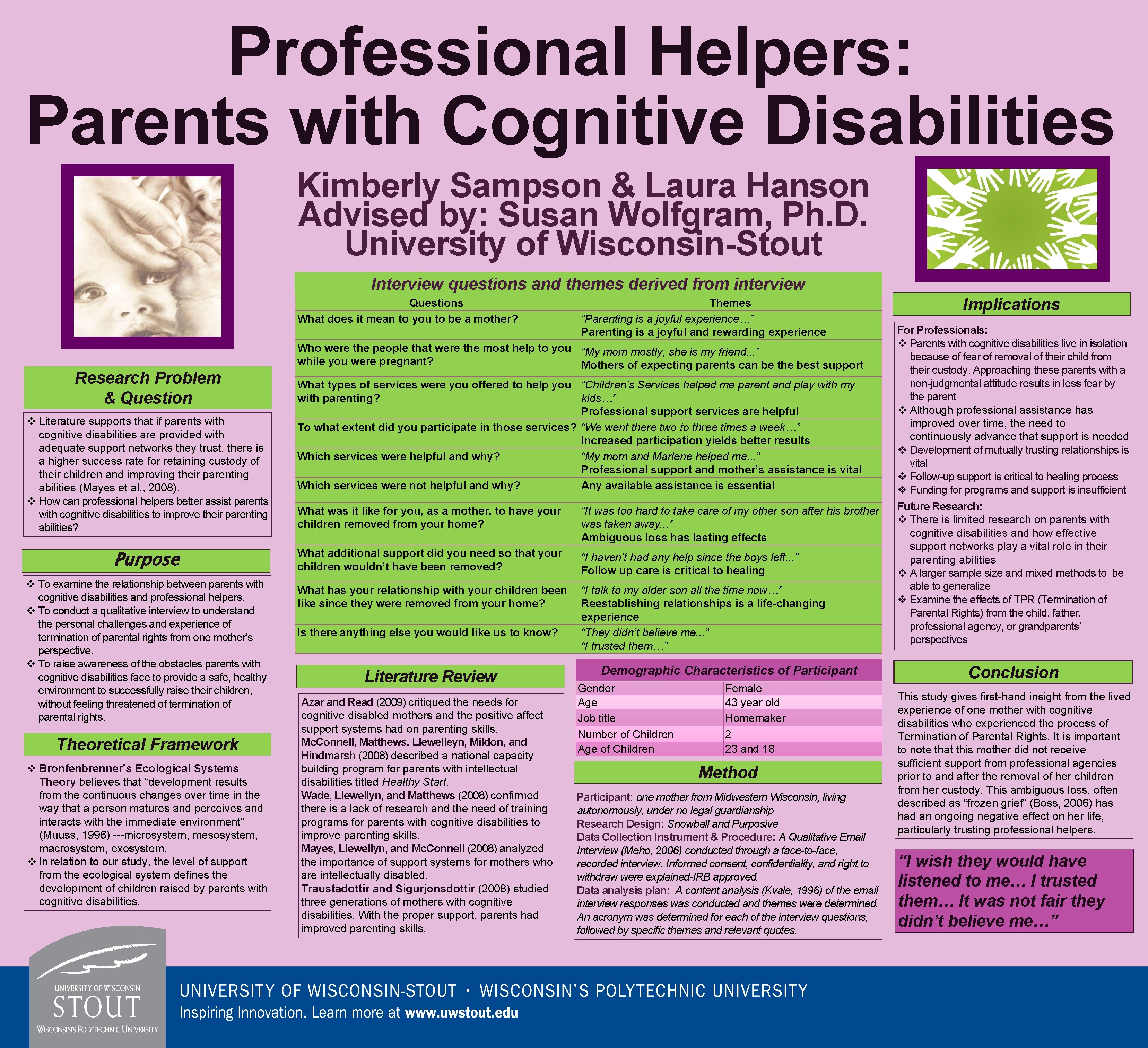
Professional Helpers: Parents with Cognitive Disabilities Kimberly Sampson & Laura Hanson Advised by: Susan Wolfgram, Ph. D. University of Wisconsin-Stout Interview questions and themes derived from interview Questions What does it mean to you to be a mother? Research Problem & Question v Literature supports that if parents with cognitive disabilities are provided with adequate support networks they trust, there is a higher success rate for retaining custody of their children and improving their parenting abilities (Mayes et al. , 2008). v How can professional helpers better assist parents with cognitive disabilities to improve their parenting abilities? Purpose v To examine the relationship between parents with cognitive disabilities and professional helpers. v To conduct a qualitative interview to understand the personal challenges and experience of termination of parental rights from one mother’s perspective. v To raise awareness of the obstacles parents with cognitive disabilities face to provide a safe, healthy environment to successfully raise their children, without feeling threatened of termination of parental rights. Theoretical Framework v Bronfenbrenner’s Ecological Systems Theory believes that “development results from the continuous changes over time in the way that a person matures and perceives and interacts with the immediate environment” (Muuss, 1996) ---microsystem, mesosystem, macrosystem, exosystem. v In relation to our study, the level of support from the ecological system defines the development of children raised by parents with cognitive disabilities. Themes “Parenting is a joyful experience…” Parenting is a joyful and rewarding experience Who were the people that were the most help to you “My mom mostly, she is my friend. . . ” while you were pregnant? Mothers of expecting parents can be the best support What types of services were you offered to help you “Children’s Services helped me parent and play with my with parenting? kids…” Professional support services are helpful To what extent did you participate in those services? “We went there two to three times a week…” Increased participation yields better results Which services were helpful and why? “My mom and Marlene helped me. . . ” Professional support and mother’s assistance is vital Which services were not helpful and why? Any available assistance is essential What was it like for you, as a mother, to have your children removed from your home? “It was too hard to take care of my other son after his brother was taken away. . . ” Ambiguous loss has lasting effects What additional support did you need so that your children wouldn’t have been removed? “I haven’t had any help since the boys left. . . ” Follow up care is critical to healing What has your relationship with your children been like since they were removed from your home? “I talk to my older son all the time now…” Reestablishing relationships is a life-changing experience “They didn’t believe me. . . ” “I trusted them…” Is there anything else you would like us to know? Literature Review Azar and Read (2009) critiqued the needs for cognitive disabled mothers and the positive affect support systems had on parenting skills. Mc. Connell, Matthews, Llewelleyn, Mildon, and Hindmarsh (2008) described a national capacity building program for parents with intellectual disabilities titled Healthy Start. Wade, Llewellyn, and Matthews (2008) confirmed there is a lack of research and the need of training programs for parents with cognitive disabilities to improve parenting skills. Mayes, Llewellyn, and Mc. Connell (2008) analyzed the importance of support systems for mothers who are intellectually disabled. Traustadottir and Sigurjonsdottir (2008) studied three generations of mothers with cognitive disabilities. With the proper support, parents had improved parenting skills. Demographic Characteristics of Participant Gender Age Job title Number of Children Age of Children Female 43 year old Homemaker 2 23 and 18 Method Participant: one mother from Midwestern Wisconsin, living autonomously, under no legal guardianship Research Design: Snowball and Purposive Data Collection Instrument & Procedure: A Qualitative Email Interview (Meho, 2006) conducted through a face-to-face, recorded interview. Informed consent, confidentiality, and right to withdraw were explained-IRB approved. Data analysis plan: A content analysis (Kvale, 1996) of the email interview responses was conducted and themes were determined. An acronym was determined for each of the interview questions, followed by specific themes and relevant quotes. Implications For Professionals: v Parents with cognitive disabilities live in isolation because of fear of removal of their child from their custody. Approaching these parents with a non-judgmental attitude results in less fear by the parent v Although professional assistance has improved over time, the need to continuously advance that support is needed v Development of mutually trusting relationships is vital v Follow-up support is critical to healing process v Funding for programs and support is insufficient Future Research: v There is limited research on parents with cognitive disabilities and how effective support networks play a vital role in their parenting abilities v A larger sample size and mixed methods to be able to generalize v Examine the effects of TPR (Termination of Parental Rights) from the child, father, professional agency, or grandparents’ perspectives Conclusion This study gives first-hand insight from the lived experience of one mother with cognitive disabilities who experienced the process of Termination of Parental Rights. It is important to note that this mother did not receive sufficient support from professional agencies prior to and after the removal of her children from her custody. This ambiguous loss, often described as “frozen grief” (Boss, 2006) has had an ongoing negative effect on her life, particularly trusting professional helpers. “I wish they would have listened to me… I trusted them… It was not fair they didn’t believe me…”
- Slides: 1