
Professional Development to Practice GROW Your Team Through


- Slides: 46
Professional Development to Practice GROW Your Team Through Coaching Dr. Teresa Tulipana tulipanat@umkc. edu @ttulipana #kcrpdc The contents of this presentation were developed under a grant from the US Department of Education to the Missouri Department of Elementary and Secondary Education (#H 323 A 120018). However, these contents do not necessarily represent the policy of the US Department of Education, and you
Professional Development to Practice Learning Outcomes q Discover why coaching is the “go to” approach for interacting with people. q Identify and practice using the four components of the GROW framework of coaching. q Develop a list of powerful questions to support the GROW model. q Identify and learn to use the coaching skills of active listening and powerful questioning.
Professional Development to Practice In Order to Achieve Outcomes, we first must q. Learn your default leadership style q. Understand the Skill-Will Matrix q. Match leadership skills to Skill-Will Matrix
Professional Development to Practice Who Are You As a Leader? Take the Leadership Styles Survey Based on Primal Leadership by Daniel Goleman
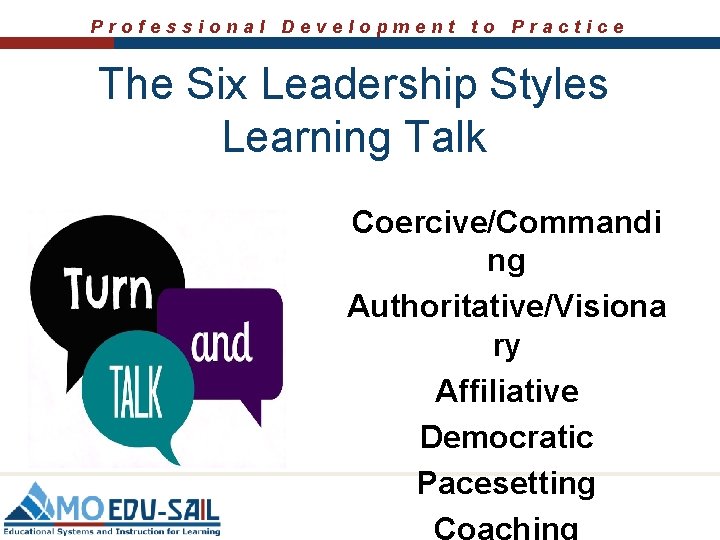
Professional Development to Practice The Six Leadership Styles Learning Talk Coercive/Commandi ng Authoritative/Visiona ry Affiliative Democratic Pacesetting Coaching
Professional Development to Practice Now I know my leadership style, so what?
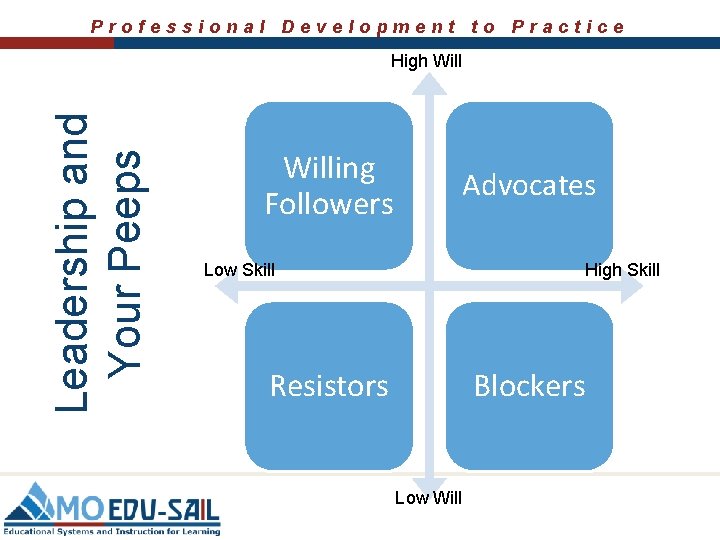
Professional Development to Practice Leadership and Your Teachers, Teams, Colleagues, etc… Individuals can be grouped based upon their skill and will. Skill: Current level of effectiveness which is a combination of experience and expertise. Will: Motivation to develop, to go on learning, to be creative and take risks in order to bring about change and continuous improvement, in the interest of students.
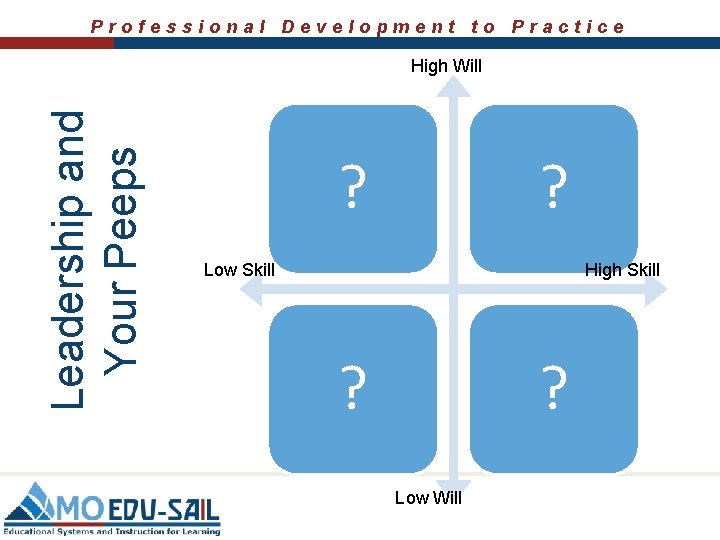
Professional Development to Practice Leadership and Your Peeps High Will ? ? Low Skill High Skill ? ? Low Will
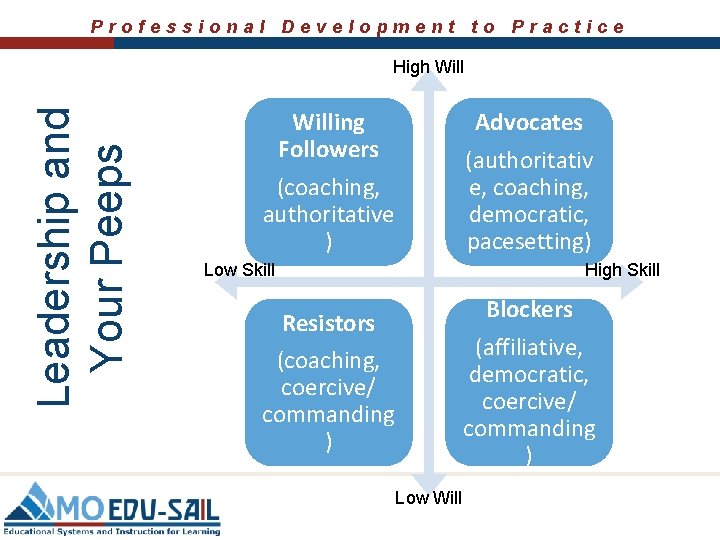
Professional Development to Practice Leadership and Your Peeps High Willing Followers Advocates Low Skill High Skill Resistors Blockers Low Will
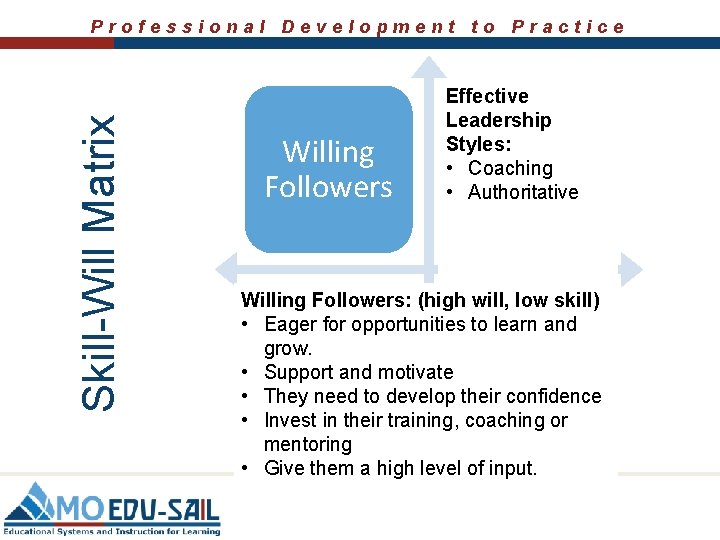
Skill-Will Matrix Professional Development to Practice Willing Followers Effective Leadership Styles: • Coaching • Authoritative Advocates Willing Followers: (high will, low skill) • Eager for opportunities to learn and grow. • Support and motivate • They need to develop their confidence • Invest in their training, coaching or mentoring • Give them a high level of input. Resistors Blockers
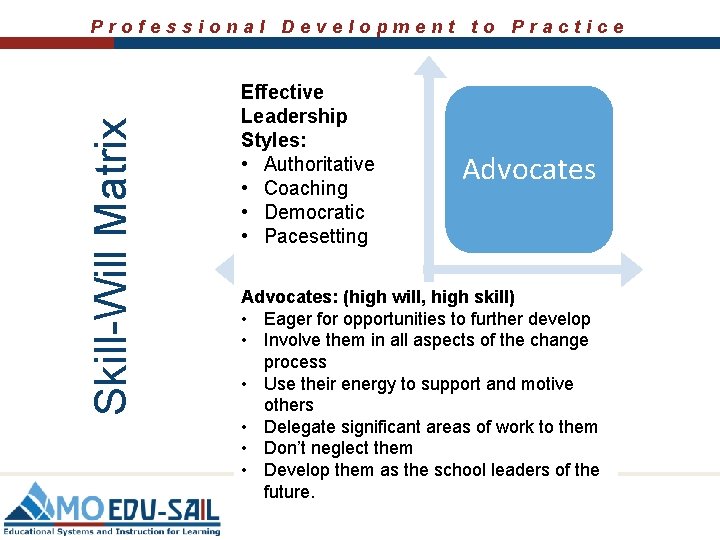
Skill-Will Matrix Professional Development to Practice Effective Leadership Styles: • Authoritative • Coaching • Democratic • Pacesetting Willing Followers Advocates: (high will, high skill) • Eager for opportunities to further develop • Involve them in all aspects of the change process • Use their energy to support and motive others • Delegate significant areas of work to them • Don’t neglect them • Develop them as the school leaders of the future. Resistors Blockers
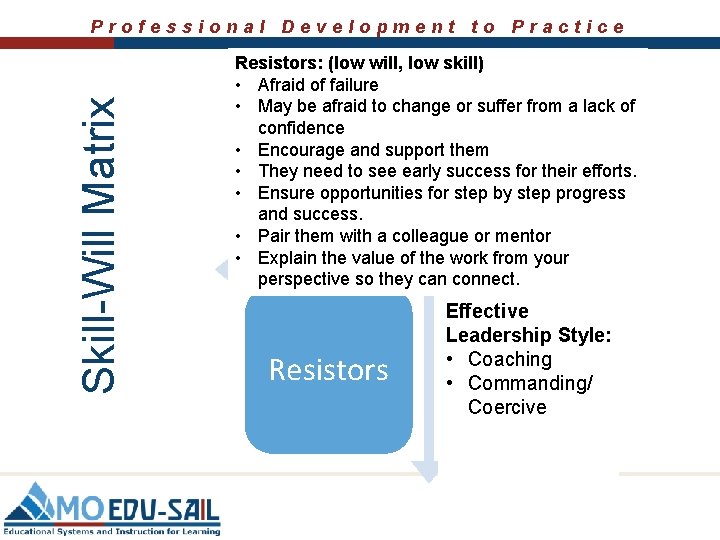
Skill-Will Matrix Professional Development to Practice Resistors: (low will, low skill) • Afraid of failure • May be afraid to change or suffer from a lack of confidence • Encourage and support them • They need to see early success for their efforts. • Ensure opportunities for step by step progress and success. • Pair them with a colleague or mentor • Explain the value of the work from your perspective so they can connect. Willing Followers Advocates Resistors Effective Leadership Style: • Coaching • Commanding/ Coercive Blockers
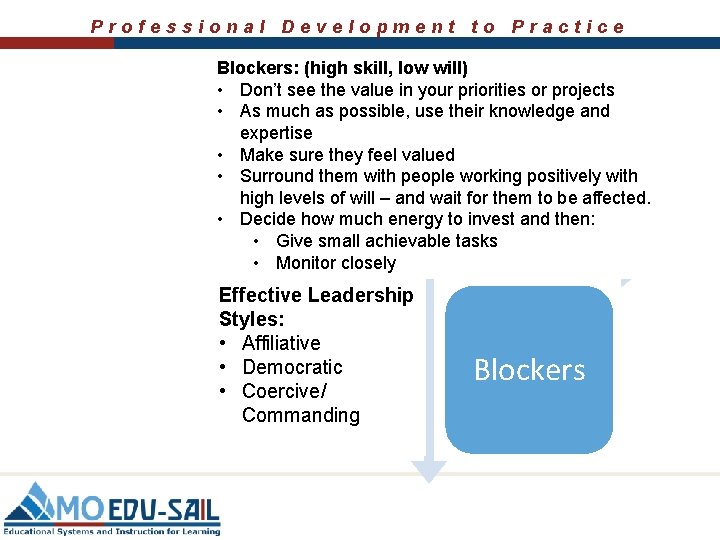
Professional Development to Practice Blockers: (high skill, low will) • Don’t see the value in your priorities or projects • As much as possible, use their knowledge and expertise • Make sure they feel valued • Surround them with people working positively with high levels of will – and wait for them to be affected. • Decide how much energy to invest and then: • Give small achievable tasks • Monitor closely Skill-Will Matrix Willing Followers Effective Leadership Styles: • Affiliative • Democratic • Coercive/ Commanding Resistors Advocates Blockers
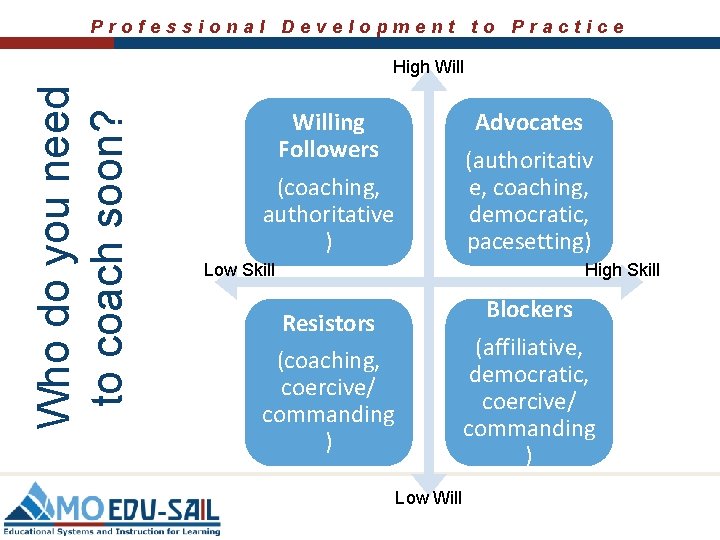
Professional Development to Practice Leadership and Your Peeps High Willing Followers (coaching, authoritative ) Advocates (authoritativ e, coaching, democratic, pacesetting) Low Skill High Skill Blockers (affiliative, democratic, coercive/ commanding ) Resistors (coaching, coercive/ commanding ) Low Will
Professional Development to Practice Continue Your Learning q Article: Leadership That Gets Results by Daniel Goleman q Book: Primal Leadership by Daniel Goleman
Professional Development to Practice So what? ! q The coaching leadership style is effective for 3 out of the 4 “types” of peeps you encounter! q. Willing Followers q. Advocates q. Resistors q No other leadership style works with this many “types” of peeps.
Visual Anchor Professional Development to Practice
Professional Development to Practice What is Coaching? Coaching is a process of helping another individual realize their inner potential, delivering fulfillment to both the individual and the related organization. q. Motivation q. Excellence q. Achievement q. Intrinsic learning q. Intense satisfaction
Professional Development to Practice “Coaching is the art of facilitating the performance, learning and development of another” Myles Downey Effective Coaching
Professional Development to Practice Coaching is NOT… q. Leading q. Managing q. Instruction q. Mandating q. Disciplinary q. Giving advice q. Offering opinions
Professional Development to Practice A Coach Does Not Need… q. To be right q. To be the expert q. To know the “right” answer q. To be in control q. To “fix” it q. To heal it or make it better
Professional Development to Practice A Coach Needs… To remove any “interference” an individual/team might be experiencing in order to realize that individual’s own extraordinary innate abilities
Professional Development to Practice What is Interference? Interference is anything that distracts the individual/team from being successful: q. Fear q. Lack of concentration q. Anger q. Boredom q. Trying too hard q. Lack of self-confidence
Professional Development to Practice Coaching is Successful When… q. There are both action and awareness: q. Clear goals have been set q. Understanding is achieved q“Interference” is gone q. There is a balance between the skill level and the desired outcome
Professional Development to Practice A Coach is successful when… The individual or team they are coaching is successful at attaining a higher level of performance. It is not the coach who “wins”.
Professional Development to Practice Why GROW Coaching? q It’s easy and efficient q Honors the coachee and creates solution ownership q Recognizes you, the coach, are not the expert on the coachee’s situation q Doesn’t “tell” (that’s training); but guides through effective questioning q Creates forward movement
Professional Development to Practice What is GROW Coaching?
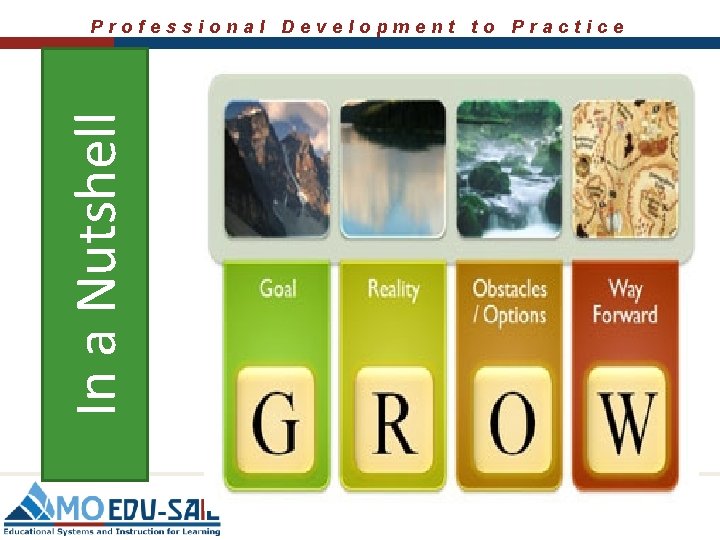
In a Nutshell Professional Development to Practice
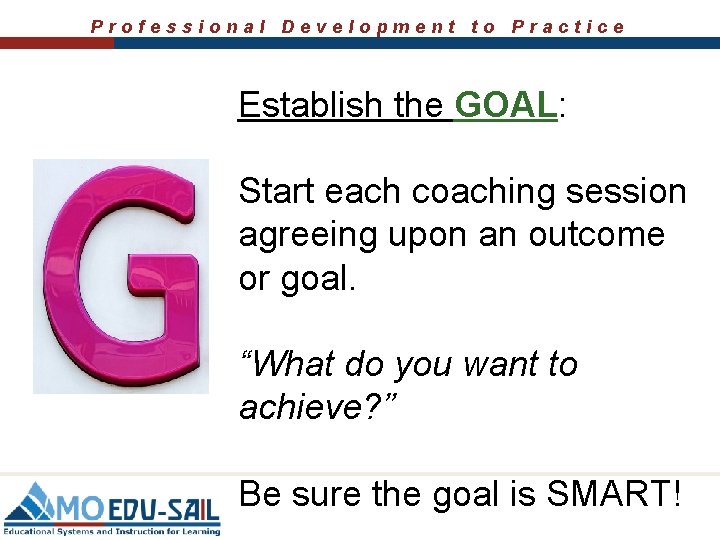
Professional Development to Practice Establish the GOAL: Start each coaching session agreeing upon an outcome or goal. “What do you want to achieve? ” Be sure the goal is SMART!
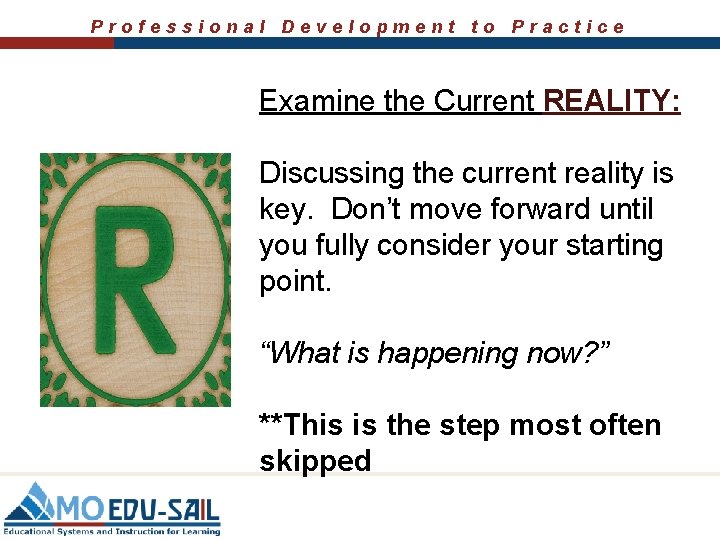
Professional Development to Practice Examine the Current REALITY: Discussing the current reality is key. Don’t move forward until you fully consider your starting point. “What is happening now? ” **This is the step most often skipped
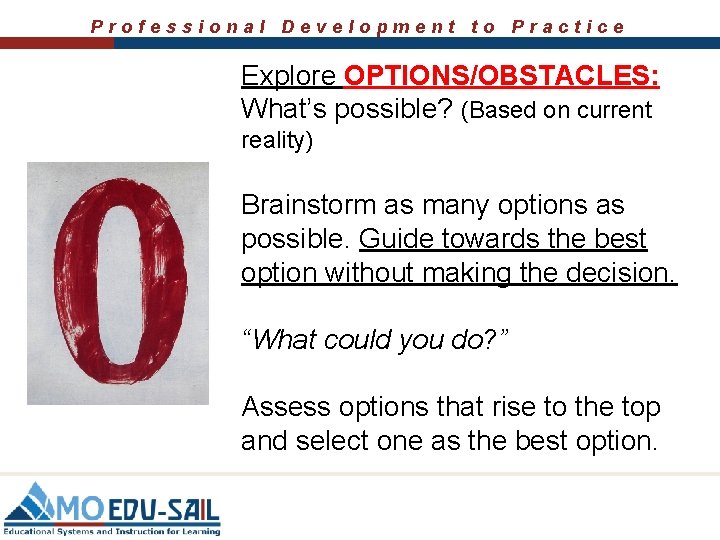
Professional Development to Practice Explore OPTIONS/OBSTACLES: What’s possible? (Based on current reality) Brainstorm as many options as possible. Guide towards the best option without making the decision. “What could you do? ” Assess options that rise to the top and select one as the best option.
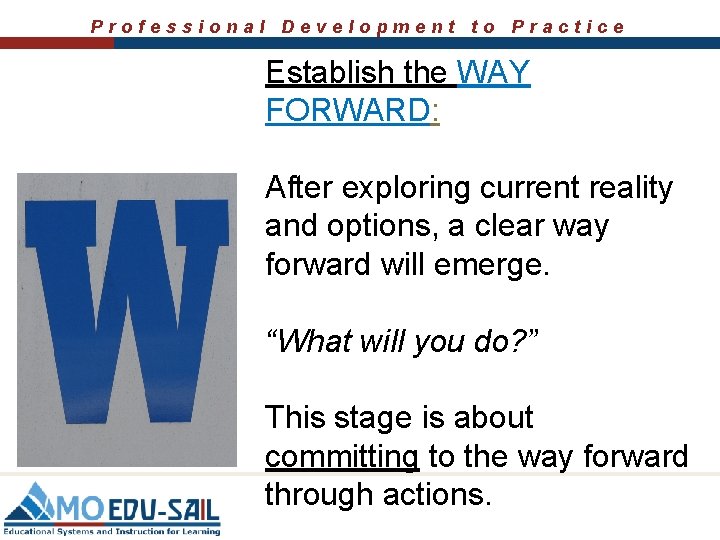
Professional Development to Practice Establish the WAY FORWARD: After exploring current reality and options, a clear way forward will emerge. “What will you do? ” This stage is about committing to the way forward through actions.
Professional Development to Practice Quality Coaching Keys q. Ask good questions q. Use active listening
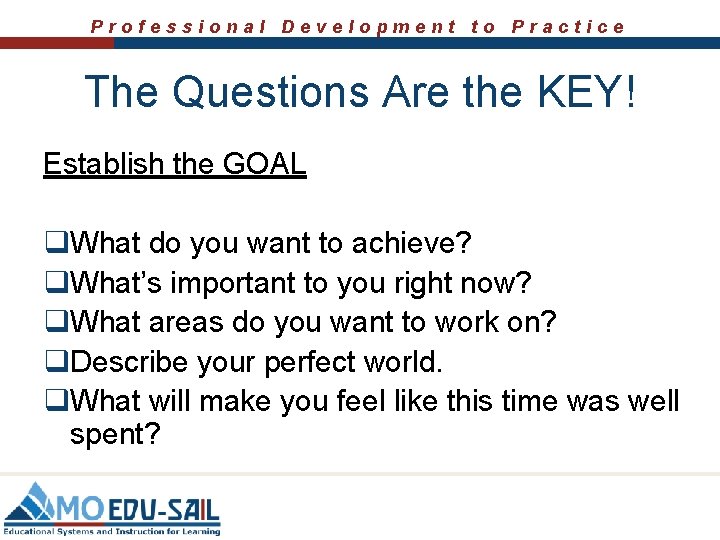
Professional Development to Practice The Questions Are the KEY! Establish the GOAL q. What do you want to achieve? q. What’s important to you right now? q. What areas do you want to work on? q. Describe your perfect world. q. What will make you feel like this time was well spent?
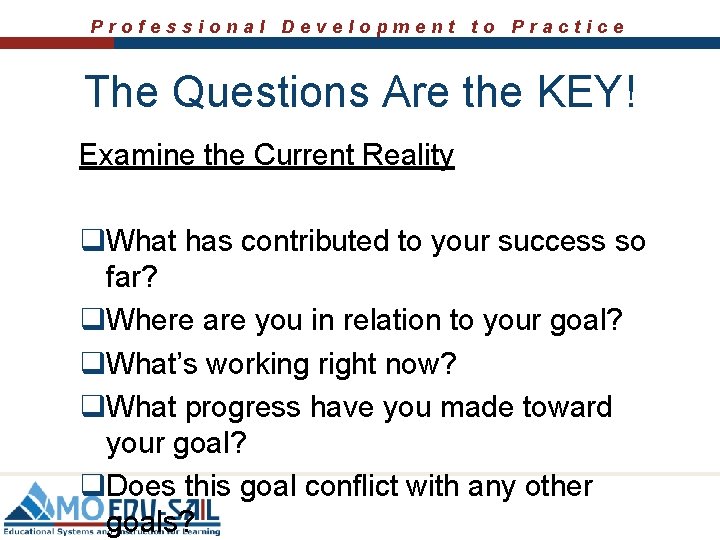
Professional Development to Practice The Questions Are the KEY! Examine the Current Reality q. What has contributed to your success so far? q. Where are you in relation to your goal? q. What’s working right now? q. What progress have you made toward your goal? q. Does this goal conflict with any other goals?
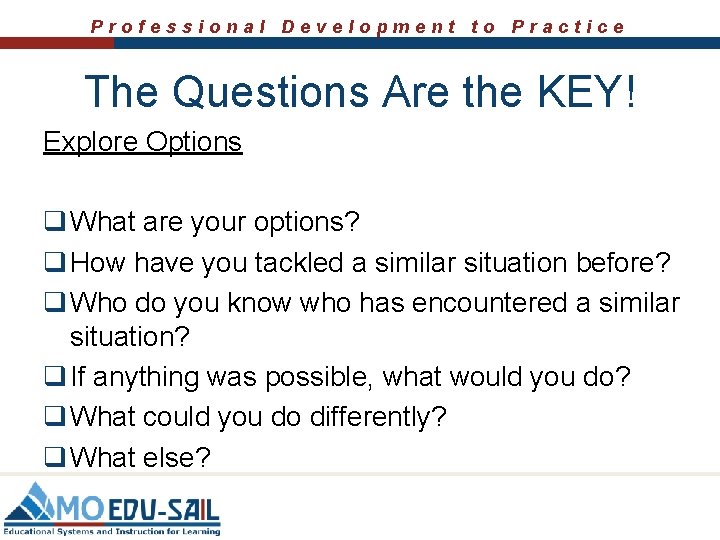
Professional Development to Practice The Questions Are the KEY! Explore Options q What are your options? q How have you tackled a similar situation before? q Who do you know who has encountered a similar situation? q If anything was possible, what would you do? q What could you do differently? q What else?
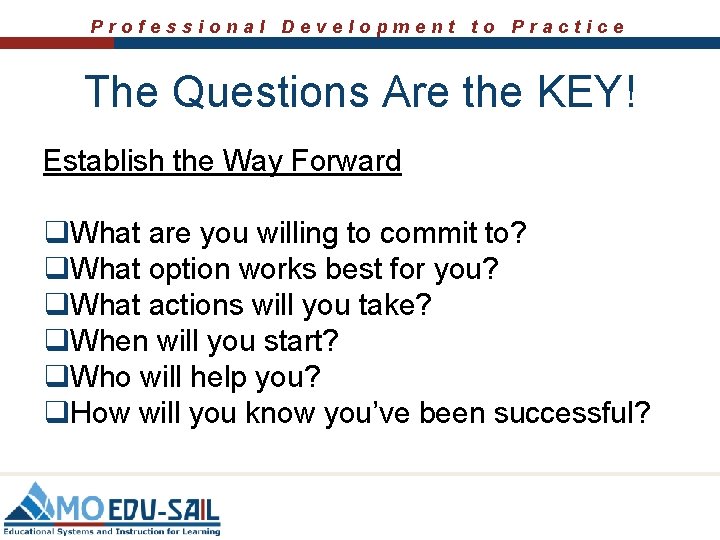
Professional Development to Practice The Questions Are the KEY! Establish the Way Forward q. What are you willing to commit to? q. What option works best for you? q. What actions will you take? q. When will you start? q. Who will help you? q. How will you know you’ve been successful?
Professional Development to Practice Fish Bowl Experience https: //www. youtube. com/watch? v=6 f 3 X 2 PEs. V-Q&t=70 s Jot down or mark questions you hear to support the four areas of GROW. If you think of a question that could have been asked, jot it down as well.
Professional Development to Practice 3 Minute Stop and Jot Capture any additional questions you might ask for each area of the GROW Model. Capture “What Went Well” and “Even Better If” for the role play video.
Professional Development to Practice What Questions Do You Have? (Before you get to try it on your own!)
Professional Development to Practice Who do you need to coach soon? High Willing Followers (coaching, authoritative ) Advocates (authoritativ e, coaching, democratic, pacesetting) Low Skill High Skill Blockers (affiliative, democratic, coercive/ commanding ) Resistors (coaching, coercive/ commanding ) Low Will
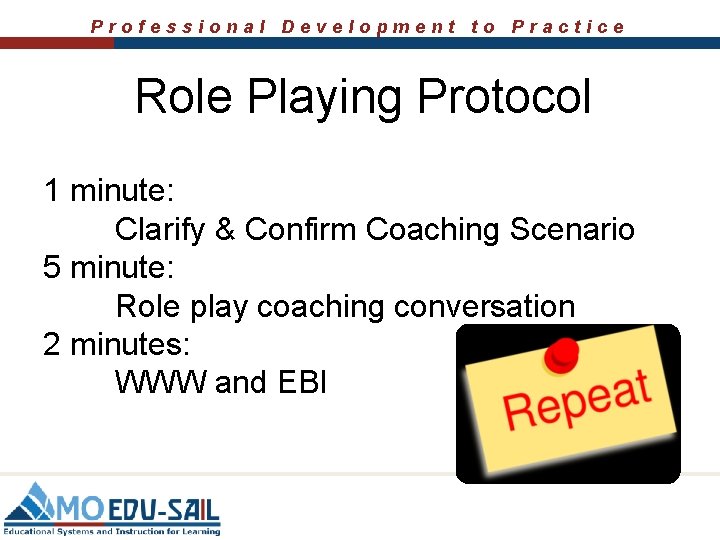
Professional Development to Practice Role Playing Protocol 1 minute: Clarify & Confirm Coaching Scenario 5 minute: Role play coaching conversation 2 minutes: WWW and EBI
Visual Anchor Professional Development to Practice
Professional Development to Practice Debrief Hmmm…. . What squares with your thinking? Name 3 points you’ll remember. What’s still circling around in your mind?
Professional Development to Practice GROW Your Teams Through Coaching Dr. Teresa Tulipana tulipanat@umkc. edu 816 -235 -5656 @ttulipana #kcrpdc The contents of this presentation were developed under a grant from the US Department of Education to the Missouri Department of Elementary and Secondary Education (#H 323 A 120018). However, these contents do not necessarily represent the policy of the US Department of Education, and you
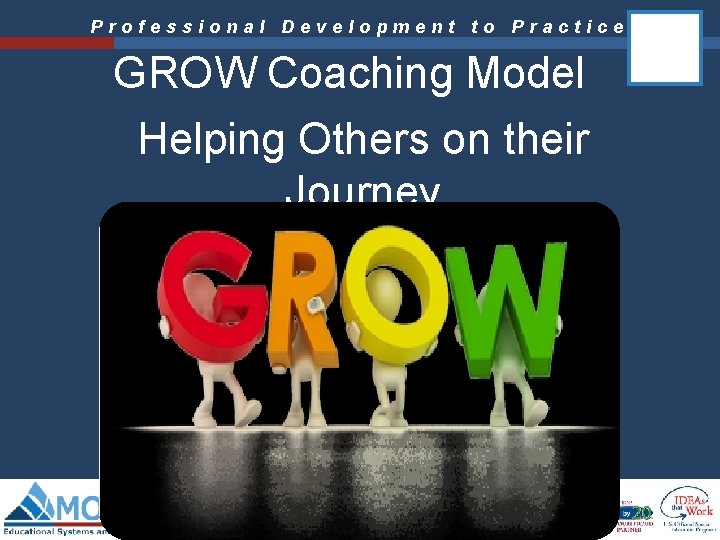
Professional Development to Practice GROW Coaching Model Helping Others on their Journey The contents of this presentation were developed under a grant from the US Department of Education to the Missouri Department of Elementary and Secondary Education (#H 323 A 120018). However, these contents do not necessarily represent the policy of the US Department of Education, and you