
Professional Development Seminar The Connection Between Reading Writing
Professional Development Seminar The Connection Between Reading, Writing and Content Sharyn Grace Texas A&M University- Commerce Reading Masters Comprehensive Exam October 17, 2014
“Over the last ten years research has shown that reading and writing are more interdependent than we thought. The relationship between reading and writing is a bit like that of the chicken and egg. Which came first is not as important as the fact that without one the other cannot exist. ” Joelle Brummitt-Yale (The Relationship Between Reading and Writing, 2014)
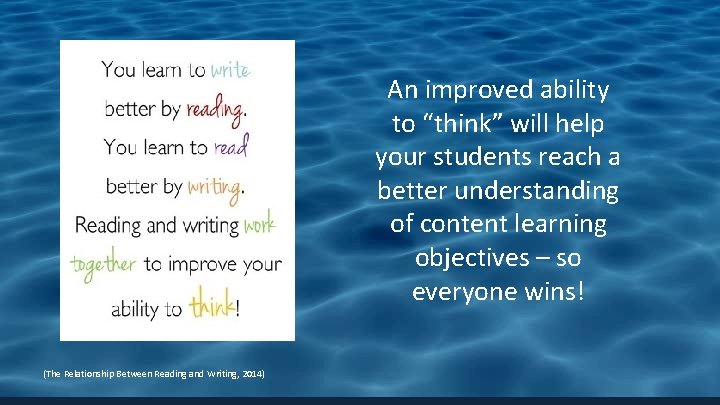
An improved ability to “think” will help your students reach a better understanding of content learning objectives – so everyone wins! (The Relationship Between Reading and Writing, 2014)
A Win-Win Approach Here's one way to look at it: Content is what we teach, but there is also the how, and this is where literacy instruction comes in. There an endless number of engaging, effective strategies to get students to think about, write about, read about, and talk about the content you teach. The ultimate goal of literacy instruction is to build a student's comprehension, writing skills, and overall skills in communication which will result in a better understanding of the content you teach. (The Relationship Between Reading and Writing, 2014)
How Reading Instruction Can Benefit Writing and Content Instruction ü When students read, they get ideas that can help them write. ü Reading can increase student vocabulary knowledge which helps with both writing and content understanding. ü Reading improves student grammar, punctuation and spelling. (The Relationship Between Reading and Writing, 2014)
How Writing Instruction Can Benefit Reading and Content Instruction ü Writing is an opportunity for students to analyze and explore the meaning of texts read. ü Writing can be used to discover meaning and to understand communicate. understanding to other students and the teacher. ü Writing can enhance retention of information. ü Writing can be a method to scaffold long text. (The Relationship Between Reading and Writing, 2014)
How Reading and Writing Are the Same ü Reading and writing both involve constructing meaning. ü Reading and writing are both thinking processes. ü Improvement in one can lead to improvement in the other. (The Relationship Between Reading and Writing, 2014)
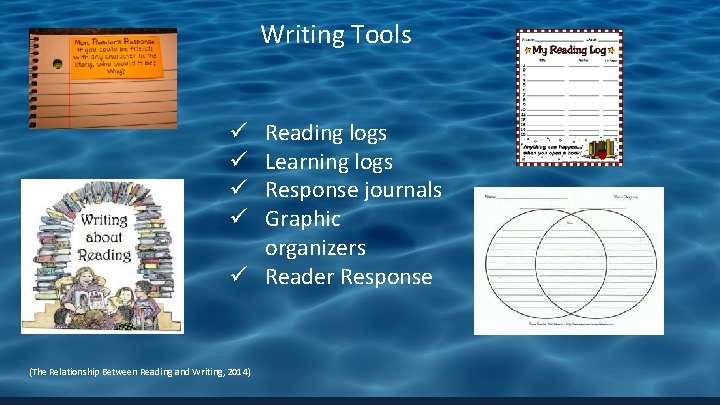
Writing Tools Reading logs Learning logs Response journals Graphic organizers ü Reader Response ü ü (The Relationship Between Reading and Writing, 2014)
Suggestions for Writing Instruction ü Teachers should write side-by-side with students on a regular basis. ü Writer’s Workshops should be created that follows the writing process, and puts the writer in charge of content, voice and structure. ü Teachers should create a student profile that contains samples of work and charts improvements. ü Writing should be displayed for student recognition. (The Relationship Between Reading and Writing, 2014)
Suggestions for Reading Instruction ü ü ü ü ü Text-to-self connections for student Predictions and activation of prior knowledge Assessments to identify reading deficiencies Phonics instruction when needed Before, During and After reading strategies Guided reading and buddy reading Think-Pair-Share reading strategy Direct teaching of genre and text organization Abundance of all types of books in the classroom A profile should be developed with samples to track reading improvement. (The Relationship Between Reading and Writing, 2014)
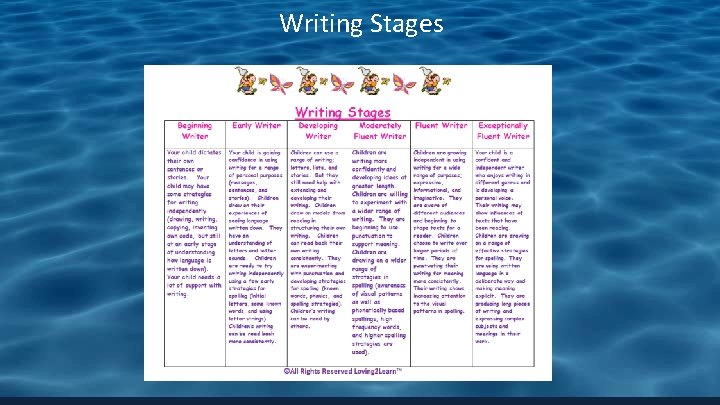
Writing Stages
The Complex Processes Influence Reading The Reading Process is a process that occurs between the reader and your content text which impacts meaning, comprehension and interpretation. This is accomplished in the mind of the reader based on: ü Knowledge about the topic ü Purpose for reading either aesthetic or efferent ü Culturally based expectations about the text ü Language community and how the language matches the text ü Previous life experience (Peterson, 2014)
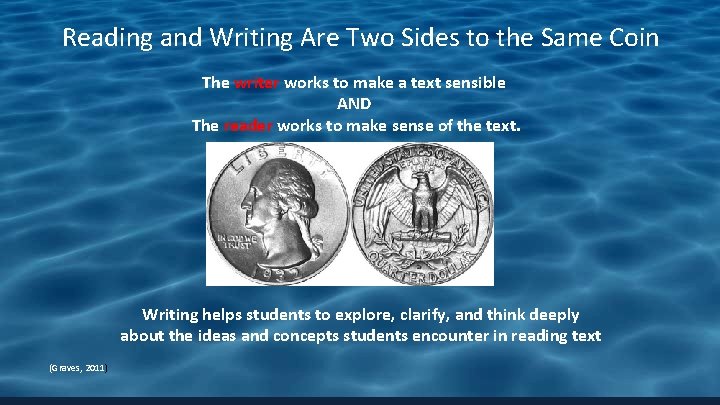
Reading and Writing Are Two Sides to the Same Coin The writer works to make a text sensible AND The reader works to make sense of the text. Writing helps students to explore, clarify, and think deeply about the ideas and concepts students encounter in reading text (Graves, 2011)
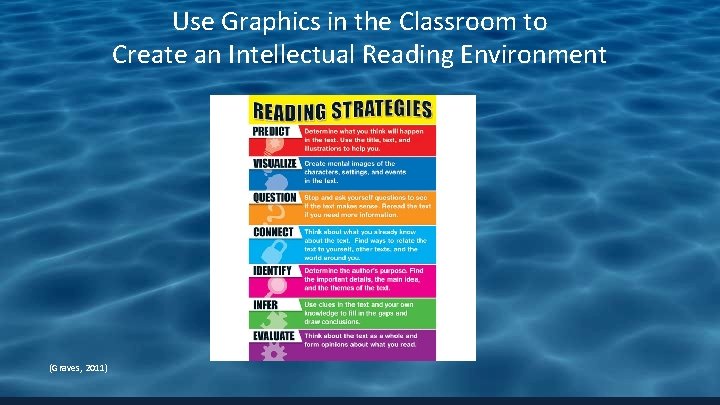
Use Graphics in the Classroom to Create an Intellectual Reading Environment (Graves, 2011)
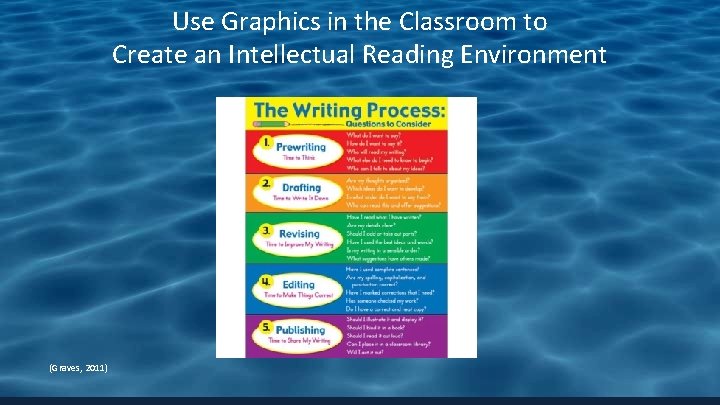
Use Graphics in the Classroom to Create an Intellectual Reading Environment (Graves, 2011)
Stage 1 of the Reading and Writing Processes The Reading Process The Writing Process Pre-Reading Brainstorming Choose books What would I like to write about? Activate background knowledge Pictures, lists, drawings, etc. Set purposes Organizing Plan for reading Choose a topic and organize thoughts Consider form, audience, topic and purpose (Peterson, 2014)
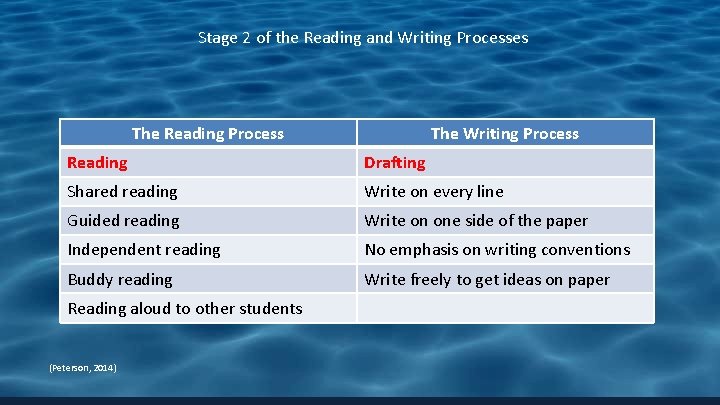
Stage 2 of the Reading and Writing Processes The Reading Process The Writing Process Reading Drafting Shared reading Write on every line Guided reading Write on one side of the paper Independent reading No emphasis on writing conventions Buddy reading Write freely to get ideas on paper Reading aloud to other students (Peterson, 2014)
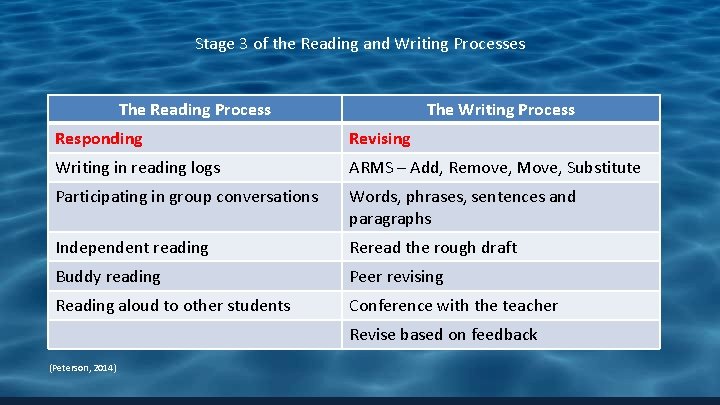
Stage 3 of the Reading and Writing Processes The Reading Process The Writing Process Responding Revising Writing in reading logs ARMS – Add, Remove, Move, Substitute Participating in group conversations Words, phrases, sentences and paragraphs Independent reading Reread the rough draft Buddy reading Peer revising Reading aloud to other students Conference with the teacher Revise based on feedback (Peterson, 2014)
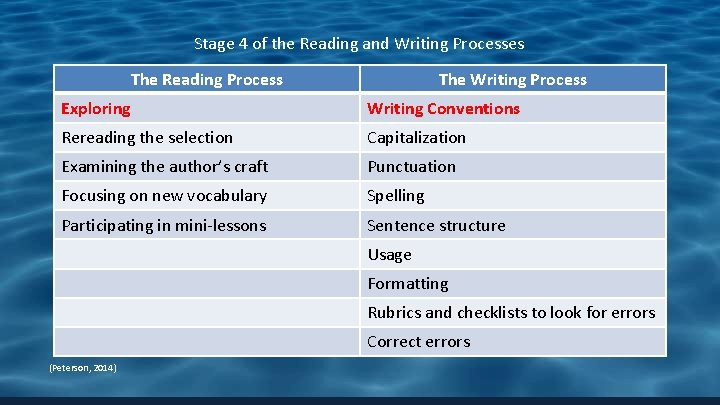
Stage 4 of the Reading and Writing Processes The Reading Process The Writing Process Exploring Writing Conventions Rereading the selection Capitalization Examining the author’s craft Punctuation Focusing on new vocabulary Spelling Participating in mini-lessons Sentence structure Usage Formatting Rubrics and checklists to look for errors Correct errors (Peterson, 2014)
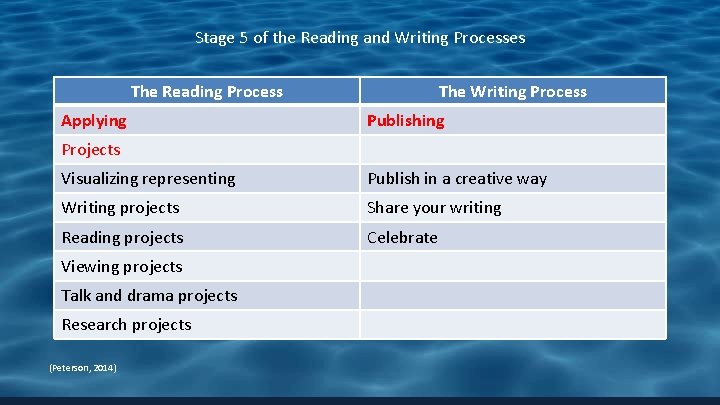
Stage 5 of the Reading and Writing Processes The Reading Process Applying The Writing Process Publishing Projects Visualizing representing Publish in a creative way Writing projects Share your writing Reading projects Celebrate Viewing projects Talk and drama projects Research projects (Peterson, 2014)
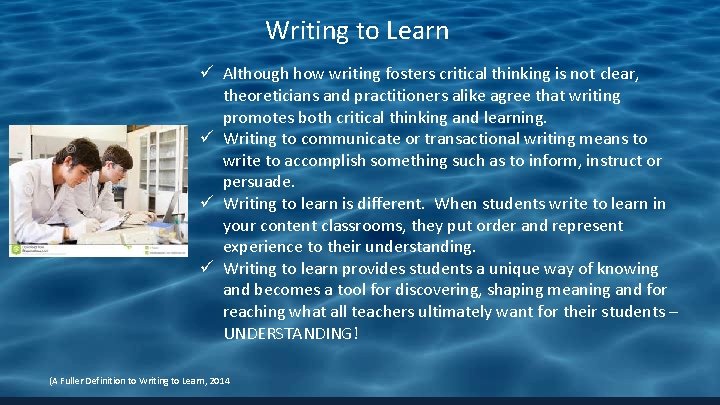
Writing to Learn ü Although how writing fosters critical thinking is not clear, theoreticians and practitioners alike agree that writing promotes both critical thinking and learning. ü Writing to communicate or transactional writing means to write to accomplish something such as to inform, instruct or persuade. ü Writing to learn is different. When students write to learn in your content classrooms, they put order and represent experience to their understanding. ü Writing to learn provides students a unique way of knowing and becomes a tool for discovering, shaping meaning and for reaching what all teachers ultimately want for their students – UNDERSTANDING! (A Fuller Definition to Writing to Learn, 2014
The Integrated Approach Instead of a fragmented approach, try an integrated approach that reflects the perspective of content literacy in content, reading and writing instruction. All three can occur at the same time. This requires comprehensive thinking on your part about what content literacy learning could be and should be, rather than reducing content area literacy to a mere imposition of a set of skills and activities. (Raudenbush, 2014)
What All Great Teachers Do! (Graves, 2011) The best teachers: ü employ a rich combination of skills instruction (phonemic awareness, phonics, comprehension, discussion about content text, writing about what they read. ü teach a lot. They work hard and their students work hard. ü employ a combination of well-planned, small-group activities and whole-class instruction. ü scaffold students’ efforts so that if students put significant effort into learning, they will be successful. ü employ higher-order thinking. ü integrate reading and writing instruction with language arts and the content area they teach. ü motivate students continually and prominently and repeatedly recognize students’ work.
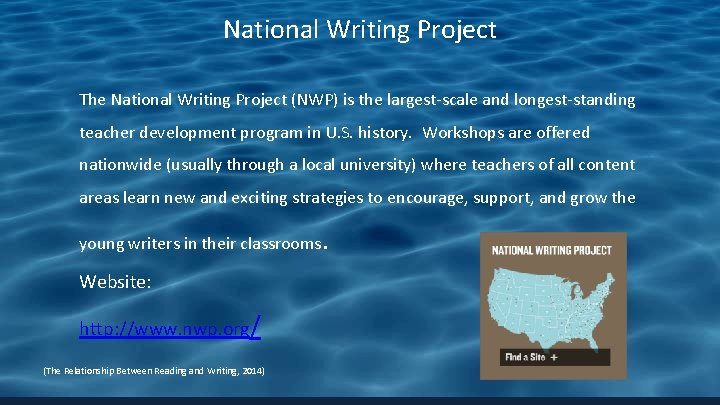
National Writing Project The National Writing Project (NWP) is the largest-scale and longest-standing teacher development program in U. S. history. Workshops are offered nationwide (usually through a local university) where teachers of all content areas learn new and exciting strategies to encourage, support, and grow the young writers in their classrooms. Website: http: //www. nwp. org/ (The Relationship Between Reading and Writing, 2014)
Any questions?
References Fuller Definition to Writing to Learn. (2014) Retrieved from wac. colostate. edu: http: //wac. colostate. edu/intro/pop 4 a. cfm Graves, M. (2011). Teaching Reading in the 21 st Century: Motivating All Learners. Boston: Allyn & Bacon. http: //www. lovetolearn. net/ https: //images. search. yahoo. com/search/images; _ylt=A 0 LEVx. FTuk. FUHIYAcjl. XNyo. A; _ylu=X 3 o. DMTB 0 OWZj. Y 3 Vu. BHNl. Yw. Nz. Yw. Rjb 2 xv. A 2 Jm. MQR 2 d. Glk. A 1 ZJUDUz MV 8 x? _adv_prop=image&fr=chrf-yff 30&sz=all&va=reading+writing Peterson, D. (2014). Reading and Writing Process. Retrieved from Powerhow. com: http: //www. powershow. com/view 1/ffd 1 b. ZDc 1 Z/Reading_and_Writing_Process_powerpoint_ppt_presentation Raudenbush, D. &. (2014). How to Help High School Students Struggling With Reading Comprehension. Retrieved from Global Post: http: //everydaylife. globalpost. com/high-school-students-struggling-reading-comprehension-6217. html The Relationship Between Reading and Writing. (2014). Retrieved from K 23 Reader: http: //www. k 12 reader. com/the-relationship-between-reading-andwriting/
- Slides: 26