
Professional Communication The Art of Effective SelfPresentation and
- Slides: 19
Professional Communication The Art of Effective Self-Presentation and Management of Personal Goals
A Definition • What is Professional Communication? • Professional Communication is explicitly goal oriented • You have a learning, leadership or career goal in mind and have requests or need to seek advice from a specific individual or group of individuals that will help you to make progress toward that goal • You need to accomplish a task that is related to a role you have in a work, community or educational setting and can only accomplish that task by seeking the input or support of a specific individual or group of individuals • You believe that effective communication with peers or colleagues will strengthen your network and help you achieve/advance your career or educational goals
Examples • You approach a faculty member about a research project that you would like to join • You request a letter of recommendation from a faculty member for an internship in which you are really interested • You seek the advice of a senior in the Honors College who has been successful in securing several impressive internships and fellowships • You invite the Director of a nonprofit organization whose work you admire for coffee to talk about ways that you might get involved in the organization • You email the Executive Vice President of Student Affairs about an idea for a new student organization on campus • You were invited for an interview for a leadership position in a community organization and would like to follow up with a thank you note • You receive an invitation from the Dean of the Honors College to attend a networking event with an organization whose work aligns with your interests
Professional Communication = Effective Communication • Professional Communication IS Effective Communication because • You pay attention to specific elements that might affect how your message is perceived or decoded • You understand that you need to deliver a message in a way that it will be heard and respected • What are the critical elements? • Who is your audience? (make sure that you know the person’s title – Dr. XX, Professor XX, Dean XX, Mr/Mrs/Ms XX) • What is the specific message that you need to communicate? • What is the goal of your communication? What action do you want the person to whom you have communicated to take? What impression do you want them to have? • What is the context for your request (e. g. , how well do you know the person, is your request controversial)
General Guidelines • People respond better to positive and respectful communication than they do to demanding and entitled communication. If your goal is to motivate someone to respond to you, use the former • Using a more formal structure in your communication establishes a professional tone that will lead to more professional engagement • When communicating with faculty, titles are important - faculty members who have Ph. Ds or other doctoral degrees, should be referred to as “Dr. Jones” or “Professor Smith”. Not all faculty have doctoral degrees, so Professor Smith will work in all cases if you are not sure. • Outside of a higher education setting, you should also be aware of a person’s title and level of authority. If you are not sure, spend a little time doing background research to ensure that you address a person appropriately • Never refer to a person by his or her first name in a professional setting unless you are invited to do so
Form of your Communication: Email • If the context is professional (e. g. , emailing a professor, administrator, supervisor, co-worker), you should avoid casual formatting and language • Make sure there is a salutation: “Dear Professor Smith” • Use full sentences, pay attention to grammar and punctuation • Don’t use casual language (e. g. “Hey Dr. Smith”) or emojis . Minimize (or eliminate use of exclamation points!) • Use respectful language that signifies the nature of your relationship with the person • Be polite and express gratitude for their time
Form of your Communication: Email • If the context is professional (e. g. , emailing a professor, administrator, supervisor, co-worker), you need to be very clear about the intent of the email • Are you simply writing to inform or update the person? If so, state that fact at the beginning of the email and indicate that no response is necessary. After that is established, you can write a paragraph with the information you want to communicate • Do you have specific action that you are requesting (e. g. , you want to set up a meeting, you need the person’s help with a specific task)? If so, be very clear about your request. In other words, do not send a general question that require a long response. That type of communication should be done in person.
Form of your Communication: Email • If the context is professional (e. g. , emailing a professor, administrator, supervisor, co-worker), pay attention to the tone of your communication • If you are asking for specific action, use a conciliatory tone that signals your understanding that you are adding work to the person’s schedule that he or she had not anticipated • If you need advice, support, or the intervention of the person, avoid a demanding or entitled tone • Be cognizant of communication systems that might be in place. For example, most supervisors have administrative assistants who do their scheduling. If you know that to be true, copy that person on the email • If your email requires follow up, make sure you take responsibility for that rather than imposing it on the person to whom you are making the request • If someone sends you an email that requires follow up, do so immediately. Do not delay!
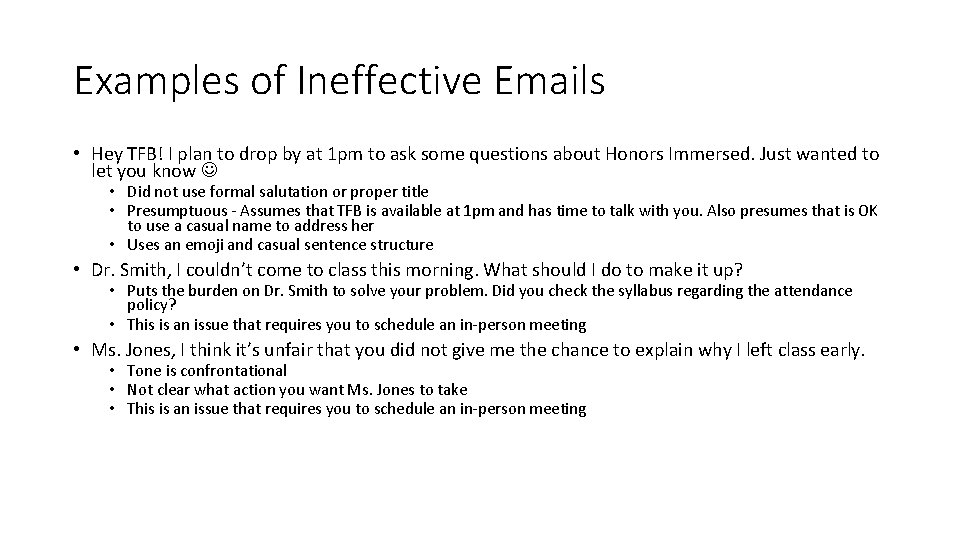
Examples of Ineffective Emails • Hey TFB! I plan to drop by at 1 pm to ask some questions about Honors Immersed. Just wanted to let you know • Did not use formal salutation or proper title • Presumptuous - Assumes that TFB is available at 1 pm and has time to talk with you. Also presumes that is OK to use a casual name to address her • Uses an emoji and casual sentence structure • Dr. Smith, I couldn’t come to class this morning. What should I do to make it up? • Puts the burden on Dr. Smith to solve your problem. Did you check the syllabus regarding the attendance policy? • This is an issue that requires you to schedule an in-person meeting • Ms. Jones, I think it’s unfair that you did not give me the chance to explain why I left class early. • Tone is confrontational • Not clear what action you want Ms. Jones to take • This is an issue that requires you to schedule an in-person meeting
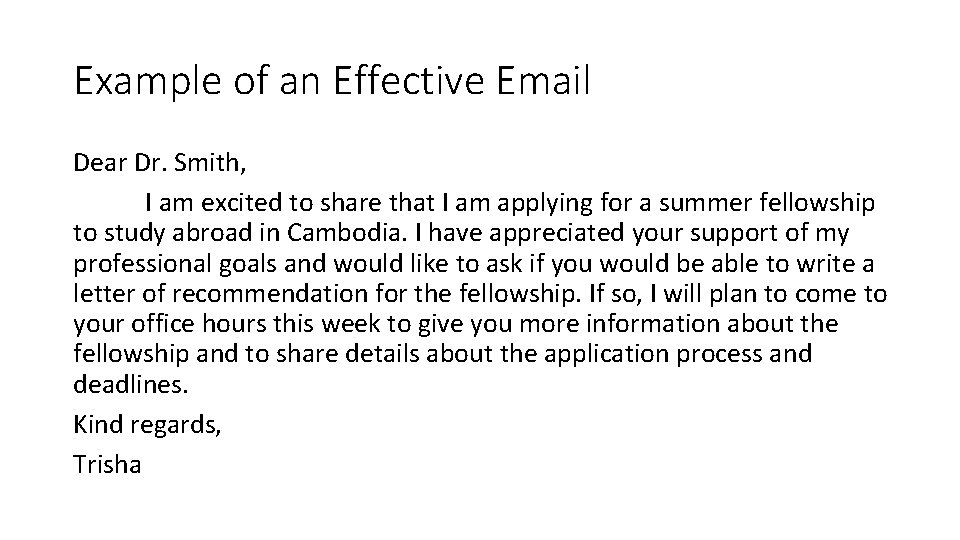
Example of an Effective Email Dear Dr. Smith, I am excited to share that I am applying for a summer fellowship to study abroad in Cambodia. I have appreciated your support of my professional goals and would like to ask if you would be able to write a letter of recommendation for the fellowship. If so, I will plan to come to your office hours this week to give you more information about the fellowship and to share details about the application process and deadlines. Kind regards, Trisha
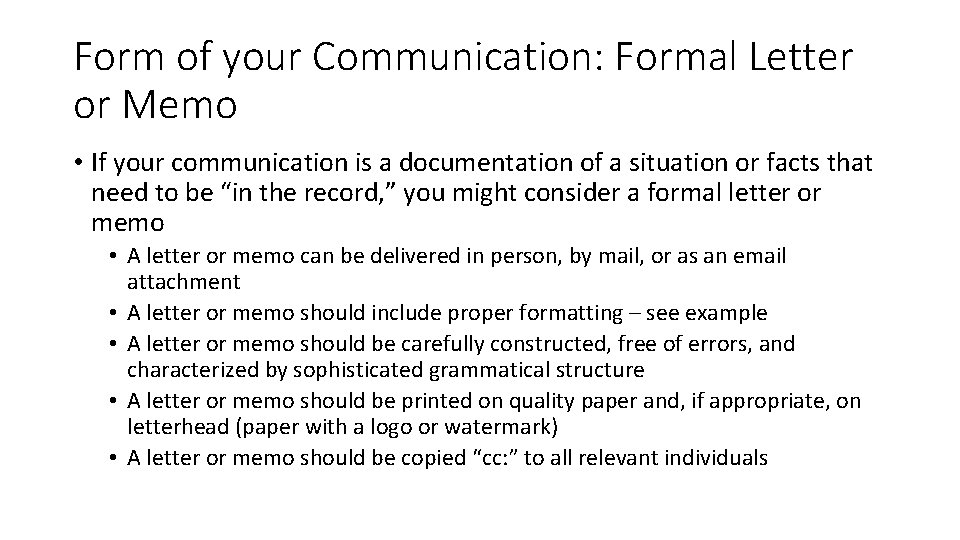
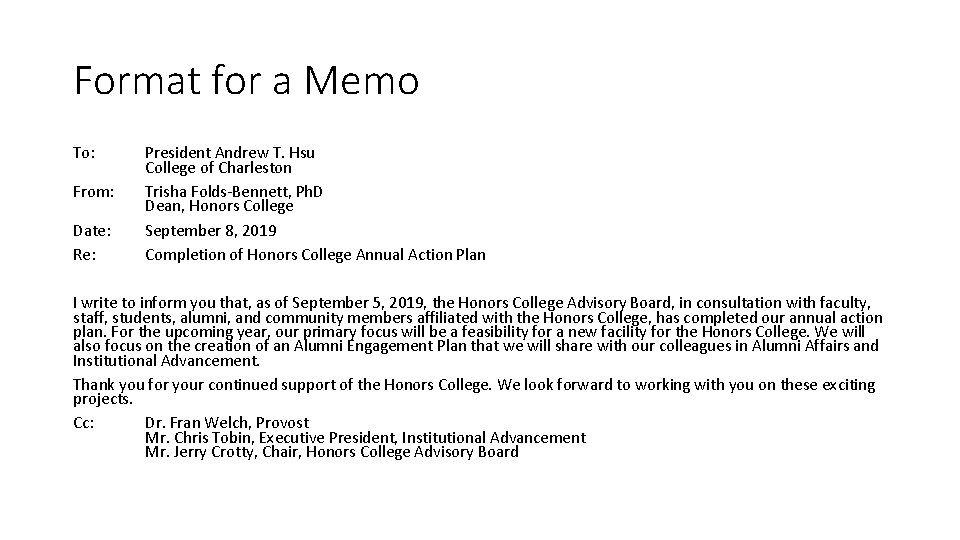
Form of your Communication: Formal Letter or Memo • If your communication is a documentation of a situation or facts that need to be “in the record, ” you might consider a formal letter or memo • A letter or memo can be delivered in person, by mail, or as an email attachment • A letter or memo should include proper formatting – see example • A letter or memo should be carefully constructed, free of errors, and characterized by sophisticated grammatical structure • A letter or memo should be printed on quality paper and, if appropriate, on letterhead (paper with a logo or watermark) • A letter or memo should be copied “cc: ” to all relevant individuals
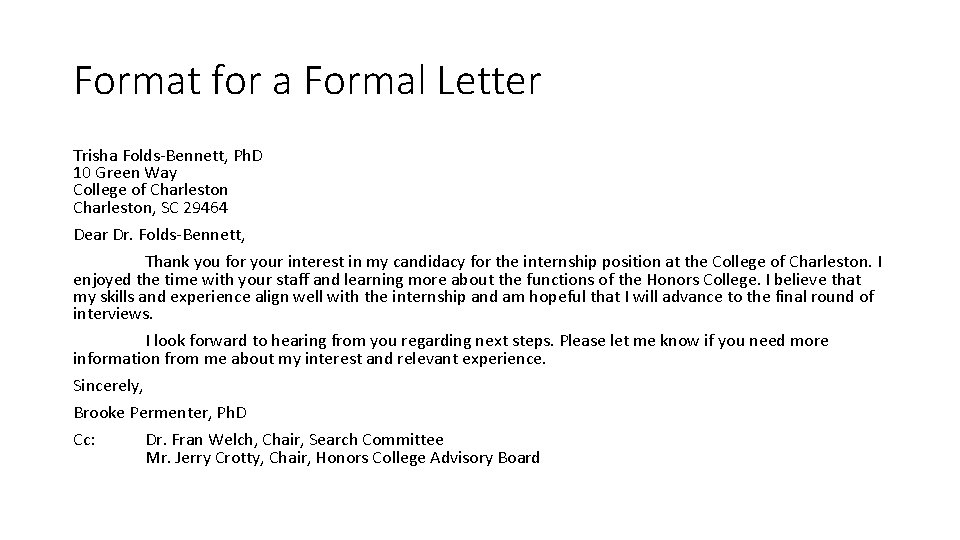
Format for a Formal Letter Trisha Folds-Bennett, Ph. D 10 Green Way College of Charleston, SC 29464 Dear Dr. Folds-Bennett, Thank you for your interest in my candidacy for the internship position at the College of Charleston. I enjoyed the time with your staff and learning more about the functions of the Honors College. I believe that my skills and experience align well with the internship and am hopeful that I will advance to the final round of interviews. I look forward to hearing from you regarding next steps. Please let me know if you need more information from me about my interest and relevant experience. Sincerely, Brooke Permenter, Ph. D Cc: Dr. Fran Welch, Chair, Search Committee Mr. Jerry Crotty, Chair, Honors College Advisory Board
Format for a Memo To: From: Date: Re: President Andrew T. Hsu College of Charleston Trisha Folds-Bennett, Ph. D Dean, Honors College September 8, 2019 Completion of Honors College Annual Action Plan I write to inform you that, as of September 5, 2019, the Honors College Advisory Board, in consultation with faculty, staff, students, alumni, and community members affiliated with the Honors College, has completed our annual action plan. For the upcoming year, our primary focus will be a feasibility for a new facility for the Honors College. We will also focus on the creation of an Alumni Engagement Plan that we will share with our colleagues in Alumni Affairs and Institutional Advancement. Thank you for your continued support of the Honors College. We look forward to working with you on these exciting projects. Cc: Dr. Fran Welch, Provost Mr. Chris Tobin, Executive President, Institutional Advancement Mr. Jerry Crotty, Chair, Honors College Advisory Board
Form of your Communication: Handwritten Note • If you have been hosted to a meal, reception, or other social engagement by someone in a professional role, you might consider a handwritten note. Also, if the person has done a specific favor for you (e. g. , has written a letter of recommendation, has introduced you to someone who might facilitate a career goal), you might consider a handwritten note • In all cases, you should thank a person who has done a personal favor for you • Handwritten thank you notes should still use formal language and formatting (no smiley faces, minimal !) • Handwritten notes should be on plain stationary (without flowers, other graphics). It is OK if the stationary has a simple monogram or border • Use your neatest cursive handwriting – no printing and no messiness!
Form of your Communication: In-Person • If you need support, advice, or intervention (e. g. , you have a problem that needs to be solved, you need advice on how to navigate a complicated situation, you need to share information that is confidential, you need to ask a specific favor – for a letter of recommendation, for a seat in a class, for permission to miss a required event), your best means of communication will be in person • Understand that a person in a professional role, has a busy work day so just dropping in is not the best approach. Dropping in during office hours is OK • Scheduling an appointment is the best approach • Make sure you are fully prepared with all the necessary information when you arrive at your meeting
Social Media • Recognize that although social media is a casual form of communication, it is often used in professional settings • Often, companies or organizations that are interviewing candidates will check social media accounts to make sure the candidate is a good fit for the job • If you do not want your social media account to affect your professional goals, carefully set privacy settings so only your friends and family are privy to what you post • If you do not want your social media account to affect your professional goals, pay careful attention to what you post, making sure that it reflects the type of person you would be in a professional setting
Know Thyself: Self Awareness Facilitates Effective Communication • Reflect on your core competencies and values so that are able to articulate your goals more clearly – use your Clifton Strengths results as a tool in this reflection • Give some thought to how you want to present yourself – consider your goals and the impression you want to convey • Remember that body language matters as much as your words. In any professional context (including class), consider the message you send through your actions, your posture, your eye contact and facial expression, etc • Develop the habit of reflecting on the way you communicate with others and what style of communication is most effective in yielding the results that you want to achieve
Practice Makes Perfect • Seek roles on campus and in the community that require professional communication • Honors Engaged is structured in such a way that professional communication is essential. Use the strategies that we recommend in this presentation when you are communicating with your peer liaison and with the staff in the organization with whom you are working • Apply for positions as Peer Facilitator, Honors Engaged Liaison, Honors College Office Intern when they are posted • Take leadership roles in organizations on campus • Participate in leadership development programs through the Higdon Leadership Center • Use every opportunity to put into practice the basic principles of effective communication that have been conveyed in this presentation
Practice NOW makes Perfect Becoming an Honors Student Ambassador is a leadership role in which current students will interact with prospective students and their families. This interaction will take place through various activities such as: • Individual meetings with prospective students, • Honors Information Sessions, • Recruitment Events, • Honors College Interview Weekend, • And much more! Honors Student Ambassadors have the unique opportunity of sharing their “What made Cof. C Honors the right choice for you? ” and “What do you like most about Cof. C Honors? ” stories with prospective students. If you are interested in becoming an Honors Student Ambassador, please send an email indicating your interest to pittsam@cofc. edu.