
PROFESSIONAL CAPITAL How educational leadership works to promote

- Slides: 12
PROFESSIONAL CAPITAL How educational leadership works to promote student learning Reference: Andy Hargreaves & Michael Fullan, Professional Capital (2012)
Proposition #1 The central role of leadership in schools is the development of the ‘professional capital’ of the staff
Proposition #2 The smart use of data is at the heart of the development of ‘professional capital’
Proposition #3 Nothing changes if you don’t do something differently Don’t be ‘data-driven’, be ‘data-informed’
2 DIFFERENT VIEWS OF ‘CAPITAL’ Why you sometimes know something is wrong, but can’t put your finger on why…
The Business Capital View: Good teaching: • May be emotionally demanding but is technically simple • Is a quick study requiring only moderate intellectual ability • Is hard at first but with dedication is mastered readily • Should be driven by hard performance data about what works and where best to target one’s efforts • Comes down to enthusiasm, hard work, raw talent and measurable results • Is often replaceable by online instruction
The Professional Capital View: Good teaching: • Is technically sophisticated and difficult • Requires high levels of education and long periods of training • Is perfected through continuous improvement • Involves wise judgment informed by evidence and experience • Is a collective accomplishment and responsibility • Maximises, mediates and moderates online instruction.
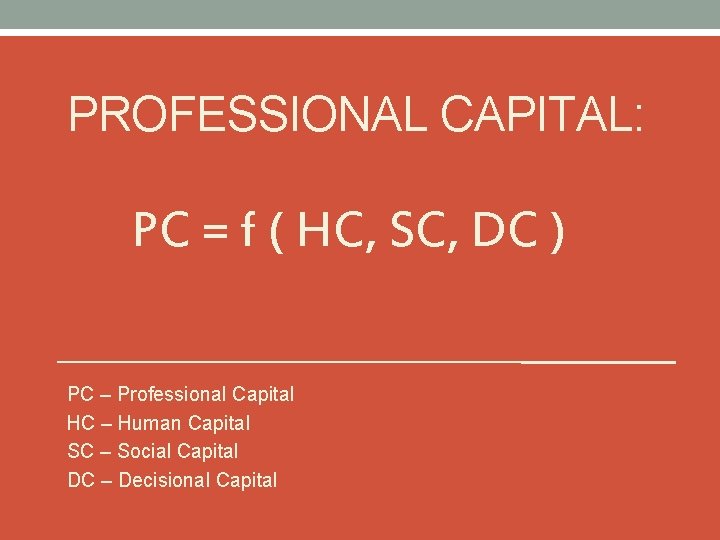
PROFESSIONAL CAPITAL: PC = f ( HC, SC, DC ) PC – Professional Capital HC – Human Capital SC – Social Capital DC – Decisional Capital
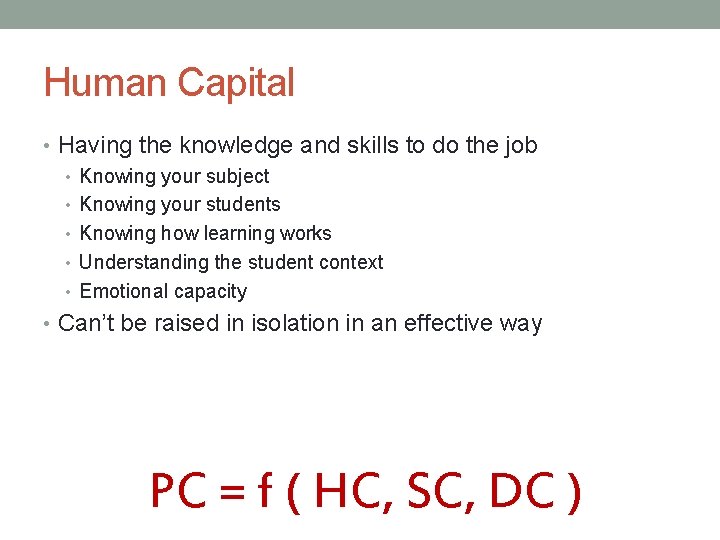
Human Capital • Having the knowledge and skills to do the job • Knowing your subject • Knowing your students • Knowing how learning works • Understanding the student context • Emotional capacity • Can’t be raised in isolation in an effective way PC = f ( HC, SC, DC )
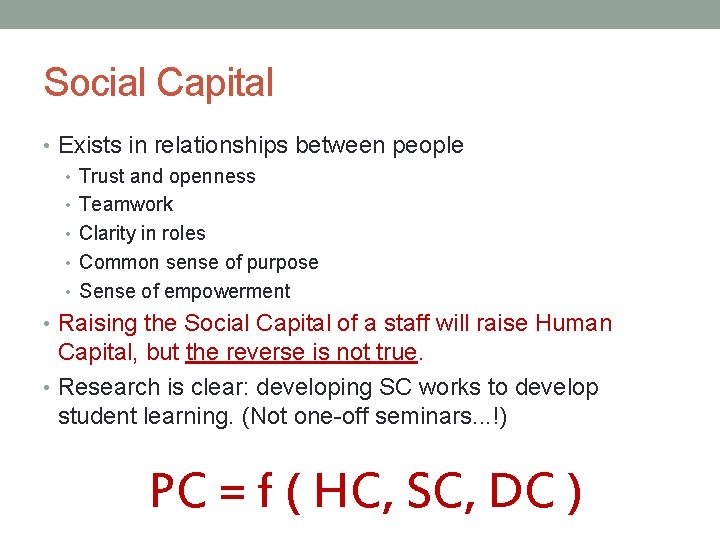
Social Capital • Exists in relationships between people • Trust and openness • Teamwork • Clarity in roles • Common sense of purpose • Sense of empowerment • Raising the Social Capital of a staff will raise Human Capital, but the reverse is not true. • Research is clear: developing SC works to develop student learning. (Not one-off seminars. . . !) PC = f ( HC, SC, DC )
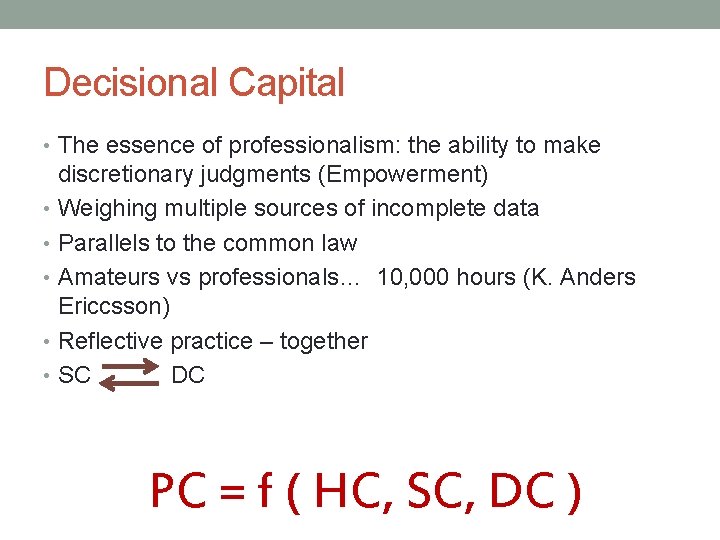
Decisional Capital • The essence of professionalism: the ability to make discretionary judgments (Empowerment) • Weighing multiple sources of incomplete data • Parallels to the common law • Amateurs vs professionals… 10, 000 hours (K. Anders Ericcsson) • Reflective practice – together • SC DC PC = f ( HC, SC, DC )
HOW DO WE UNPACK THE ROLE OF DATA USE IN THIS? … the ‘Data Divide’, with the Hart Data to explain.