
Professional and Business Ethics Prof Peter Hadreas Spring
Professional and Business Ethics Prof. Peter Hadreas Spring, 2014 Course Website: http: //www. sjsu. edu/people/peter. hadreas/courses/P rofand. Bus. Ethics/ 1
Specific Workplace Ethical Troublespots Human Resources Issues – ‘People Issues’ Treviño and Nelson textbook, pp. 113 -148. 2
Discrimination Issues Treviño and Nelson textbook, pp. 114 -122 3
Discrimination Issues Three Conditions of Workplace Prejudicial Discrimination 1. A decision is made about an employee not by merit, but about employee’s membership in a group. 2. The decision assumes employee’s group is morally inferior and thereby deserving of unequal treatment. 3. The decision causes the employee harm. 4
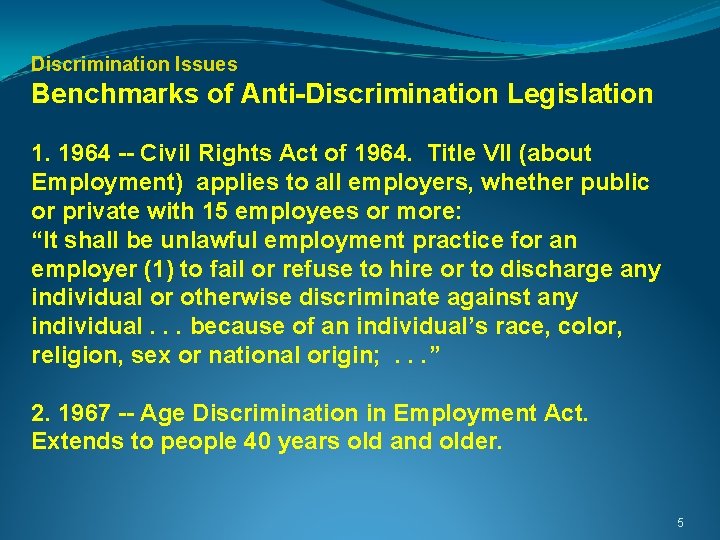
Discrimination Issues Benchmarks of Anti-Discrimination Legislation 1. 1964 -- Civil Rights Act of 1964. Title VII (about Employment) applies to all employers, whether public or private with 15 employees or more: “It shall be unlawful employment practice for an employer (1) to fail or refuse to hire or to discharge any individual or otherwise discriminate against any individual. . . because of an individual’s race, color, religion, sex or national origin; . . . ” 2. 1967 -- Age Discrimination in Employment Act. Extends to people 40 years old and older. 5
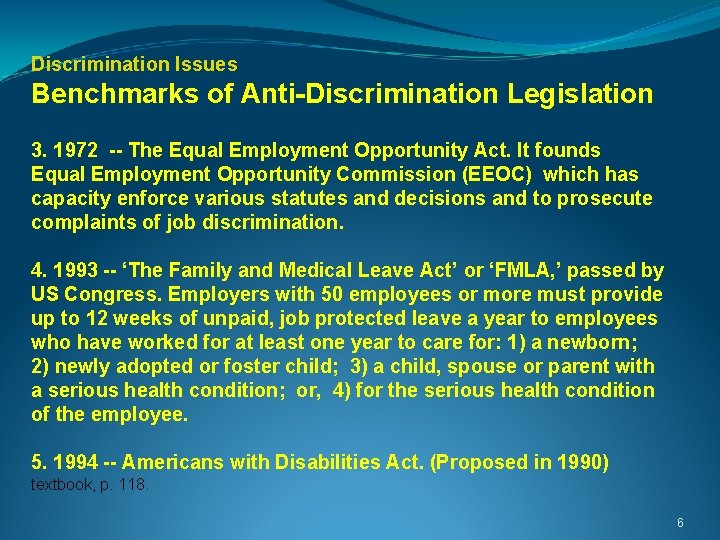
Discrimination Issues Benchmarks of Anti-Discrimination Legislation 3. 1972 -- The Equal Employment Opportunity Act. It founds Equal Employment Opportunity Commission (EEOC) which has capacity enforce various statutes and decisions and to prosecute complaints of job discrimination. 4. 1993 -- ‘The Family and Medical Leave Act’ or ‘FMLA, ’ passed by US Congress. Employers with 50 employees or more must provide up to 12 weeks of unpaid, job protected leave a year to employees who have worked for at least one year to care for: 1) a newborn; 2) newly adopted or foster child; 3) a child, spouse or parent with a serious health condition; or, 4) for the serious health condition of the employee. 5. 1994 -- Americans with Disabilities Act. (Proposed in 1990) textbook, p. 118. 6
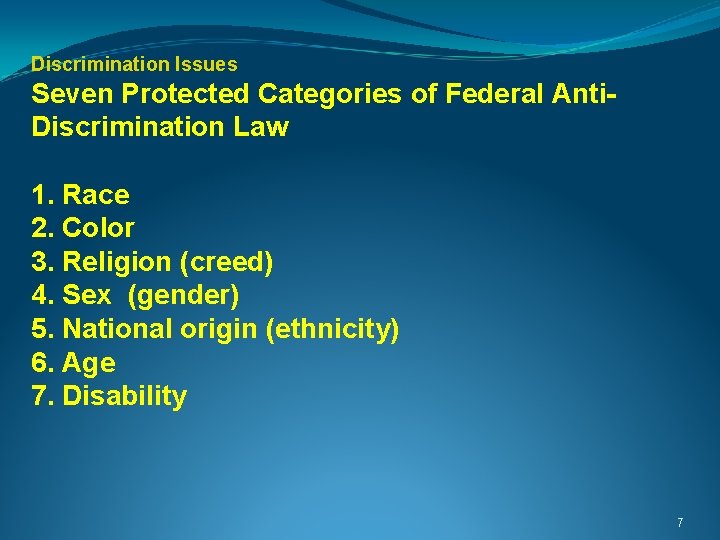
Discrimination Issues Seven Protected Categories of Federal Anti. Discrimination Law 1. Race 2. Color 3. Religion (creed) 4. Sex (gender) 5. National origin (ethnicity) 6. Age 7. Disability 7
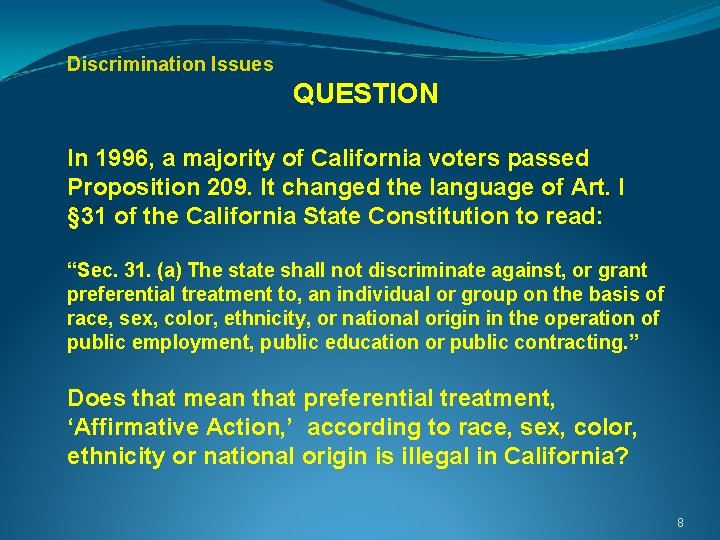
Discrimination Issues QUESTION In 1996, a majority of California voters passed Proposition 209. It changed the language of Art. I § 31 of the California State Constitution to read: “Sec. 31. (a) The state shall not discriminate against, or grant preferential treatment to, an individual or group on the basis of race, sex, color, ethnicity, or national origin in the operation of public employment, public education or public contracting. ” Does that mean that preferential treatment, ‘Affirmative Action, ’ according to race, sex, color, ethnicity or national origin is illegal in California? 8
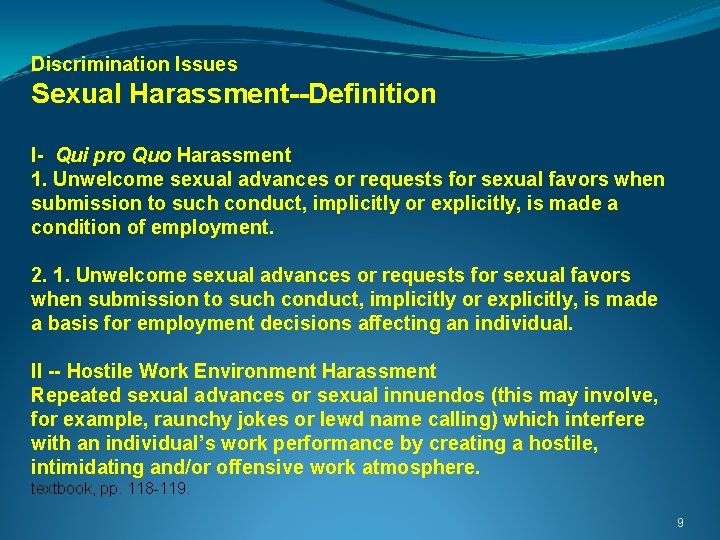
Discrimination Issues Sexual Harassment--Definition I- Qui pro Quo Harassment 1. Unwelcome sexual advances or requests for sexual favors when submission to such conduct, implicitly or explicitly, is made a condition of employment. 2. 1. Unwelcome sexual advances or requests for sexual favors when submission to such conduct, implicitly or explicitly, is made a basis for employment decisions affecting an individual. II -- Hostile Work Environment Harassment Repeated sexual advances or sexual innuendos (this may involve, for example, raunchy jokes or lewd name calling) which interfere with an individual’s work performance by creating a hostile, intimidating and/or offensive work atmosphere. textbook, pp. 118 -119. 9
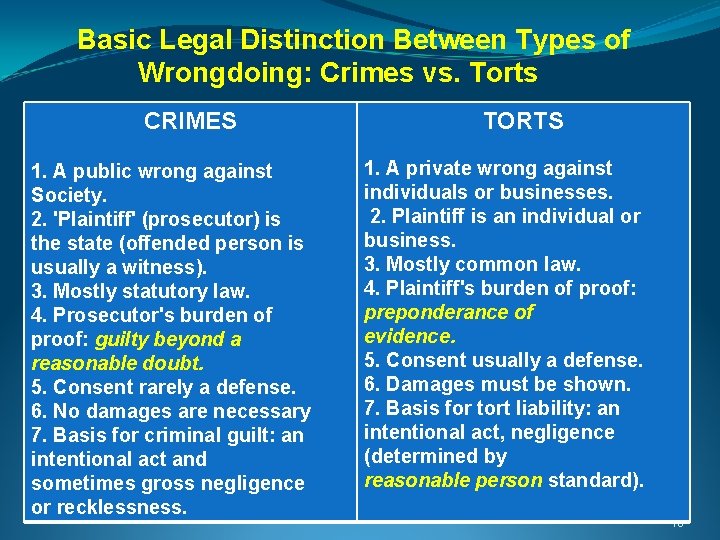
Basic Legal Distinction Between Types of Wrongdoing: Crimes vs. Torts CRIMES 1. A public wrong against Society. 2. 'Plaintiff' (prosecutor) is the state (offended person is usually a witness). 3. Mostly statutory law. 4. Prosecutor's burden of proof: guilty beyond a reasonable doubt. 5. Consent rarely a defense. 6. No damages are necessary 7. Basis for criminal guilt: an intentional act and sometimes gross negligence or recklessness. TORTS 1. A private wrong against individuals or businesses. 2. Plaintiff is an individual or business. 3. Mostly common law. 4. Plaintiff's burden of proof: preponderance of evidence. 5. Consent usually a defense. 6. Damages must be shown. 7. Basis for tort liability: an intentional act, negligence (determined by reasonable person standard). 10
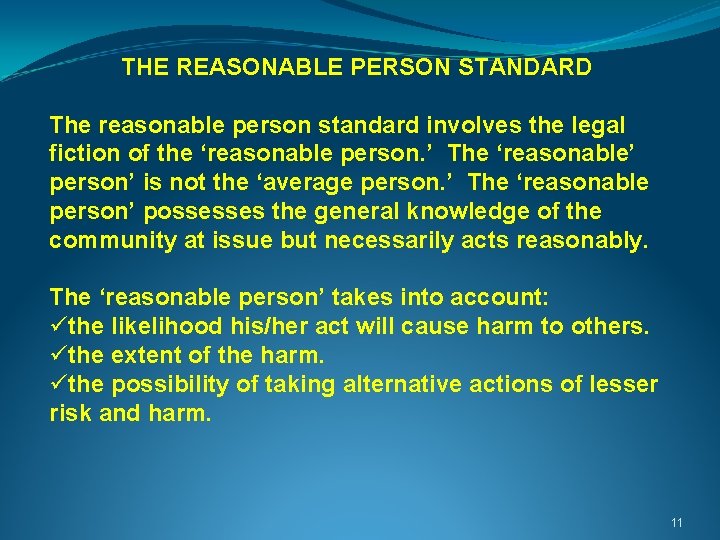
THE REASONABLE PERSON STANDARD The reasonable person standard involves the legal fiction of the ‘reasonable person. ’ The ‘reasonable’ person’ is not the ‘average person. ’ The ‘reasonable person’ possesses the general knowledge of the community at issue but necessarily acts reasonably. The ‘reasonable person’ takes into account: üthe likelihood his/her act will cause harm to others. üthe extent of the harm. üthe possibility of taking alternative actions of lesser risk and harm. 11
Applying the Reasonable Person Standard in Sexual Harassment Cases: The Reasonable Woman Standard? 12
Ellison vs. Brady (1991, Ninth Circuit Court Appeals Case) “Kerry Ellison worked as a revenue agent for the Internal Revenue Service in San Mateo, California. During her initial training in 1984 she met Sterling Gray, another trainee, who was also assigned to the San Mateo office. The two co-workers never became friends, and they did not work closely together. . In June of 1986 when no one else was in the office, Gray asked Ellison to lunch. She accepted. Gray had to pick up his son's forgotten lunch, so they stopped by Gray's house. He gave Ellison a tour of his house. ” 13
Ellison vs. Brady (1991, Ninth Circuit Court Appeals Case) “Ellison alleges that after the June lunch Gray started to pester her with unnecessary questions and hang around her desk. On October 9, 1986, Gray asked Ellison out for a drink after work. She declined, but she suggested that they have lunch the following week. She did not want to have lunch alone with him, and she tried to stay away from the office during lunch time. ” 14
Ellison vs. Brady (1991, Ninth Circuit Court Appeals Case) “October 22, 1986 Gray handed Ellison a note he wrote on a telephone message slip which read: “I cried over you last night and I'm totally drained today. I have never been in such constant term oil (sic). Thank you for talking with me. I could not stand to feel your hatred for another day. ” When Ellison realized that Gray wrote the note, she became shocked and frightened and left the room. ” 15
Ellison vs. Brady (1991, Ninth Circuit Court Appeals Case) “Ellison asked a male co-worker to talk to Gray, to tell him that she was not interested in him and to leave her alone. . on the following Monday, she started four weeks of training in St. Louis, Missouri. Gray mailed her a card and a typed, single-spaced, three-page letter. She describes this letter as "twenty times, a hundred times weirder" than the prior note. 16
Ellison vs. Brady (1991, Ninth Circuit Court Appeals Case) “Gray wrote, in part: “I know that you are worth knowing with or without sex. . Don't you think it odd that two people who have never even talked together, alone, are striking off such intense sparks. . . I will [write] another letter in the near future. ” Explaining her reaction, Ellison stated: "I just thought he was crazy. I thought he was nuts. I didn't know what he would do next. I was frightened. " 17
Ellison vs. Brady (1991, Ninth Circuit Court Appeals Case) included in decision of Robert R. Beezer and Alex Kozinski, Circuit Judges: “We adopt the standard of a reasonable woman because a sex-blind reasonable person standard tends to be male-biased and tends to systematically ignore the experiences of women. ”. . . “We reverse the district court's decision that Ellison did not allege a prima facie case of sexual harassment due to a hostile working environment. . ” 18
Sexual Harassment-Who’s Liable? An employer --or its agents or supervisory employees -- is liable when it knew or should have known of the conduct unless the employer can show it took immediate and appropriate corrective actions. Under current law, it’s difficult for an employer to claim lack of knowledge of offensive conduct, since if the employer had some knowledge of offensive incidents, the employer was obligated to investigate the reports. 19
Conflict of Interest Issues Treviño and Nelson textbook, pp. 122 -126 20
Conflict of Interest Defined “A conflict of interest occurs when your judgment or objectivity is compromised. The appearance of conflict of interest – when a third party could think your judgment has been compromised – is generally considered just as damaging as an actual conflict. ” Treviño and Nelson textbook, p. 123. 21
Conflict of Interest QUESTION Why do you think that ‘potential’, that is, merely the appearance of conflict of interest is illegal and unethical, along with actual conflict of interest? See Treviño and Nelson textbook, ”Why Is It an Ethical Problem? ” p. 126. 22
Conflict of Interest Issues ü ü Overt Bribes or Kickbacks Subtle “Bribes” Influence Privileged Information • Trade Secrets • Insider Trading Treviño and Nelson textbook, pp. 122 -127 23
Conflict of Interest Issues Overt Bribes or Kickbacks and Subtle ‘Bribes’ Defined Overt Bribe: remuneration or valuable goods offered to person(s) for favorable consideration in a future transaction. The remuneration or goods are outside of the work contract. Overt Kickback: the payment of an additional percentage of cost, outside of the work contract, to person(s) that are able to influence or control the source of income. Subtle 'Bribes': Gifts, outside the work contract, which create a sense of preferentiality, indebtedness or favoritism towards a client or vendor. Treviño and Nelson textbook, pp. 123 -4. 24
Conflict of Interest Issues Influence – Personal conflict of interest “Your relationship with someone in itself can constitute a conflict of interest. For example, if you’re in charge of purchasing corporate advertising and your cousin or neighbor or college friend owns an advertising agency, it will be considered a conflict if you make the decision to hire than firm. That doesn’t preclude the firm from the bidding, but it does preclude you from making the decision. ” Treviño and Nelson textbook, p. 124. 25
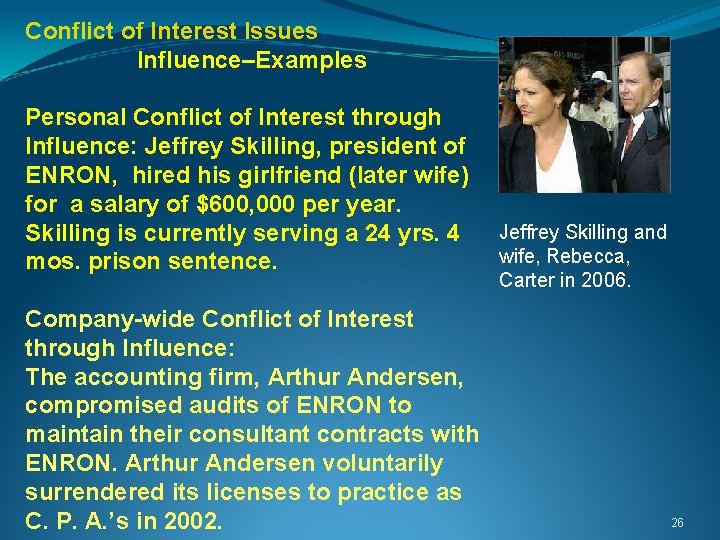
Conflict of Interest Issues Influence–Examples Personal Conflict of Interest through Influence: Jeffrey Skilling, president of ENRON, hired his girlfriend (later wife) for a salary of $600, 000 per year. Skilling is currently serving a 24 yrs. 4 mos. prison sentence. Company-wide Conflict of Interest through Influence: The accounting firm, Arthur Andersen, compromised audits of ENRON to maintain their consultant contracts with ENRON. Arthur Andersen voluntarily surrendered its licenses to practice as C. P. A. ’s in 2002. Jeffrey Skilling and wife, Rebecca, Carter in 2006. 26
Conflict of Interest Issues Privileged Information Trade Secrets Unlike copyrights (owned for life of author + 50 years), patents (owned 17 years) and trademarks (owned 10 years but renewable), trade secrets last as long as they can be kept secret. The formula for Coca-Cola, for example, is a legendary trade secret. The formula is not patented. It is ‘owned’ by being kept secret. Any formula, pattern, device or compilation of information which gives a company an advantage over its competitors can count as a trade secret. Employees who disclose such trade secrets violate the confidentiality owed to their employers. 27
Conflict of Interest Issues Privileged Information Insider Trading -- Defined “The buying or selling of stocks or other securities by business ‘insiders’ on the basis of information that has not yet been made public and is likely to affect the price of the stock. ” Shaw, William H. and Barry, Vincent, Moral Issues in Business, 11 th Ed. (Belmont, CA: Wadsworth, 2010), p. 542. 28
Conflict of Interest Issues Privileged Information Insider Trading – Who’s an ‘Insider? ’ Corporate executives, directors, officers and other key employees are insiders. Employees a company temporarily employs such as accountants, lawyers, and contractors. Shaw, William H. and Barry, Vincent, Moral Issues in Business, 11 th Ed. (Belmont, CA: Wadsworth, 2010), p. 542. 29
Conflict of Interest Issues Privileged Information Insider Trading – Who’s an ‘Insider? ’ Non-insiders can still be prosecuted for insider trading if they’re outsiders who’ve obtained their information from an insider who breaches a legal duty to the corporation’s shareholders for personal gain or to show favor to friends. Shaw, William H. and Barry, Vincent, Moral Issues in Business, 11 th Ed. (Belmont, CA: Wadsworth, 2010), p. 543. 30
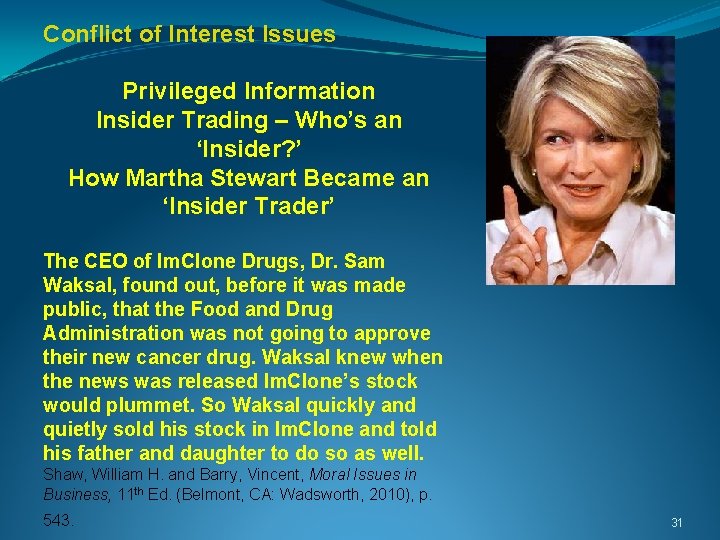
Conflict of Interest Issues Privileged Information Insider Trading – Who’s an ‘Insider? ’ How Martha Stewart Became an ‘Insider Trader’ The CEO of Im. Clone Drugs, Dr. Sam Waksal, found out, before it was made public, that the Food and Drug Administration was not going to approve their new cancer drug. Waksal knew when the news was released Im. Clone’s stock would plummet. So Waksal quickly and quietly sold his stock in Im. Clone and told his father and daughter to do so as well. Shaw, William H. and Barry, Vincent, Moral Issues in Business, 11 th Ed. (Belmont, CA: Wadsworth, 2010), p. 543. 31
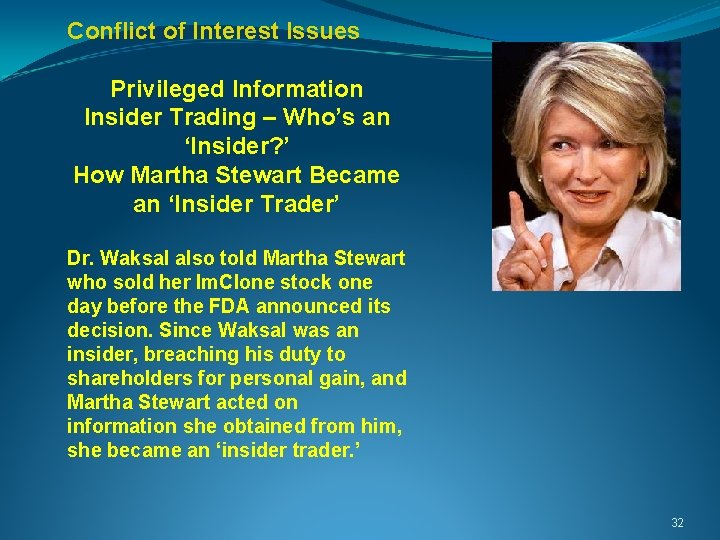
Conflict of Interest Issues Privileged Information Insider Trading – Who’s an ‘Insider? ’ How Martha Stewart Became an ‘Insider Trader’ Dr. Waksal also told Martha Stewart who sold her Im. Clone stock one day before the FDA announced its decision. Since Waksal was an insider, breaching his duty to shareholders for personal gain, and Martha Stewart acted on information she obtained from him, she became an ‘insider trader. ’ 32
Conflict of Interest Issues Privileged Information Insider Trading – What’s Wrong With It? Conflict of of interest problem: ‘Insider’s or company associate’s financial gain is made at the expense of the company’s shareholders. Free trade problem: ‘Insider’ information undermines the possibility that outsider investors have an equal opportunity to research and prudently select investments. 33
Specific Workplace Issues: (Textbook, Chapter 4) Main Areas (Continued): > Use of Corporate Resources (pp. 131 -136) > Blowing the Whistle (pp. 138 -144) 34
Use of Corporate Resources ü Use of Corporate Reputation ü Corporate Financial Resources ü Providing Honest Information Treviño and Nelson textbook, pp. 131 - 136. 35
Use of Corporate Resources ü Use of Corporate Reputation 1. Company letterheads should only be used for company business. 2. Posting sensitive information about your boss or coworker on social networking sites can be interpreted as you’re speaking as as employee of your company. As a result discrimination and privacy issues arise. 3. Dealing with reporters. This is tricky business and shouldn’t be attempted by a novice. What “off the record” means: For the most part this means the reporter won’t quote you directly or attribute any remarks to you. But, you can’t tell a reporter that your remarks are off the record after the fact. But the very best way to make sure that your remarks are off the record is not give the information to the reporter. Treviño and Nelson textbook, pp. 132 - 134. 36
Use of Corporate Resources ü Use of Corporate Financial Resources Simile II [a software company] provides an ethics game entitled: “Where Do You Draw the Line. ” One of the scenarios: Which of the following is justifiable: 1. Taking $10 worth of pencils from your company and distributing them to poor children. 2. Making $10 worth of long-distance calls at work. 3. Taking $10 from the petty cash drawer. None of them. The bottom line is that corporate equipment and services should be used only for company purposes. Treviño and Nelson textbook, pp. 134 - 135. 37
Use of Corporate Resources ü Proving Honest Information Issue often arises as managers feel it necessary to put a positive spin on financial reports. Understand that putting a ‘positive spin’ on financial data can have serious consequences since senior management may make crucial decision based on flawed data. Further, in the case of the manager wishing to delay expenses until after he or she leaves the area, s/he not only harms the person who is taking his place. It’s grossly unfair to ask supplier to wait almost 60 extra days before getting paid. Treviño and Nelson textbook, pp. 135 - 136. 38
When All Else Fails: Blowing the Whistle 39
How to Blow the Whistle 1. Approach Your Immediate Manager First. (Generally do should bring up the issue a few times if left unheeded at first. In a second attempt, speel out your concerns in a memo. ) 2. Discuss the Issue with Your Family. (Can affect your family as well as yourself. Keep a diary of the activities related to the issue). textbook, pp. 140 - 144. 40
How to Blow the Whistle 3. Take it to the next level. (Even though there’s been no satisfaction from your supervisor, generally a good idea to ask her/him if s/he’ll go with you to the next level of management. ) 4. Contact Your Company’s Ethics Officer or Ombudsman. (Also find out your state’s protections for whistle-blowers. See Sarbane’s Oxley legislation -- applies to publicly traded corporations. See MBE, p. 143) Treviño and Nelson textbook, pp. 140 - 144. 41
How to Blow the Whistle 5. Consider Going Outside Your Chain of Command. (Does issue apply to Human Resources? Internal auditors? Legal department? 6. Go Outside of the Company. (Contact regulators? Press? Understand effect on whistle-blowers of False Claims Act; understand same by Dodd-Frank Wall Street Reform and Consumer Protection Act, (MBE, pp. 142 -3) Treviño and Nelson textbook, pp. 140 - 144. 42
How to Blow the Whistle 7. Leave the Company. (“Whistle-blowing is so stressful that in one study, one-third of whistle-blowers surveyed would advise other people not to blow the whistle at all. ” MBE, p. 144. ) But, what sort of situations might make leaving the company not conscionable? An alternative: find another job and then blow the whistle. Treviño and Nelson textbook, pp. 140 - 144. 43
Ethics as Organizational Culture Corresponds to chapter five of Nelson and Treviño textbook. 44
1. slide # 26, photo of Jeffrey Skilling and his wife, Rebecca Carter: www. usatoday. com/money/ industries/energy/2006. . . 2. slides # 31 and 32, photo of Martha Stewart: http: //roccosrevolution. com/2011/01/31/martha-stewart-wasnt-put-on-this-earth-to-danceand-sing/ 45
- Slides: 45