
Professional Agency and Creativity in Information Technology Work
- Slides: 13
Professional Agency and Creativity in Information Technology Work EARLI sig 14, 2016 Susanna Paloniemi, Kaija Collin & Sanna Herranen University of Jyväskylä, Finland
Background v. Global competition, structural reforms, management cultures with tightened accountability, decreased professional autonomy, and a higher employee workload (Anderson et al. , 2014; Sohlberg et al. , 2007) v. Employees seem to have less control over their work and are in danger of losing their professional agency (Eteläpelto et al. , 2014; Harteis et al. , 2014) v. Need for creativity in responding to the demands of a rapidlychanging and efficiency-driven working life – especially within the information technology (IT) domain (Ulrich & Mengiste, 2014). v. The importance of exploring manifestations of professional agency and creativity in everyday work (e. g. Caldwell, 2007; Ci, 2011).
Professional agency and creativity v Professional agency is here understood as intentional choices and actions (Eteläpelto et al. , 2013; Vähäsantanen et al. , 2016) concerning work and work practices v Further, professional agency is seen as relational and temporally situational (Archer, 2003; Glăveanu, 2011). v Creativity is approached as an everyday creativity (Forsman et al. , 2014)
The aim of the study v The importance of professional agency and creativity has been acknowledged, yet their relations are relatively understudied both empirically and qualitatively. v We explore relations between professional agency and creativity in two Finnish IT organisations through asking: 1. How does the IT personnel in this study describe creativity in their everyday work? 2. How is professional agency manifested in the creative work practices of the IT personnel?
CREANCY project (2015– 2016) Leadership as an enabler of creative professional agency in information technology organisations v. Exploring connections between professional agency, creativity, and leadership in everyday information technology work in Finland. v. An ethnographic and mixed-method approach applied in a development research project implemented in two IT organisations. v. Funded by The Finnish Work Environment Fund
Data and analysis v Data utilised here v 34 audio-recorded interviews with staff members (e. g daily work practices, sources of motivation, challenges, opportunities to influence, creativity, and leadership). vopen-ended questionnaire responses of 89 staff members regarding the question “What is creativity in your work? ”. v A qualitative thematic analysis (e. g. Braun & Clarke, 2006) in line with the two research questions proposed. v. A researcher triangulation utilized in the analysis
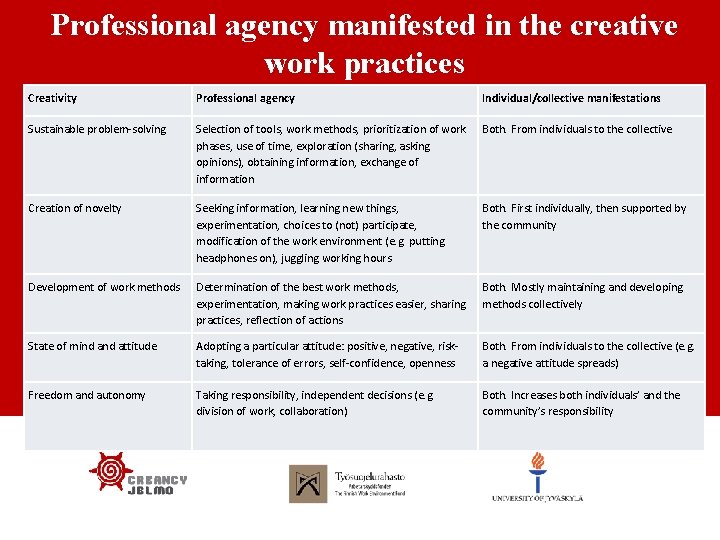
Creativity in IT work v Five themes describing creativity at IT work: 1) sustainable problem-solving 2) creation of novelty 3) development of work methods 4) one’s own state of mind attitude 5) freedom and autonomy at work v Creativity as: i) work practices, ii) individual capabilities, and iii) a social structure at the work community
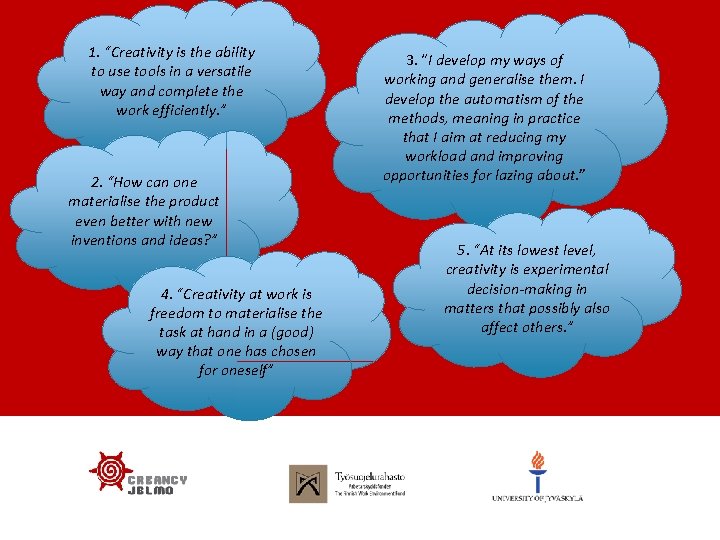
1. “Creativity is the ability to use tools in a versatile way and complete the work efficiently. ” 2. “How can one materialise the product even better with new inventions and ideas? ” 4. “Creativity at work is freedom to materialise the task at hand in a (good) way that one has chosen for oneself” 3. “I develop my ways of working and generalise them. I develop the automatism of the methods, meaning in practice that I aim at reducing my workload and improving opportunities for lazing about. ” 5. “At its lowest level, creativity is experimental decision-making in matters that possibly also affect others. ”
Professional agency manifested in the creative work practices Creativity Professional agency Individual/collective manifestations Sustainable problem-solving Selection of tools, work methods, prioritization of work phases, use of time, exploration (sharing, asking opinions), obtaining information, exchange of information Both. From individuals to the collective Creation of novelty Seeking information, learning new things, experimentation, choices to (not) participate, modification of the work environment (e. g. putting headphones on), juggling working hours Both. First individually, then supported by the community Development of work methods Determination of the best work methods, experimentation, making work practices easier, sharing practices, reflection of actions Both. Mostly maintaining and developing methods collectively State of mind attitude Adopting a particular attitude: positive, negative, risktaking, tolerance of errors, self-confidence, openness Both. From individuals to the collective (e. g. a negative attitude spreads) Freedom and autonomy Taking responsibility, independent decisions (e. g. division of work, collaboration) Both. Increases both individuals’ and the community’s responsibility
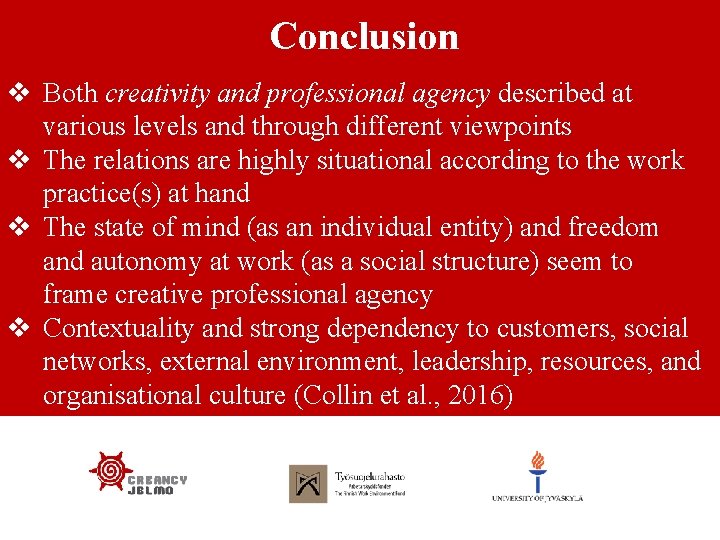
Conclusion v Both creativity and professional agency described at various levels and through different viewpoints v The relations are highly situational according to the work practice(s) at hand v The state of mind (as an individual entity) and freedom and autonomy at work (as a social structure) seem to frame creative professional agency v Contextuality and strong dependency to customers, social networks, external environment, leadership, resources, and organisational culture (Collin et al. , 2016)
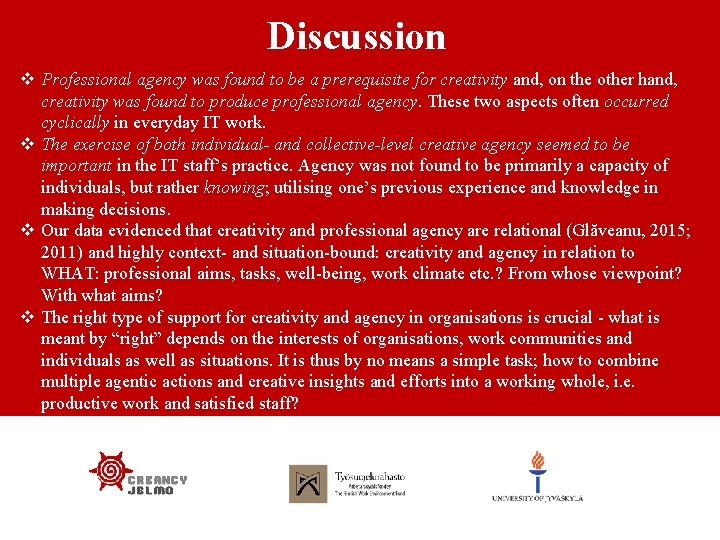
Discussion v Professional agency was found to be a prerequisite for creativity and, on the other hand, creativity was found to produce professional agency. These two aspects often occurred cyclically in everyday IT work. v The exercise of both individual- and collective-level creative agency seemed to be important in the IT staff’s practice. Agency was not found to be primarily a capacity of individuals, but rather knowing; utilising one’s previous experience and knowledge in making decisions. v Our data evidenced that creativity and professional agency are relational (Glăveanu, 2015; 2011) and highly context- and situation-bound: creativity and agency in relation to WHAT: professional aims, tasks, well-being, work climate etc. ? From whose viewpoint? With what aims? v The right type of support for creativity and agency in organisations is crucial - what is meant by “right” depends on the interests of organisations, work communities and individuals as well as situations. It is thus by no means a simple task; how to combine multiple agentic actions and creative insights and efforts into a working whole, i. e. productive work and satisfied staff?
References Anderson, N. , Potocnik, K. , and Zhou, J. 2014. Innovation and creativity in organizations: A state-of-the-science review, prospective commentary, and guiding framework. Journal of Management, 40(5), 1297– 1333. Archer, 2003. Structure, agency and the internal conversation. Cambridge: Cambridge University Press. Braun, V. and Clarke, V. 2006. Using thematic analysis in psychology. Qualitative Research in Psychology, 3(2), 77– 101. Caldwell, R. 2007. Agency and change: re-evaluating Foucault’s legacy. Organization, 14(6), 769– 791. Ci, J. 2011. Evaluating agency: A fundamental question for social and political philosophy. Metaphilosophy, 42(3), 261– 281. Collin, K. , Auvinen, T. , Sintonen, T. , Riivari, E. , Herranen, S. & Paloniemi, S. 2016. What does leadership (or its imagined absence) mean for creativity and professional agency? An empirical study in (non) hierarchical organizations. Paper presented in AOM 5. -9. 8. 2016, Anaheim, USA. Eteläpelto, A. , Vähäsantanen, K. , Hökkä, P. and Paloniemi, S. 2013. What is agency? Conceptualizing professional agency at work. Educational Research Review, 10, 45– 65. Eteläpelto, A. , Vähäsantanen, K. , Hökkä, P. and Paloniemi, S. 2014. Identity and agency in professional learning. In S. Billett, C. Harteis & H. Gruber (eds. ), International Handbook of Research in Professional and Practice-based Learning: 645– 672. Dordrecht: Springer. Forsman, P. , Collin, K. and Eteläpelto, A. 2014. The practice of professional agency and the emergence of collaborative creativity in developmental staff meetings. In C. Harteis, A. Rausch & J. Seifried (eds. ), Discourses on Professional Learning: On the Boundary Between Learning and Working: 45– 74. Dordrecht: Springer Glăveanu, V. P. 2011. How are we creative together? Comparing sociocognitive and sociocultural answers. Theory & Psychology, 21(4), 473 -492. Glăveanu, V. P. 2015. From individual agency to co-agency. In C. W. Gruber et al. (Eds. ) Constraints of Agency. Annals of Theoretical Psychology 12. Springer International Publishing Switzerland, 245 -265. Harteis, C. , Rausch, A. and Seifried, J. 2014. (eds). Discourses on Professional Learning: On the Boundary Between Learning and Working, Dordrecht: Springer, pp. 45– 74. Järvensivu, A. and Alasoini, T. 2012. Mitä työelämän muutoksen tulevaisuussuuntautunut tut-kimus voisi olla? [What could future-orientated research of working life change be? ] Työpoliittinen Aikakauskirja 2 [Work Policy Review 2]. Publication of the Ministry of Employment and the Economy, Finland. Sohlberg, P. , et al. 2007. Professional expertise under restructuring: comparative studies of education and health care. Report. http: //www. gu. se/digital. Assets/1321780_profknow_wp 3. pdf. Ulrich, F. and Mengiste, S. A. 2014. The challenges of creativity in software organizations. In B. Bergvall-Kåreborn & P. A. Nielsen (eds. ), Creating Value for All Through IT: 16– 34. Dordrecht: Springer. Vähäsantanen, K. , Hökkä, P. , Paloniemi, S. , Herranen, S. and Eteläpelto, A. 2016. Professional learning and agency in an identity coaching programme. Professional Development in Education (submitted)