
Prof Uri Littauer Lecture Changes in the brain
Prof. Uri Littauer Lecture: Changes in the brain during chronic exposure to nicotine Studies on genes, receptor binding, proteins, drugs, cells, circuits, and behavior Henry Lester February, 2009 1/33
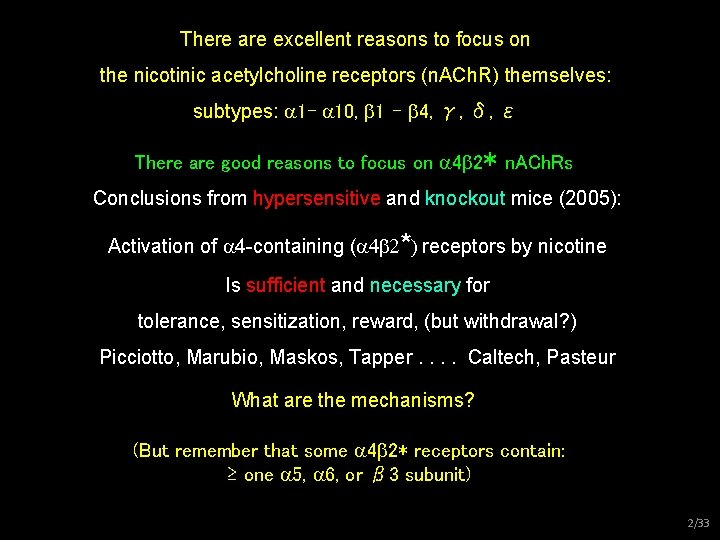
There are excellent reasons to focus on the nicotinic acetylcholine receptors (n. ACh. R) themselves: subtypes: 1 - 10, 1 - 4, γ, δ, ε There are good reasons to focus on 4 2* n. ACh. Rs Conclusions from hypersensitive and knockout mice (2005): Activation of 4 -containing ( 4 2*) receptors by nicotine Is sufficient and necessary for tolerance, sensitization, reward, (but withdrawal? ) Picciotto, Marubio, Maskos, Tapper. . Caltech, Pasteur What are the mechanisms? (But remember that some 4 2* receptors contain: ≥ one 5, 6, or β 3 subunit) 2/33
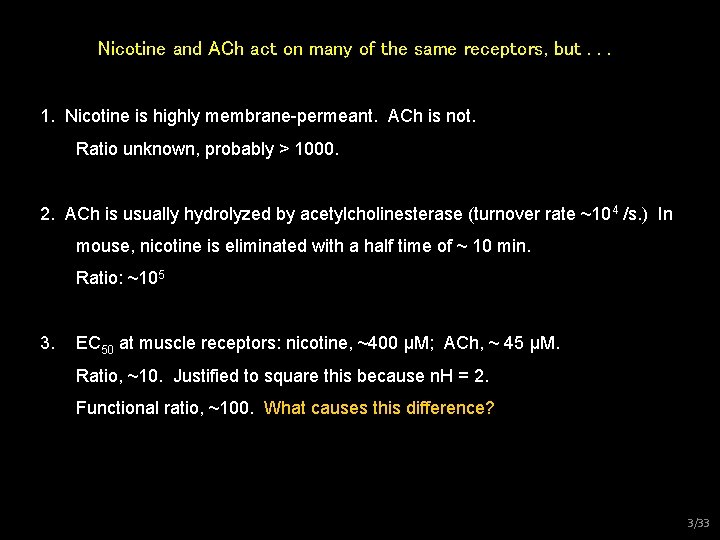
Nicotine and ACh act on many of the same receptors, but. . . 1. Nicotine is highly membrane-permeant. ACh is not. Ratio unknown, probably > 1000. 2. ACh is usually hydrolyzed by acetylcholinesterase (turnover rate ~104 /s. ) In mouse, nicotine is eliminated with a half time of ~ 10 min. Ratio: ~105 3. EC 50 at muscle receptors: nicotine, ~400 μM; ACh, ~ 45 μM. Ratio, ~10. Justified to square this because n. H = 2. Functional ratio, ~100. What causes this difference? 3/33
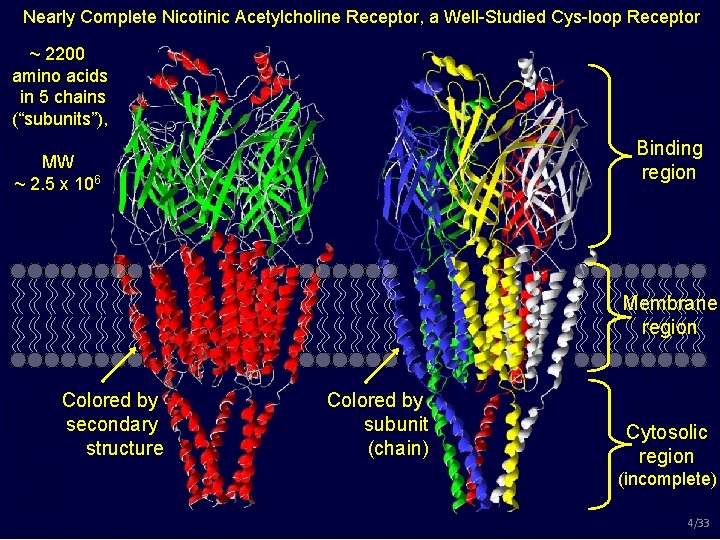
Nearly Complete Nicotinic Acetylcholine Receptor, a Well-Studied Cys-loop Receptor ~ 2200 amino acids in 5 chains (“subunits”), Binding region MW ~ 2. 5 x 10⁶ Membrane region Colored by secondary structure Colored by subunit (chain) Cytosolic region (incomplete) 4/33
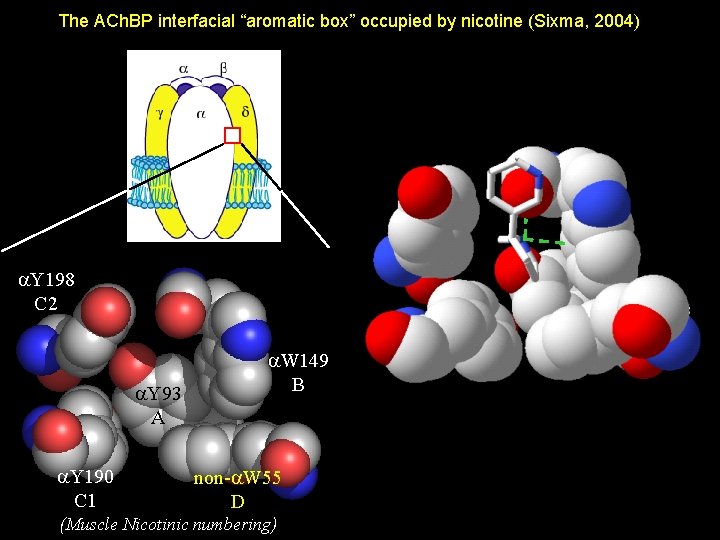
The ACh. BP interfacial “aromatic box” occupied by nicotine (Sixma, 2004) Y 198 C 2 Y 93 A Y 190 C 1 W 149 B non- W 55 D (Muscle Nicotinic numbering) 5/30
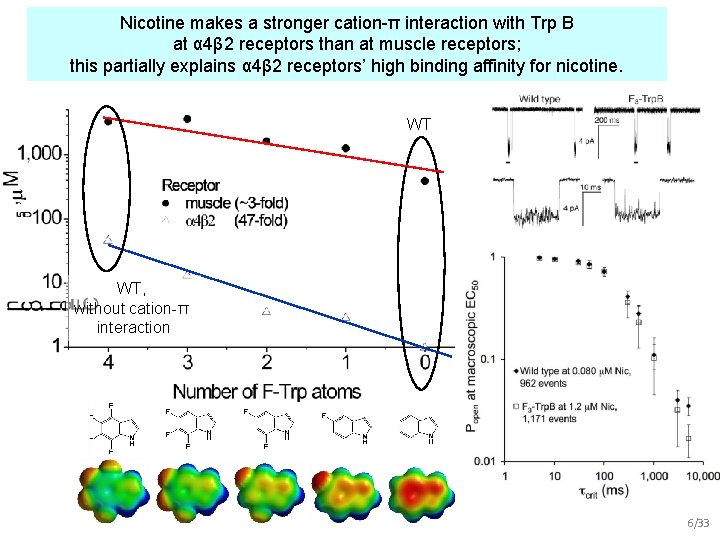
Nicotine makes a stronger cation-π interaction with Trp B at α 4β 2 receptors than at muscle receptors; this partially explains α 4β 2 receptors’ high binding affinity for nicotine. WT WT, without cation-π interaction 6/33
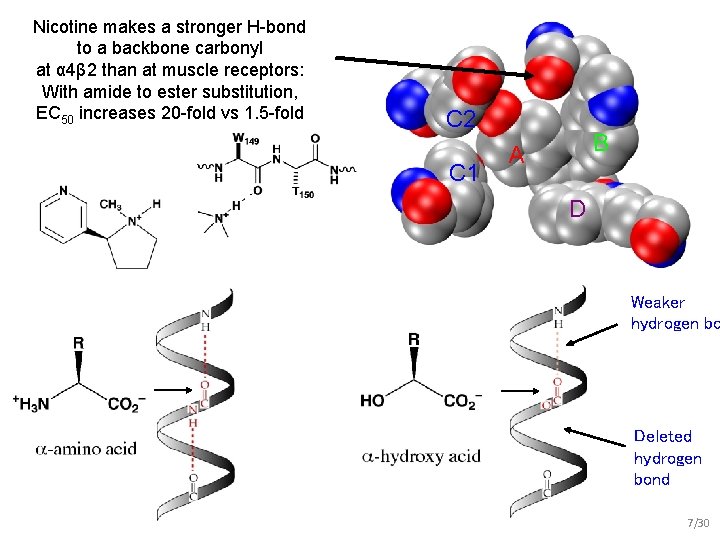
Nicotine makes a stronger H-bond to a backbone carbonyl at α 4β 2 than at muscle receptors: With amide to ester substitution, EC 50 increases 20 -fold vs 1. 5 -fold C 2 C 1 B A D Weaker hydrogen bo Deleted hydrogen bond 7/30
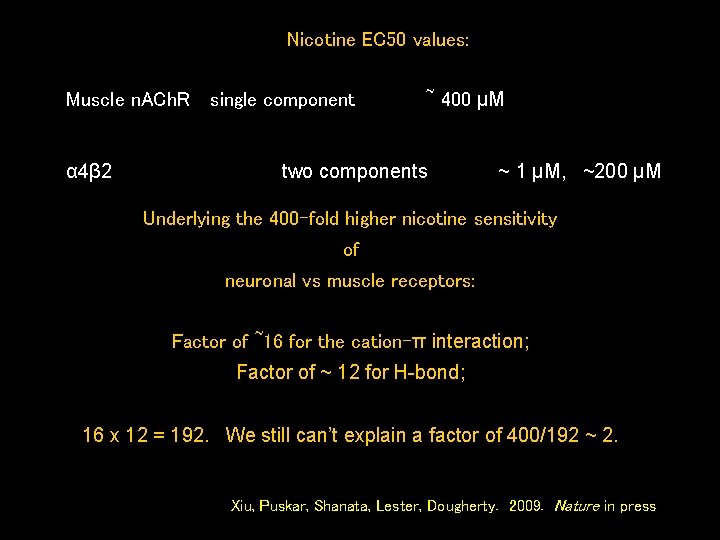
Nicotine EC 50 values: Muscle n. ACh. R α 4β 2 single component ~ 400 μM two components ~ 1 μM, ~200 μM Underlying the 400 -fold higher nicotine sensitivity of neuronal vs muscle receptors: Factor of ~16 for the cation-π interaction; Factor of ~ 12 for H-bond; 16 x 12 = 192. We still can’t explain a factor of 400/192 ~ 2. Xiu, Puskar, Shanata, Lester, Dougherty. 2009. Nature in press 8/30
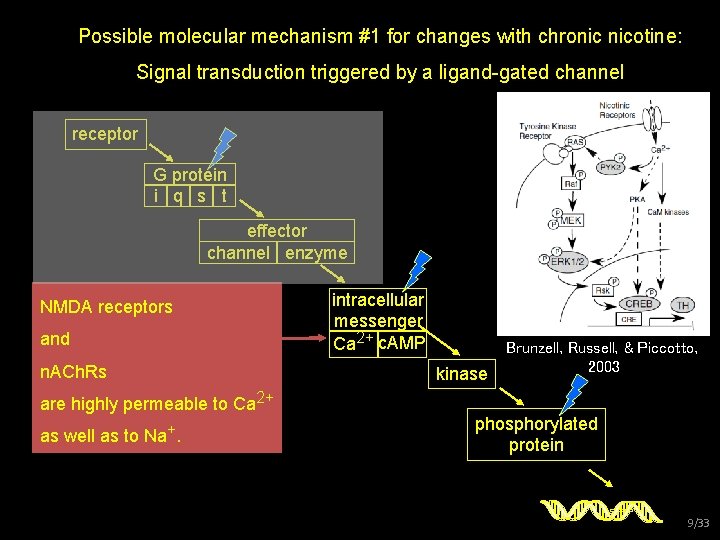
Possible molecular mechanism #1 for changes with chronic nicotine: Signal transduction triggered by a ligand-gated channel receptor G protein i q s t effector channel enzyme NMDA receptors and n. ACh. Rs are highly permeable to Ca 2+ as well as to Na+. intracellular messenger Ca 2+ c. AMP kinase Brunzell, Russell, & Piccotto, 2003 phosphorylated protein 9/33
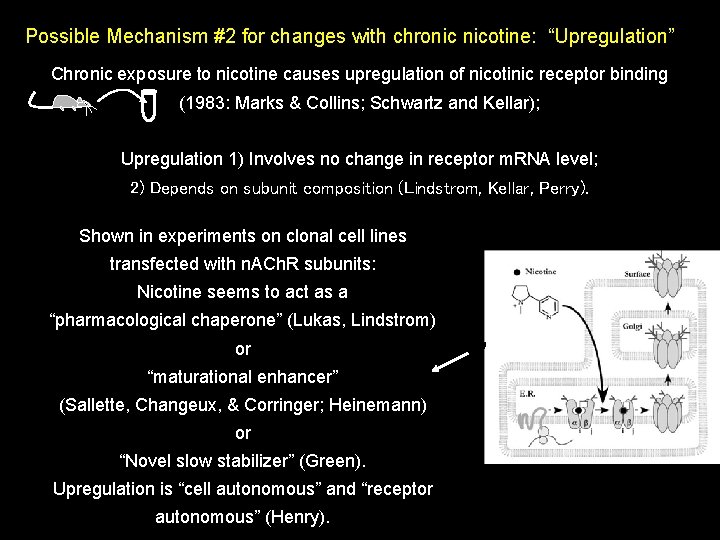
Possible Mechanism #2 for changes with chronic nicotine: “Upregulation” Chronic exposure to nicotine causes upregulation of nicotinic receptor binding (1983: Marks & Collins; Schwartz and Kellar); Upregulation 1) Involves no change in receptor m. RNA level; 2) Depends on subunit composition (Lindstrom, Kellar, Perry). Shown in experiments on clonal cell lines transfected with n. ACh. R subunits: Nicotine seems to act as a “pharmacological chaperone” (Lukas, Lindstrom) or “maturational enhancer” (Sallette, Changeux, & Corringer; Heinemann) or “Novel slow stabilizer” (Green). Upregulation is “cell autonomous” and “receptor autonomous” (Henry). 10/62
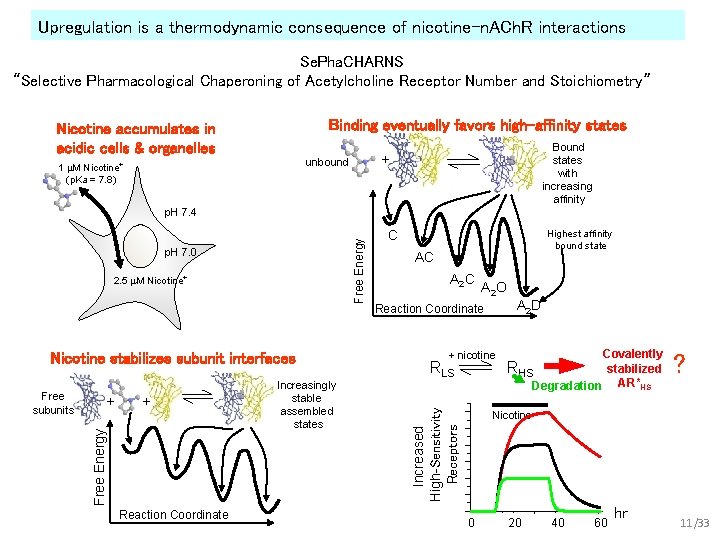
Upregulation is a thermodynamic consequence of nicotine-n. ACh. R interactions Se. Pha. CHARNS “Selective Pharmacological Chaperoning of Acetylcholine Receptor Number and Stoichiometry” Binding eventually favors high-affinity states Nicotine accumulates in acidic cells & organelles + unbound 1 m. M Nicotine+ (p. Ka = 7. 8) Bound states with increasing affinity p. H 7. 0 2. 5 m. M Nicotine+ Nicotine stabilizes subunit interfaces + + Free Energy Free subunits Reaction Coordinate Increasingly stable assembled states Highest affinity bound state C AC A 2 O Reaction Coordinate + nicotine RLS Increased High-Sensitivity Receptors Free Energy p. H 7. 4 A 2 D Covalently stabilized RHS Degradation AR*HS ? Nicotine 0 20 40 60 hr 11/33
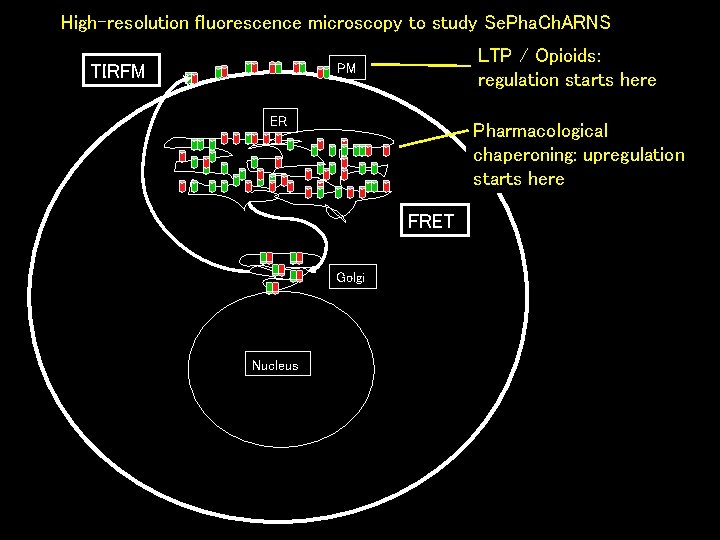
High-resolution fluorescence microscopy to study Se. Pha. Ch. ARNS LTP / Opioids: regulation starts here PM TIRFM ER Pharmacological chaperoning: upregulation starts here FRET Golgi Nucleus 12
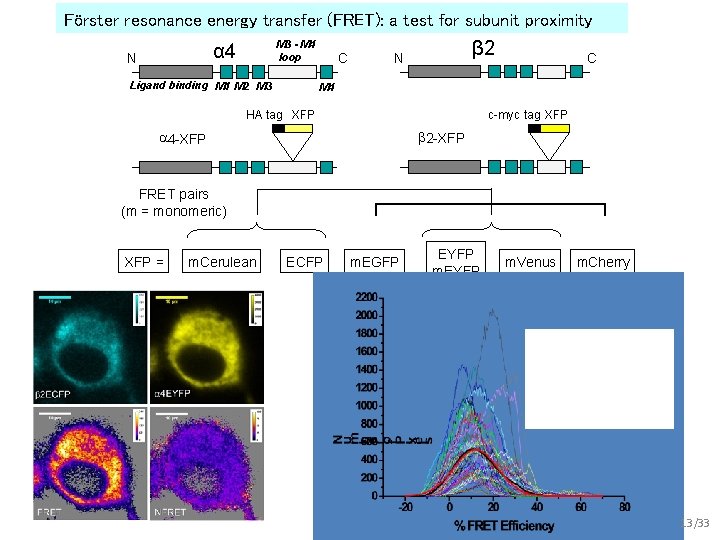
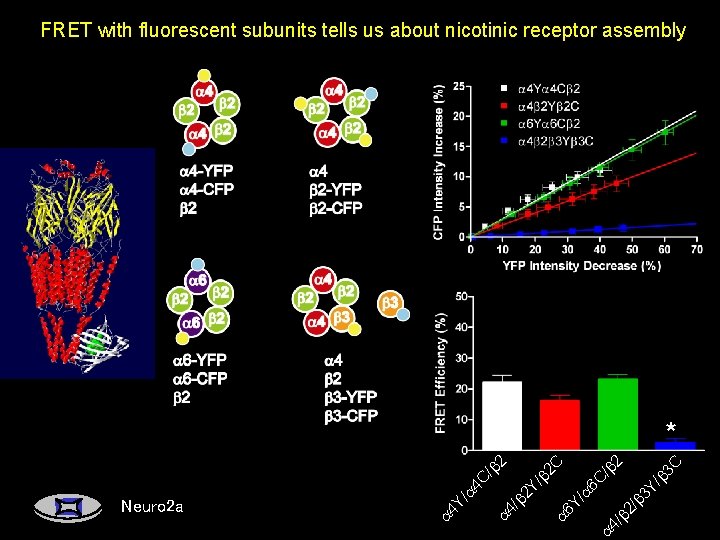
Förster resonance energy transfer (FRET): a test for subunit proximity M 3 - M 4 loop α 4 N C β 2 N C M 3 -M 4 loop Ligand binding M 1 M 2 M 3 M 4 HA tag XFP c-myc tag XFP 2 -XFP 4 -XFP FRET pairs (m = monomeric) XFP = m. Cerulean ECFP m. EGFP EYFP m. Venus m. Cherry 13/33
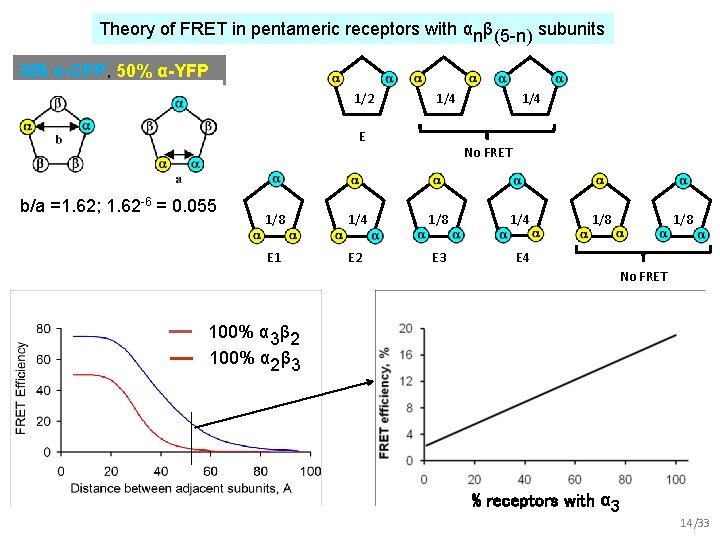
Theory of FRET in pentameric receptors with αnβ(5 -n) subunits 50% α-CFP, 50% α-YFP 1/2 1/4 E b/a =1. 62; 1. 62 -6 = 0. 055 1/4 No FRET 1/8 1/4 E 1 E 2 E 3 E 4 1/8 No FRET 100% α 3β 2 100% α 2β 3 % receptors with α 3 14/33
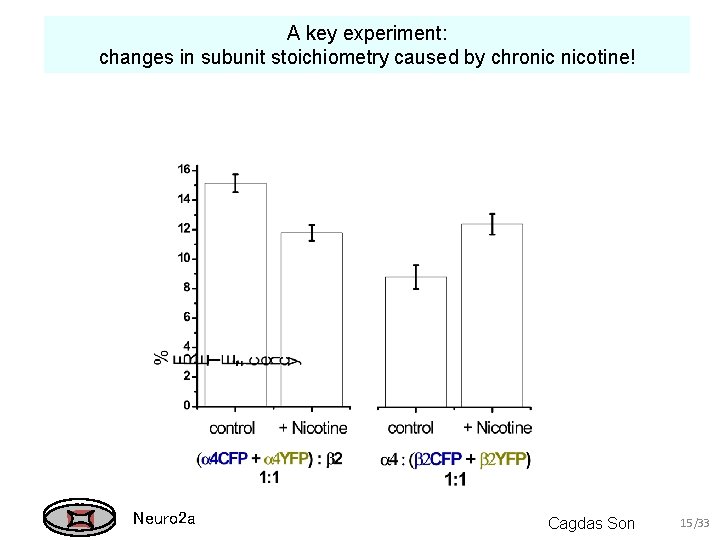
A key experiment: changes in subunit stoichiometry caused by chronic nicotine! Neuro 2 a Cagdas Son 15/33
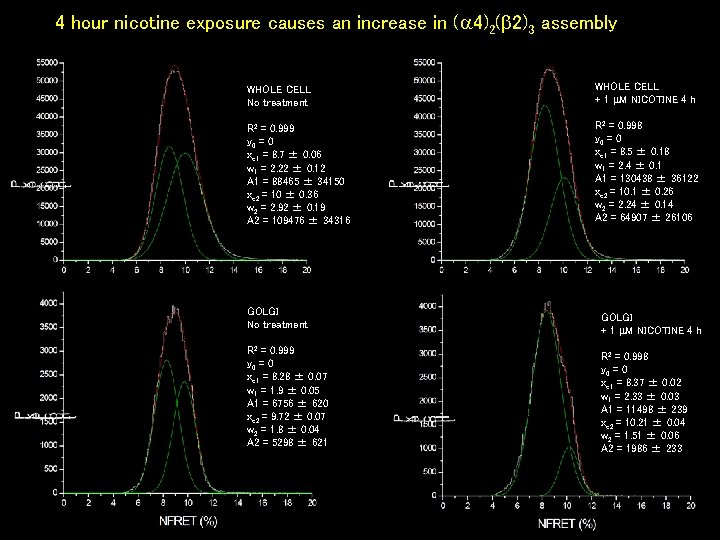
4 hour nicotine exposure causes an increase in ( 4)2( 2)3 assembly WHOLE CELL No treatment WHOLE CELL + 1 m. M NICOTINE 4 h R 2 = 0. 999 y 0 = 0 xc 1 = 8. 7 ± 0. 06 w 1 = 2. 22 ± 0. 12 A 1 = 88465 ± 34150 xc 2 = 10 ± 0. 36 w 2 = 2. 92 ± 0. 19 A 2 = 109476 ± 34316 R 2 = 0. 998 y 0 = 0 xc 1 = 8. 5 ± 0. 18 w 1 = 2. 4 ± 0. 1 A 1 = 130438 ± 36122 xc 2 = 10. 1 ± 0. 26 w 2 = 2. 24 ± 0. 14 A 2 = 64907 ± 26106 GOLGI No treatment R 2 = 0. 999 y 0 = 0 xc 1 = 8. 28 ± 0. 07 w 1 = 1. 9 ± 0. 05 A 1 = 6756 ± 620 xc 2 = 9. 72 ± 0. 07 w 2 = 1. 8 ± 0. 04 A 2 = 5298 ± 621 GOLGI + 1 m. M NICOTINE 4 h R 2 = 0. 998 y 0 = 0 xc 1 = 8. 37 ± 0. 02 w 1 = 2. 33 ± 0. 03 A 1 = 11498 ± 239 xc 2 = 10. 21 ± 0. 04 w 2 = 1. 51 ± 0. 06 A 2 = 1986 ± 233 16
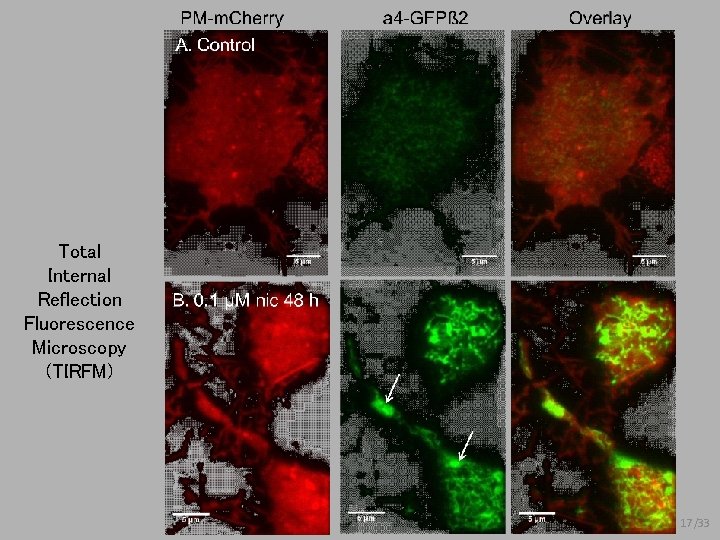
Total Internal Reflection Fluorescence Microscopy (TIRFM) 17/33
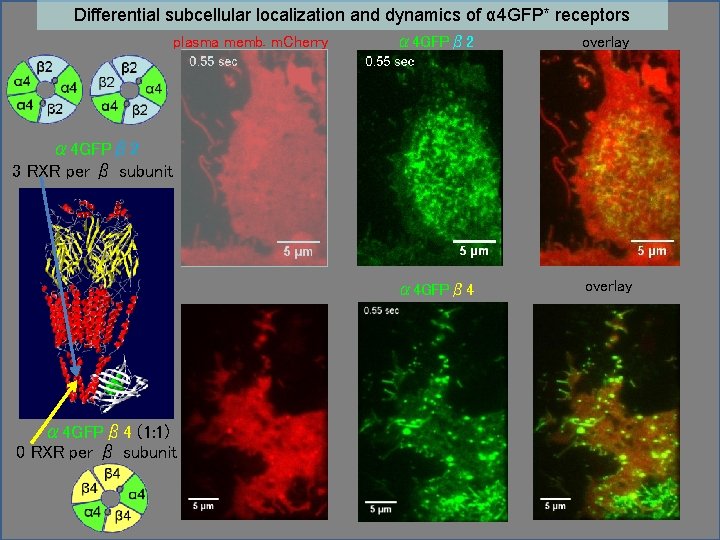
Differential subcellular localization and dynamics of α 4 GFP* receptors plasma memb. m. Cherry α 4 GFPβ 2 overlay α 4 GFPβ 4 overlay α 4 GFPβ 2 3 RXR per β subunit α 4 GFPβ 4 (1: 1) 0 RXR per β subunit 18
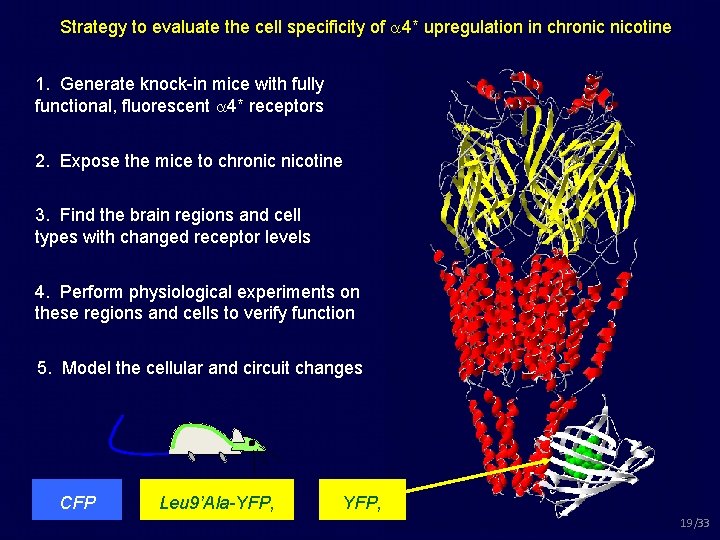
Strategy to evaluate the cell specificity of 4* upregulation in chronic nicotine 1. Generate knock-in mice with fully functional, fluorescent 4* receptors 2. Expose the mice to chronic nicotine 3. Find the brain regions and cell types with changed receptor levels 4. Perform physiological experiments on these regions and cells to verify function 5. Model the cellular and circuit changes CFP Leu 9’Ala-YFP, 19/33
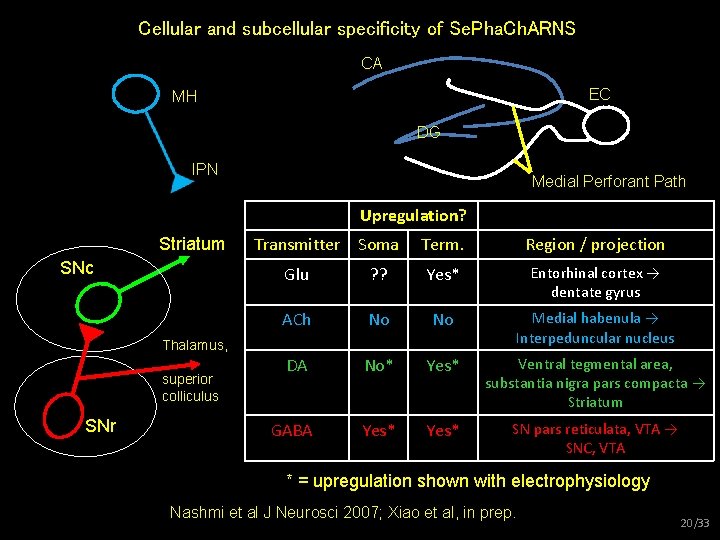
Cellular and subcellular specificity of Se. Pha. Ch. ARNS CA EC MH DG IPN Medial Perforant Path Upregulation? Striatum SNc Transmitter Soma Term. Region / projection Glu ? ? Yes* Entorhinal cortex → dentate gyrus ACh No No Medial habenula → Interpeduncular nucleus DA No* Yes* Ventral tegmental area, substantia nigra pars compacta → Striatum GABAA Yes* SN pars reticulata, VTA → SNC, VTA Thalamus, superior colliculus SNr * = upregulation shown with electrophysiology Nashmi et al J Neurosci 2007; Xiao et al, in prep. 20/33
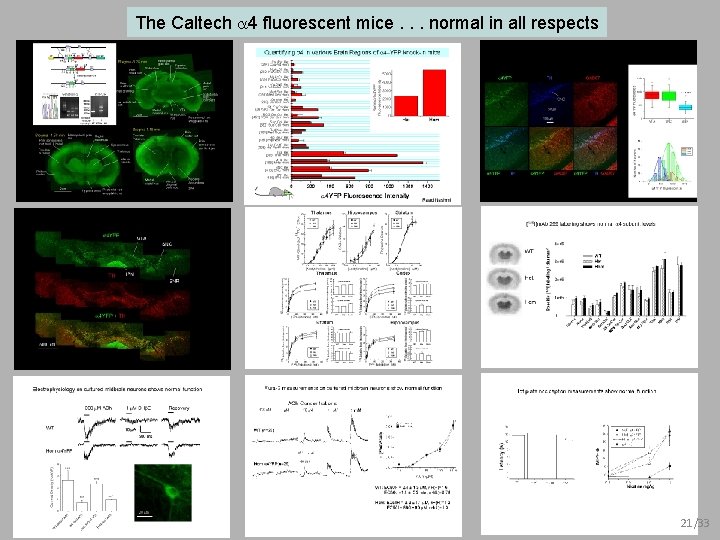
The Caltech 4 fluorescent mice. . . normal in all respects 21/33
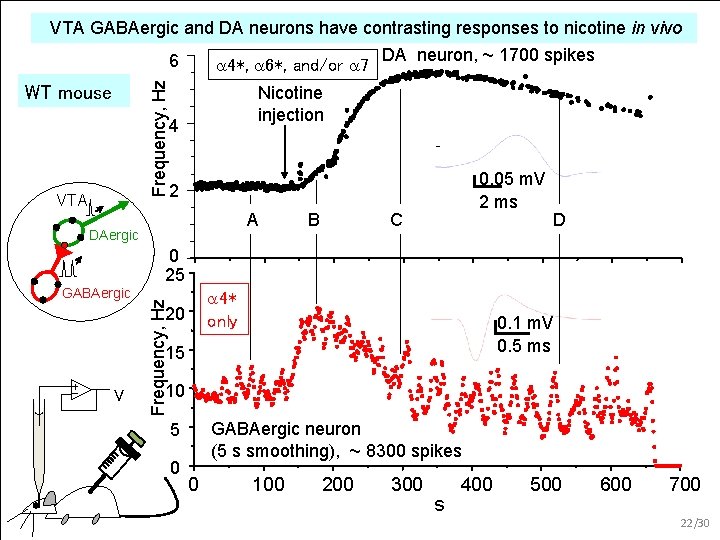
Frequency, Hz VTA GABAergic and DA neurons have contrasting responses to nicotine in vivo DA neuron, ~ 1700 spikes 6 4*, 6*, and/or 7 WT mouse Nicotine injection 4 0. 05 m. V 2 ms 2 VTA A DAergic B C D 0 25 4* only Frequency, Hz GABAergic 20 0. 1 m. V 0. 5 ms 15 V 10 GABAergic neuron (5 s smoothing), ~ 8300 spikes 5 0 0 100 200 300 s 400 500 600 700 22/30
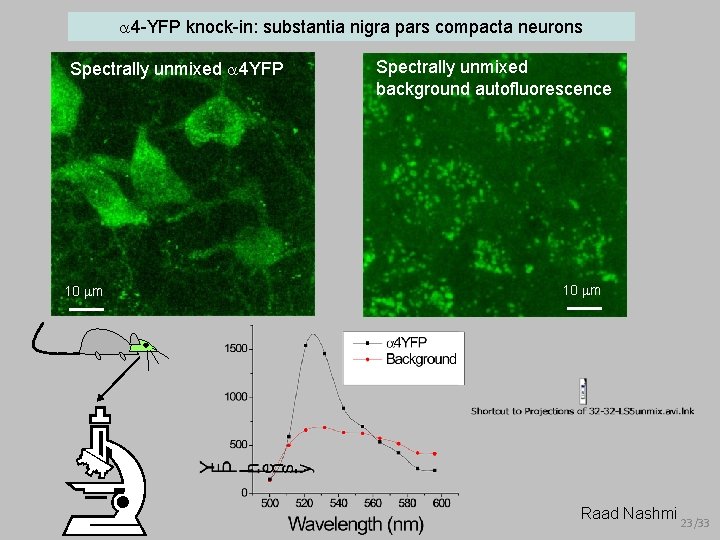
4 -YFP knock-in: substantia nigra pars compacta neurons Spectrally unmixed 4 YFP 10 mm Spectrally unmixed background autofluorescence 10 mm Raad Nashmi 23/33
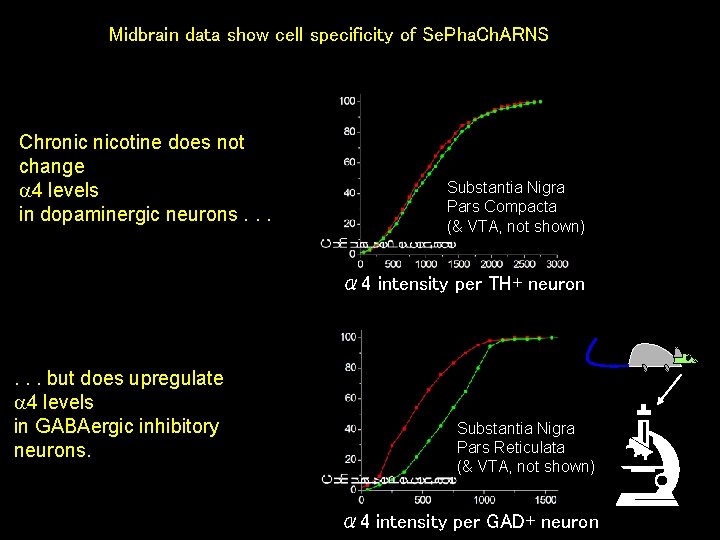
Midbrain data show cell specificity of Se. Pha. Ch. ARNS Chronic nicotine does not change 4 levels in dopaminergic neurons. . . Substantia Nigra Pars Compacta (& VTA, not shown) α 4 intensity per TH+ neuron . . . but does upregulate 4 levels in GABAergic inhibitory neurons. Substantia Nigra Pars Reticulata (& VTA, not shown) 24/24 α 4 intensity per GAD+ neuron
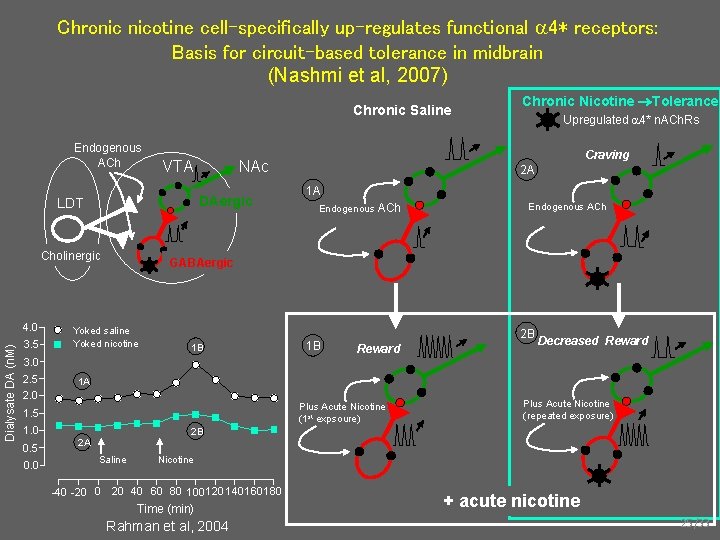
Chronic nicotine cell-specifically up-regulates functional 4* receptors: Basis for circuit-based tolerance in midbrain (Nashmi et al, 2007) Chronic Saline Endogenous ACh VTA LDT Cholinergic Dialysate DA (n. M) 4. 0 3. 5 Upregulated 4* n. ACh. Rs Craving NAc DAergic Chronic Nicotine Tolerance 2 A 1 A Endogenous ACh GABAergic Yoked saline Yoked nicotine 1 B 1 B 2 B Reward Decreased Reward 3. 0 2. 5 2. 0 1 A Plus Acute Nicotine (1 st expsoure) 1. 5 1. 0 0. 5 0. 0 Plus Acute Nicotine (repeated exposure) 2 B 2 A Saline Nicotine -40 -20 0 20 40 60 80 100 120 140 160180 Time (min) Rahman et al, 2004 + acute nicotine 25/33
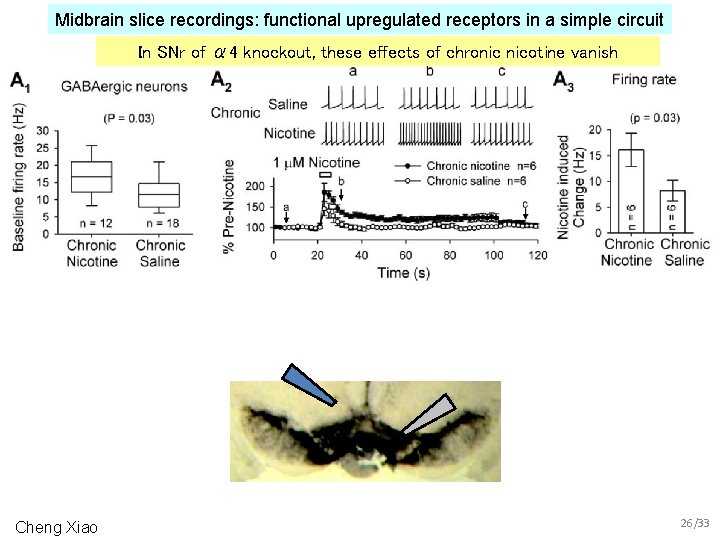
Midbrain slice recordings: functional upregulated receptors in a simple circuit In SNr of α 4 knockout, these effects of chronic nicotine vanish Cheng Xiao 26/33
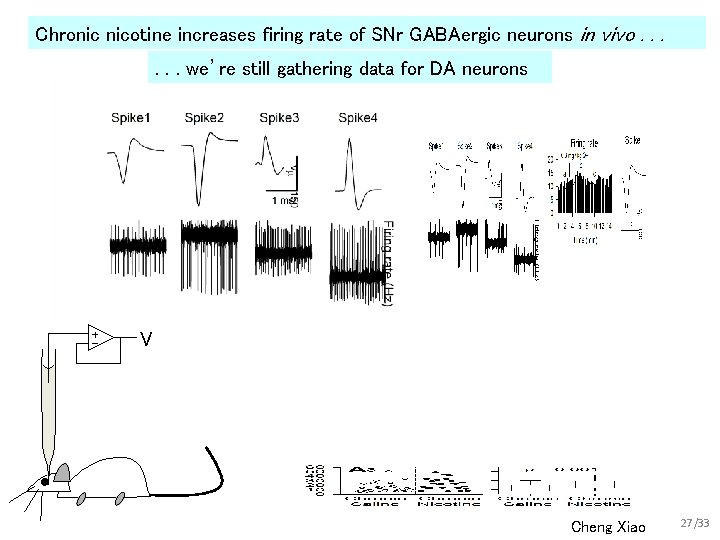
Chronic nicotine increases firing rate of SNr GABAergic neurons in vivo. . . we’re still gathering data for DA neurons V Cheng Xiao 27/33
Chronic nicotine causes cognitive sensitization In the human context, cognitive sensitization is epitomized by smokers’ reports that they think better when they smoke; this anecdotal observation is confirmed by data that smokers who smoke nicotine cigarettes (but not nicotine-free cigarettes) display certain cognitive enhancements (Rusted and Warburton, 1992; Rusted et al. , 1995). In the rodent context, mice show more contextual fear conditioning if, one day after withdrawal from chronic nicotine, they receive an acute nicotine dose (Davis et al. , 2005); β* dependent also chronic nicotine produces better spatial working memory performance in the radial arm maze (Levin et al. , 1990; Levin et al. , 1996). 28/33
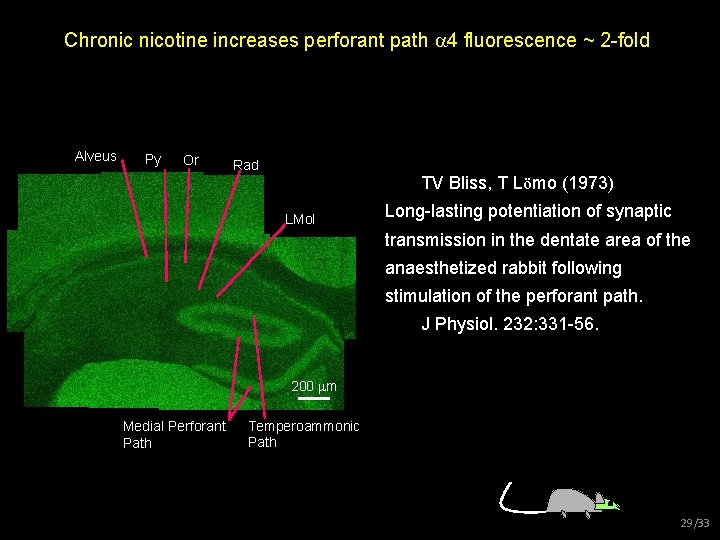
Chronic nicotine increases perforant path 4 fluorescence ~ 2 -fold Alveus Py Or Rad TV Bliss, T Lömo (1973) LMol Long-lasting potentiation of synaptic transmission in the dentate area of the anaesthetized rabbit following stimulation of the perforant path. J Physiol. 232: 331 -56. 200 mm Medial Perforant Path Temperoammonic Path 29/33
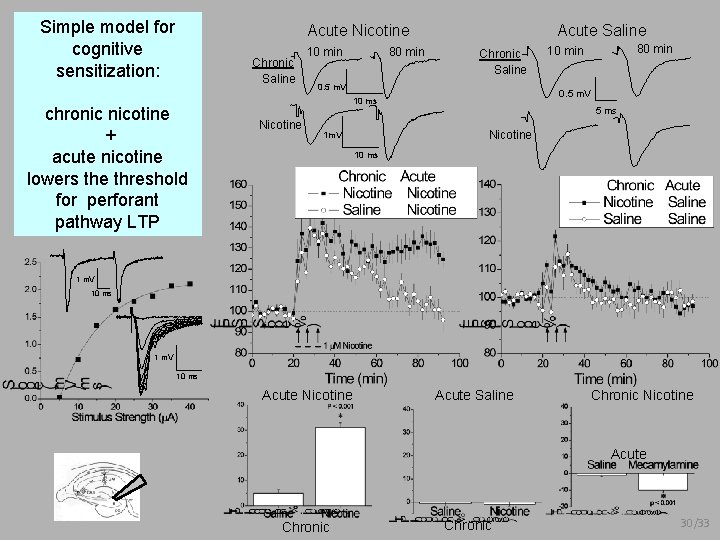
Simple model for cognitive sensitization: Acute Nicotine Chronic Saline chronic nicotine + acute nicotine lowers the threshold for perforant pathway LTP 10 min 80 min Acute Saline Chronic Saline 0. 5 m. V 10 ms Nicotine 80 min 10 min 5 ms Nicotine 1 m. V 10 ms 1 m. V 10 ms Acute Nicotine Acute Saline Chronic Nicotine Acute Chronic 30/33
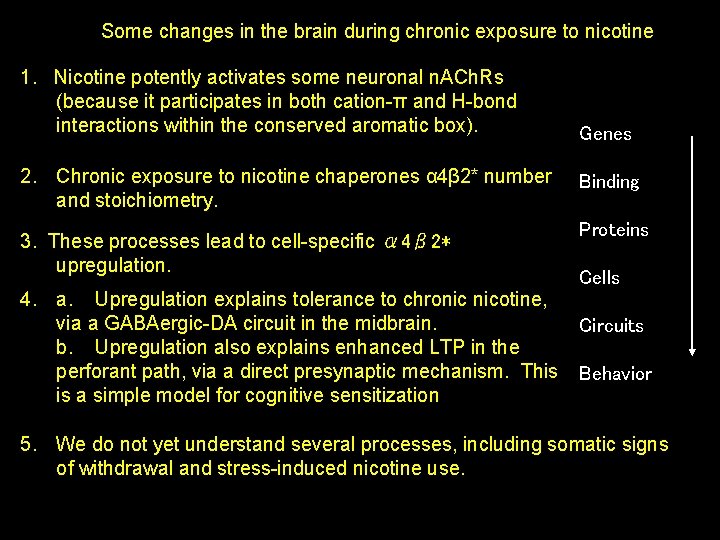
Some changes in the brain during chronic exposure to nicotine 1. Nicotine potently activates some neuronal n. ACh. Rs (because it participates in both cation-π and H-bond interactions within the conserved aromatic box). 2. Chronic exposure to nicotine chaperones α 4β 2* number and stoichiometry. 3. These processes lead to cell-specific α 4β 2* upregulation. 4. a. Upregulation explains tolerance to chronic nicotine, via a GABAergic-DA circuit in the midbrain. b. Upregulation also explains enhanced LTP in the perforant path, via a direct presynaptic mechanism. This is a simple model for cognitive sensitization Genes Binding Proteins Cells Circuits Behavior 5. We do not yet understand several processes, including somatic signs of withdrawal and stress-induced nicotine use. 31/62
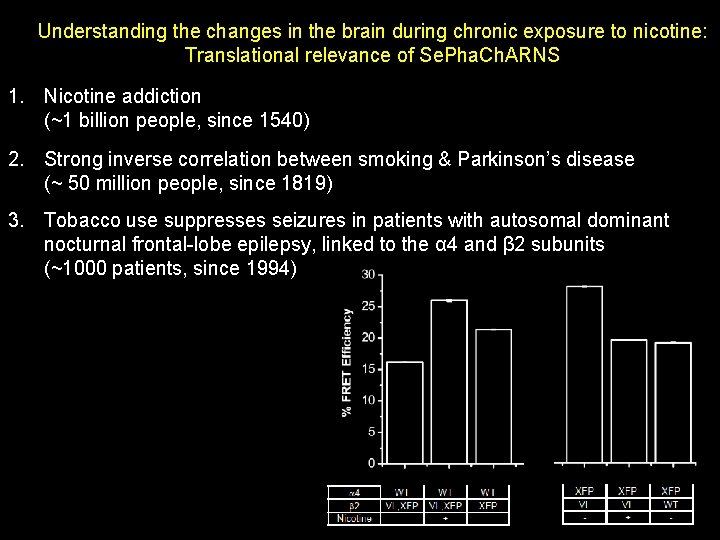
Understanding the changes in the brain during chronic exposure to nicotine: Translational relevance of Se. Pha. Ch. ARNS 1. Nicotine addiction (~1 billion people, since 1540) 2. Strong inverse correlation between smoking & Parkinson’s disease (~ 50 million people, since 1819) 3. Tobacco use suppresses seizures in patients with autosomal dominant nocturnal frontal-lobe epilepsy, linked to the α 4 and β 2 subunits (~1000 patients, since 1994) 32/62
Dennis Dougherty Kiowa Bower, Shawna Frazier, Ariel Hanek, Fraser Moss, Caltech Nyssa Puskar, Rigo Pantoja, Kristin Rule, Erik Rodriguez, “Unnatural Club” Jai Shanata, Mike Torrice, Joanne Xiu Univ. of Cambridge Neil Harrison, Sarah Lummis, Claire Padgett, Kerry Price, Andy Thompson Uni Queensland Stephan Pless, Joe Lynch Caltech Bruce Cohen, Purnima Deshpande, Ryan Drenan, Carlos Fonck, “Alpha Club” Sheri Mc. Kinney, Raad Nashmi, Johannes Schwarz, Rahul Srinivasan, Cagdas Son, Andrew Tapper, Larry Wade, Cheng Xiao Univ of Colorado, Al Collins, Sharon Grady, Mike Marks, Erin Meyers, Boulder Tristan Mc. Clure-Begley, Charles Wageman, Paul Whiteaker Targacept Merouane Bencherif, Greg Gatto, Daniel Yohannes Univ. Pennsylvania Jon Lindstrom Univ. Utah Mike Mc. Intosh Rockefeller Univ Julie Miwa, Nathaniel Heintz 33/33
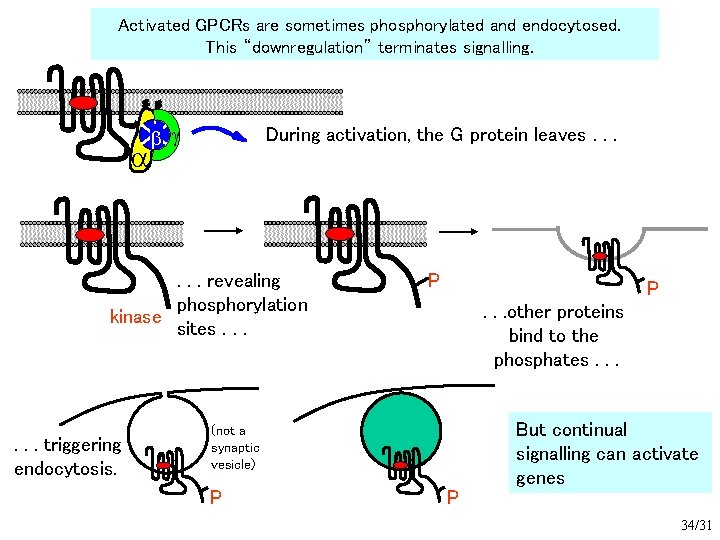
Activated GPCRs are sometimes phosphorylated and endocytosed. This “downregulation” terminates signalling. g During activation, the G protein leaves. . . revealing phosphorylation kinase sites. . . triggering endocytosis. P P. . . other proteins bind to the phosphates. . . (not a synaptic vesicle) P P But continual signalling can activate genes 34/31
FRET with fluorescent subunits tells us about nicotinic receptor assembly 3 C 2 / Y/ C 4 / 2/ 3 6 Y/ 6 2 Y 4 / Y/ 4 Neuro 2 a 4 C / / 2 C 2 * 35/62
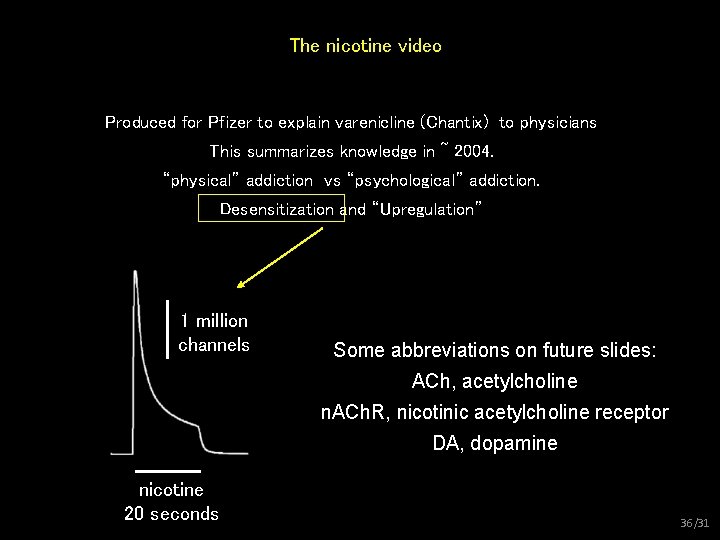
The nicotine video Produced for Pfizer to explain varenicline (Chantix) to physicians This summarizes knowledge in ~ 2004. “physical” addiction vs “psychological” addiction. Desensitization and “Upregulation” 1 million channels Some abbreviations on future slides: ACh, acetylcholine n. ACh. R, nicotinic acetylcholine receptor DA, dopamine nicotine 20 seconds 36/31
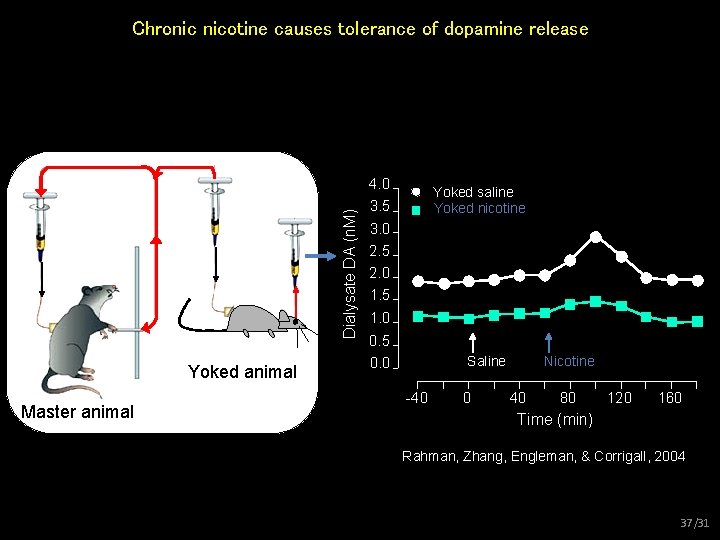
Dialysate DA (n. M) Chronic nicotine causes tolerance of dopamine release Yoked animal Master animal 4. 0 3. 5 Yoked saline Yoked nicotine 3. 0 2. 5 2. 0 1. 5 1. 0 0. 5 0. 0 Saline -40 0 Nicotine 40 80 120 160 Time (min) Rahman, Zhang, Engleman, & Corrigall, 2004 37/31
- Slides: 37