
Prof Philip Koopman Key Ideas UL 4600 Safety
![Example 4600 Clause { { [UL 4600] © 2020 Philip Koopman](https://slidetodoc.com/presentation_image_h2/a1f58642e2e88f7348eba2826be58cbb/image-4.jpg "Example 4600 Clause { { [UL 4600] © 2020 Philip Koopman")
![Flexible Approaches { [UL 4600] © 2020 Philip Koopman](https://slidetodoc.com/presentation_image_h2/a1f58642e2e88f7348eba2826be58cbb/image-5.jpg "Flexible Approaches { [UL 4600] © 2020 Philip Koopman")

- Slides: 16
Prof. Philip Koopman Key Ideas: UL 4600 Safety Standard for Autonomous Vehicles AVS / July 2020 @Phil. Koopman
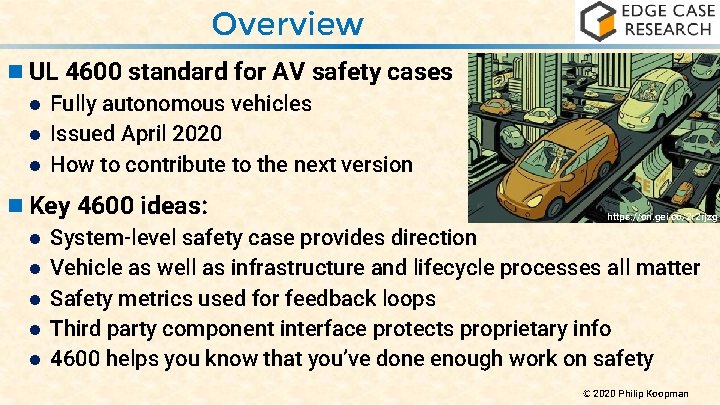
Overview n UL 4600 standard for AV safety cases Fully autonomous vehicles Issued April 2020 How to contribute to the next version n Key 4600 ideas: https: //on. gei. co/2 r 2 rjzg System-level safety case provides direction Vehicle as well as infrastructure and lifecycle processes all matter Safety metrics used for feedback loops Third party component interface protects proprietary info 4600 helps you know that you’ve done enough work on safety © 2020 Philip Koopman
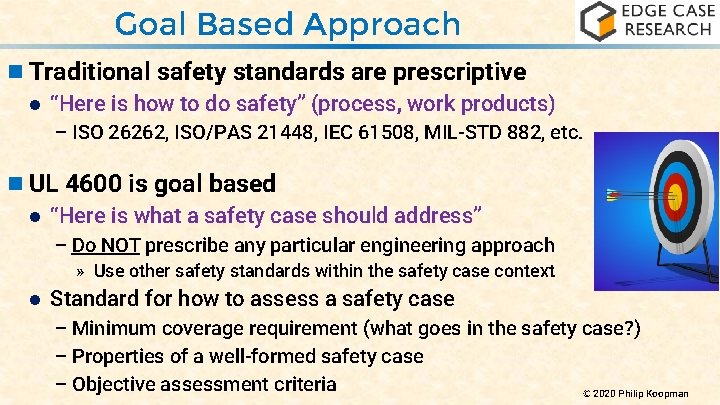
Goal Based Approach n Traditional safety standards are prescriptive “Here is how to do safety” (process, work products) – ISO 26262, ISO/PAS 21448, IEC 61508, MIL-STD 882, etc. n UL 4600 is goal based “Here is what a safety case should address” – Do NOT prescribe any particular engineering approach » Use other safety standards within the safety case context Standard for how to assess a safety case – Minimum coverage requirement (what goes in the safety case? ) – Properties of a well-formed safety case – Objective assessment criteria © 2020 Philip Koopman
Example 4600 Clause { { [UL 4600] © 2020 Philip Koopman
Flexible Approaches { [UL 4600] © 2020 Philip Koopman
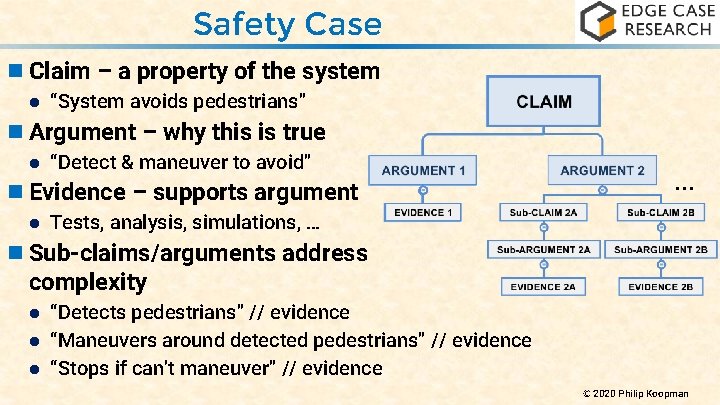
Safety Case n Claim – a property of the system “System avoids pedestrians” n Argument – why this is true “Detect & maneuver to avoid” n Evidence – supports argument … Tests, analysis, simulations, … n Sub-claims/arguments address complexity “Detects pedestrians” // evidence “Maneuvers around detected pedestrians” // evidence “Stops if can’t maneuver” // evidence © 2020 Philip Koopman
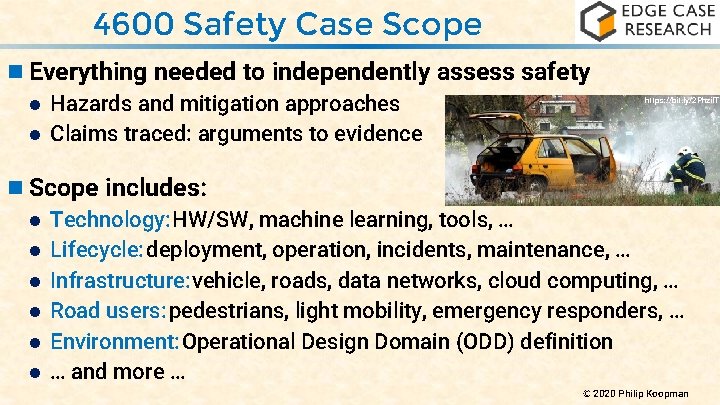
4600 Safety Case Scope n Everything needed to independently assess safety Hazards and mitigation approaches Claims traced: arguments to evidence https: //bit. ly/2 Phzil. T n Scope includes: Technology: HW/SW, machine learning, tools, … Lifecycle: deployment, operation, incidents, maintenance, … Infrastructure: vehicle, roads, data networks, cloud computing, … Road users: pedestrians, light mobility, emergency responders, … Environment: Operational Design Domain (ODD) definition … and more … © 2020 Philip Koopman
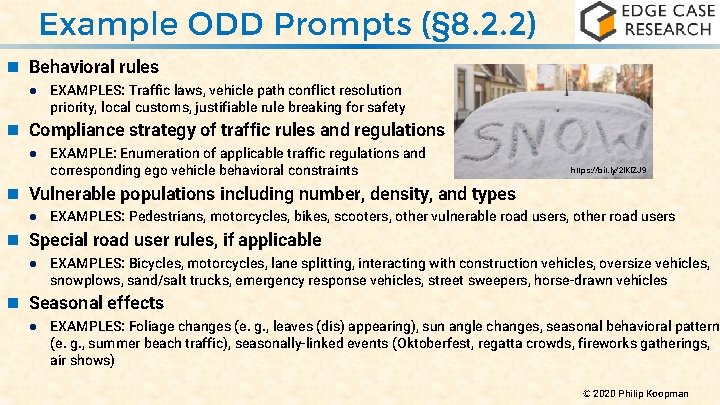
Example ODD Prompts (§ 8. 2. 2) n Behavioral rules EXAMPLES: Traffic laws, vehicle path conflict resolution priority, local customs, justifiable rule breaking for safety n Compliance strategy of traffic rules and regulations EXAMPLE: Enumeration of applicable traffic regulations and corresponding ego vehicle behavioral constraints https: //bit. ly/2 IKl. ZJ 9 n Vulnerable populations including number, density, and types EXAMPLES: Pedestrians, motorcycles, bikes, scooters, other vulnerable road users, other road users n Special road user rules, if applicable EXAMPLES: Bicycles, motorcycles, lane splitting, interacting with construction vehicles, oversize vehicles, snowplows, sand/salt trucks, emergency response vehicles, street sweepers, horse-drawn vehicles n Seasonal effects EXAMPLES: Foliage changes (e. g. , leaves (dis) appearing), sun angle changes, seasonal behavioral patterns (e. g. , summer beach traffic), seasonally-linked events (Oktoberfest, regatta crowds, fireworks gatherings, air shows) © 2020 Philip Koopman
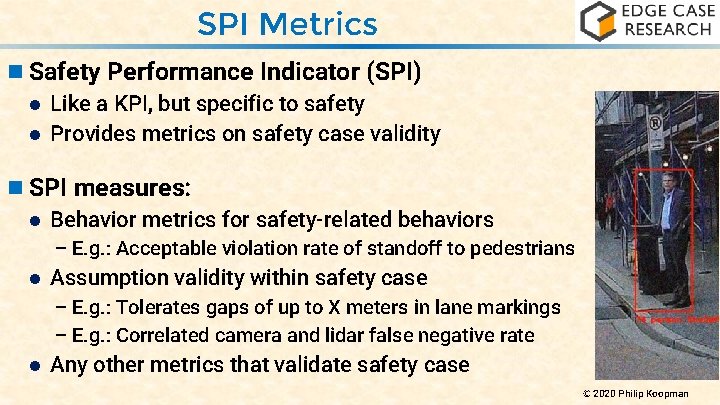
SPI Metrics n Safety Performance Indicator (SPI) Like a KPI, but specific to safety Provides metrics on safety case validity n SPI measures: Behavior metrics for safety-related behaviors – E. g. : Acceptable violation rate of standoff to pedestrians Assumption validity within safety case – E. g. : Tolerates gaps of up to X meters in lane markings – E. g. : Correlated camera and lidar false negative rate Any other metrics that validate safety case © 2020 Philip Koopman
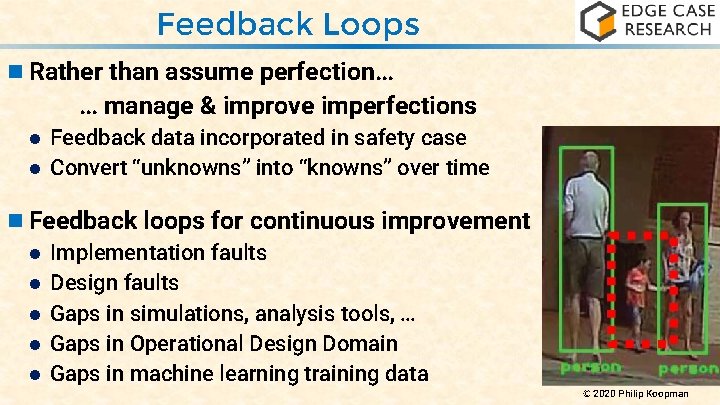
Feedback Loops n Rather than assume perfection… … manage & improve imperfections Feedback data incorporated in safety case Convert “unknowns” into “knowns” over time n Feedback loops for continuous improvement Implementation faults Design faults Gaps in simulations, analysis tools, … Gaps in Operational Design Domain Gaps in machine learning training data © 2020 Philip Koopman
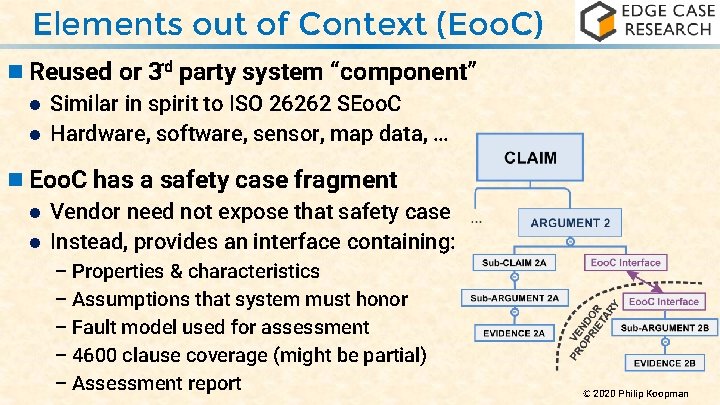
Elements out of Context (Eoo. C) n Reused or 3 rd party system “component” Similar in spirit to ISO 26262 SEoo. C Hardware, software, sensor, map data, … n Eoo. C has a safety case fragment Vendor need not expose that safety case Instead, provides an interface containing: – Properties & characteristics – Assumptions that system must honor – Fault model used for assessment – 4600 clause coverage (might be partial) – Assessment report © 2020 Philip Koopman
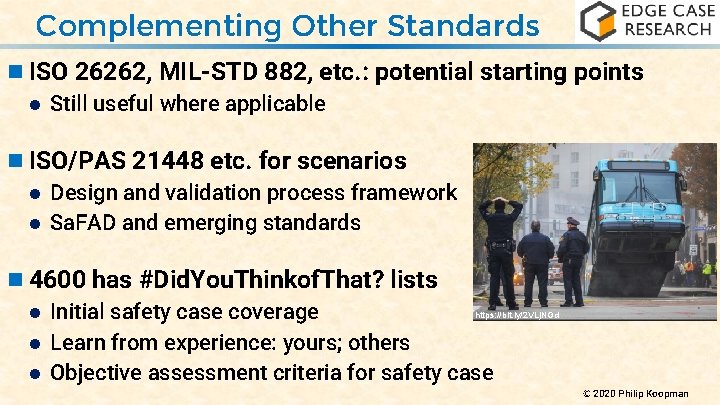
Complementing Other Standards n ISO 26262, MIL-STD 882, etc. : potential starting points Still useful where applicable n ISO/PAS 21448 etc. for scenarios Design and validation process framework Sa. FAD and emerging standards n 4600 has #Did. You. Thinkof. That? lists Initial safety case coverage Learn from experience: yours; others Objective assessment criteria for safety case https: //bit. ly/2 VLj. NGd © 2020 Philip Koopman
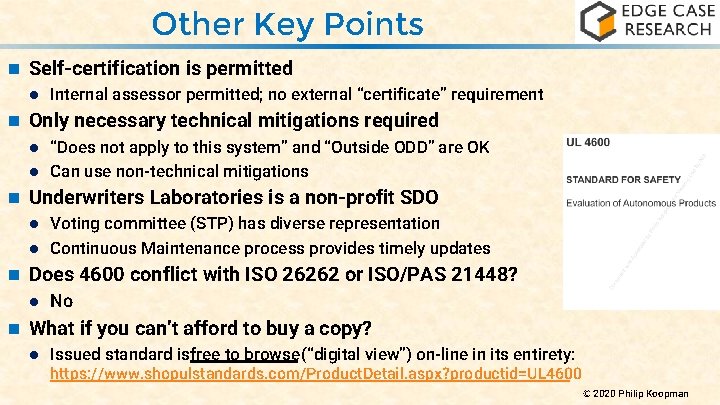
Other Key Points n Self-certification is permitted Internal assessor permitted; no external “certificate” requirement n Only necessary technical mitigations required “Does not apply to this system” and “Outside ODD” are OK Can use non-technical mitigations n Underwriters Laboratories is a non-profit SDO Voting committee (STP) has diverse representation Continuous Maintenance process provides timely updates n Does 4600 conflict with ISO 26262 or ISO/PAS 21448? No n What if you can’t afford to buy a copy? Issued standard is free to browse (“digital view”) on-line in its entirety: https: //www. shopulstandards. com/Product. Detail. aspx? productid=UL 4600 © 2020 Philip Koopman
Review of Key Ideas n System-level safety case provides direction Highlights gaps in evidence and arguments n Vehicle, infrastructure, and lifecycle processes all matter If safety case depends upon it, that makes it safety related n Metrics combine with feedback loops Operational feedback will be essential for practical safety n Third party component interface to protect proprietary info Eoo. C interface permits separate component assessment n 4600 helps you know that you’ve done enough safety work Robust prompts and pitfalls capture best practice/lessons learned © 2020 Philip Koopman
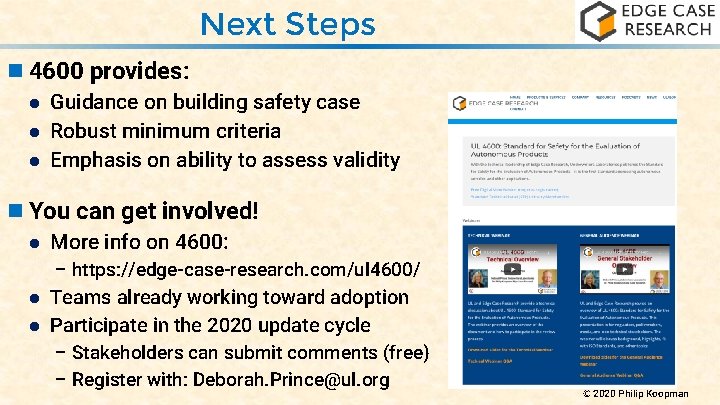
Next Steps n 4600 provides: Guidance on building safety case Robust minimum criteria Emphasis on ability to assess validity n You can get involved! More info on 4600: – https: //edge-case-research. com/ul 4600/ Teams already working toward adoption Participate in the 2020 update cycle – Stakeholders can submit comments (free) – Register with: Deborah. Prince@ul. org © 2020 Philip Koopman
EDGE CASE RESEARCH WE DELIVER THE PROMISE OF AUTONOMY © 2019 Philip Koopman 16