
Prof Marco Olivetti University of Rome LUMSA October
Prof. Marco Olivetti University of Rome – LUMSA, October 15, 2020 The systems of government in the Liberal-democratic State
The study of the systems of government • The distribution of powers between the main political authorities of the State • How the Governing structure is articulated • At the center the relation between the executive power and the legislative power • A pre-requisite –The separation of powers: executive, legislative, judiciary and other powers (Head of State, Constitutional court) • Relevance of other elements, like referendum, federalism, and so on

Classical classifications • Classification according to the number of rulers and to the proper or degenerated form: • One ruler Monarchy Tyranny • Few rulers Aristocracy Oligarchy • Many (all) rulers Democracy Demagoguery
Monarchy and Republic: an old classification The traditional classification: e. g. “Repubbliche e principati” according to Machiavelli (The Prince, 1527) This classification may be intended as referred to different principles of legitimation of the power (topdown, monarchy; bottom-up, republic) Currently it explains the form in which the Head of State is chosen
Monarchy and Republic Two different techniques to choose the Head of State: a) As an heritage procedure Monarchy b) Through and election(popular or by an organ of the State) Republic Duration of the Head of State: a) For life (Monarchy) b) For a pre-defined period of time: 4, 5 or 7 years, sometimes with the possibility of reelection (Republic)
The search for criterias allowing a fruitful classification One or two forms of democratic legitimacy: electing only Parliament or also the chief of the executive power? How the separation of powers is structured (rigid or flexible) Two or three political organs (in particular: is the Head of State distinguished from the Government or is it identified with it? ) Result: parliamentary versus presidential form of government
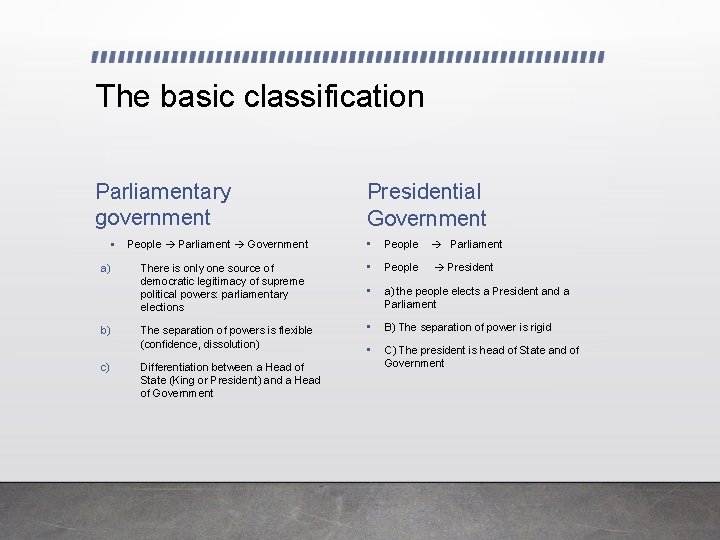
The basic classification Parliamentary government a) b) c) Presidential Government • People Parliament There is only one source of democratic legitimacy of supreme political powers: parliamentary elections • People President • a) the people elects a President and a Parliament The separation of powers is flexible (confidence, dissolution) • B) The separation of power is rigid • C) The president is head of State and of Government People Parliament Government Differentiation between a Head of State (King or President) and a Head of Government
We will study the following models, in a historical perspective • Constitutional monarchy • Parliamentary government • Presidential government • Semi-presidential government • Directorial government • Direct election of the Prime minister
- Slides: 8