
Prof K Sivapalan Definition of Reproduction Reproduction is



![Social Development of Adolescents [HUMAN] • Period of establishing self identity in the society.](https://slidetodoc.com/presentation_image_h2/dc6045b945f9e7b95c423329e3046cf9/image-26.jpg "Social Development of Adolescents [HUMAN] • Period of establishing self identity in the society.")
- Slides: 39
Prof. K. Sivapalan.
Definition of Reproduction • Reproduction is, “production of further individuals LIKE ONESELF or itself by sexual or asexual means”. • Reproductive Health is defined by the World Health Organization as, “a condition in which reproduction is accomplished in a state of complete physical, mental and social wellbeing and not merely as the absence of disease or disorders of the reproductive process”. 15. 03. 2013 Biology of human sexuality 2
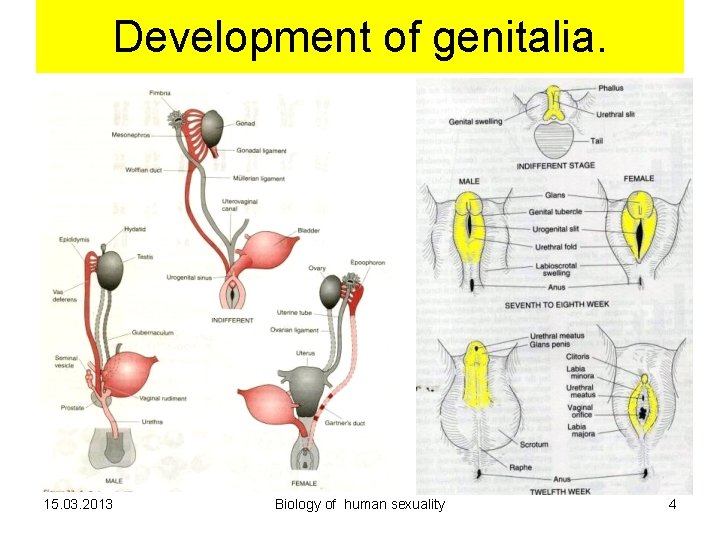
General Aspects of Reproduction • • • Reproduction is not essential for existence of individual. It is needed for ‘healthy living’. It is essential for the survival of the species. When does Reproduction start and when does it end? Who are the participants? Difference between male and female depends on Y chromosome. • Development of testes or ovary is determined genetically • Development of male genitalia needs testes and absence results in female genitalia. 15. 03. 2013 Biology of human sexuality 3
Development of genitalia. 15. 03. 2013 Biology of human sexuality 4
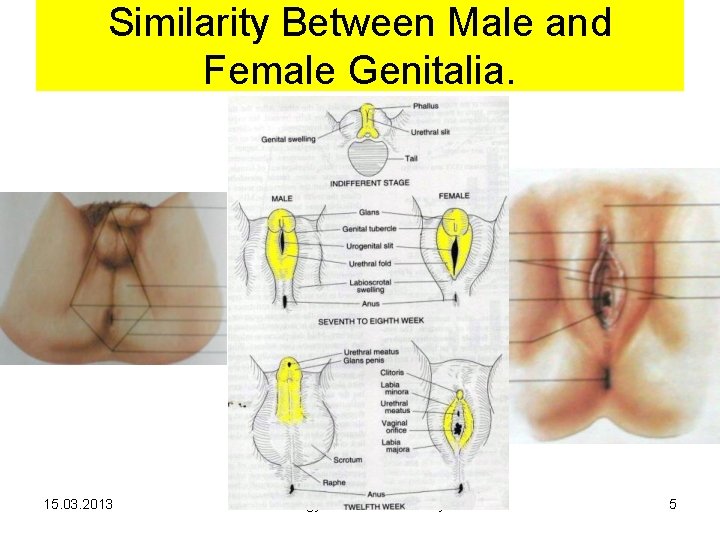
Similarity Between Male and Female Genitalia. 15. 03. 2013 Biology of human sexuality 5
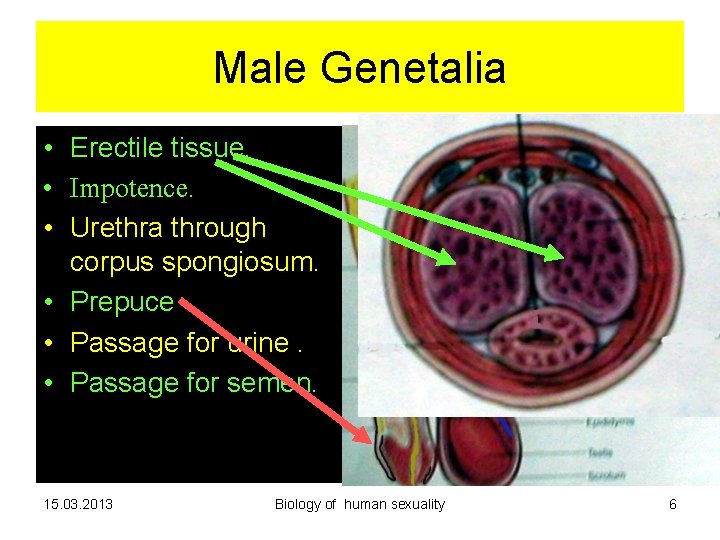
Male Genetalia • Erectile tissue. • Impotence. • Urethra through corpus spongiosum. • Prepuce • Passage for urine. • Passage for semen. 15. 03. 2013 Biology of human sexuality 6
Semen. • Sperm count- 100, 000 per ml. • Clotted on ejaculation [fibrinogen from seminal vesicle and clotting enzyme from prostate] • The coagulum dissolves in 15 to 30 minutes [prostatic profibrinolysin activated] • Life of ejaculated sperm is about 48 hours. [storage in Vas deference 42 days] 15. 03. 2013 Biology of human sexuality 7
Abnormalities of Spermatogenesis. • Infections- bilateral orchitis due to mumps. • Inborn degenerate tubular epithelia due to strictures in genital ducts. • Excessive temperature of the testes due to failure to descend [cryptorchidism] and hot environment. 15. 03. 2013 Biology of human sexuality 8
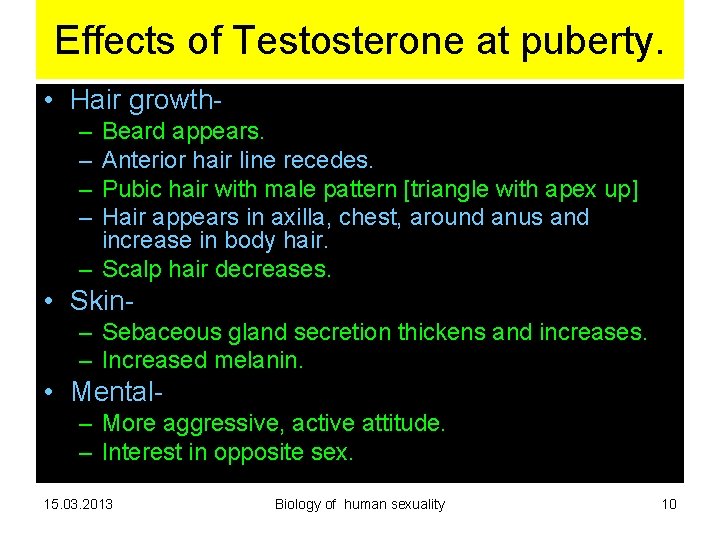
Effects of Testosterone at puberty. • External Genitalia – Penis increases in length and width. – Scrotum becomes pigmented and rugose with testicular enlargement. • Internal Genitalia. – Seminal vesicles enlarge and secrete. – Prostrate and bulbourethral glands enlarge and secrete. – Ejaculation occurs with wet-dreams • Voice becomes deeper– Larynx enlarges. – Vocal cords increase in length and thickness. • Body conformation– Shoulders broaden, all bones matrix increased. – Narrow pelvic outlet, [male pelvis] – Muscles enlarge [50% more than female]. 15. 03. 2013 Biology of human sexuality 9
Effects of Testosterone at puberty. • Hair growth– – Beard appears. Anterior hair line recedes. Pubic hair with male pattern [triangle with apex up] Hair appears in axilla, chest, around anus and increase in body hair. – Scalp hair decreases. • Skin– Sebaceous gland secretion thickens and increases. – Increased melanin. • Mental– More aggressive, active attitude. – Interest in opposite sex. 15. 03. 2013 Biology of human sexuality 10
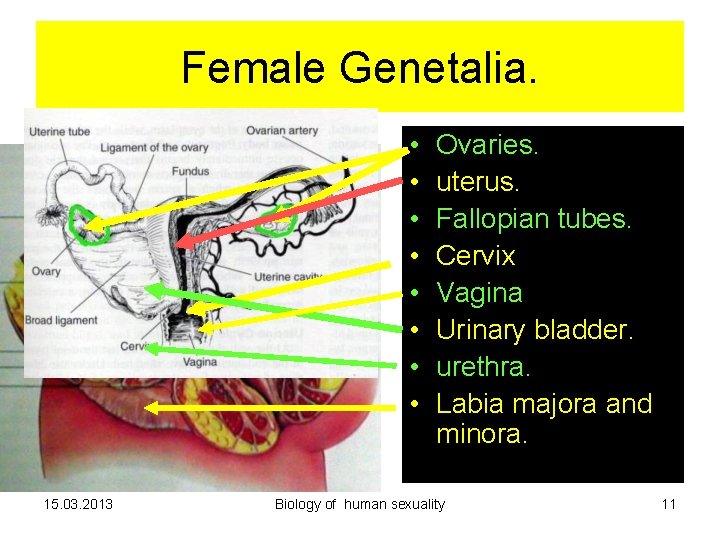
Female Genetalia. • • 15. 03. 2013 Ovaries. uterus. Fallopian tubes. Cervix Vagina Urinary bladder. urethra. Labia majora and minora. Biology of human sexuality 11
Female External genitalia. • • 15. 03. 2013 Labia majora clitoris. Labia Minora Hymen (? virginity) Vaginal sphincter [Rape] Vaginism. Biology of human sexuality 12
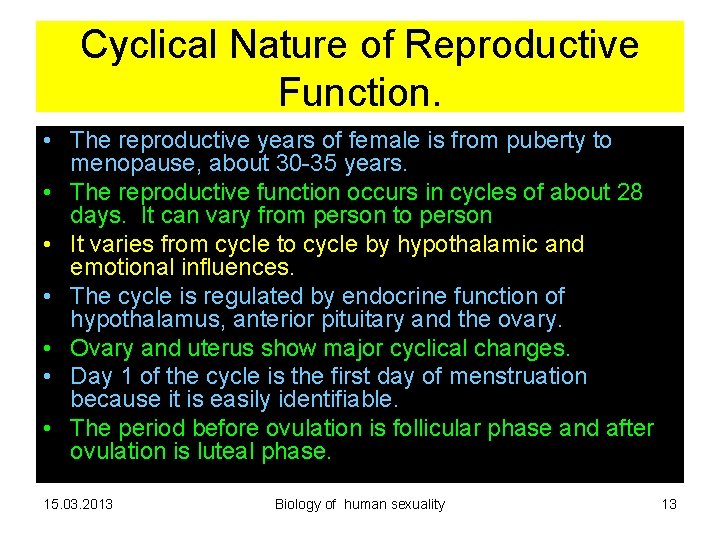
Cyclical Nature of Reproductive Function. • The reproductive years of female is from puberty to menopause, about 30 -35 years. • The reproductive function occurs in cycles of about 28 days. It can vary from person to person • It varies from cycle to cycle by hypothalamic and emotional influences. • The cycle is regulated by endocrine function of hypothalamus, anterior pituitary and the ovary. • Ovary and uterus show major cyclical changes. • Day 1 of the cycle is the first day of menstruation because it is easily identifiable. • The period before ovulation is follicular phase and after ovulation is luteal phase. 15. 03. 2013 Biology of human sexuality 13
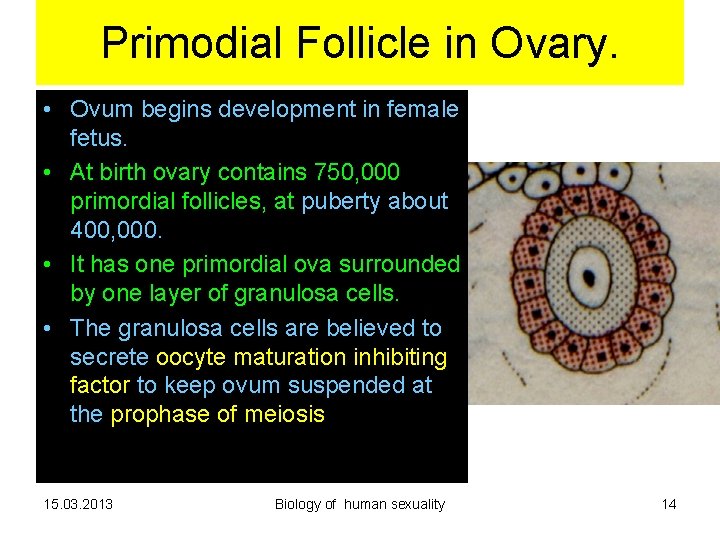
Primodial Follicle in Ovary. • Ovum begins development in female fetus. • At birth ovary contains 750, 000 primordial follicles, at puberty about 400, 000. • It has one primordial ova surrounded by one layer of granulosa cells. • The granulosa cells are believed to secrete oocyte maturation inhibiting factor to keep ovum suspended at the prophase of meiosis 15. 03. 2013 Biology of human sexuality 14
Cyclical secretion of Hormones • The hypothalamus secrets Gn. RH • The anterior pituitary secrets LH and FSH. • Overies secrete estrogen, progesteron, inhibin A and inhibin B. • Feed back regulation and the nature of the glands result in cyclical changes in secretion of the hormones. 15. 03. 2013 Biology of human sexuality 15
Estrogen on Puberty • Enlargement of uterus and vagina. • Narrow shoulders, broad hips, thighs that converge, arms that diverge [wide carrying angle] • Deposition of fat in breasts, buttocks, thighs and subcutaneous tissue. [25 % fat] • All the above are seen in castrate males. • The effect may be action of estrogen and also absence of testosterone. • Pubic and axillary hair- adrenal androgens. 15. 03. 2013 Biology of human sexuality 16
Effects of Estrogen CNS • Estrous behavior in animals. • Libido increased in human Skin: • Soft, smooth, more vascular Breast: • Proliferation of mammary ducts • Development of stromal tissues. • Deposition of fat. • Pigmentation of areola. 15. 03. 2013 Biology of human sexuality 17
Estrogen- Effects on Female Genitalia • • Facilitates growth of ovarian follicles. Increases motility of the fallopian tubes. Increases uterine blood flow. Increases the amount of uterine muscles and its content of contractile proteins. Makes myometrium more excitable and active and becomes more sensitive to oxytocin. Hypertrophy of endometrium on administration and sloughing and bleeding on withdrawal. Cervical mucus is thin and alkaline. Cornification of vaginal epithelium. 15. 03. 2013 Biology of human sexuality 18
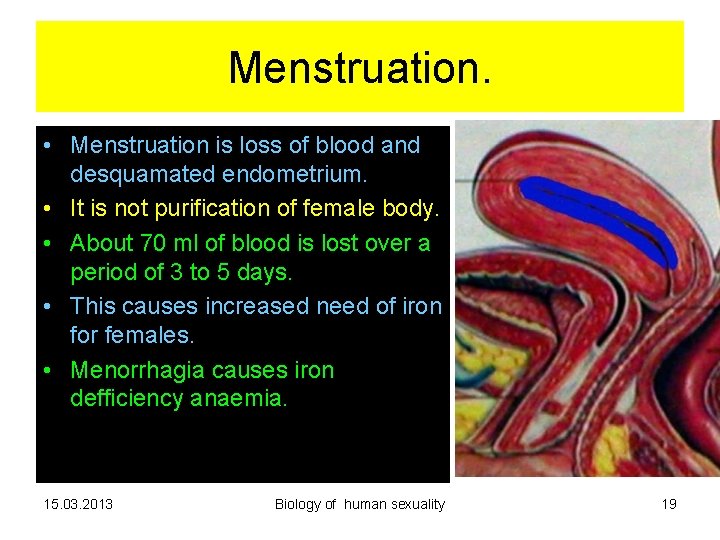
Menstruation. • Menstruation is loss of blood and desquamated endometrium. • It is not purification of female body. • About 70 ml of blood is lost over a period of 3 to 5 days. • This causes increased need of iron for females. • Menorrhagia causes iron defficiency anaemia. 15. 03. 2013 Biology of human sexuality 19
Menarche. • First menstruation is the first land mark to indicate that the person is capable of reproducing. [? Ceremony] • It indicates that the cyclical activities are taking effect. • It is not necessary to be followed by either regular ovulation or menstruation for about 2 years. • The uterus, pelvis and the mind are not matured enough for child bearing until after 18 years. 15. 03. 2013 Biology of human sexuality 20
Normal Menstruation. • Contains tissue debris, prostaglandins and large amounts of fibrinolysin. • The menstrual blood does not clot unless it is excessive. 15. 03. 2013 Biology of human sexuality 21
Puberty • It is a period when gametogenic and endocrine functions of the gonads have first developed to the point where reproduction is possible. • Adolescence- a person matures fully to be self sufficient. • Thelarche- development of breast. • Pubarche- development of axillary and pubic hair. • Menarche- first menstrual period. • Adrenarche- secretion of androgens by adrenal cortex. 15. 03. 2013 Biology of human sexuality 22
Mental Development • • • Peak intelligence. Logical thought Peak memory and concentration powers Interest in learning and reading Exploring and enjoying nature Inquisitiveness about secrets of life Lot of imagination- day dreaming. Benefits- stories, poetry, and creativity. Dangers- anti social behavior and unhealthy sexual drives 15. 03. 2013 Biology of human sexuality 23
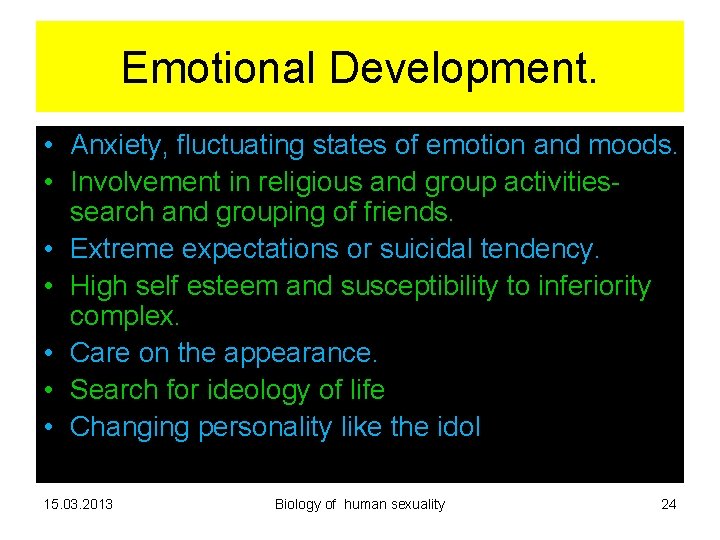
Emotional Development. • Anxiety, fluctuating states of emotion and moods. • Involvement in religious and group activitiessearch and grouping of friends. • Extreme expectations or suicidal tendency. • High self esteem and susceptibility to inferiority complex. • Care on the appearance. • Search for ideology of life • Changing personality like the idol 15. 03. 2013 Biology of human sexuality 24
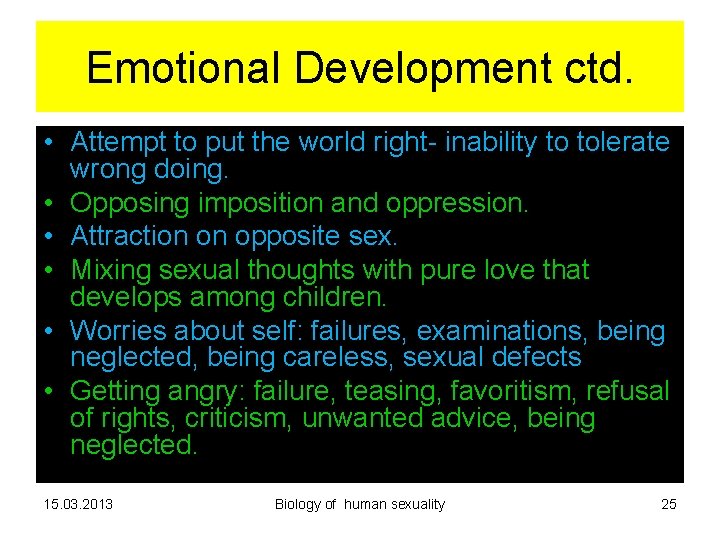
Emotional Development ctd. • Attempt to put the world right- inability to tolerate wrong doing. • Opposing imposition and oppression. • Attraction on opposite sex. • Mixing sexual thoughts with pure love that develops among children. • Worries about self: failures, examinations, being neglected, being careless, sexual defects • Getting angry: failure, teasing, favoritism, refusal of rights, criticism, unwanted advice, being neglected. 15. 03. 2013 Biology of human sexuality 25
Social Development of Adolescents [HUMAN] • Period of establishing self identity in the society. • Friendship develops first on emotional level and later on the nature of the individual • First friendship within the same sex then within both sexes and finally with one of the opposite sex which becomes life partnership • ? Dog Culture or cat culture: Cinema culture 15. 03. 2013 26 Biology of human sexuality
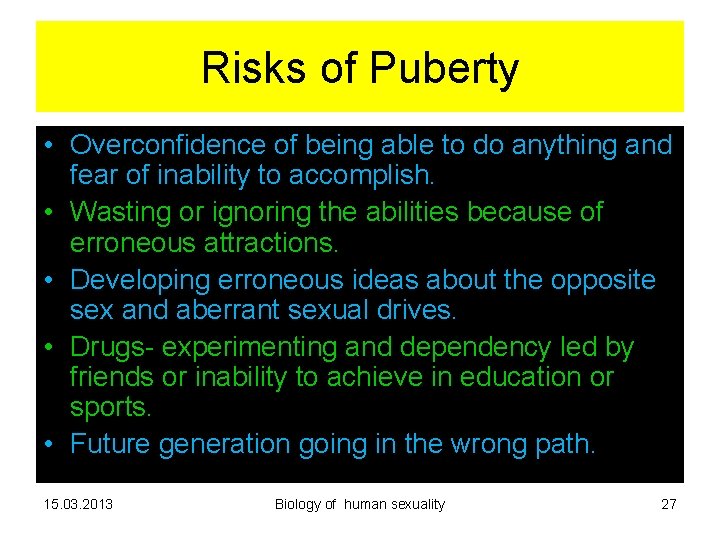
Risks of Puberty • Overconfidence of being able to do anything and fear of inability to accomplish. • Wasting or ignoring the abilities because of erroneous attractions. • Developing erroneous ideas about the opposite sex and aberrant sexual drives. • Drugs- experimenting and dependency led by friends or inability to achieve in education or sports. • Future generation going in the wrong path. 15. 03. 2013 Biology of human sexuality 27
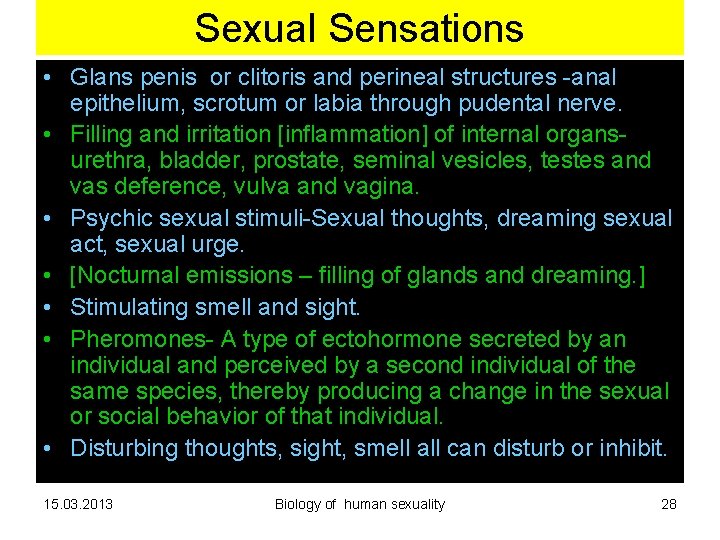
Sexual Sensations • Glans penis or clitoris and perineal structures -anal epithelium, scrotum or labia through pudental nerve. • Filling and irritation [inflammation] of internal organsurethra, bladder, prostate, seminal vesicles, testes and vas deference, vulva and vagina. • Psychic sexual stimuli-Sexual thoughts, dreaming sexual act, sexual urge. • [Nocturnal emissions – filling of glands and dreaming. ] • Stimulating smell and sight. • Pheromones- A type of ectohormone secreted by an individual and perceived by a second individual of the same species, thereby producing a change in the sexual or social behavior of that individual. • Disturbing thoughts, sight, smell all can disturb or inhibit. 15. 03. 2013 Biology of human sexuality 28
Coordination • Hypothalamus and limbic system and Sacral segments. • In lower animals- entire act is reflex. • As cerebral cortex develop, more of voluntary act and control. • Human sexual act is more of voluntary act. • Subconscious and environmental factors can influence the reflex erection and ejaculation. 15. 03. 2013 Biology of human sexuality 29
Responses to Sexual Arousal. • Increased sympathetic activity – vasoconstriction, tachycardia, elevated BP • Erection [filling the erectile tissue with blood at high pressure] of the penis, labia. • Relaxation of vaginal sphincter. • Copulatory movements. • Emission and ejaculation. • Orgasm [activation of ? reward center]. • Resolution 15. 03. 2013 Biology of human sexuality 30
Autonomic Responses of Sexual Act. • Increased sympathetic activity and adrenalin secretion– Increased heart rate and force resulting in increased blood pressure. – Increased metabolic rate. • Increased parasympathetic outflow in nervi erigentes dilate the arterioles [NO] in erectile tissue resulting in rapid filling. It may also constrict the veins. • Parasympathetics to Bartholin’s glands to secrete mucus for lubrication. • Sympathetic impulses from T 12 to L 2 at the height of stimulation cause emission- emptying of contents of ampula of vas deferens, prostate and seminal vesicles in that order. • Internal sphincter of the bladder contracts and prevents mixing urine with semen. 15. 03. 2013 Biology of human sexuality 31
Ejaculation. • Filling of internal urethra with semen initiates impulses through pudental nerve. • The sacral centers send up ward impulses which provoke sense of fullness in genital organs. • The impulses also increase contractions of internal genital organs. • Ischiocavernosus and bulbocavernosus contracts rhythmically and compress the base of penile erectile tissue propelling semen outejaculation [? CO]. • Muscles of the pelvis and trunk cause thrusting movements of the pelvis. 15. 03. 2013 Biology of human sexuality 32
Orgasm and Resolution • The male goes through orgasm during emission and ejaculation. • The female goes through orgasm when perineal muscles contract rhythmically, increased uterine and fallopian motility, dilation of cervical canal (for 30 minutes), intense muscle tension through out the body. • After a few minutes of orgasm, resolution begins. • The erection passes of because of sympathetic outflow to erectile tissue associated with a sense of satisfaction and peacefulness. 15. 03. 2013 Biology of human sexuality 33
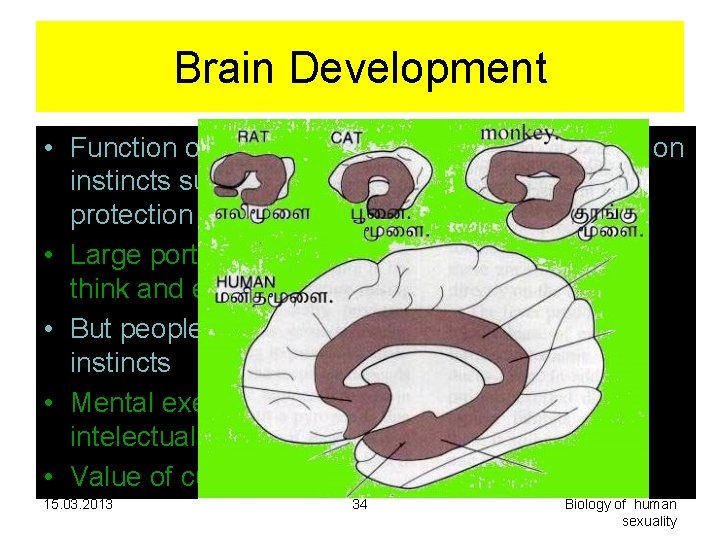
Brain Development • Function of the brain in lower animals is based on instincts such as feeding, reproduction and protection • Large portions of human brain are allocated to think and execute • But people are unable to overcome the basic instincts • Mental exercise is necessary to use the intelectual brain • Value of culture and tradition 15. 03. 2013 34 Biology of human sexuality
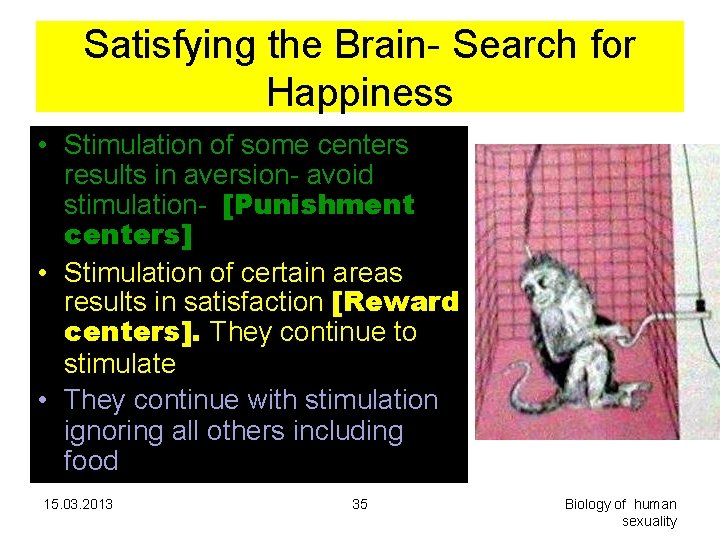
Satisfying the Brain- Search for Happiness • Stimulation of some centers results in aversion- avoid stimulation- [Punishment centers] • Stimulation of certain areas results in satisfaction [Reward centers]. They continue to stimulate • They continue with stimulation ignoring all others including food 15. 03. 2013 35 Biology of human sexuality
Benefits of Sexual Experience • • Reduction of stress blood pressure reduction increased immunity decreased risk of prostate cancer helps people bond and build trust helps you look between 4 -7 years younger greater contentment better sleep 15. 03. 2013 Biology of human sexuality 36
Importance of Reproductive Health • Sexual and reproductive health is at the centre of human dignity, relationships and well-being. • The private nature of sexual and reproductive health does not diminish its significance on the lives of men and women in every culture. • Every where in the world sexuality and sexual behaviour have profound consequences on individuals, families, and societies. 15. 03. 2013 Biology of human sexuality 37
Sexual Health Of Men And Women • Mutually fulfilling sexual relationship is important for mental health of men and women. • When sexual act take place, the joy should be shared equally by both, the man and the woman • If it involves anger, violence, coercion, abuse or rape it can have serious consequences on the partner and the child conceived. • Sexuality can be affected by the environment, mental state, physical state and social state. • Sexuality is often surrounded by strict social, moral, and religious beliefs. 15. 03. 2013 Biology of human sexuality 38
Conclusion • Reproductive function is everyone’s right and everyone’s responsibility. • But it also should reflect the social, cultural and moral identity of the community. 15. 03. 2013 Biology of human sexuality 39