
Prof Dr Ghada Fahmy Helaly Virus structure classification

- Slides: 24
Prof. Dr. Ghada Fahmy Helaly
Virus structure & classification Prof. Dr. Ghada Fahmy Helaly Microbiology & Immunology Department Faculty of Medicine Mu’tah University Prof. Dr. Ghada Fahmy Helaly
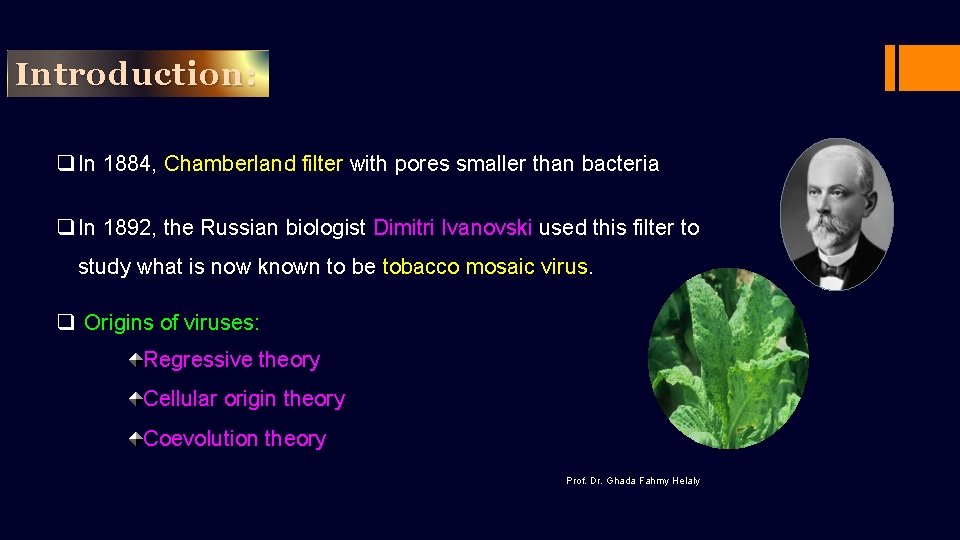
Introduction: q In 1884, Chamberland filter with pores smaller than bacteria q In 1892, the Russian biologist Dimitri Ivanovski used this filter to study what is now known to be tobacco mosaic virus. q Origins of viruses: Regressive theory Cellular origin theory Coevolution theory Prof. Dr. Ghada Fahmy Helaly
General Characteristics: 1. Wide diversity of shapes and sizes. 2. Small size: EM, 10 - 300 nanometers ( Filoviruses: length up to 1400 nm, diameters, 80 nm). 3. Filterable. 4. Obligate intracellular parasites: using the biosynthetic machinery of the host. 5. They contain molecular machinery for viral replication. 5. Protein coat. 6. No ribosomes, mitochondria or other organelles. 7. Only one type of nucleic acid. 8. Naked or enveloped (lipoprotein envelope). 9. Do not grow in size. Prof. Dr. Ghada Fahmy Helaly
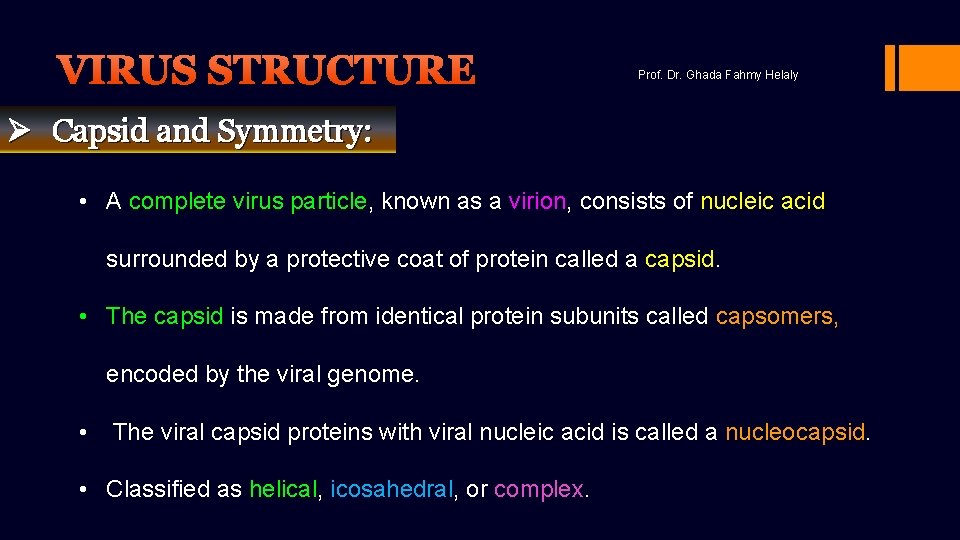
VIRUS STRUCTURE Prof. Dr. Ghada Fahmy Helaly Ø Capsid and Symmetry: • A complete virus particle, known as a virion, consists of nucleic acid surrounded by a protective coat of protein called a capsid. • The capsid is made from identical protein subunits called capsomers, encoded by the viral genome. • The viral capsid proteins with viral nucleic acid is called a nucleocapsid. • Classified as helical, icosahedral, or complex.
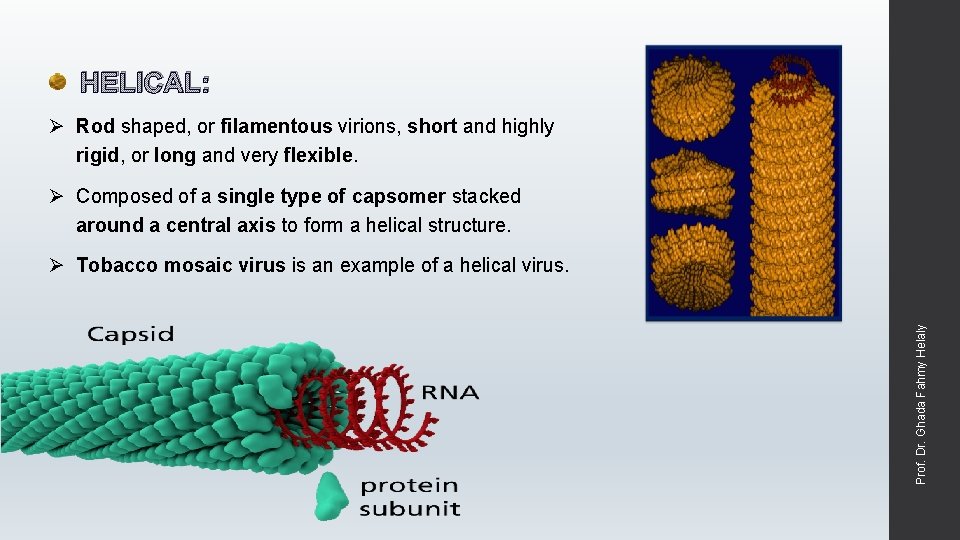
HELICAL: Ø Rod shaped, or filamentous virions, short and highly rigid, or long and very flexible. Ø Composed of a single type of capsomer stacked around a central axis to form a helical structure. Prof. Dr. Ghada Fahmy Helaly Ø Tobacco mosaic virus is an example of a helical virus.
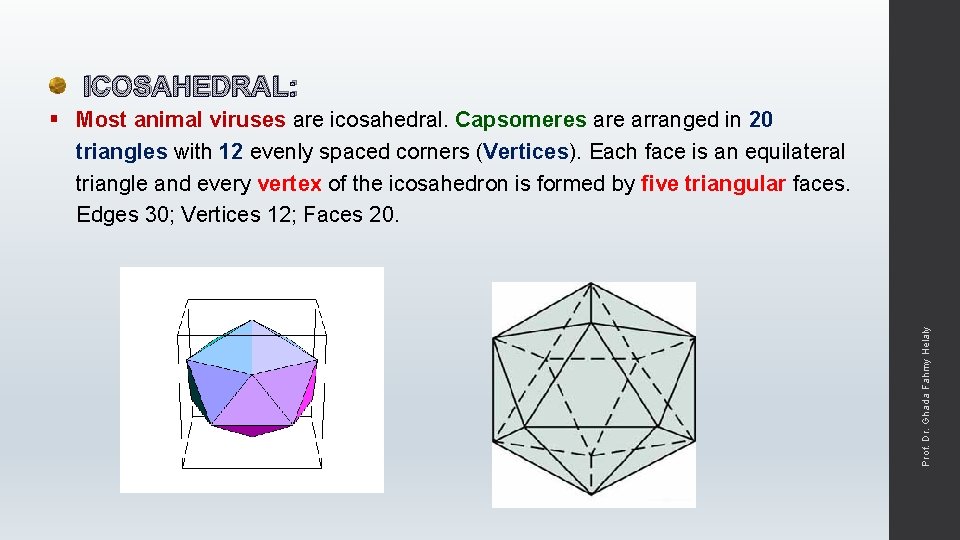
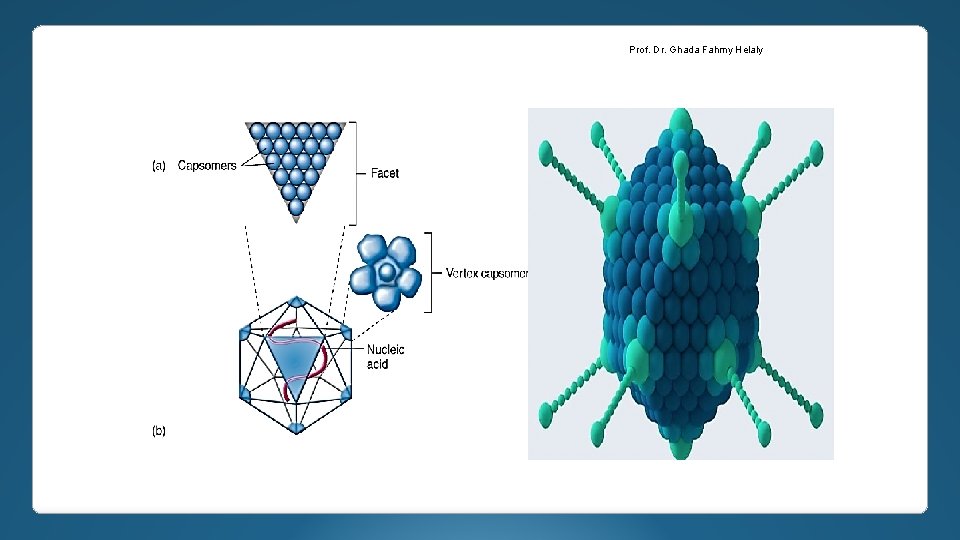
ICOSAHEDRAL: Prof. Dr. Ghada Fahmy Helaly § Most animal viruses are icosahedral. Capsomeres are arranged in 20 triangles with 12 evenly spaced corners (Vertices). Each face is an equilateral triangle and every vertex of the icosahedron is formed by five triangular faces. Edges 30; Vertices 12; Faces 20.
Prof. Dr. Ghada Fahmy Helaly
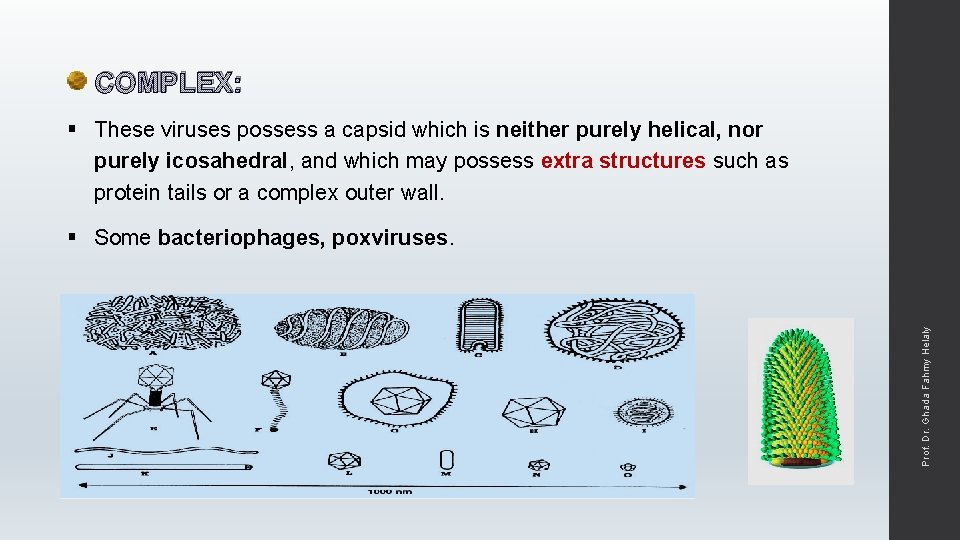
COMPLEX: § These viruses possess a capsid which is neither purely helical, nor purely icosahedral, and which may possess extra structures such as protein tails or a complex outer wall. Prof. Dr. Ghada Fahmy Helaly § Some bacteriophages, poxviruses.
Prof. Dr. Ghada Fahmy Helaly Functions of the capsid protein : Protect viral nucleic acid. Interact specifically with the viral nucleic acid for packaging. Mediate the attachment of the virus to the cell ( host receptors) for entry to cell. Antigenic determinants. Stimulates antibody production. Allow for release of nucleic acid upon entry into new cell.
Ø Virus Envelopes: Prof. Dr. Ghada Fahmy Helaly 1. Present in some but not all viruses 2. Composed of viral specific glycoproteins and host-cellderived lipids. 3. The envelope contains almost no host protein. 4. Enveloped viruses persistent infections. 5. It contains molecules to initiate infection, stimulus for antibody production, and serve as antigens; ether sensitive.
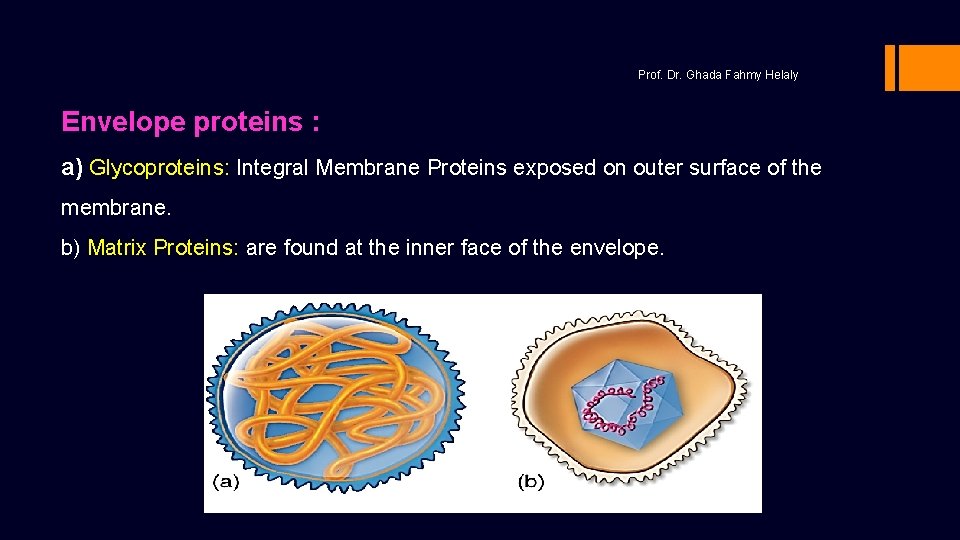
Prof. Dr. Ghada Fahmy Helaly Envelope proteins : a) Glycoproteins: Integral Membrane Proteins exposed on outer surface of the membrane. b) Matrix Proteins: are found at the inner face of the envelope.
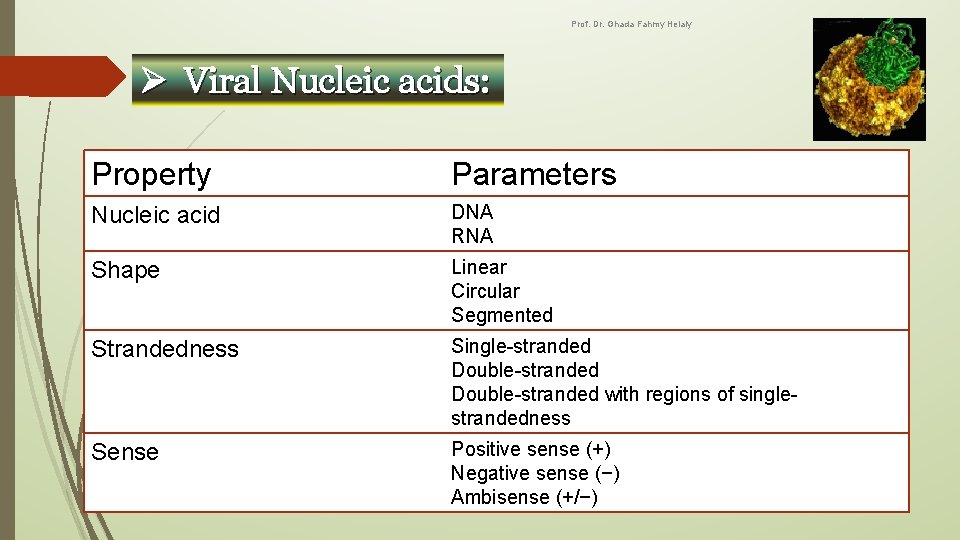
Prof. Dr. Ghada Fahmy Helaly Ø Viral Nucleic acids: Property Parameters Nucleic acid DNA RNA Shape Linear Circular Segmented Strandedness Single-stranded Double-stranded with regions of singlestrandedness Sense Positive sense (+) Negative sense (−) Ambisense (+/−)
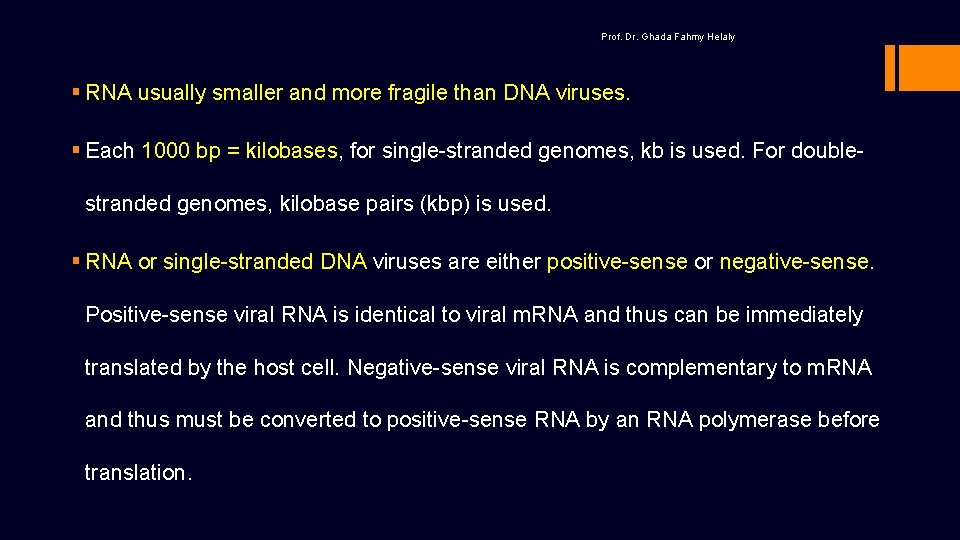
Prof. Dr. Ghada Fahmy Helaly § RNA usually smaller and more fragile than DNA viruses. § Each 1000 bp = kilobases, for single-stranded genomes, kb is used. For doublestranded genomes, kilobase pairs (kbp) is used. § RNA or single-stranded DNA viruses are either positive-sense or negative-sense. Positive-sense viral RNA is identical to viral m. RNA and thus can be immediately translated by the host cell. Negative-sense viral RNA is complementary to m. RNA and thus must be converted to positive-sense RNA by an RNA polymerase before translation.
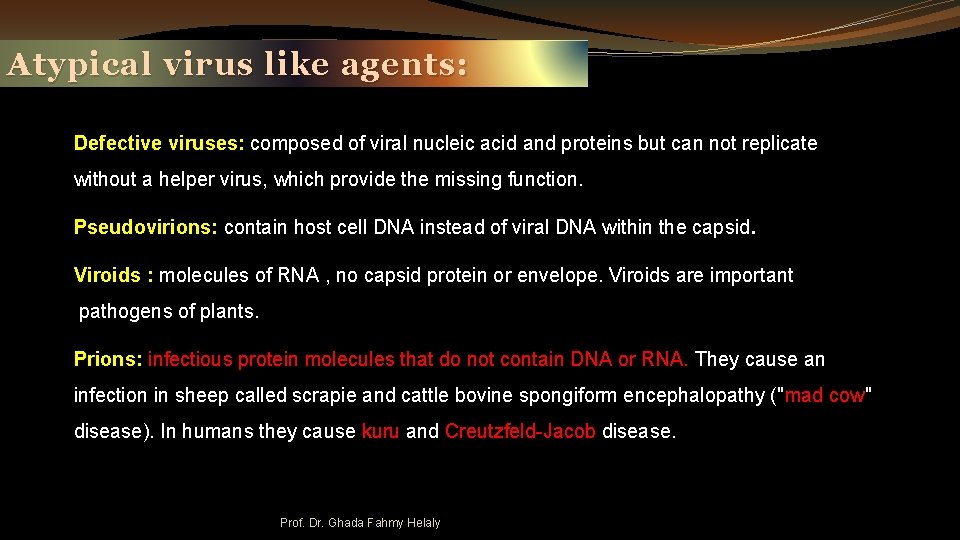
Atypical virus like agents: Defective viruses: composed of viral nucleic acid and proteins but can not replicate without a helper virus, which provide the missing function. Pseudovirions: contain host cell DNA instead of viral DNA within the capsid. Viroids : molecules of RNA , no capsid protein or envelope. Viroids are important pathogens of plants. Prions: infectious protein molecules that do not contain DNA or RNA. They cause an infection in sheep called scrapie and cattle bovine spongiform encephalopathy ("mad cow" disease). In humans they cause kuru and Creutzfeld-Jacob disease. Prof. Dr. Ghada Fahmy Helaly
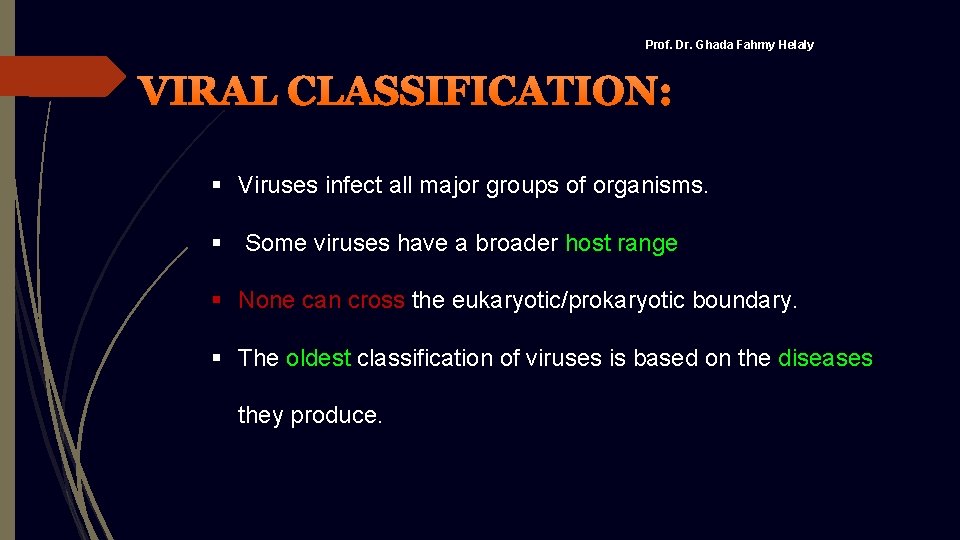
Prof. Dr. Ghada Fahmy Helaly VIRAL CLASSIFICATION: § Viruses infect all major groups of organisms. § Some viruses have a broader host range § None can cross the eukaryotic/prokaryotic boundary. § The oldest classification of viruses is based on the diseases they produce.
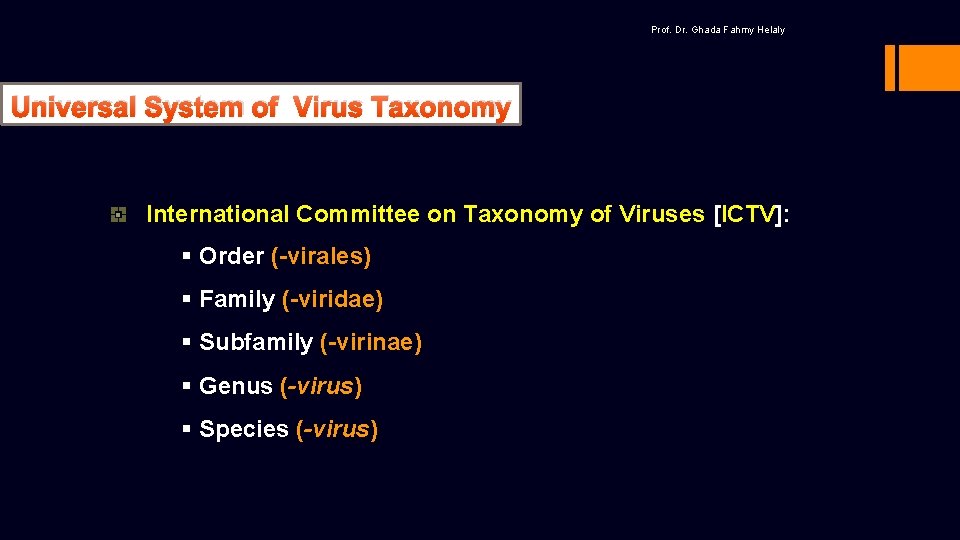
Prof. Dr. Ghada Fahmy Helaly Universal System of Virus Taxonomy International Committee on Taxonomy of Viruses [ICTV]: § Order (-virales) § Family (-viridae) § Subfamily (-virinae) § Genus (-virus) § Species (-virus)
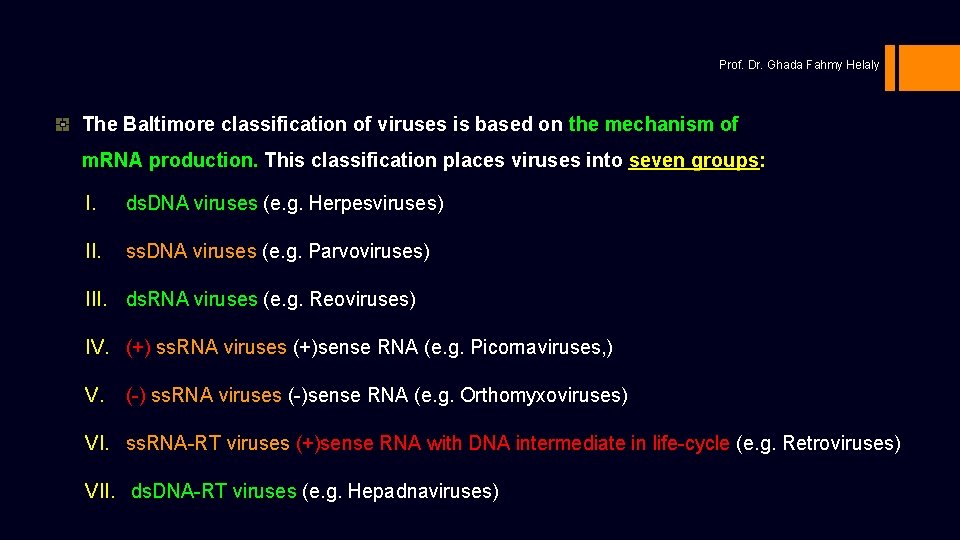
Prof. Dr. Ghada Fahmy Helaly The Baltimore classification of viruses is based on the mechanism of m. RNA production. This classification places viruses into seven groups: I. ds. DNA viruses (e. g. Herpesviruses) II. ss. DNA viruses (e. g. Parvoviruses) III. ds. RNA viruses (e. g. Reoviruses) IV. (+) ss. RNA viruses (+)sense RNA (e. g. Picornaviruses, ) V. (-) ss. RNA viruses (-)sense RNA (e. g. Orthomyxoviruses) VI. ss. RNA-RT viruses (+)sense RNA with DNA intermediate in life-cycle (e. g. Retroviruses) VII. ds. DNA-RT viruses (e. g. Hepadnaviruses)
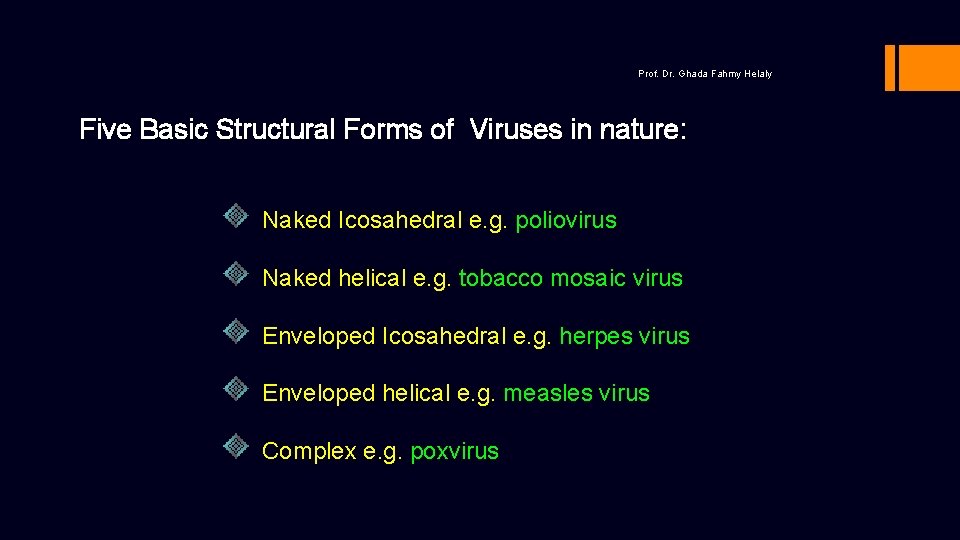
Prof. Dr. Ghada Fahmy Helaly Five Basic Structural Forms of Viruses in nature: Naked Icosahedral e. g. poliovirus Naked helical e. g. tobacco mosaic virus Enveloped Icosahedral e. g. herpes virus Enveloped helical e. g. measles virus Complex e. g. poxvirus
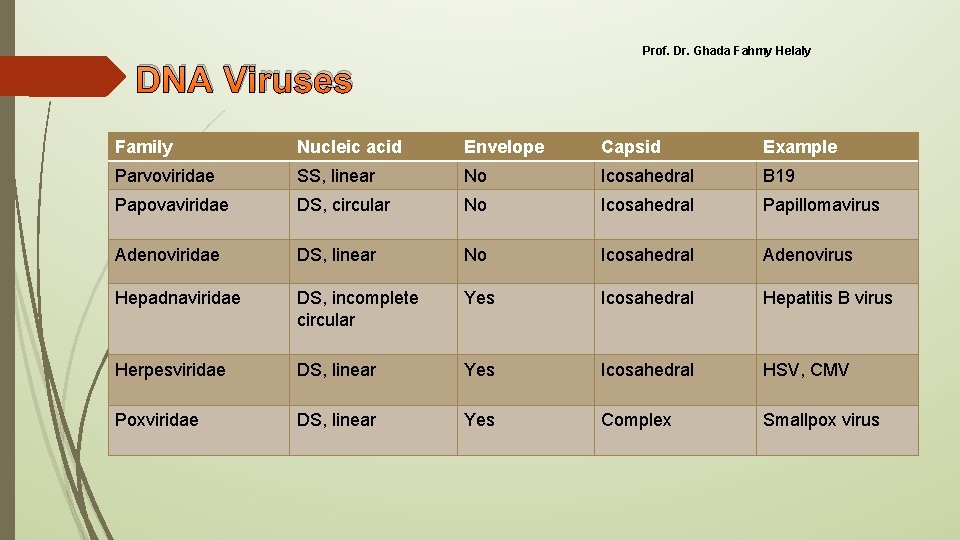
Prof. Dr. Ghada Fahmy Helaly DNA Viruses Family Nucleic acid Envelope Capsid Example Parvoviridae SS, linear No Icosahedral B 19 Papovaviridae DS, circular No Icosahedral Papillomavirus Adenoviridae DS, linear No Icosahedral Adenovirus Hepadnaviridae DS, incomplete circular Yes Icosahedral Hepatitis B virus Herpesviridae DS, linear Yes Icosahedral HSV, CMV Poxviridae DS, linear Yes Complex Smallpox virus
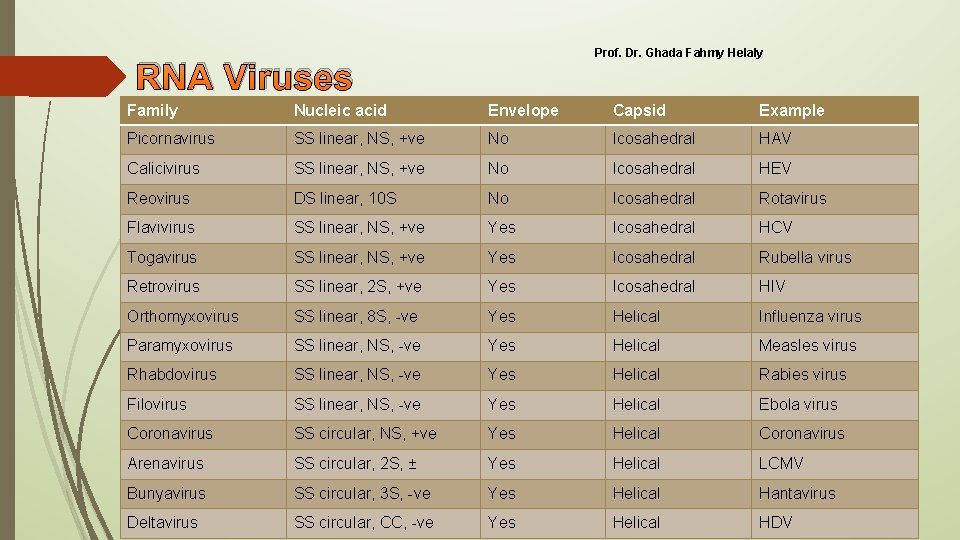
Prof. Dr. Ghada Fahmy Helaly RNA Viruses Family Nucleic acid Envelope Capsid Example Picornavirus SS linear, NS, +ve No Icosahedral HAV Calicivirus SS linear, NS, +ve No Icosahedral HEV Reovirus DS linear, 10 S No Icosahedral Rotavirus Flavivirus SS linear, NS, +ve Yes Icosahedral HCV Togavirus SS linear, NS, +ve Yes Icosahedral Rubella virus Retrovirus SS linear, 2 S, +ve Yes Icosahedral HIV Orthomyxovirus SS linear, 8 S, -ve Yes Helical Influenza virus Paramyxovirus SS linear, NS, -ve Yes Helical Measles virus Rhabdovirus SS linear, NS, -ve Yes Helical Rabies virus Filovirus SS linear, NS, -ve Yes Helical Ebola virus Coronavirus SS circular, NS, +ve Yes Helical Coronavirus Arenavirus SS circular, 2 S, ± Yes Helical LCMV Bunyavirus SS circular, 3 S, -ve Yes Helical Hantavirus Deltavirus SS circular, CC, -ve Yes Helical HDV
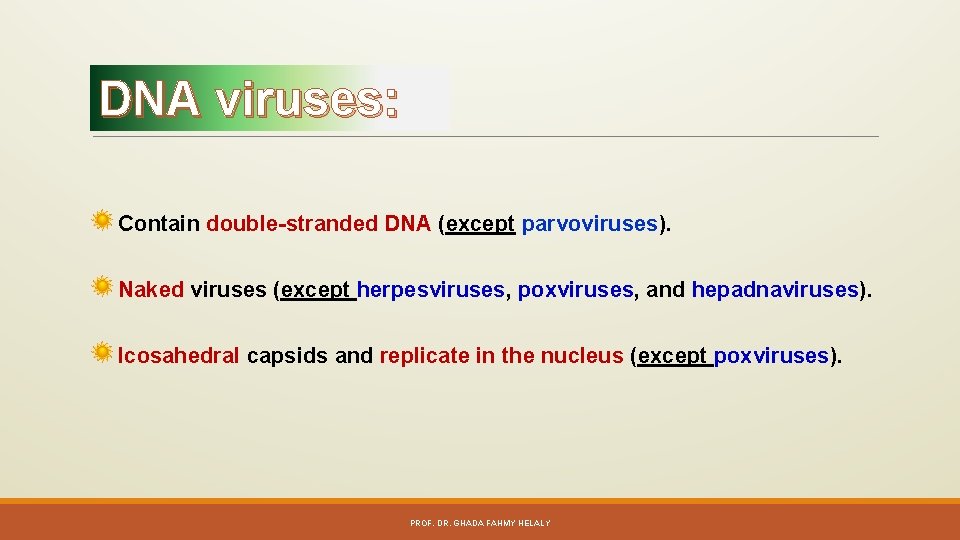
DNA viruses: Contain double-stranded DNA (except parvoviruses). Naked viruses (except herpesviruses, poxviruses, and hepadnaviruses). Icosahedral capsids and replicate in the nucleus (except poxviruses). PROF. DR. GHADA FAHMY HELALY
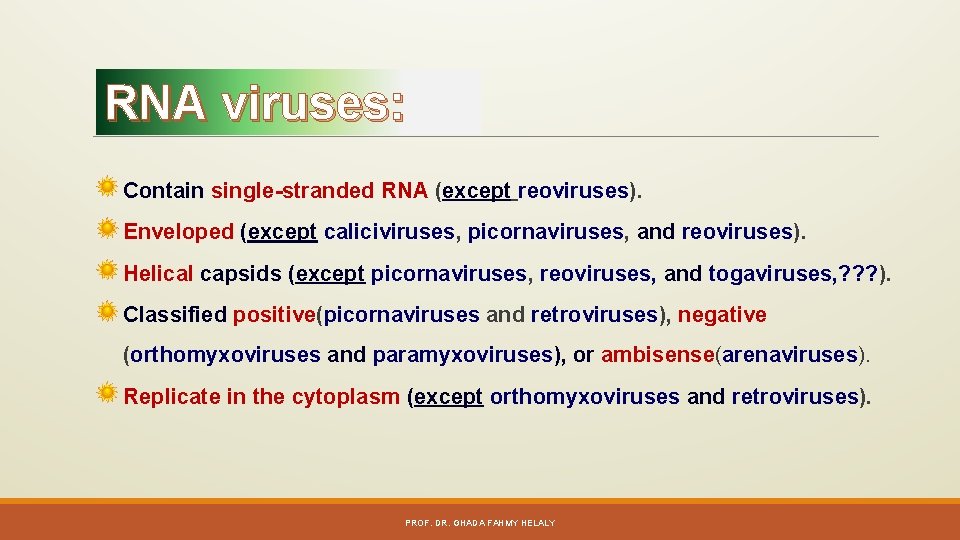
RNA viruses: Contain single-stranded RNA (except reoviruses). Enveloped (except caliciviruses, picornaviruses, and reoviruses). Helical capsids (except picornaviruses, reoviruses, and togaviruses, ? ? ? ). Classified positive(picornaviruses and retroviruses), negative (orthomyxoviruses and paramyxoviruses), or ambisense(arenaviruses). Replicate in the cytoplasm (except orthomyxoviruses and retroviruses). PROF. DR. GHADA FAHMY HELALY
Prof. Dr. Ghada Fahmy Helaly