
Prof Dr Andreas Stephan European University Viadrina FrankfurtOder



- Slides: 24
Prof. Dr. Andreas Stephan European University Viadrina Frankfurt/Oder and German Institute for Economic Research (DIW Berlin) Anna Lejpras European University Viadrina Frankfurt/Oder and German Institute for Economic Research (DIW Berlin) 16 th January 2007 Location Factors, Innovativeness and Firm Performance. Empirical Analysis of Firm Level Data from East Germany and Poland.
2 Background of the Research Project Location Factors, Innovativeness and Firm Performance. • German Institute for Economic Research (DIW Berlin) has carried out large-scale surveys for the German Ministry of Economic Affairs on the situation and perspectives of East German firms over years 1995 to 2004. • For example, in year 2000 about 8000 firms across all branches of the economy responded, and in 2004 about 6000 firms responded (response rates approximately 20%) • Reports for the ministry were prepared and descriptive analyses of the data were performed, but no ambitious research on these unique firm panel data so far. • Approval of an application to the German Science Foundation (DFG) on a research project based on this data and conducting a survey of Polish firms.
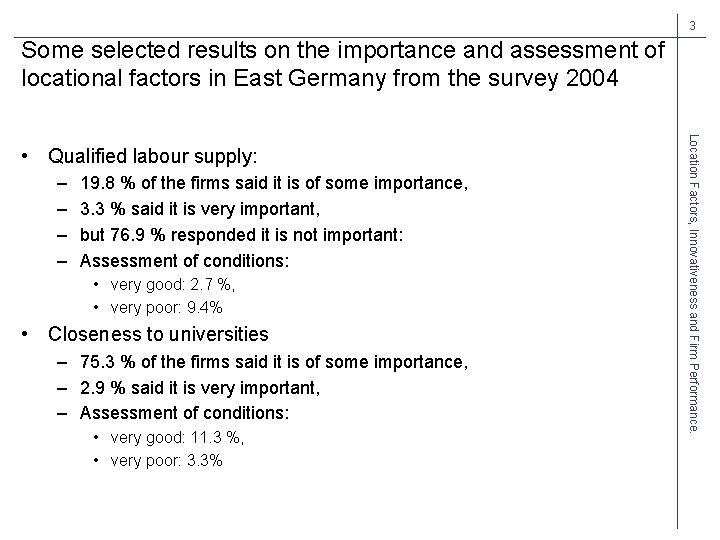
3 Some selected results on the importance and assessment of locational factors in East Germany from the survey 2004 – – 19. 8 % of the firms said it is of some importance, 3. 3 % said it is very important, but 76. 9 % responded it is not important: Assessment of conditions: • very good: 2. 7 %, • very poor: 9. 4% • Closeness to universities – 75. 3 % of the firms said it is of some importance, – 2. 9 % said it is very important, – Assessment of conditions: • very good: 11. 3 %, • very poor: 3. 3% Location Factors, Innovativeness and Firm Performance. • Qualified labour supply:
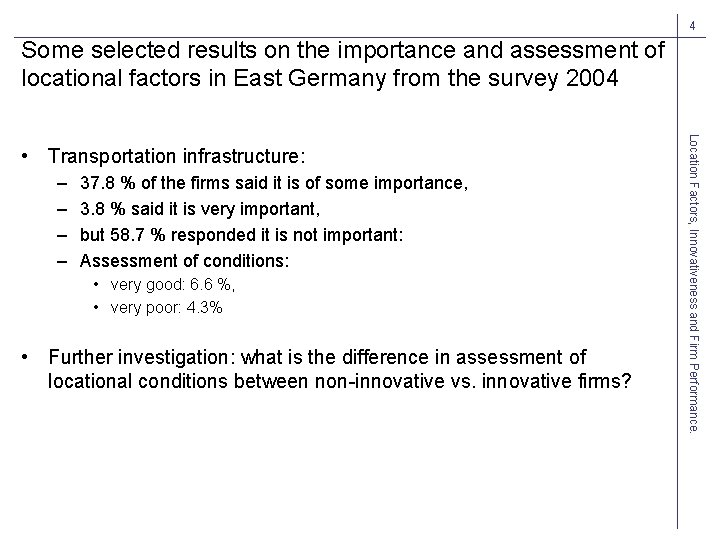
4 Some selected results on the importance and assessment of locational factors in East Germany from the survey 2004 – – 37. 8 % of the firms said it is of some importance, 3. 8 % said it is very important, but 58. 7 % responded it is not important: Assessment of conditions: • very good: 6. 6 %, • very poor: 4. 3% • Further investigation: what is the difference in assessment of locational conditions between non-innovative vs. innovative firms? Location Factors, Innovativeness and Firm Performance. • Transportation infrastructure:
5 Purpose of the seminar/meeting Location Factors, Innovativeness and Firm Performance. • Presentation and discussion of research project • Presentation and discussion of the questionaire for the Polish firms • Agreement on conducting the survey in behalf of both European University Viadrina and the Polish Academy of Sciences (PAN) • Further research cooperation
Prof. Dr. Andreas Stephan European University Viadrina Frankfurt/Oder and German Institute for Economic Research (DIW Berlin) Anna Lejpras European University Viadrina Frankfurt/Oder and German Institute for Economic Research (DIW Berlin) 16 th January 2007 Location Factors, Innovativeness and Firm Performance. Empirical Analysis of Firm Level Data from East Germany and Poland.
7 Overview Cluster approach and Porter‘s Diamond model Conceptual design of the model Model estimation for East-German firms Survey of Polish firms Location Factors, Innovativeness and Firm Performance. Project aims
8 Project Aims • To this end a structural equation model is developed that: – derives from Porter‘s Cluster Approach – is estimated with the Partial Least Squares method – is based on the data that was collected in 2004 by DIW Berlin (survey „Situation and Perspectives of Firms in East Germany“) Location Factors, Innovativeness and Firm Performance. • Analysis of the impact of location factors on the innovativeness and firm performance in East Germany and Poland
9 Cluster - Definition Examples for world-famous clusters are: Hollywood, Wall Street, Ferragamo und Gucci or automotive manufacturers in Southern Germany Location Factors, Innovativeness and Firm Performance. „Clusters are geographic concentrations of interconnected companies and institutions in a particular field. “
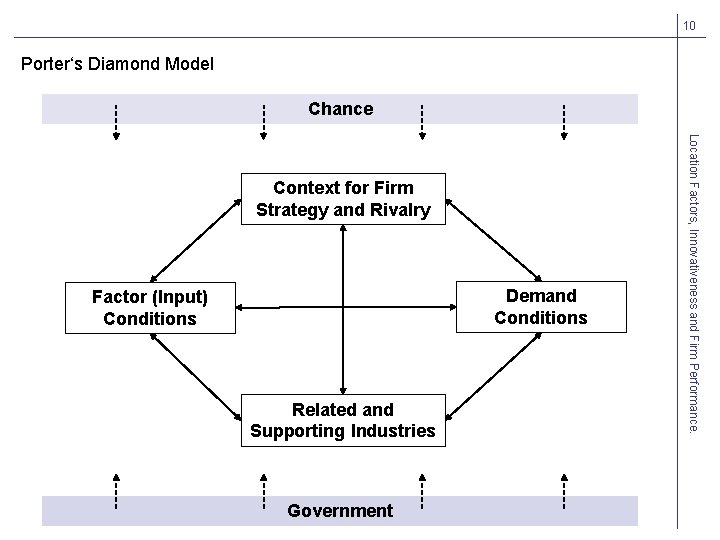
10 Porter‘s Diamond Model Chance Demand Conditions Factor (Input) Conditions Related and Supporting Industries Government Location Factors, Innovativeness and Firm Performance. Context for Firm Strategy and Rivalry
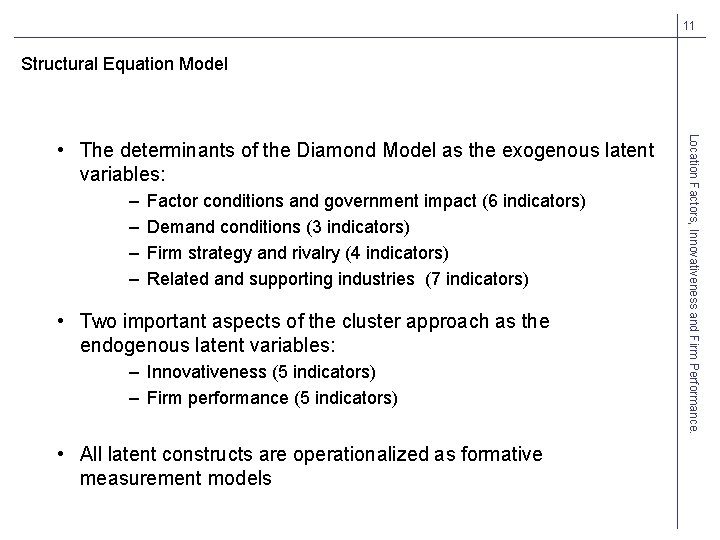
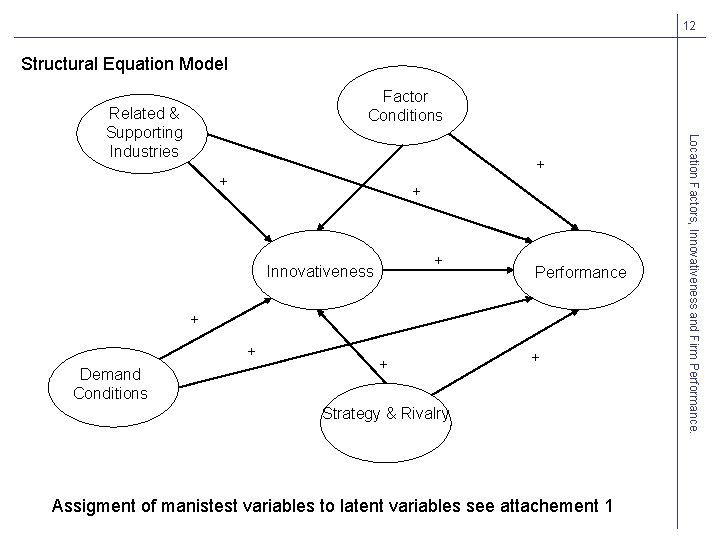
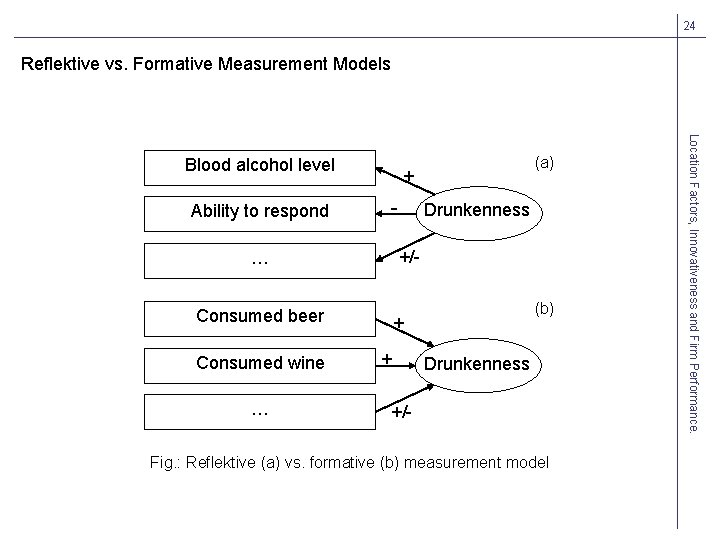
11 Structural Equation Model – – Factor conditions and government impact (6 indicators) Demand conditions (3 indicators) Firm strategy and rivalry (4 indicators) Related and supporting industries (7 indicators) • Two important aspects of the cluster approach as the endogenous latent variables: – Innovativeness (5 indicators) – Firm performance (5 indicators) • All latent constructs are operationalized as formative measurement models Location Factors, Innovativeness and Firm Performance. • The determinants of the Diamond Model as the exogenous latent variables:
12 Structural Equation Model Factor Conditions + + Innovativeness Performance + + Demand Conditions + + Strategy & Rivalry Assigment of manistest variables to latent variables see attachement 1 Location Factors, Innovativeness and Firm Performance. Related & Supporting Industries
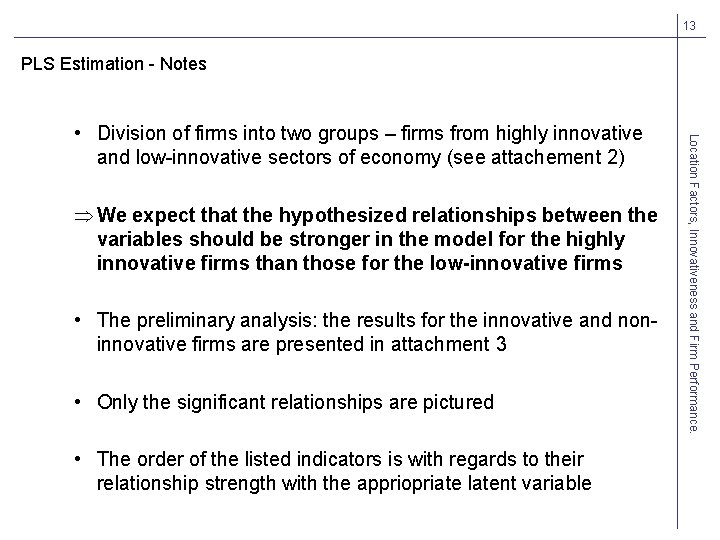
13 PLS Estimation - Notes Þ We expect that the hypothesized relationships between the variables should be stronger in the model for the highly innovative firms than those for the low-innovative firms • The preliminary analysis: the results for the innovative and noninnovative firms are presented in attachment 3 • Only the significant relationships are pictured • The order of the listed indicators is with regards to their relationship strength with the appriopriate latent variable Location Factors, Innovativeness and Firm Performance. • Division of firms into two groups – firms from highly innovative and low-innovative sectors of economy (see attachement 2)
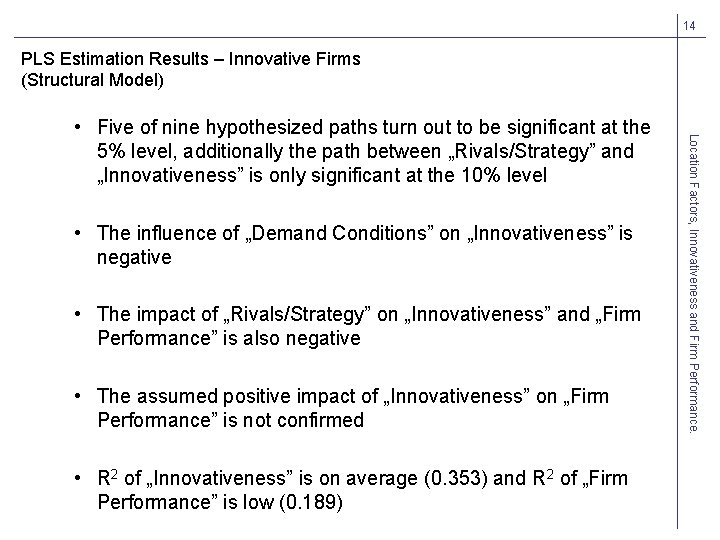
14 PLS Estimation Results – Innovative Firms (Structural Model) • The influence of „Demand Conditions” on „Innovativeness” is negative • The impact of „Rivals/Strategy” on „Innovativeness” and „Firm Performance” is also negative • The assumed positive impact of „Innovativeness” on „Firm Performance” is not confirmed • R 2 of „Innovativeness” is on average (0. 353) and R 2 of „Firm Performance” is low (0. 189) Location Factors, Innovativeness and Firm Performance. • Five of nine hypothesized paths turn out to be significant at the 5% level, additionally the path between „Rivals/Strategy” and „Innovativeness” is only significant at the 10% level
15 PLS Estimation Results – Non-innovative Firms (Structural Model) • The influence of „Demand Conditions” on „Innovativeness” is negative • The impact of „Rivals/Strategy” on „Innovativeness” or „Firm Performance” is not confirmed • R 2 of „Innovativeness” is extremely low (0. 083) and R 2 of „Firm Performance” is on average (0. 306) Location Factors, Innovativeness and Firm Performance. • Four of nine hypothesized relationships are significant first at the 10% level
16 Estimation Results – Innovative vs. Non-innovative Firms (Measurement Models) • For innovative firms the closeness to universities and research establishments are the most important factors, for non-innovative ones the closeness to research establishments and the supraregional transportation system are most important • All manifest variables of „Innovativeness” are significant for the innovative firms, for the non-innovative ones only the patent count • „Firm Performance” is measured by the market volume in the case of the innovative firms and by the employment growth for their non-innovative counterparts Location Factors, Innovativeness and Firm Performance. • Higher intensity of cooperation activities and more significant cooperation fields in the case of the innovative firms
17 Model Comparision – Innovative vs. Non-innovative Firms Location Factors, Innovativeness and Firm Performance. Þ As expected the relationships between the variables in the model for the firms from highly innovative sectors of economy are stronger compared to those for the lessinnovative firms
18 Survey of Polish firms • The survey of 2000 Polish firms is planned in February/March 2007 • We took the firm adresses from the database on the webpage http: //www. teleadreson. pl/ considering the following criteria: – the economic sectors (NACE): 22. 3 24. 4 29. 1 29. 4 29. 7 30 31 32 33 34 35. 3 72. 2 72. 3 72. 4 73 74. 3 – the ownership form: private, mixed, foreign capital – the legal form: corporations, individual enterprises, agencies of foreign enterprises Location Factors, Innovativeness and Firm Performance. • The questionnaire for Polish firms is based on the survey that was sent in 2004 to East-German firms by the German Institute for Economic Research (DIW Berlin)
Thank you for your attention! Location Factors, Innovativeness and Firm Performance. Empirical Analysis of Firm Level Data from East Germany and Poland.
Backup Location Factors, Innovativeness and Firm Performance. Empirical Analysis of Firm Level Data from East Germany and Poland.
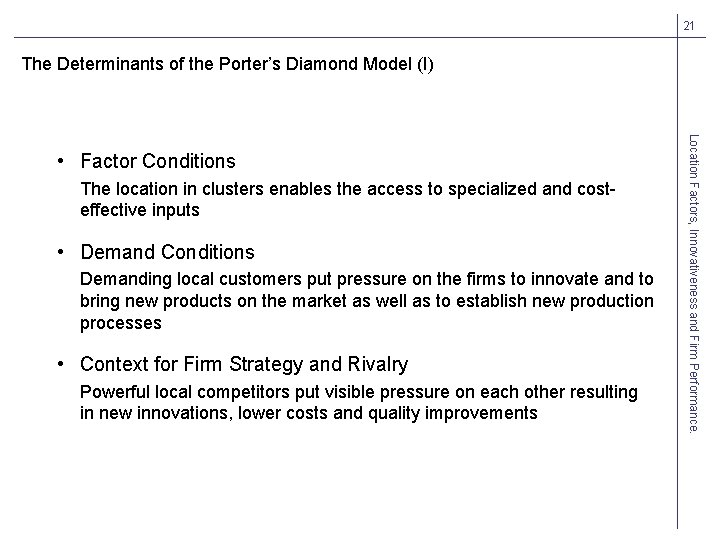
21 The Determinants of the Porter’s Diamond Model (I) The location in clusters enables the access to specialized and costeffective inputs • Demand Conditions Demanding local customers put pressure on the firms to innovate and to bring new products on the market as well as to establish new production processes • Context for Firm Strategy and Rivalry Powerful local competitors put visible pressure on each other resulting in new innovations, lower costs and quality improvements Location Factors, Innovativeness and Firm Performance. • Factor Conditions
22 The Determinands of the Porter’s Diamond Model (II) efficient access to cost-effective inputs and machinery; lower transaction costs; in the close cooperation the suppliers help the firms to perceive new methods or technologies • Government influence all determinands of the Diamond Model, e. g. by the subventions, the education policy, the regulations of the product norms or the tax policy • Chance providing the discontinuities, cause of the changes in the competition situation (e. g. the sudden changes of the input costs or wars) Location Factors, Innovativeness and Firm Performance. • Related and Supporting Industries
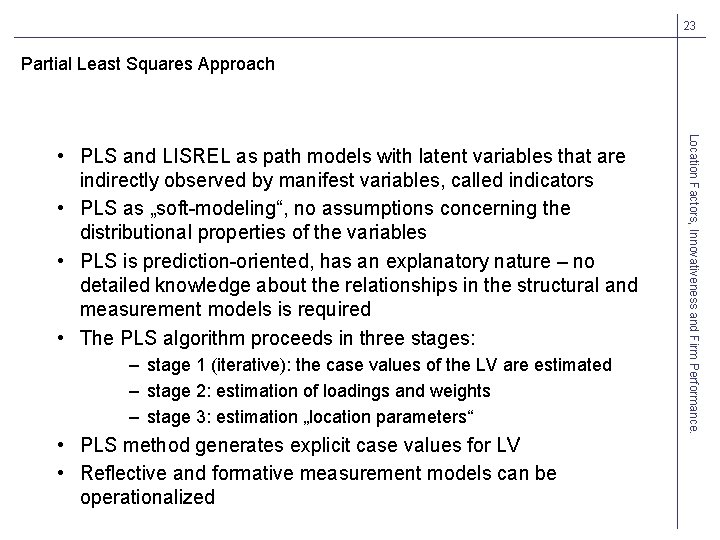
23 Partial Least Squares Approach – stage 1 (iterative): the case values of the LV are estimated – stage 2: estimation of loadings and weights – stage 3: estimation „location parameters“ • PLS method generates explicit case values for LV • Reflective and formative measurement models can be operationalized Location Factors, Innovativeness and Firm Performance. • PLS and LISREL as path models with latent variables that are indirectly observed by manifest variables, called indicators • PLS as „soft-modeling“, no assumptions concerning the distributional properties of the variables • PLS is prediction-oriented, has an explanatory nature – no detailed knowledge about the relationships in the structural and measurement models is required • The PLS algorithm proceeds in three stages:
24 Reflektive vs. Formative Measurement Models Ability to respond + - Consumed beer … Drunkenness +/- … Consumed wine (a) (b) + + Drunkenness +/- Fig. : Reflektive (a) vs. formative (b) measurement model Location Factors, Innovativeness and Firm Performance. Blood alcohol level