
Prof Dr Abha Majumdar Director and Head Center
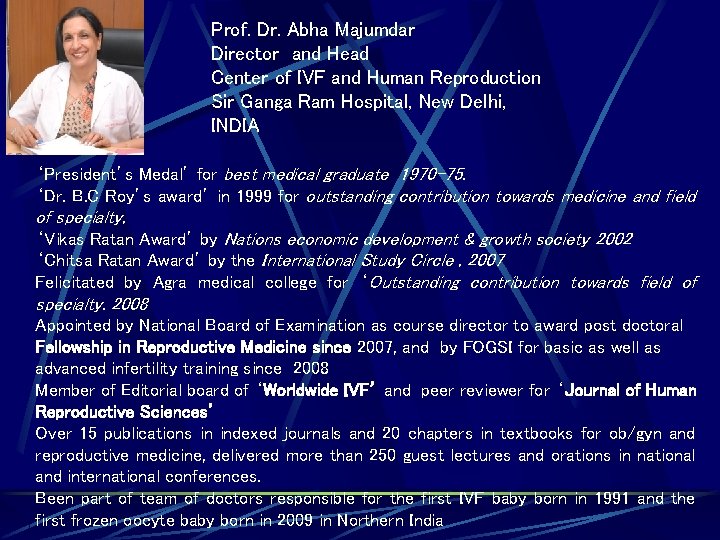
Prof. Dr. Abha Majumdar Director and Head Center of IVF and Human Reproduction Sir Ganga Ram Hospital, New Delhi, INDIA ‘President’s Medal’ for best medical graduate 1970 -75. ‘Dr. B. C Roy’s award’ in 1999 for outstanding contribution towards medicine and field of specialty, ‘Vikas Ratan Award’ by Nations economic development & growth society 2002 ‘Chitsa Ratan Award’ by the International Study Circle , 2007 Felicitated by Agra medical college for ‘Outstanding contribution towards field of specialty. 2008 Appointed by National Board of Examination as course director to award post doctoral Fellowship in Reproductive Medicine since 2007, and by FOGSI for basic as well as advanced infertility training since 2008 Member of Editorial board of ‘Worldwide IVF’ and peer reviewer for ‘Journal of Human Reproductive Sciences’ Over 15 publications in indexed journals and 20 chapters in textbooks for ob/gyn and reproductive medicine, delivered more than 250 guest lectures and orations in national and international conferences. Been part of team of doctors responsible for the first IVF baby born in 1991 and the first frozen oocyte baby born in 2009 in Northern India
Individualized controlled ovulation stimulation (i. COS) Prof. Dr. Abha Majumdar Center IVF and Human Reproduction Sir Ganga Ram Hospital New Delhi INDIA
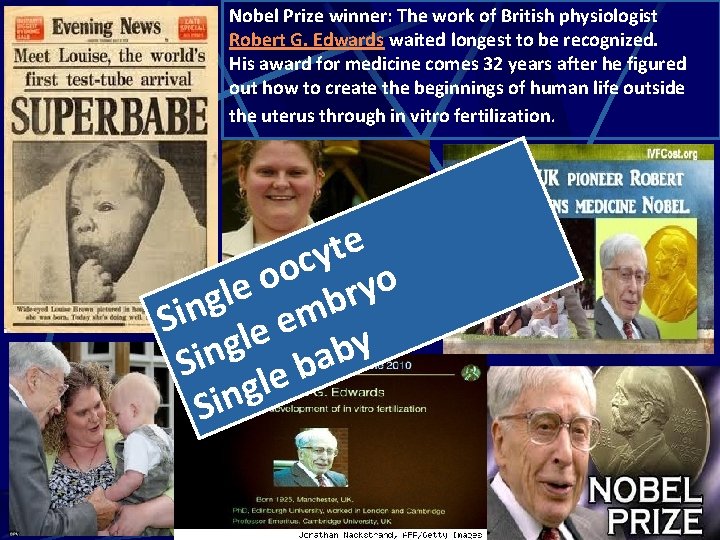
Nobel Prize winner: The work of British physiologist Robert G. Edwards waited longest to be recognized. His award for medicine comes 32 years after he figured out how to create the beginnings of human life outside the uterus through in vitro fertilization. e t y c o o o y e l r g b n i m S e e l y g b n Si le ba g n i S
IVF started to develop fast with the aim of maximizing pregnancy rates per cycle • • • Higher number of oocytes and thus more embryos Use of unphysiological high doses of gonadotropins Time consuming protocols Higher costs Patient discomfort Higher risk of OHSS Very high risk of multiple gestation Rapid progression of protocols and technology h c e t y g o l o n
This magic wheel had to slow down h c te o n y g lo
Definition of success in IVF started shifting from pregnancy rate per cycle towards achieving healthy singleton child per started course of treatment. For achieving this aim the first change had to be in the stimulation protocols with the aim of: • Less oocytes • less pain /stress • less cost • Less complications • Obtaining a good oocyte / embryo/ implantation rate Further progression of technology aimed at minimizing complication rate yet maintaining optimal pregnancy rates y g lo te o n ch
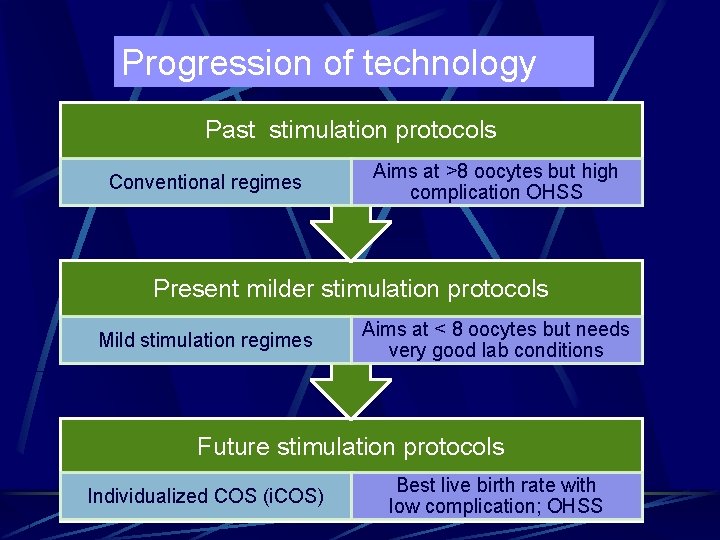
Progression of technology Past stimulation protocols Conventional regimes Aims at >8 oocytes but high complication OHSS Present milder stimulation protocols Mild stimulation regimes Aims at < 8 oocytes but needs very good lab conditions Future stimulation protocols Individualized COS (i. COS) Best live birth rate with low complication; OHSS
What does i. COS mean? A cycle with ovarian stimulation which gives the couple best chance of singleton pregnancy with lowest or no risk of OHSS and minimal chance of cycle cancellation (what ever the underlying diagnosis may be for which the couple has to undergo IVF)
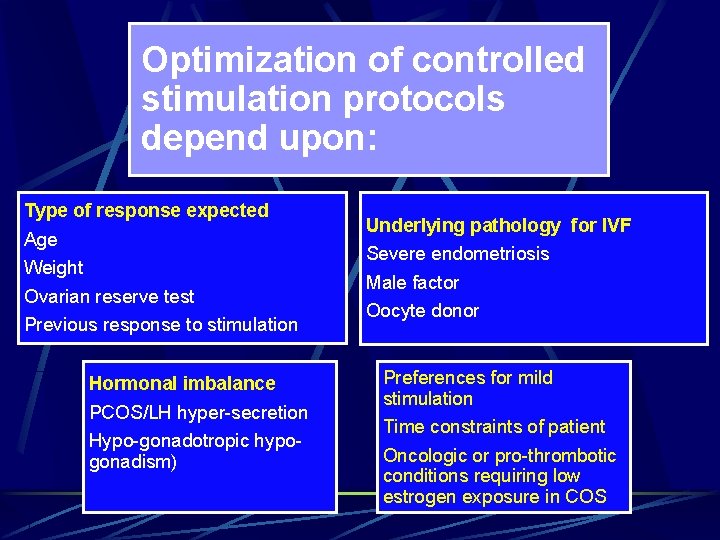
Optimization of controlled stimulation protocols depend upon: Type of response expected Age Weight Ovarian reserve test Previous response to stimulation Hormonal imbalance PCOS/LH hyper-secretion Hypo-gonadotropic hypogonadism) Underlying pathology for IVF Severe endometriosis Male factor Oocyte donor Preferences for mild stimulation Time constraints of patient Oncologic or pro-thrombotic conditions requiring low estrogen exposure in COS
Type of response expected Age Weight Ovarian reserve test (ORT) Previous response to stimulation
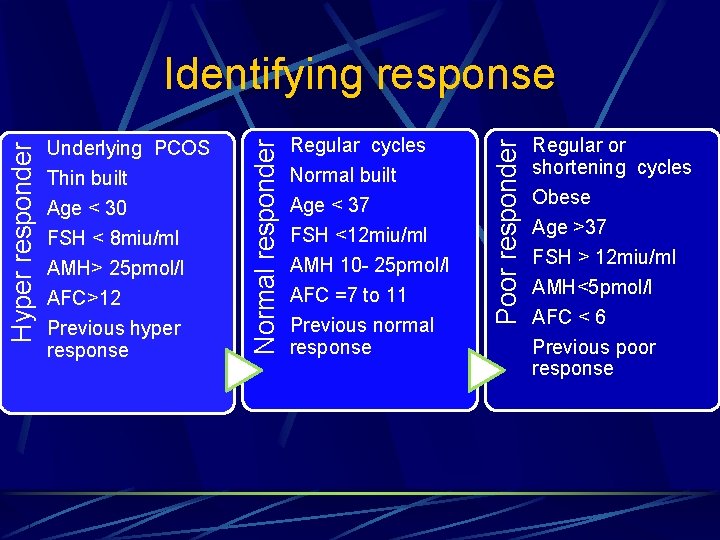
Regular cycles Normal built Age < 37 FSH <12 miu/ml AMH 10 - 25 pmol/l AFC =7 to 11 Previous normal response Poor responder Underlying PCOS Thin built Age < 30 FSH < 8 miu/ml AMH> 25 pmol/l AFC>12 Previous hyper response Normal responder Hyper responder Identifying response Regular or shortening cycles Obese Age >37 FSH > 12 miu/ml AMH<5 pmol/l AFC < 6 Previous poor response
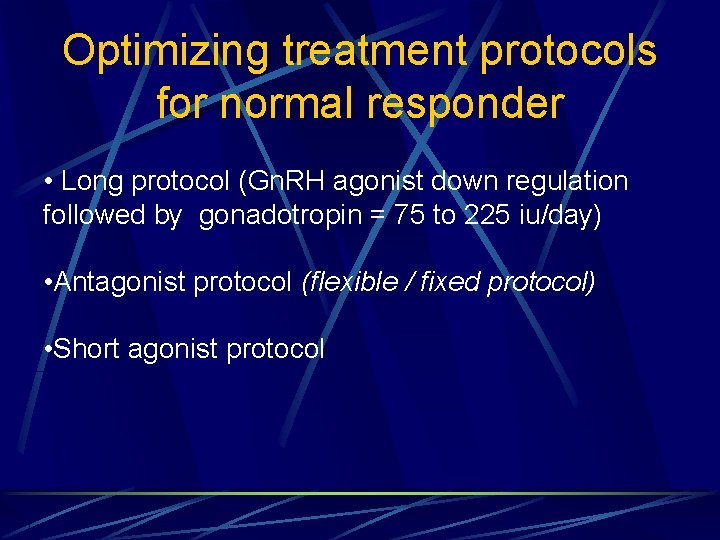
Optimizing treatment protocols for normal responder • Long protocol (Gn. RH agonist down regulation followed by gonadotropin = 75 to 225 iu/day) • Antagonist protocol (flexible / fixed protocol) • Short agonist protocol
Optimizing treatment protocols for high responder / PCOS • Antagonist protocol (fixed dose regime preferred) • Short agonist protocol • Long protocol • Minimal stimulation protocols with clomiphene citrate and gonadotropins All protocols require low starting dose of FSH 75 -150 IU/day
Optimizing treatment protocols for poor responder • Gn. RHa long protocol • Conventional protocol • Gn. RH agonist ‘stop’ or ‘mini’ dose protocol • Antagonist protocol with flexible regime • Short agonist protocol • Flare agonist with antagonist with flexible protocol (pre treatment: ocp 14 -21 days or antagonist 0. 25 mg/day from day 25 or estradiol valerate 4 mg /day from day 22 of previous cycle for better cohort) • Milder stimulation regimes • Higher dose of FSH 150 to 300 units per day • Add LH or HMG to FSH
The Cochrane database of systemic reviews 2008 Treatment protocols for poor responders 6 comparison groups (9 trials analyzed) q. Stop protocol vs. conventional Gn. RHa long protocol q. Gn. RH antagonist vs. conventional Gn. RHa long protocol q. Bromocriptine rebound protocol vs. Gn. RHa long protocol q. Gn. RHa short protocol vs. Gn. RHa long protocol q. Gn. RH antagonist vs. Gn. RHa short protocol q. Low dose flare protocol vs. spontaneous natural
The Cochrane database of systemic reviews 2008 Summary of results in poor responders There is insufficient evidence to support the routine use of any particular intervention for ovarian stimulation or adjuvant therapy. Evaluation of interventions proposed have been performed in single, under-powered studies, which might not have allowed the detection of the true effect of the intervention. More robust data from good quality RCT’s with relevant outcomes are needed.
Hormonal imbalance PCOS/LH hyper-secretion Hypo-gonadotropic hypo-gonadism
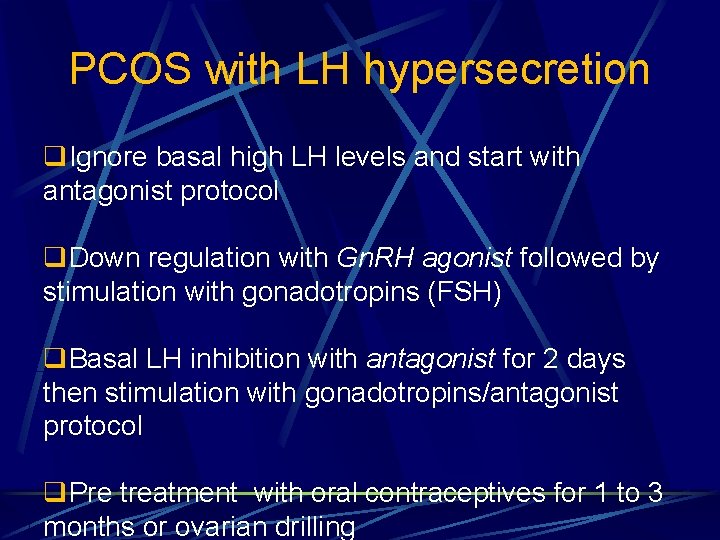
PCOS with LH hypersecretion q. Ignore basal high LH levels and start with antagonist protocol q. Down regulation with Gn. RH agonist followed by stimulation with gonadotropins (FSH) q. Basal LH inhibition with antagonist for 2 days then stimulation with gonadotropins/antagonist protocol q. Pre treatment with oral contraceptives for 1 to 3 months or ovarian drilling
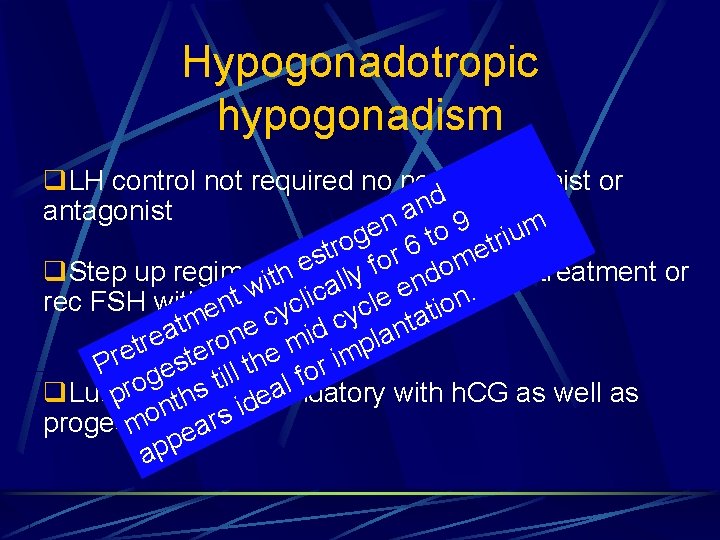
Hypogonadotropic hypogonadism q. LH control not required no need of agonist or d n antagonist a 9 n m e o u g i t r o t r 6 t e r s m o e f q. Step up regime with HMG is the ideal treatment or h ally ndo t i e w. c t i n l e rec FSH with rec LH l n o c c tati e y y c m c t e n a d i n a e l r t ro e m imp e e r t P ges ill th for t l o r a s q. Luteal support mandatory with h. CG as well as p nth e d i progesterone. mo ears p p a
Underlying diagnosis Severe endometriosis Male factor Oocyte donor
Severe endometriosis
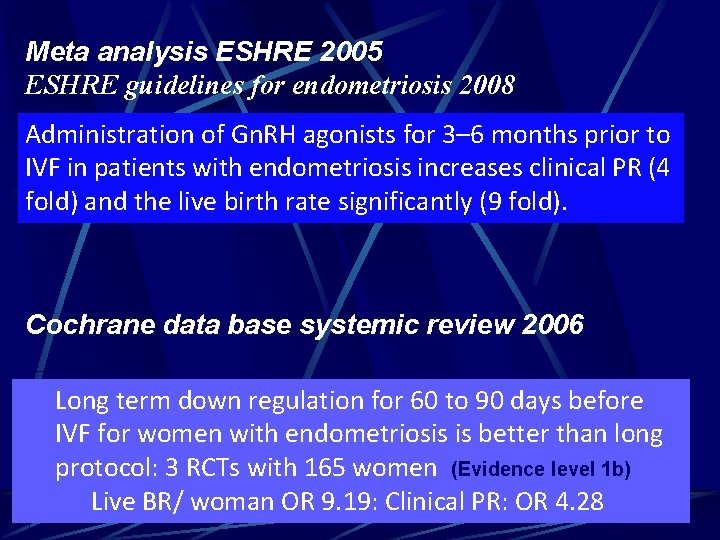
Meta analysis ESHRE 2005 ESHRE guidelines for endometriosis 2008 Administration of Gn. RH agonists for 3– 6 months prior to IVF in patients with endometriosis increases clinical PR (4 fold) and the live birth rate significantly (9 fold). Cochrane data base systemic review 2006 Long term down regulation for 60 to 90 days before IVF for women with endometriosis is better than long protocol: 3 RCTs with 165 women (Evidence level 1 b) Live BR/ woman OR 9. 19: Clinical PR: OR 4. 28
Male factor infertility Stimulated as per the response of female partner expected hyper - responder normal - responder poor-responder
Optimum stimulation for Oocyte donors
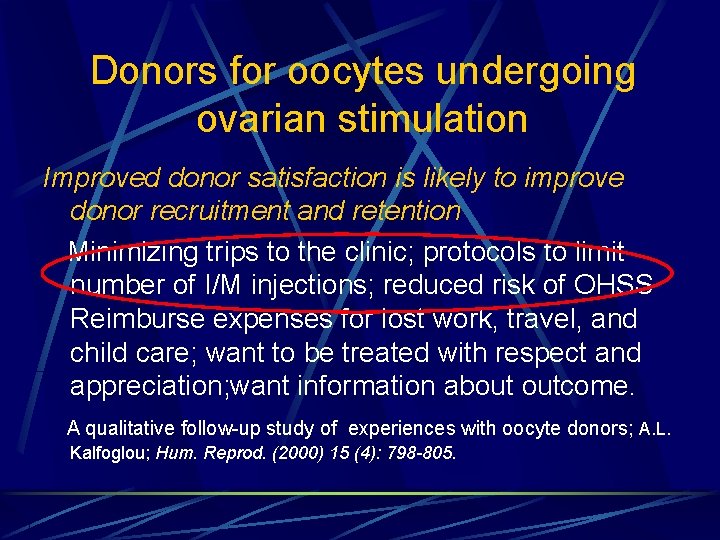
Donors for oocytes undergoing ovarian stimulation Improved donor satisfaction is likely to improve donor recruitment and retention Minimizing trips to the clinic; protocols to limit number of I/M injections; reduced risk of OHSS Reimburse expenses for lost work, travel, and child care; want to be treated with respect and appreciation; want information about outcome. A qualitative follow-up study of experiences with oocyte donors; A. L. Kalfoglou; Hum. Reprod. (2000) 15 (4): 798 -805.
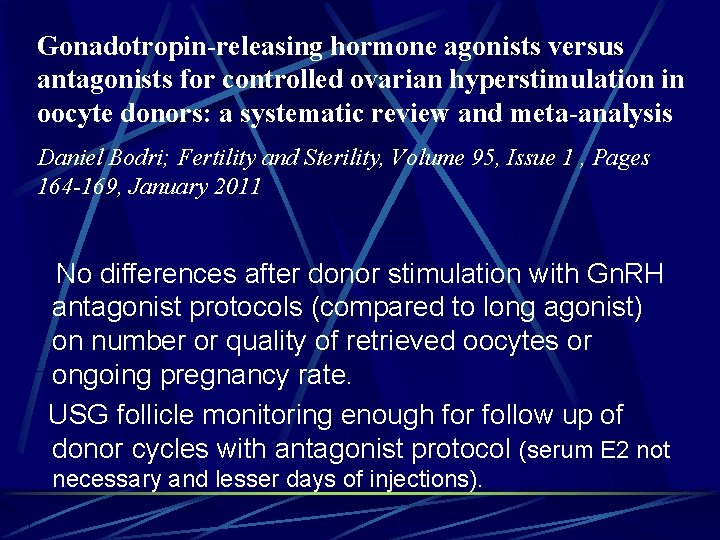
Gonadotropin-releasing hormone agonists versus antagonists for controlled ovarian hyperstimulation in oocyte donors: a systematic review and meta-analysis Daniel Bodri; Fertility and Sterility, Volume 95, Issue 1 , Pages 164 -169, January 2011 No differences after donor stimulation with Gn. RH antagonist protocols (compared to long agonist) on number or quality of retrieved oocytes or ongoing pregnancy rate. USG follicle monitoring enough for follow up of donor cycles with antagonist protocol (serum E 2 not necessary and lesser days of injections).
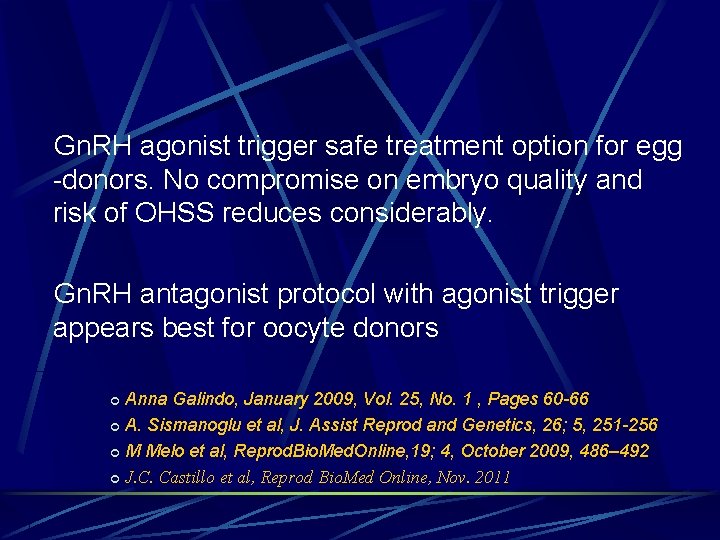
Gn. RH agonist trigger safe treatment option for egg -donors. No compromise on embryo quality and risk of OHSS reduces considerably. Gn. RH antagonist protocol with agonist trigger appears best for oocyte donors Anna Galindo, January 2009, Vol. 25, No. 1 , Pages 60 -66 A. Sismanoglu et al, J. Assist Reprod and Genetics, 26; 5, 251 -256 M Melo et al, Reprod. Bio. Med. Online, 19; 4, October 2009, 486– 492 J. C. Castillo et al, Reprod Bio. Med Online, Nov. 2011
Preferences for mild stimulation Time constraints of patient Oncologic or pro-thrombotic conditions requiring low estrogen exposure in COS
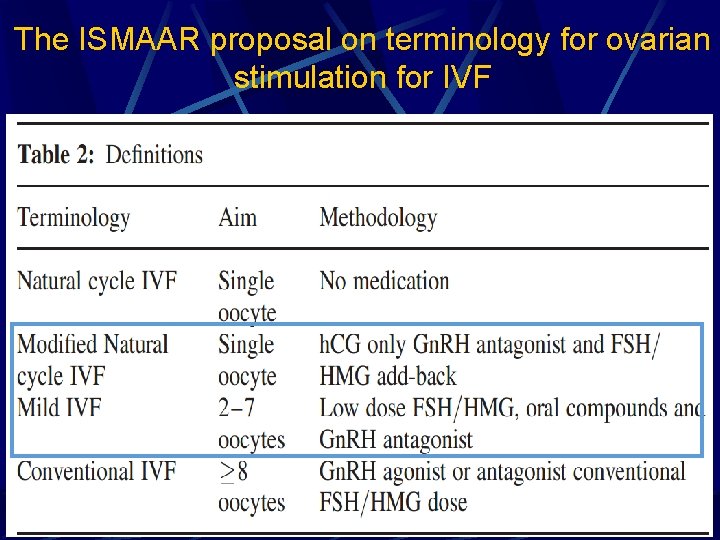
The ISMAAR proposal on terminology for ovarian stimulation for IVF
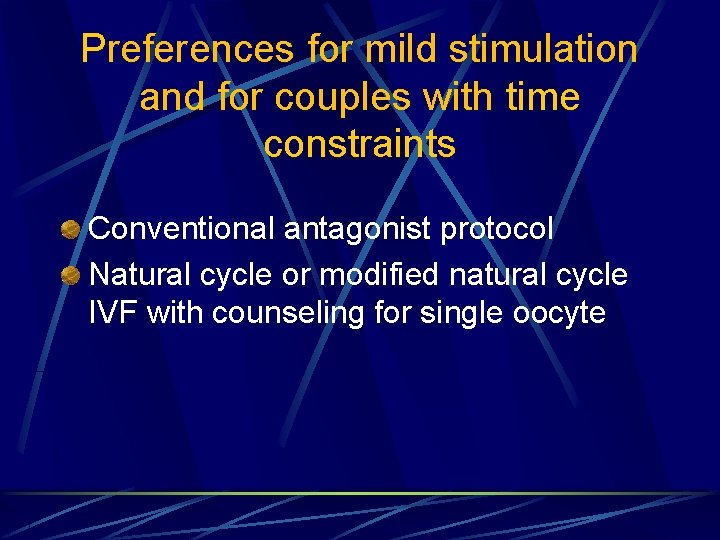
Preferences for mild stimulation and for couples with time constraints Conventional antagonist protocol Natural cycle or modified natural cycle IVF with counseling for single oocyte
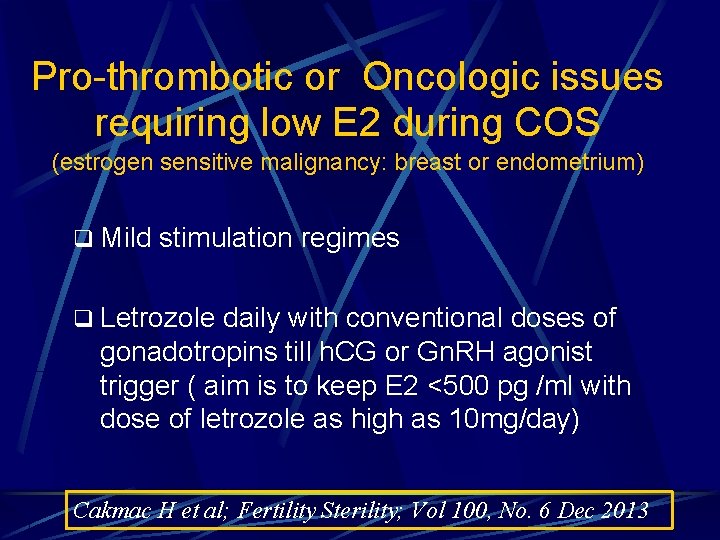
Pro-thrombotic or Oncologic issues requiring low E 2 during COS (estrogen sensitive malignancy: breast or endometrium) q Mild stimulation regimes q Letrozole daily with conventional doses of gonadotropins till h. CG or Gn. RH agonist trigger ( aim is to keep E 2 <500 pg /ml with dose of letrozole as high as 10 mg/day) Cakmac H et al; Fertility Sterility; Vol 100, No. 6 Dec 2013
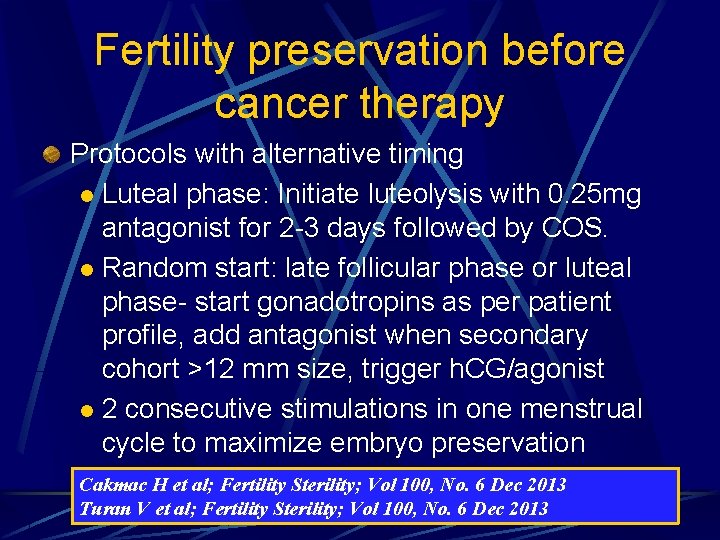
Fertility preservation before cancer therapy Protocols with alternative timing l Luteal phase: Initiate luteolysis with 0. 25 mg antagonist for 2 -3 days followed by COS. l Random start: late follicular phase or luteal phase- start gonadotropins as per patient profile, add antagonist when secondary cohort >12 mm size, trigger h. CG/agonist l 2 consecutive stimulations in one menstrual cycle to maximize embryo preservation Cakmac H et al; Fertility Sterility; Vol 100, No. 6 Dec 2013 Turan V et al; Fertility Sterility; Vol 100, No. 6 Dec 2013
Summary of Pre-requisite for i. COS Prospective identification of ovarian response II. Determine co-existing hormonal imbalances affecting COS III. Determine underlying pathology which could change the need for protocol for optimal i. COS IV. Ensure complete safety for oocyte donors without compromising on oocyte quality V. Adopt protocols to fit the need of an individual patient as per time available to her for an ART cycle VI. Respect a woman’s desire of minimal stimulation VII. ICOS for patients with oncologic issues with urgent need for oocyte or embryo cryo preservation. VIII. Pro-thrombotic conditions or oestrogen dependent cancers at risk with high oestrogen levels during COS IX. Optimizing total reproductive potential of a couple by use of embryo cryopreservation technology. I.
ICOS in ART for maximizing success would eventually mean? A cycle with ovarian stimulation which gives the couple best chance of singleton pregnancy with lowest or no risk of OHSS and minimal chance of cycle cancellation (what ever the underlying diagnosis may be for which the couple has to undergo IVF)
OVULATION INDUCTION IS NOT ONLY A SCIENCE BUT ALSO AN ART
- Slides: 35