
ProductService Management ProductService Management is a marketing function

- Slides: 29
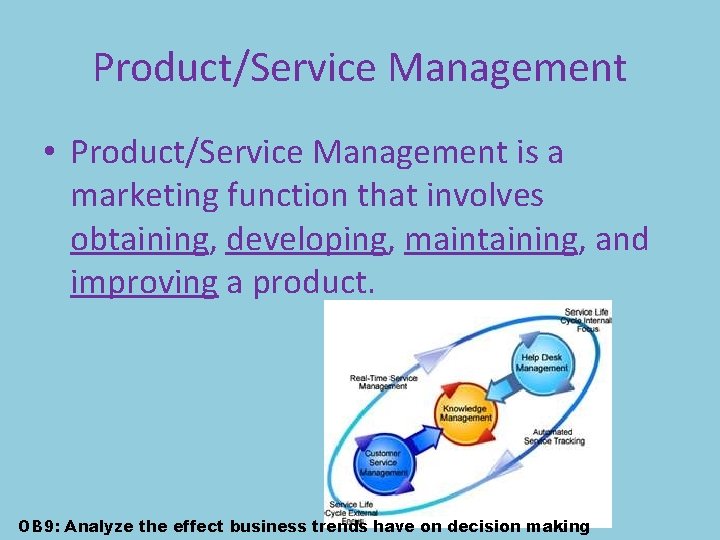
Product/Service Management • Product/Service Management is a marketing function that involves obtaining, developing, maintaining, and improving a product. OB 9: Analyze the effect business trends have on decision making
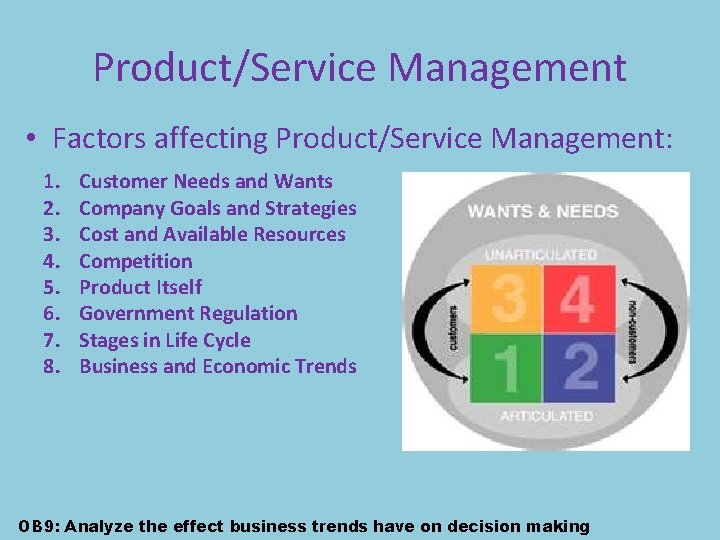
Product/Service Management • Factors affecting Product/Service Management: 1. 2. 3. 4. 5. 6. 7. 8. Customer Needs and Wants Company Goals and Strategies Cost and Available Resources Competition Product Itself Government Regulation Stages in Life Cycle Business and Economic Trends OB 9: Analyze the effect business trends have on decision making
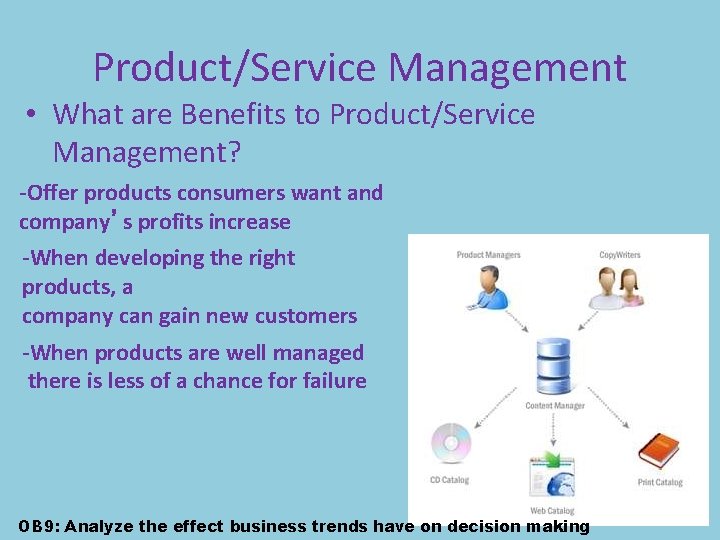
Product/Service Management • What are Benefits to Product/Service Management? -Offer products consumers want and company’s profits increase -When developing the right products, a company can gain new customers -When products are well managed there is less of a chance for failure OB 9: Analyze the effect business trends have on decision making
Product/Service Management • What role does Product/Service Management play in Marketing? 1. Affects positioning of product -what image do you want to create about the product in the minds of consumers? 2. Improves product success 3. Gives product an image -what impressions do you have of certain brands OB 9: Analyze the effect business trends have on decision making
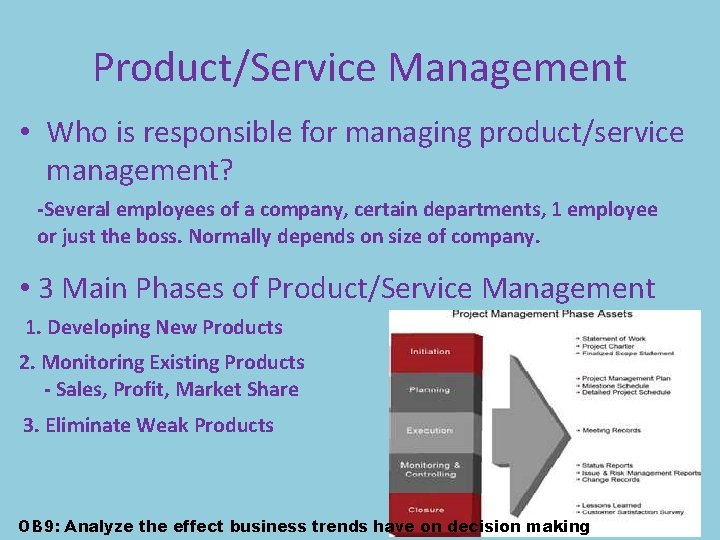
Product/Service Management • Who is responsible for managing product/service management? -Several employees of a company, certain departments, 1 employee or just the boss. Normally depends on size of company. • 3 Main Phases of Product/Service Management 1. Developing New Products 2. Monitoring Existing Products - Sales, Profit, Market Share 3. Eliminate Weak Products OB 9: Analyze the effect business trends have on decision making
=The nature, scope, and importance of branding in product planning =The various branding elements =The different types of brands =How to classify branding strategies The right name is an important part of every successful business. The name and symbols of a business or a product project the personality of the company, product, or service. OB 9: Analyze the effect business trends have on decision making
= private distributor brand = generic brand = brand extension = brand licensing = brand name = mixed-brand strategy = co-branding strategy = brand mark = trade name = trade character = trademark = manufacturer brand OB 9: Analyze the effect business trends have on decision making
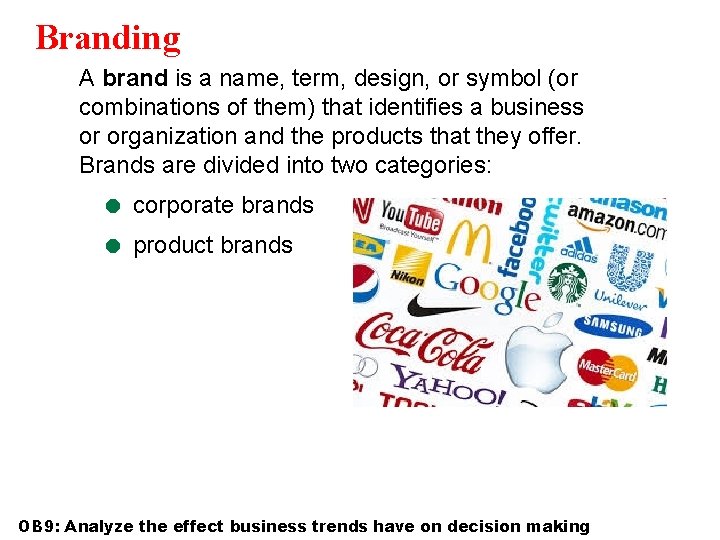
Branding A brand is a name, term, design, or symbol (or combinations of them) that identifies a business or organization and the products that they offer. Brands are divided into two categories: = corporate brands = product brands OB 9: Analyze the effect business trends have on decision making
PRODUCT RECOGNITION It is important that customers who are satisfied with a product can easily recognize and find a company’s branded products when they want to buy them again ◦ Nine out of ten people will pay 25% more for a GE Soft White light bulb over a private or generic brand because it is perceived by customers to be better than the competitors OB 9: Analyze the effect business trends have on decision making
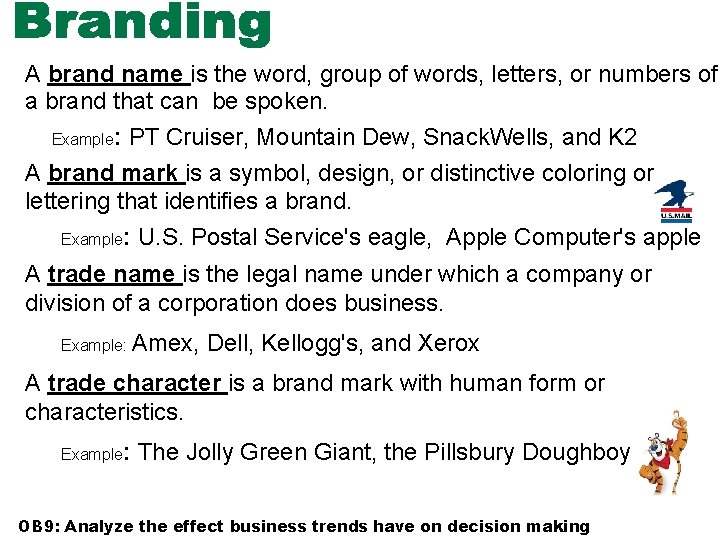
A brand name is the word, group of words, letters, or numbers of a brand that can be spoken. Example: PT Cruiser, Mountain Dew, Snack. Wells, and K 2 A brand mark is a symbol, design, or distinctive coloring or lettering that identifies a brand. Example: U. S. Postal Service's eagle, Apple Computer's apple A trade name is the legal name under which a company or division of a corporation does business. Example: Amex, Dell, Kellogg's, and Xerox A trade character is a brand mark with human form or characteristics. Example: The Jolly Green Giant, the Pillsbury Doughboy OB 9: Analyze the effect business trends have on decision making
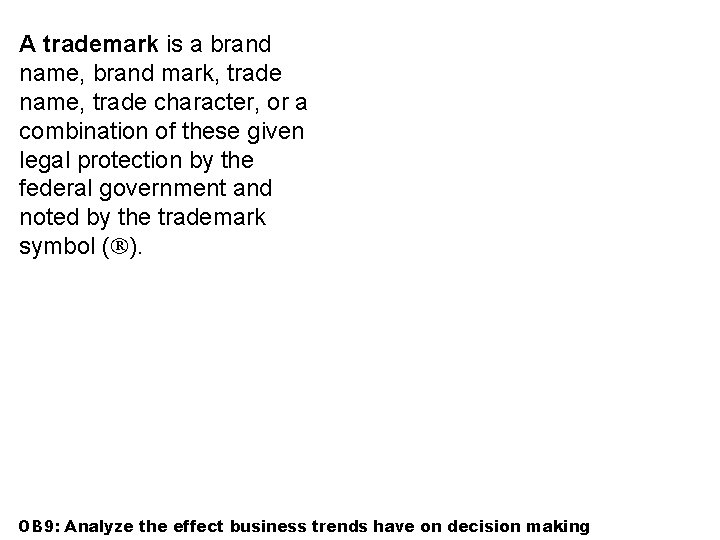
A trademark is a brand name, brand mark, trade name, trade character, or a combination of these given legal protection by the federal government and noted by the trademark symbol ( ). OB 9: Analyze the effect business trends have on decision making
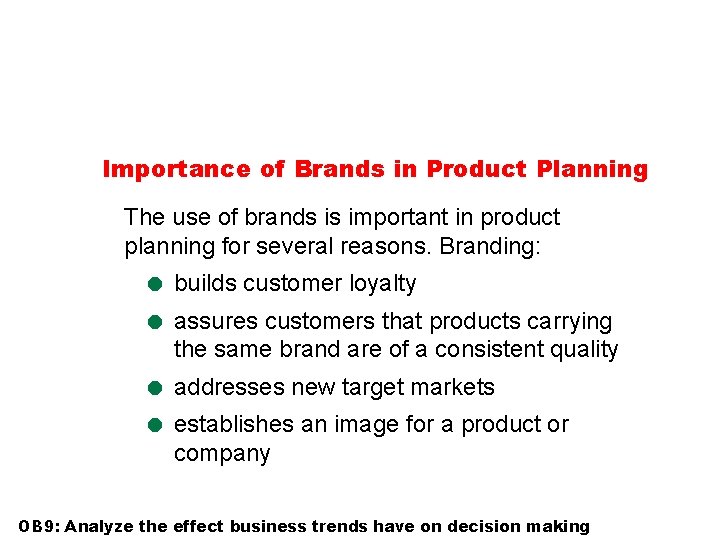
Importance of Brands in Product Planning The use of brands is important in product planning for several reasons. Branding: = builds customer loyalty = assures customers that products carrying the same brand are of a consistent quality = addresses new target markets = establishes an image for a product or company OB 9: Analyze the effect business trends have on decision making
BRAND EXPOSURE Helps companies extend their products into new target markets, new product lines, and new categories ◦ Customers are more willing to try new products that carry a name they are familiar with ◦ Example: GLAD family of products Started with trash bags and has now moved into food storage containers and baggies OB 9: Analyze the effect business trends have on decision making
Generating Brands Seventy-five percent of companies introduce a new product name each year. Brand names are generated by: = company employees = specialized computer software programs = branding agencies, naming consultants, and public relations agencies Half of all corporate name changes occur because of company mergers and acquisitions. OB 9: Analyze the effect business trends have on decision making
Types of Brands Three classifications of brands are: = manufacturer brands (national or producer) = private distributor brands = generic brands OB 9: Analyze the effect business trends have on decision making
TYPES OF BRANDS National Brands (producer brands) owned by national manufacturers ◦ Generate the majority of sales for most categories ◦ Examples: Hershey Foods, Whirlpool, Ford, Hilton, American Airlines, Kraft and Nestle ◦ Internet based national brands Amazon. com, e. Bay, Monster OB 9: Analyze the effect business trends have on decision making
TYPES OF BRANDS Private Distributor Brands private brands, store brands, or dealer brands ◦ Developed and owned by wholesalers and retailers ◦ Examples: Arizona for JC Penney, George for Wal -Mart, Villager for Kohl's Both are private distributor brands from SEARS OB 9: Analyze the effect business trends have on decision making
TYPES OF BRANDS Generic Brands Does not carry a company identity ◦ Packaging usually features a description of the product Example: Pancake Mix, Paper Towels ◦ Usually sold in supermarkets and discount stores ◦ Often sold for 30 – 50% less than name brands OB 9: Analyze the effect business trends have on decision making
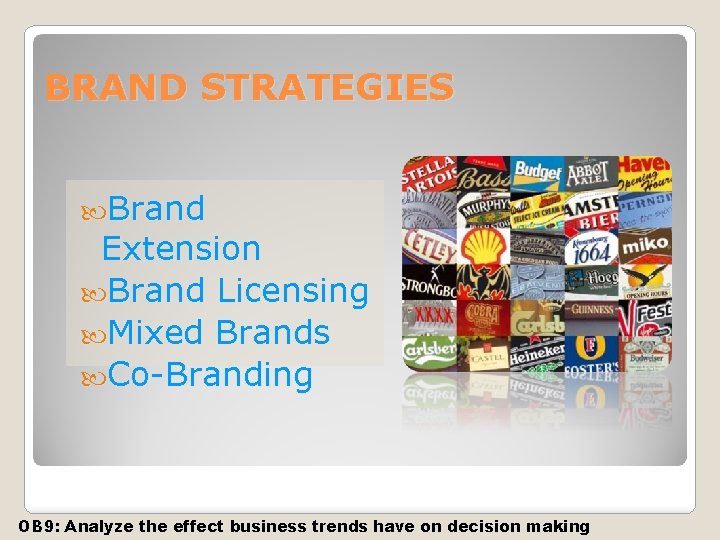
BRAND STRATEGIES Brand Extension Brand Licensing Mixed Brands Co-Branding OB 9: Analyze the effect business trends have on decision making
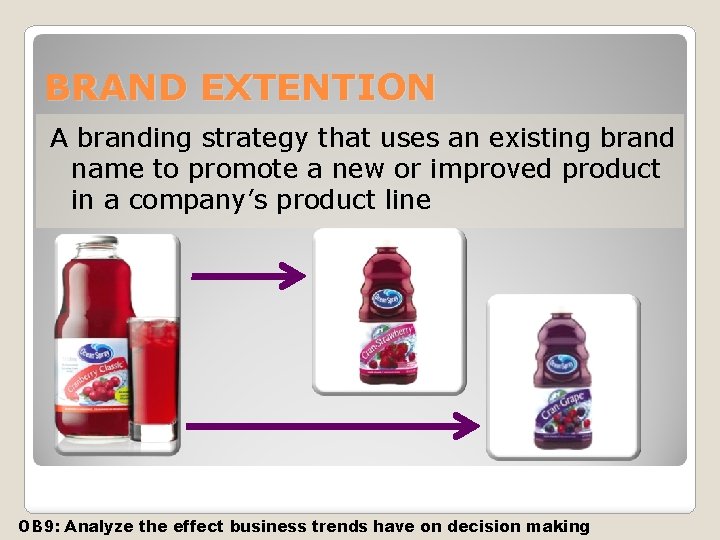
BRAND EXTENTION A branding strategy that uses an existing brand name to promote a new or improved product in a company’s product line OB 9: Analyze the effect business trends have on decision making
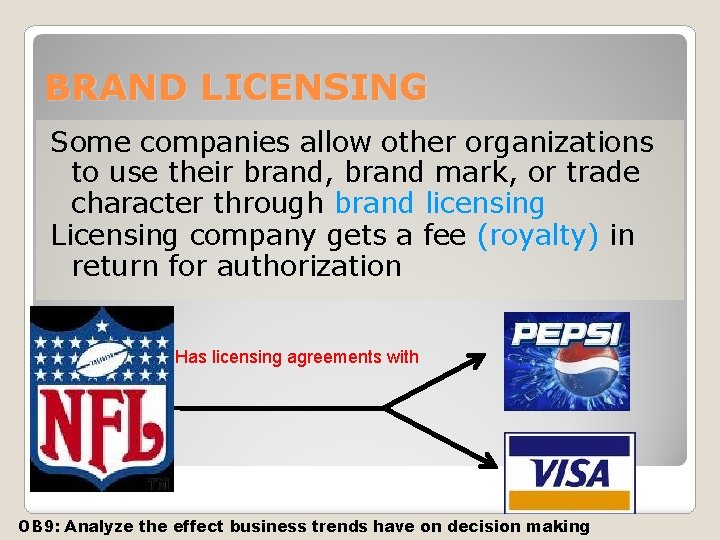
BRAND LICENSING Some companies allow other organizations to use their brand, brand mark, or trade character through brand licensing Licensing company gets a fee (royalty) in return for authorization Has licensing agreements with OB 9: Analyze the effect business trends have on decision making
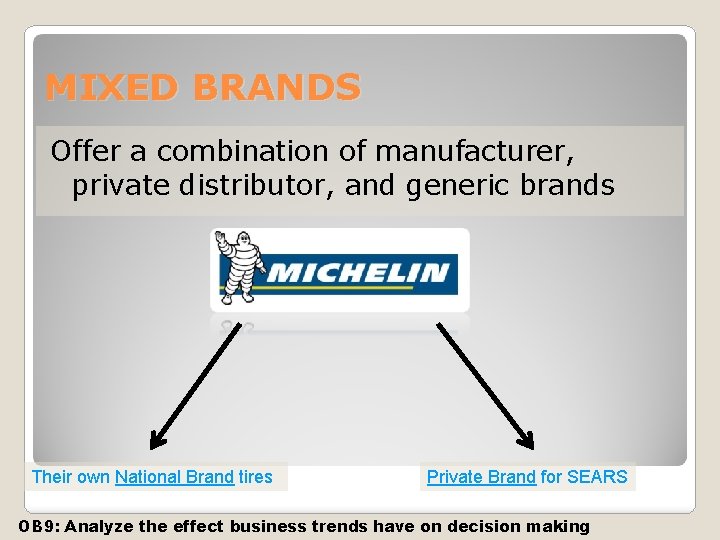
MIXED BRANDS Offer a combination of manufacturer, private distributor, and generic brands Their own National Brand tires Private Brand for SEARS OB 9: Analyze the effect business trends have on decision making
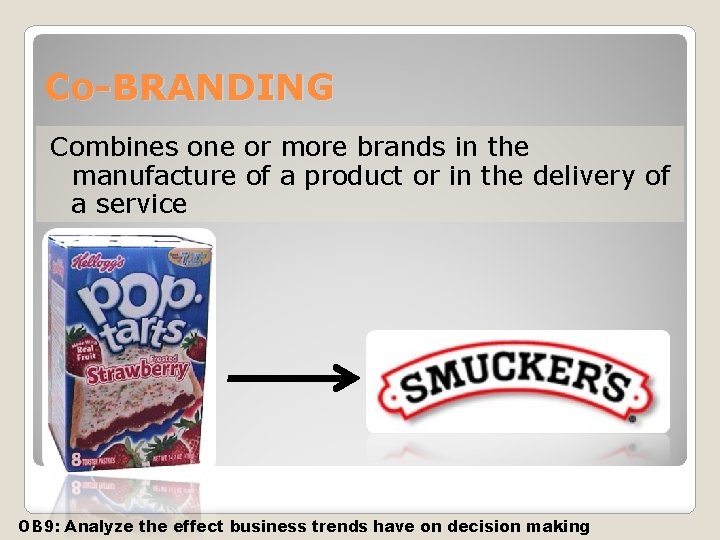
Co-BRANDING Combines one or more brands in the manufacture of a product or in the delivery of a service OB 9: Analyze the effect business trends have on decision making
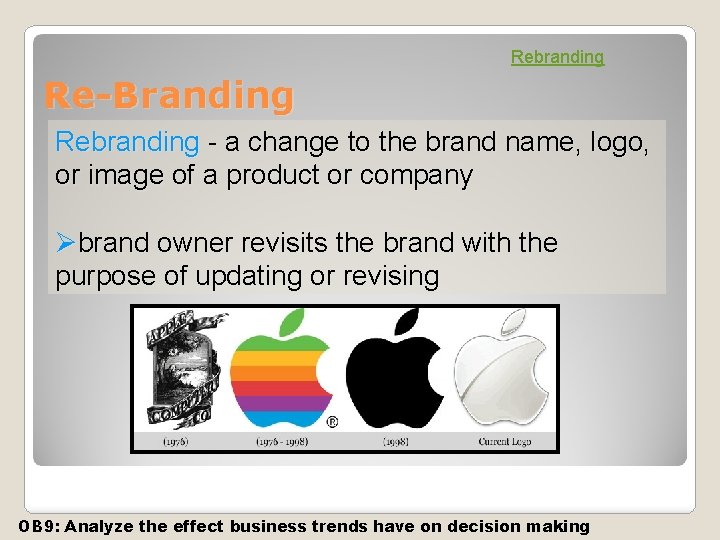
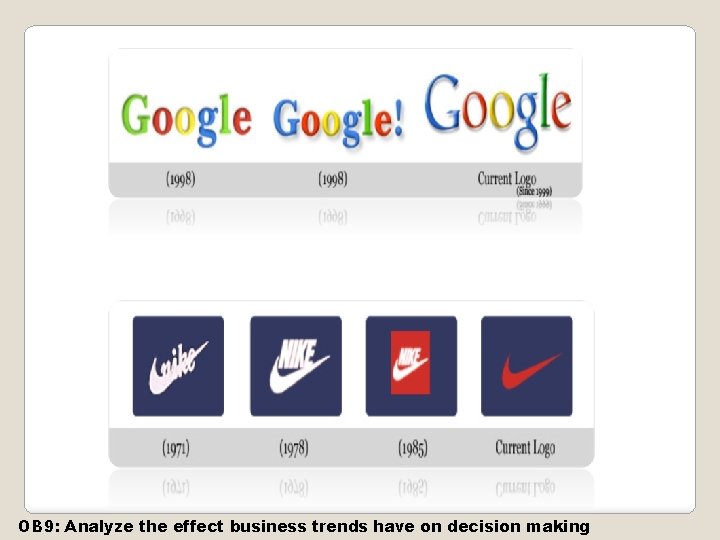
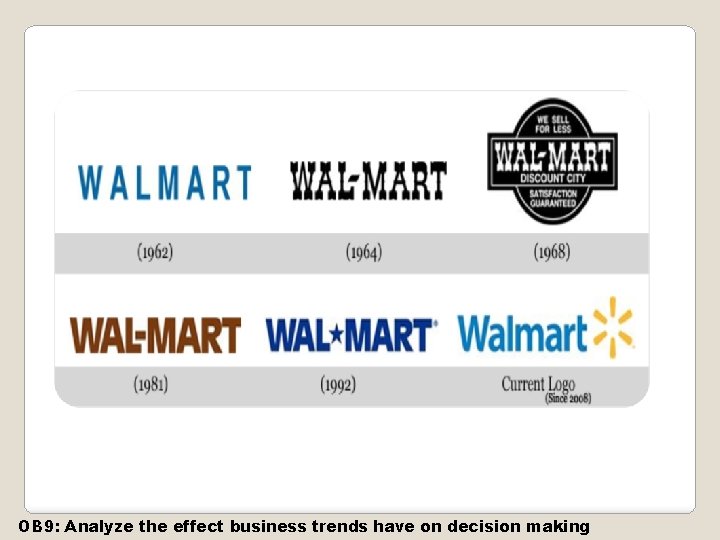
Rebranding Re-Branding Rebranding - a change to the brand name, logo, or image of a product or company Øbrand owner revisits the brand with the purpose of updating or revising OB 9: Analyze the effect business trends have on decision making
OB 9: Analyze the effect business trends have on decision making
OB 9: Analyze the effect business trends have on decision making
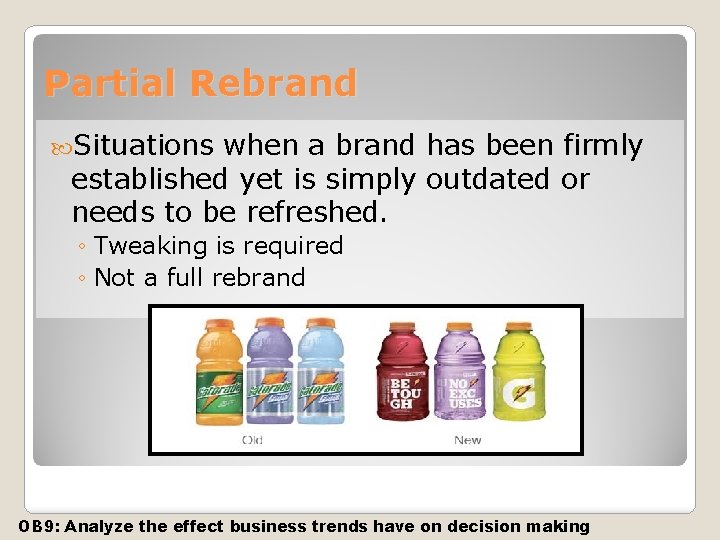
Partial Rebrand Situations when a brand has been firmly established yet is simply outdated or needs to be refreshed. ◦ Tweaking is required ◦ Not a full rebrand OB 9: Analyze the effect business trends have on decision making
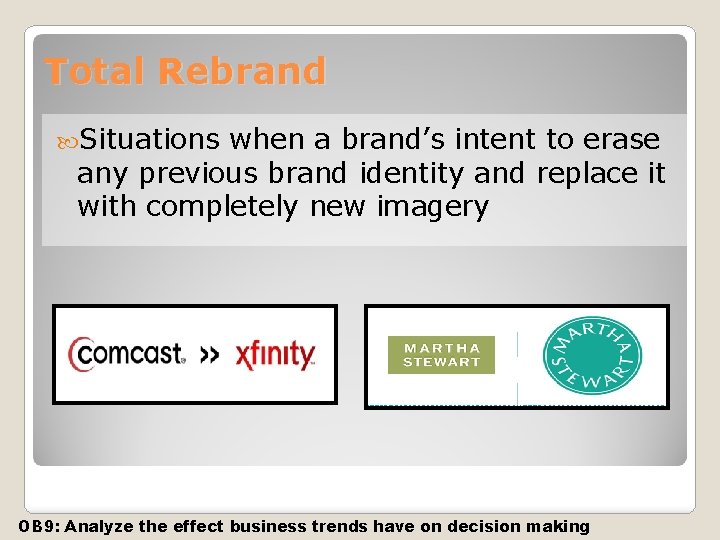
Total Rebrand Situations when a brand’s intent to erase any previous brand identity and replace it with completely new imagery OB 9: Analyze the effect business trends have on decision making
Why Rebrand? Rebranding can help change a businesses: Quality Target Market New Product Line Repositioning and Image Altered Public Image OB 9: Analyze the effect business trends have on decision making