
Productivity Susceptibility Analysis PSA Tool overview and preliminary
Productivity Susceptibility Analysis (PSA) Tool overview and preliminary findings ERA Workshop Long Beach, CA | June 15, 2017
Overview • Share information about PSA tool and process • Share draft results • Discuss feedback, next steps (in next agenda item)
Overview: OST Pilot Project PSA: Select and apply a Productivity Susceptibility Analysis (PSA) on target species ERA: Customize and pilot a habitat and bycatch Ecological Risk Assessment and document lessons learned
Scope of PSA Project Need: A rapid, systematic, quantitative approach to assess risk to CA marine fisheries with varying amounts of available information to assist with management prioritization Request: Conduct PSA on 45 fisheries, representing 36 statemanaged marine species Components: 1. Select a Productivity-Susceptibility Analysis (PSA) 2. Conduct PSA with CDFW experts (consultant led) 3. Share results and hear feedback from community
PSA Overview What is it? • Widely utilized risk assessment tool for understanding relative risk to target species • Established NOAA PSA methodology • NOAA customized PSA for US fisheries • Drawing from other PSA methodologies • “Off the shelf approach” - Did not adapt or change methodology for CA fisheries • Publicly available
What a PSA Does… • Assesses potential vulnerability of stocks to fishing activities relative to other assessed stocks • Assesses both data-poor and data-rich species within the same analysis • Alerts managers to fisheries that are likely to be most sensitive to a particular method of fishing • Useful for a baseline comparison among fisheries with varying levels of available information • Can be conducted alone or as part of a series of data analyses on vulnerability
Risk to Target Species – NOAA PSA • Widely utilized risk assessment tool for understanding relative risk to target species • NOAA customized PSA for US fisheries • “Off the shelf approach” - Did not adapt or change methodology for CA fisheries • Publicly available
How can information and results be used? • Assist with focusing management attention (e. g. , review, action, or data collection) on higher risk fisheries • PSA is anticipated to be a primary basis for the initial priority list of fisheries presented in the draft amended MLMA Master Plan • Does not: § provide information on the current status of a stock, only the potential vulnerability to fishing § assess absolute risk § specify harvest guidelines or management actions
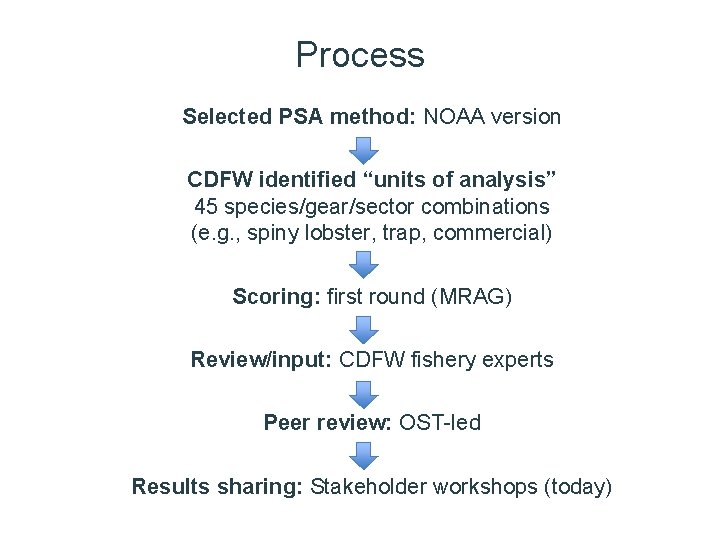
Process Selected PSA method: NOAA version CDFW identified “units of analysis” 45 species/gear/sector combinations (e. g. , spiny lobster, trap, commercial) Scoring: first round (MRAG) Review/input: CDFW fishery experts Peer review: OST-led Results sharing: Stakeholder workshops (today)
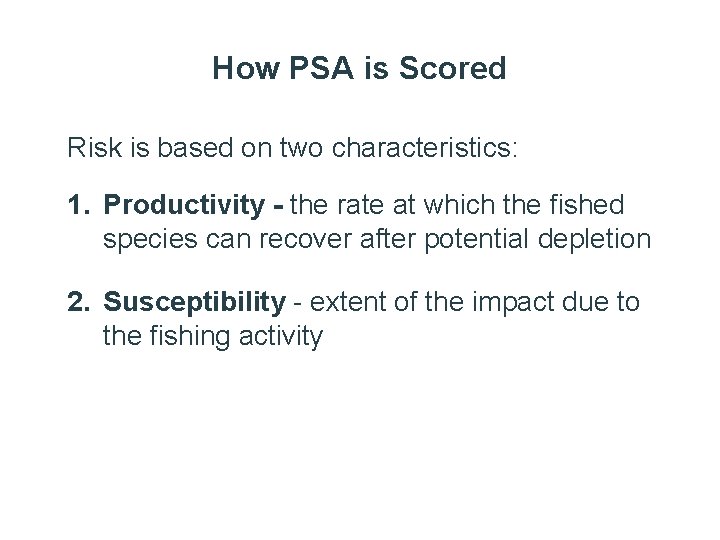
How PSA is Scored Risk is based on two characteristics: 1. Productivity - the rate at which the fished species can recover after potential depletion 2. Susceptibility - extent of the impact due to the fishing activity
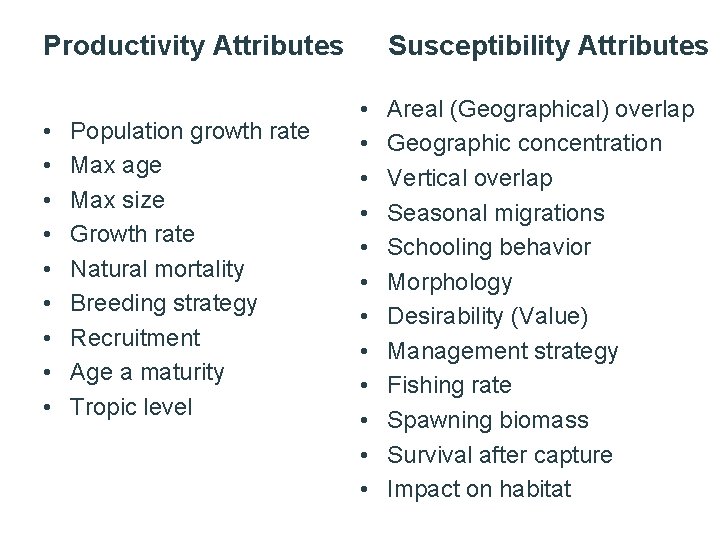
Productivity Attributes • • • Population growth rate Max age Max size Growth rate Natural mortality Breeding strategy Recruitment Age a maturity Tropic level Susceptibility Attributes • • • Areal (Geographical) overlap Geographic concentration Vertical overlap Seasonal migrations Schooling behavior Morphology Desirability (Value) Management strategy Fishing rate Spawning biomass Survival after capture Impact on habitat
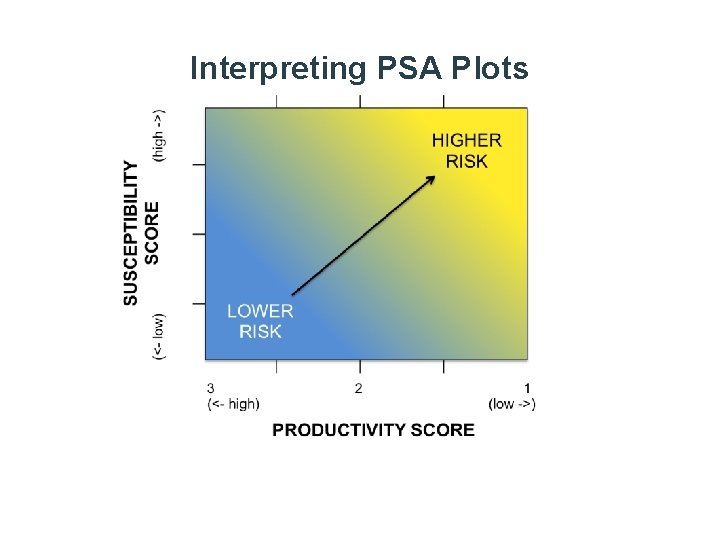
Interpreting PSA Plots
Draft PSA Results • CDFW still in process of considering information gathering projects and their utility in the master plan amendment • If used, will be one of several factors that affect the overall priority list for management action
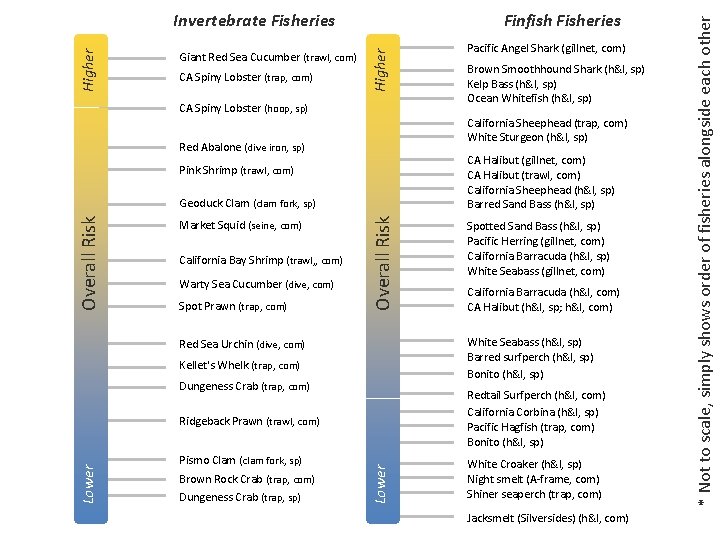
CA Spiny Lobster (trap, com) CA Spiny Lobster (hoop, sp) CA Halibut (gillnet, com) CA Halibut (trawl, com) California Sheephead (h&l, sp) Barred Sand Bass (h&l, sp) Pink Shrimp (trawl, com) Warty Sea Cucumber (dive, com) Spot Prawn (trap, com) Overall Risk Geoduck Clam (clam fork, sp) California Bay Shrimp (trawl, , com) Kellet's Whelk (trap, com) Dungeness Crab (trap, com) Lower Dungeness Crab (trap, sp) California Barracuda (h&l, com) CA Halibut (h&l, sp; h&l, com) Redtail Surfperch (h&l, com) California Corbina (h&l, sp) Pacific Hagfish (trap, com) Bonito (h&l, sp) Ridgeback Prawn (trawl, com) Brown Rock Crab (trap, com) Spotted Sand Bass (h&l, sp) Pacific Herring (gillnet, com) California Barracuda (h&l, sp) White Seabass (gillnet, com) White Seabass (h&l, sp) Barred surfperch (h&l, sp) Bonito (h&l, sp) Red Sea Urchin (dive, com) Pismo Clam (clam fork, sp) Brown Smoothhound Shark (h&l, sp) Kelp Bass (h&l, sp) Ocean Whitefish (h&l, sp) California Sheephead (trap, com) White Sturgeon (h&l, sp) Red Abalone (dive iron, sp) Market Squid (seine, com) Pacific Angel Shark (gillnet, com) White Croaker (h&l, sp) Night smelt (A-frame, com) Shiner seaperch (trap, com) Jacksmelt (Silversides) (h&l, com) * Not to scale, simply shows order of fisheries alongside each other Giant Red Sea Cucumber (trawl, com) Finfish Fisheries Higher Invertebrate Fisheries
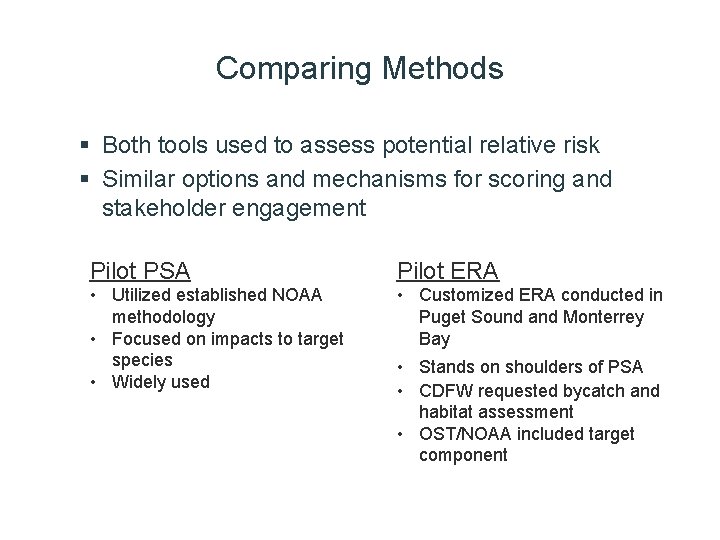
Comparing Methods § Both tools used to assess potential relative risk § Similar options and mechanisms for scoring and stakeholder engagement Pilot PSA Pilot ERA • Utilized established NOAA methodology • Focused on impacts to target species • Widely used • Customized ERA conducted in Puget Sound and Monterrey Bay • Stands on shoulders of PSA • CDFW requested bycatch and habitat assessment • OST/NOAA included target component
Questions? • Any questions about what a PSA is? The relationship between PSA and ERA? • Do the PSA scores reflect your own understanding of these fisheries? Any surprising results?
- Slides: 16