
Productivity Measurement and Control Prepared by Douglas Cloud

Productivity Measurement and Control Prepared by Douglas Cloud Pepperdine University 18 -1

Objectives 1. Explain the meaning of productive efficiency, After studying this and describechapter, the difference between technical you should and allocative efficiency. be able to: 2. Define partial productivity measurement, and list its advantages and disadvantages. 3. Explain what total productivity measurement is, and name its advantages. 4. Discuss the role of productivity measurement in assessing activity improvement. 18 -2
Productivity: Measurement and Control Productivity is concerned with producing output efficiently, and it specifically addresses the relationship of output and the inputs used to produce the outputs. 18 -3

Productive Efficiency Total productive efficiency is the point at which two conditions are satisfied: (1) For any mix of inputs that will produce a given output, no more of any one input is used than necessary to produce the output. (2) Given the mixes that satisfy the first condition, the least costly mix is chosen. 18 -4

Improving Technical Efficiency is the condition where no more of any one input is used than necessary to produce a given output. Technical efficiency improvement is when less inputs are used to produce the same output or more output are produced using the same input. Current productivity Inputs: Labor Capital 4 Outputs: 6 18 -5
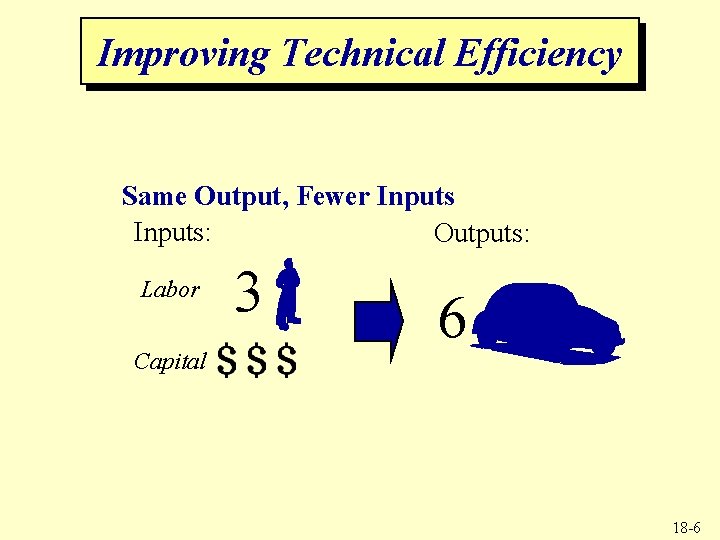
Improving Technical Efficiency Same Output, Fewer Inputs: Outputs: Labor Capital 3 6 18 -6
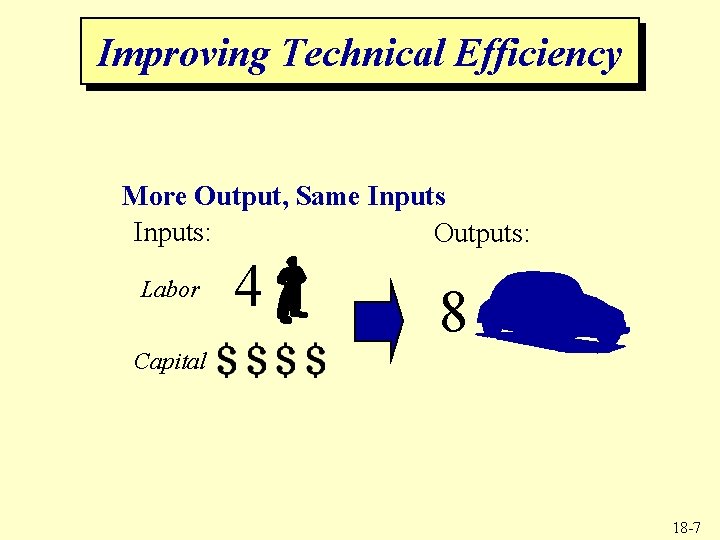
Improving Technical Efficiency More Output, Same Inputs: Outputs: Labor 4 8 Capital 18 -7
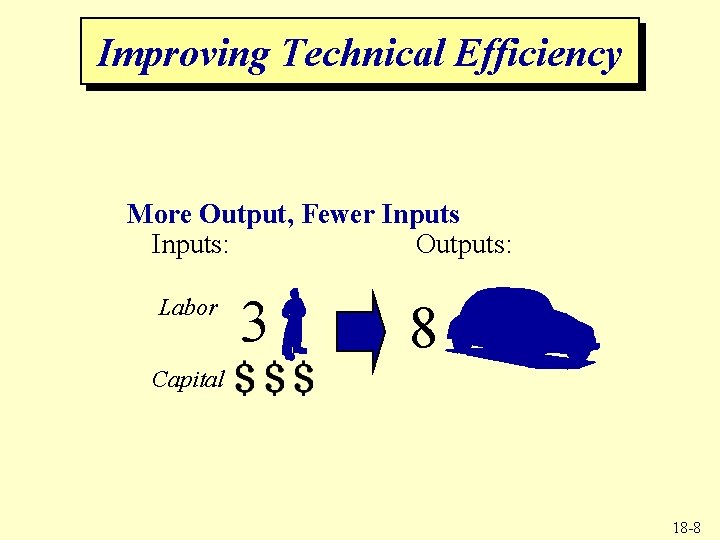
Improving Technical Efficiency More Output, Fewer Inputs: Outputs: Labor 3 8 Capital 18 -8

Improving Technical Efficiency Technically Efficient Combination I: Inputs: Outputs: Labor 3 8 Capital Total cost of inputs = $20, 000 18 -9
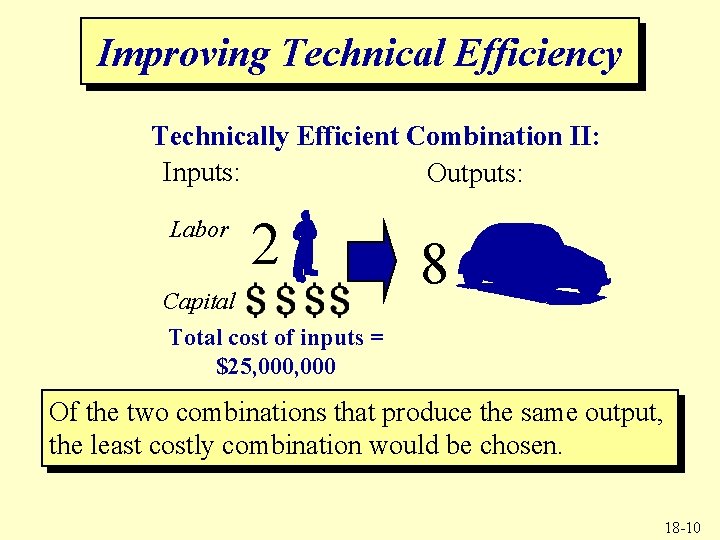
Improving Technical Efficiency Technically Efficient Combination II: Inputs: Outputs: Labor 2 Capital Total cost of inputs = $25, 000 8 Of the two combinations that produce the same output, the least costly combination would be chosen. 18 -10
Productive Measurement Productive measurement— ü is a quantitative assessment of productivity changes ü can be actual or prospective ü is forward looking ü serves as input for strategic decision making ü allows managers to compare relative benefits of different input combinations 18 -11

Partial Productivity Measurement ü Partial Productivity Measurement: Measuring productivity for one input at a time. Partial Measure = Output/Input ü Operational Productivity Measure: Partial measure where both input and output are expressed in physical terms. ü Financial Productivity Measure: Partial measure where both input and output are expressed in dollars. 18 -12

Profile Productivity Measures No Trade-Offs Number of frames produced Labor hours used Materials used (lbs. ) Labor productivity ratio Material productivity ratio 2003 240, 000 60, 000 1, 300, 000 2004 250, 000 1, 150, 000 250, 000/50, 000 Partial Productivity Ratios 250, 000/1, 150, 000 2003 Profile 2004 Profile 4. 000 0. 200 5. 000 0. 217 18 -13
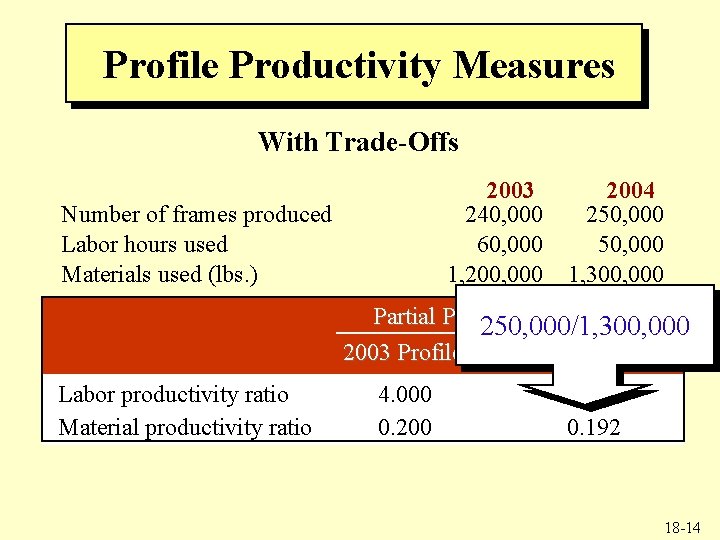
Profile Productivity Measures With Trade-Offs 2003 240, 000 60, 000 1, 200, 000 Number of frames produced Labor hours used Materials used (lbs. ) 2004 250, 000 1, 300, 000 Partial Productivity Ratios 250, 000/1, 300, 000 2003 Profile 2004 Profile Labor productivity ratio Material productivity ratio 4. 000 0. 200 5. 000 0. 192 18 -14

Profit-Linked Productivity Measurement Profit-Linkage Rule: For the current period, calculate the cost of the inputs that would have been used in the absence of any productivity change, and compare this cost with the cost of the inputs actually used. The difference in costs is the amount by which profits changed because of productivity changes. To compute the inputs that would have been used (PQ), use the following formula: PQ = Current-period Output/Base-period productivity ratio 18 -15
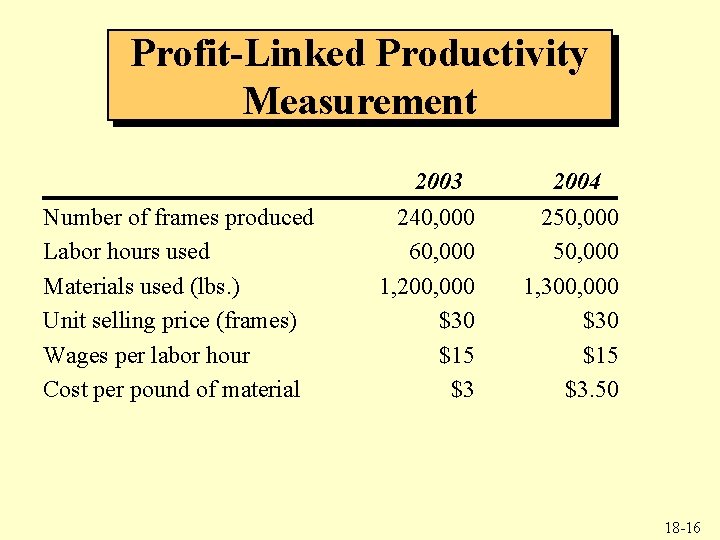
Profit-Linked Productivity Measurement Number of frames produced Labor hours used Materials used (lbs. ) Unit selling price (frames) Wages per labor hour Cost per pound of material 2003 240, 000 60, 000 1, 200, 000 $30 $15 $3 2004 250, 000 1, 300, 000 $30 $15 $3. 50 18 -16

Profit-Linked Productivity Measurement PQ (labor) = 250, 000/4 = 62, 500 hrs. PQ (materials) = 250, 000/0. 200 = 1, 250, 000 lbs. Cost of labor: (62, 500 x $15) = Cost of materials: (1, 250, 000 x $3. 50) = Total PQ cost The actual cost of inputs: Cost of labor: (50, 000 x $15) = Cost of materials: (1, 300, 000 x $3. 50) = Total current cost $ 937, 500 4, 375, 000 $5, 312, 500 $ 750, 000 4, 550, 000 $5, 300, 000 18 -17

Profit-Linked Productivity Measurement Profit-linked effect = Total PQ cost – Total current cost = $5, 312, 500 – $5, 300, 000 = $12, 500 increase in profits The net effect of the process change was favorable. Profits increased $12, 500 because of productivity changes. 18 -18

Profit-Linked Productivity Measurement Input Labor Materials (1) (2) (3) (4) PQ PQ x P AQ AQ x P 62, 500 $ 937, 500 50, 000 $ 750, 000 1, 250, 000 4, 375, 000 1, 300, 000 4, 550, 000 $5, 312, 500 $5, 300, 000 250, 000/4 250, 000/0. 200 (2) – (4) (PQ x P) – (AQ x P) $817, 500 -175, 000 $ 12, 500 18 -19
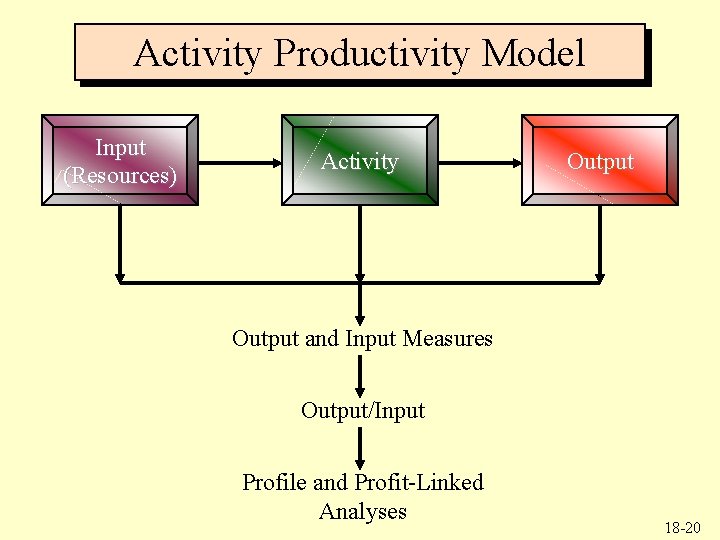
Activity Productivity Model Input (Resources) Activity Output and Input Measures Output/Input Profile and Profit-Linked Analyses 18 -20
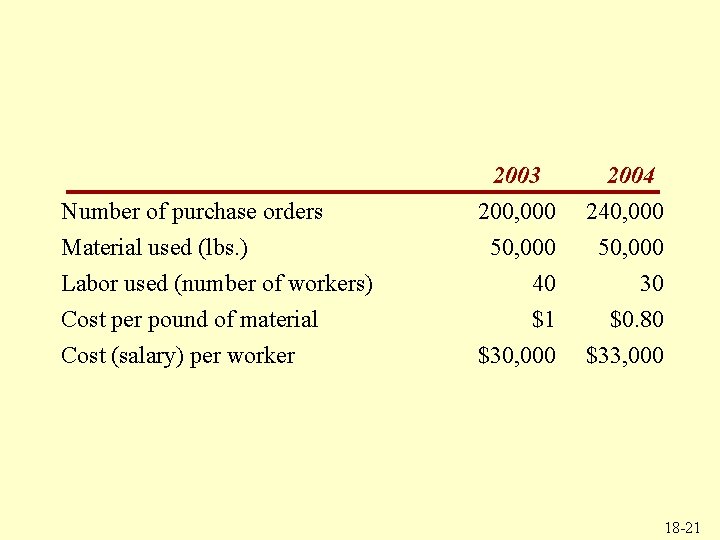
Number of purchase orders 2003 200, 000 2004 240, 000 Material used (lbs. ) Labor used (number of workers) Cost per pound of material Cost (salary) per worker 50, 000 40 $1 $30, 000 50, 000 30 $0. 80 $33, 000 18 -21
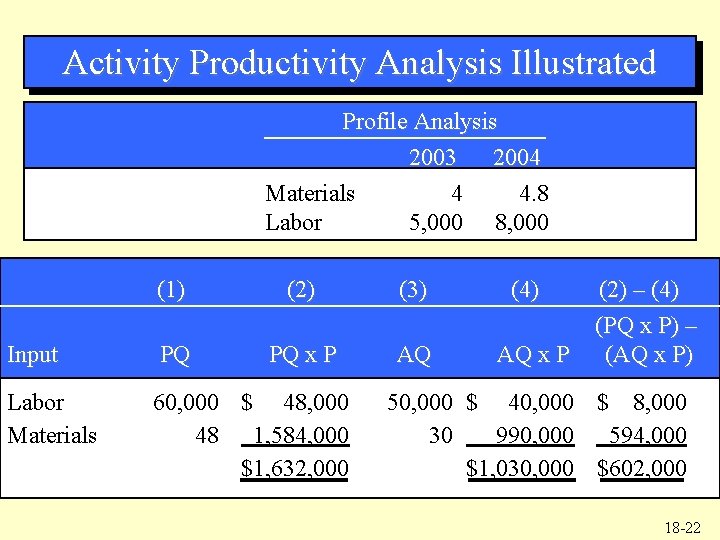
Activity Productivity Analysis Illustrated Profile Analysis 2003 2004 Materials 4 4. 8 Labor 5, 000 8, 000 (1) (2) (3) Input PQ PQ x P AQ Labor Materials 60, 000 $ 48, 000 48 1, 584, 000 $1, 632, 000 (4) AQ x P (2) – (4) (PQ x P) – (AQ x P) 50, 000 $ 40, 000 $ 8, 000 30 990, 000 594, 000 $1, 030, 000 $602, 000 18 -22
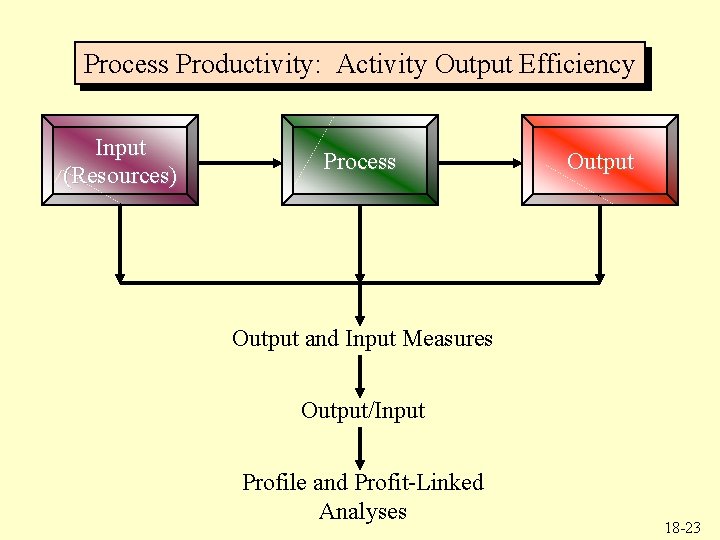
Process Productivity: Activity Output Efficiency Input (Resources) Process Output and Input Measures Output/Input Profile and Profit-Linked Analyses 18 -23
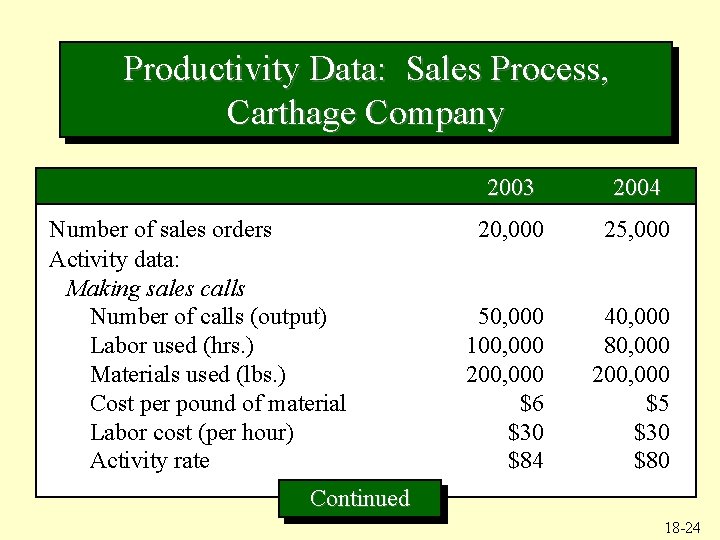
Productivity Data: Sales Process, Carthage Company Number of sales orders Activity data: Making sales calls Number of calls (output) Labor used (hrs. ) Materials used (lbs. ) Cost per pound of material Labor cost (per hour) Activity rate 2003 2004 20, 000 25, 000 50, 000 100, 000 200, 000 $6 $30 $84 40, 000 80, 000 200, 000 $5 $30 $80 Continued 18 -24
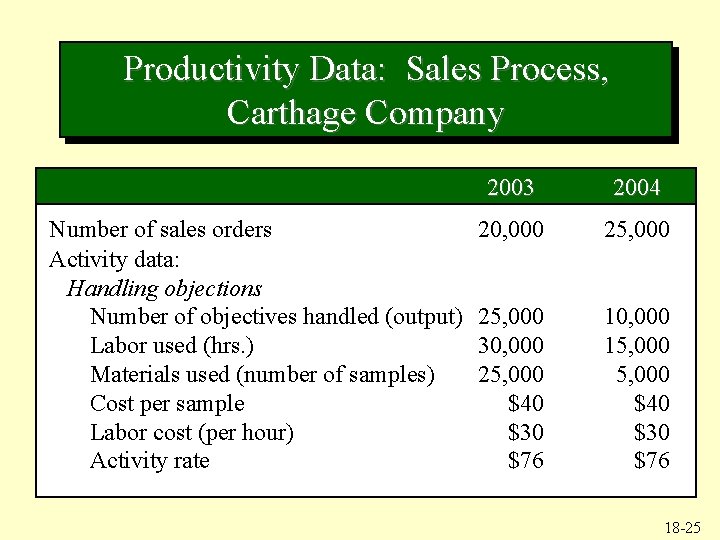
Productivity Data: Sales Process, Carthage Company Number of sales orders Activity data: Handling objections Number of objectives handled (output) Labor used (hrs. ) Materials used (number of samples) Cost per sample Labor cost (per hour) Activity rate 2003 2004 20, 000 25, 000 30, 000 25, 000 $40 $30 $76 10, 000 15, 000 $40 $30 $76 18 -25
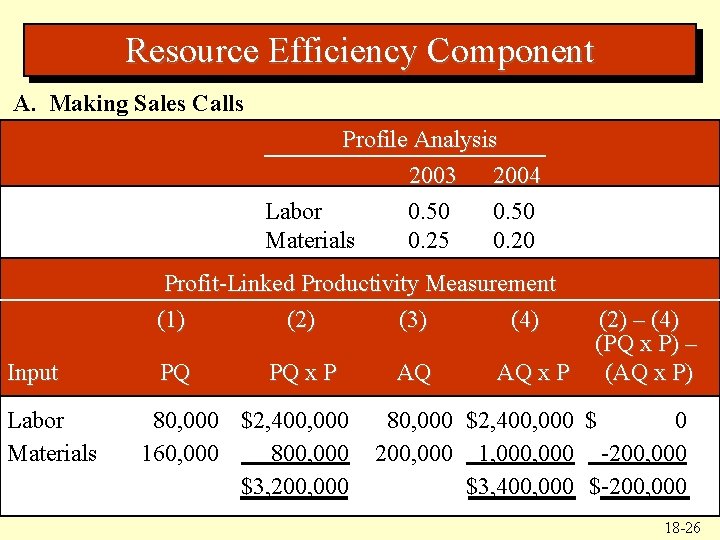
Resource Efficiency Component A. Making Sales Calls Profile Analysis 2003 2004 Labor 0. 50 Materials 0. 25 0. 20 Profit-Linked Productivity Measurement (1) (2) (3) (4) Input Labor Materials PQ PQ x P 80, 000 $2, 400, 000 160, 000 800, 000 $3, 200, 000 AQ AQ x P (2) – (4) (PQ x P) – (AQ x P) 80, 000 $2, 400, 000 $ 0 200, 000 1, 000 -200, 000 $3, 400, 000 $-200, 000 18 -26
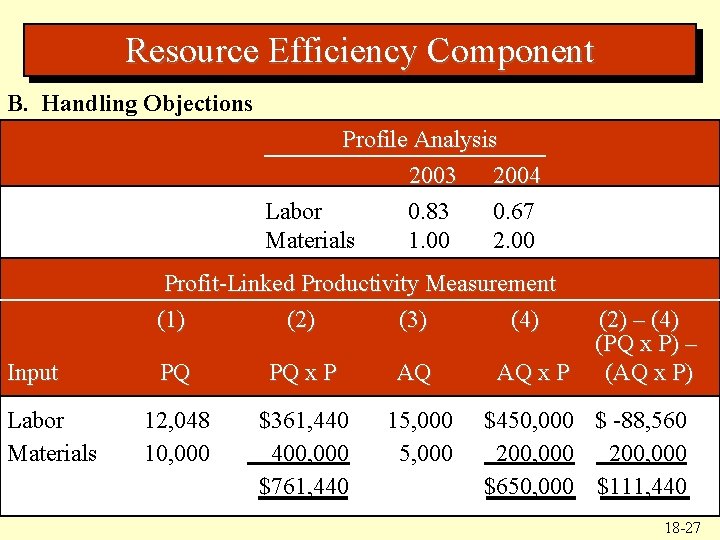
Resource Efficiency Component B. Handling Objections Profile Analysis 2003 2004 Labor 0. 83 0. 67 Materials 1. 00 2. 00 Profit-Linked Productivity Measurement (1) (2) (3) (4) Input Labor Materials PQ PQ x P AQ 12, 048 10, 000 $361, 440 400, 000 $761, 440 15, 000 AQ x P (2) – (4) (PQ x P) – (AQ x P) $450, 000 $ -88, 560 200, 000 $650, 000 $111, 440 18 -27
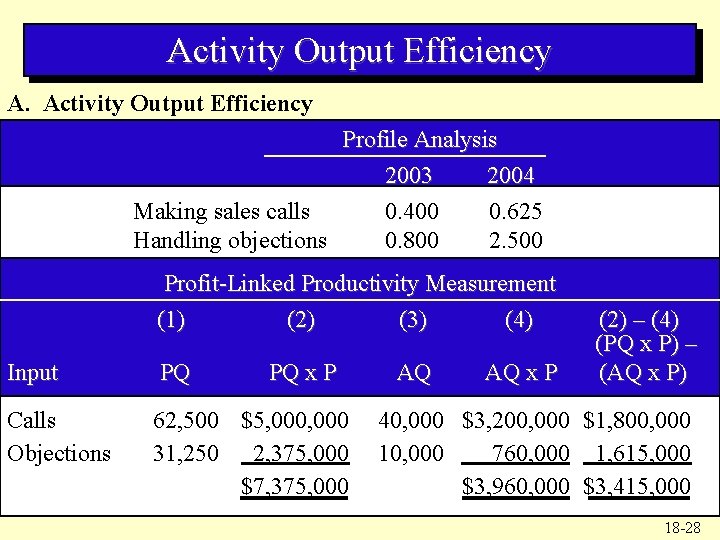
Activity Output Efficiency A. Activity Output Efficiency Profile Analysis 2003 2004 Making sales calls 0. 400 0. 625 Handling objections 0. 800 2. 500 Profit-Linked Productivity Measurement (1) (2) (3) (4) Input PQ PQ x P Calls Objections 62, 500 $5, 000 31, 250 2, 375, 000 $7, 375, 000 AQ AQ x P (2) – (4) (PQ x P) – (AQ x P) 40, 000 $3, 200, 000 $1, 800, 000 10, 000 760, 000 1, 615, 000 $3, 960, 000 $3, 415, 000 18 -28
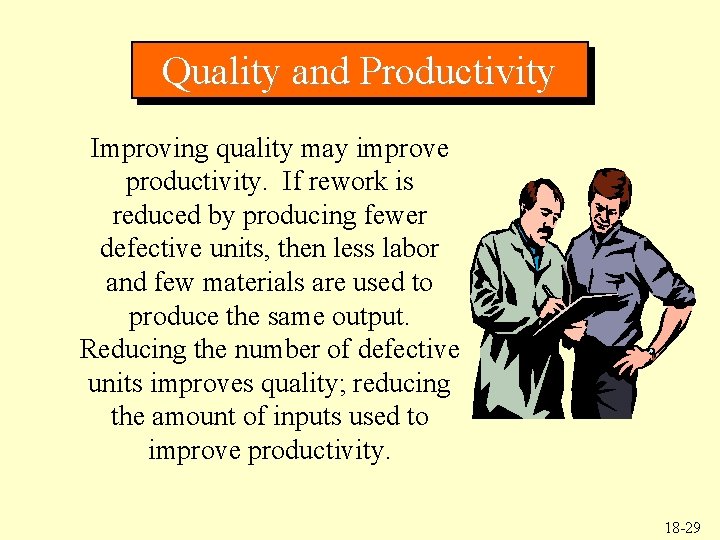
Quality and Productivity Improving quality may improve productivity. If rework is reduced by producing fewer defective units, then less labor and few materials are used to produce the same output. Reducing the number of defective units improves quality; reducing the amount of inputs used to improve productivity. 18 -29

End of Chapter 18 -30

18 -31
- Slides: 31