
Productivity and Quality Management Lecture 28 MOTIVATING FOR





- Slides: 70
Productivity and Quality Management Lecture 28
MOTIVATING FOR QUALITY LAST LECTURE
Summary • The motivation process begins with proper leadership. • Leadership should lead to an appropriate motivating environment which provides consistency in purpose and sincerity, and where goals are realistic and there are no hidden agendas. • Management needs to be aware that each individual has different needs depending on her stage in life and should be treated accordingly. • Operator dissatisfaction will be reflected in her work when these needs are not recognized.
Summary • The motivation process begins with proper leadership. • Leadership should lead to an appropriate motivating environment which provides consistency in purpose and sincerity, and where goals are realistic and there are no hidden agendas. • Management needs to be aware that each individual has different needs depending on her stage in life and should be treated accordingly. • Operator dissatisfaction will be reflected in her work when these needs are not recognized. • When management communicates in only one direction to employees, mostly through threats and very few rewards, employees will form informal objectives that are diametrically opposed to those of the organization, resulting in ever-decreasing levels of output value.
TOTAL QUALITY MANAGEMENT INTRODUCTION AND THEORY
LEARNING GOALS • State what is the quality of a product • Explain the difference between actual and perceived quality • State the definition of TQM • State the characteristics of TQM or implications for a business • State the benefits and problems of using TQM
Quality • The features of a product that allow it to satisfy customers’ needs or simply some standard of excellence. • Actual quality • Perceived quality © Photo. Disc
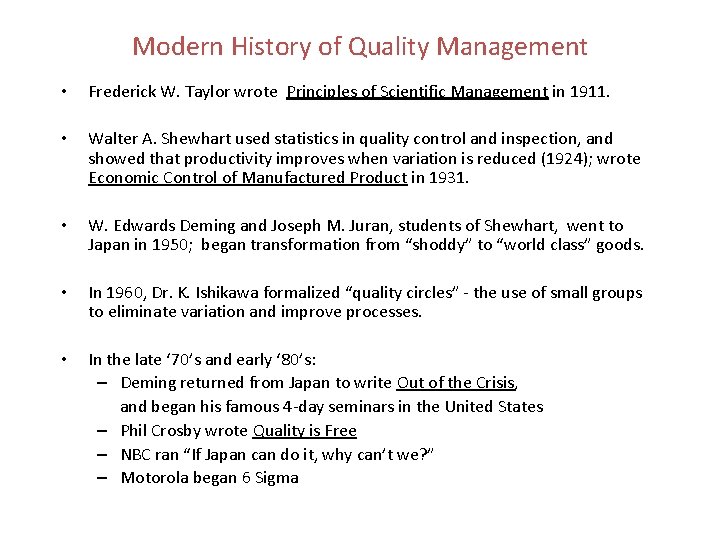
Modern History of Quality Management • Frederick W. Taylor wrote Principles of Scientific Management in 1911. • Walter A. Shewhart used statistics in quality control and inspection, and showed that productivity improves when variation is reduced (1924); wrote Economic Control of Manufactured Product in 1931. • W. Edwards Deming and Joseph M. Juran, students of Shewhart, went to Japan in 1950; began transformation from “shoddy” to “world class” goods. • In 1960, Dr. K. Ishikawa formalized “quality circles” - the use of small groups to eliminate variation and improve processes. • In the late ‘ 70’s and early ‘ 80’s: – Deming returned from Japan to write Out of the Crisis, and began his famous 4 -day seminars in the United States – Phil Crosby wrote Quality is Free – NBC ran “If Japan can do it, why can’t we? ” – Motorola began 6 Sigma
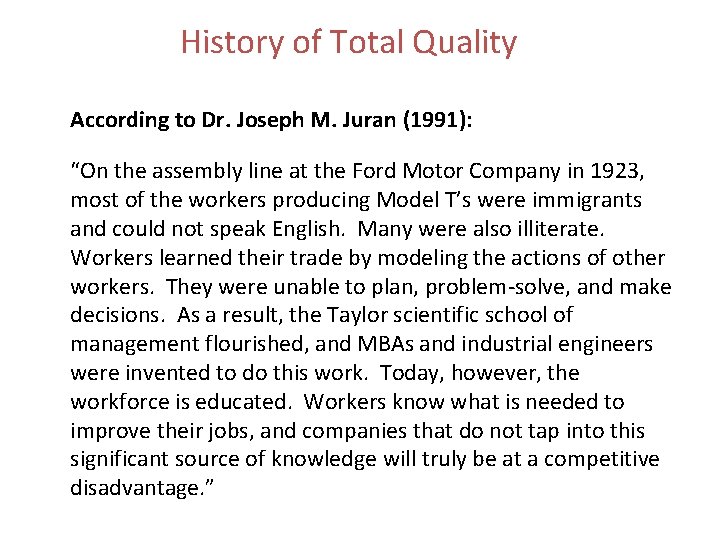
History of Total Quality According to Dr. Joseph M. Juran (1991): “On the assembly line at the Ford Motor Company in 1923, most of the workers producing Model T’s were immigrants and could not speak English. Many were also illiterate. Workers learned their trade by modeling the actions of other workers. They were unable to plan, problem-solve, and make decisions. As a result, the Taylor scientific school of management flourished, and MBAs and industrial engineers were invented to do this work. Today, however, the workforce is educated. Workers know what is needed to improve their jobs, and companies that do not tap into this significant source of knowledge will truly be at a competitive disadvantage. ”
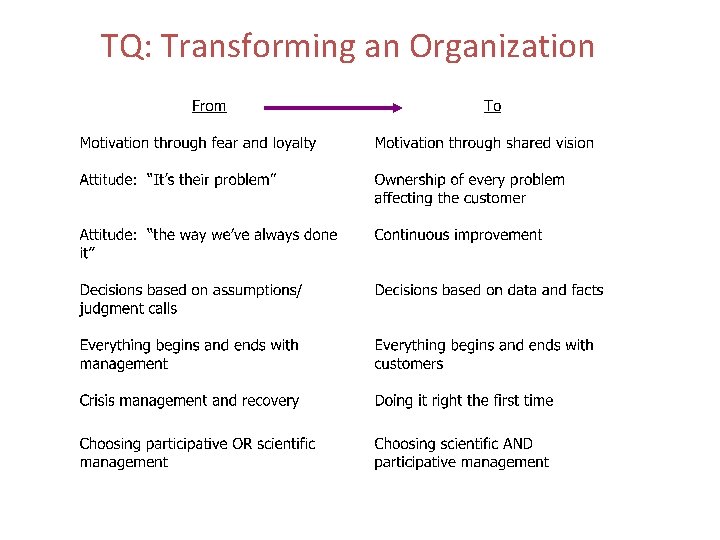
TQ: Transforming an Organization
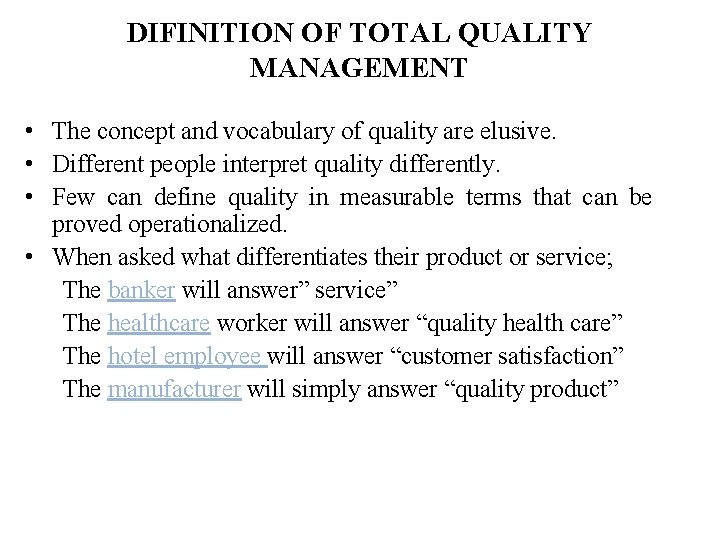
DIFINITION OF TOTAL QUALITY MANAGEMENT • The concept and vocabulary of quality are elusive. • Different people interpret quality differently. • Few can define quality in measurable terms that can be proved operationalized. • When asked what differentiates their product or service; The banker will answer” service” The healthcare worker will answer “quality health care” The hotel employee will answer “customer satisfaction” The manufacturer will simply answer “quality product”
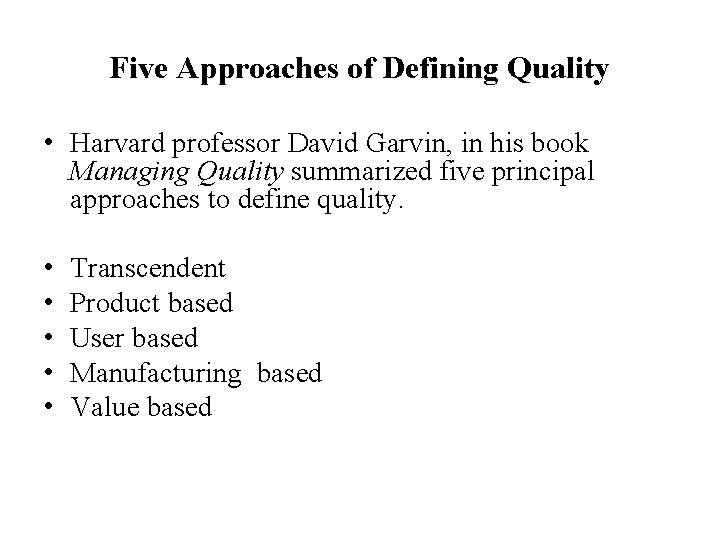
Five Approaches of Defining Quality • Harvard professor David Garvin, in his book Managing Quality summarized five principal approaches to define quality. • • • Transcendent Product based User based Manufacturing based Value based
Transcendental view • Those who hold the transcendental view would say “I can’t define it, but I know it when I see it” • Advertisers are fond of promoting products in these terms. “ Where shopping is a pleasure” (supermarket). “We love to fly and it shows" (airline). Television and print media are awash with such indefinable claims and therein lies the problem: • Quality is difficult to define or to operationalize. It thus becomes elusive when using the approach as basis for competitive advantage. Moreover, the functions of design, production and service may find it difficult to use the definition as a basis for quality management.
PRODUCT BASED • Quality is viewed as a quantifiable or measurable characteristic or attribute. For example durability or reliability can be measured and the engineer can design to that benchmark. • Quality is determined objectively. • Although this approach has many benefits, it has limitation as well. Where quality is based on individual taste or preference, the benchmark for measurement may be misleading.
USER BASED It is based on idea that quality is an individual matter and products that best satisfy their preferences are those with the highest quality. This is rational approach but leads to two problems; § Consumer preference vary widely and it is difficult to aggregate these preferences into products with wide appeal. This leads to the choice between a niche strategy or a market aggregation approach which tries to identify those product attributes that meet the needs of the largest number of consumers. § Another problem concerns the answer to the question “Are quality and customer satisfaction the same? ” the answer is probably not. One may admit that a Lincoln continental has many quality attribute, but satisfaction may be better achieved with an Escort.
MANUFACTURING BASED • Manufacturing-based definitions are concerned primarily with engineering and manufacturing practices and use the universal definition of “conformance to requirements”. Requirements or specifications are established by design and any deviation implies a reduction in quality. The concept applies to services as well as product. Excellence in quality is not necessarily in the eye of the beholder but rather in the standards set by the organization. • This approach has the serious weakness. The consumer’s perception of quality is equated with conformance and hence is internally focused.
Value Based • It is defined in term of costs and prices as well as number of other attributes. Thus, the consumer’s purchased decision is based on quality at an acceptable price. This approach is reflected in the popular Consumer Reports magazine which ranks products and services based on two criteria: Quality and Value. • The highest quality is not usually the best value. That designation is assigned to the “best- buy” product or service.
Total quality management (TQM) • Total Quality Management (or TQM) is a management concept coined by W. Edwards Deming. The basis of TQM is to reduce the errors produced during the manufacturing or service process, increase customer satisfaction, streamline supply chain management, aim for modernization of equipment and ensure workers have the highest level of training. • A managerial approach which focuses on quality and aims to improve the effectiveness of the business involving every department, activity and individual. • It is also a method designed to prevent errors, such as poor quality products, from happening at every stage of the production process. © Photo. Disc
What is TQM? ? The essence of Total Quality Management is a common sense dedication to understanding what the customer wants and then using people and science to set up systems to deliver products and services that delight the customer. Greg Hughes President AT&T Transmission Systems
Why TQM? Ford Motor Company had operating losses of $3. 3 billion between 1980 and 1982. Xerox market share dropped from 93% in 1971 to 40% in 1981. Attention to quality was seen as a way to combat the competition. Total Quality Management
TQM: A “Buzzword” Losing Popularity • For many companies, the term TQM is associated with corporate programs (mid 1980 s ~ early 1990 s) aimed at implementing employee teams and statistical process control. • Unfortunately, many companies were dissatisfied with the perceived results of these programs, concluding TQM does not work. Question: Why were they dissatisfied? Were they justified? Total Quality Management
TQM • Total - made up of the whole • Quality - degree of excellence a product or service provides • Management - act, art or manner of planning, controlling, directing, …. Therefore, TQM is the art of managing the whole to achieve excellence Total Quality Management
What does TQM mean? • Total Quality Management means that the organization's culture is defined by and supports the constant attainment of customer satisfaction through an integrated system of tools, techniques, and training. • This involves the continuous improvement of organizational processes, resulting in high quality products and services. Total Quality Management
What’s the goal of TQM? “Do the right things right the first time, every time. ” Total Quality Management
Total Quality Management • Total Quality Management (TQ, QM or TQM) and Six Sigma (6 ) are sweeping “culture change” efforts to position a company for greater customer satisfaction, profitability and competitiveness. • TQ may be defined as managing the entire organization so that it excels on all dimensions of products and services that are important to the customer. • We often think of features when we think of the quality of a product or service; TQ is about conformance quality, not features.
Total Quality Is… • Meeting Our Customer’s Requirements • Doing Things Right the First Time; Freedom from Failure (Defects) • Consistency (Reduction in Variation) • Continuous Improvement • Quality in Everything We Do
A Quality Management System Is… • A belief in the employee’s ability to solve problems • A belief that people doing the work are best able to improve it • A belief that everyone is responsible for quality
Elements for Success • • • Management Support Mission Statement Proper Planning Customer and Bottom Line Focus Measurement Empowerment Teamwork/Effective Meetings Continuous Process Improvement Dedicated Resources
INTRODUCTION TO TQM What is TQM? TQM is the integration of all functions and processes within an organization in order to achieve continuous improvement of the quality of goods and services. The goal is customer satisfaction. “ No doubt , humans are always deficient” (Al-Quran)
Another way to put it • At it’s simplest, TQM is all managers leading and facilitating all contributors in everyone’s two main objectives: 4(1) total client satisfaction through quality products and services; and 4(2) continuous improvements to processes, systems, people, suppliers, partners, products, and services. Total Quality Management
Productivity and TQM • Traditional view: – Quality cannot be improved without significant losses in productivity. • TQM view: – Improved quality leads to improved productivity. Total Quality Management
Basic Tenets of TQM • 1. The customer makes the ultimate determination of quality. • 2. Top management must provide leadership and support for all quality initiatives. • 3. Preventing variability is the key to producing high quality. • 4. Quality goals are a moving target, thereby requiring a commitment toward continuous improvement. • 5. Improving quality requires the establishment of effective metrics. We must speak with data and facts not just opinions. Total Quality Management
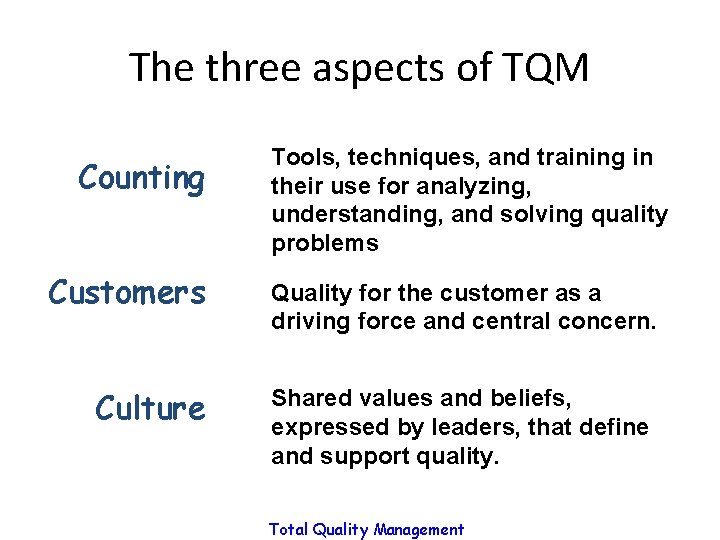
The three aspects of TQM Counting Customers Culture Tools, techniques, and training in their use for analyzing, understanding, and solving quality problems Quality for the customer as a driving force and central concern. Shared values and beliefs, expressed by leaders, that define and support quality. Total Quality Management
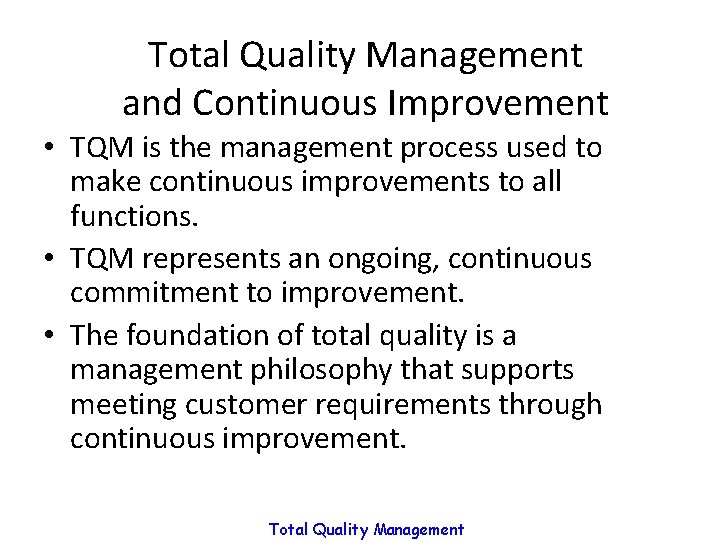
Total Quality Management and Continuous Improvement • TQM is the management process used to make continuous improvements to all functions. • TQM represents an ongoing, continuous commitment to improvement. • The foundation of total quality is a management philosophy that supports meeting customer requirements through continuous improvement. Total Quality Management
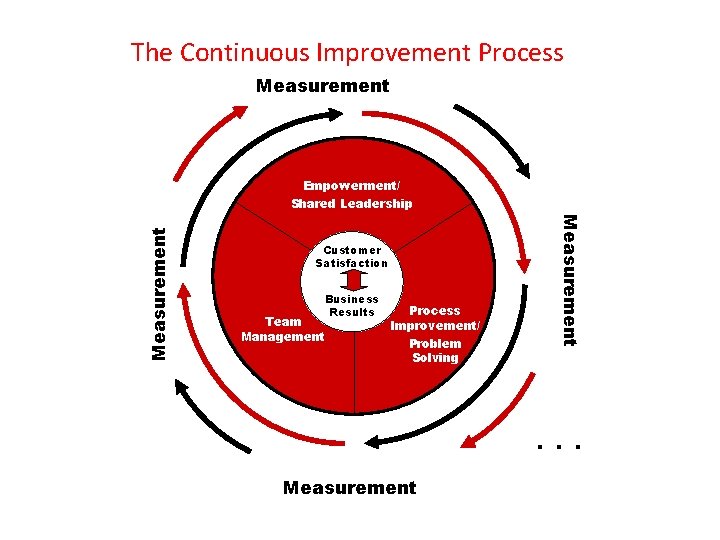
The Continuous Improvement Process Measurement Empowerment/ Customer Satisfaction Business Results Team Management Process Improvement/ Problem Solving Measurement Shared Leadership . . . Measurement
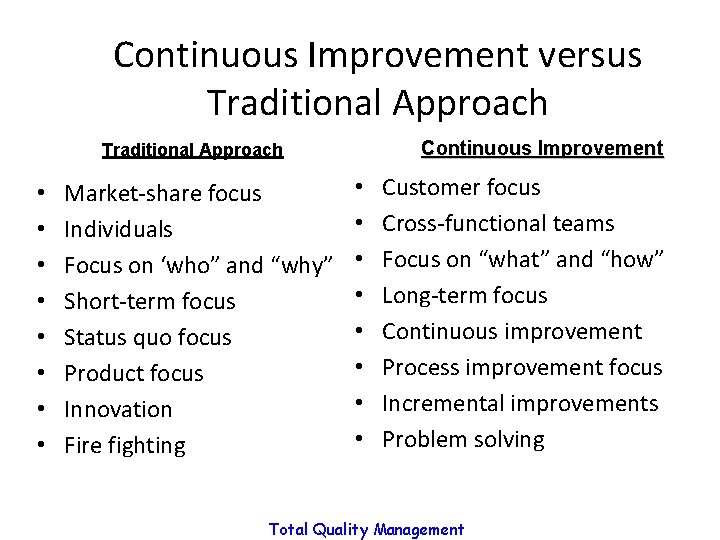
Continuous Improvement versus Traditional Approach Continuous Improvement Traditional Approach • • Market-share focus Individuals Focus on ‘who” and “why” Short-term focus Status quo focus Product focus Innovation Fire fighting • • Customer focus Cross-functional teams Focus on “what” and “how” Long-term focus Continuous improvement Process improvement focus Incremental improvements Problem solving Total Quality Management
Quality Throughout • “A Customer’s impression of quality begins with the initial contact with the company and continues through the life of the product. ” – Customers look to the total package - sales, service during the sale, packaging, deliver, and service after the sale. – Quality extends to how the receptionist answers the phone, how managers treat subordinates, how courteous sales and repair people are, and how the product is serviced after the sale. • “All departments of the company must strive to improve the quality of their operations. ” Total Quality Management
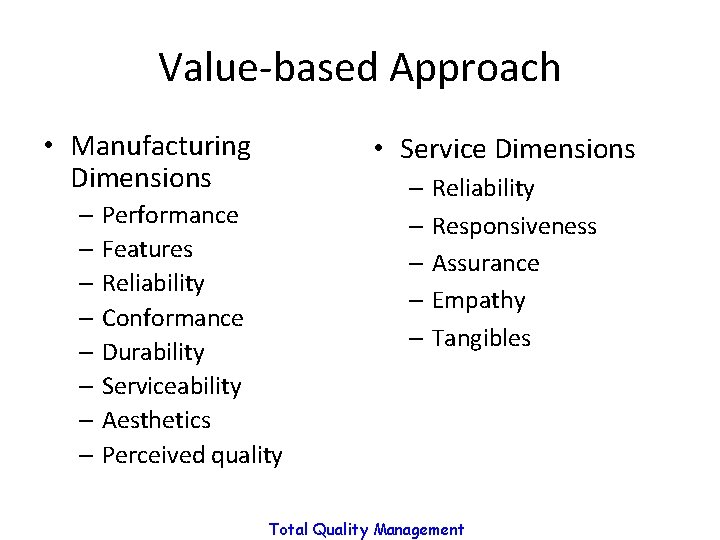
Value-based Approach • Manufacturing Dimensions • Service Dimensions – Performance – Features – Reliability – Conformance – Durability – Serviceability – Aesthetics – Perceived quality – Reliability – Responsiveness – Assurance – Empathy – Tangibles Total Quality Management
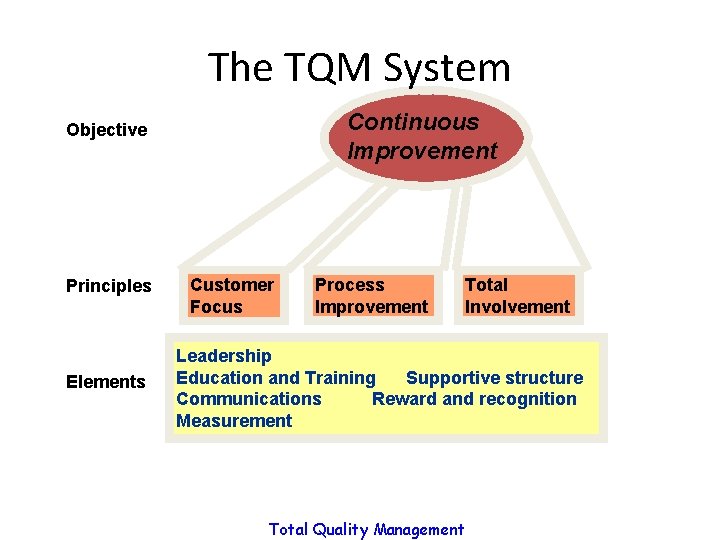
The TQM System Continuous Improvement Objective Principles Elements Customer Focus Process Improvement Total Involvement Leadership Education and Training Supportive structure Communications Reward and recognition Measurement Total Quality Management
Characteristics of TQM Leader • • Visible, Committed and Knowledgeable A Missionary Zeal Aggressive Targets Strong Drivers Communication of Values Organization Customers Contact
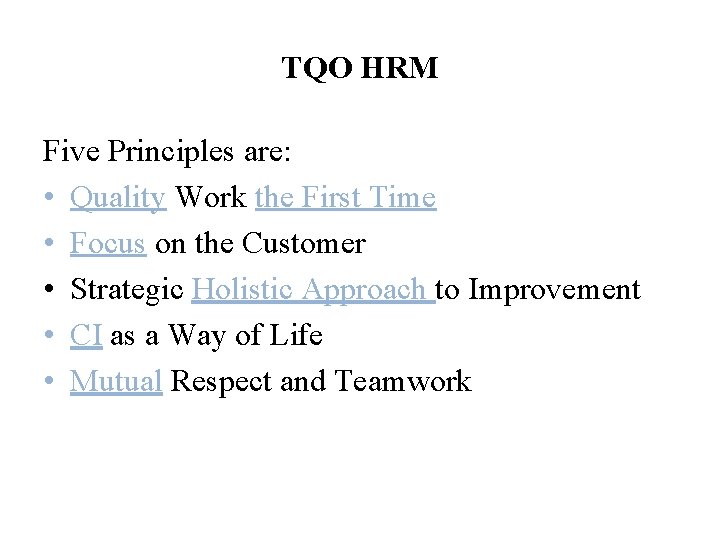
TQO HRM Five Principles are: • Quality Work the First Time • Focus on the Customer • Strategic Holistic Approach to Improvement • CI as a Way of Life • Mutual Respect and Teamwork
CHARACTERISTICS OF TQM
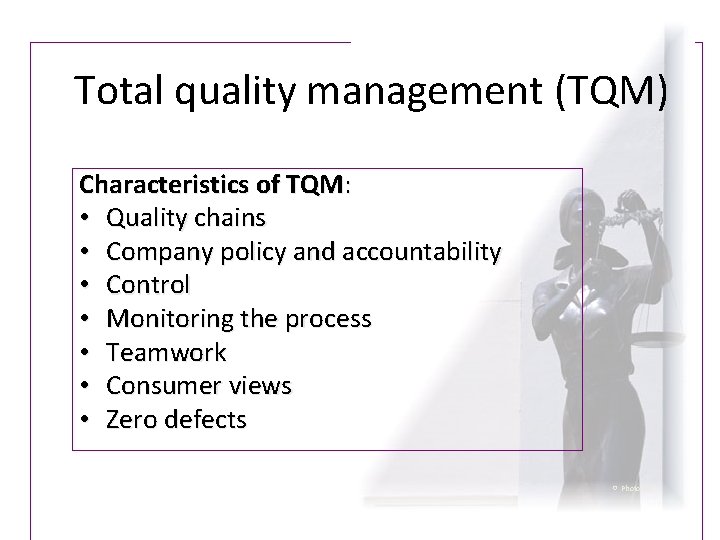
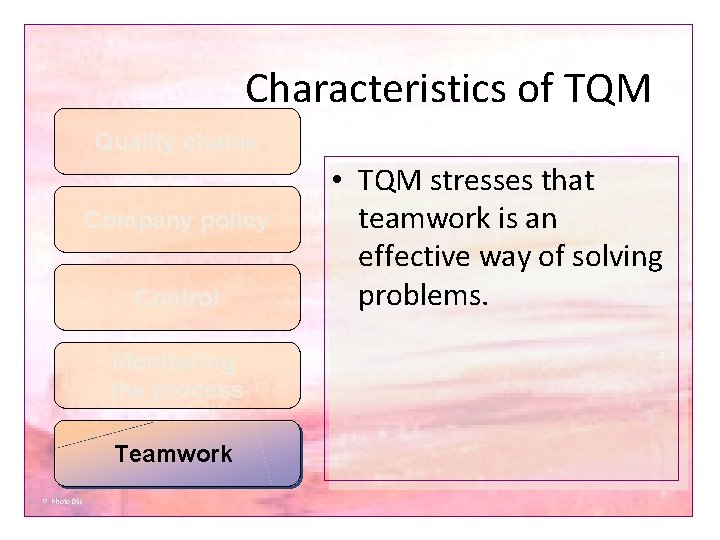
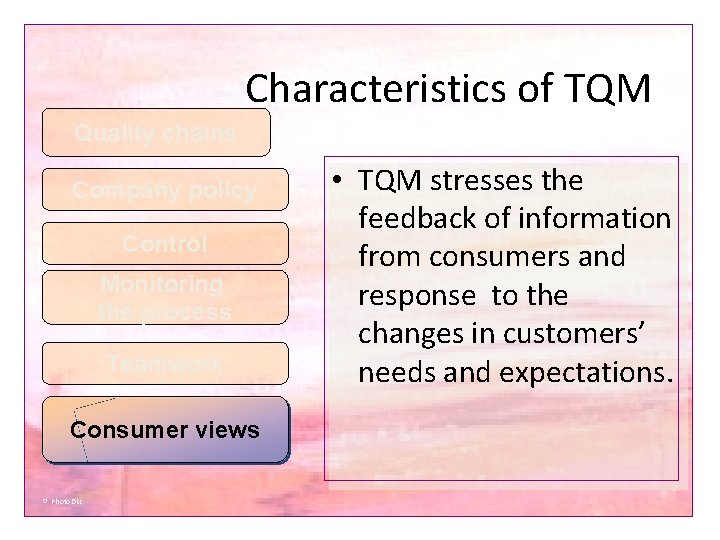
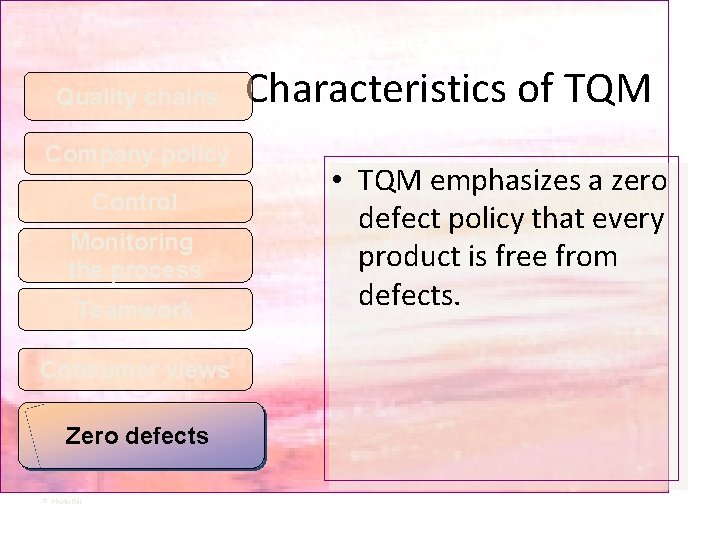
Total quality management (TQM) Characteristics of TQM: • Quality chains • Company policy and accountability • Control • Monitoring the process • Teamwork • Consumer views • Zero defects © Photo. Disc
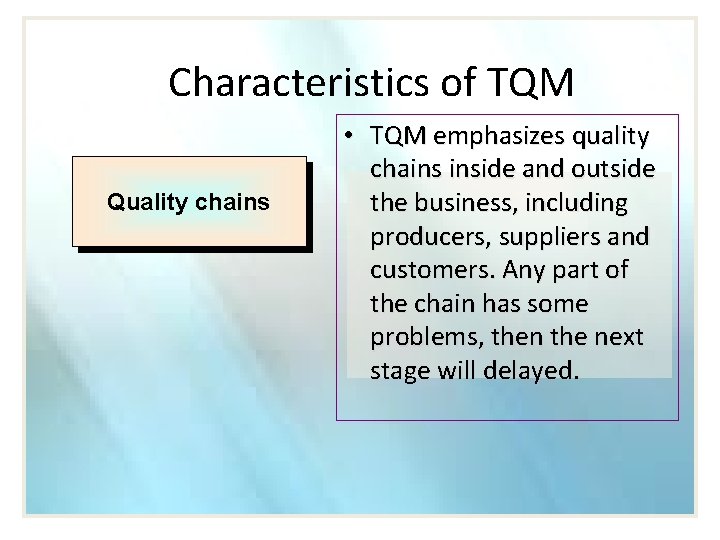
Characteristics of TQM Quality chains • TQM emphasizes quality chains inside and outside the business, including producers, suppliers and customers. Any part of the chain has some problems, then the next stage will delayed.
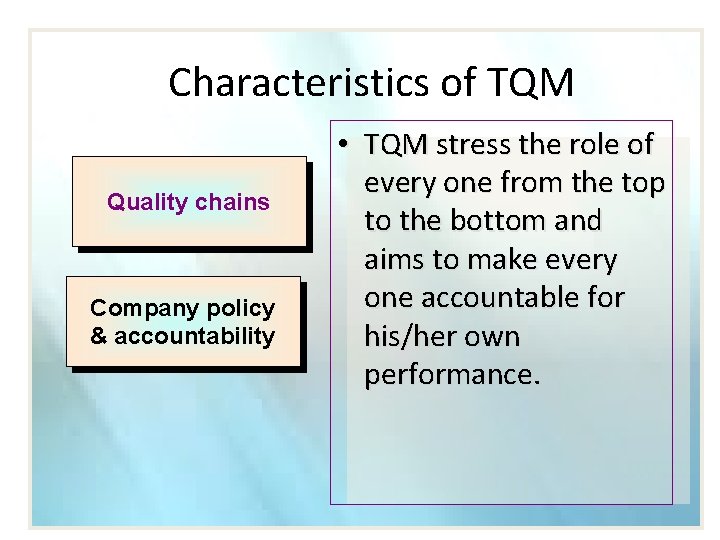
Characteristics of TQM Quality chains Company policy & accountability • TQM stress the role of every one from the top to the bottom and aims to make every one accountable for his/her own performance.
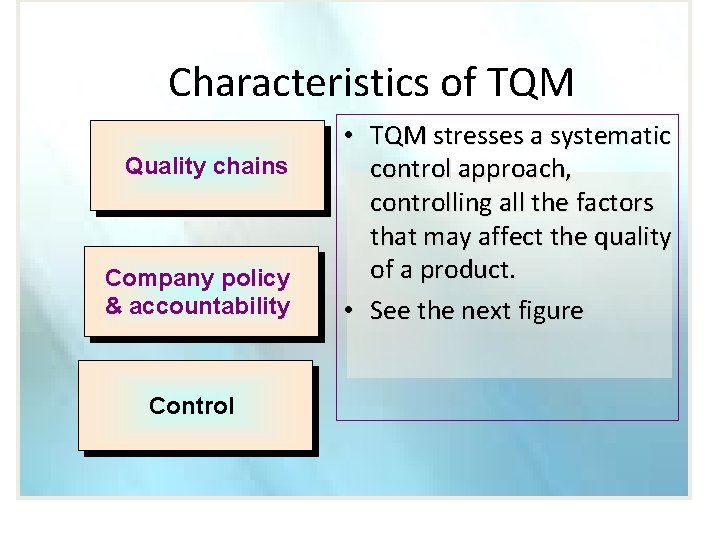
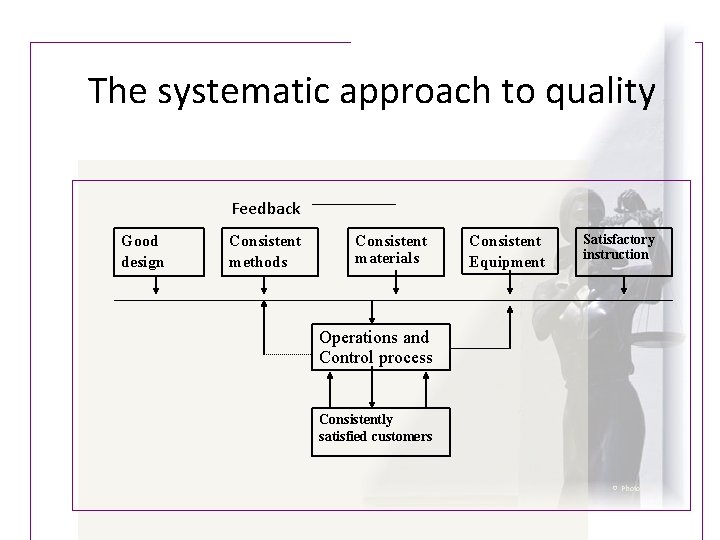
Characteristics of TQM Quality chains Company policy & accountability Control • TQM stresses a systematic control approach, controlling all the factors that may affect the quality of a product. • See the next figure
The systematic approach to quality Feedback Good design Consistent methods Consistent materials Consistent Equipment Satisfactory instruction Operations and Control process Consistently satisfied customers © Photo. Disc
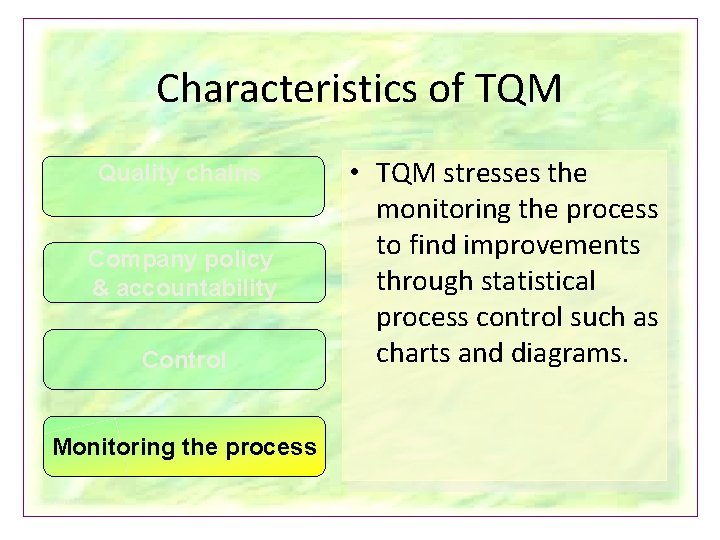
Characteristics of TQM Quality chains Company policy & accountability Control Monitoring the process © Photo. Disc • TQM stresses the monitoring the process to find improvements through statistical process control such as charts and diagrams.
Characteristics of TQM Quality chains Company policy Control Monitoring the process Teamwork © Photo. Disc • TQM stresses that teamwork is an effective way of solving problems.
Characteristics of TQM Quality chains Company policy Control Monitoring the process Teamwork Consumer views © Photo. Disc • TQM stresses the feedback of information from consumers and response to the changes in customers’ needs and expectations.
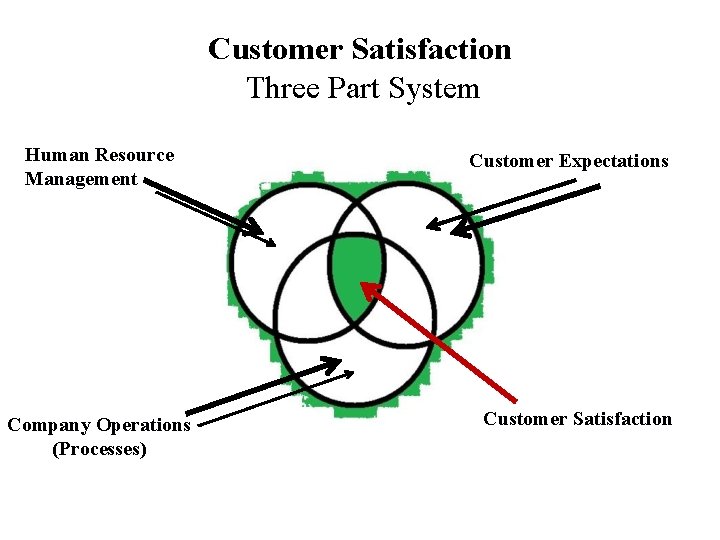
Customer Satisfaction Three Part System Human Resource Management Company Operations (Processes) Customer Expectations Customer Satisfaction
Indicators for Customer Satisfaction • Frontline empowerment • Excellent hiring, training, attitude and morale for front line employees • Proactive customer service system • Proactive management of relationship with customers • Use of all listening posts • Quality requirements of market segment • Commitment to customers • Understanding customer requirements • Service standards meeting customers requirements
Quality chains Company policy Control Monitoring the process Teamwork Consumer views Zero defects © Photo. Disc Characteristics of TQM • TQM emphasizes a zero defect policy that every product is free from defects.
QUALITY COSTS
Costs of ensuring costs Businesses are likely to face costs when trying to improve the quality of their products: • The costs of designing and setting up control systems • The costs of monitoring the systems • The costs of faulty goods • The costs of improving the quality © Photo. Disc
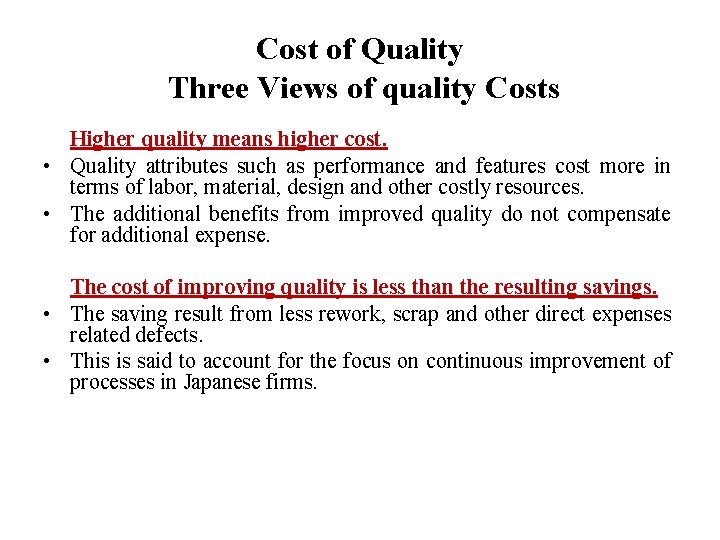
Cost of Quality Three Views of quality Costs Higher quality means higher cost. • Quality attributes such as performance and features cost more in terms of labor, material, design and other costly resources. • The additional benefits from improved quality do not compensate for additional expense. The cost of improving quality is less than the resulting savings. • The saving result from less rework, scrap and other direct expenses related defects. • This is said to account for the focus on continuous improvement of processes in Japanese firms.
Three Views of quality Costs Quality costs are those incurred in excess of those that would have been incurred if the product were built or the service performed exactly right the first time. q This view is held by adherents of TQM philosophy. Costs include not only those that are direct, but also those resulting from lost customers, lost market share and the many hidden costs and foregone opportunities not identified by modern cost accounting systems.
Quality Costs COST OF QUALITY IS THE COST OF NON QUALITY 1: 100 Rule “A stitch in time saves nine”
Types of Quality Costs The cost of quality is generally classified into four categories 1. 2. 3. 4. Cost of Prevention Cost of Appraisal Cost of Internal Failure Cost of External Failure
Quality Costs Cost of Prevention • Prevention costs include those activities which remove and prevent defects from occurring in the production process. • Included are such activities as quality planning, production reviews, training, and engineering analysis, which are incurred to ensure that poor quality is not produced. Appraisal • Those costs incurred to identify poor quality products after they occur but before shipment to customers. e. g. Inspection activity.
Quality Costs Internal Failure • Those incurred during the production process. • Include such items as machine downtime, poor quality materials, scrap, and rework. External Failure • Those incurred after the product is shipped. • External failure costs include returns and allowances, warranty costs, and hidden costs of customer dissatisfaction and lost market share.
Benefits of TQM • • • Greater customer loyalty Market share improvement Higher stock prices Reduced service calls Higher prices Greater productivity
Benefits and problems of using TQM Benefits: • • • Focus on the customer needs and relationship Achieve quality in all aspects Analyzes all processes to remove defects Find improvements on a continuous basis Develop team approach to problem solving Effective procedures of communication Problems: • • High training and development costs Requiring commitment from the entire business Bureaucracy and regular audits are needed Stress is put on process not the product.
Summary • • Definition and Explanation of TQM History of TQM Five Approaches of Quality Characteristics of TQM – – – – Quality chains Company policy and accountability Control Monitoring the process Teamwork Consumer views Zero defects
Improving Productivity