
Productional Biology Kinetic Imaging of Plant Chlorophyll Fluorescence
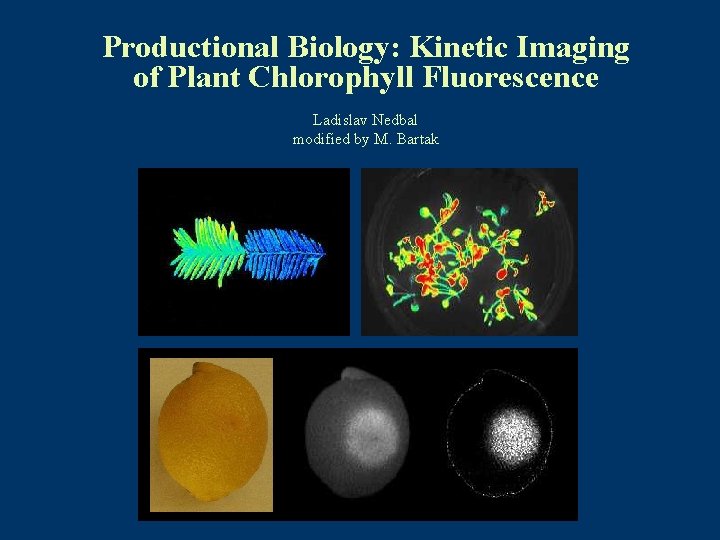
Productional Biology: Kinetic Imaging of Plant Chlorophyll Fluorescence Ladislav Nedbal modified by M. Bartak
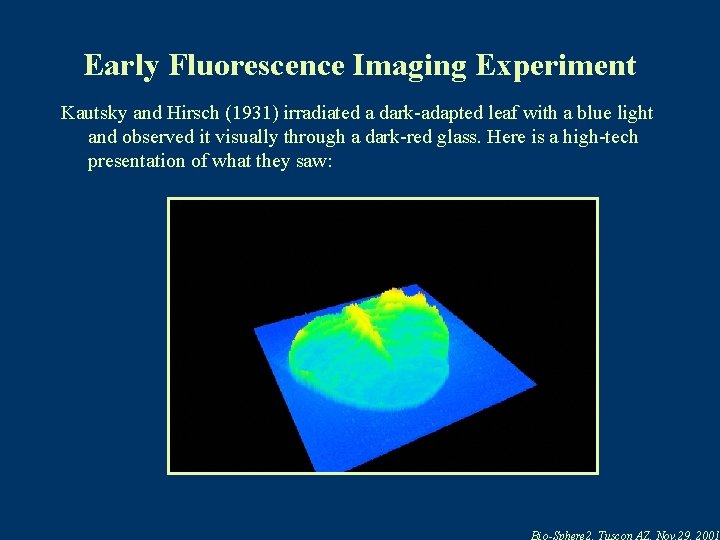
Early Fluorescence Imaging Experiment Kautsky and Hirsch (1931) irradiated a dark-adapted leaf with a blue light and observed it visually through a dark-red glass. Here is a high-tech presentation of what they saw: Bio-Sphere 2, Tuscon AZ, Nov. 29, 2001

Chlorophyll a fluorescence competes with photosynthesis for excitation energy S 2 hnblue S 1 photosynthesis Heat Fluorescence Chla S 0 hn. NIR
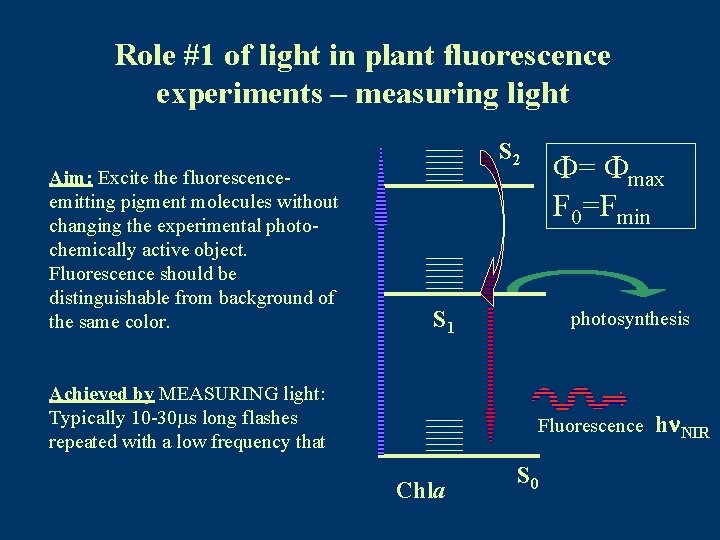
Role #1 of light in plant fluorescence experiments – measuring light Aim: Excite the fluorescenceemitting pigment molecules without changing the experimental photochemically active object. Fluorescence should be distinguishable from background of the same color. S 2 F= Fmax F 0=Fmin S 1 Achieved by MEASURING light: Typically 10 -30 ms long flashes repeated with a low frequency that photosynthesis Fluorescence Chla S 0 hn. NIR
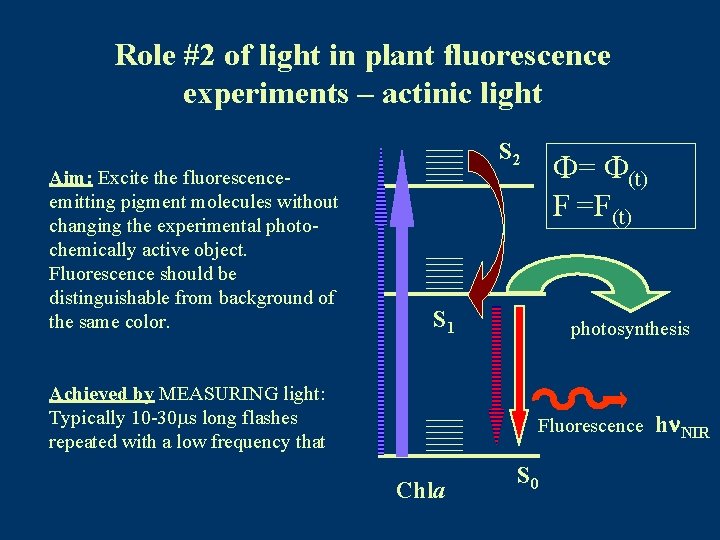
Role #2 of light in plant fluorescence experiments – actinic light Aim: Excite the fluorescenceemitting pigment molecules without changing the experimental photochemically active object. Fluorescence should be distinguishable from background of the same color. S 2 F= F(t) F =F(t) S 1 Achieved by MEASURING light: Typically 10 -30 ms long flashes repeated with a low frequency that photosynthesis Fluorescence Chla S 0 hn. NIR
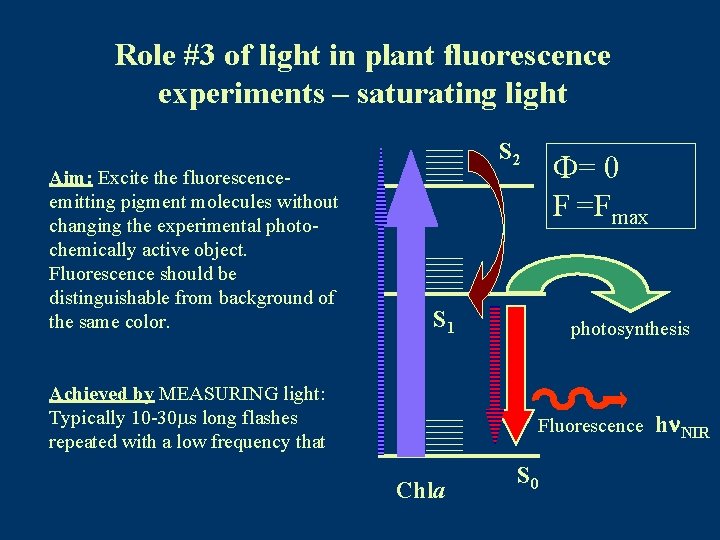
Role #3 of light in plant fluorescence experiments – saturating light Aim: Excite the fluorescenceemitting pigment molecules without changing the experimental photochemically active object. Fluorescence should be distinguishable from background of the same color. S 2 F= 0 F =Fmax S 1 Achieved by MEASURING light: Typically 10 -30 ms long flashes repeated with a low frequency that photosynthesis Fluorescence Chla S 0 hn. NIR
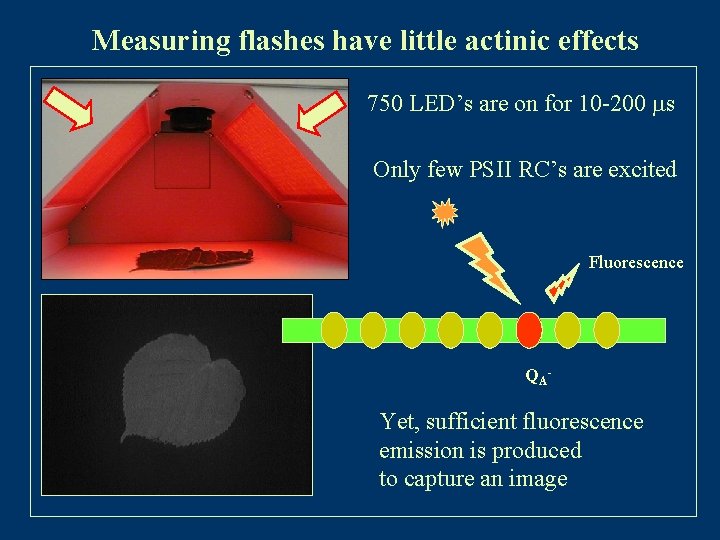
Measuring flashes have little actinic effects 750 LED’s are on for 10 -200 ms Only few PSII RC’s are excited Fluorescence QA - Yet, sufficient fluorescence emission is produced to capture an image
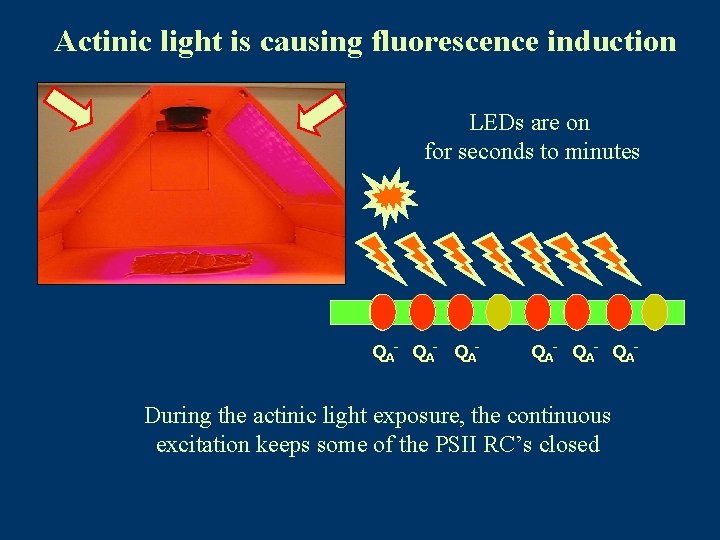
Actinic light is causing fluorescence induction LEDs are on for seconds to minutes QA- QA- QA- During the actinic light exposure, the continuous excitation keeps some of the PSII RC’s closed
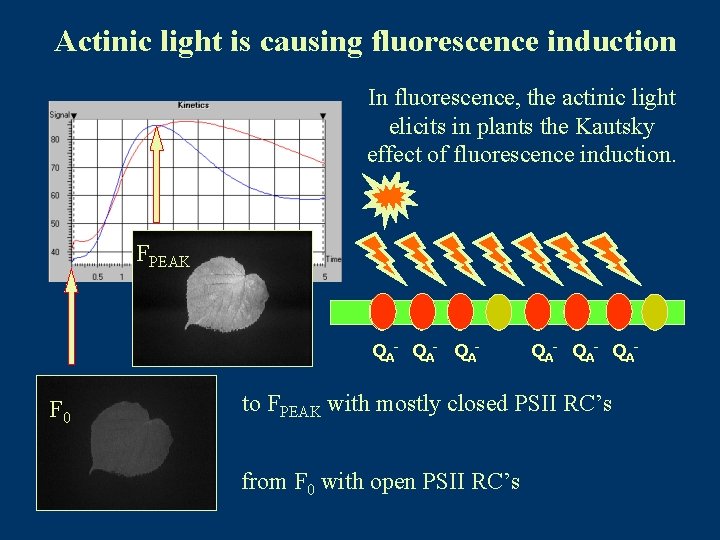
Actinic light is causing fluorescence induction In fluorescence, the actinic light elicits in plants the Kautsky effect of fluorescence induction. FPEAK QA- QA- F 0 QA- QA- to FPEAK with mostly closed PSII RC’s from F 0 with open PSII RC’s
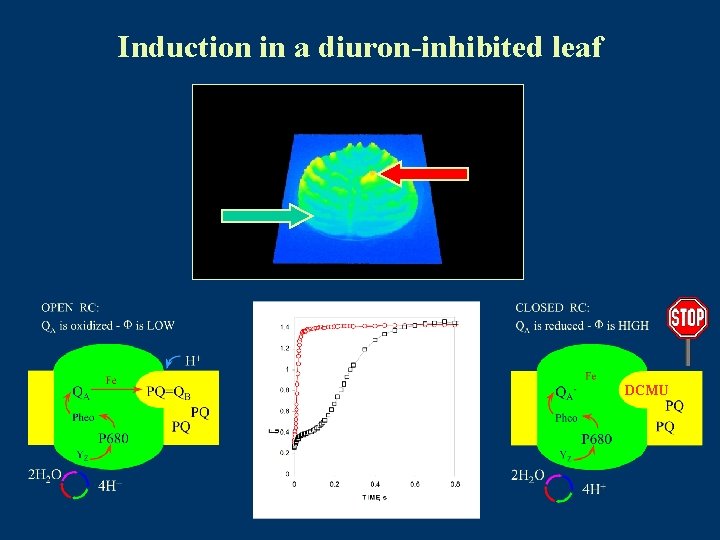
Induction in a diuron-inhibited leaf DCMU
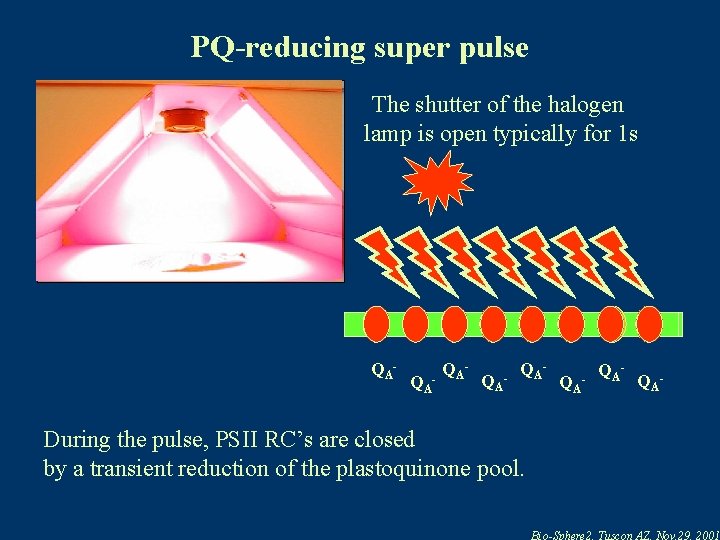
PQ-reducing super pulse The shutter of the halogen Before thetypically pulse for 1 s lamp is open QA - QA - During the pulse, PSII RC’s are closed by a transient reduction of the plastoquinone pool. Bio-Sphere 2, Tuscon AZ, Nov. 29, 2001
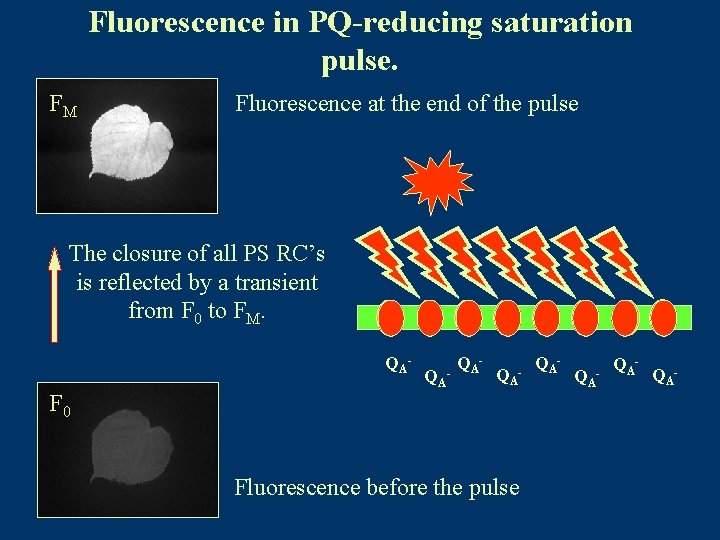
Fluorescence in PQ-reducing saturation pulse. FM Fluorescence at the end of the pulse The closure of all PS RC’s is reflected by a transient from F 0 to FM. Open PSII reaction centers QA - F 0 Fluorescence before the pulse QA -
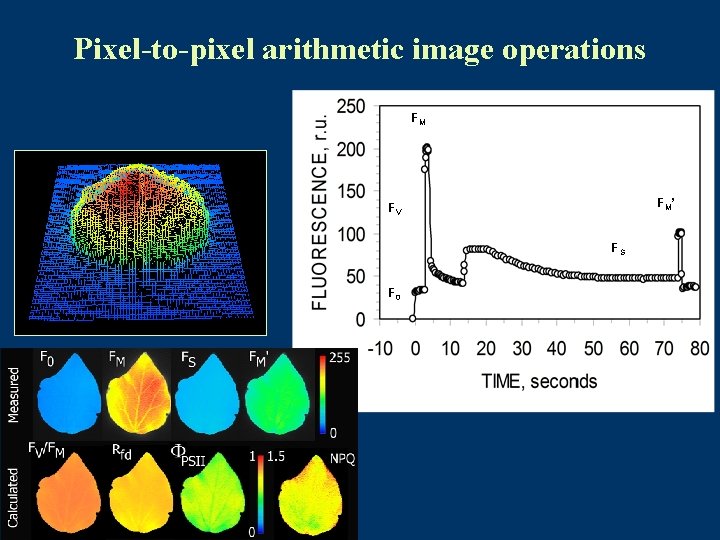
Pixel-to-pixel arithmetic image operations FM F M’ FV FS F 0
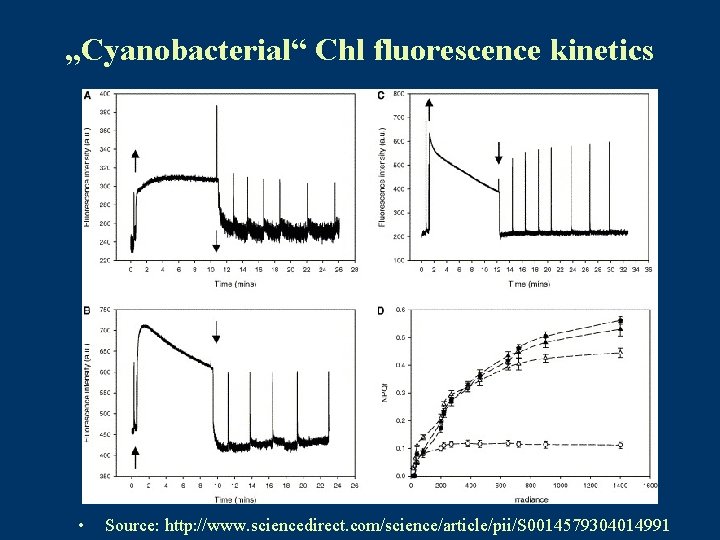
„Cyanobacterial“ Chl fluorescence kinetics • Source: http: //www. sciencedirect. com/science/article/pii/S 0014579304014991
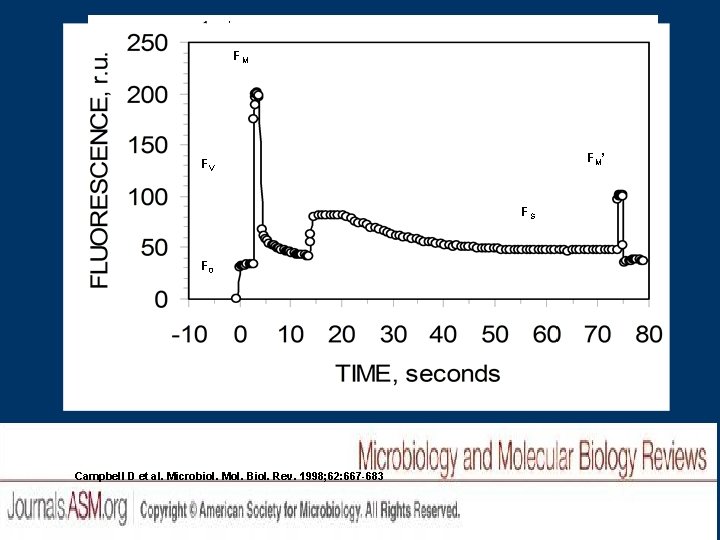
FM Fluorescence emission trace for cyanobacterial quenching analysis. F M’ FV FS F 0 Campbell D et al. Microbiol. Mol. Biol. Rev. 1998; 62: 667 -683
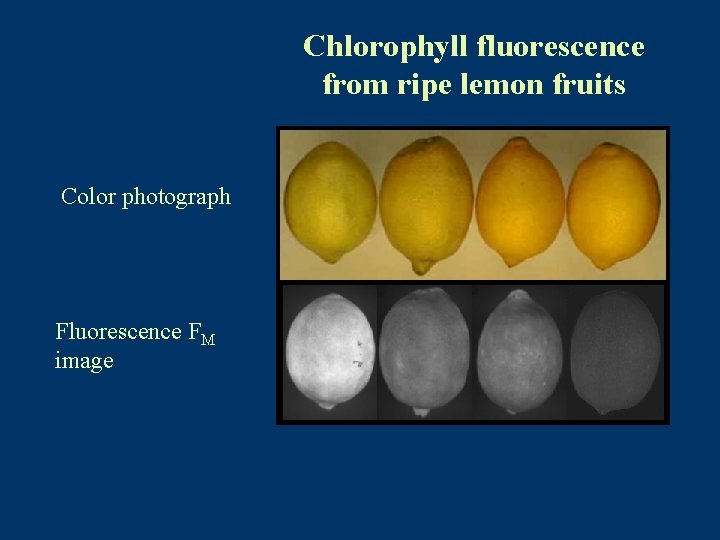
Chlorophyll fluorescence from ripe lemon fruits Color photograph Fluorescence FM image
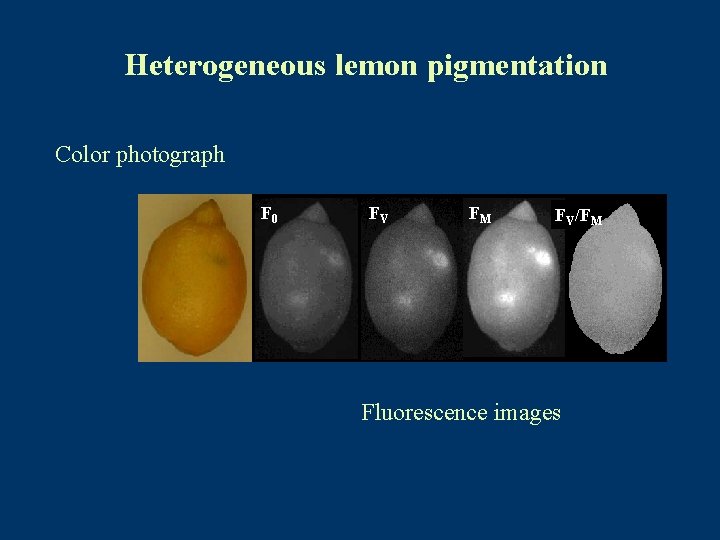
Heterogeneous lemon pigmentation Color photograph F 0 FV FM FV/FM Fluorescence images
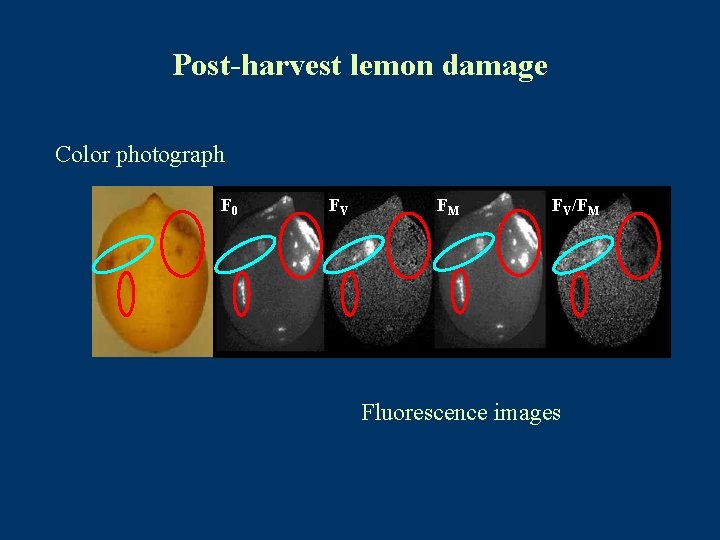
Post-harvest lemon damage Color photograph F 0 FV FM FV/FM Fluorescence images
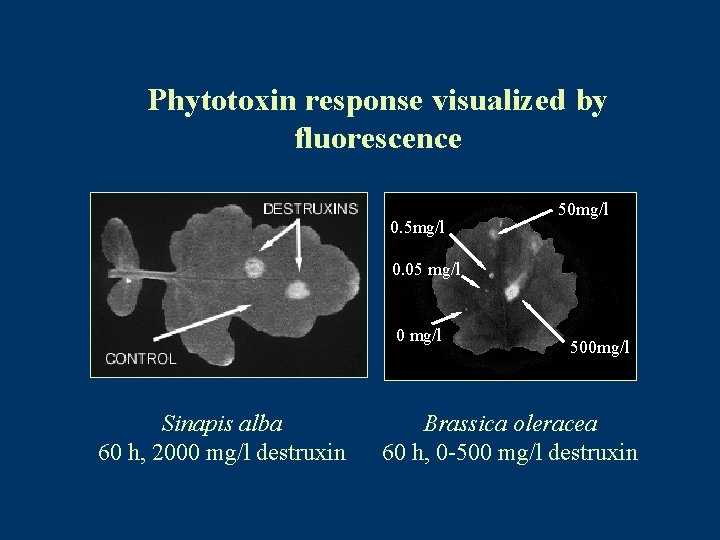
Phytotoxin response visualized by fluorescence 0. 5 mg/l 50 mg/l 0. 05 mg/l 0 mg/l Sinapis alba 60 h, 2000 mg/l destruxin 500 mg/l Brassica oleracea 60 h, 0 -500 mg/l destruxin
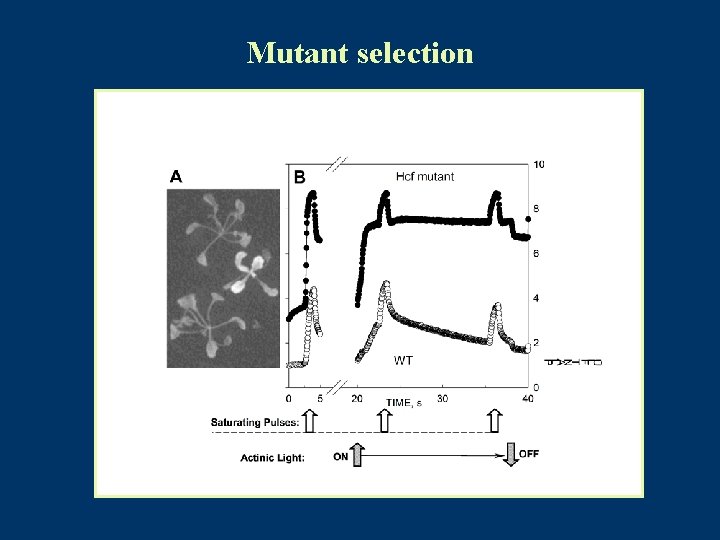
Mutant selection
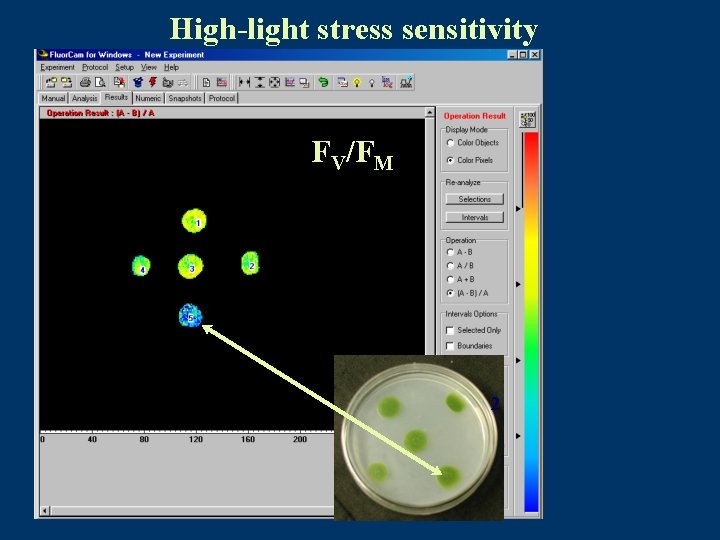
High-light stress sensitivity FV/FM 2
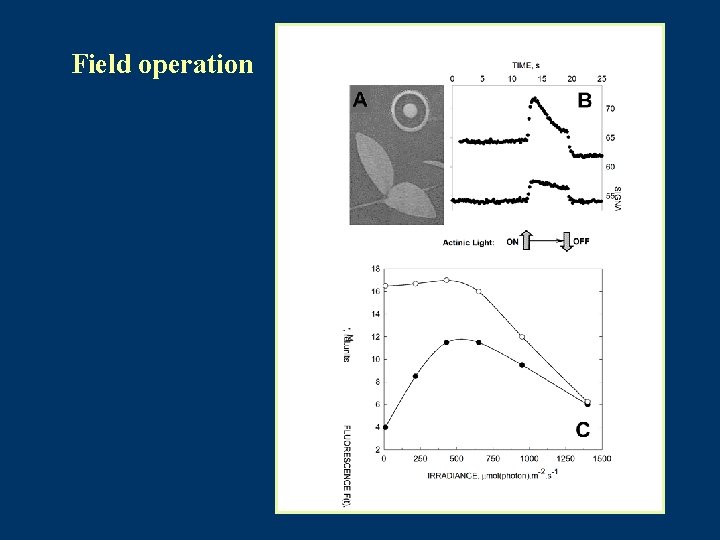
Field operation
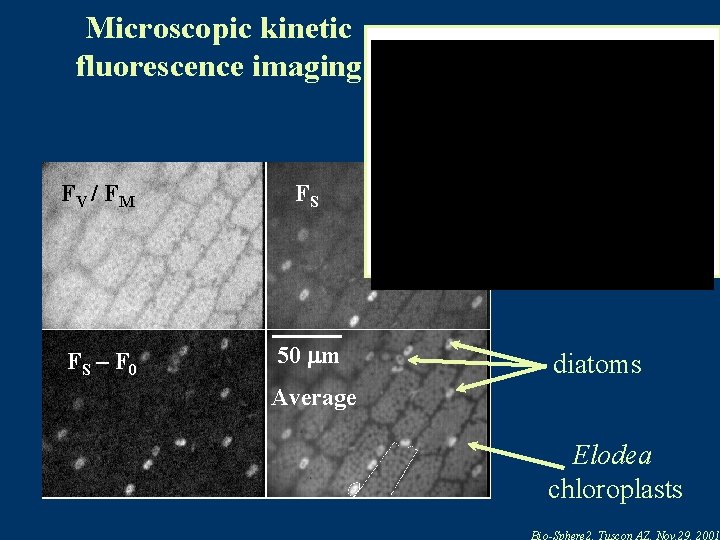
Microscopic kinetic fluorescence imaging FV / F M FS FS – F 0 50 mm diatoms Average Elodea chloroplasts Bio-Sphere 2, Tuscon AZ, Nov. 29, 2001
- Slides: 23