
Production scheduling of a single machine with finite







- Slides: 38
Production scheduling of a single machine with finite states to minimize energy costs Mohammadmohsen AGHELINEJAD Supervisors: Dr. Yassine OUAZENE, Dr. Alice YALAOUI, Prof. Farouk YALAOUI LOSI ICD-UMR-CNRS 6281 Université de technologie de Troyes Institut Charles Delaunay - ICD UMR 6281 27/09/2017
Index • ICD – LOSI / UMR-CNRS-6281 2
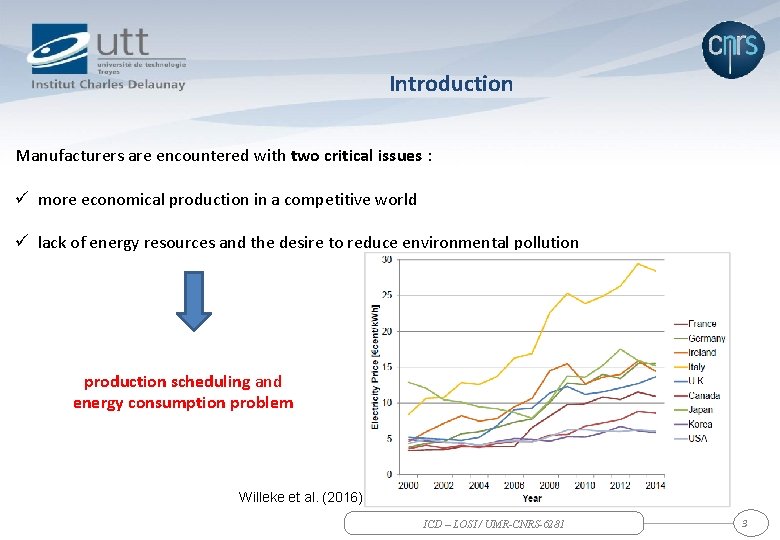
Introduction Manufacturers are encountered with two critical issues : ü more economical production in a competitive world ü lack of energy resources and the desire to reduce environmental pollution production scheduling and energy consumption problem Willeke et al. (2016) ICD – LOSI / UMR-CNRS-6281 3
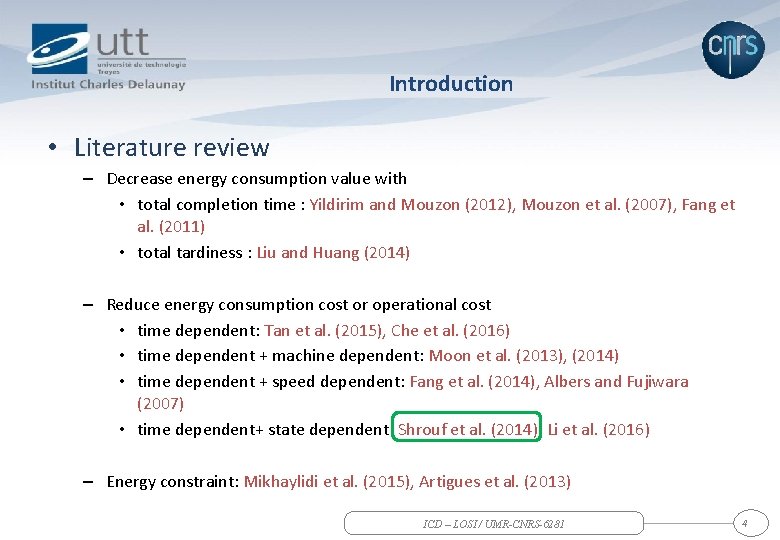
Introduction • Literature review – Decrease energy consumption value with • total completion time : Yildirim and Mouzon (2012), Mouzon et al. (2007), Fang et al. (2011) • total tardiness : Liu and Huang (2014) – Reduce energy consumption cost or operational cost • time dependent: Tan et al. (2015), Che et al. (2016) • time dependent + machine dependent: Moon et al. (2013), (2014) • time dependent + speed dependent: Fang et al. (2014), Albers and Fujiwara (2007) • time dependent+ state dependent: Shrouf et al. (2014), Li et al. (2016) – Energy constraint: Mikhaylidi et al. (2015), Artigues et al. (2013) ICD – LOSI / UMR-CNRS-6281 4
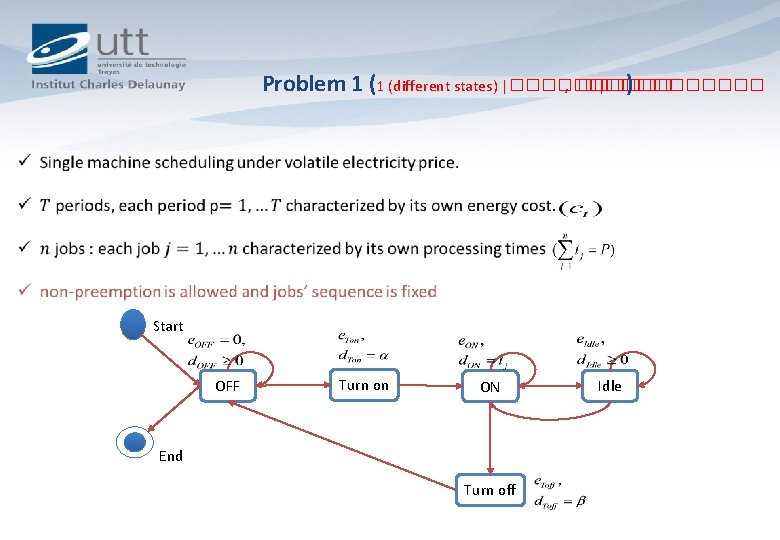
Problem 1 (1 (different states) |�������� , ������ |������ ) Start OFF Turn on ON End Turn off Idle
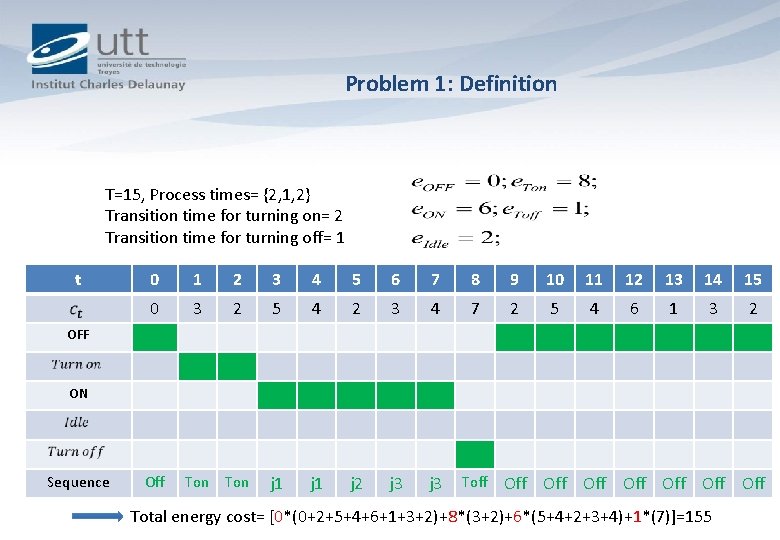
Problem 1: Definition T=15, Process times= {2, 1, 2} Transition time for turning on= 2 Transition time for turning off= 1 t 0 1 2 3 4 5 6 7 8 9 10 11 12 13 14 15 0 3 2 5 4 2 3 4 7 2 5 4 6 1 3 2 j 1 j 2 j 3 OFF ON Sequence Off Ton Toff Off Off Total energy cost= [0*(0+2+5+4+6+1+3+2)+8*(3+2)+6*(5+4+2+3+4)+1*(7)]=155
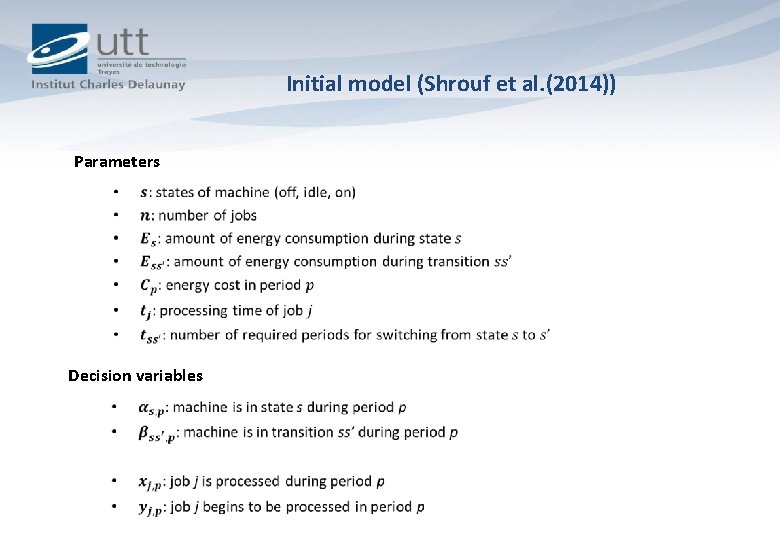
Initial model (Shrouf et al. (2014)) Parameters Decision variables
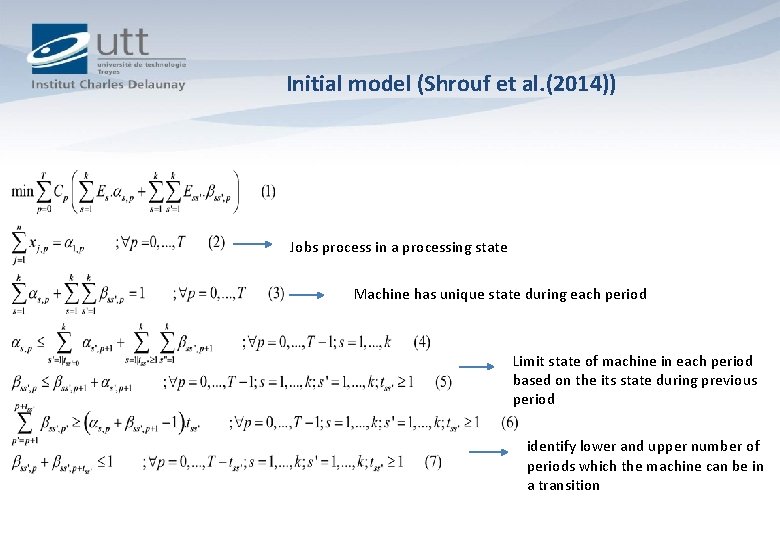
Initial model (Shrouf et al. (2014)) Jobs process in a processing state Machine has unique state during each period Limit state of machine in each period based on the its state during previous period identify lower and upper number of periods which the machine can be in a transition
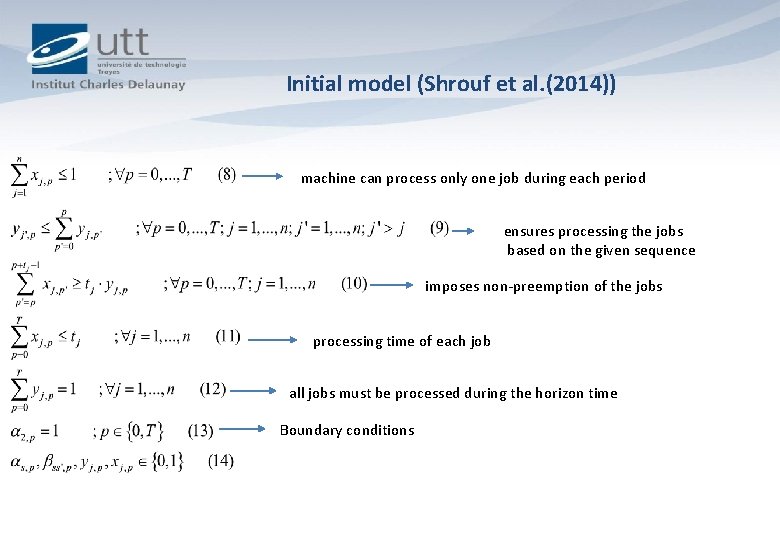
Initial model (Shrouf et al. (2014)) machine can process only one job during each period ensures processing the jobs based on the given sequence imposes non-preemption of the jobs processing time of each job all jobs must be processed during the horizon time Boundary conditions
New mathematical formulation …. 0 1 j 2 j 2 3 j 3 13 14 15 16 17 18 j 3 19 j 3 …. 20 T (just one job can be processed at a time and preemption is not allowed)
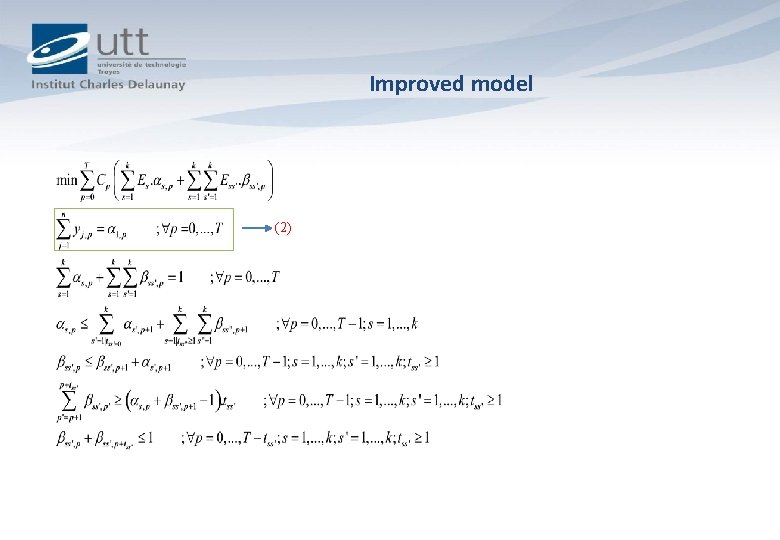
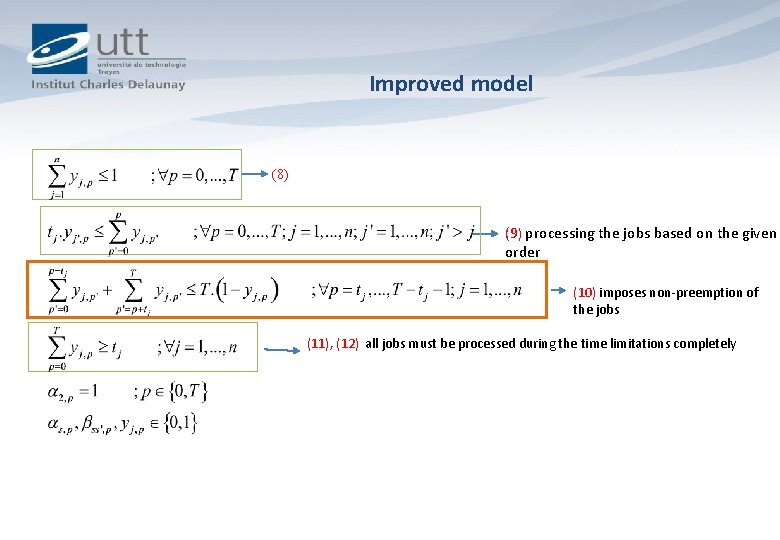
Improved model (2)
Improved model (8) (9) processing the jobs based on the given order (10) imposes non-preemption of the jobs (11), (12) all jobs must be processed during the time limitations completely
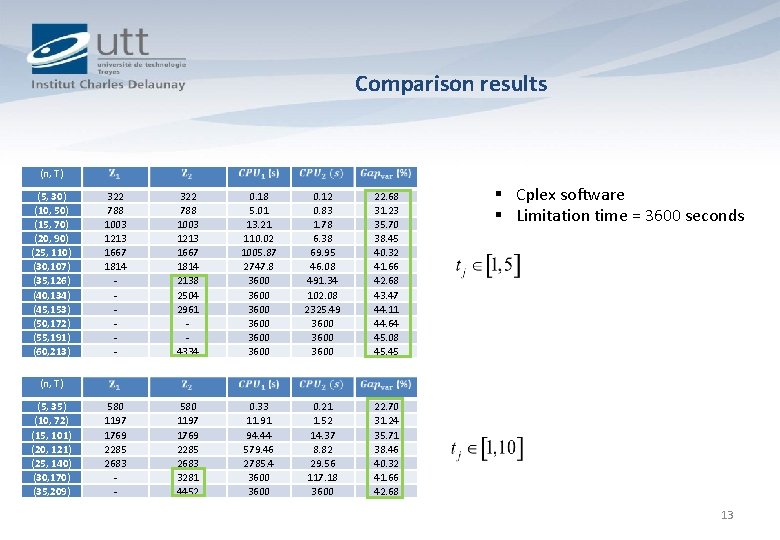
Comparison results (n, T) (5, 30) (10, 50) (15, 70) (20, 90) (25, 110) (30, 107) (35, 126) (40, 134) (45, 153) (50, 172) (55, 191) (60, 213) 322 788 1003 1213 1667 1814 - 322 788 1003 1213 1667 1814 2138 2504 2961 4334 0. 18 5. 01 13. 21 110. 02 1005. 87 2747. 8 3600 3600 0. 12 0. 83 1. 78 6. 38 69. 95 46. 08 491. 34 102. 08 2325. 49 3600 22. 68 31. 23 35. 70 38. 45 40. 32 41. 66 42. 68 43. 47 44. 11 44. 64 45. 08 45. 45 580 1197 1769 2285 2683 - 580 1197 1769 2285 2683 3281 4452 0. 33 11. 91 94. 44 579. 46 2785. 4 3600 0. 21 1. 52 14. 37 8. 82 29. 56 117. 18 3600 22. 70 31. 24 35. 71 38. 46 40. 32 41. 66 42. 68 § Cplex software § Limitation time = 3600 seconds (n, T) (5, 35) (10, 72) (15, 101) (20, 121) (25, 140) (30, 170) (35, 209) 13
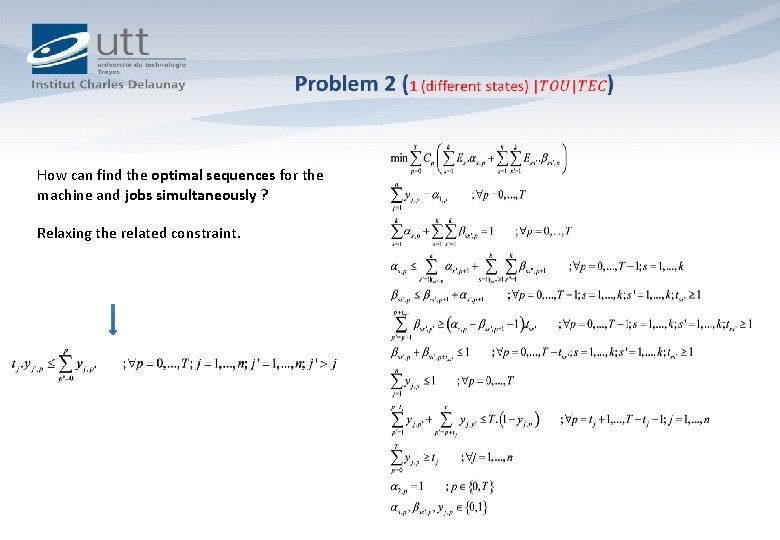
How can find the optimal sequences for the machine and jobs simultaneously ? Relaxing the related constraint.
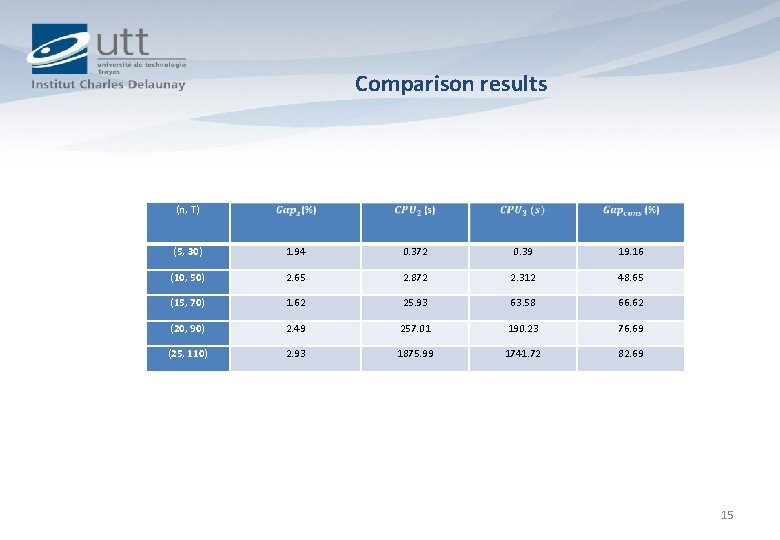
Comparison results (n, T) (5, 30) 1. 94 0. 372 0. 39 19. 16 (10, 50) 2. 65 2. 872 2. 312 48. 65 (15, 70) 1. 62 25. 93 63. 58 66. 62 (20, 90) 2. 49 257. 01 190. 23 76. 69 (25, 110) 2. 93 1875. 99 1741. 72 82. 69 15
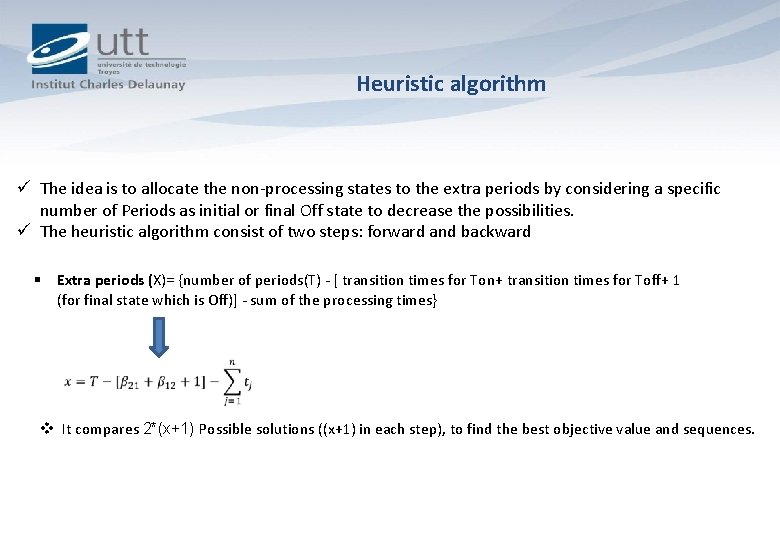
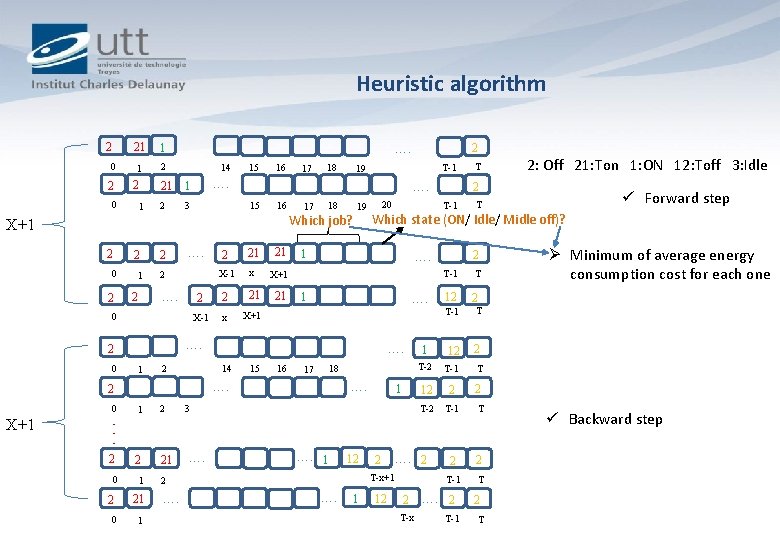
Heuristic algorithm ü The idea is to allocate the non-processing states to the extra periods by considering a specific number of Periods as initial or final Off state to decrease the possibilities. ü The heuristic algorithm consist of two steps: forward and backward § Extra periods (X)= {number of periods(T) - [ transition times for Ton+ transition times for Toff+ 1 (for final state which is Off)] - sum of the processing times} v It compares 2*(x+1) Possible solutions ((x+1) in each step), to find the best objective value and sequences.
Heuristic algorithm 21 1 0 1 2 2 0 1 …. 14 16 0 2 2 1 15 3 2 …. 2 2 0 X-1 16 1 2 X+1 2 21 21 X-1 x X+1 2 21 x 18 21 19 20 16 1 1 …. 1 2 T …. 12 T-1 T 1 12 2 T-1 T 12 2 2 T-1 T 18 …. 1 3 0 2 1 2 21 0 1 21 …. 1 12 …. 2 T-x+1 2 …. 1 12 2 …. 2 T-x T-1 Ø Minimum of average energy consumption cost for each one 2 . . . 2 ü Forward step T 2 …. T-1 17 2: Off 21: Ton 1: ON 12: Toff 3: Idle Which state (ON/ Idle/ Midle off)? X+1 15 T 2 T-1 …. 14 2 0 17 …. 2 0 T-1 19 Which job? …. 2 18 …. X+1 2 17 …. 21 1 2 15 2 2 T ü Backward step
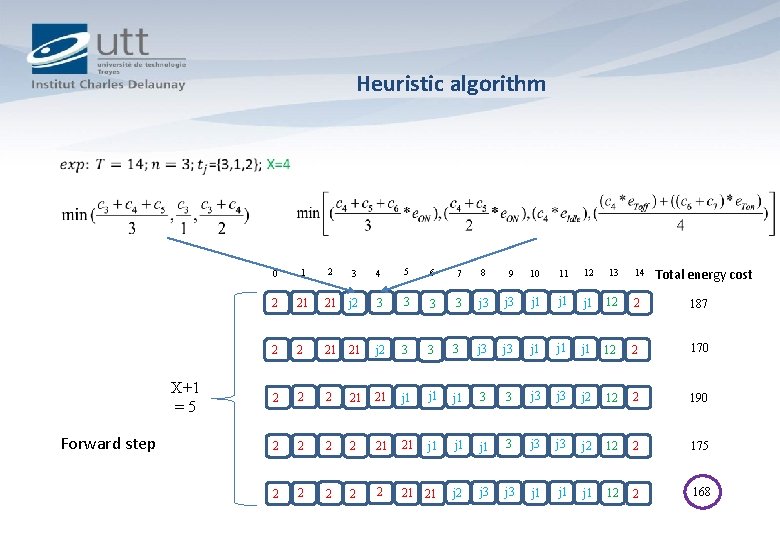
Heuristic algorithm X+1 =5 Forward step 4 5 6 7 8 9 10 11 12 13 14 21 21 j 2 3 3 j 3 j 1 j 1 12 2 187 2 2 21 21 j 2 3 3 3 j 3 j 1 j 1 12 2 170 2 21 21 j 1 j 1 3 3 j 3 j 2 12 2 190 2 2 21 21 j 1 j 1 3 j 3 j 2 12 2 175 2 2 21 21 j 2 j 3 j 1 j 1 12 2 168 1 2 2 Total energy cost 3 0
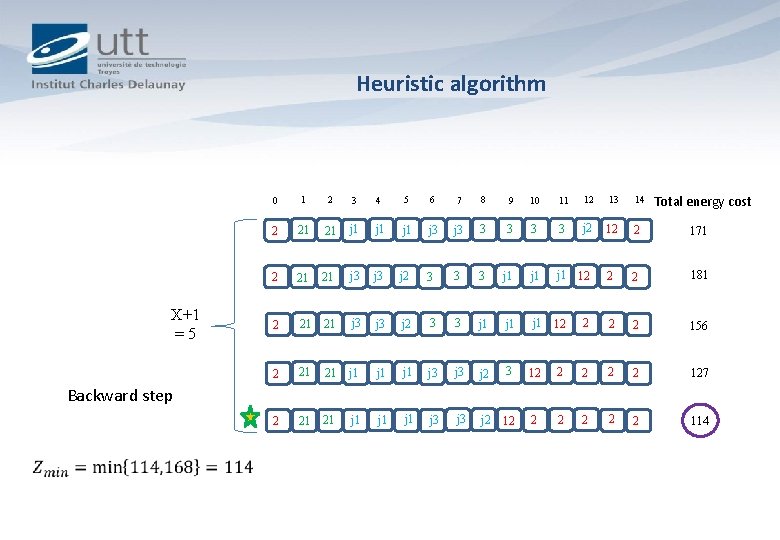
Heuristic algorithm X+1 =5 Total energy cost 0 1 2 3 4 5 6 7 8 9 10 11 12 13 14 2 21 21 j 1 j 3 j 3 3 3 j 2 12 2 171 2 21 21 j 3 j 2 3 3 3 j 1 j 1 12 2 2 181 2 21 21 j 3 j 2 3 3 j 1 j 1 12 2 156 2 21 21 j 1 j 3 j 2 3 12 2 2 127 2 21 21 j 1 j 3 j 2 12 2 2 114 Backward step
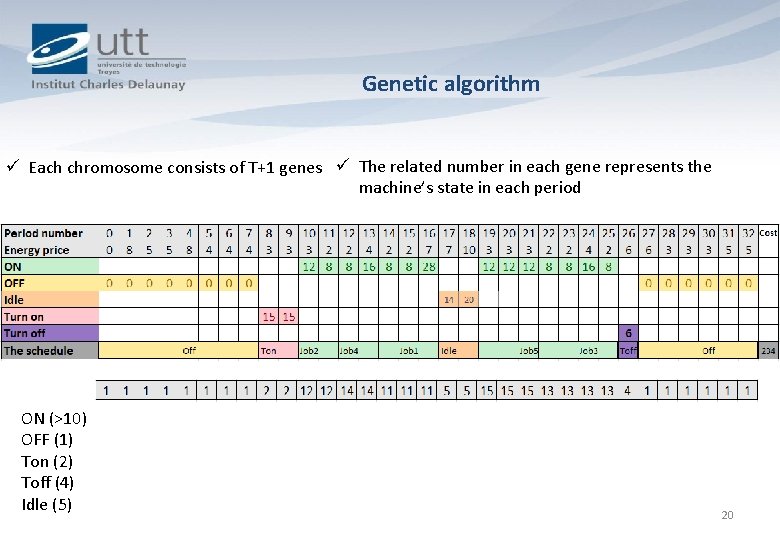
Genetic algorithm ü Each chromosome consists of T+1 genes ü The related number in each gene represents the machine’s state in each period ON (>10) OFF (1) Ton (2) Toff (4) Idle (5) 20
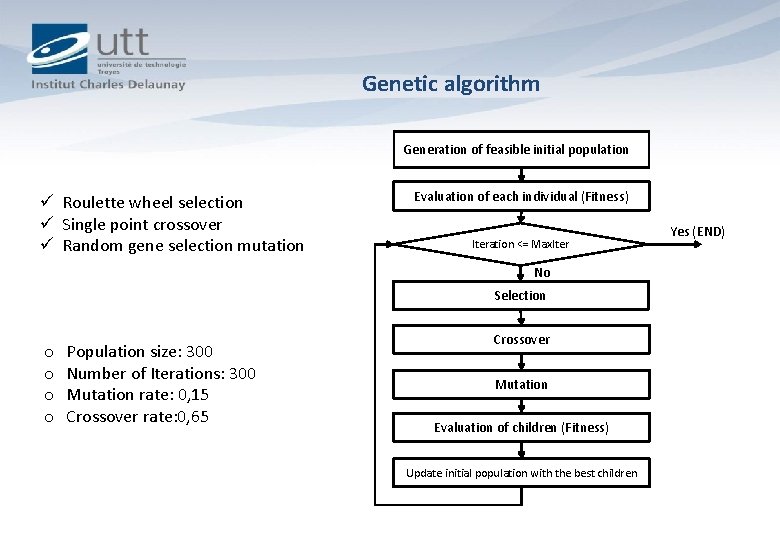
Genetic algorithm Generation of feasible initial population g ü Roulette wheel selection ü Single point crossover ü Random gene selection mutation Evaluation of each individual (Fitness) Iteration <= Max. Iter No Selection o o Population size: 300 Number of Iterations: 300 Mutation rate: 0, 15 Crossover rate: 0, 65 Crossover Mutation Evaluation of children (Fitness) Update initial population with the best children Yes (END)
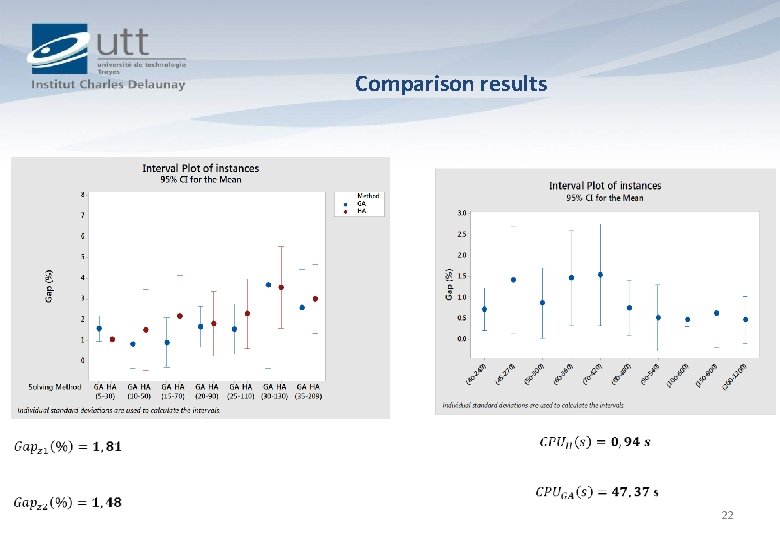
Comparison results 22
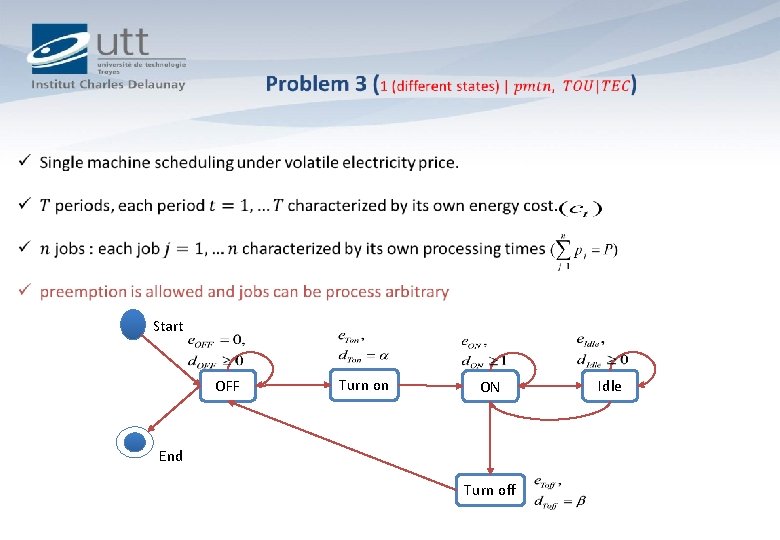
Start OFF Turn on ON End Turn off Idle
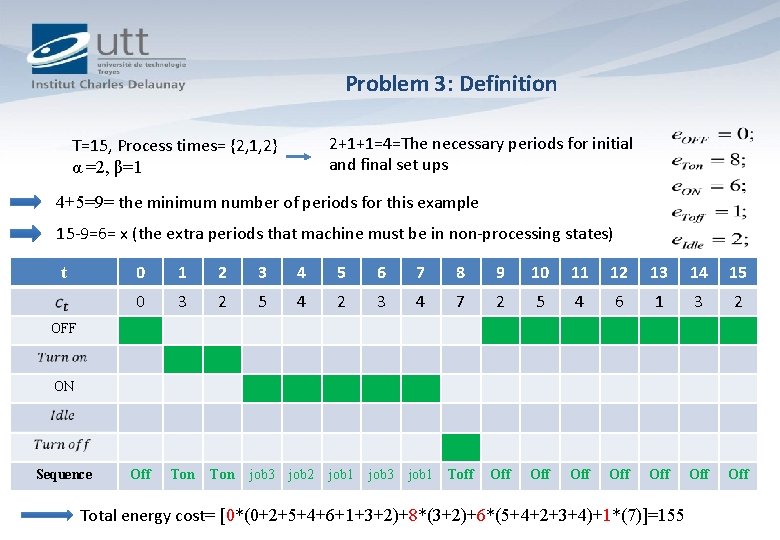
Problem 3: Definition 2+1+1=4=The necessary periods for initial and final set ups T=15, Process times= {2, 1, 2} α =2, β=1 4+5=9= the minimum number of periods for this example 15 -9=6= x (the extra periods that machine must be in non-processing states) t 0 1 2 3 4 5 6 7 8 9 10 11 12 13 14 15 0 3 2 5 4 2 3 4 7 2 5 4 6 1 3 2 Off Ton job 3 job 2 job 1 job 3 job 1 Toff Off Off Off OFF ON Sequence Total energy cost= [0*(0+2+5+4+6+1+3+2)+8*(3+2)+6*(5+4+2+3+4)+1*(7)]=155
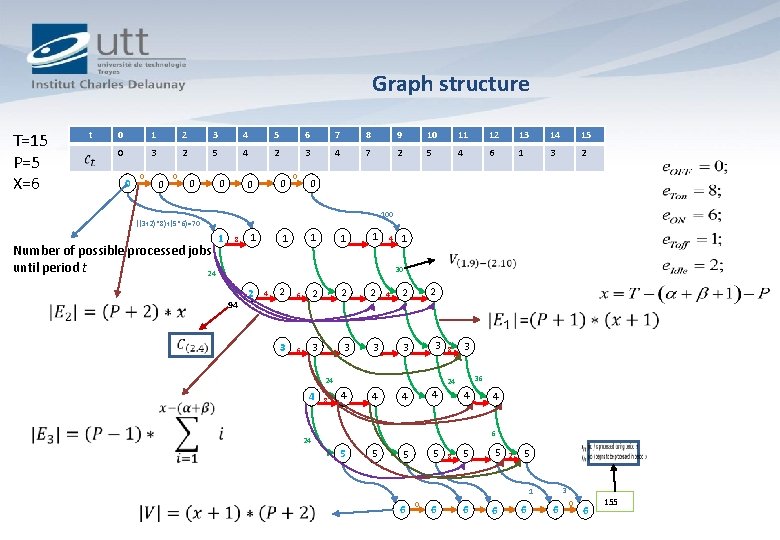
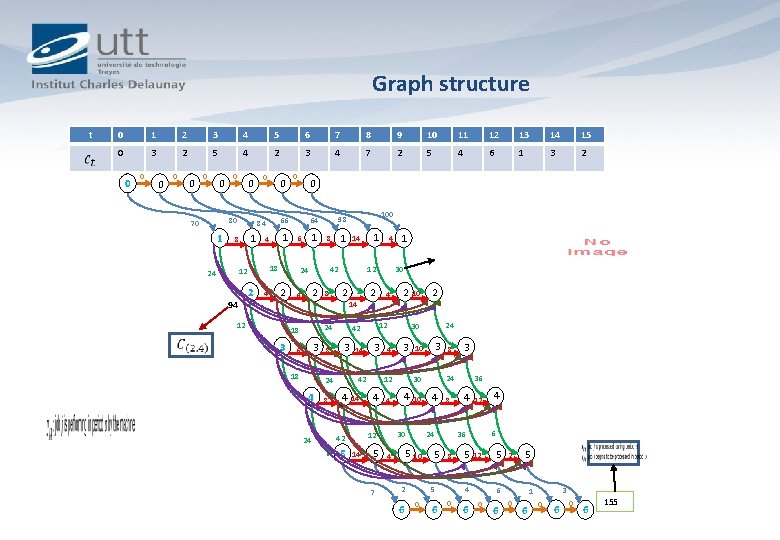
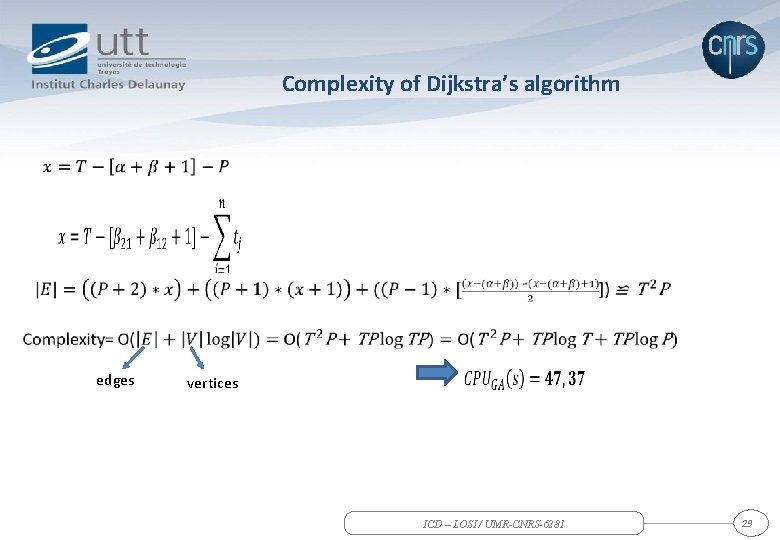
An exact polynomial approach 1. Model the problem consist of T periods and P process times, by using a finite graph which is decomposed in T+1 levels and P+2 lines. 1. 2. 3. 4. Put the nodes Draw the edges Calculate the edges’ value Compute the nodes’ cost 2. Find the shortest path between node (0, 0) and node (P+1, T) of the graph by Dijkstra’s algorithm. ICD – LOSI / UMR-CNRS-6281 25
Graph structure T=15 P=5 X=6 t 0 1 2 3 4 5 6 7 8 9 10 11 12 13 14 15 0 3 2 5 4 2 3 4 7 2 5 4 6 1 3 2 0 0 0 0 0 100 ((3+2)*8)+(5*6)=70 Number of possible processed jobs until period t 24 1 8 1 1 4 1 30 94 1 2 4 2 2 2 6 2 4 2 2 3 3 6 3 3 24 4 8 8 3 36 24 4 4 4 6 24 5 5 8 5 5 2 5 3 1 6 0 6 6 6 0 6 155
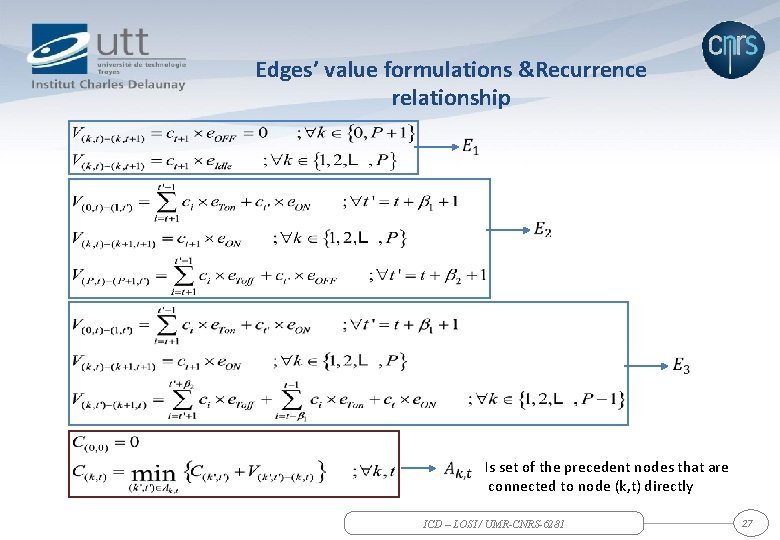
Edges’ value formulations &Recurrence relationship Is set of the precedent nodes that are connected to node (k, t) directly ICD – LOSI / UMR-CNRS-6281 27
Graph structure t 0 1 2 3 4 5 6 7 8 9 10 11 12 13 14 15 0 3 2 5 4 2 3 4 7 2 5 4 6 1 3 2 0 0 0 0 0 80 70 1 1 4 2 4 1 6 2 1 8 14 42 2 6 8 1 4 12 30 2 2 1 4 2 10 2 14 24 18 3 100 98 64 24 12 0 18 12 94 0 66 84 8 24 0 3 6 18 8 3 24 8 14 3 42 24 4 12 42 4 14 5 7 3 30 4 4 10 30 0 3 36 24 4 8 4 12 5 8 6 5 12 4 0 6 4 6 36 5 2 6 8 24 5 10 4 3 10 12 12 42 5 4 24 30 5 2 6 0 6 5 3 1 0 6 0 6 155
Complexity of Dijkstra’s algorithm edges vertices ICD – LOSI / UMR-CNRS-6281 29
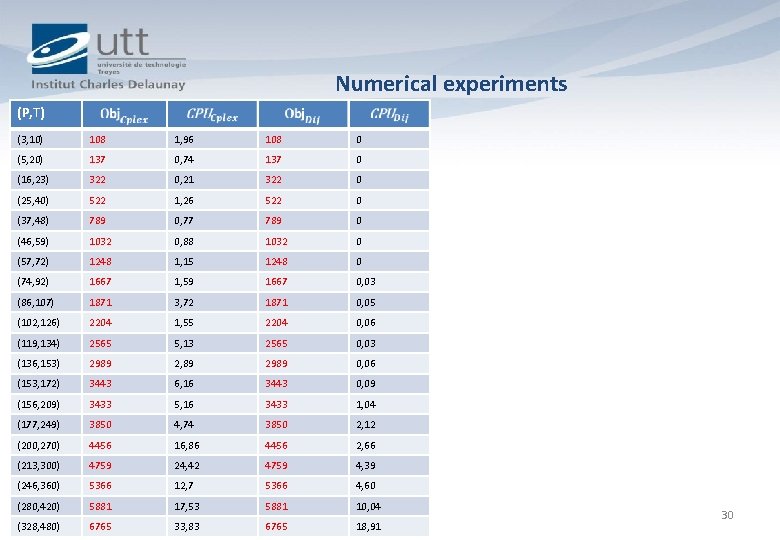
Numerical experiments (P, T) (3, 10) 108 1, 96 108 0 (5, 20) 137 0, 74 137 0 (16, 23) 322 0, 21 322 0 (25, 40) 522 1, 26 522 0 (37, 48) 789 0, 77 789 0 (46, 59) 1032 0, 88 1032 0 (57, 72) 1248 1, 15 1248 0 (74, 92) 1667 1, 59 1667 0, 03 (86, 107) 1871 3, 72 1871 0, 05 (102, 126) 2204 1, 55 2204 0, 06 (119, 134) 2565 5, 13 2565 0, 03 (136, 153) 2989 2, 89 2989 0, 06 (153, 172) 3443 6, 16 3443 0, 09 (156, 209) 3433 5, 16 3433 1, 04 (177, 249) 3850 4, 74 3850 2, 12 (200, 270) 4456 16, 86 4456 2, 66 (213, 300) 4759 24, 42 4759 4, 39 (246, 360) 5366 12, 7 5366 4, 60 (280, 420) 5881 17, 53 5881 10, 04 (328, 480) 6765 33, 83 6765 18, 91 30
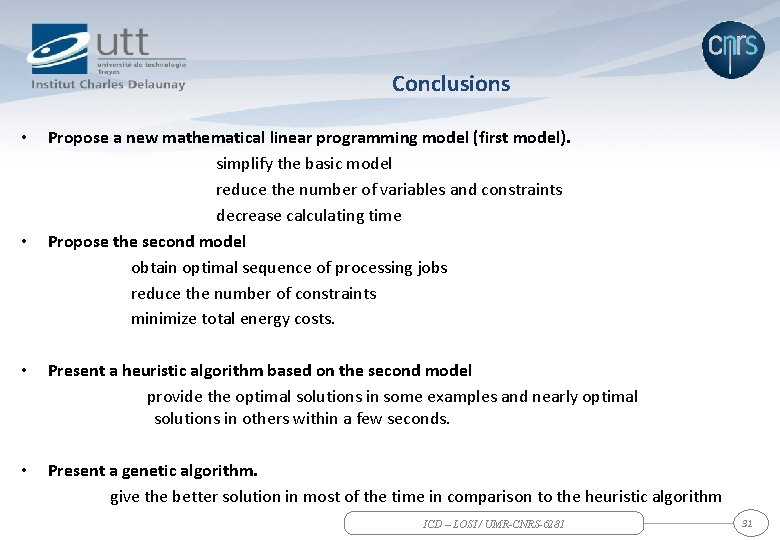
Conclusions • Propose a new mathematical linear programming model (first model). simplify the basic model reduce the number of variables and constraints decrease calculating time • Propose the second model obtain optimal sequence of processing jobs reduce the number of constraints minimize total energy costs. • Present a heuristic algorithm based on the second model provide the optimal solutions in some examples and nearly optimal solutions in others within a few seconds. • Present a genetic algorithm. give the better solution in most of the time in comparison to the heuristic algorithm ICD – LOSI / UMR-CNRS-6281 31
Conclusions • ICD – LOSI / UMR-CNRS-6281 32
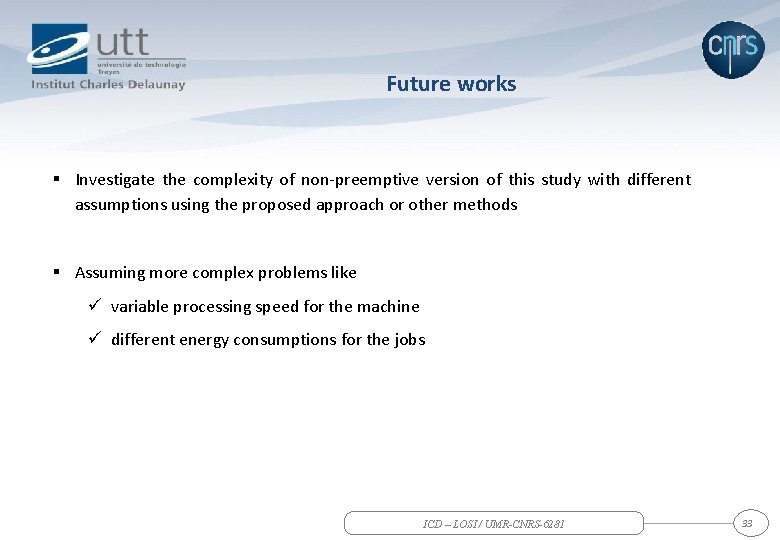
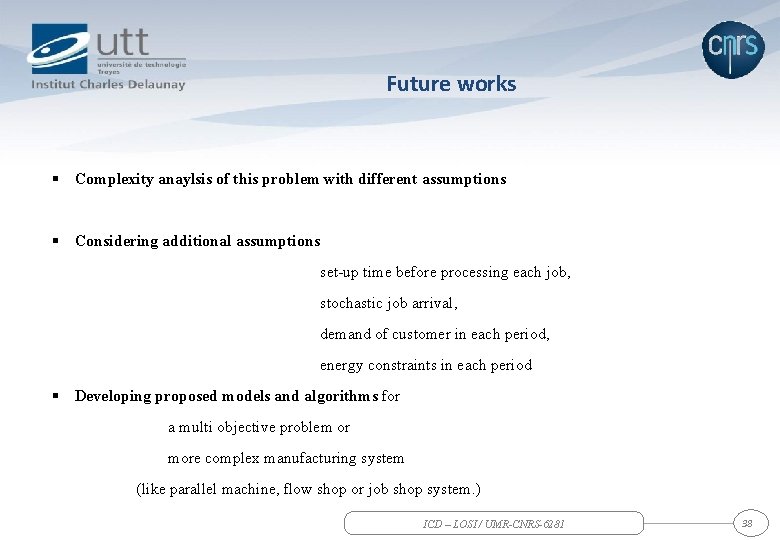
Future works § Investigate the complexity of non-preemptive version of this study with different assumptions using the proposed approach or other methods § Assuming more complex problems like ü variable processing speed for the machine ü different energy consumptions for the jobs ICD – LOSI / UMR-CNRS-6281 33
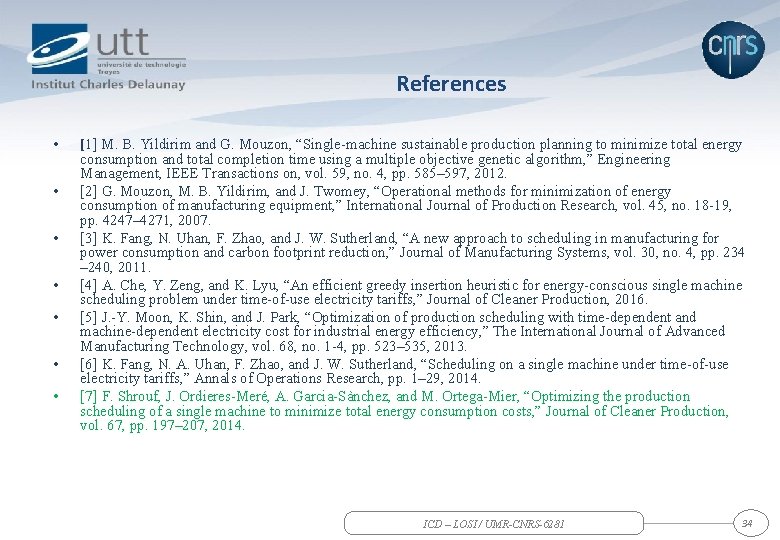
References • • [1] M. B. Yildirim and G. Mouzon, “Single-machine sustainable production planning to minimize total energy consumption and total completion time using a multiple objective genetic algorithm, ” Engineering Management, IEEE Transactions on, vol. 59, no. 4, pp. 585– 597, 2012. [2] G. Mouzon, M. B. Yildirim, and J. Twomey, “Operational methods for minimization of energy consumption of manufacturing equipment, ” International Journal of Production Research, vol. 45, no. 18 -19, pp. 4247– 4271, 2007. [3] K. Fang, N. Uhan, F. Zhao, and J. W. Sutherland, “A new approach to scheduling in manufacturing for power consumption and carbon footprint reduction, ” Journal of Manufacturing Systems, vol. 30, no. 4, pp. 234 – 240, 2011. [4] A. Che, Y. Zeng, and K. Lyu, “An efficient greedy insertion heuristic for energy-conscious single machine scheduling problem under time-of-use electricity tariffs, ” Journal of Cleaner Production, 2016. [5] J. -Y. Moon, K. Shin, and J. Park, “Optimization of production scheduling with time-dependent and machine-dependent electricity cost for industrial energy efficiency, ” The International Journal of Advanced Manufacturing Technology, vol. 68, no. 1 -4, pp. 523– 535, 2013. [6] K. Fang, N. A. Uhan, F. Zhao, and J. W. Sutherland, “Scheduling on a single machine under time-of-use electricity tariffs, ” Annals of Operations Research, pp. 1– 29, 2014. [7] F. Shrouf, J. Ordieres-Meré, A. Garcia-Sànchez, and M. Ortega-Mier, “Optimizing the production scheduling of a single machine to minimize total energy consumption costs, ” Journal of Cleaner Production, vol. 67, pp. 197– 207, 2014. ICD – LOSI / UMR-CNRS-6281 34
ICD – LOSI / UMR-CNRS-6281 35
• Shrouf et al. 2014: Because the shop floor scheduling problem is considered to be an NP-hard-complete problem, the formulated problem in their paper cannot be solved in real life. ICD – LASMIS / date 36
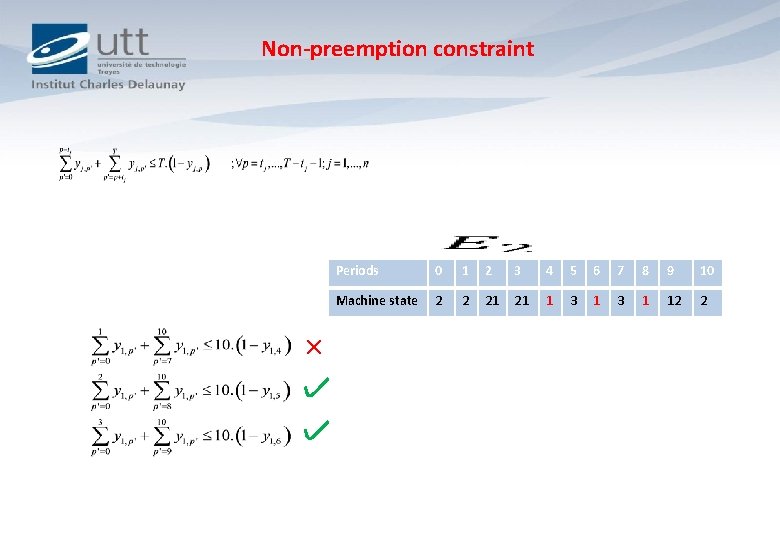
Non-preemption constraint × Periods 0 1 2 3 4 5 6 7 8 9 10 Machine state 2 2 21 21 1 3 1 12 2
Future works § Complexity anaylsis of this problem with different assumptions § Considering additional assumptions set-up time before processing each job, stochastic job arrival, demand of customer in each period, energy constraints in each period § Developing proposed models and algorithms for a multi objective problem or more complex manufacturing system (like parallel machine, flow shop or job shop system. ) ICD – LOSI / UMR-CNRS-6281 38