
Production Readiness Review Presentation Template Version 12 0
![[System Name and Release Number] Production Readiness Review [Date] [Document Identifier – Technology Office](https://slidetodoc.com/presentation_image_h2/5b55a5521ba1cc3a0338629462838de5/image-2.jpg "[System Name and Release Number] Production Readiness Review [Date] [Document Identifier – Technology Office")
![[System] Business Background [Describe the business purpose of the system in general. Describe legislative](https://slidetodoc.com/presentation_image_h2/5b55a5521ba1cc3a0338629462838de5/image-4.jpg "[System] Business Background [Describe the business purpose of the system in general. Describe legislative")
![Scope of Release [Insert Release #] [Describe the scope of the release that is](https://slidetodoc.com/presentation_image_h2/5b55a5521ba1cc3a0338629462838de5/image-5.jpg "Scope of Release [Insert Release #] [Describe the scope of the release that is")
![Scope of Release [Insert Release #] [Describe the business impact of delaying implementation. Include](https://slidetodoc.com/presentation_image_h2/5b55a5521ba1cc3a0338629462838de5/image-6.jpg "Scope of Release [Insert Release #] [Describe the business impact of delaying implementation. Include")
![Review of Open Risks Risk Name Risk Description Probability Impact [High] [Moderate] [Low] Mitigation](https://slidetodoc.com/presentation_image_h2/5b55a5521ba1cc3a0338629462838de5/image-8.jpg "Review of Open Risks Risk Name Risk Description Probability Impact [High] [Moderate] [Low] Mitigation")
![Security and Privacy • Documented system owner is [name] • ISSO is [name], confirmed](https://slidetodoc.com/presentation_image_h2/5b55a5521ba1cc3a0338629462838de5/image-20.jpg "Security and Privacy • Documented system owner is [name] • ISSO is [name], confirmed")
![Security and Privacy • The System Owner and ISSO [have / have not] reviewed](https://slidetodoc.com/presentation_image_h2/5b55a5521ba1cc3a0338629462838de5/image-21.jpg "Security and Privacy • The System Owner and ISSO [have / have not] reviewed")
![End User Support and Communication • Outage window for end users will be [date/time]](https://slidetodoc.com/presentation_image_h2/5b55a5521ba1cc3a0338629462838de5/image-34.jpg "End User Support and Communication • Outage window for end users will be [date/time]")
![Lessons Learned • [Describe how lessons learned were captured for this release. ] •](https://slidetodoc.com/presentation_image_h2/5b55a5521ba1cc3a0338629462838de5/image-35.jpg "Lessons Learned • [Describe how lessons learned were captured for this release. ] •")
![Meeting Closure • Implementation is scheduled for [date]. • Completion of formal sign-off (next](https://slidetodoc.com/presentation_image_h2/5b55a5521ba1cc3a0338629462838de5/image-36.jpg "Meeting Closure • Implementation is scheduled for [date]. • Completion of formal sign-off (next")
- Slides: 38
Production Readiness Review Presentation Template Version 12. 0 FINAL July 31, 2012 Document Identifier: FSA_TOQA_STDS_RLS. PRR_001 Template Instructions: The following slides are provided as a guide to developing PRR presentations. • It is expected that the slides will be adjusted to fit the needs of particular releases; information requested by this template should be included in the presentation in a way that is understandable within the context of the release. • Information in [blue and brackets] is guidance and should be deleted and replaced with release-specific information. PRR Presentations should not include [brackets]. Black text, outside of brackets, should be left as part of the presentation. • Please remove this cover slide when using the template to create a PRR Presentation. • Detailed slide-by-slide guidance is included in the PRR Process Description Document, please refer to that document when preparing for a PRR.
[System Name and Release Number] Production Readiness Review [Date] [Document Identifier – Technology Office PRRs, please contact CM Team for a Document Identifier. All others, please delete the document identifier item. ]
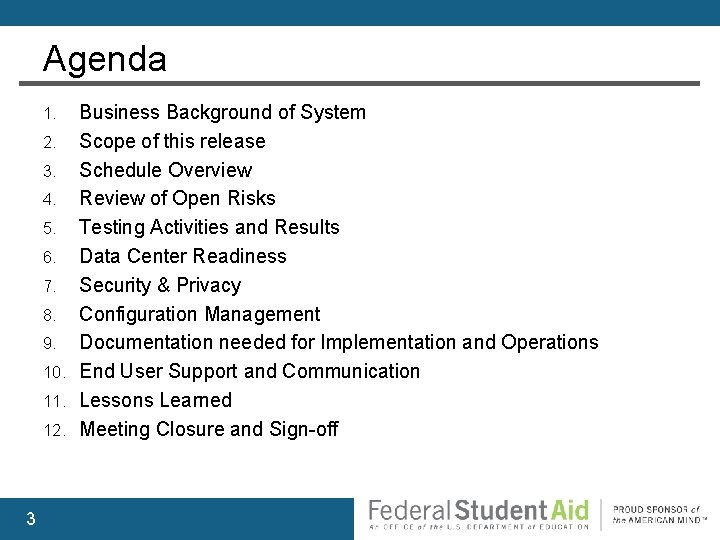
Agenda Business Background of System 2. Scope of this release 3. Schedule Overview 4. Review of Open Risks 5. Testing Activities and Results 6. Data Center Readiness 7. Security & Privacy 8. Configuration Management 9. Documentation needed for Implementation and Operations 10. End User Support and Communication 11. Lessons Learned 12. Meeting Closure and Sign-off 1. 3
[System] Business Background [Describe the business purpose of the system in general. Describe legislative requirements that the system supports. Describe major FSA functions that are performed by the system. Describe technology used by the system at a high level. This includes development tools, software languages, database system used, and major components that are being leveraged. Example: ABC was developed in Drupal and uses My. SQL Enterprise database. ABC utilizes the General Service Administration USASearch engine. Describe number and type of users supported by the system] 4
Scope of Release [Insert Release #] [Describe the scope of the release that is being implemented. Describe the business benefits that will be realized by implementing this release. Describe the technology changes being implemented by this release. Examples: new functionality to meet a legislative requirement, improvements to the user experience, moves the system to a more current version of a product, expands capacity, etc. ] The build number of this release is: [obtain number from system’s configuration manager] 5
Scope of Release [Insert Release #] [Describe the business impact of delaying implementation. Include the maximum implementation delay that could be tolerated and still meet FSA’s business objectives. If there is a legislative or regulatory deadline associated with this implementation, please include that information. ] 6
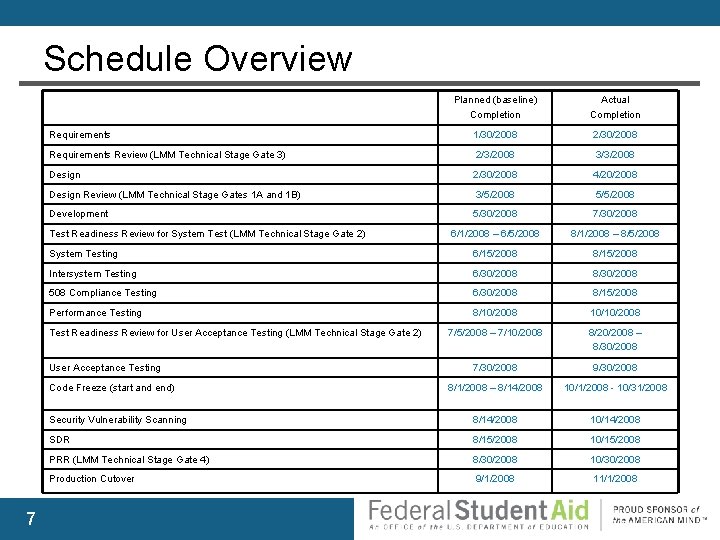
Schedule Overview Planned (baseline) Completion Actual Completion Requirements 1/30/2008 2/30/2008 Requirements Review (LMM Technical Stage Gate 3) 2/3/2008 3/3/2008 Design 2/30/2008 4/20/2008 Design Review (LMM Technical Stage Gates 1 A and 1 B) 3/5/2008 5/5/2008 Development 5/30/2008 7/30/2008 6/1/2008 – 6/5/2008 8/1/2008 – 8/5/2008 System Testing 6/15/2008 8/15/2008 Intersystem Testing 6/30/2008 8/30/2008 508 Compliance Testing 6/30/2008 8/15/2008 Performance Testing 8/10/2008 10/10/2008 7/5/2008 – 7/10/2008 8/20/2008 – 8/30/2008 7/30/2008 9/30/2008 8/1/2008 – 8/14/2008 10/1/2008 - 10/31/2008 Security Vulnerability Scanning 8/14/2008 10/14/2008 SDR 8/15/2008 10/15/2008 PRR (LMM Technical Stage Gate 4) 8/30/2008 10/30/2008 Production Cutover 9/1/2008 11/1/2008 Test Readiness Review for System Test (LMM Technical Stage Gate 2) Test Readiness Review for User Acceptance Testing (LMM Technical Stage Gate 2) User Acceptance Testing Code Freeze (start and end) 7
Review of Open Risks Risk Name Risk Description Probability Impact [High] [Moderate] [Low] Mitigation Strategy Risk Owner [Note: This slide should include only the risks related to deploying this release to production, not the entire project risk register. ] Probability Scale High Moderate Low 8 Definition Risk has a 50% or greater chance of occurring. Risk is more likely to occur than not. Risk has a greater than 10% and less than 50% chance of occurring Risk has a 10% or less chance of occurring Impact Scale High Moderate Low Definition If realized, the risk results in an inability to meet business mission/outcomes of the system. If realized, the risk results in a degraded ability to meet business mission/outcomes of the system. If realized, the risk results in annoyance or inconvenience, but the business mission/outcomes of the system will continue to be met.
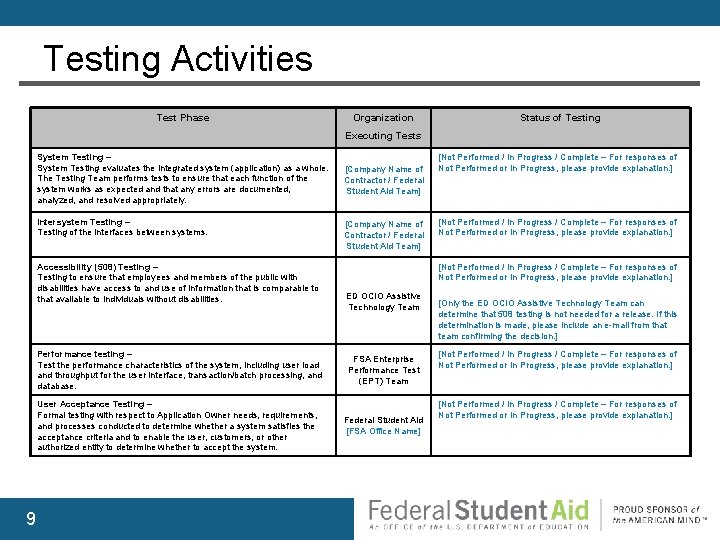
Testing Activities Test Phase Organization Status of Testing Executing Tests System Testing – System Testing evaluates the integrated system (application) as a whole. The Testing Team performs tests to ensure that each function of the system works as expected and that any errors are documented, analyzed, and resolved appropriately. Intersystem Testing – Testing of the interfaces between systems. Accessibility (508) Testing – Testing to ensure that employees and members of the public with disabilities have access to and use of information that is comparable to that available to individuals without disabilities. Performance testing – Test the performance characteristics of the system, including user load and throughput for the user interface, transaction/batch processing, and database. User Acceptance Testing – Formal testing with respect to Application Owner needs, requirements, and processes conducted to determine whether a system satisfies the acceptance criteria and to enable the user, customers, or other authorized entity to determine whether to accept the system. 9 [Company Name of Contractor / Federal Student Aid Team] [Not Performed / In Progress / Complete – For responses of Not Performed or In Progress, please provide explanation. ] ED OCIO Assistive Technology Team FSA Enterprise Performance Test (EPT) Team Federal Student Aid [FSA Office Name] [Only the ED OCIO Assistive Technology Team can determine that 508 testing is not needed for a release. If this determination is made, please include an e-mail from that team confirming the decision. ] [Not Performed / In Progress / Complete – For responses of Not Performed or In Progress, please provide explanation. ]
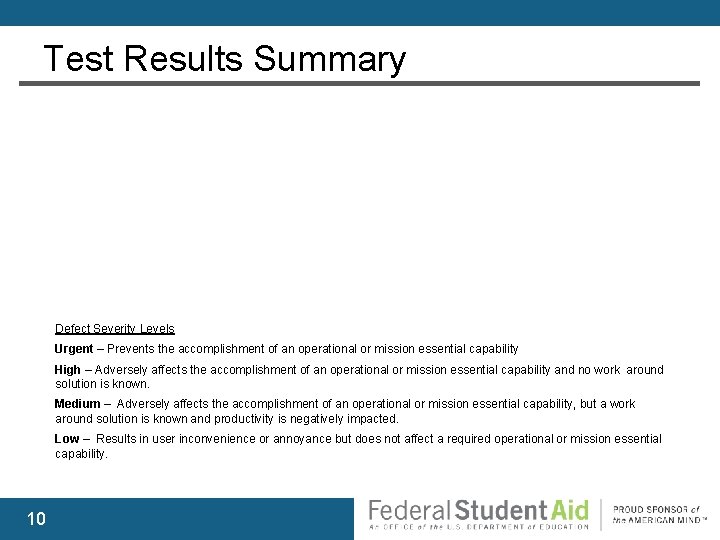
Test Results Summary Defect Severity Levels Urgent – Prevents the accomplishment of an operational or mission essential capability High – Adversely affects the accomplishment of an operational or mission essential capability and no work around solution is known. Medium – Adversely affects the accomplishment of an operational or mission essential capability, but a work around solution is known and productivity is negatively impacted. Low – Results in user inconvenience or annoyance but does not affect a required operational or mission essential capability. 10
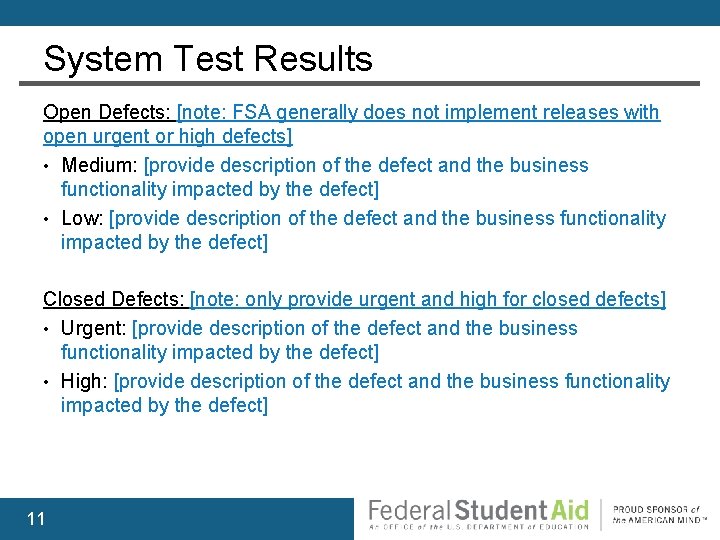
System Test Results Open Defects: [note: FSA generally does not implement releases with open urgent or high defects] • Medium: [provide description of the defect and the business functionality impacted by the defect] • Low: [provide description of the defect and the business functionality impacted by the defect] Closed Defects: [note: only provide urgent and high for closed defects] • Urgent: [provide description of the defect and the business functionality impacted by the defect] • High: [provide description of the defect and the business functionality impacted by the defect] 11
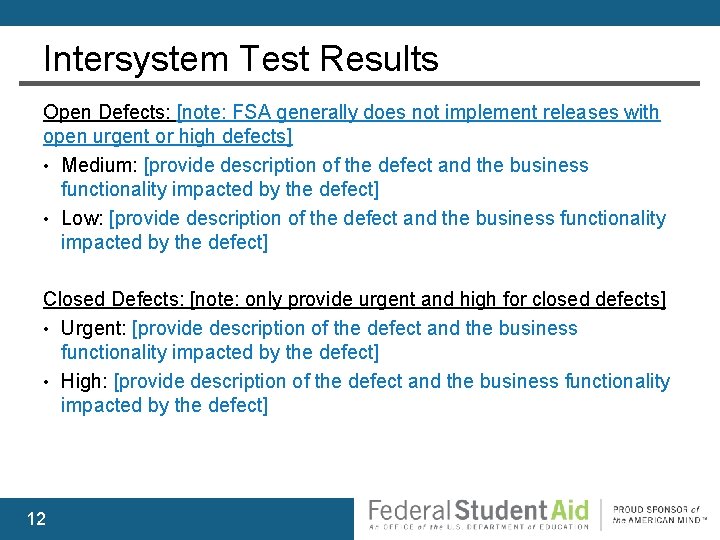
Intersystem Test Results Open Defects: [note: FSA generally does not implement releases with open urgent or high defects] • Medium: [provide description of the defect and the business functionality impacted by the defect] • Low: [provide description of the defect and the business functionality impacted by the defect] Closed Defects: [note: only provide urgent and high for closed defects] • Urgent: [provide description of the defect and the business functionality impacted by the defect] • High: [provide description of the defect and the business functionality impacted by the defect] 12
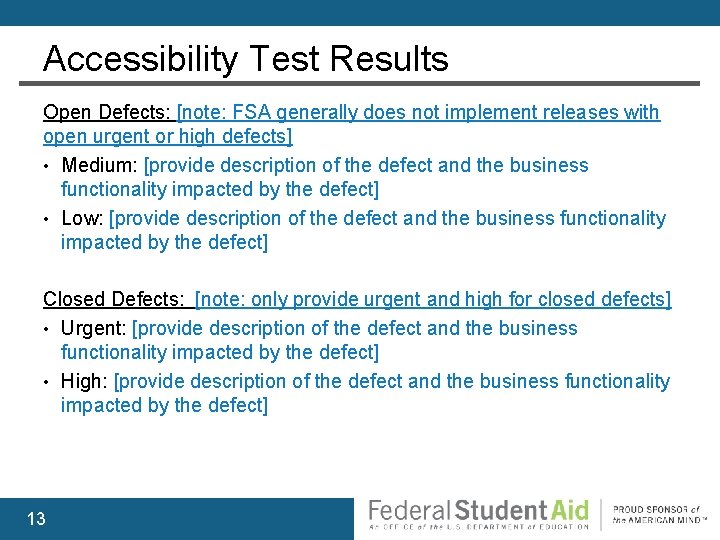
Accessibility Test Results Open Defects: [note: FSA generally does not implement releases with open urgent or high defects] • Medium: [provide description of the defect and the business functionality impacted by the defect] • Low: [provide description of the defect and the business functionality impacted by the defect] Closed Defects: [note: only provide urgent and high for closed defects] • Urgent: [provide description of the defect and the business functionality impacted by the defect] • High: [provide description of the defect and the business functionality impacted by the defect] 13
Performance Test Results [Please contact the Enterprise Performance Test Team (EPT). When performance testing is conducted, EPT will provide slides to insert for performance test results. ] 14
User Acceptance Test Results Open Defects: [note: FSA generally does not implement releases with open urgent or high defects] • Medium: [provide description of the defect and the business functionality impacted by the defect] • Low: [provide description of the defect and the business functionality impacted by the defect] Closed Defects: [note: only provide urgent and high for closed defects] • Urgent: [provide description of the defect and the business functionality impacted by the defect] • High: [provide description of the defect and the business functionality impacted by the defect] 15
Data Center Readiness • • • This release will be implemented in FSA’s Virtual Data Center in Plano, TX. [identify other data center if applicable] Operational roles and responsibilities between different teams (data center, middleware, application support) have been defined and communicated. CMDB review and validation completed on [date – usually done in conjunction with SDR, if release does not have an SDR this validation still needs to be done]. Service Delivery Review (SDR) completed on [date]. [ Describe any outstanding issues from SDR]. Disaster recovery objectives revalidated based on this release: • • 16 Recovery Time Objective (RTO): [Mission Essential = 48 hours or Essential = 72 hours or Non-Essential = 72 hours] Recovery Point Objective (RPO): [Mission Essential = 24 hours or Non-Essential = 48 hours]
Data Center Readiness • Change Request (CCM Ticket) for production implementation has been submitted to the data center. Ticket # [insert ticket number]. • The release will be implemented [during / outside of] the normal maintenance window [state outage period if outside of maintenance window]. • Hour-by-Hour Plan has been completed and all resources understand the actions required to complete implementation. • Roll-back Plan can be completed within the maintenance window [if extension would be required, indicate how long] 17
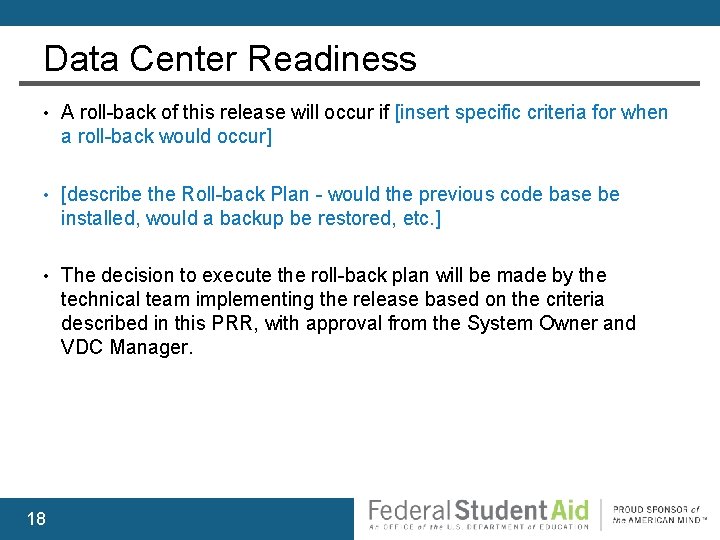
Data Center Readiness • A roll-back of this release will occur if [insert specific criteria for when a roll-back would occur] • [describe the Roll-back Plan - would the previous code base be installed, would a backup be restored, etc. ] • The decision to execute the roll-back plan will be made by the technical team implementing the release based on the criteria described in this PRR, with approval from the System Owner and VDC Manager. 18
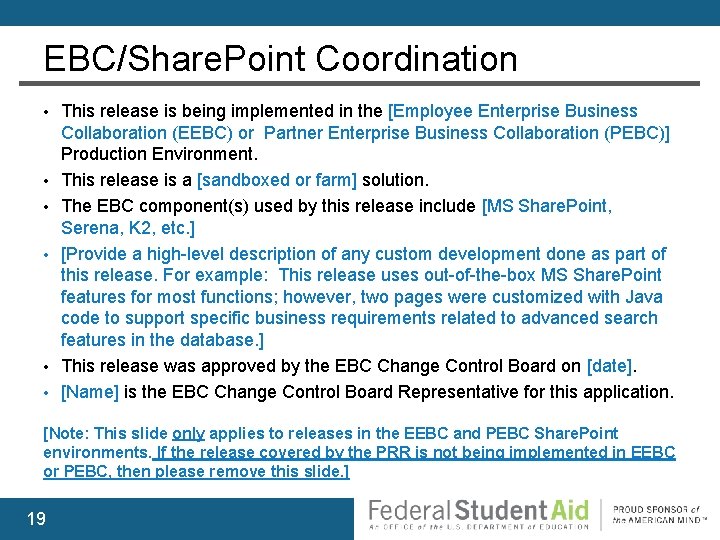
EBC/Share. Point Coordination • • • This release is being implemented in the [Employee Enterprise Business Collaboration (EEBC) or Partner Enterprise Business Collaboration (PEBC)] Production Environment. This release is a [sandboxed or farm] solution. The EBC component(s) used by this release include [MS Share. Point, Serena, K 2, etc. ] [Provide a high-level description of any custom development done as part of this release. For example: This release uses out-of-the-box MS Share. Point features for most functions; however, two pages were customized with Java code to support specific business requirements related to advanced search features in the database. ] This release was approved by the EBC Change Control Board on [date]. [Name] is the EBC Change Control Board Representative for this application. [Note: This slide only applies to releases in the EEBC and PEBC Share. Point environments. If the release covered by the PRR is not being implemented in EEBC or PEBC, then please remove this slide. ] 19
Security and Privacy • Documented system owner is [name] • ISSO is [name], confirmed by assignment memo dated [date] • Alternate ISSO is [name], confirmed by assignment memo dated [date] • System is classified as a [GSS, Major Application, Minor Application] • System [does/does not] contain Personally Identifiable Information (PII). • Confidentiality is categorized as [High, Moderate, Low] • Integrity is categorized as [High, Moderate, Low] • Availability is categorized as [High, Moderate, Low] 20
Security and Privacy • The System Owner and ISSO [have / have not] reviewed the security and privacy documents on the PRR slides titled “Documentation needed for Implementation and Operations” and verify that all appropriate updates have occurred. • The ISSO has reviewed the website(s) for the system and validated that a Human and Machine Readable Privacy Policy [is / is not] in place. [if not in place, please explain] • The ISSO has evaluated the changes being implemented in this release and has determined that there [is / is not] an impact to the security posture/controls of the system [state the impact if there is one]. • The ISSO has validated that a current Authority to Operate (ATO) is in place for the system. • The Monthly Authenticated Vulnerability Scans are scheduled for the system on [date; i. e. 5 th calendar day of month, second Saturday of month, etc. ]. 21
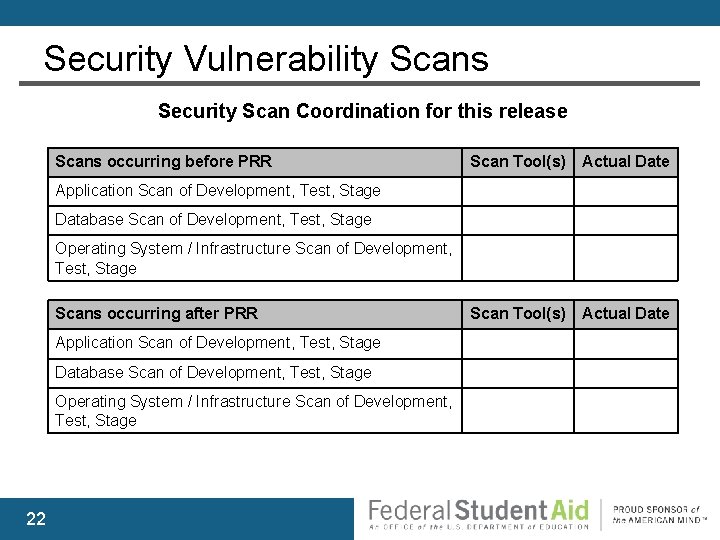
Security Vulnerability Scans Security Scan Coordination for this release Scans occurring before PRR Scan Tool(s) Actual Date Application Scan of Development, Test, Stage Database Scan of Development, Test, Stage Operating System / Infrastructure Scan of Development, Test, Stage Scans occurring after PRR Application Scan of Development, Test, Stage Database Scan of Development, Test, Stage Operating System / Infrastructure Scan of Development, Test, Stage 22
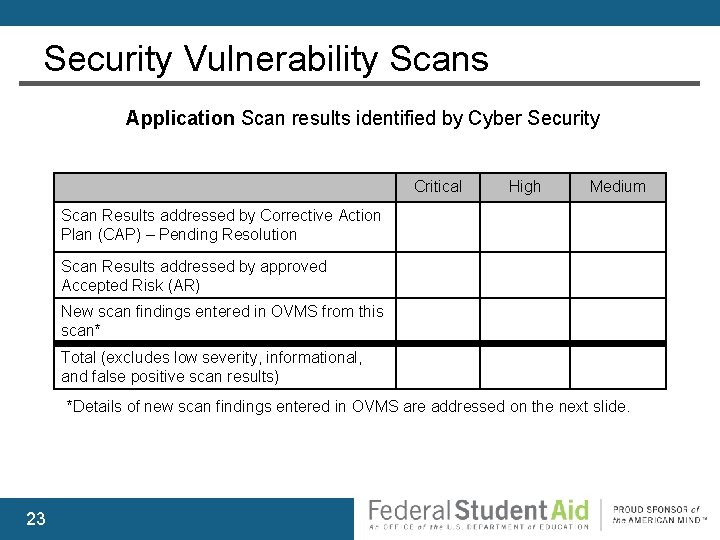
Security Vulnerability Scans Application Scan results identified by Cyber Security Critical High Medium Scan Results addressed by Corrective Action Plan (CAP) – Pending Resolution Scan Results addressed by approved Accepted Risk (AR) New scan findings entered in OVMS from this scan* Total (excludes low severity, informational, and false positive scan results) *Details of new scan findings entered in OVMS are addressed on the next slide. 23
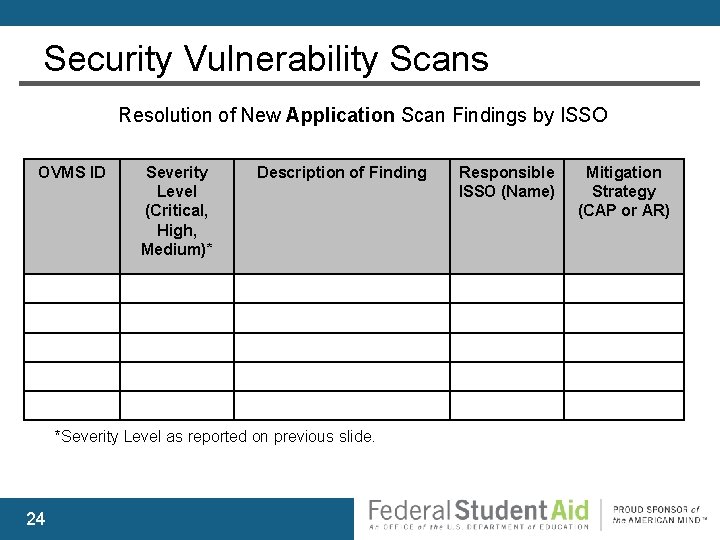
Security Vulnerability Scans Resolution of New Application Scan Findings by ISSO OVMS ID Severity Level (Critical, High, Medium)* Description of Finding *Severity Level as reported on previous slide. 24 Responsible ISSO (Name) Mitigation Strategy (CAP or AR)
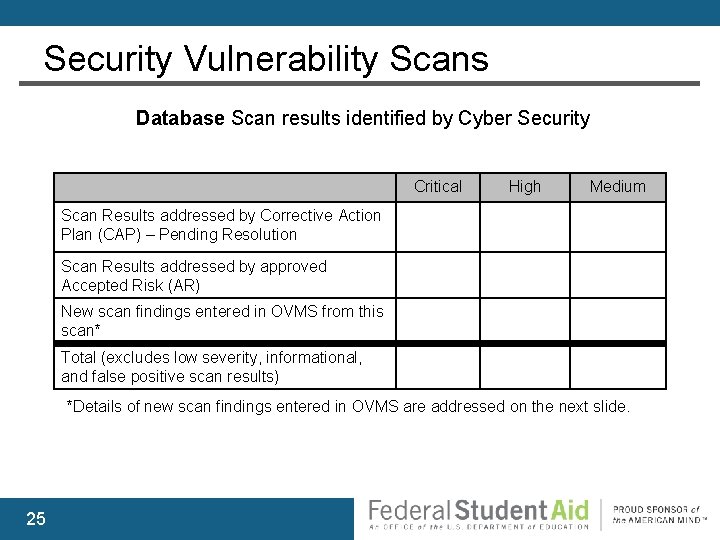
Security Vulnerability Scans Database Scan results identified by Cyber Security Critical High Medium Scan Results addressed by Corrective Action Plan (CAP) – Pending Resolution Scan Results addressed by approved Accepted Risk (AR) New scan findings entered in OVMS from this scan* Total (excludes low severity, informational, and false positive scan results) *Details of new scan findings entered in OVMS are addressed on the next slide. 25
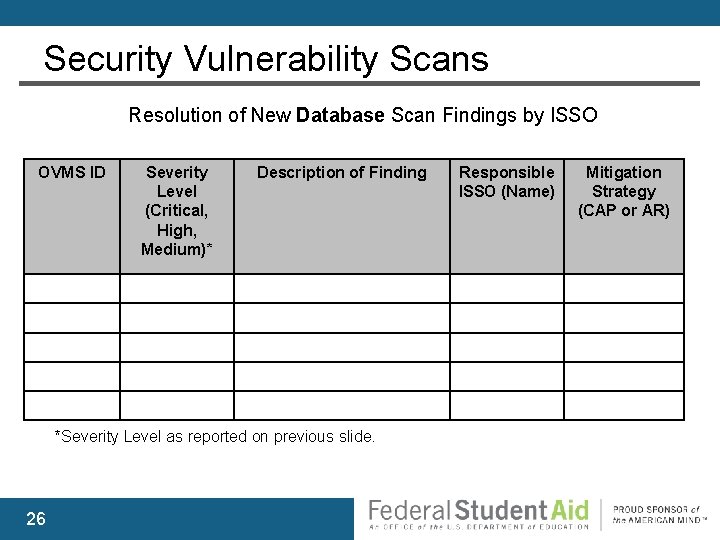
Security Vulnerability Scans Resolution of New Database Scan Findings by ISSO OVMS ID Severity Level (Critical, High, Medium)* Description of Finding *Severity Level as reported on previous slide. 26 Responsible ISSO (Name) Mitigation Strategy (CAP or AR)
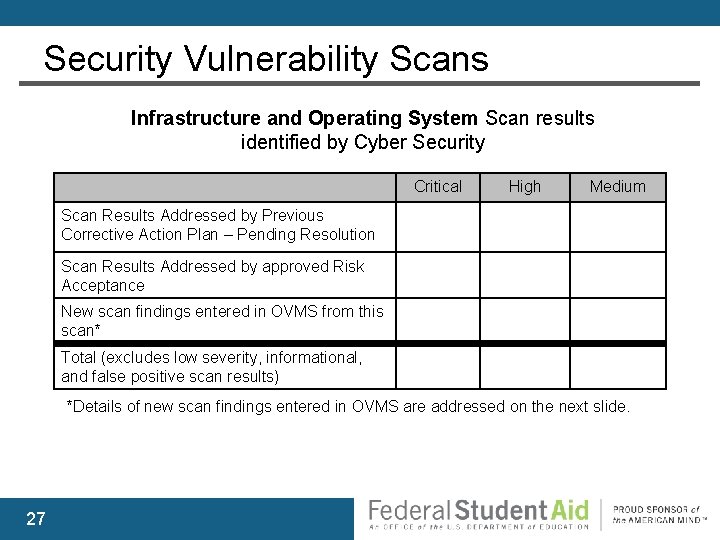
Security Vulnerability Scans Infrastructure and Operating System Scan results identified by Cyber Security Critical High Medium Scan Results Addressed by Previous Corrective Action Plan – Pending Resolution Scan Results Addressed by approved Risk Acceptance New scan findings entered in OVMS from this scan* Total (excludes low severity, informational, and false positive scan results) *Details of new scan findings entered in OVMS are addressed on the next slide. 27
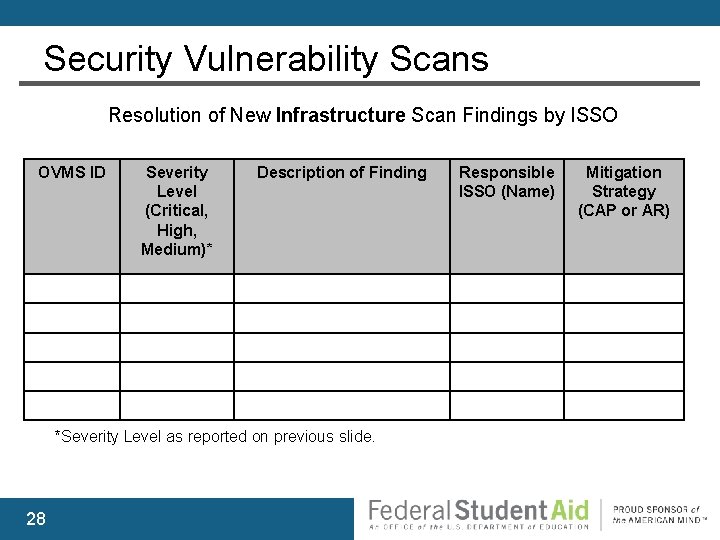
Security Vulnerability Scans Resolution of New Infrastructure Scan Findings by ISSO OVMS ID Severity Level (Critical, High, Medium)* Description of Finding *Severity Level as reported on previous slide. 28 Responsible ISSO (Name) Mitigation Strategy (CAP or AR)
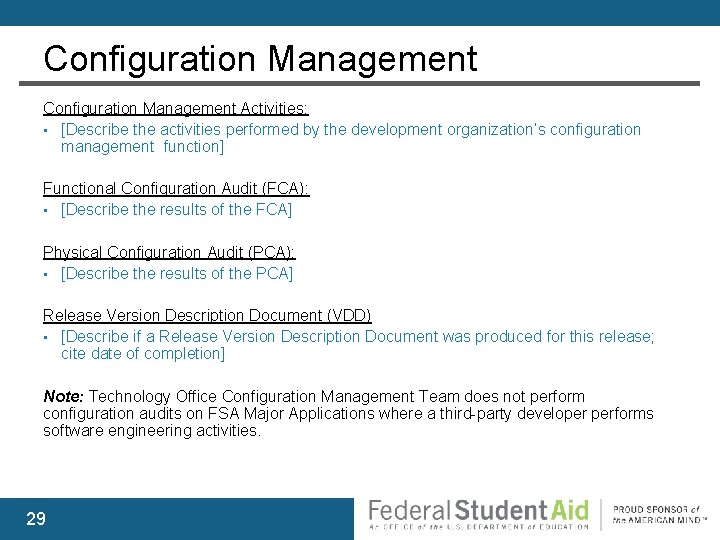
Configuration Management Activities: • [Describe the activities performed by the development organization’s configuration management function] Functional Configuration Audit (FCA): • [Describe the results of the FCA] Physical Configuration Audit (PCA): • [Describe the results of the PCA] Release Version Description Document (VDD) • [Describe if a Release Version Description Document was produced for this release; cite date of completion] Note: Technology Office Configuration Management Team does not perform configuration audits on FSA Major Applications where a third-party developer performs software engineering activities. 29
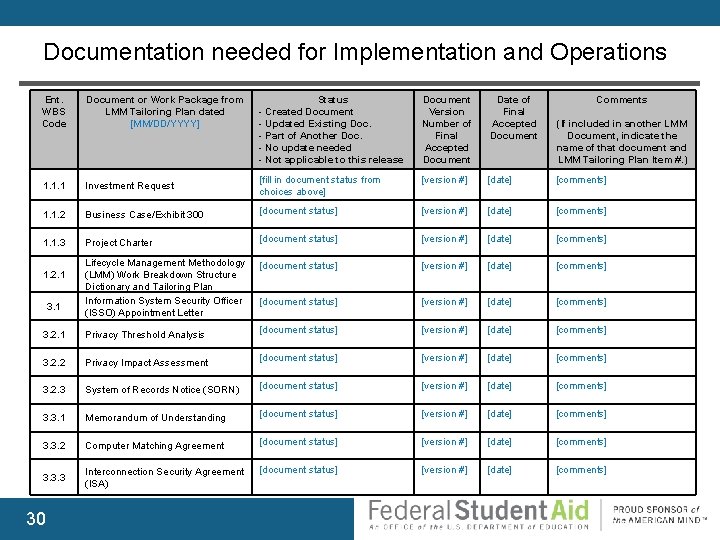
Documentation needed for Implementation and Operations Ent. WBS Code Document or Work Package from LMM Tailoring Plan dated [MM/DD/YYYY] Status - Created Document - Updated Existing Doc. - Part of Another Doc. - No update needed - Not applicable to this release Document Version Number of Final Accepted Document Date of Final Accepted Document 1. 1. 1 Investment Request [fill in document status from choices above] [version #] [date] [comments] 1. 1. 2 Business Case/Exhibit 300 [document status] [version #] [date] [comments] 1. 1. 3 Project Charter [document status] [version #] [date] [comments] Lifecycle Management Methodology (LMM) Work Breakdown Structure Dictionary and Tailoring Plan Information System Security Officer (ISSO) Appointment Letter [document status] [version #] [date] [comments] 3. 2. 1 Privacy Threshold Analysis [document status] [version #] [date] [comments] 3. 2. 2 Privacy Impact Assessment [document status] [version #] [date] [comments] 3. 2. 3 System of Records Notice (SORN) [document status] [version #] [date] [comments] 3. 3. 1 Memorandum of Understanding [document status] [version #] [date] [comments] 3. 3. 2 Computer Matching Agreement [document status] [version #] [date] [comments] 3. 3. 3 Interconnection Security Agreement (ISA) [document status] [version #] [date] [comments] 1. 2. 1 30 Comments (If included in another LMM Document, indicate the name of that document and LMM Tailoring Plan Item #. )
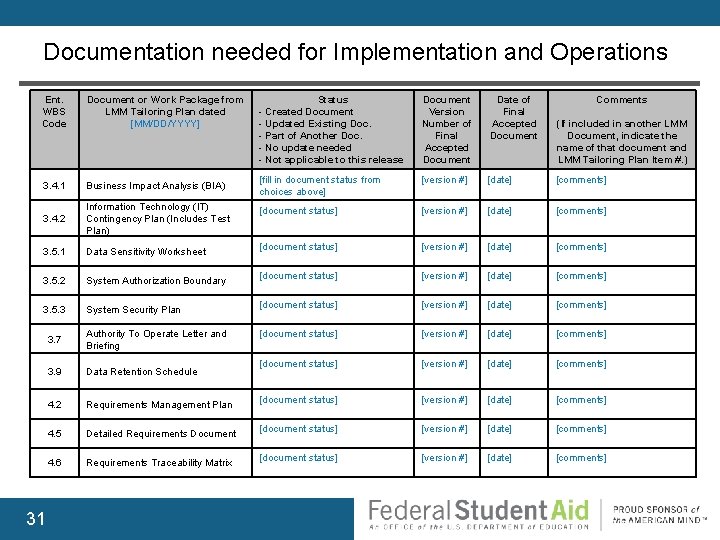
Documentation needed for Implementation and Operations Ent. WBS Code Document or Work Package from LMM Tailoring Plan dated [MM/DD/YYYY] 3. 4. 1 Business Impact Analysis (BIA) 3. 4. 2 Information Technology (IT) Contingency Plan (Includes Test Plan) 3. 5. 1 Data Sensitivity Worksheet 3. 5. 2 System Authorization Boundary 3. 5. 3 System Security Plan 31 3. 7 Authority To Operate Letter and Briefing 3. 9 Data Retention Schedule 4. 2 Requirements Management Plan 4. 5 Detailed Requirements Document 4. 6 Requirements Traceability Matrix Status - Created Document - Updated Existing Doc. - Part of Another Doc. - No update needed - Not applicable to this release Document Version Number of Final Accepted Document Date of Final Accepted Document Comments [fill in document status from choices above] [version #] [date] [comments] [document status] [version #] [date] [comments] [document status] [version #] [date] [comments] [document status] [version #] [date] [comments] (If included in another LMM Document, indicate the name of that document and LMM Tailoring Plan Item #. )
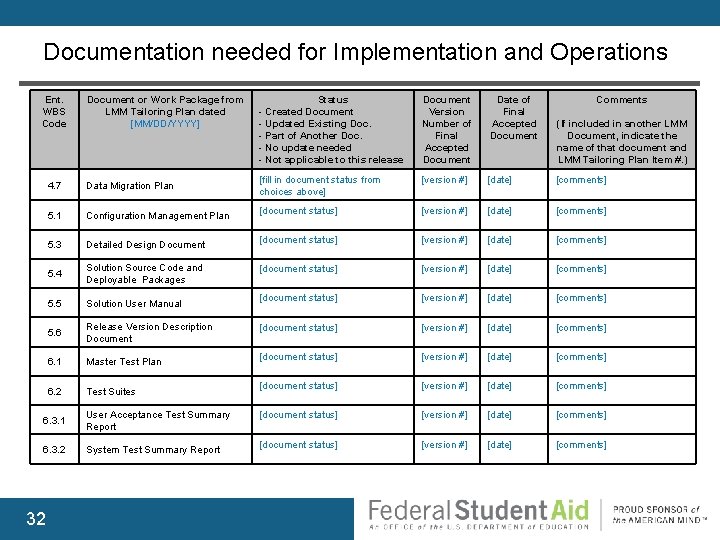
Documentation needed for Implementation and Operations Ent. WBS Code Document or Work Package from LMM Tailoring Plan dated [MM/DD/YYYY] 4. 7 Data Migration Plan 5. 1 Configuration Management Plan 5. 3 Detailed Design Document 5. 4 Solution Source Code and Deployable Packages 5. 5 Solution User Manual 5. 6 Release Version Description Document 6. 1 Master Test Plan 6. 2 Test Suites 6. 3. 1 User Acceptance Test Summary Report 6. 3. 2 System Test Summary Report 32 Status - Created Document - Updated Existing Doc. - Part of Another Doc. - No update needed - Not applicable to this release Document Version Number of Final Accepted Document Date of Final Accepted Document Comments [fill in document status from choices above] [version #] [date] [comments] [document status] [version #] [date] [comments] [document status] [version #] [date] [comments] [document status] [version #] [date] [comments] (If included in another LMM Document, indicate the name of that document and LMM Tailoring Plan Item #. )
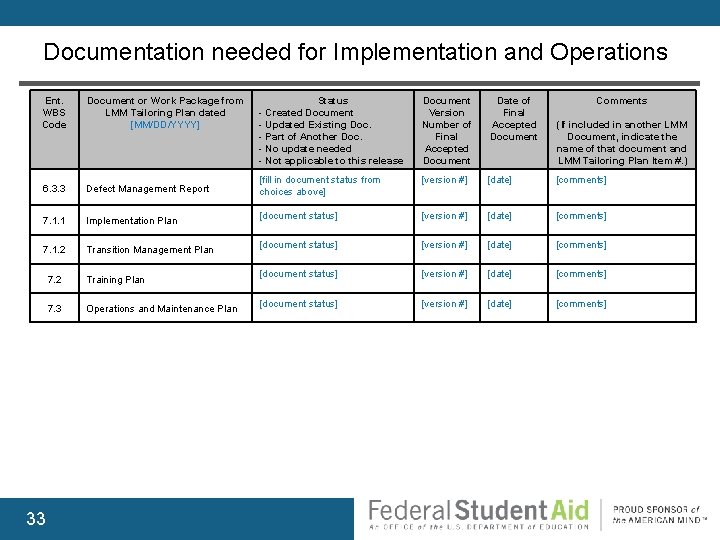
Documentation needed for Implementation and Operations Ent. WBS Code Document or Work Package from LMM Tailoring Plan dated [MM/DD/YYYY] 6. 3. 3 Defect Management Report 7. 1. 1 Implementation Plan 7. 1. 2 Transition Management Plan 33 7. 2 Training Plan 7. 3 Operations and Maintenance Plan Status - Created Document - Updated Existing Doc. - Part of Another Doc. - No update needed - Not applicable to this release Document Version Number of Final Accepted Document Date of Final Accepted Document Comments [fill in document status from choices above] [version #] [date] [comments] [document status] [version #] [date] [comments] (If included in another LMM Document, indicate the name of that document and LMM Tailoring Plan Item #. )
End User Support and Communication • Outage window for end users will be [date/time] to [date/time]. • [describe how end users will be notified of the release] • Application help desk is aware of the release and has updated their procedures. The help desk phone number is [phone number] • Call center scripts and procedures have been updated to support calls from end users. The Customer Call Center phone number is [phone number]. • [describe any additional end user support / communication activities] 34
Lessons Learned • [Describe how lessons learned were captured for this release. ] • A lessons learned meeting [is/is not] planned for [date/if not planned, explain approach for eliciting lessons]. • Lessons Learned for this release will be entered in FSA’s Lessons Learned Database on or before [date]. [Note: This slide should inform readers of the process for identifying and capturing lessons learned. It should not include the specific lessons. ] 35
Meeting Closure • Implementation is scheduled for [date]. • Completion of formal sign-off (next page) • Delivery of sign-off pages and supporting documentation to Technology Office, Enterprise Quality Assurance Team. 36
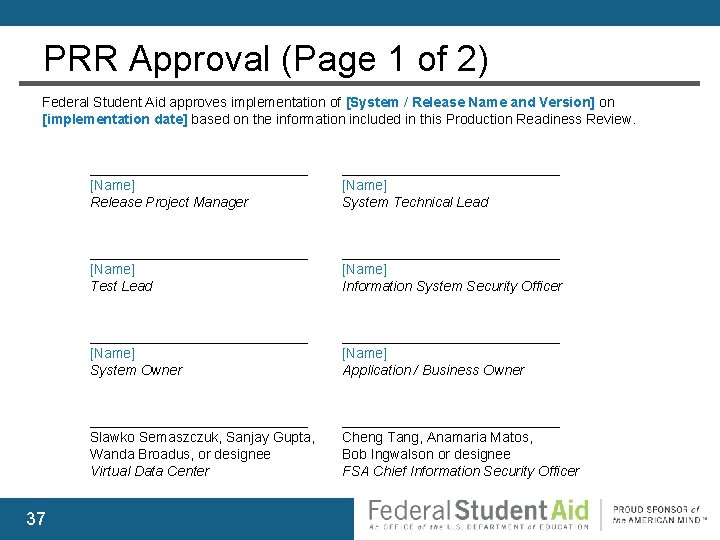
PRR Approval (Page 1 of 2) Federal Student Aid approves implementation of [System / Release Name and Version] on [implementation date] based on the information included in this Production Readiness Review. 37 ______________ [Name] Release Project Manager ______________ [Name] System Technical Lead ______________ [Name] Test Lead ______________ [Name] Information System Security Officer ______________ [Name] System Owner ______________ [Name] Application / Business Owner ______________ Slawko Semaszczuk, Sanjay Gupta, Wanda Broadus, or designee Virtual Data Center ______________ Cheng Tang, Anamaria Matos, Bob Ingwalson or designee FSA Chief Information Security Officer
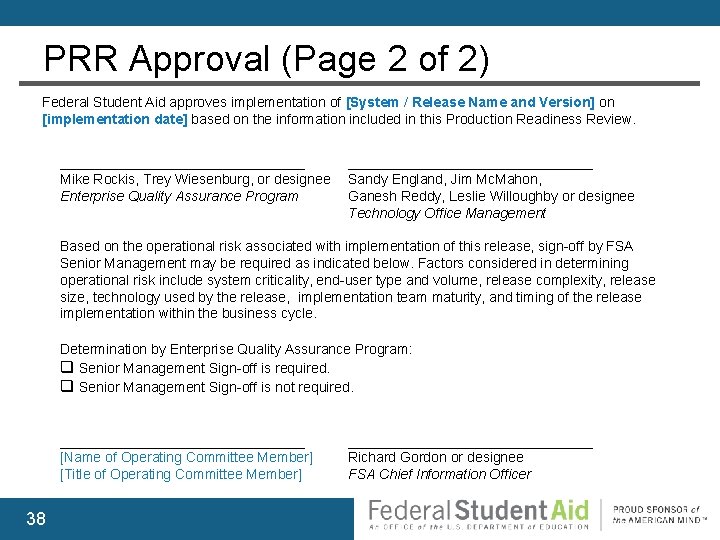
PRR Approval (Page 2 of 2) Federal Student Aid approves implementation of [System / Release Name and Version] on [implementation date] based on the information included in this Production Readiness Review. __________________ Mike Rockis, Trey Wiesenburg, or designee Enterprise Quality Assurance Program __________________ Sandy England, Jim Mc. Mahon, Ganesh Reddy, Leslie Willoughby or designee Technology Office Management Based on the operational risk associated with implementation of this release, sign-off by FSA Senior Management may be required as indicated below. Factors considered in determining operational risk include system criticality, end-user type and volume, release complexity, release size, technology used by the release, implementation team maturity, and timing of the release implementation within the business cycle. Determination by Enterprise Quality Assurance Program: q Senior Management Sign-off is required. q Senior Management Sign-off is not required. __________________ [Name of Operating Committee Member] [Title of Operating Committee Member] 38 __________________ Richard Gordon or designee FSA Chief Information Officer