
Production of knowledge Mode 1 and Mode 2



- Slides: 10
Production of knowledge • Mode 1 and Mode 2 (Gibbons et al. , 1994; Fisher, 2013) • Mode 1 (hierarchical) • Propositional knowledge planned to improve various academic disciplines, developed in universities/institutes. • Mode 2 (open and inclusive – horizontal) • developed through partnership between a range of stakeholders in a variety of settings. • Hybrid Forum - The expert group with various stakeholders (Décieux, 2020) • The relevance criterion
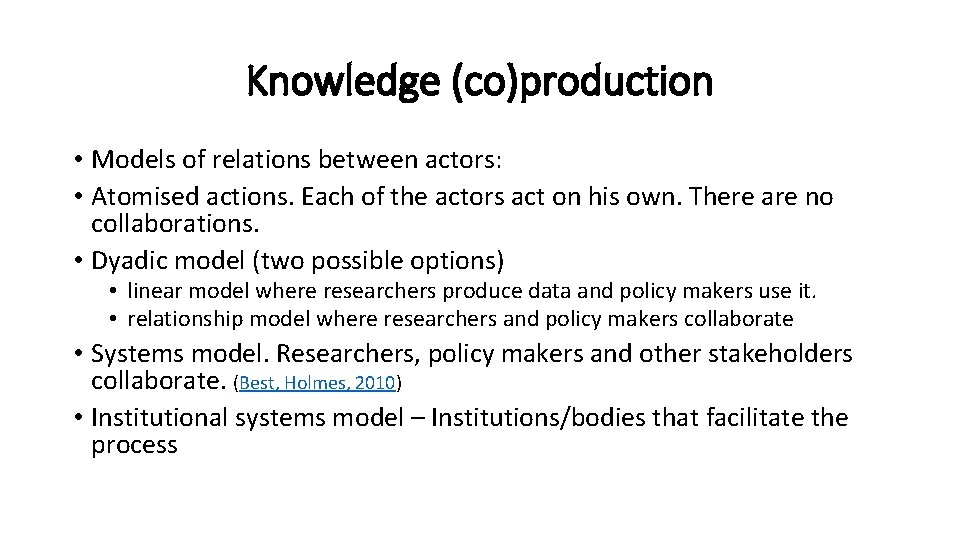
Knowledge (co)production • Models of relations between actors: • Atomised actions. Each of the actors act on his own. There are no collaborations. • Dyadic model (two possible options) • linear model where researchers produce data and policy makers use it. • relationship model where researchers and policy makers collaborate • Systems model. Researchers, policy makers and other stakeholders collaborate. (Best, Holmes, 2010) • Institutional systems model – Institutions/bodies that facilitate the process
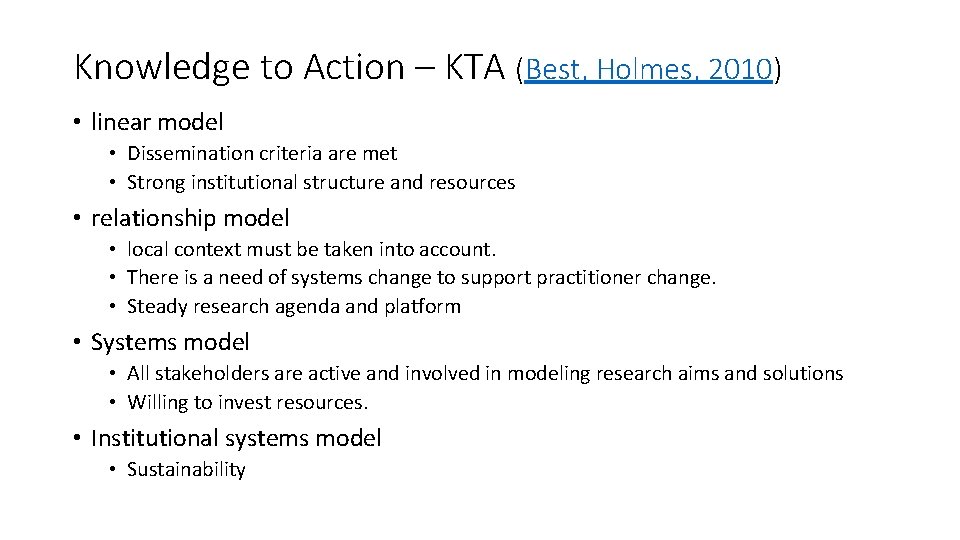
Knowledge to Action – KTA (Best, Holmes, 2010) • linear model • Dissemination criteria are met • Strong institutional structure and resources • relationship model • local context must be taken into account. • There is a need of systems change to support practitioner change. • Steady research agenda and platform • Systems model • All stakeholders are active and involved in modeling research aims and solutions • Willing to invest resources. • Institutional systems model • Sustainability
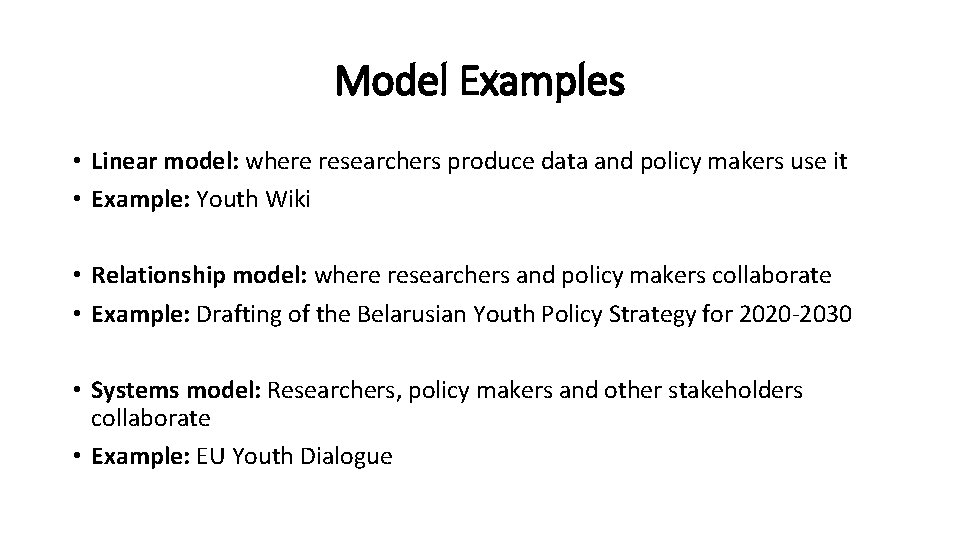
Model Examples • Linear model: where researchers produce data and policy makers use it • Example: Youth Wiki • Relationship model: where researchers and policy makers collaborate • Example: Drafting of the Belarusian Youth Policy Strategy for 2020 -2030 • Systems model: Researchers, policy makers and other stakeholders collaborate • Example: EU Youth Dialogue
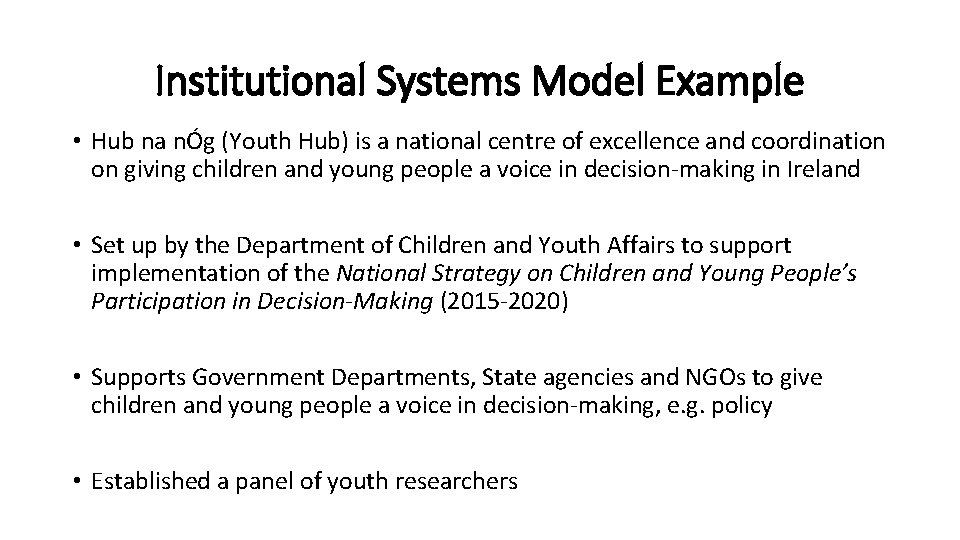
Institutional Systems Model Example • Hub na nÓg (Youth Hub) is a national centre of excellence and coordination on giving children and young people a voice in decision-making in Ireland • Set up by the Department of Children and Youth Affairs to support implementation of the National Strategy on Children and Young People’s Participation in Decision-Making (2015 -2020) • Supports Government Departments, State agencies and NGOs to give children and young people a voice in decision-making, e. g. policy • Established a panel of youth researchers
Policy Issue: Ireland 2016 Consultations • Getting the view of children and young people on how they would like to remember children who died in the 1916 Rising Strategic Partners: • Department of the Arts, Culture and Heritage • Department of Children and Youth Affairs • Ireland 2016 • Office of Public Works • Áras an Úachtarain (Residence of the President of Ireland) • Researchers from University College Cork Methodological Approach: • Regional consultations with children (8 -12 years) and young people (13 - 17 years)
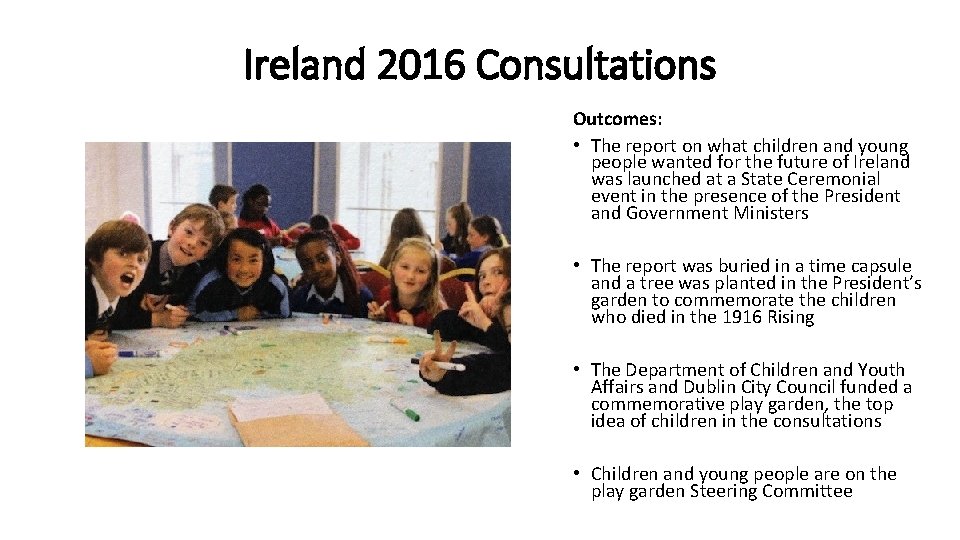
Ireland 2016 Consultations Outcomes: • The report on what children and young people wanted for the future of Ireland was launched at a State Ceremonial event in the presence of the President and Government Ministers • The report was buried in a time capsule and a tree was planted in the President’s garden to commemorate the children who died in the 1916 Rising • The Department of Children and Youth Affairs and Dublin City Council funded a commemorative play garden, the top idea of children in the consultations • Children and young people are on the play garden Steering Committee
The involvement of children in appointing the Ombudsman for Children Policy issue: • Ensure the appropriate involvement of children and young people in the appointment of the Ombudsman for Children Strategic Partners: • Department of Children and Youth Affairs • Public Appointments Service • Office of the Ombudsman for Children (OCO) • Independent Researcher Methodological Approach: • Consultations with 40 children and 40 young people on the ideal qualities for the post • Selection of a panel of 11 children and young people for the interview process
The involvement of children in appointing the Ombudsman for Children Outcomes: • Children and young people were meaningfully involved in the interview process for the appointment of the Ombudsman for Children • The wall of ideas graphic from the consultation workshops hangs on the wall of the Ombudsman for Children Office
Thank you!