
PRODUCTION OF FILAMENT WOUND COMPOSITE TUBES FOR CONSTRUCTION
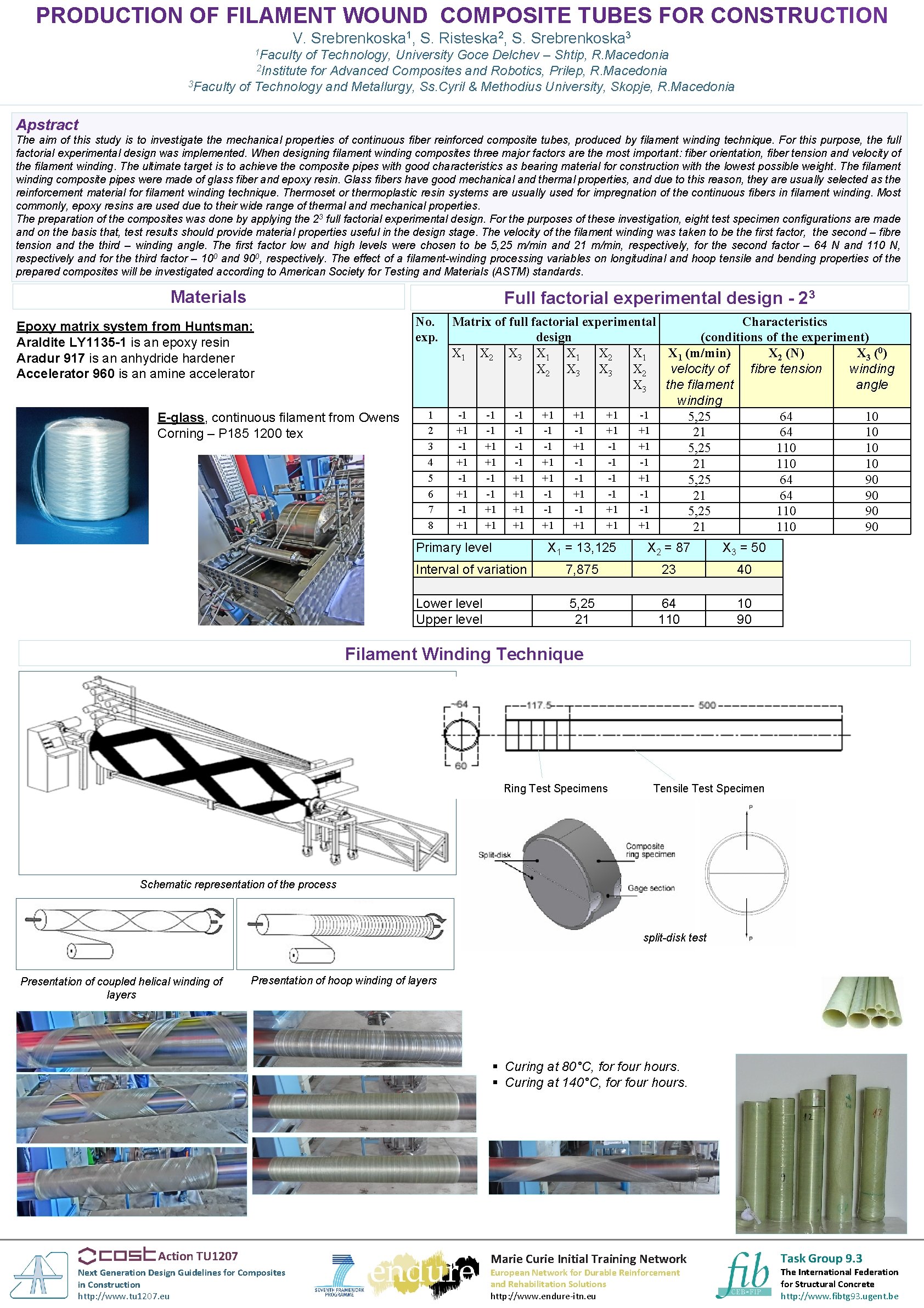
PRODUCTION OF FILAMENT WOUND COMPOSITE TUBES FOR CONSTRUCTION V. Srebrenkoska 1, S. Risteska 2, S. Srebrenkoska 3 1 Faculty of Technology, University Goce Delchev – Shtip, R. Macedonia 2 Institute for Advanced Composites and Robotics, Prilep, R. Macedonia 3 Faculty of Technology and Metallurgy, Ss. Cyril & Methodius University, Skopje, R. Macedonia Apstract The aim of this study is to investigate the mechanical properties of continuous fiber reinforced composite tubes, produced by filament winding technique. For this purpose, the full factorial experimental design was implemented. When designing filament winding composites three major factors are the most important: fiber orientation, fiber tension and velocity of the filament winding. The ultimate target is to achieve the composite pipes with good characteristics as bearing material for construction with the lowest possible weight. The filament winding composite pipes were made of glass fiber and epoxy resin. Glass fibers have good mechanical and thermal properties, and due to this reason, they are usually selected as the reinforcement material for filament winding technique. Thermoset or thermoplastic resin systems are usually used for impregnation of the continuous fibers in filament winding. Most commonly, epoxy resins are used due to their wide range of thermal and mechanical properties. The preparation of the composites was done by applying the 23 full factorial experimental design. For the purposes of these investigation, eight test specimen configurations are made and on the basis that, test results should provide material properties useful in the design stage. The velocity of the filament winding was taken to be the first factor, the second – fibre tension and the third – winding angle. The first factor low and high levels were chosen to be 5, 25 m/min and 21 m/min, respectively, for the second factor – 64 N and 110 N, respectively and for the third factor – 100 and 900, respectively. The effect of a filament-winding processing variables on longitudinal and hoop tensile and bending properties of the prepared composites will be investigated according to American Society for Testing and Materials (ASTM) standards. Materials Full factorial experimental design - 23 No. exp. Epoxy matrix system from Huntsman: Araldite LY 1135 -1 is an epoxy resin Aradur 917 is an anhydride hardener Accelerator 960 is an amine accelerator E-glass, continuous filament from Owens Corning – P 185 1200 tex 1 2 3 4 5 6 7 8 Matrix of full factorial experimental Characteristics design (conditions of the experiment) X 1 X 2 X 3 X 1 X 2 X 1 (m/min) X 2 (N) X 3 (0) X 2 X 3 X 2 velocity of fibre tension winding X 3 the filament angle winding -1 -1 -1 +1 +1 +1 -1 5, 25 64 10 +1 -1 -1 +1 +1 21 64 10 -1 +1 5, 25 110 10 +1 +1 -1 -1 -1 21 110 10 -1 -1 +1 +1 -1 -1 +1 5, 25 64 90 +1 -1 -1 21 64 90 -1 +1 +1 -1 -1 +1 -1 5, 25 110 90 +1 +1 21 110 90 Primary level X 1 = 13, 125 X 2 = 87 X 3 = 50 Interval of variation 7, 875 23 40 Lower level Upper level 5, 25 21 64 110 10 90 Filament Winding Technique Ring Test Specimens Tensile Test Specimen Schematic representation of the process split-disk test Presentation of coupled helical winding of layers Presentation of hoop winding of layers § Curing at 80°C, for four hours. § Curing at 140°C, for four hours. Action TU 1207 Next Generation Design Guidelines for Composites in Construction http: //www. tu 1207. eu Marie Curie Initial Training Network European Network for Durable Reinforcement and Rehabilitation Solutions http: //www. endure-itn. eu Task Group 9. 3 The International Federation for Structural Concrete http: //www. fibtg 93. ugent. be
- Slides: 1