
Production of Compactainer Capabilities Required for the production
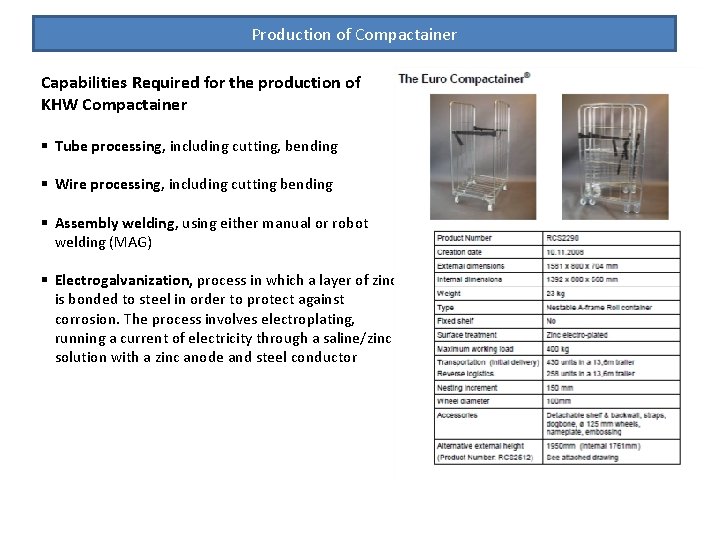
Production of Compactainer Capabilities Required for the production of KHW Compactainer § Tube processing, including cutting, bending § Wire processing, including cutting bending § Assembly welding, using either manual or robot welding (MAG) § Electrogalvanization, process in which a layer of zinc is bonded to steel in order to protect against corrosion. The process involves electroplating, running a current of electricity through a saline/zinc solution with a zinc anode and steel conductor
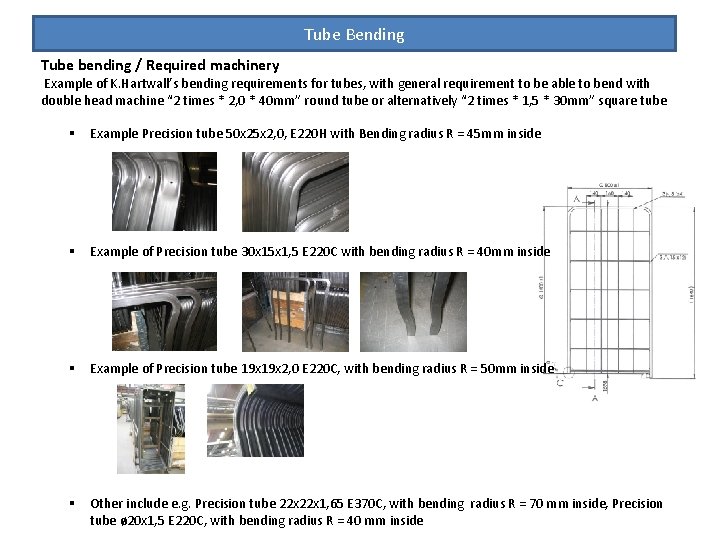
Tube Bending Tube bending / Required machinery Example of K. Hartwall’s bending requirements for tubes, with general requirement to be able to bend with double head machine “ 2 times * 2, 0 * 40 mm” round tube or alternatively “ 2 times * 1, 5 * 30 mm” square tube § Example Precision tube 50 x 25 x 2, 0, E 220 H with Bending radius R = 45 mm inside § Example of Precision tube 30 x 15 x 1, 5 E 220 C with bending radius R = 40 mm inside § Example of Precision tube 19 x 2, 0 E 220 C, with bending radius R = 50 mm inside § Other include e. g. Precision tube 22 x 1, 65 E 370 C, with bending radius R = 70 mm inside, Precision tube ø 20 x 1, 5 E 220 C, with bending radius R = 40 mm inside
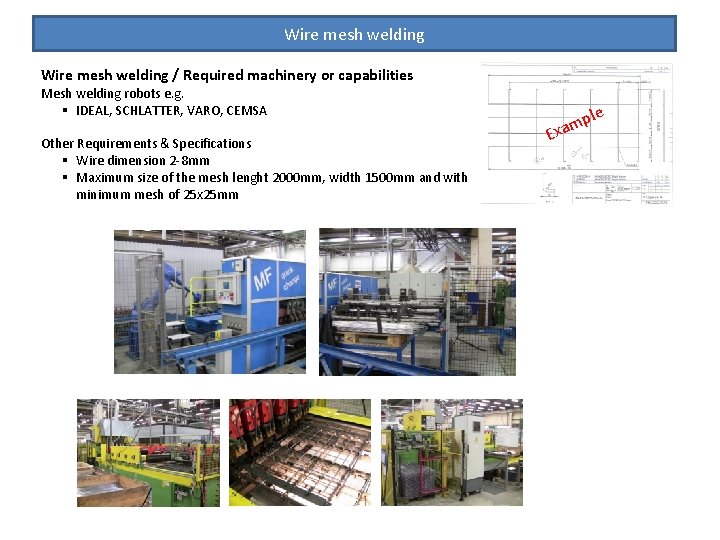
Wire mesh welding / Required machinery or capabilities Mesh welding robots e. g. § IDEAL, SCHLATTER, VARO, CEMSA Other Requirements & Specifications § Wire dimension 2 -8 mm § Maximum size of the mesh lenght 2000 mm, width 1500 mm and with minimum mesh of 25 x 25 mm E ple m xa
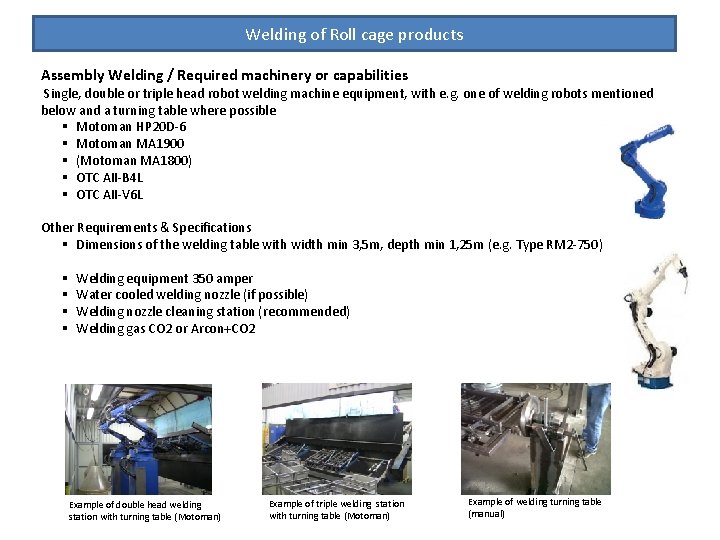
Welding of Roll cage products Assembly Welding / Required machinery or capabilities Single, double or triple head robot welding machine equipment, with e. g. one of welding robots mentioned below and a turning table where possible § Motoman HP 20 D-6 § Motoman MA 1900 § (Motoman MA 1800) § OTC AII-B 4 L § OTC AII-V 6 L Other Requirements & Specifications § Dimensions of the welding table with width min 3, 5 m, depth min 1, 25 m (e. g. Type RM 2 -750) § § Welding equipment 350 amper Water cooled welding nozzle (if possible) Welding nozzle cleaning station (recommended) Welding gas CO 2 or Arcon+CO 2 Example of double head welding station with turning table (Motoman) Example of triple welding station with turning table (Motoman) Example of welding turning table (manual)
Surface Treatment of Roll cage products / Electro plating Electroplating (“Electrogalvanization”) in General Electrogalvanization is a galvanization process in which a layer of zinc is bonded to steel in order to protect against corrosion. The process involves electroplating, running a current of electricity through a saline/zinc solution with a zinc anode and steel conductor KHW requirement for Electroplating KHW requires an electroplating based on requirements § Electroplating: EN 12329: 2008 § Topcoat: Lacquer/sealer § Quality Control by Salt Spray Tests: ISO 9227 (min. 96/144 hours) § Bath sizes should be minimum 2 m depth, 800 wide and 3 -6 meter long, to fit products with sizes e. g. 800 mm wide x 1800 mm long x 300 mm width Electroplating of KHW components are done according to the standard EN 12329: 2000. Typical requirement of for KHW Products electroplating is Fe/Zn 12/A; which means: § Fe = base steel material to be electroplated § Zn 12 = zinc layer on top of the steel, layer thickness 8 -12 microns § A = code for the chromate type, bright This specification is marked on the assembly drawing and is specified individually for each type of Product More detailed information of the electroplating requirement can be found on the standard mentioned earlier, EN 12329: 2000. One basic exception compared to standard EN 12329: 2000 is that K. Hartwall is using only 3 -valent chromium (Cr 3+) in blue passivation. K. Hartwall requires this also from its partners making electroplating.
- Slides: 5