
Production of bioethanol from wood biomass Muhammad Kamrul
Production of bioethanol from wood biomass Muhammad Kamrul Hasan Student ID: 306641 Course name: Academic skills in forest science Wood Material Science

Contents: What is bioethanol ? History of bioethanol production Bioethanol feedstock resources Wood biomass Special feature of bioethanol Process of converting biomass to bioethanol Advantage and disadvantage of bioethanol Top ethanol producer countries Conclusion

What is bioethanol? Bioethanol is the energy source for fuel cell that is made from the conversion of carbon-based feedstock (wood biomass) It is produced from the fermentation of various feedstocks that contain mainly fermentable sugars or carbohydrates. The principle fuel used as a petrol substitute is bioethanol Bioethanol fuel is mainly produced by the sugar or cellulose fermentation process Ethanol is a high-octane fuel and has replaced lead as an octane enhancer in petrol Bioethanol is an alternative to gasoline for flexifuel vehicles

History of bioethanol production: Fig. 1. Historical background of bioethanol production.

Bioethanol feedstock resources: First-generation bioethanol feedstock is mainly food crops such as rice, wheat, barley, potato, corn, sugarcane, and vegetable oil etc. Second-generation bioethanol feedstocks, including lignocellulosic biomass such as forest residue, woody biomass, herbaceous biomass, etc. ; nonfood crops; municipal solid waste; and animal fat Third-generation bioethanol feedstocks algal biomass (i. e. , microalgae, microbes) Fourth-generation bioethanol feedstocks –industrial waste carbon dioxide

Wood Biomass: Wood biomass is generated from cellulose, hemicellulose, and lignin. Around 90% of the biomass consist by those three components, rest of the percentage being attributed with ash, extractives, and proteins. Cellulose and hemicellulose are mainly consisting of C 6 and C 5 sugars which can easily convert to bioethanol by fermentable bacteria
Special feature of bioethanol: Colorless and clear liquid It has a high-octane level; It is similar to gasoline, for using it does not require engine modification; It is also regarded as renewable fuel that does not have CO 2 emissions; It has low-cost production; Lower toxicity level & Much more environmentally friendly It can be made at home and low-cost production than fossil fuel; The physical characteristic of bioethanol in its pure form is soluble in all proportions with water and also with ether, acetone, benzene, and some other organic solvents And its characteristic chemical function are dominated by the OH-group, which can readily help reactions in chemical industries such as dehydration, halogenation, ester formation, and oxidation
Process of converting biomass to bioethanol: q Production workflow 1. Grinding to small particle size 2. Separation of cellulose from hemicellulose and lignin 3. Saccharification with the aid of cellulase enzymes 4. Fermentation of free sugars (glucose, xylose) to ethanol (by yeast, or modified microorganisms) 5. Product distillation, dehydration

( C 6 H 10 O 5)n + n H 2 O → n C 6 H 12 O 6 → 2 n C 2 H 5 OH + 2 n CO 2 Fig: 2. Schematic diagram of ethanol production in general principle

Advantage of bioethanol: Exhaust gases of ethanol are much cleaner – it burns more cleanly as a result of more complete combustion Greenhouse gases reduce – ethanol-blended fuels such as E 85 (85% ethanol and 15% gasoline) reduce up to 37. 1% of GHGs Decrease in ozone formation – The emissions produced by burning ethanol are less reactive with sunlight than those produced by burning gasoline, which results in a lower potential forming ozone Carbon neutral – the CO 2 released in the bioethanol production process is the same amount as the one the crops previously absorbed during photosynthesis Any plant can be use for production of bioethanol – it only has to contain sugar and starch
Disadvantages: § Biodiversity – A large amount of arable land is required to grow crops, natural habitats would be destroyed § Food vs. Fuel debate – due to the lucrative prices of bioethanol some farmers may sacrifice food crops for biofuel production which will increase food prices around the world § Carbon emissions (controversial) – During production of bioethanol, huge amount of carbon dioxide is released – Emission of GHGs from production of bioethanol is comparable to the emissions of internal combustion engines
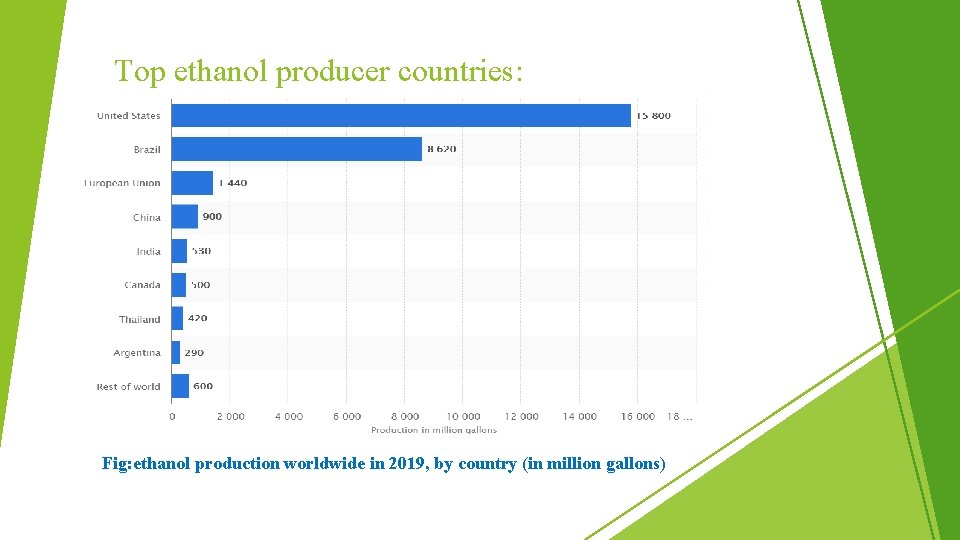
Top ethanol producer countries: Fig: ethanol production worldwide in 2019, by country (in million gallons)
Conclusion Renewable fuels and energy are a vital demand of the human being when fossil resources are exhausted and the global warming is at the red alarming level. The production of bioethanol from wood biomass can meet the requirement of food security and the sustainable vision of a green world.
Refarence: Chemistry of Biofuels 3410365 Copyright (c) 2020 J. Jänis, UEF Chemistry BIOETHANOL PRODUCTION FROM WOOD WASTE Lacrimioara SENILA 1*, Cerasel VARATICEANU 1, Marius ROMAN 1, Mirela MICLEAN 1, Cecilia ROMAN 1 https: //www. intechopen. com/books/alcohol-fuels-current-technologies-and-future- prospect/bioethanol-production-from-lignocellulosic-biomass https: //www. eubia. org/cms/wiki-biomass/biofuels/bioethanol/ https: //www. sciencedirect. com/topics/materials-science/bioethanol https: //www. slideshare. net/bioethanol https: //en. wikipedia. org/wiki/Lignocellulosic_biomass Prospects and technological advancement of cellulosic bioethanol ecofuel production Pobitra Halder*, † , Kalam Azad‡ , Shaheen Shah§ , Eity Sarker¶ https: //www. statista. com/statistics/281606/ethanol-production-in-selected-countries/

Thanks for your patience
- Slides: 15