
Production of Biodiesel from Used Groundnut Oil from
Production of Biodiesel from Used Groundnut Oil from Bosso Market, Minna, Niger State, Nigeria Alabadan B. A. Department of Agricultural and Bioresources Engineering, Federal University, Oye – Ekiti. Ajayi E. S. Department of Agricultural and Bioresources Engineering, Federal University, Oye – Ekiti. Godwin J. A. Department of Agricultural and Bioresources Engineering, Federal University of Technology, Minna, Niger State.
Abstract The transesterification of used cooking oil with shortchain alcohols, in the presence of base catalyst sodium hydroxide (Na. OH) and methanol as solvent, by means of single step batch transesterification process in order to obtain biodiesel fuel was studied using a reaction ratio of 6: 1 for alcohol to oil ratio. The oil was heated in a water bath. The process variables that were investigated are catalyst concentration and reaction time. The variable that was fixed throughout the whole experiment was quantity of used vegetable oil, mixing degree of mechanical stirrer at 1300 rpm and alcohol to oil ratio. The oil was divided into three samples namely, 1, 2, and 3.
Abstract Cont’d The biodiesel yield for the samples are 58 ml, 79 ml and 70 ml respectively while the glycerine yield for the samples were 19 ml, 19 ml and 20 ml respectively. The reaction times for the three samples are 60, 90 and 120 minutes respectively. The best result for highest yield and highest purity is at 90 minutes reaction time and 1. 5 g catalyst concentration. Sample 2 was found to have the highest cetane rating closer to the ASTM standard which implies that sample 2 will be a more efficient fuel than the other two samples, guarantee smooth running of the engine as well as burn cleaner.
Introduction • Biodiesel is defined as mono-alkyl esters of long chain fatty acids derived from vegetable oils or animal fats which conform to American Society for Testing and Materials, ASTM D 6751 specifications for use in diesel engines. • It is a clean burning alternative fuel, produced from domestic and renewable resources. • Biodiesel can be blended at any level with diesel to create a biodiesel blend.
Advantages of Biodiesel • • • Biodiesel is simple to use, Biodegradable (biodegrades as fast as sugar) Nontoxic Essentially free of sulphur and aromatics. Much cleaner than fossil-fuel diesel. Diesel engines run better and last longer with biodiesel. • Better for the environment because it is made from renewable resources and has lower emissions compared to petroleum diesel (Ramadhas et al. , 2005).
• Biodiesel is made through a chemical process called transesterification. • The process leaves behind two products: (i) methyl esters or biodiesel and (ii) glycerine. Using biodiesel in a usual diesel engine substantially reduces emissions of unburned hydrocarbons, carbon monoxide, sulphates, polycyclic aromatic hydrocarbons, nitrated polycyclic aromatic hydrocarbons, and particulate matter
• In many European countries, a 5% biodiesel blend, B 5 is widely used and is available at thousands of gas stations. • The majority of vehicle manufacturers limit their recommendations to 15% biodiesel blended with mineral diesel. • Diesel blends containing up to 20% biodiesel called B 20 can be used in nearly all diesels powered equipment, and higher-level blends and pure biodiesel. • B 100 can be used in many engines with little or no modification. • Lower-level blends are compatible with most storage and distribution equipment, but special handling is required for higher-level blends
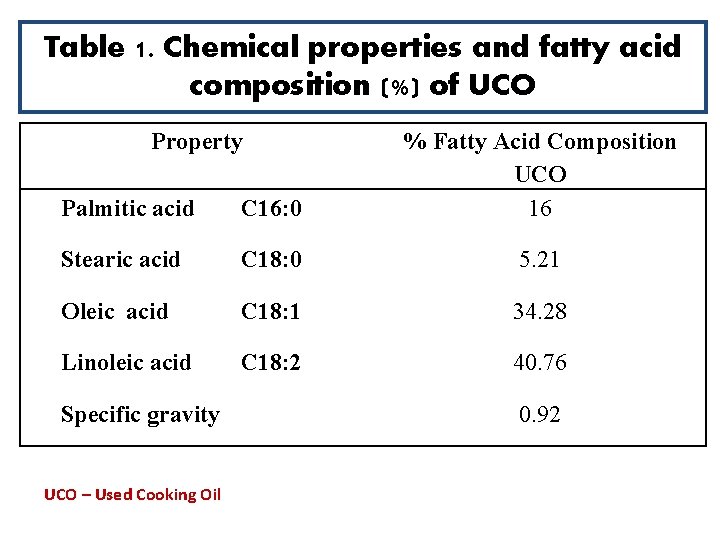
Table 1. Chemical properties and fatty acid composition (%) of UCO Property Palmitic acid C 16: 0 % Fatty Acid Composition UCO 16 Stearic acid C 18: 0 5. 21 Oleic acid C 18: 1 34. 28 Linoleic acid C 18: 2 40. 76 Specific gravity UCO – Used Cooking Oil 0. 92
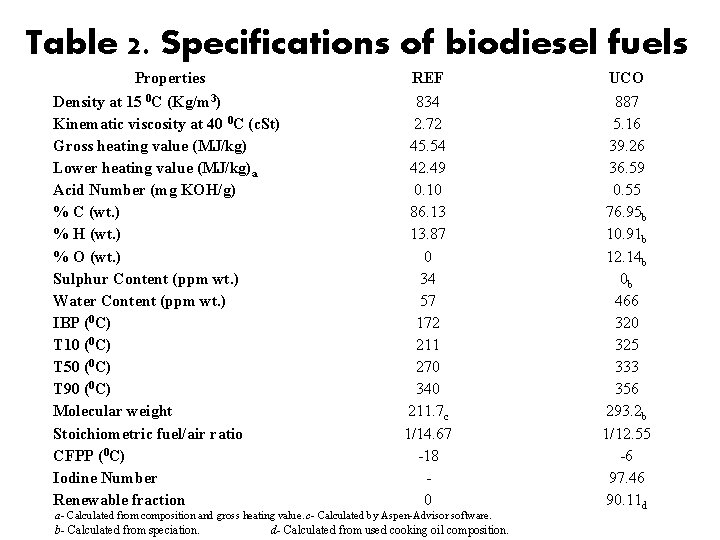
Table 2. Specifications of biodiesel fuels Properties Density at 15 0 C (Kg/m 3) Kinematic viscosity at 40 0 C (c. St) Gross heating value (MJ/kg) Lower heating value (MJ/kg)a Acid Number (mg KOH/g) % C (wt. ) % H (wt. ) % O (wt. ) Sulphur Content (ppm wt. ) Water Content (ppm wt. ) IBP (0 C) T 10 (0 C) T 50 (0 C) T 90 (0 C) Molecular weight Stoichiometric fuel/air ratio CFPP (0 C) Iodine Number Renewable fraction REF 834 2. 72 45. 54 42. 49 0. 10 86. 13 13. 87 0 34 57 172 211 270 340 211. 7 c 1/14. 67 -18 0 a- Calculated from composition and gross heating value. c- Calculated by Aspen-Advisor software. b- Calculated from speciation. d- Calculated from used cooking oil composition. UCO 887 5. 16 39. 26 36. 59 0. 55 76. 95 b 10. 91 b 12. 14 b 0 b 466 320 325 333 356 293. 2 b 1/12. 55 -6 97. 46 90. 11 d
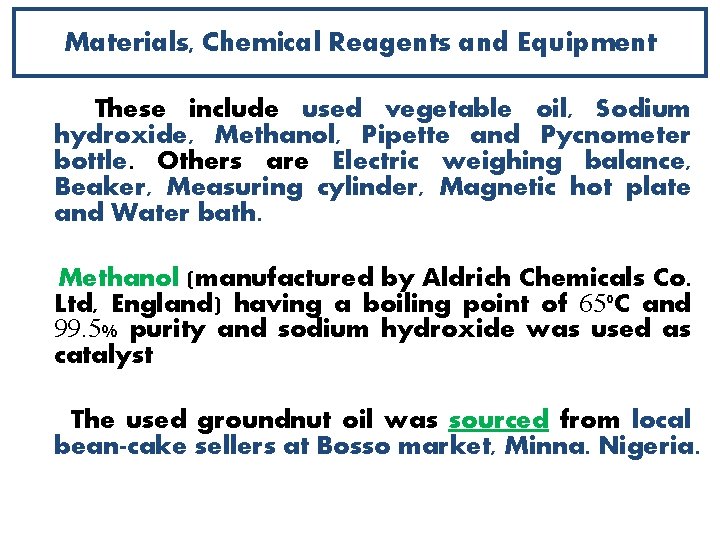
Materials, Chemical Reagents and Equipment These include used vegetable oil, Sodium hydroxide, Methanol, Pipette and Pycnometer bottle. Others are Electric weighing balance, Beaker, Measuring cylinder, Magnetic hot plate and Water bath. Methanol (manufactured by Aldrich Chemicals Co. Ltd, England) having a boiling point of 650 C and 99. 5% purity and sodium hydroxide was used as catalyst The used groundnut oil was sourced from local bean-cake sellers at Bosso market, Minna. Nigeria.
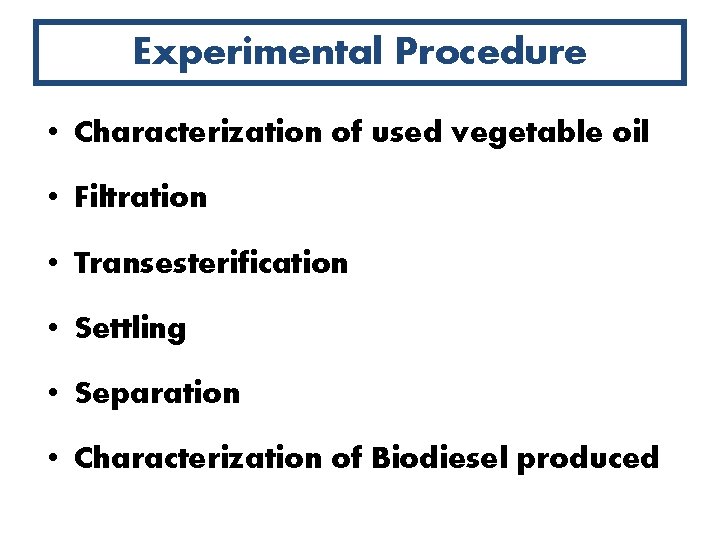
Experimental Procedure • Characterization of used vegetable oil • Filtration • Transesterification • Settling • Separation • Characterization of Biodiesel produced
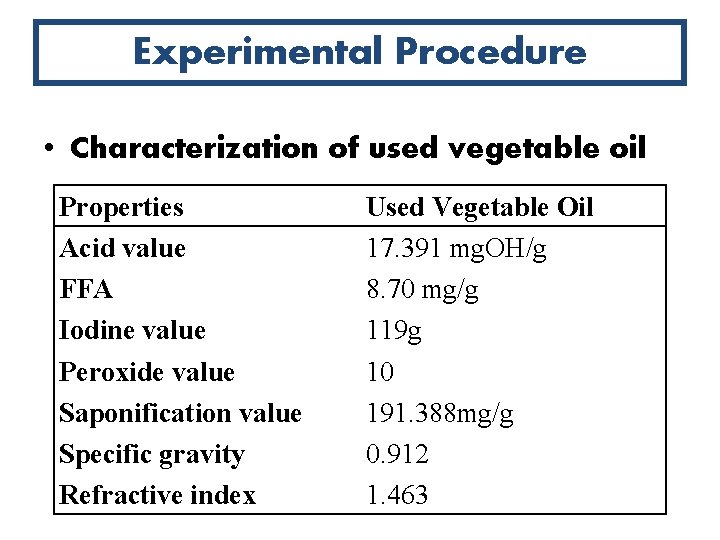
Experimental Procedure • Characterization of used vegetable oil Properties Acid value FFA Iodine value Peroxide value Saponification value Specific gravity Refractive index Used Vegetable Oil 17. 391 mg. OH/g 8. 70 mg/g 119 g 10 191. 388 mg/g 0. 912 1. 463
Filtration The used vegetable oil collected from the bean-cake fryers was first properly filtered using a filter paper and transferred into a clean beaker so as to remove completely every food particle present in the oil and obtain a very clean, clear and particle free oil which will guarantee a good and acceptable result.
Transesterification Process Three samples of the used vegetable oil were put in three different beakers to produce the biodiesel at varying temperature, time and quantity of catalyst
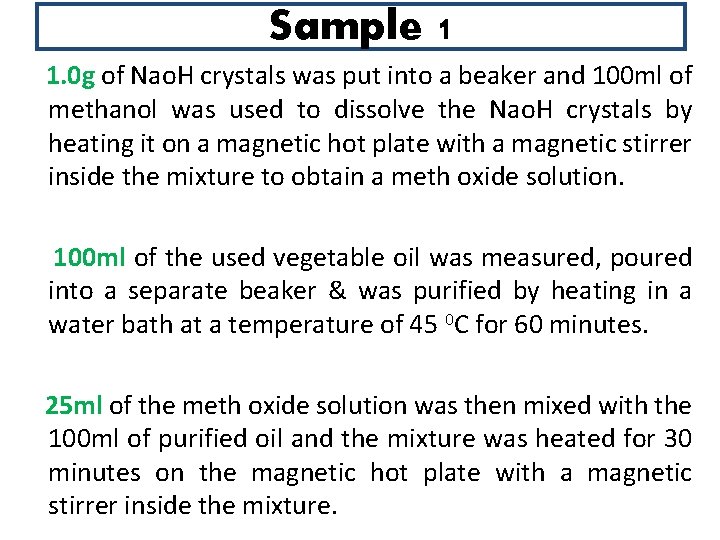
Sample 1 1. 0 g of Nao. H crystals was put into a beaker and 100 ml of methanol was used to dissolve the Nao. H crystals by heating it on a magnetic hot plate with a magnetic stirrer inside the mixture to obtain a meth oxide solution. 100 ml of the used vegetable oil was measured, poured into a separate beaker & was purified by heating in a water bath at a temperature of 45 0 C for 60 minutes. 25 ml of the meth oxide solution was then mixed with the 100 ml of purified oil and the mixture was heated for 30 minutes on the magnetic hot plate with a magnetic stirrer inside the mixture.
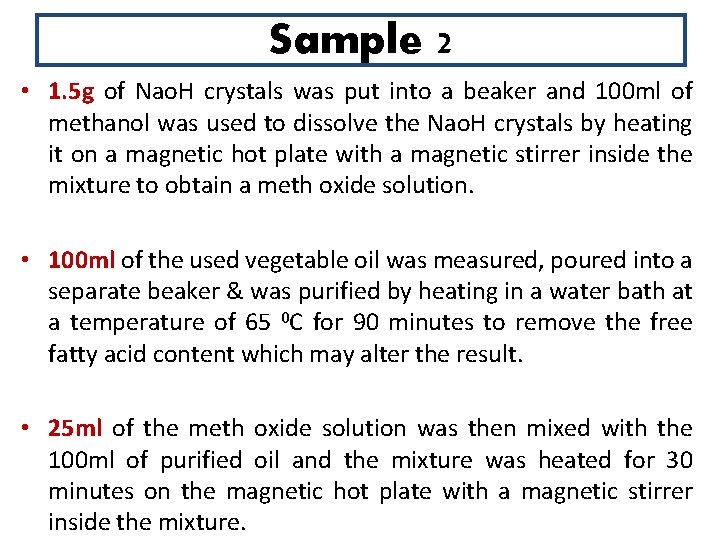
Sample 2 • 1. 5 g of Nao. H crystals was put into a beaker and 100 ml of methanol was used to dissolve the Nao. H crystals by heating it on a magnetic hot plate with a magnetic stirrer inside the mixture to obtain a meth oxide solution. • 100 ml of the used vegetable oil was measured, poured into a separate beaker & was purified by heating in a water bath at a temperature of 65 0 C for 90 minutes to remove the free fatty acid content which may alter the result. • 25 ml of the meth oxide solution was then mixed with the 100 ml of purified oil and the mixture was heated for 30 minutes on the magnetic hot plate with a magnetic stirrer inside the mixture.
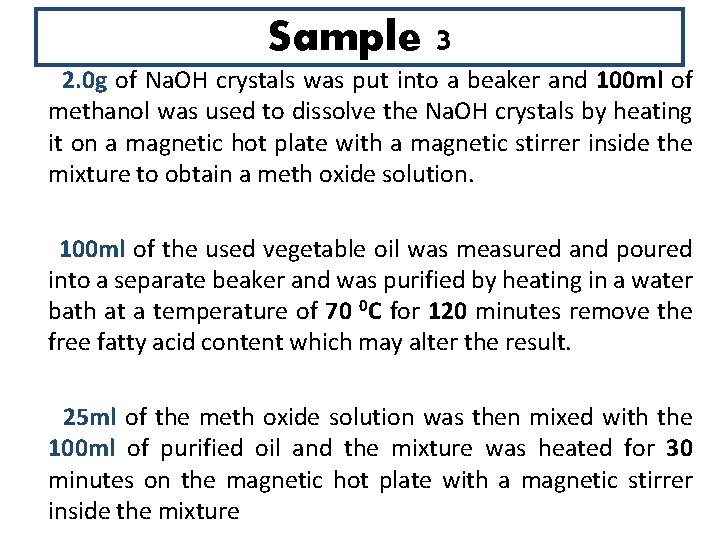
Sample 3 2. 0 g of Na. OH crystals was put into a beaker and 100 ml of methanol was used to dissolve the Na. OH crystals by heating it on a magnetic hot plate with a magnetic stirrer inside the mixture to obtain a meth oxide solution. 100 ml of the used vegetable oil was measured and poured into a separate beaker and was purified by heating in a water bath at a temperature of 70 0 C for 120 minutes remove the free fatty acid content which may alter the result. 25 ml of the meth oxide solution was then mixed with the 100 ml of purified oil and the mixture was heated for 30 minutes on the magnetic hot plate with a magnetic stirrer inside the mixture
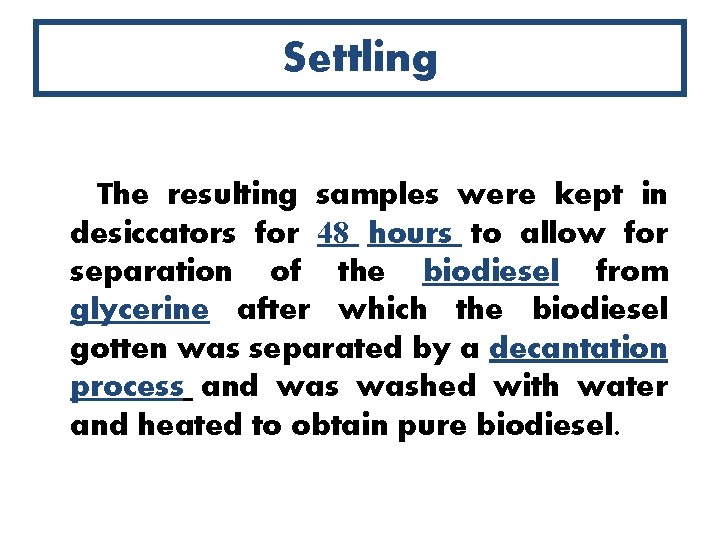
Settling The resulting samples were kept in desiccators for 48 hours to allow for separation of the biodiesel from glycerine after which the biodiesel gotten was separated by a decantation process and washed with water and heated to obtain pure biodiesel.
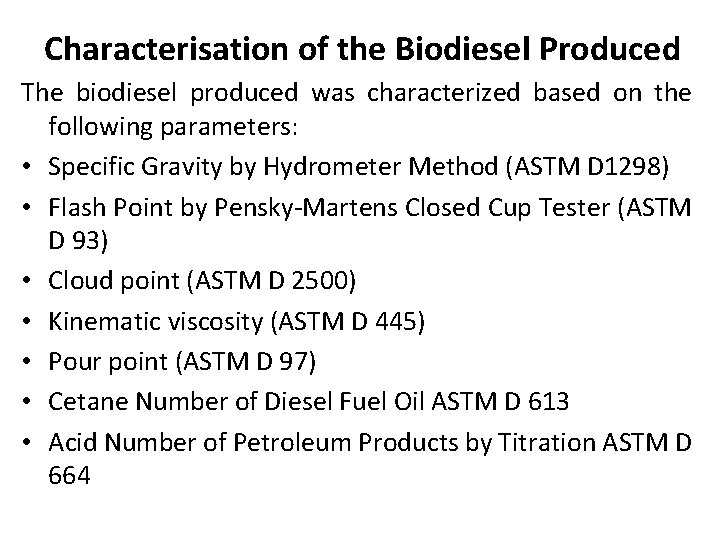
Characterisation of the Biodiesel Produced The biodiesel produced was characterized based on the following parameters: • Specific Gravity by Hydrometer Method (ASTM D 1298) • Flash Point by Pensky-Martens Closed Cup Tester (ASTM D 93) • Cloud point (ASTM D 2500) • Kinematic viscosity (ASTM D 445) • Pour point (ASTM D 97) • Cetane Number of Diesel Fuel Oil ASTM D 613 • Acid Number of Petroleum Products by Titration ASTM D 664
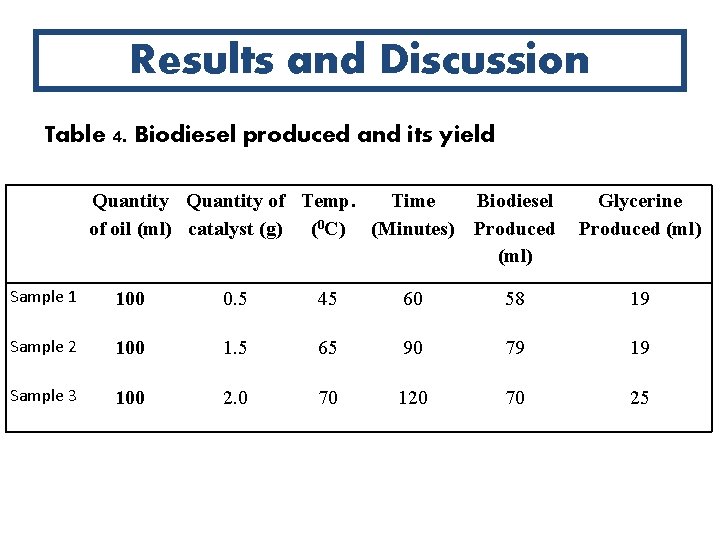
Results and Discussion Table 4. Biodiesel produced and its yield Quantity of Temp. Time Biodiesel of oil (ml) catalyst (g) (0 C) (Minutes) Produced (ml) Glycerine Produced (ml) Sample 1 100 0. 5 45 60 58 19 Sample 2 100 1. 5 65 90 79 19 Sample 3 100 2. 0 70 120 70 25
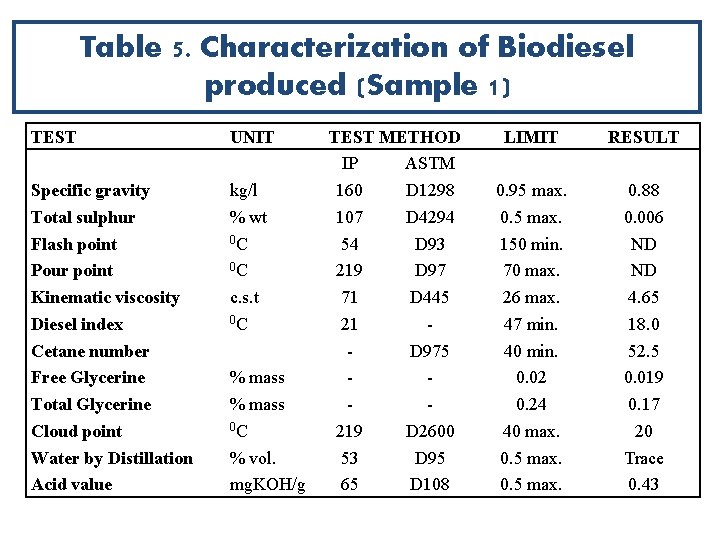
Table 5. Characterization of Biodiesel produced (Sample 1) TEST UNIT Specific gravity Total sulphur Flash point Pour point Kinematic viscosity Diesel index Cetane number Free Glycerine Total Glycerine Cloud point Water by Distillation Acid value kg/l % wt 0 C 0 C c. s. t 0 C % mass 0 C % vol. mg. KOH/g TEST METHOD IP ASTM 160 D 1298 107 D 4294 54 D 93 219 D 97 71 D 445 21 D 975 219 D 2600 53 D 95 65 D 108 LIMIT RESULT 0. 95 max. 0. 5 max. 150 min. 70 max. 26 max. 47 min. 40 min. 0. 02 0. 24 40 max. 0. 5 max. 0. 88 0. 006 ND ND 4. 65 18. 0 52. 5 0. 019 0. 17 20 Trace 0. 43
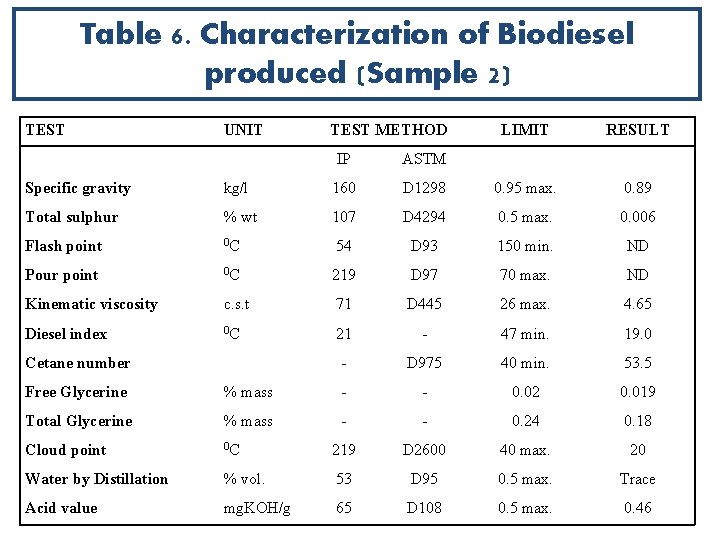
Table 6. Characterization of Biodiesel produced (Sample 2) TEST UNIT TEST METHOD IP ASTM LIMIT RESULT Specific gravity kg/l 160 D 1298 0. 95 max. 0. 89 Total sulphur % wt 107 D 4294 0. 5 max. 0. 006 Flash point 0 C 54 D 93 150 min. ND Pour point 0 C 219 D 97 70 max. ND Kinematic viscosity c. s. t 71 D 445 26 max. 4. 65 Diesel index 0 C 21 - 47 min. 19. 0 - D 975 40 min. 53. 5 Cetane number Free Glycerine % mass - - 0. 02 0. 019 Total Glycerine % mass - - 0. 24 0. 18 Cloud point 0 C 219 D 2600 40 max. 20 Water by Distillation % vol. 53 D 95 0. 5 max. Trace Acid value mg. KOH/g 65 D 108 0. 5 max. 0. 46
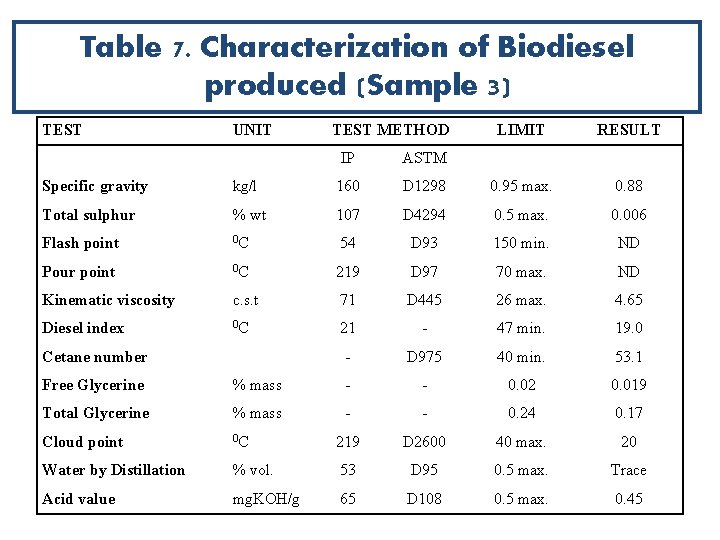
Table 7. Characterization of Biodiesel produced (Sample 3) TEST UNIT TEST METHOD IP ASTM LIMIT RESULT Specific gravity kg/l 160 D 1298 0. 95 max. 0. 88 Total sulphur % wt 107 D 4294 0. 5 max. 0. 006 Flash point 0 C 54 D 93 150 min. ND Pour point 0 C 219 D 97 70 max. ND Kinematic viscosity c. s. t 71 D 445 26 max. 4. 65 Diesel index 0 C 21 - 47 min. 19. 0 - D 975 40 min. 53. 1 Cetane number Free Glycerine % mass - - 0. 02 0. 019 Total Glycerine % mass - - 0. 24 0. 17 Cloud point 0 C 219 D 2600 40 max. 20 Water by Distillation % vol. 53 D 95 0. 5 max. Trace Acid value mg. KOH/g 65 D 108 0. 5 max. 0. 45
Effect of Catalyst concentration on purity The purity of the biodiesel obtained from sample 1 did not conform to the acceptable standard because the viscosity of the diesel, cetane rating among other properties is below the recommended value and this could lead to excessive use of the diesel by automobiles and smoky exhaust.
Effect of Catalyst Concentration on Yield The yield of the first sample was the smallest of the three. The second sample produced more biodiesel because of the reaction ratio of the oil sample to the catalyst. From this, It can be deduced that a biodiesel produced using this ratio will yield more product and less glycerine.
Effect of Reaction Time on Purity • The reaction time of 90 minutes produced the biodiesel that is in its purest state than the other two at 60 minutes and 120 minutes. • This implies that at a either lower reaction or higher reaction time than 90 minutes, the biodiesel produced may likely be of low quality as well as contain some form of impurities. • This can be checked by ensuring that diesel produced at acceptable reaction ratio is allowed to completely react at corresponding time, which will enhance the purity of the diesel produced.
Effect of Reaction Time on Yield • The result obtained shows that the highest quantity of biodiesel produced was at a reaction time of 90 minutes. • This implies that the biodiesel produced at 60 minutes and 120 minutes have lower yield and which suggest that with a reaction time of 90 minutes, the second sample produced more biodiesel with good combustion properties and less glycerine than the other two.
Conclusion • High yield of quality biodiesel can be produced using used vegetable oil as feedstock with a good reaction ratio, appropriate concentration of catalyst, temperature and time of heating.
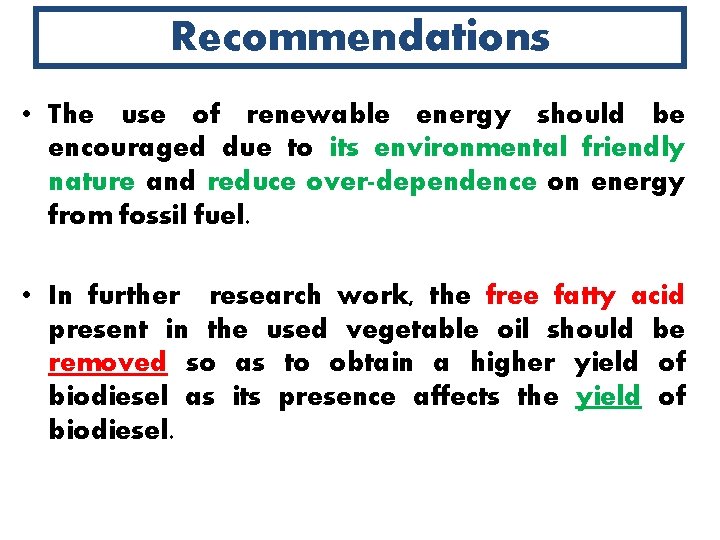
Recommendations • The use of renewable energy should be encouraged due to its environmental friendly nature and reduce over-dependence on energy from fossil fuel. • In further research work, the free fatty acid present in the used vegetable oil should be removed so as to obtain a higher yield of biodiesel as its presence affects the yield of biodiesel.
- Slides: 29