
Production Control Queuing Group 1 Ray Quintero Lei

- Slides: 7
Production Control & Queuing Group 1 Ray Quintero, Lei Tian, Jiayin Liu, Morvarid Amirfathi, Rabeeh Sahranavard, Max Tubbs
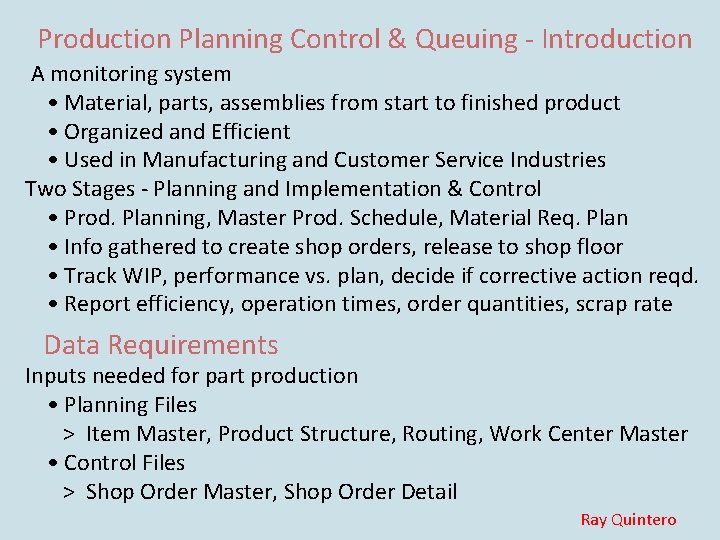
Production Planning Control & Queuing - Introduction A monitoring system • Material, parts, assemblies from start to finished product • Organized and Efficient • Used in Manufacturing and Customer Service Industries Two Stages - Planning and Implementation & Control • Prod. Planning, Master Prod. Schedule, Material Req. Plan • Info gathered to create shop orders, release to shop floor • Track WIP, performance vs. plan, decide if corrective action reqd. • Report efficiency, operation times, order quantities, scrap rate Data Requirements Inputs needed for part production • Planning Files > Item Master, Product Structure, Routing, Work Center Master • Control Files > Shop Order Master, Shop Order Detail Ray Quintero
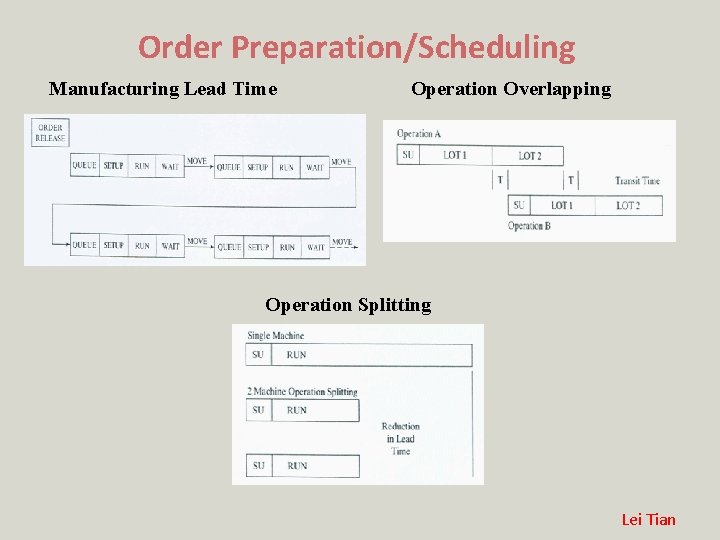
Order Preparation/Scheduling Manufacturing Lead Time Operation Overlapping Operation Splitting Lei Tian
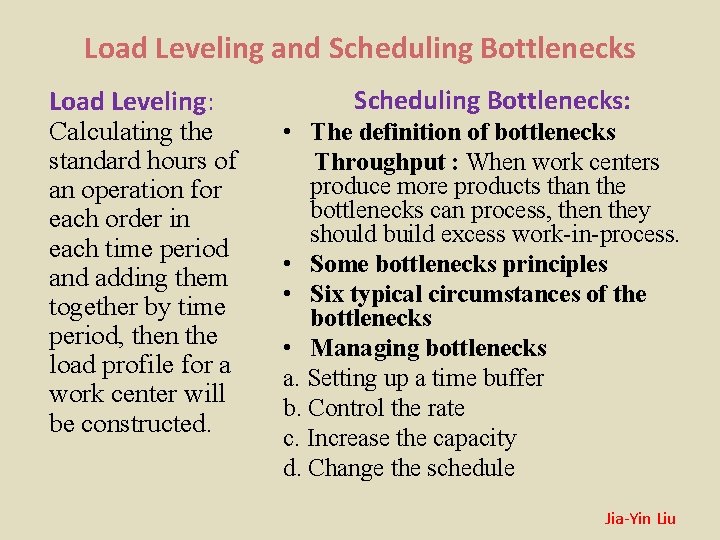
Load Leveling and Scheduling Bottlenecks Load Leveling: Calculating the standard hours of an operation for each order in each time period and adding them together by time period, then the load profile for a work center will be constructed. Scheduling Bottlenecks: • The definition of bottlenecks Throughput : When work centers produce more products than the bottlenecks can process, then they should build excess work-in-process. • Some bottlenecks principles • Six typical circumstances of the bottlenecks • Managing bottlenecks a. Setting up a time buffer b. Control the rate c. Increase the capacity d. Change the schedule Jia-Yin Liu
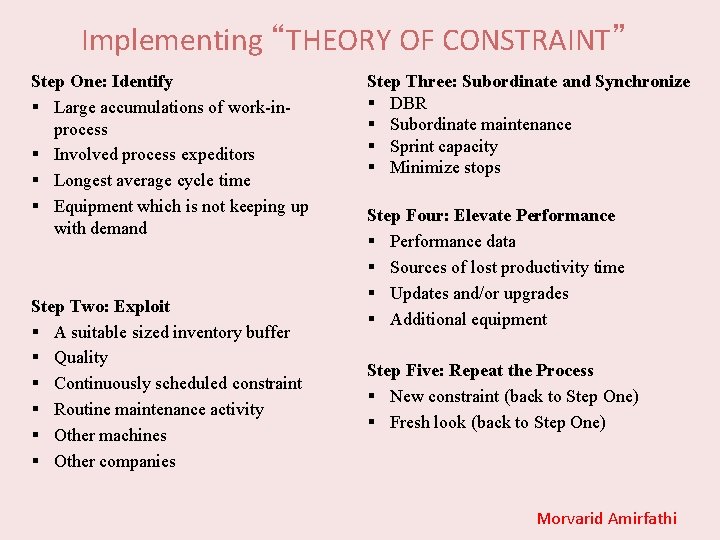
Implementing “THEORY OF CONSTRAINT” Step One: Identify § Large accumulations of work-inprocess § Involved process expeditors § Longest average cycle time § Equipment which is not keeping up with demand Step Two: Exploit § A suitable sized inventory buffer § Quality § Continuously scheduled constraint § Routine maintenance activity § Other machines § Other companies Step Three: Subordinate and Synchronize § DBR § Subordinate maintenance § Sprint capacity § Minimize stops Step Four: Elevate Performance § Performance data § Sources of lost productivity time § Updates and/or upgrades § Additional equipment Step Five: Repeat the Process § New constraint (back to Step One) § Fresh look (back to Step One) Morvarid Amirfathi
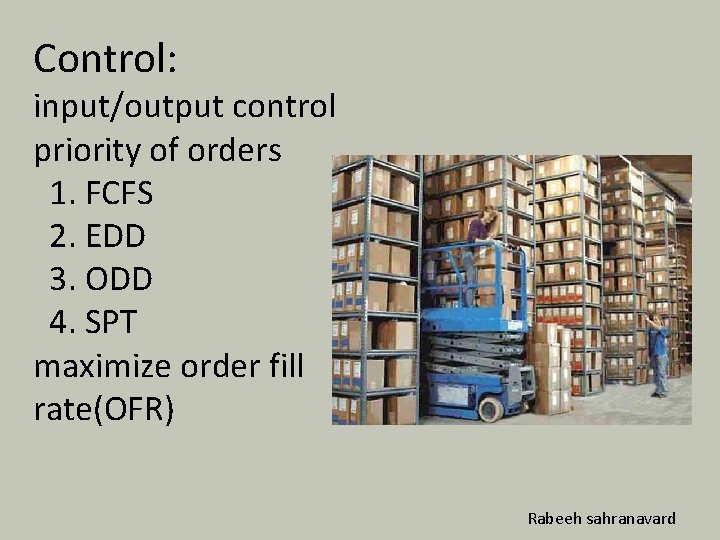
Control: input/output control priority of orders 1. FCFS 2. EDD 3. ODD 4. SPT maximize order fill rate(OFR) Rabeeh sahranavard
Queuing & Conclusion Queuing- coordinating time when people or objects arrive for service -Danish Engineer A. K. Erlang, telephone demand; auto-dialers -Optimum servers to reduce cost -Service industries; hospitals, airports, etc. -Efficiency in arrivals and waiting and serving to keep customers -Competitiveness, Satisfaction, Growth -Mathematical expressions; mean queue length and delay as function of mean arrival and service rates for probability distributions Conclusion- Engineering Management tools, relatively recent, created to -Reduce cost of design and manufacturing, reduce time, increase efficiency, reduce waste, stay competitive and innovative, stay on schedule -Production Control and Queuing are geared more towards the logistics and man hours and control of different process-lines from start to finish. -Importance of planning, scheduling and organizing -All master production schedules mapped out, hours logged, queues analyzed, etc. -Without it many changes and differences and obstacles arrive, causing down-time, wasted time and money, delays, loss of customers and contracts. -Cannot succeed without organization, planning and control. -Natural human attributes, especially engineers, simply a transposition of tools we use in our lives adapted to improve the engineering world. Maxwell Tubbs