
Production Consumption and Resource Sustainability Conventional and Contemporary
Production, Consumption and Resource Sustainability: Conventional and Contemporary Approaches Prof. Dr. Göksel N. Demirer Middle East Technical University Department of Environmental Engineering Ankara, Turkey Partnerships for Sustainable Development, Sustainable Public Policies and Business Practices for Black Sea Countries Regional Environmental Center (REC), Venice International University, Agroinnova and Bilgi University, June 15 - 24 , 2008
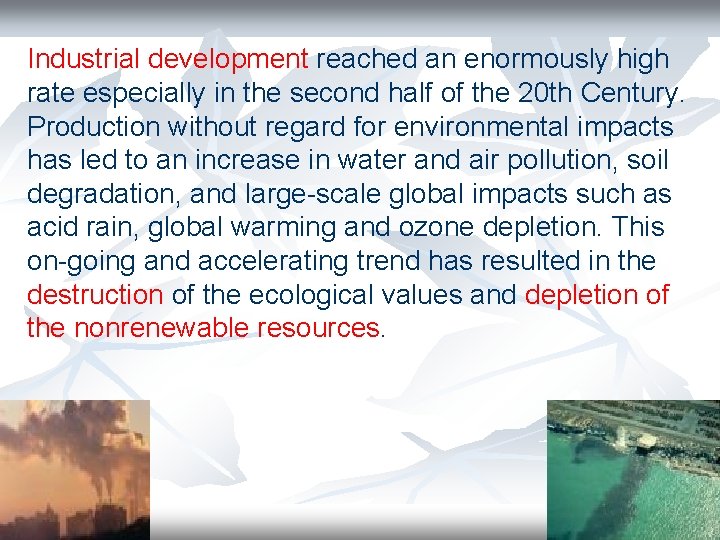
Industrial development reached an enormously high rate especially in the second half of the 20 th Century. Production without regard for environmental impacts has led to an increase in water and air pollution, soil degradation, and large-scale global impacts such as acid rain, global warming and ozone depletion. This on-going and accelerating trend has resulted in the destruction of the ecological values and depletion of the nonrenewable resources.
Can we see the relation of the production, consumption, waste management and resource sustainability ?
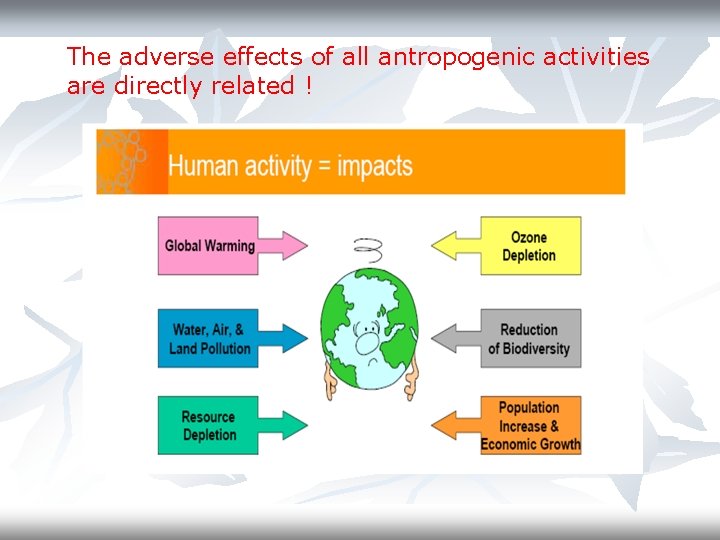
The adverse effects of all antropogenic activities are directly related !
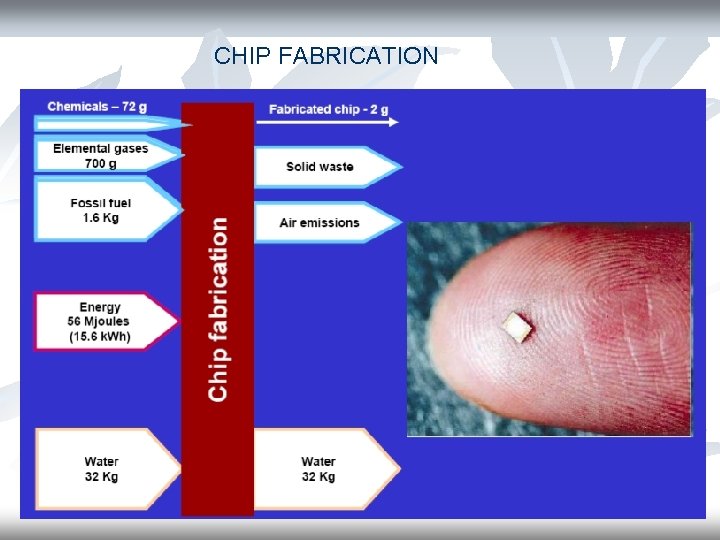
CHIP FABRICATION
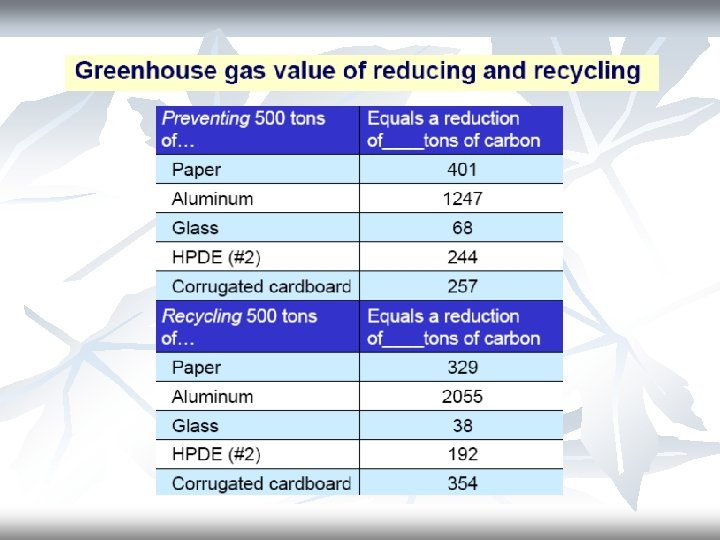
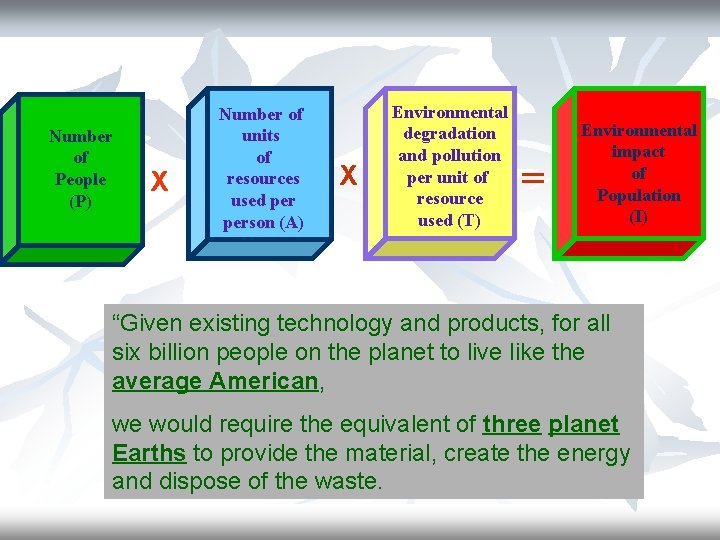
Number of People (P) X Number of units of resources used person (A) X Environmental degradation and pollution per unit of resource used (T) = Environmental impact of Population (I) “Given existing technology and products, for all six billion people on the planet to live like the average American, we would require the equivalent of three planet Earths to provide the material, create the energy and dispose of the waste.
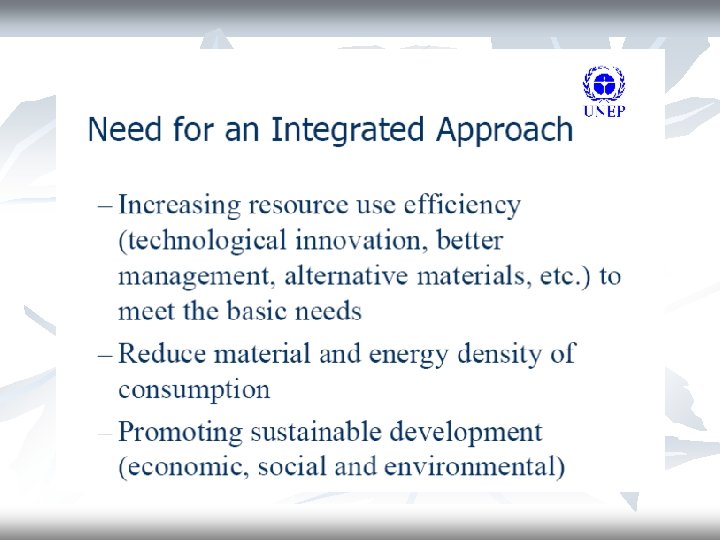
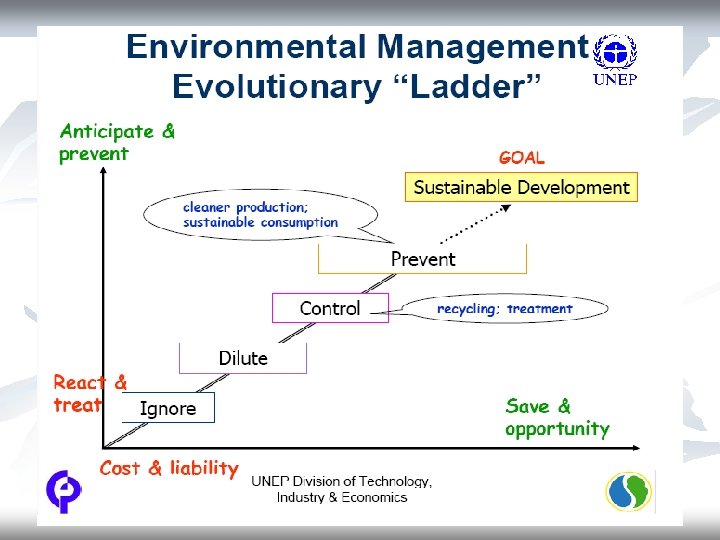
To create more sustainable means of life, there must be a shift in attitudes towards conventional production, consumption as well as waste management practices A preventive approach must be applied in all antropogenic activities. Used in complement with other elements of sound environmental management, cleaner production (Sustainable Consumption and Production) is a practical method for protecting human and environmental health and supporting the goal of sustainability.
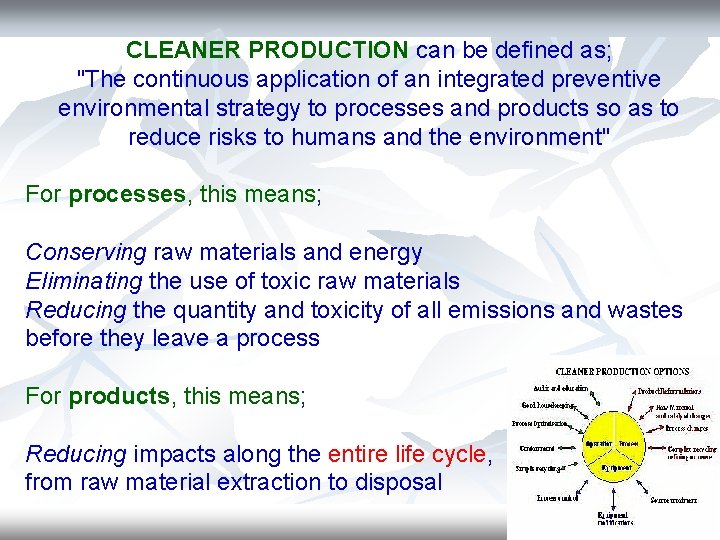
CLEANER PRODUCTION can be defined as; "The continuous application of an integrated preventive environmental strategy to processes and products so as to reduce risks to humans and the environment" For processes, this means; Conserving raw materials and energy Eliminating the use of toxic raw materials Reducing the quantity and toxicity of all emissions and wastes before they leave a process For products, this means; Reducing impacts along the entire life cycle, from raw material extraction to disposal
POLLUTION: Undesired products of industrial activities. What are they ? Mainly unprocessed raw materials, waste energy, etc. or Inefficiency in converting raw materials, water, energy, etc. into products and services SO LOW LEVEL OF RESOURCE CONVERSION EFFICIENCY. CLEANER PRODUCTION: Increased efficiency in converting raw materials, water, energy, etc. into products and services. SO HIGH LEVEL OF RESOURCE CONVERSION EFFICIENCY CP≡ POLLUTION REDUCTION+ INCREASE IN EFFICIENY
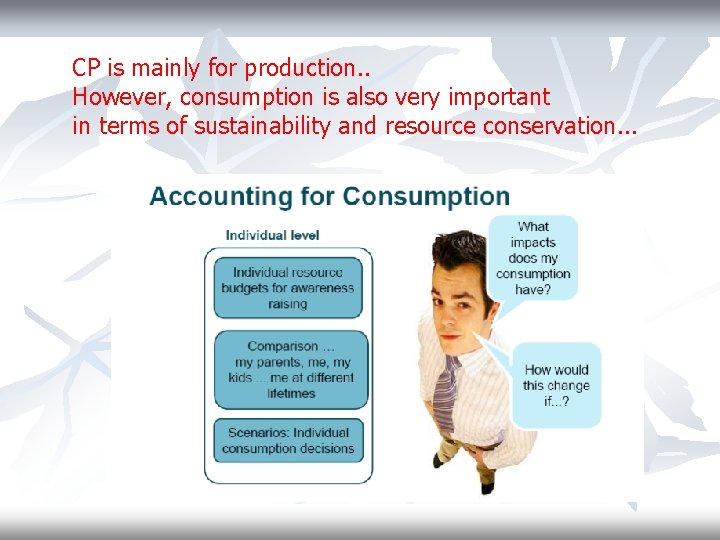
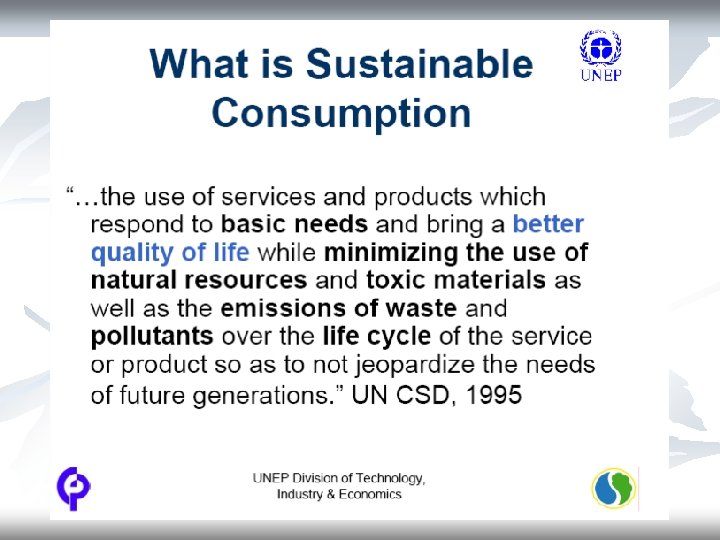
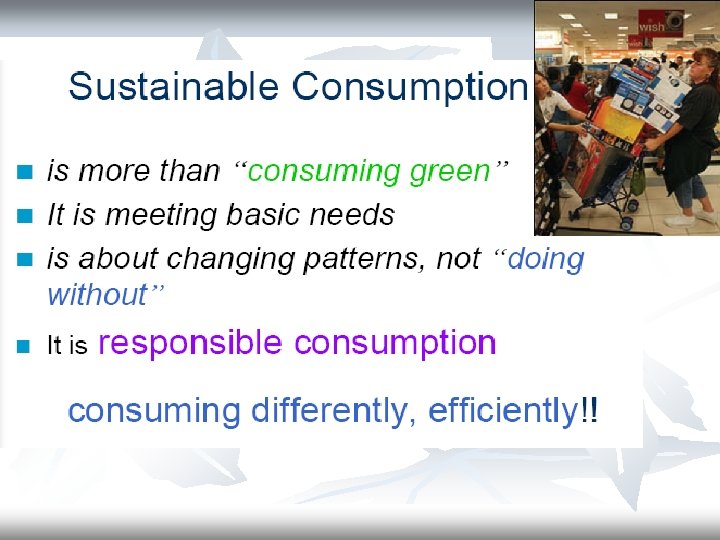
CP is mainly for production. . However, consumption is also very important in terms of sustainability and resource conservation. . .
There is NOT Sustainable Consumption without Sustainable Production and viceversa
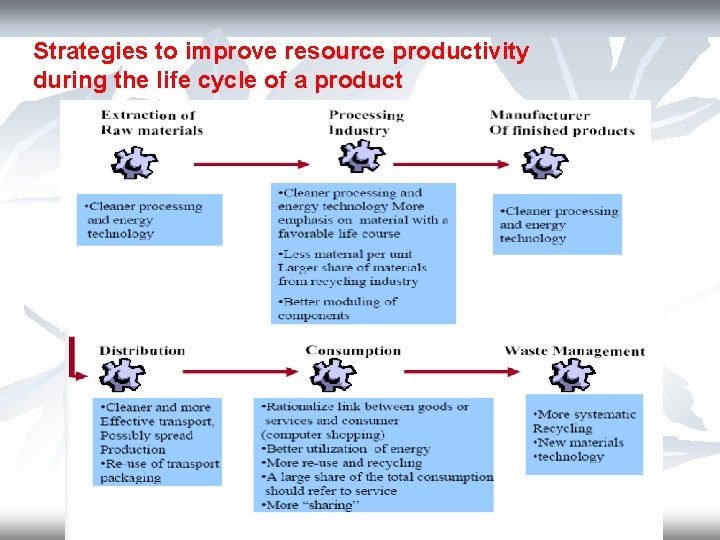
Strategies to improve resource productivity during the life cycle of a product
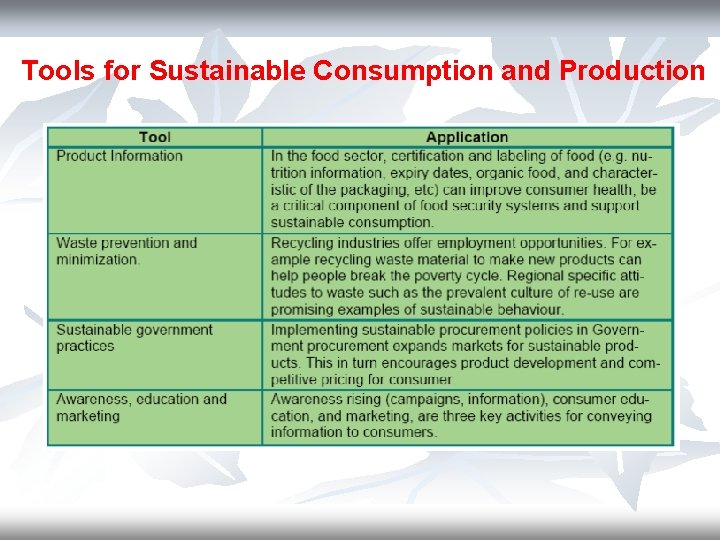
Tools for Sustainable Consumption and Production
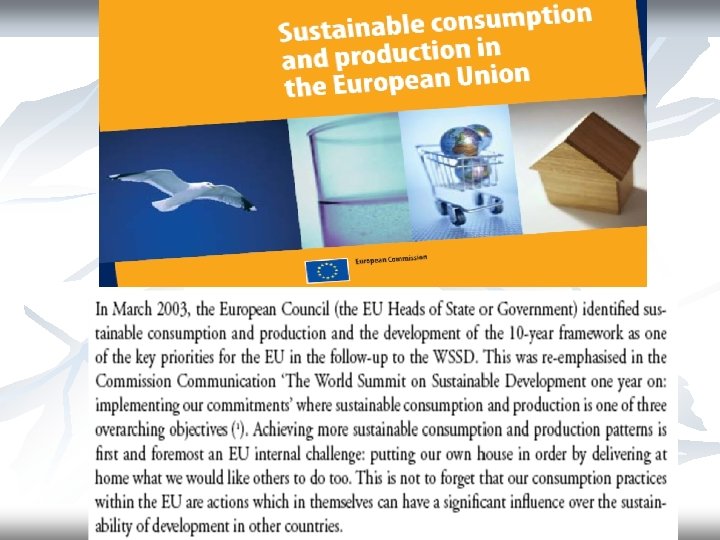
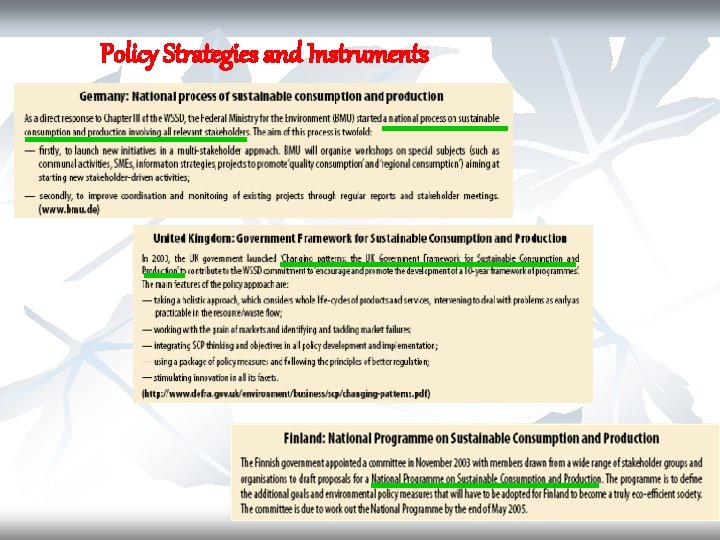
Policy Strategies and Instruments
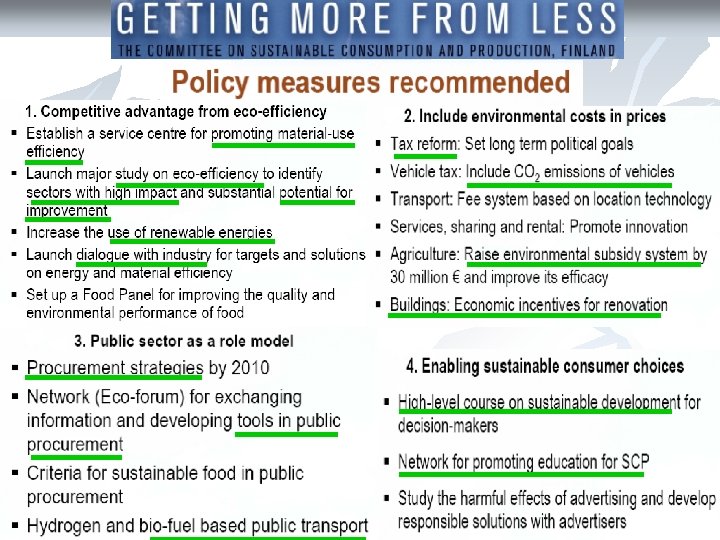
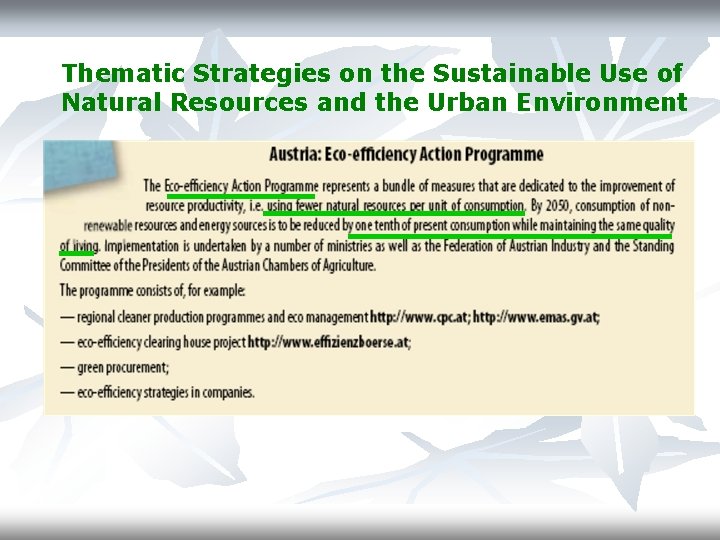
Thematic Strategies on the Sustainable Use of Natural Resources and the Urban Environment
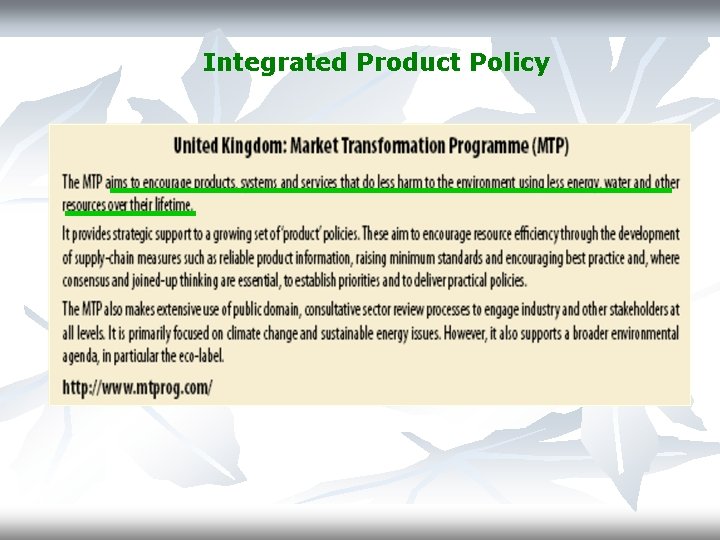
Integrated Product Policy

Consumer Policies
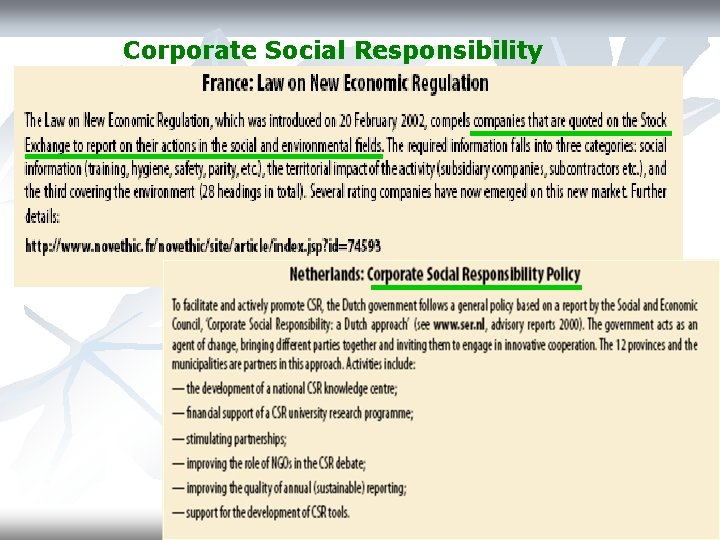
Corporate Social Responsibility
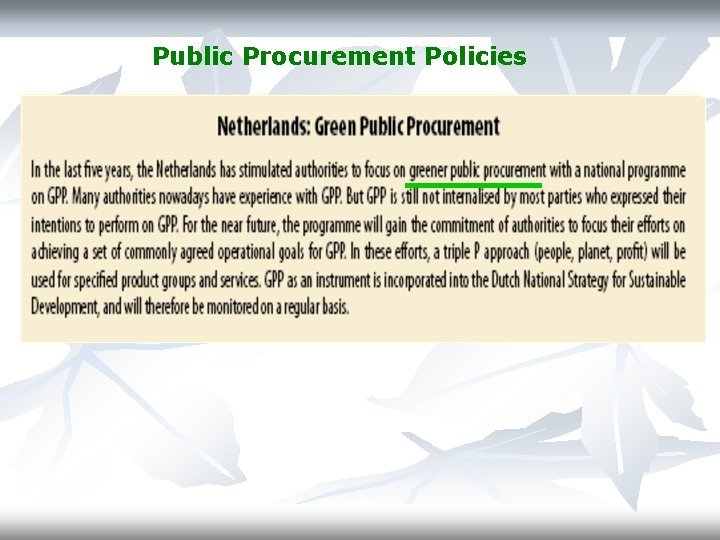
Public Procurement Policies
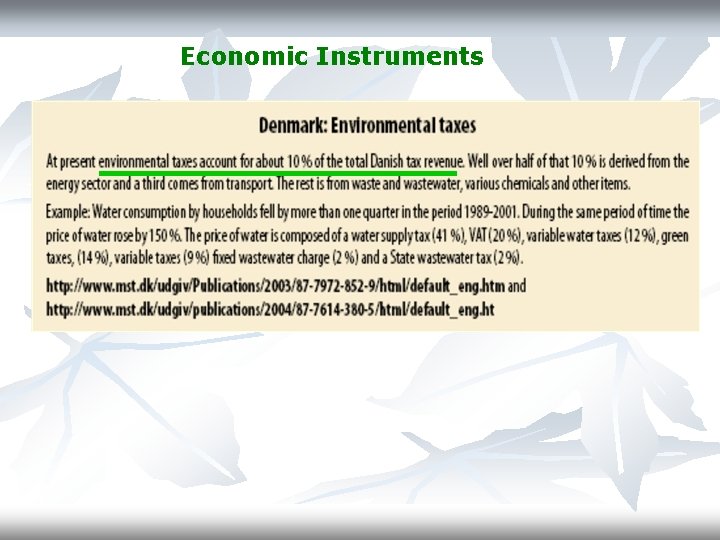
Economic Instruments
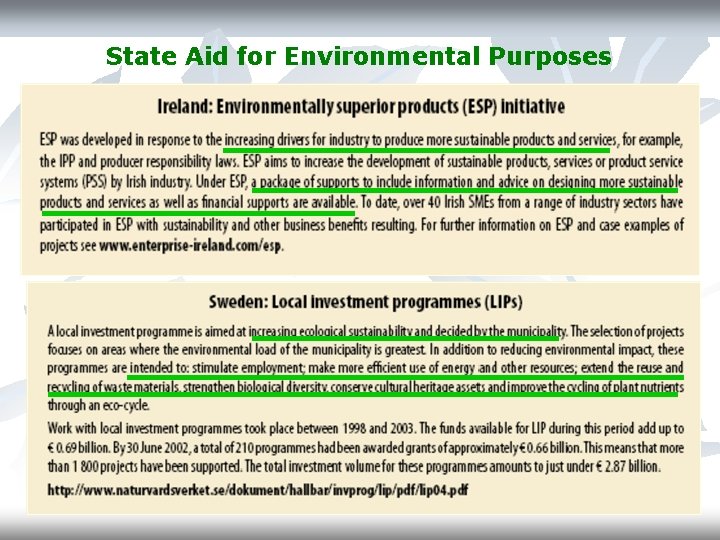
State Aid for Environmental Purposes
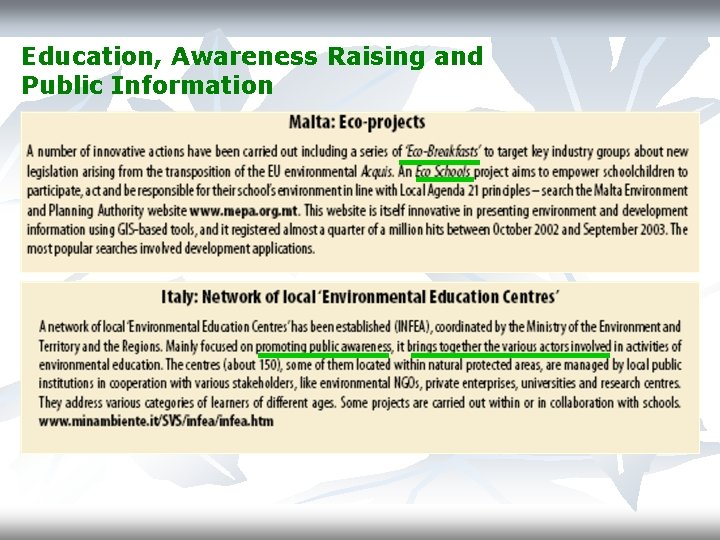
Education, Awareness Raising and Public Information
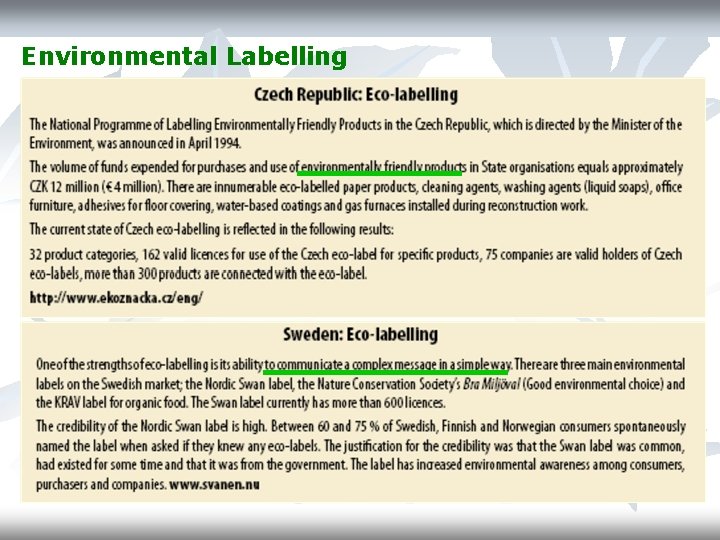
Environmental Labelling
SCP Research and Implementation Activities carried out at Middle East Technical University √ Started in 1998. √ Mainly on Ecoefficiency and Cleaner Production Demonstration projects Case Studies Dissemination activities A graduate course A web page √ A summary of the related activities is provided in the following slights
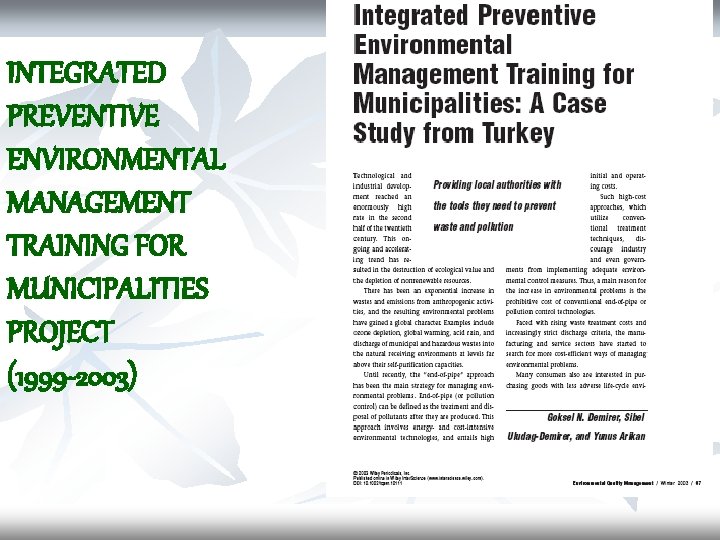
INTEGRATED PREVENTIVE ENVIRONMENTAL MANAGEMENT TRAINING FOR MUNICIPALITIES PROJECT (1999 -2003)
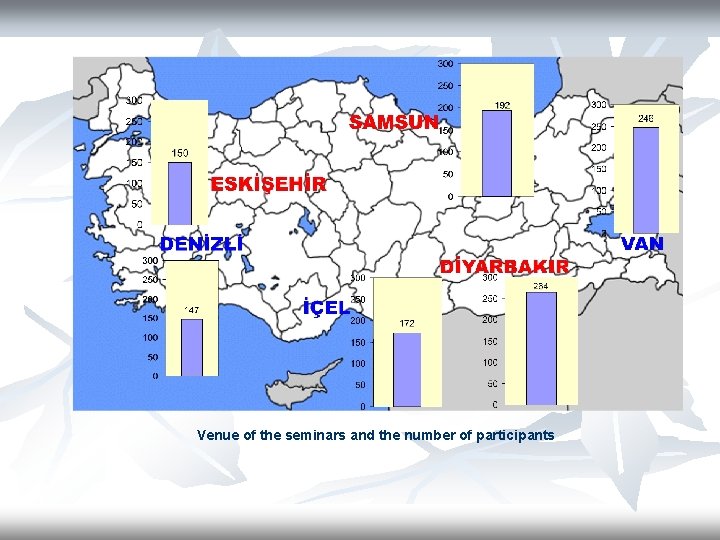
Venue of the seminars and the number of participants
GOOD HOUSEKEEPING APPLICATIONS IN TURKISH COMPANIES DELTA (Developing Environmental Leadership Towards Action) Eco-Efficiency Programme (2001 -2002)
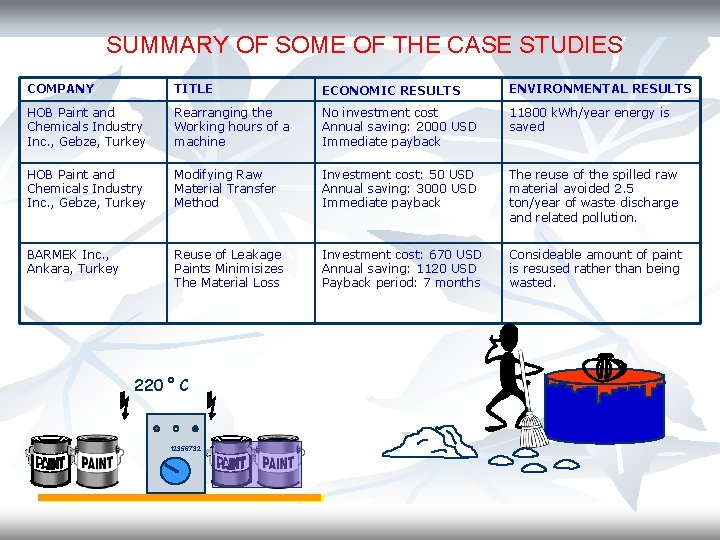
SUMMARY OF SOME OF THE CASE STUDIES COMPANY TITLE ECONOMIC RESULTS ENVIRONMENTAL RESULTS HOB Paint and Chemicals Industry Inc. , Gebze, Turkey Rearranging the Working hours of a machine No investment cost Annual saving: 2000 USD Immediate payback 11800 k. Wh/year energy is saved HOB Paint and Chemicals Industry Inc. , Gebze, Turkey Modifying Raw Material Transfer Method Investment cost: 50 USD Annual saving: 3000 USD Immediate payback The reuse of the spilled raw material avoided 2. 5 ton/year of waste discharge and related pollution. BARMEK Inc. , Ankara, Turkey Reuse of Leakage Paints Minimisizes The Material Loss Investment cost: 670 USD Annual saving: 1120 USD Payback period: 7 months Consideable amount of paint is resused rather than being wasted. 220 ° C 12356732
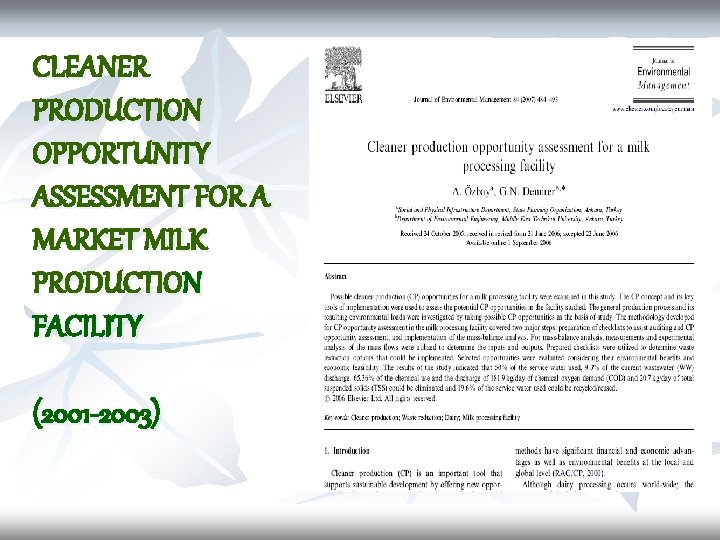
CLEANER PRODUCTION OPPORTUNITY ASSESSMENT FOR A MARKET MILK PRODUCTION FACILITY (2001 -2003)
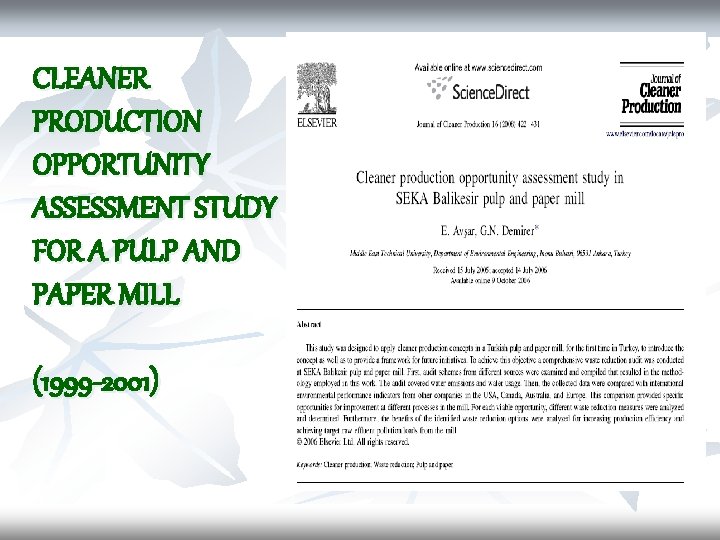
CLEANER PRODUCTION OPPORTUNITY ASSESSMENT STUDY FOR A PULP AND PAPER MILL (1999 -2001)
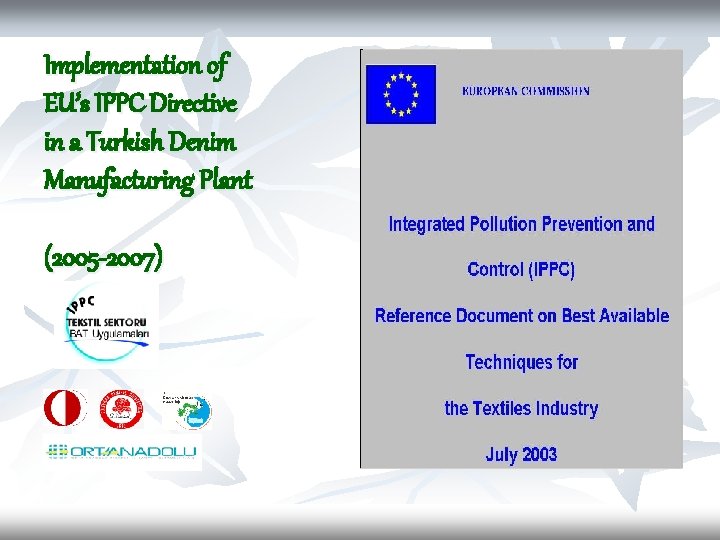
Implementation of EU’s IPPC Directive in a Turkish Denim Manufacturing Plant (2005 -2007)
MICROTRAINING: SUSTAINABLE TECHNOLOGICAL INNOVATION PARTNERS Delft University of Technology, The Netherlands Technical University of Catalonia, Spain Aachen University, Germany. Middle East Technical University, Turkey Royal Institute of Technology/KTH, Sweden
Parallel Development of Industrial Productivity and Environmental Performance at SME’s Level (2007 -) in cooperation with Turkish National Productivity Center and Çankaya University
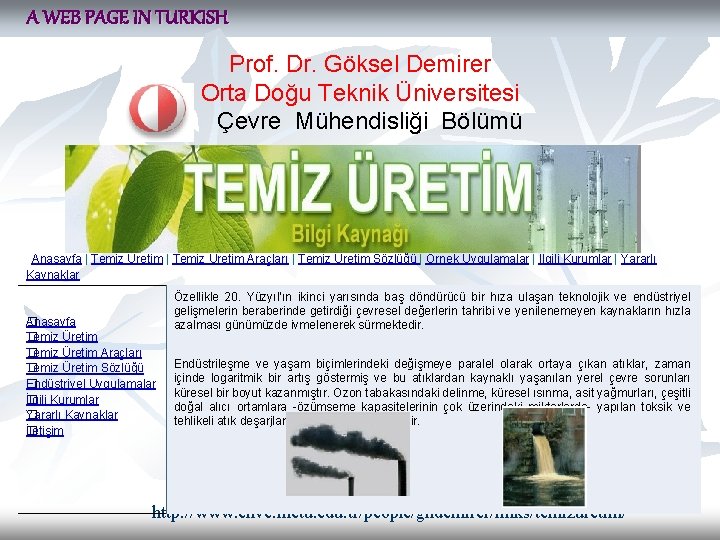
A WEB PAGE IN TURKISH Prof. Dr. Göksel Demirer Orta Doğu Teknik Üniversitesi Çevre Mühendisliği Bölümü Anasayfa | Temiz Üretim Araçları | Temiz Üretim Sözlüğü | Örnek Uygulamalar | İlgili Kurumlar | Yararlı Kaynaklar �nasayfa A Temiz Üretim � Temiz Üretim Araçları � Temiz Üretim Sözlüğü � Endüstriyel Uygulamalar � İlgili Kurumlar � Yararlı Kaynaklar � İletişim � Özellikle 20. Yüzyıl’ın ikinci yarısında baş döndürücü bir hıza ulaşan teknolojik ve endüstriyel gelişmelerin beraberinde getirdiği çevresel değerlerin tahribi ve yenilenemeyen kaynakların hızla azalması günümüzde ivmelenerek sürmektedir. Endüstrileşme ve yaşam biçimlerindeki değişmeye paralel olarak ortaya çıkan atıklar, zaman içinde logaritmik bir artış göstermiş ve bu atıklardan kaynaklı yaşanılan yerel çevre sorunları küresel bir boyut kazanmıştır. Ozon tabakasındaki delinme, küresel ısınma, asit yağmurları, çeşitli doğal alıcı ortamlara -özümseme kapasitelerinin çok üzerindeki miktarlarda- yapılan toksik ve tehlikeli atık deşarjları bu kapsamda sayılabilir. http: //www. enve. metu. edu. tr/people/gndemirer/links/temizuretim/
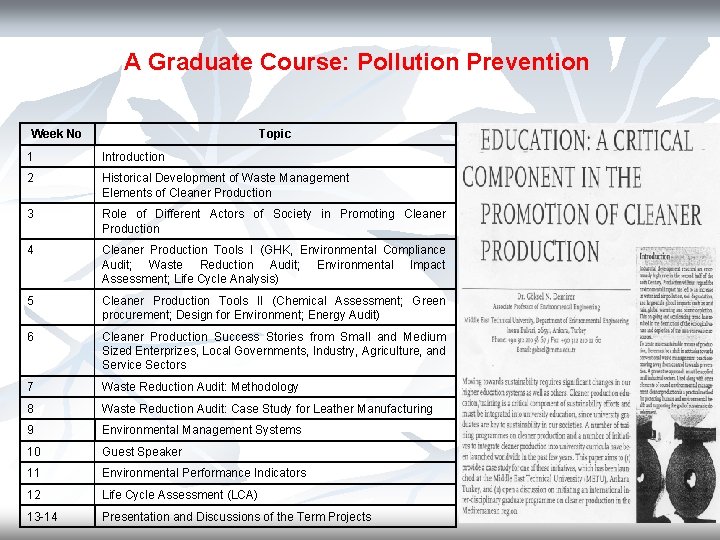
A Graduate Course: Pollution Prevention Week No Topic 1 Introduction 2 Historical Development of Waste Management Elements of Cleaner Production 3 Role of Different Actors of Society in Promoting Cleaner Production 4 Cleaner Production Tools I (GHK, Environmental Compliance Audit; Waste Reduction Audit; Environmental Impact Assessment; Life Cycle Analysis) 5 Cleaner Production Tools II (Chemical Assessment; Green procurement; Design for Environment; Energy Audit) 6 Cleaner Production Success Stories from Small and Medium Sized Enterprizes, Local Governments, Industry, Agriculture, and Service Sectors 7 Waste Reduction Audit: Methodology 8 Waste Reduction Audit: Case Study for Leather Manufacturing 9 Environmental Management Systems 10 Guest Speaker 11 Environmental Performance Indicators 12 Life Cycle Assessment (LCA) 13 -14 Presentation and Discussions of the Term Projects
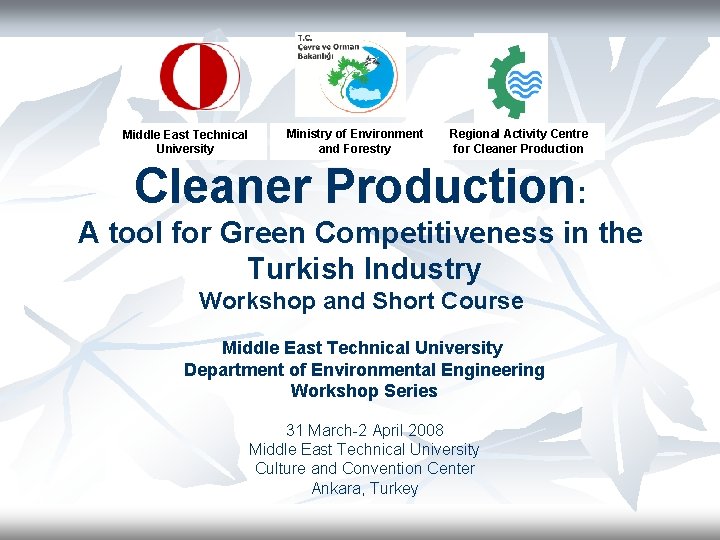
Middle East Technical University Ministry of Environment and Forestry Regional Activity Centre for Cleaner Production: A tool for Green Competitiveness in the Turkish Industry Workshop and Short Course Middle East Technical University Department of Environmental Engineering Workshop Series 31 March-2 April 2008 Middle East Technical University Culture and Convention Center Ankara, Turkey
THANK YOU FOR YOUR PARTICIPATION Prof. Dr. Göksel N. Demirer Middle East Technical University Department of Environmental Engineering Inönü Bulvari, 06531 Ankara-TURKEY Phone: +90 -312 -210 58 67 Fax: +90 -312 -210 26 46 E. mail: goksel@metu. edu. tr http: //www. enve. metu. edu. tr
- Slides: 44