
Production and Operations Management Systems Chapter 7 Project

- Slides: 25
Production and Operations Management Systems Chapter 7: Project Management Sushil K. Gupta Martin K. Starr 2014 1
After reading this chapter, you should be able to (continued): Ø Draw project network diagrams. Ø Find critical paths and project durations. Ø Calculate early start, early finish, late start and late finish times of activities. Ø Explain how to use forward-pass calculations to determine the shortest feasible time for project completion. Ø Explain how to use backward-pass calculations to determine which project activities are on the critical path. 2
After reading this chapter, you should be able to (continued): Ø Describe what slack means; explain how to derive it. Ø Crash activities (including multiple paths) to reduce project duration; perform time-cost tradeoff analysis. Ø Analyze probabilistic projects; explain when deterministic and probabilistic estimates for activity times apply. Ø Show to use optimistic and pessimistic activity time estimates to obtain a variance measure for activity times. Ø Identify implications of limited resources. 3
Introduction Projects consist of a set of goal-oriented activities that end when the goal is achieved. Such undertakings are time-based endeavors and have a finite planning horizon. Projects are special work configurations designed to accomplish singular or nearly singular goals. Examples include: putting on one play, writing new software, constructing a building, launching a new product, redesigning an established traditional hotel, and developing a new service etc. In this presentation we discuss management of projects. 4
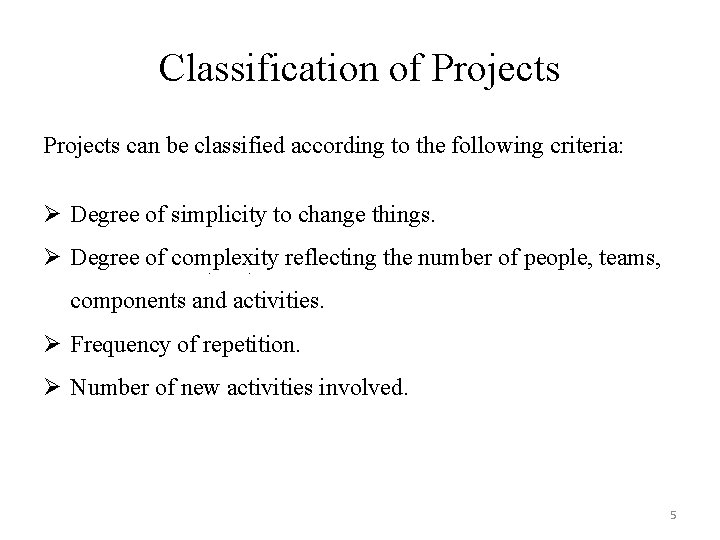
Classification of Projects can be classified according to the following criteria: Ø Degree of simplicity to change things. Ø Degree of complexity reflecting the number of people, teams, . . components and activities. Ø Frequency of repetition. Ø Number of new activities involved. 5
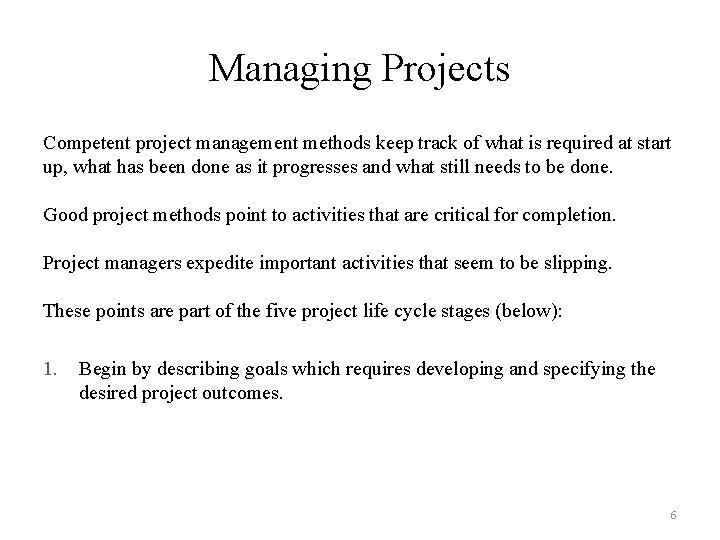
Managing Projects Competent project management methods keep track of what is required at start up, what has been done as it progresses and what still needs to be done. Good project methods point to activities that are critical for completion. Project managers expedite important activities that seem to be slipping. These points are part of the five project life cycle stages (below): 1. Begin by describing goals which requires developing and specifying the desired project outcomes. 6
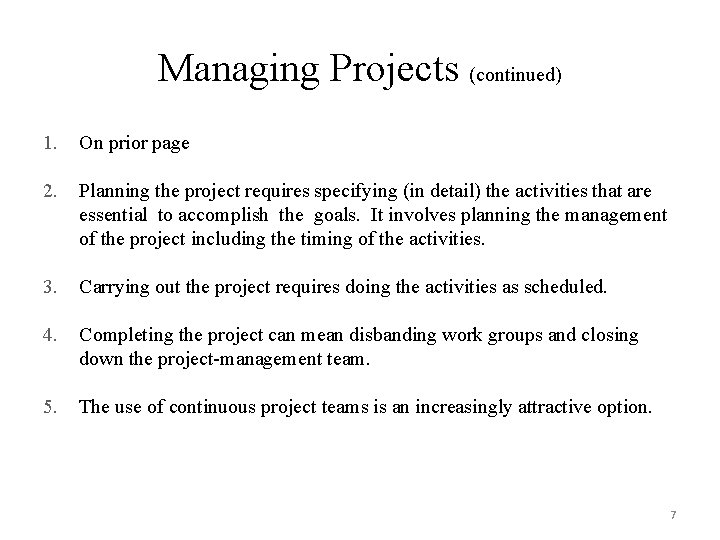
Managing Projects (continued) 1. On prior page 2. Planning the project requires specifying (in detail) the activities that are essential to accomplish the goals. It involves planning the management of the project including the timing of the activities. 3. Carrying out the project requires doing the activities as scheduled. 4. Completing the project can mean disbanding work groups and closing down the project-management team. 5. The use of continuous project teams is an increasingly attractive option. 7
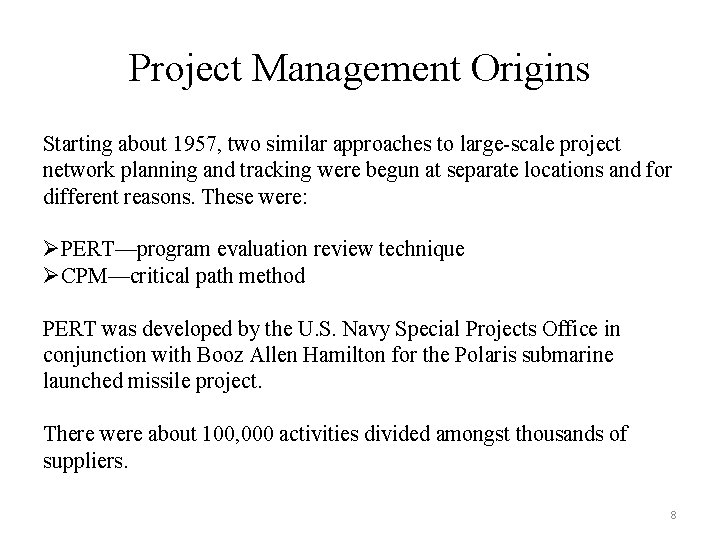
Project Management Origins Starting about 1957, two similar approaches to large-scale project network planning and tracking were begun at separate locations and for different reasons. These were: ØPERT—program evaluation review technique ØCPM—critical path method PERT was developed by the U. S. Navy Special Projects Office in conjunction with Booz Allen Hamilton for the Polaris submarine launched missile project. There were about 100, 000 activities divided amongst thousands of suppliers. 8
Project Management Origins (continued) CPM was a similar method developed by Du. Pont and Remington Rand, which later became Unisys. It was used to design and coordinate chemical plant operations. The essential difference between PERT and CPM is in specifying the times for performing various activities. PERT was used for projects where the activity times were not certain because project managers were unfamiliar with the activities. On the other hand the projects and activities were familiar to the project managers in the case of CPM. These days the distinction between PERT and CPM seems to be disappearing and together these are called PERT/CPM or simply network techniques. These two methods share the notion of a critical path as discussed later in the chapter. 9
Project Network The following steps are required to utilize these network models. Make a list of all activities that are required to complete the project. Establish the precedence relationships among activities and document the rationale for these relationships. Estimate the time to perform each task or activity using one of the following two options. Ø Option 1: deterministic estimates for activity times. Ø Option 2: probabilistic estimates for activity times. Draw the precedence diagram (of project activities). Develop a project schedule. 10
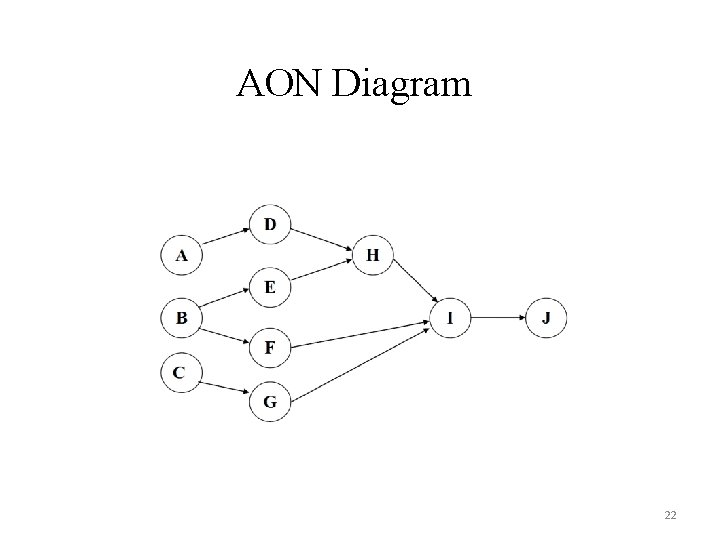
Project Management Example Activity Immediate Predecessors Immediate Followers Time (Weeks) A B C D E F G H I J None A B B C D, E F, G, H I D E, F G H H I I I J None 9 5 7 12 8 6 11 5 4 10 Activity on Node (AON) Diagram Note: Either Immediate Predecessors or Immediate Followers need to be specified. 11
Finding Critical Path and Project Duration Activity Time (Weeks) A 9 B C D E F G H I J 5 7 12 8 6 11 5 4 10 12
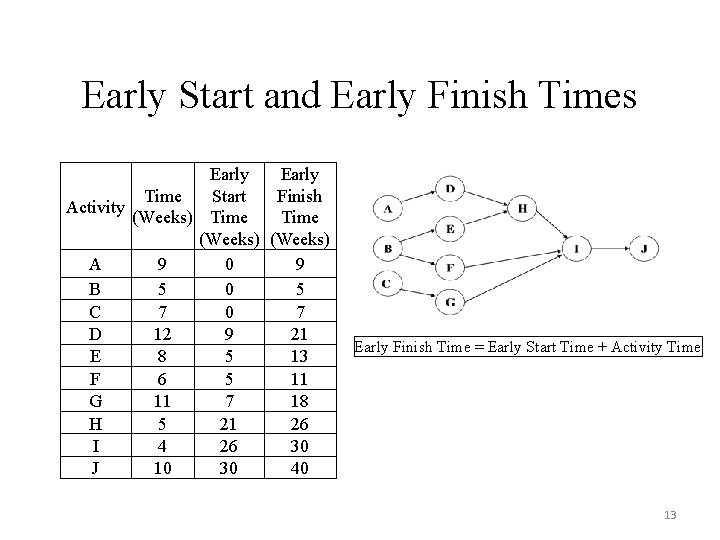
Early Start and Early Finish Times Early Time Start Finish Activity (Weeks) Time (Weeks) A 9 0 9 B 5 0 5 C 7 0 7 D 12 9 21 E 8 5 13 F 6 5 11 G 11 7 18 H 5 21 26 I 4 26 30 J 10 30 40 Early Finish Time = Early Start Time + Activity Time 13
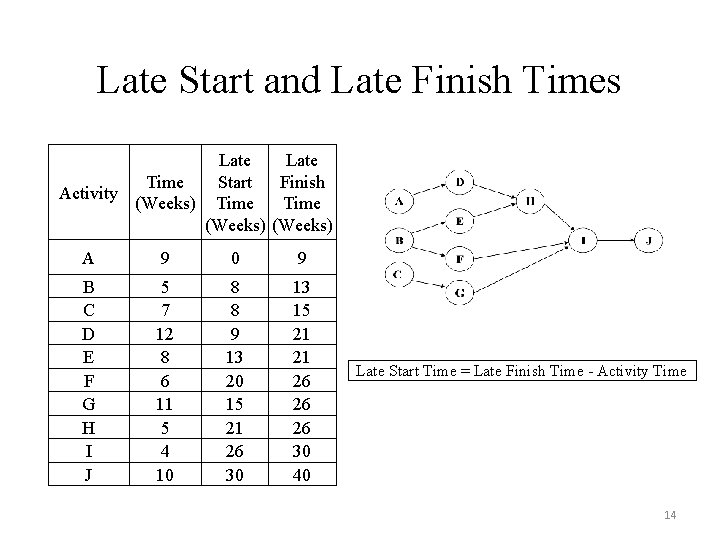
Late Start and Late Finish Times Late Time Start Finish Activity (Weeks) Time (Weeks) A 9 0 9 B C D E F G H I J 5 7 12 8 6 11 5 4 10 8 8 9 13 20 15 21 26 30 13 15 21 21 26 26 26 30 40 Late Start Time = Late Finish Time - Activity Time 14
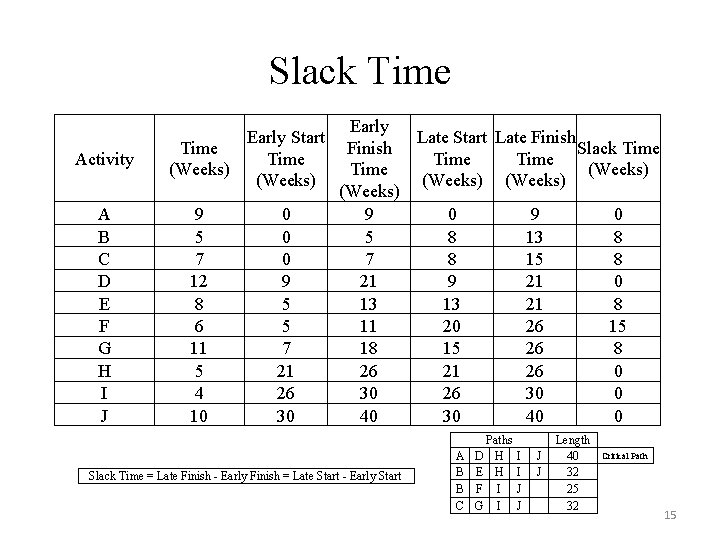
Slack Time Activity A B C D E F G H I J Early Start Late Finish Time Finish Slack Time (Weeks) Time (Weeks) (Weeks) 9 0 9 0 5 8 13 8 7 0 7 8 15 8 12 9 21 0 8 5 13 13 21 8 6 5 11 20 26 15 11 7 18 15 26 8 5 21 26 0 4 26 30 0 10 30 40 0 Slack Time = Late Finish - Early Finish = Late Start - Early Start A B B C Paths D H E H F I G I I I J J Length 40 32 25 32 Critical Path 15
Reducing Project Duration: Crashing of Activities 16
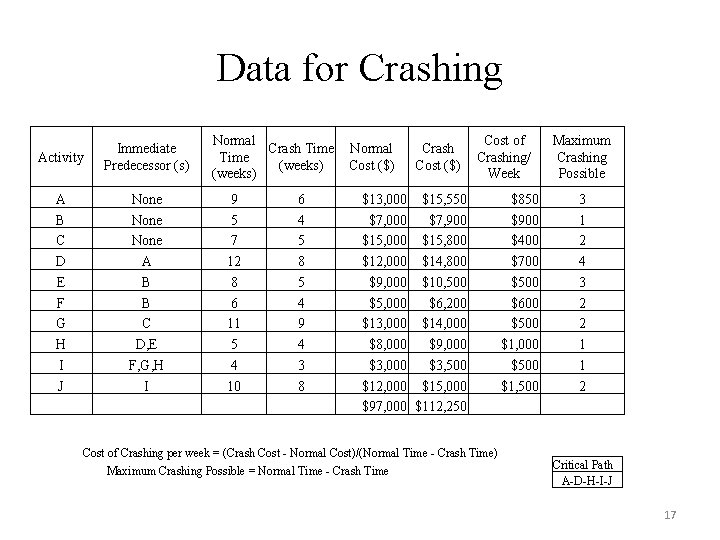
Data for Crashing Activity Immediate Predecessor (s) A B C D E F G H I J None A B B C D, E F, G, H I Normal Crash Time Normal Time (weeks) Cost ($) (weeks) 9 5 7 12 8 6 11 5 4 10 6 4 5 8 5 4 9 4 3 8 Crash Cost ($) Cost of Crashing/ Week $13, 000 $15, 550 $7, 000 $7, 900 $15, 000 $15, 800 $12, 000 $14, 800 $9, 000 $10, 500 $5, 000 $6, 200 $13, 000 $14, 000 $8, 000 $9, 000 $3, 500 $12, 000 $15, 000 $97, 000 $112, 250 Cost of Crashing per week = (Crash Cost - Normal Cost)/(Normal Time - Crash Time) Maximum Crashing Possible = Normal Time - Crash Time $850 $900 $400 $700 $500 $600 $500 $1, 000 $500 $1, 500 Maximum Crashing Possible 3 1 2 4 3 2 2 1 1 2 Critical Path A-D-H-I-J 17
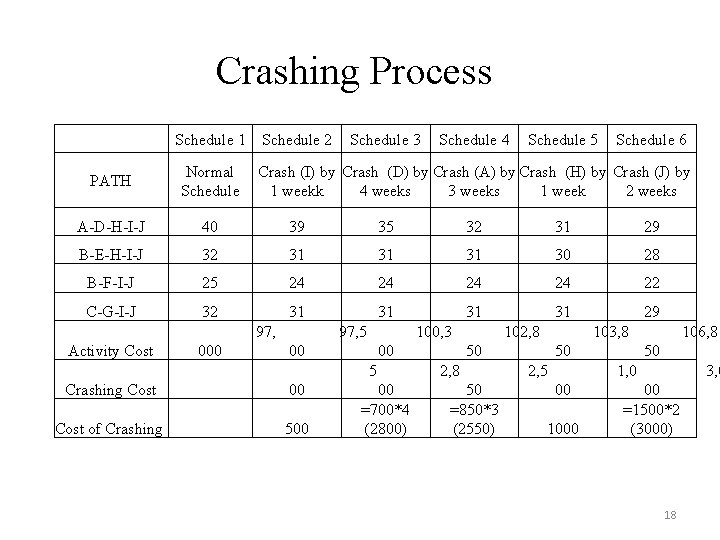
Crashing Process Schedule 1 PATH Normal Schedule A-D-H-I-J 40 39 35 32 31 29 B-E-H-I-J 32 31 31 31 30 28 B-F-I-J 25 24 24 22 C-G-I-J 32 31 31 29 97, 5 100, 3 102, 8 103, 8 106, 8 000 00 00 50 50 50 5 2, 8 2, 5 1, 0 3, 0 00 00 50 00 00 =700*4 =850*3 =1500*2 500 (2800) (2550) 1000 (3000) Activity Cost Crashing Cost of Crashing Schedule 2 Schedule 3 Schedule 4 Schedule 5 Schedule 6 Crash (I) by Crash (D) by Crash (A) by Crash (H) by Crash (J) by 1 weekk 4 weeks 3 weeks 1 week 2 weeks 18
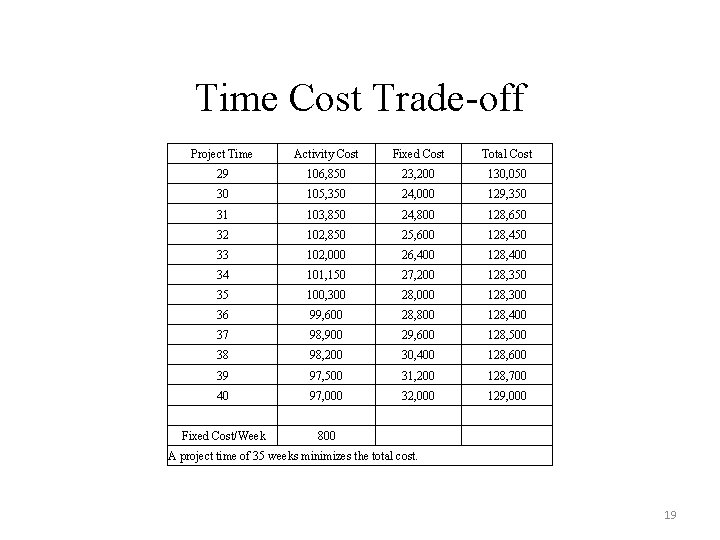
Time Cost Trade-off Project Time Activity Cost Fixed Cost Total Cost 29 106, 850 23, 200 130, 050 30 105, 350 24, 000 129, 350 31 103, 850 24, 800 128, 650 32 102, 850 25, 600 128, 450 33 102, 000 26, 400 128, 400 34 101, 150 27, 200 128, 350 35 100, 300 28, 000 128, 300 36 99, 600 28, 800 128, 400 37 98, 900 29, 600 128, 500 38 98, 200 30, 400 128, 600 39 97, 500 31, 200 128, 700 40 97, 000 32, 000 129, 000 Fixed Cost/Week 800 A project time of 35 weeks minimizes the total cost. 19
Project Management - Probabilistic 20
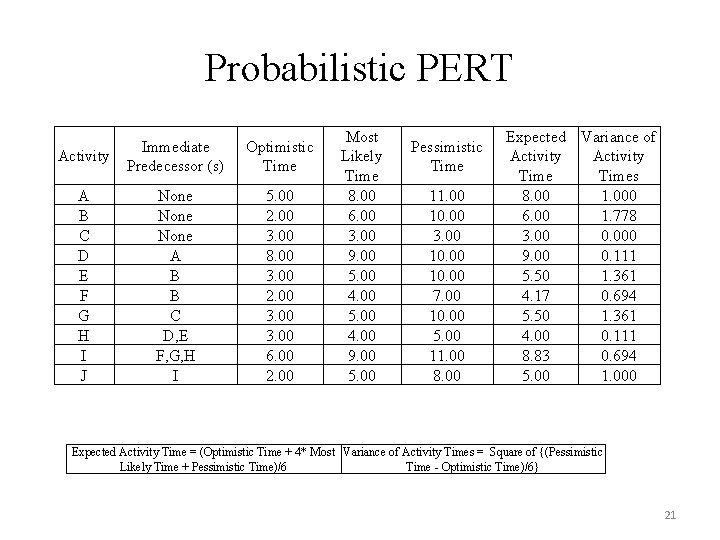
Probabilistic PERT Activity Immediate Predecessor (s) Optimistic Time A B C D E F G H I J None A B B C D, E F, G, H I 5. 00 2. 00 3. 00 8. 00 3. 00 2. 00 3. 00 6. 00 2. 00 Most Likely Time 8. 00 6. 00 3. 00 9. 00 5. 00 4. 00 9. 00 5. 00 Pessimistic Time 11. 00 10. 00 3. 00 10. 00 7. 00 10. 00 5. 00 11. 00 8. 00 Expected Variance of Activity Times 8. 00 1. 000 6. 00 1. 778 3. 00 0. 000 9. 00 0. 111 5. 50 1. 361 4. 17 0. 694 5. 50 1. 361 4. 00 0. 111 8. 83 0. 694 5. 00 1. 000 Expected Activity Time = (Optimistic Time + 4* Most Variance of Activity Times = Square of {(Pessimistic Likely Time + Pessimistic Time)/6 Time - Optimistic Time)/6} 21
AON Diagram 22
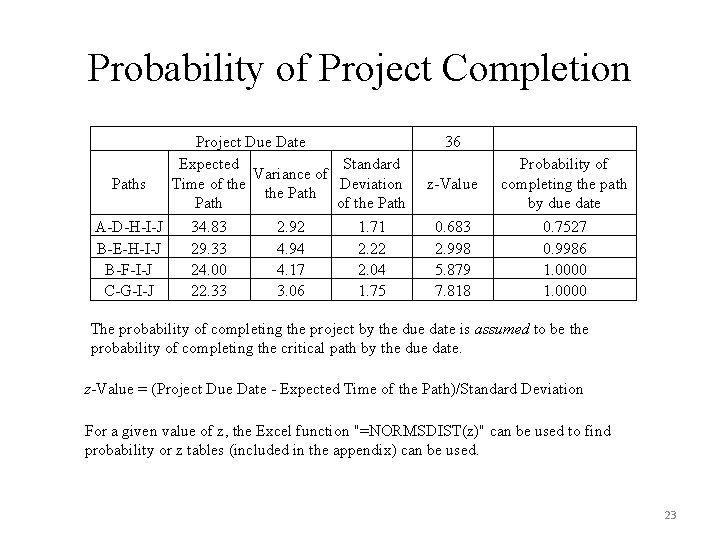
Probability of Project Completion Paths A-D-H-I-J B-E-H-I-J B-F-I-J C-G-I-J Project Due Date Expected Standard Variance of Time of the Deviation the Path of the Path 34. 83 29. 33 24. 00 22. 33 2. 92 4. 94 4. 17 3. 06 1. 71 2. 22 2. 04 1. 75 36 z-Value 0. 683 2. 998 5. 879 7. 818 Probability of completing the path by due date 0. 7527 0. 9986 1. 0000 The probability of completing the project by the due date is assumed to be the probability of completing the critical path by the due date. z-Value = (Project Due Date - Expected Time of the Path)/Standard Deviation For a given value of z, the Excel function "=NORMSDIST(z)" can be used to find probability or z tables (included in the appendix) can be used. 23
Resource Management Resource management switches extra resources from places where they are not essential to places where they could be used immediately, that is, balance resource assignments across activities over time. Resource management has two functions – resource leveling and resource scheduling. In resource leveling the goal is to minimize the fluctuations in resources required from one period to another over the life of the project. In resource scheduling it is assumed that there is an upper limit on the resources available and all activities are to be scheduled within the resource constraints. 24
Thank you 25