
PRODUCTION AND OPERATIONS MANAGEMENT Ch 5 Forecasting POM


- Slides: 45
PRODUCTION AND OPERATIONS MANAGEMENT Ch. 5: Forecasting POM - J. Galván 1
Learning Objectives n Understand techniques to foresee the future POM - J. Galván 2
What is Forecasting? ¨ Process of predicting a future event ¨ Underlying basis of all business decisions Sales will be $200 Million! Production ¨ Inventory ¨ Personnel ¨ Facilities ¨ POM - J. Galván 3
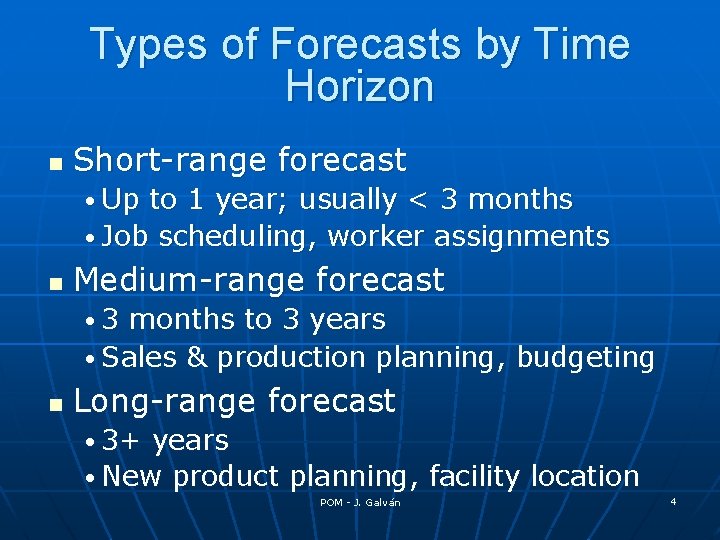
Types of Forecasts by Time Horizon n Short-range forecast • Up to 1 year; usually < 3 months • Job scheduling, worker assignments n Medium-range forecast • 3 months to 3 years • Sales & production planning, budgeting n Long-range forecast • 3+ years • New product planning, facility location POM - J. Galván 4
Short-term vs. Longer-term Forecasting n n n Medium/long range forecasts deal with more comprehensive issues and support management decisions regarding planning and products, plants and processes. Short-term forecasting usually employs different methodologies than longerterm forecasting Short-term forecasts tend to be more accurate than longer-term forecasts. POM - J. Galván 5
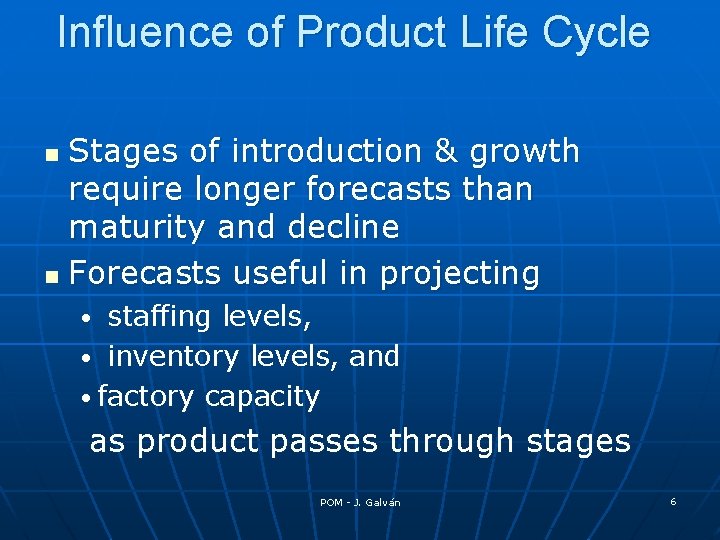
Influence of Product Life Cycle Stages of introduction & growth require longer forecasts than maturity and decline n Forecasts useful in projecting n staffing levels, • inventory levels, and • factory capacity • as product passes through stages POM - J. Galván 6
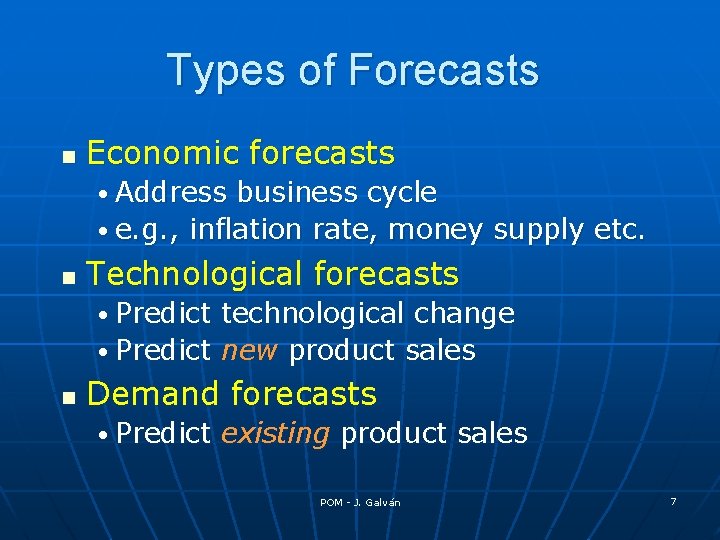
Types of Forecasts n Economic forecasts • Address business cycle • e. g. , inflation rate, money supply etc. n Technological forecasts • Predict technological change • Predict new product sales n Demand forecasts • Predict existing product sales POM - J. Galván 7
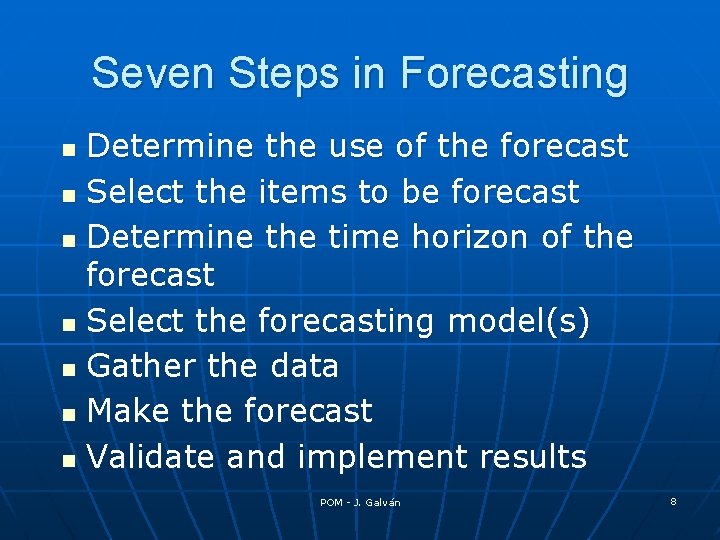
Seven Steps in Forecasting Determine the use of the forecast n Select the items to be forecast n Determine the time horizon of the forecast n Select the forecasting model(s) n Gather the data n Make the forecast n Validate and implement results n POM - J. Galván 8
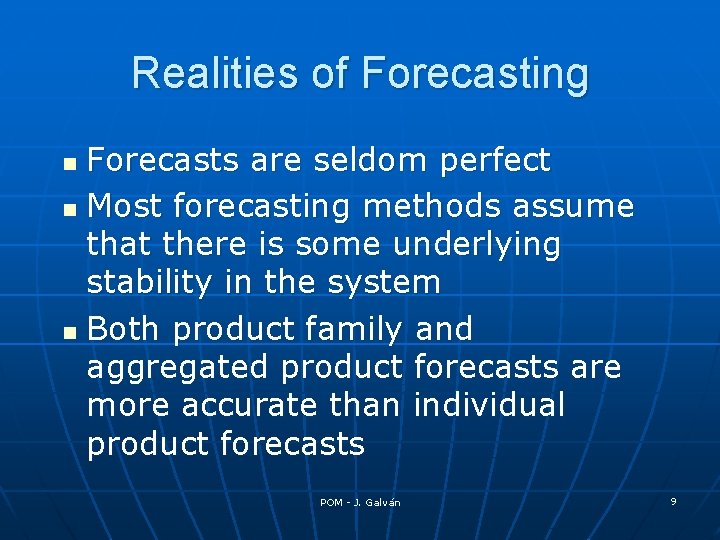
Realities of Forecasting Forecasts are seldom perfect n Most forecasting methods assume that there is some underlying stability in the system n Both product family and aggregated product forecasts are more accurate than individual product forecasts n POM - J. Galván 9
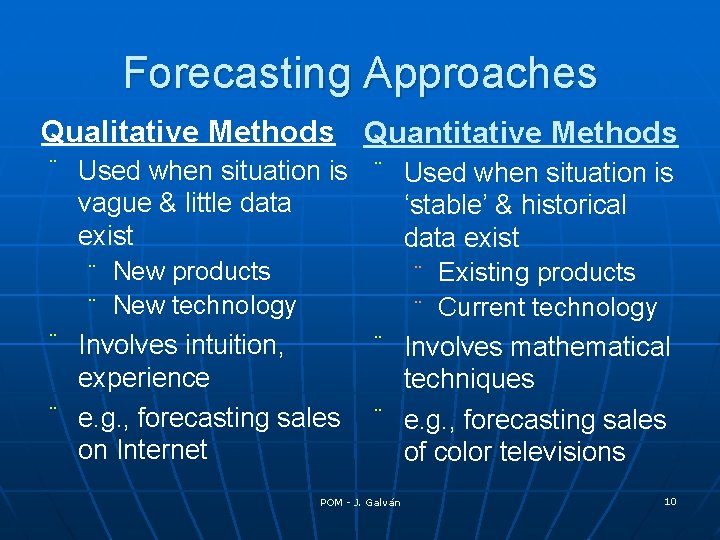
Forecasting Approaches Qualitative Methods Quantitative Methods ¨ Used when situation is vague & little data ‘stable’ & historical exist data exist New products ¨ New technology Existing products ¨ Current technology ¨ ¨ ¨ Involves intuition, experience ¨ e. g. , forecasting sales on Internet ¨ Involves mathematical techniques ¨ e. g. , forecasting sales of color televisions POM - J. Galván 10
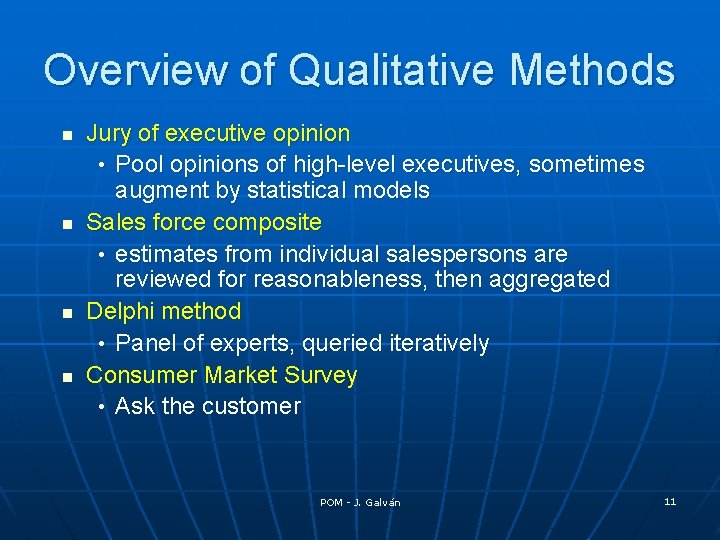
Overview of Qualitative Methods n n Jury of executive opinion • Pool opinions of high-level executives, sometimes augment by statistical models Sales force composite • estimates from individual salespersons are reviewed for reasonableness, then aggregated Delphi method • Panel of experts, queried iteratively Consumer Market Survey • Ask the customer POM - J. Galván 11
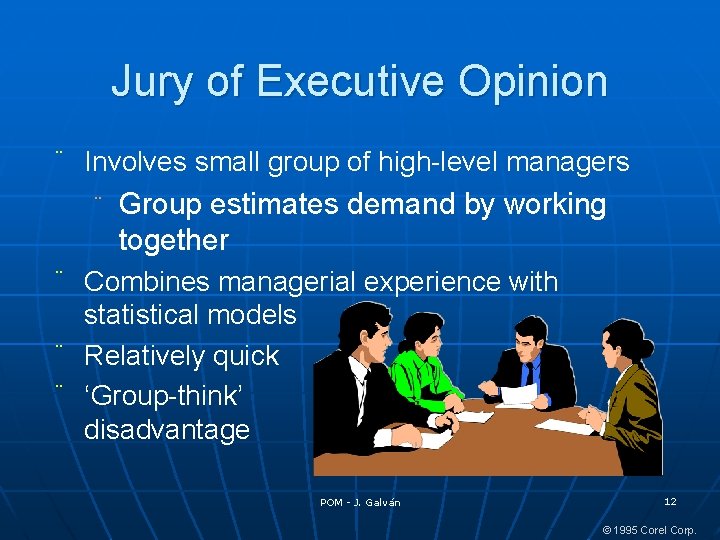
Jury of Executive Opinion ¨ Involves small group of high-level managers ¨ Group estimates demand by working together ¨ Combines managerial experience with statistical models ¨ Relatively quick ¨ ‘Group-think’ disadvantage POM - J. Galván 12 © 1995 Corel Corp.
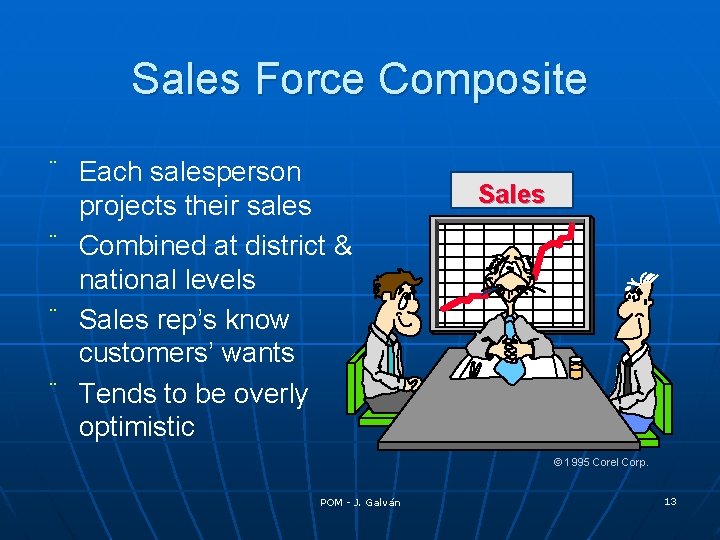
Sales Force Composite ¨ Each salesperson projects their sales ¨ Combined at district & national levels ¨ Sales rep’s know customers’ wants ¨ Tends to be overly optimistic Sales © 1995 Corel Corp. POM - J. Galván 13
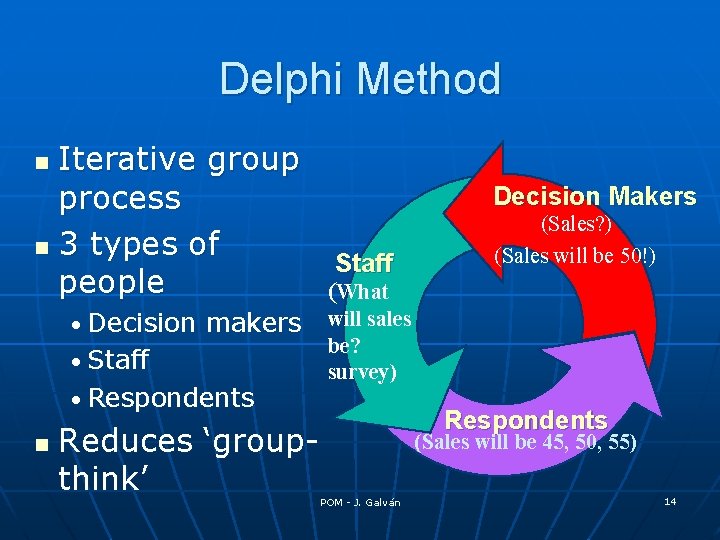
Delphi Method Iterative group process n 3 types of Staff people (What n • Decision (Sales? ) (Sales will be 50!) makers will sales be? survey) • Staff • Respondents n Decision Makers Reduces ‘groupthink’ POM - J. Galván Respondents (Sales will be 45, 50, 55) 14
Consumer Market Survey ¨ Ask customers about purchasing plans ¨ What consumers say, and what they actually do are often different ¨ Sometimes difficult to answer How many hours will you use the Internet next week? © 1995 Corel Corp. POM - J. Galván 15
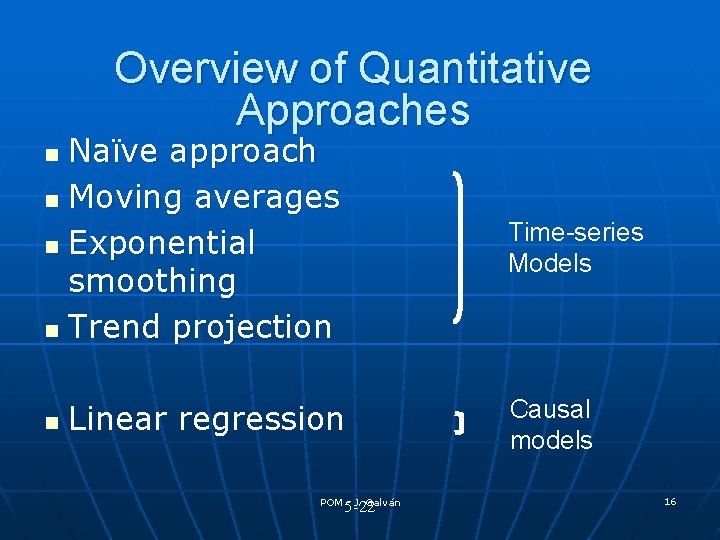
Overview of Quantitative Approaches Naïve approach n Moving averages n Exponential smoothing n Trend projection n n Time-series Models Linear regression POM - J. Galván 5 -22 Causal models 16
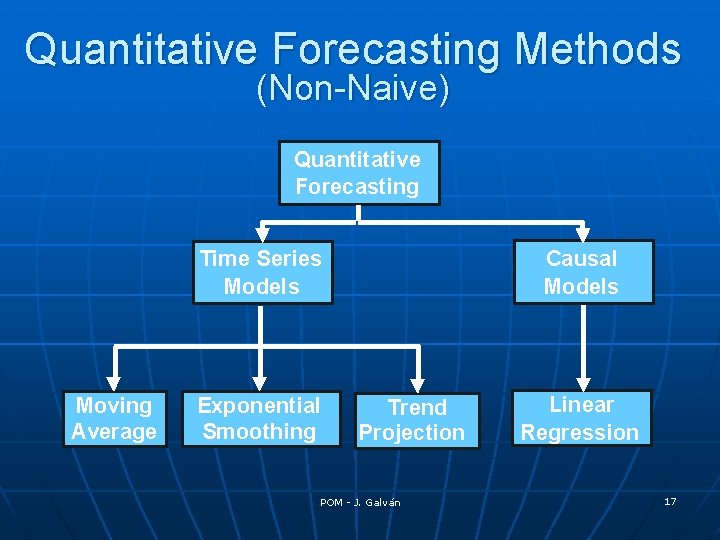
Quantitative Forecasting Methods (Non-Naive) Quantitative Forecasting Causal Models Time Series Models Moving Average Exponential Smoothing Trend Projection POM - J. Galván Linear Regression 17
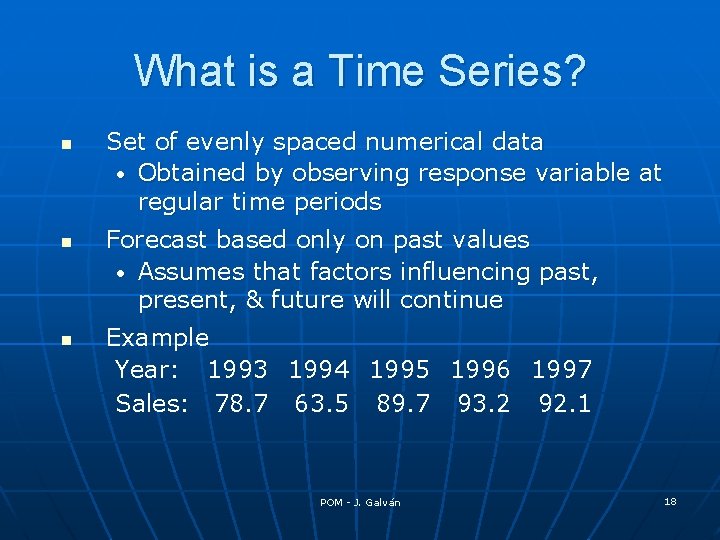
What is a Time Series? n n n Set of evenly spaced numerical data • Obtained by observing response variable at regular time periods Forecast based only on past values • Assumes that factors influencing past, present, & future will continue Example Year: 1993 1994 1995 1996 1997 Sales: 78. 7 63. 5 89. 7 93. 2 92. 1 POM - J. Galván 18
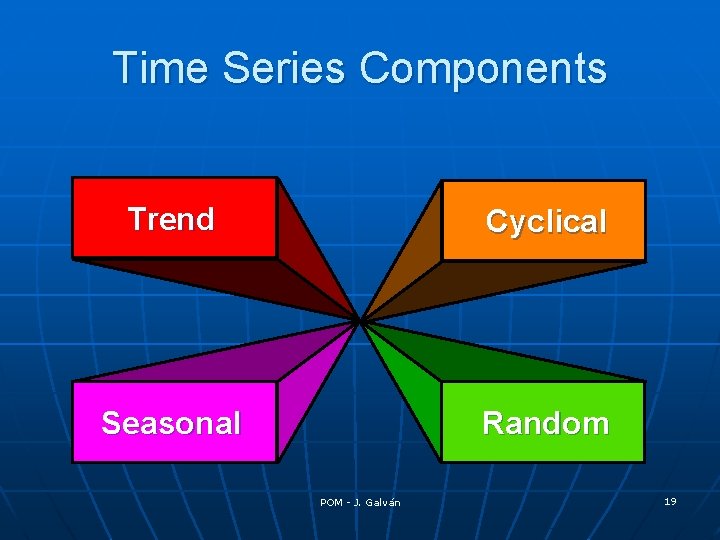
Time Series Components Trend Cyclical Seasonal Random POM - J. Galván 19
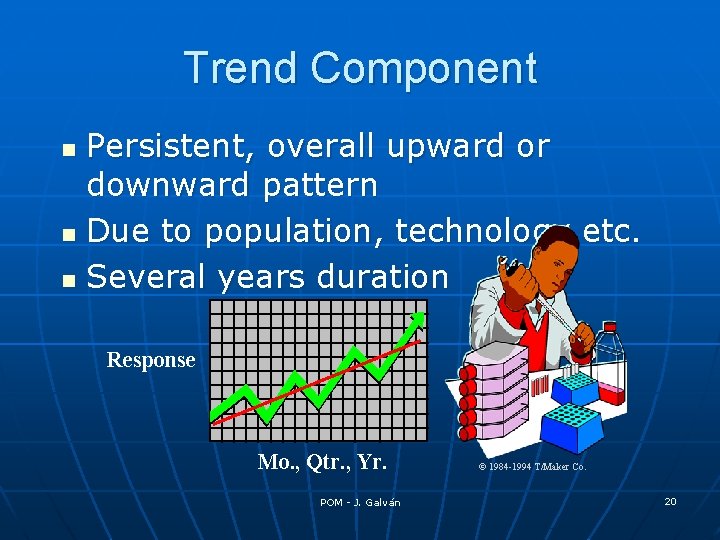
Trend Component Persistent, overall upward or downward pattern n Due to population, technology etc. n Several years duration n Response Mo. , Qtr. , Yr. POM - J. Galván © 1984 -1994 T/Maker Co. 20
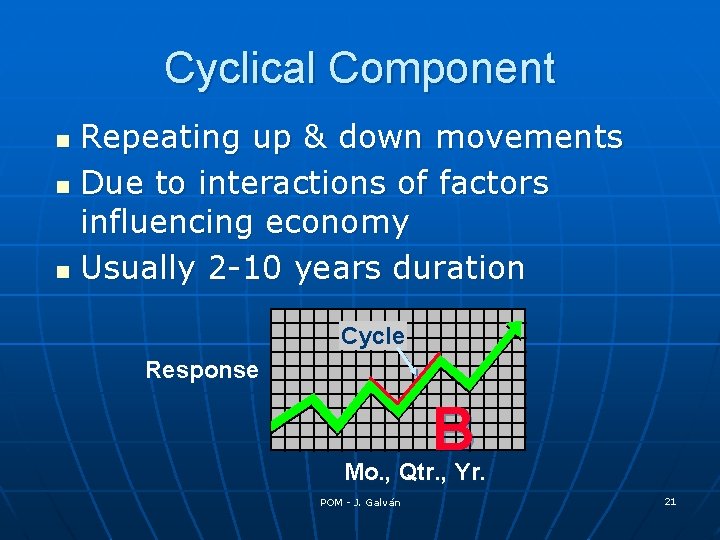
Cyclical Component Repeating up & down movements n Due to interactions of factors influencing economy n Usually 2 -10 years duration n Cycle Response B Mo. , Qtr. , Yr. POM - J. Galván 21
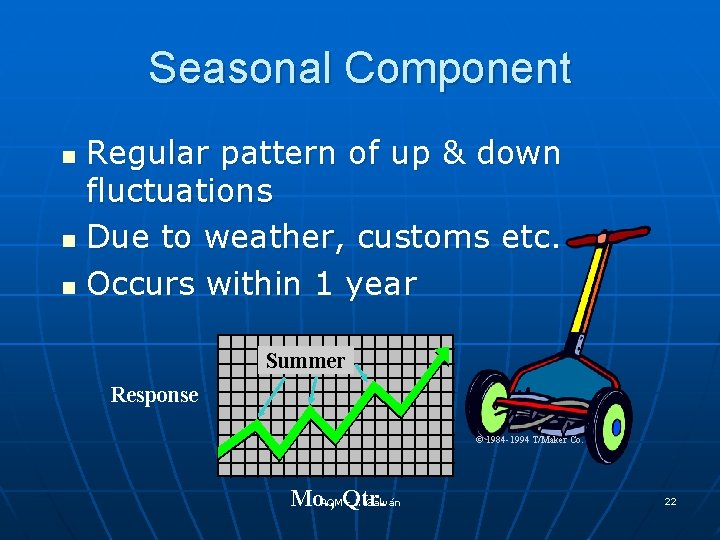
Seasonal Component Regular pattern of up & down fluctuations n Due to weather, customs etc. n Occurs within 1 year n Summer Response © 1984 -1994 T/Maker Co. POMQtr. - J. Galván Mo. , 22
Random Component Erratic, unsystematic, ‘residual’ fluctuations n Due to random variation or unforeseen events n • Union strike • Tornado n Short duration & nonrepeating POM - J. Galván 23
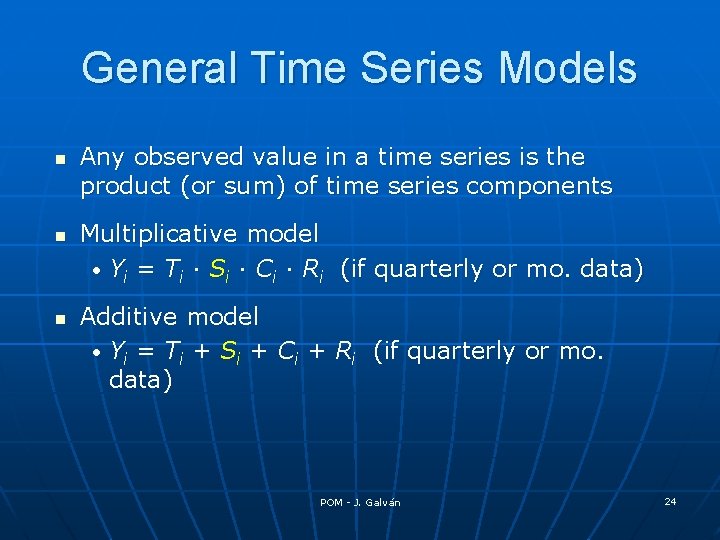
General Time Series Models n n n Any observed value in a time series is the product (or sum) of time series components Multiplicative model • Yi = Ti · Si · Ci · Ri (if quarterly or mo. data) Additive model • Yi = Ti + Si + Ci + Ri (if quarterly or mo. data) POM - J. Galván 24
Naive Approach ¨ Assumes demand in next period is the same as demand in most recent period ¨ e. g. , If May sales were 48, then June sales will be 48 ¨ Sometimes cost effective & efficient © 1995 Corel Corp. POM - J. Galván 25
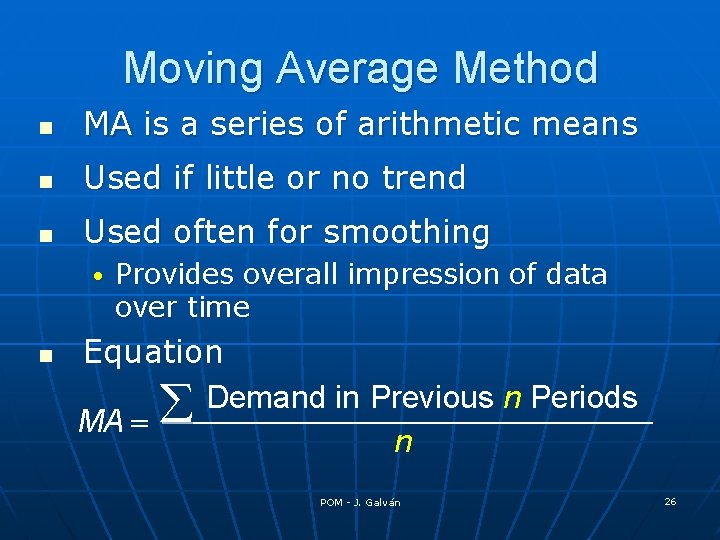
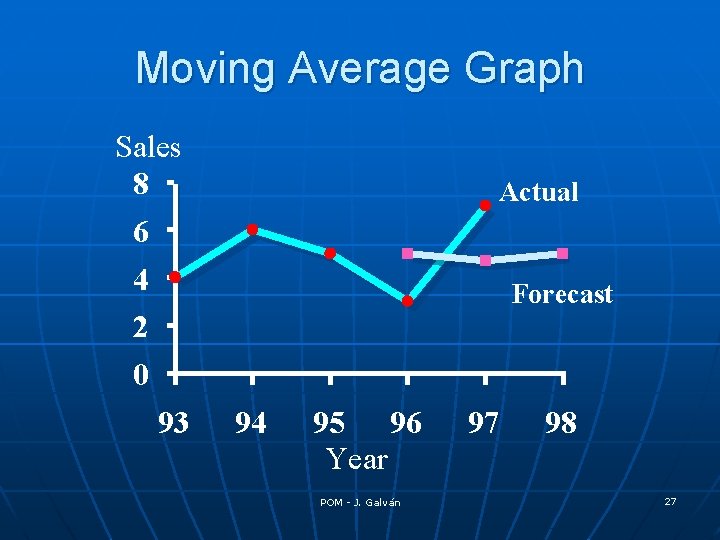
Moving Average Method n MA is a series of arithmetic means n Used if little or no trend n Used often for smoothing • n Provides overall impression of data over time Equation Demand in Previous n Periods å MA = n POM - J. Galván 26
Moving Average Graph Sales 8 6 4 2 0 93 Actual Forecast 94 95 96 Year POM - J. Galván 97 98 27
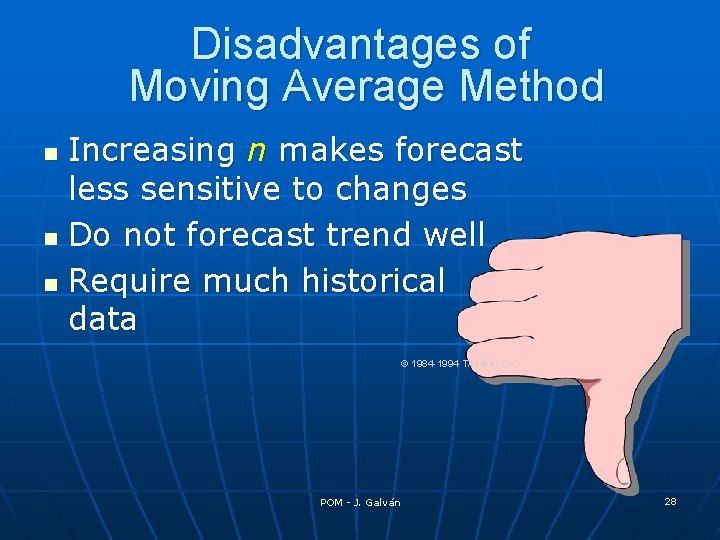
Disadvantages of Moving Average Method Increasing n makes forecast less sensitive to changes n Do not forecast trend well n Require much historical data n © 1984 -1994 T/Maker Co. POM - J. Galván 28
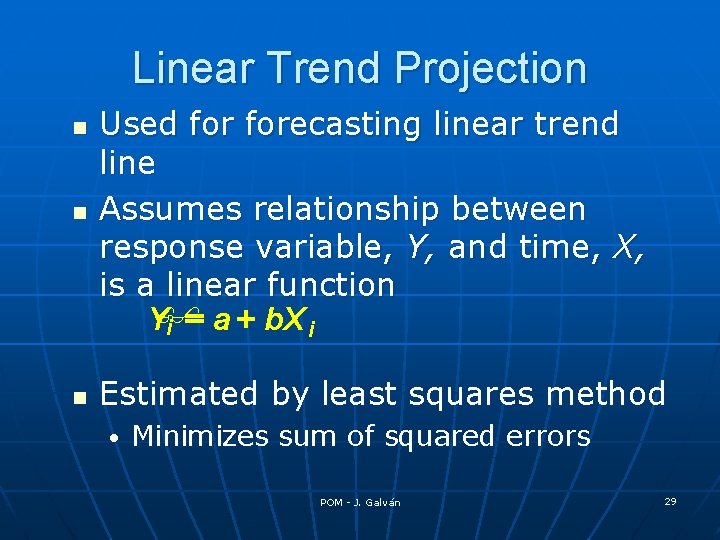
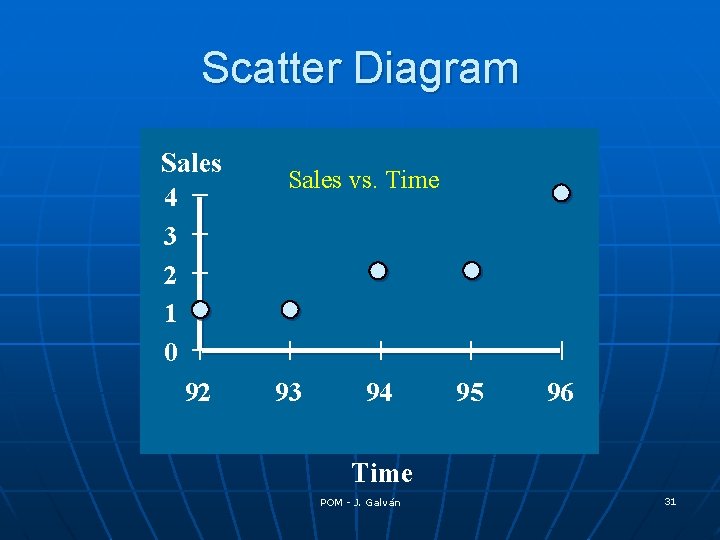
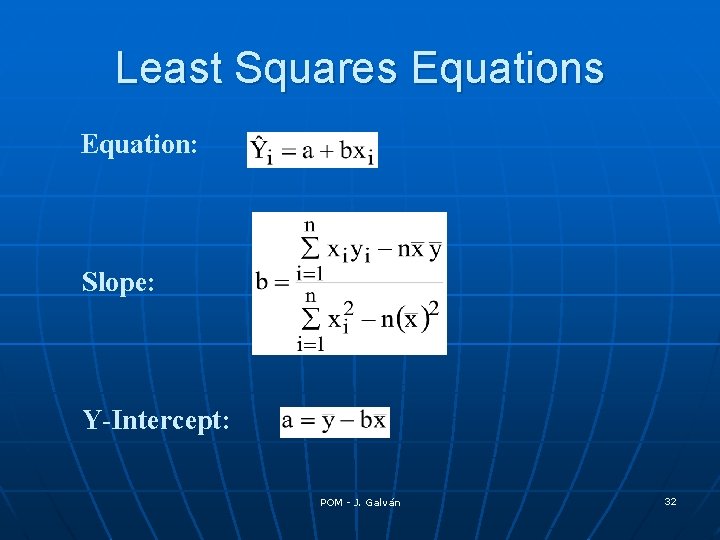
Linear Trend Projection n Used forecasting linear trend line Assumes relationship between response variable, Y, and time, X, is a linear function Y$ i = a + b. X i n Estimated by least squares method n • Minimizes sum of squared errors POM - J. Galván 29
Scatter Diagram Sales 4 3 2 1 0 92 Sales vs. Time 93 94 95 96 Time POM - J. Galván 31
Least Squares Equation: Slope: Y-Intercept: POM - J. Galván 32
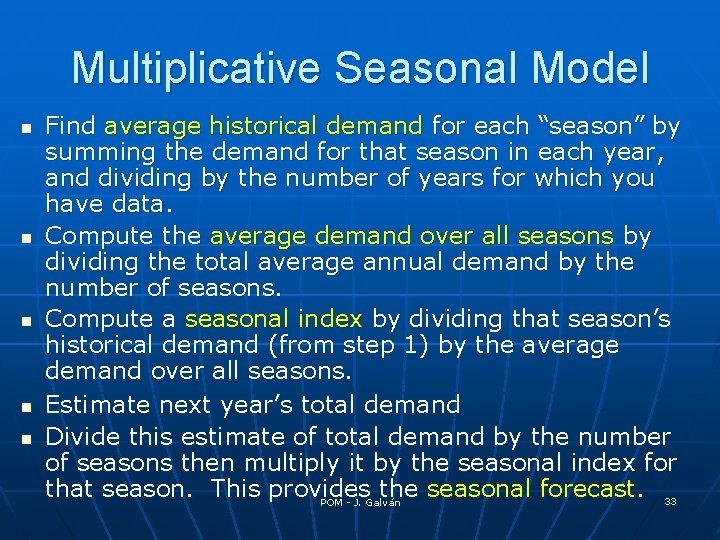
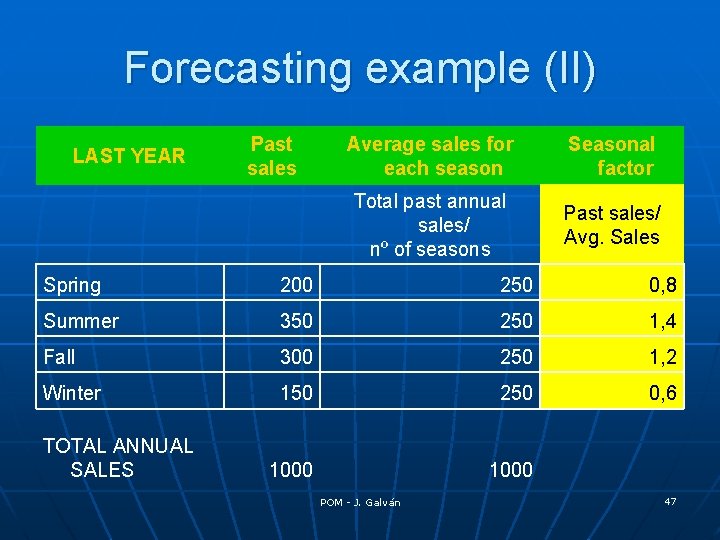
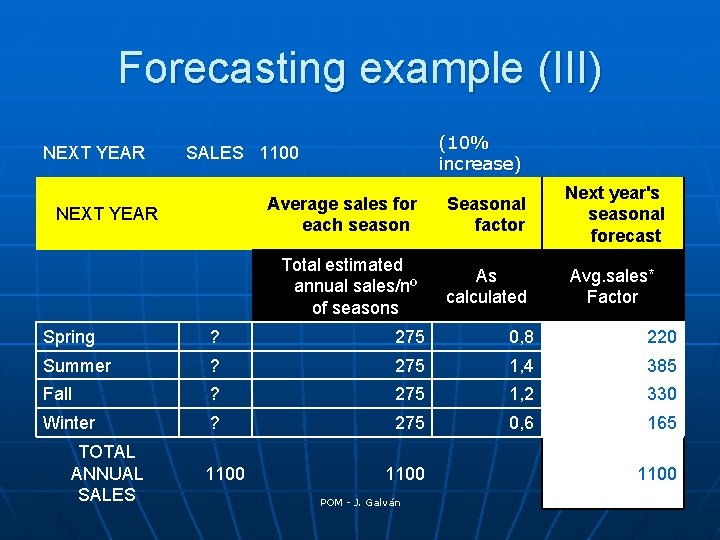
Multiplicative Seasonal Model n n n Find average historical demand for each “season” by summing the demand for that season in each year, and dividing by the number of years for which you have data. Compute the average demand over all seasons by dividing the total average annual demand by the number of seasons. Compute a seasonal index by dividing that season’s historical demand (from step 1) by the average demand over all seasons. Estimate next year’s total demand Divide this estimate of total demand by the number of seasons then multiply it by the seasonal index for that season. This provides the seasonal forecast. 33 POM - J. Galván
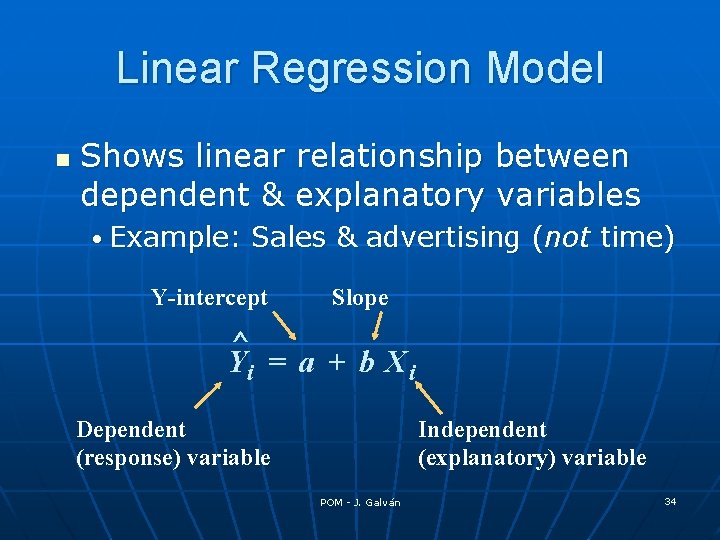
Linear Regression Model n Shows linear relationship between dependent & explanatory variables • Example: Sales & advertising (not time) Y-intercept Slope ^ Yi = a + b X i Dependent (response) variable Independent (explanatory) variable POM - J. Galván 34
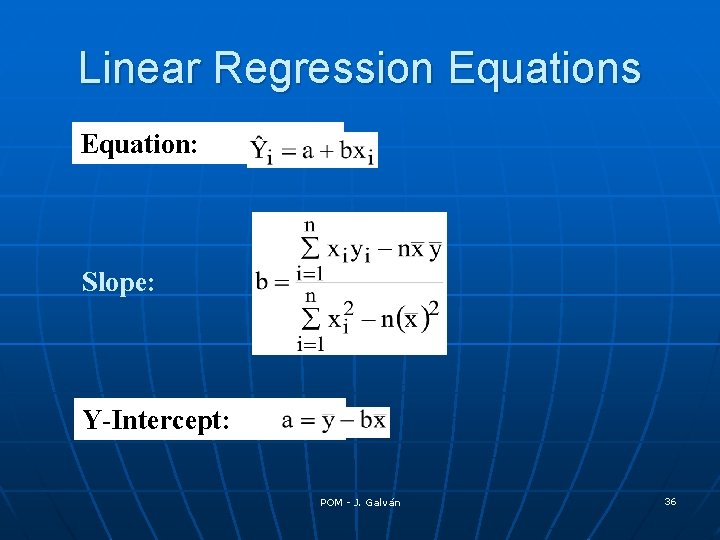
Linear Regression Equations Equation: Slope: Y-Intercept: POM - J. Galván 36
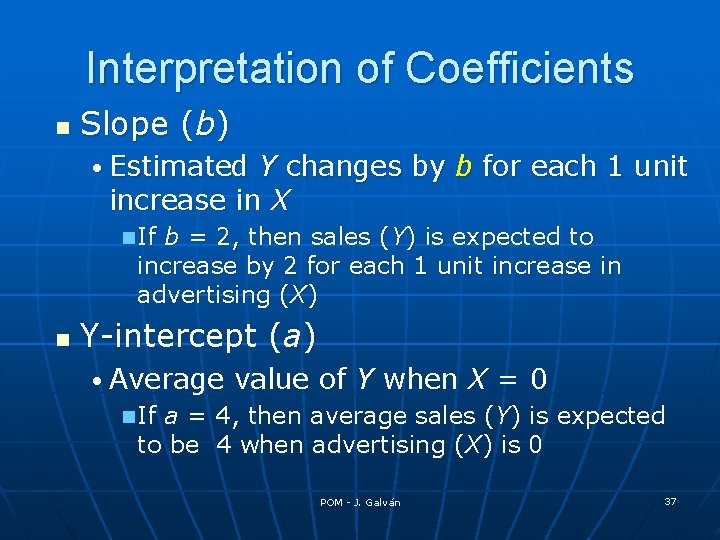
Interpretation of Coefficients n Slope (b) • Estimated Y changes by b for each 1 unit increase in X n If b = 2, then sales (Y) is expected to increase by 2 for each 1 unit increase in advertising (X) n Y-intercept (a) • Average value of Y when X = 0 n If a = 4, then average sales (Y) is expected to be 4 when advertising (X) is 0 POM - J. Galván 37
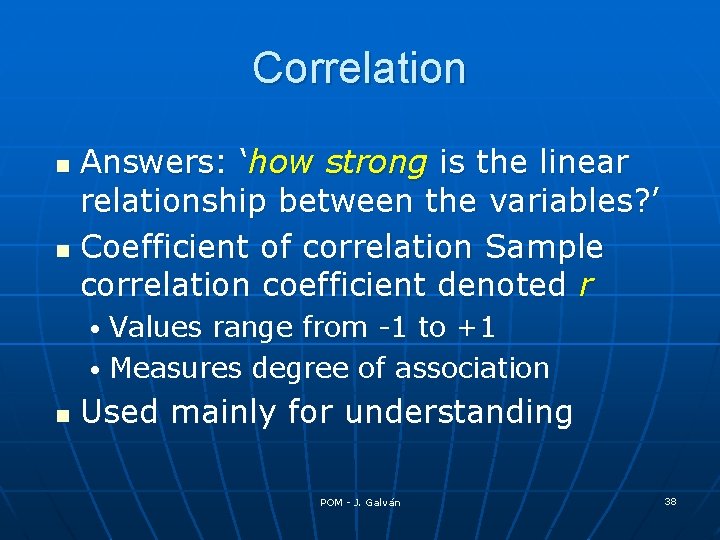
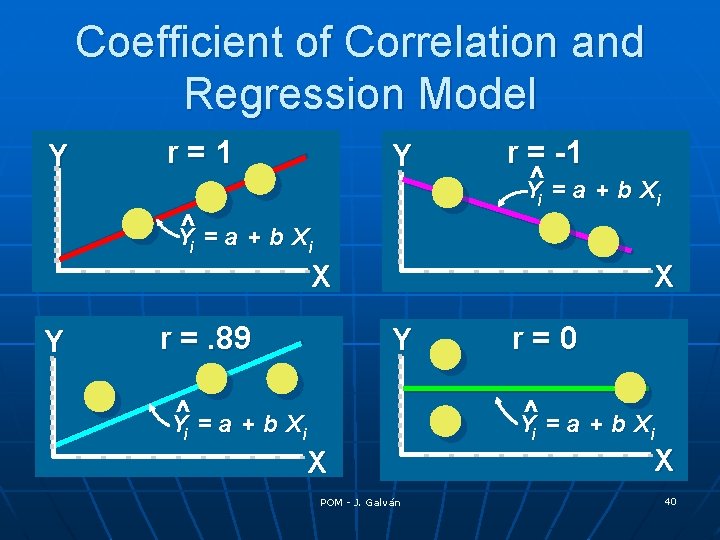
Correlation Answers: ‘how strong is the linear relationship between the variables? ’ n Coefficient of correlation Sample correlation coefficient denoted r n Values range from -1 to +1 • Measures degree of association • n Used mainly for understanding POM - J. Galván 38
Coefficient of Correlation and Regression Model Y r=1 Y ^=a +b X Y i i r = -1 ^=a +b X Y i i X Y r =. 89 X Y ^=a +b X Y i i r=0 ^=a +b X Y i i X POM - J. Galván X 40
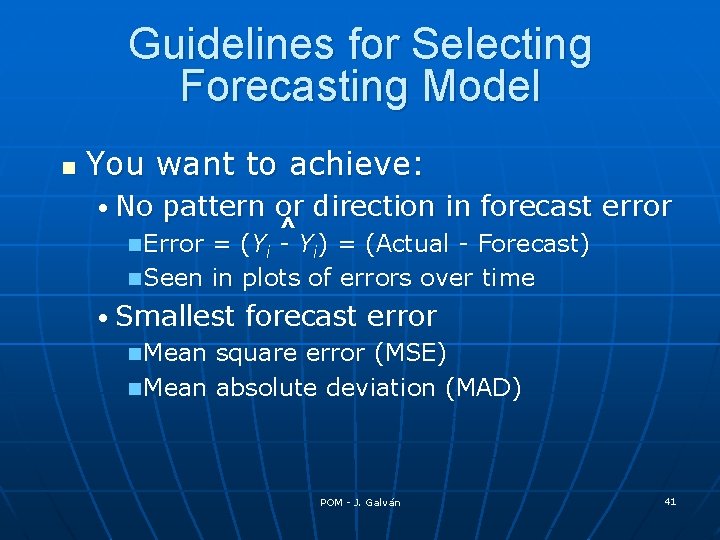
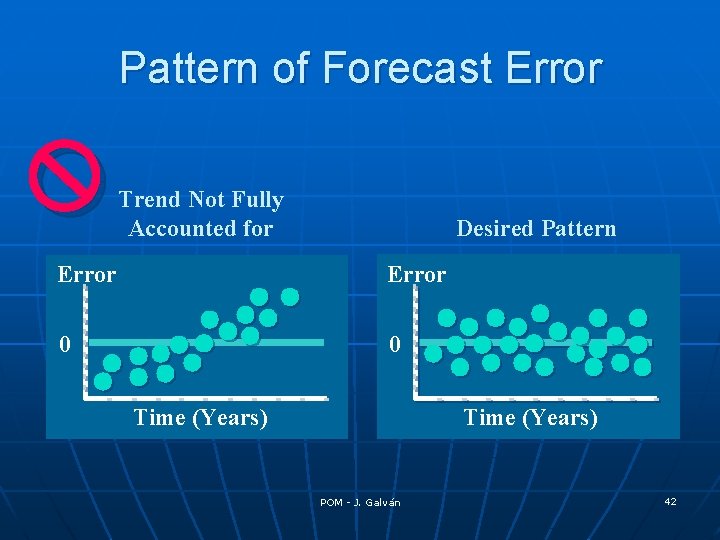
Guidelines for Selecting Forecasting Model n You want to achieve: • No pattern or direction in forecast error ^ n Error = (Yi - Yi) = (Actual - Forecast) n Seen in plots of errors over time • Smallest forecast error n Mean square error (MSE) n Mean absolute deviation (MAD) POM - J. Galván 41
Pattern of Forecast Error Trend Not Fully Accounted for Desired Pattern Error 0 0 Time (Years) POM - J. Galván 42
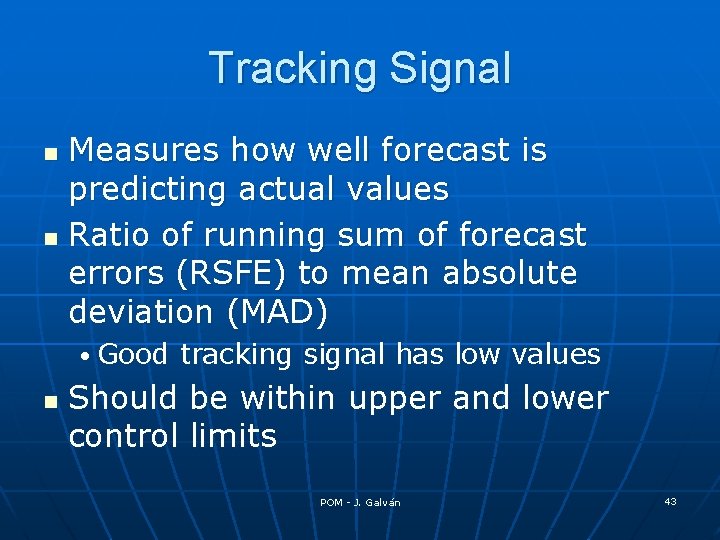
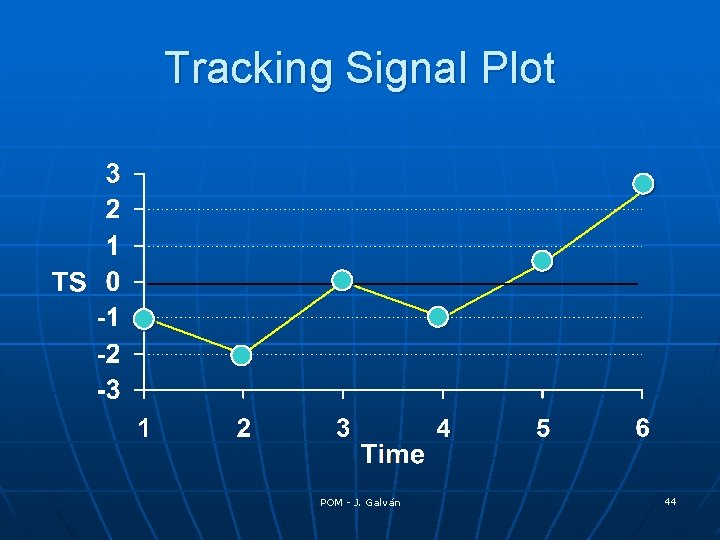
Tracking Signal Measures how well forecast is predicting actual values n Ratio of running sum of forecast errors (RSFE) to mean absolute deviation (MAD) n • Good n tracking signal has low values Should be within upper and lower control limits POM - J. Galván 43
Tracking Signal Plot POM - J. Galván 44
Forecasting in the Service Sector n Presents unusual challenges • special need for short term records • needs differ greatly as function of industry and product • issues of holidays and calendar • unusual events POM - J. Galván 45
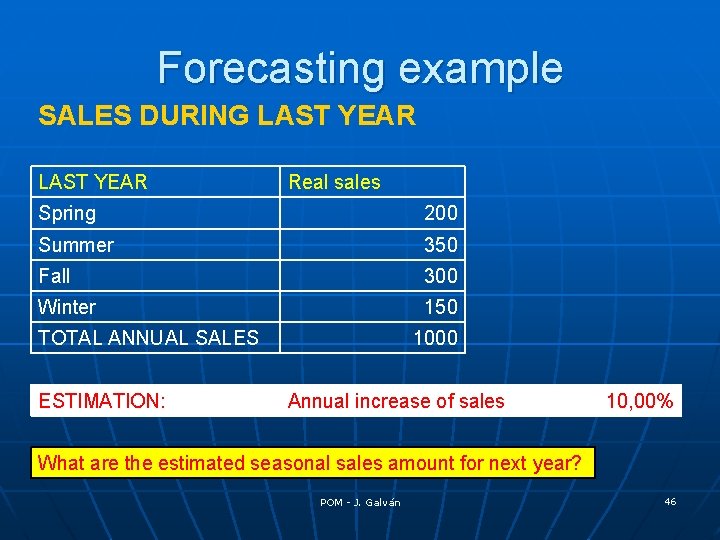
Forecasting example SALES DURING LAST YEAR Real sales Spring 200 Summer 350 Fall 300 Winter 150 TOTAL ANNUAL SALES ESTIMATION: 1000 Annual increase of sales 10, 00% What are the estimated seasonal sales amount for next year? POM - J. Galván 46
Forecasting example (II) LAST YEAR Past sales Average sales for each season Seasonal factor Total past annual sales/ nº of seasons Past sales/ Avg. Sales Spring 200 250 0, 8 Summer 350 250 1, 4 Fall 300 250 1, 2 Winter 150 250 0, 6 1000 TOTAL ANNUAL SALES POM - J. Galván 47
Forecasting example (III) NEXT YEAR (10% increase) SALES 1100 NEXT YEAR Average sales for each season Seasonal factor Next year's seasonal forecast Total estimated annual sales/nº of seasons As calculated Avg. sales* Factor Spring ? 275 0, 8 220 Summer ? 275 1, 4 385 Fall ? 275 1, 2 330 Winter ? 275 0, 6 165 TOTAL ANNUAL SALES 1100 POM - J. Galván 1100 48