
PRODUCTION AND OPERATIONS MANAGEMENT Ch 11 Human Resources

- Slides: 49
PRODUCTION AND OPERATIONS MANAGEMENT Ch. 11: Human Resources and Job Design POM - J. Galván 1
Learning Objectives n n n Define job design Describe job design components Explain motivation theories & studies Define work measurement Describe work measurement techniques Calculate standard time POM - J. Galván 2
Objective of Human Resource Strategy n To manage labor and design jobs so people are effectively and efficiently utilized POM - J. Galván 3
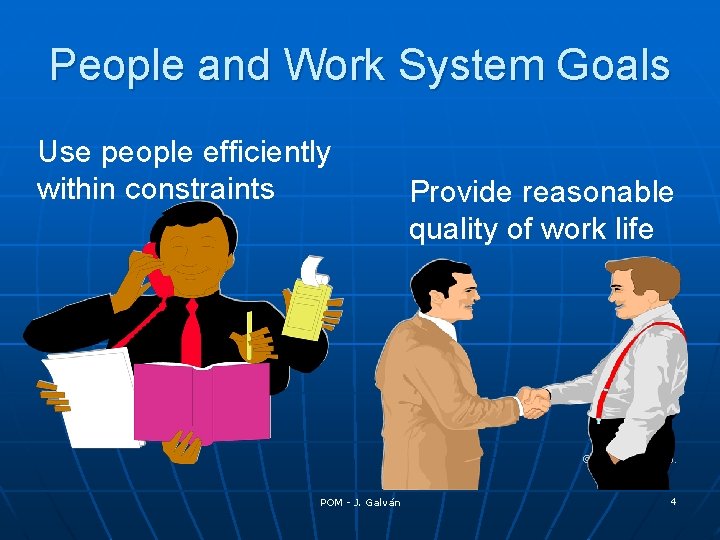
People and Work System Goals Use people efficiently within constraints Provide reasonable quality of work life © 1995 Corel Corp. POM - J. Galván 4
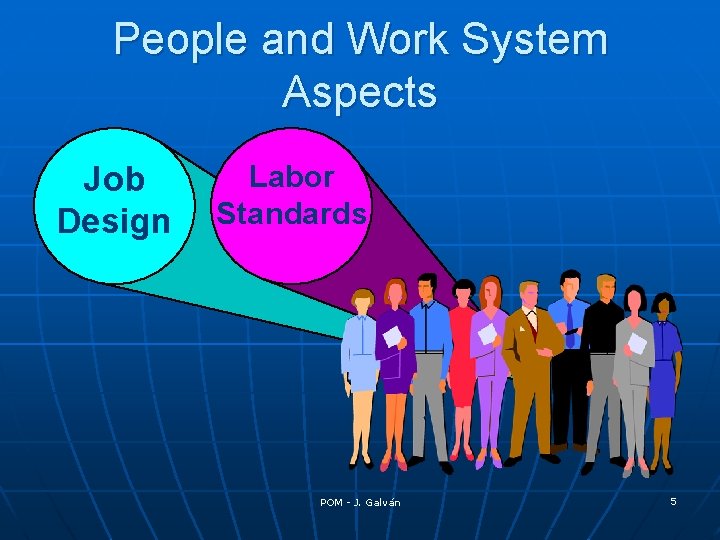
People and Work System Aspects Job Design Labor Standards POM - J. Galván 5
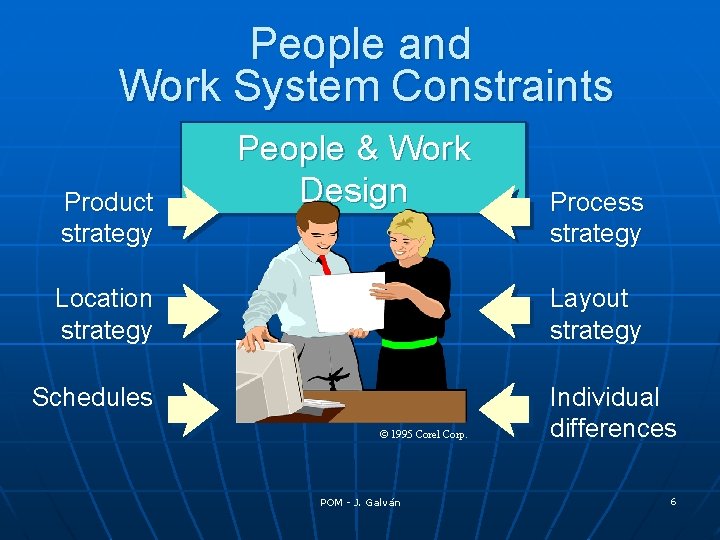
People and Work System Constraints Product strategy People & Work Design Location strategy Process strategy Layout strategy Schedules © 1995 Corel Corp. POM - J. Galván Individual differences 6
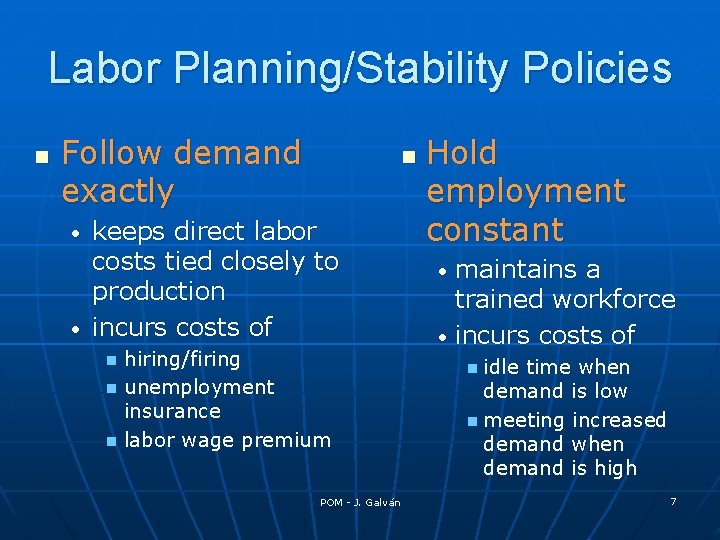
Labor Planning/Stability Policies n Follow demand exactly n keeps direct labor costs tied closely to production • incurs costs of • hiring/firing n unemployment insurance n labor wage premium n POM - J. Galván Hold employment constant • maintains a trained workforce • incurs costs of n idle time when demand is low n meeting increased demand when demand is high 7
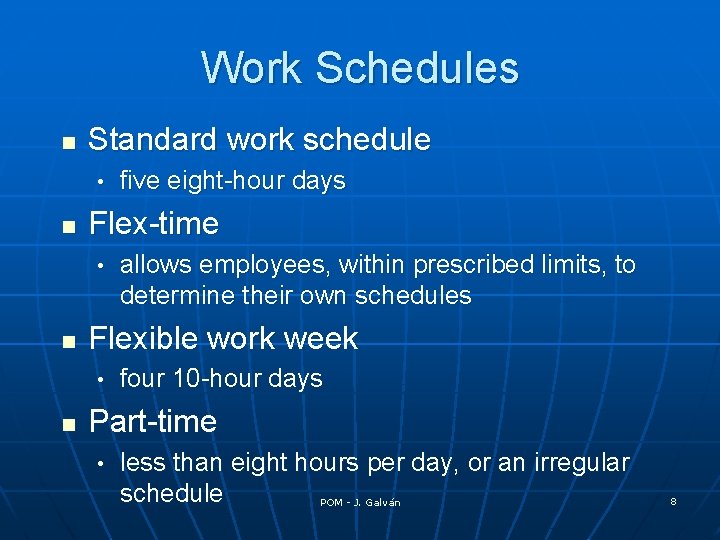
Work Schedules n Standard work schedule • n Flex-time • n allows employees, within prescribed limits, to determine their own schedules Flexible work week • n five eight-hour days four 10 -hour days Part-time • less than eight hours per day, or an irregular schedule POM - J. Galván 8
Job Classifications and Work Rules n Specify • who can do what • when they can do it • under what conditions they can do it Often result of union pressure n Restricts flexibility in assignments; consequently restricts efficiency of production n POM - J. Galván 9
Job Design n n Specifying the tasks that make up a job for an individual or group Involves determining What is to be done (i. e. , responses) • How it is to be done (i. e. , tools etc. ) • Why it is to be done (i. e. , purpose) • n Results in job description • Shows nature of job in task-related behaviors POM - J. Galván 10
Components of Job Design Job specialization n Job expansion n Psychological components n Self-directed teams n Motivation and incentive systems n Ergonomics and work methods n POM - J. Galván 11
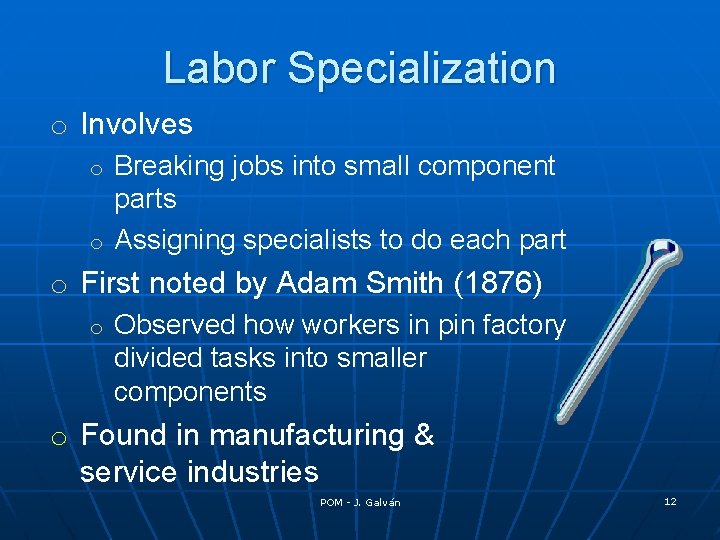
Labor Specialization o Involves Breaking jobs into small component parts o Assigning specialists to do each part o o First noted by Adam Smith (1876) o Observed how workers in pin factory divided tasks into smaller components o Found in manufacturing & service industries POM - J. Galván 12
Labor Specialization Often Reduces Cost ¨ Greater dexterity & faster learning ¨ Less lost time changing jobs or tools ¨ Use more specialized tools ¨ Pay only for needed skills POM - J. Galván 13
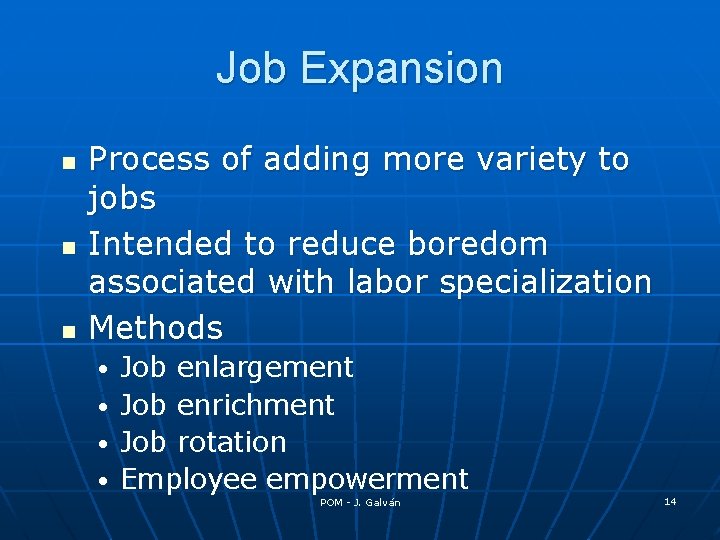
Job Expansion n Process of adding more variety to jobs Intended to reduce boredom associated with labor specialization Methods • • Job enlargement Job enrichment Job rotation Employee empowerment POM - J. Galván 14
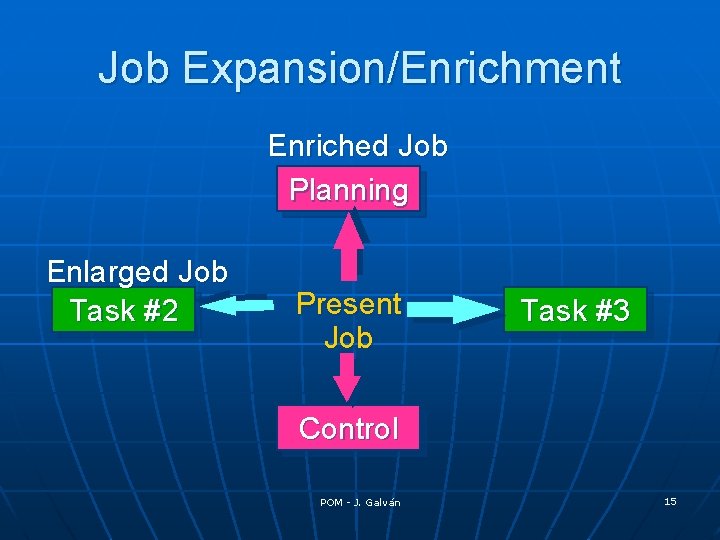
Job Expansion/Enrichment Enriched Job Planning Enlarged Job Task #2 Present Job Task #3 Control POM - J. Galván 15
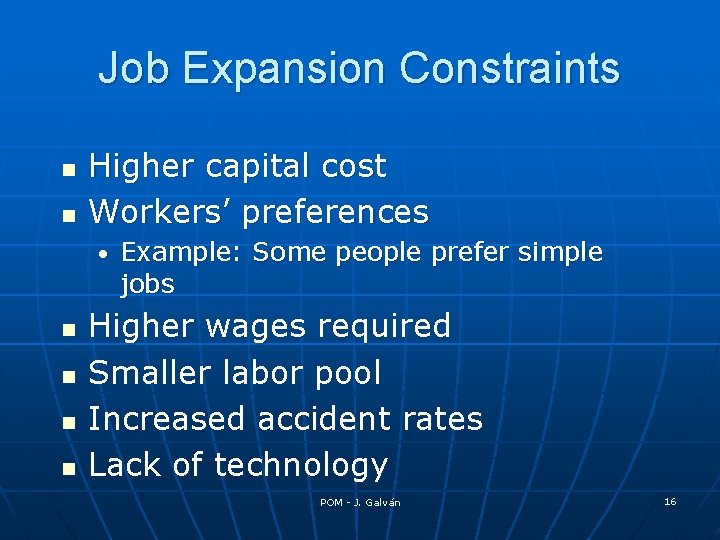
Job Expansion Constraints n n Higher capital cost Workers’ preferences • n n Example: Some people prefer simple jobs Higher wages required Smaller labor pool Increased accident rates Lack of technology POM - J. Galván 16
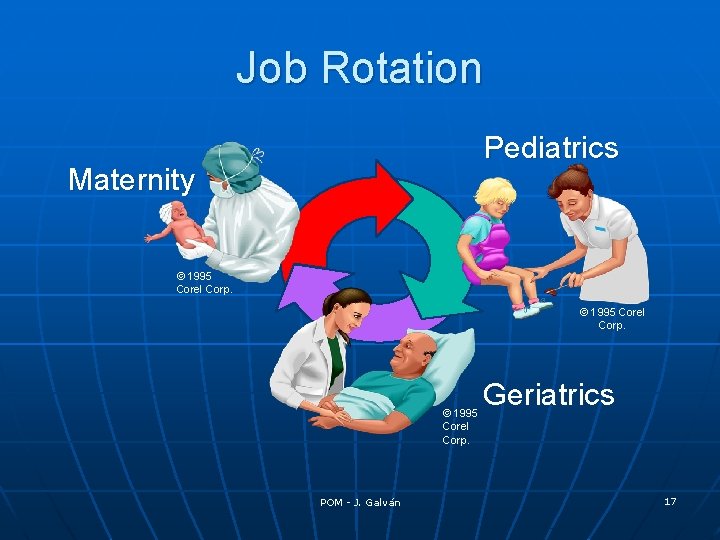
Job Rotation Pediatrics Maternity © 1995 Corel Corp. POM - J. Galván Geriatrics 17
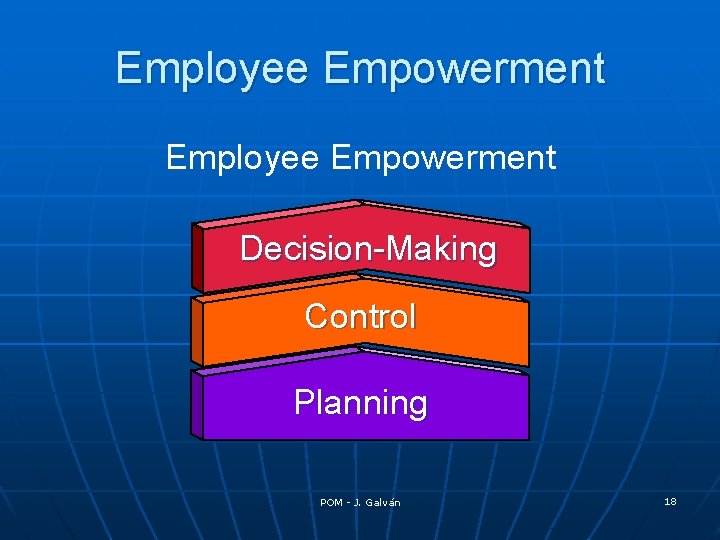
Employee Empowerment Decision-Making Control Planning POM - J. Galván 18
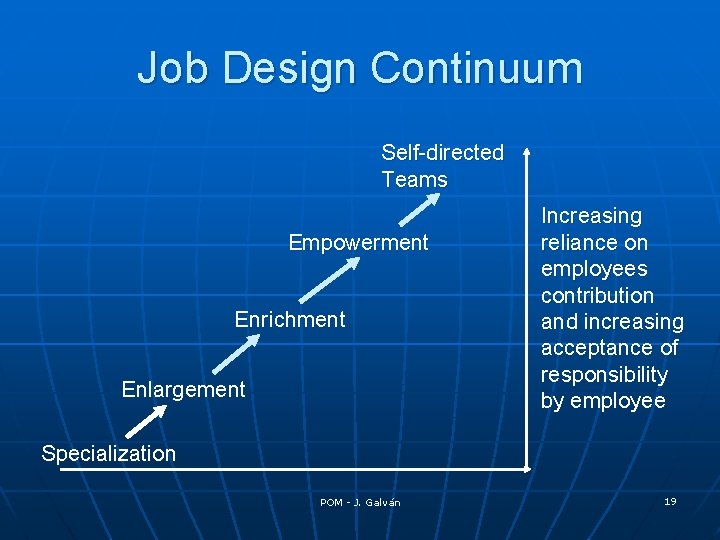
Job Design Continuum Self-directed Teams Empowerment Enrichment Enlargement Increasing reliance on employees contribution and increasing acceptance of responsibility by employee Specialization POM - J. Galván 19
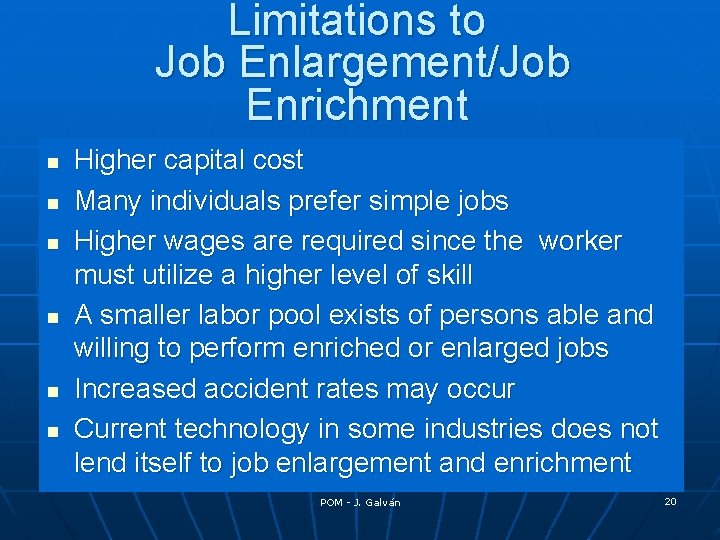
Limitations to Job Enlargement/Job Enrichment n n n Higher capital cost Many individuals prefer simple jobs Higher wages are required since the worker must utilize a higher level of skill A smaller labor pool exists of persons able and willing to perform enriched or enlarged jobs Increased accident rates may occur Current technology in some industries does not lend itself to job enlargement and enrichment POM - J. Galván 20
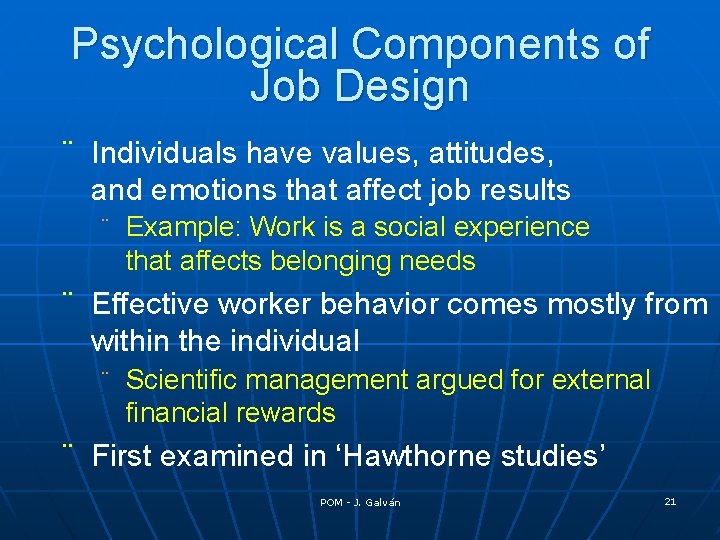
Psychological Components of Job Design ¨ Individuals have values, attitudes, and emotions that affect job results ¨ Example: Work is a social experience that affects belonging needs ¨ Effective worker behavior comes mostly from within the individual ¨ Scientific management argued for external financial rewards ¨ First examined in ‘Hawthorne studies’ POM - J. Galván 21
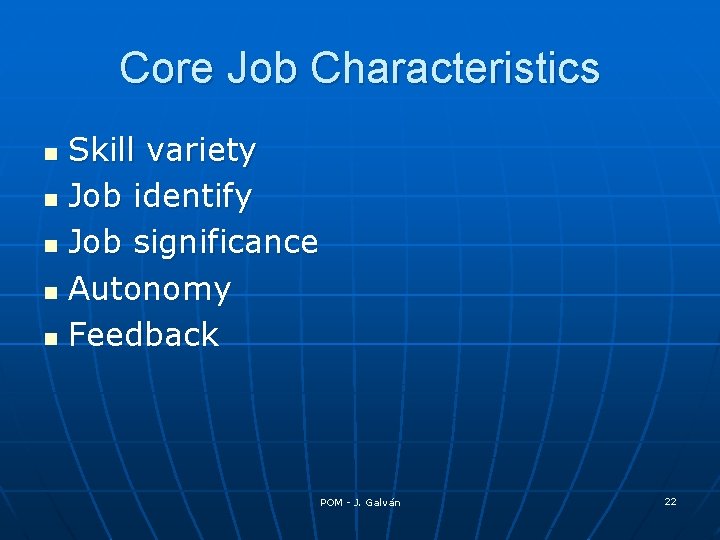
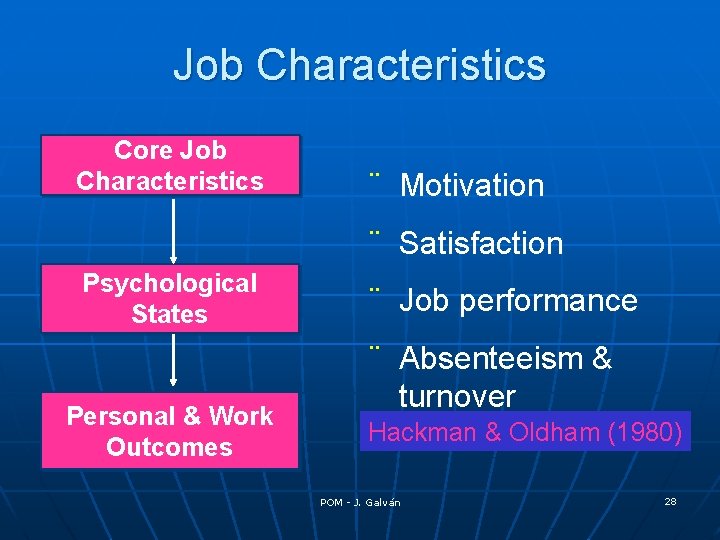
Core Job Characteristics Skill variety n Job identify n Job significance n Autonomy n Feedback n POM - J. Galván 22
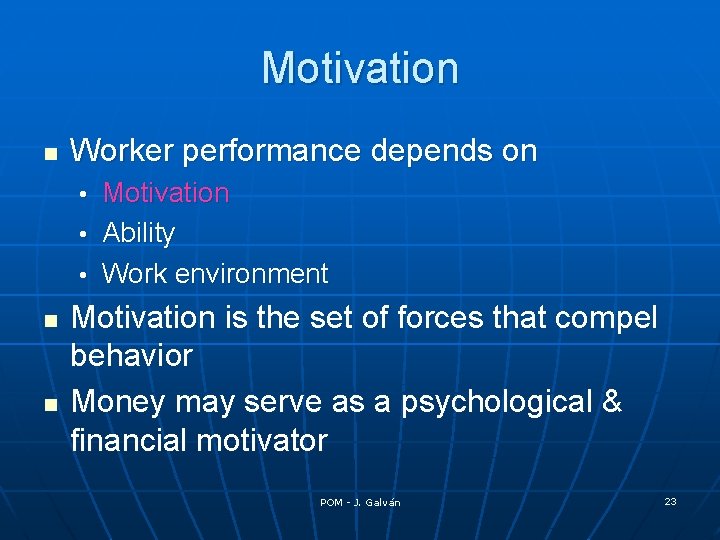
Motivation n Worker performance depends on Motivation • Ability • Work environment • n n Motivation is the set of forces that compel behavior Money may serve as a psychological & financial motivator POM - J. Galván 23
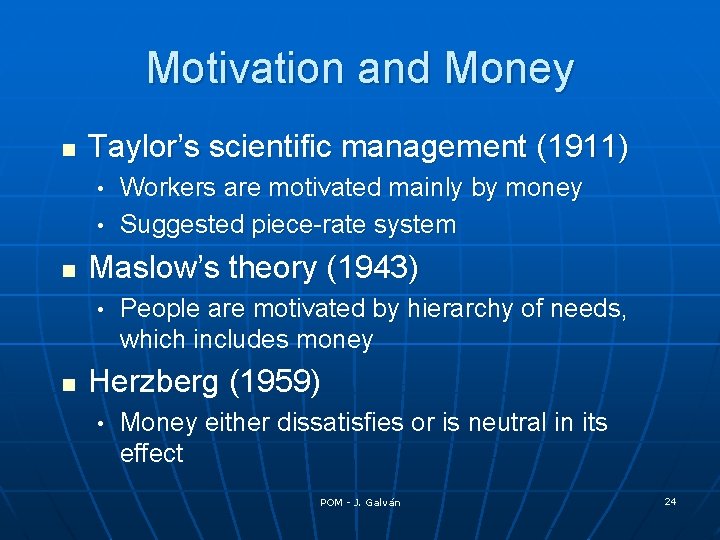
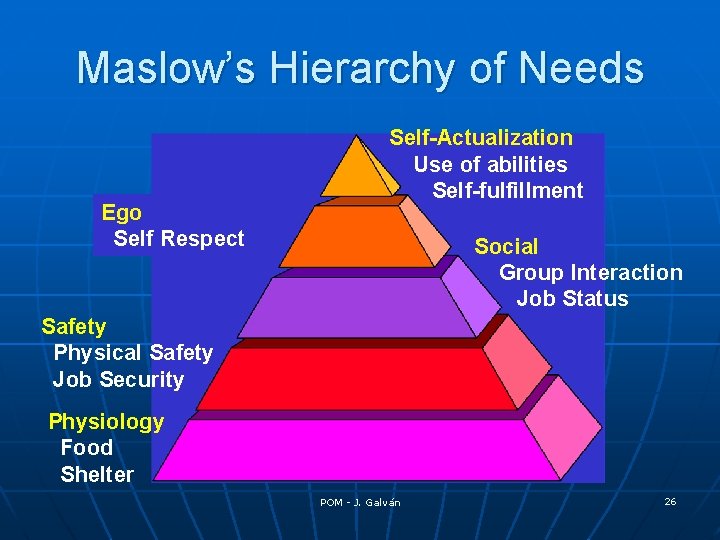
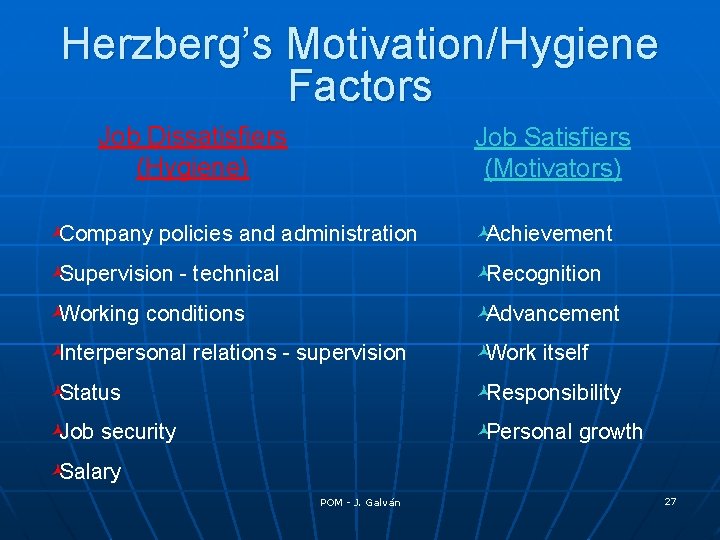
Motivation and Money n Taylor’s scientific management (1911) Workers are motivated mainly by money • Suggested piece-rate system • n Maslow’s theory (1943) • n People are motivated by hierarchy of needs, which includes money Herzberg (1959) • Money either dissatisfies or is neutral in its effect POM - J. Galván 24
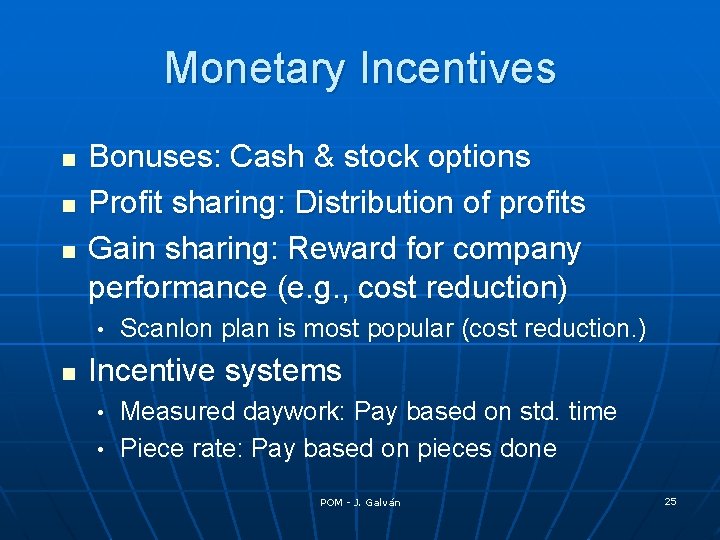
Monetary Incentives n n n Bonuses: Cash & stock options Profit sharing: Distribution of profits Gain sharing: Reward for company performance (e. g. , cost reduction) • n Scanlon plan is most popular (cost reduction. ) Incentive systems Measured daywork: Pay based on std. time • Piece rate: Pay based on pieces done • POM - J. Galván 25
Maslow’s Hierarchy of Needs Ego Self Respect Self-Actualization Use of abilities Self-fulfillment Social Group Interaction Job Status Safety Physical Safety Job Security Physiology Food Shelter POM - J. Galván 26
Herzberg’s Motivation/Hygiene Factors Job Dissatisfiers (Hygiene) Job Satisfiers (Motivators) ©Company policies and administration ©Achievement ©Supervision - technical ©Recognition ©Working conditions ©Advancement ©Interpersonal relations - supervision ©Work itself ©Status ©Responsibility ©Job security ©Personal growth ©Salary POM - J. Galván 27
Job Characteristics Core Job Characteristics ¨ Motivation ¨ Satisfaction Psychological States Personal & Work Outcomes ¨ Job performance ¨ Absenteeism & turnover Hackman & Oldham (1980) POM - J. Galván 28
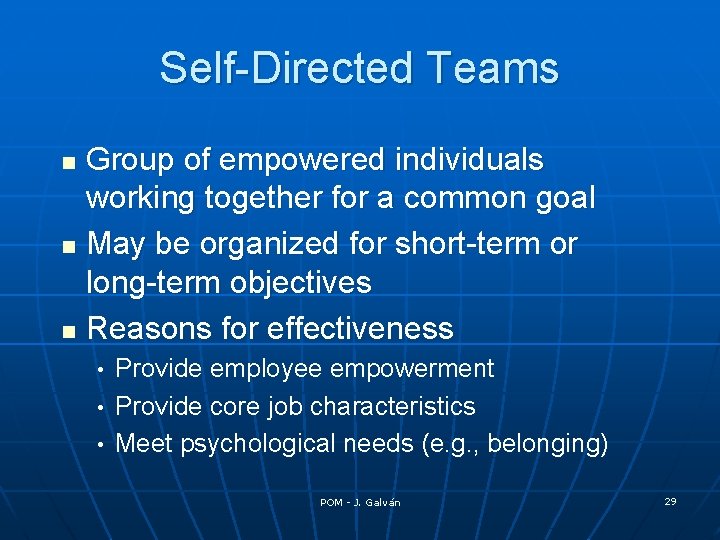
Self-Directed Teams Group of empowered individuals working together for a common goal n May be organized for short-term or long-term objectives n Reasons for effectiveness n Provide employee empowerment • Provide core job characteristics • Meet psychological needs (e. g. , belonging) • POM - J. Galván 29
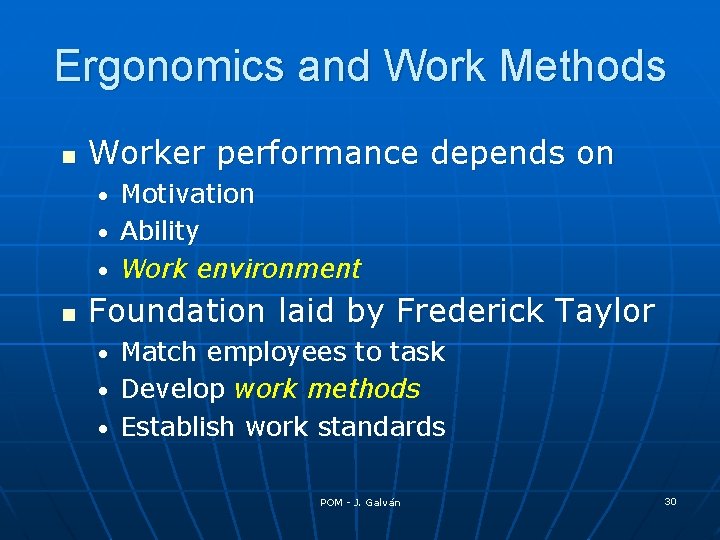
Ergonomics and Work Methods n Worker performance depends on Motivation • Ability • Work environment • n Foundation laid by Frederick Taylor Match employees to task • Develop work methods • Establish work standards • POM - J. Galván 30
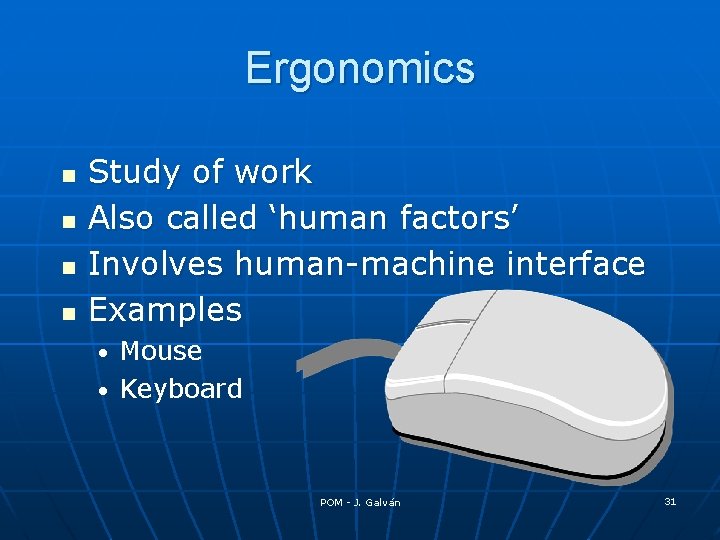
Ergonomics n n Study of work Also called ‘human factors’ Involves human-machine interface Examples Mouse • Keyboard • POM - J. Galván 31
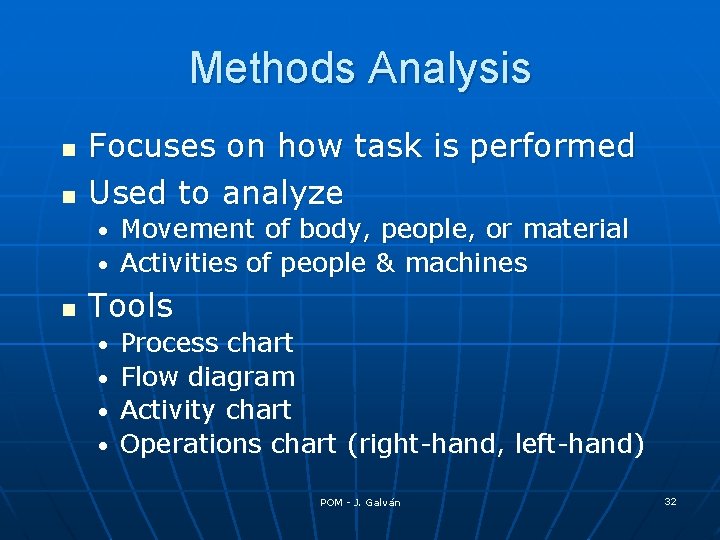
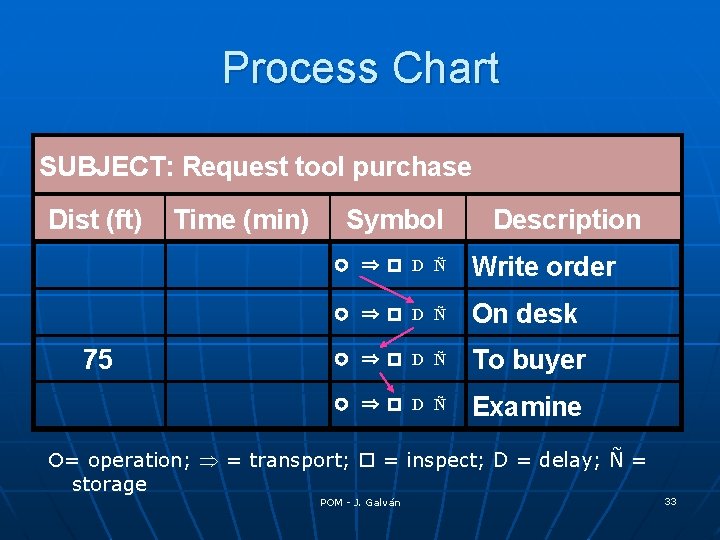
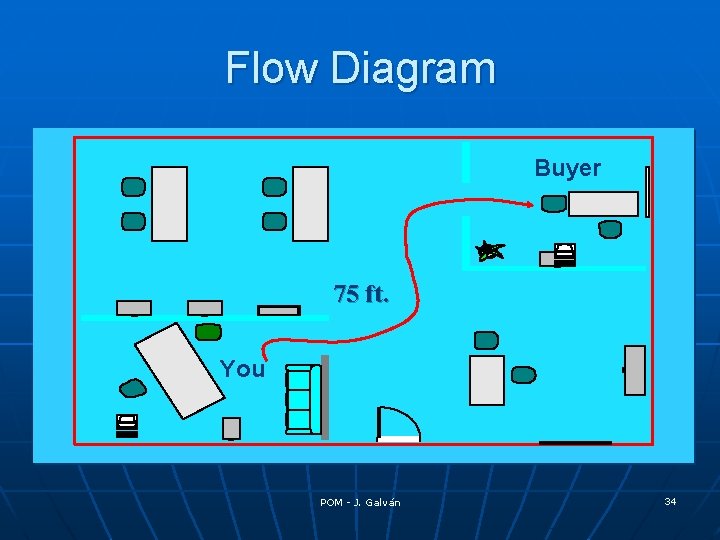
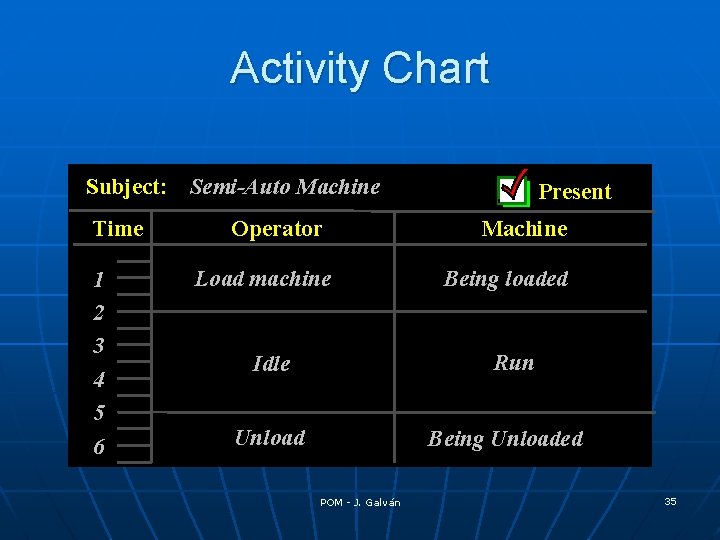
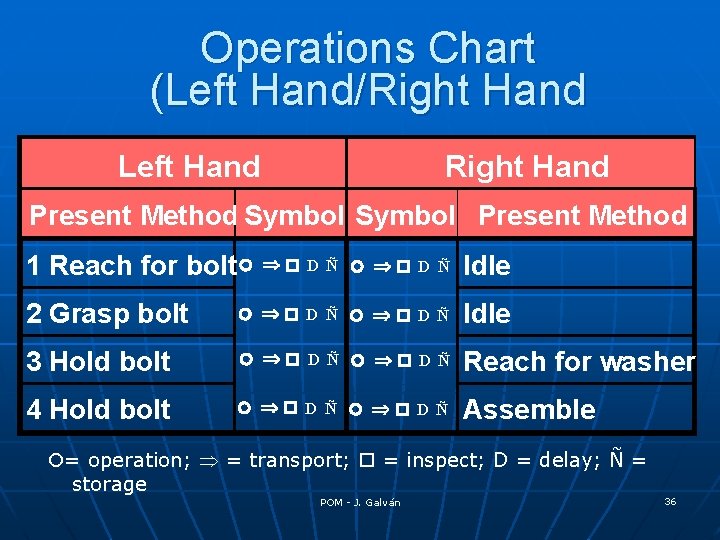
Methods Analysis n n Focuses on how task is performed Used to analyze Movement of body, people, or material • Activities of people & machines • n Tools • • Process chart Flow diagram Activity chart Operations chart (right-hand, left-hand) POM - J. Galván 32
Process Chart SUBJECT: Request tool purchase Dist (ft) 75 Time (min) Symbol Description ¡ Þ o D Ñ Write order ¡ Þ o D Ñ On desk ¡ Þ o D Ñ To buyer ¡ Þ o D Ñ Examine ¡= operation; Þ = transport; o = inspect; D = delay; Ñ = storage POM - J. Galván 33
Flow Diagram Buyer 75 ft. You POM - J. Galván 34
Activity Chart Subject: Semi-Auto Machine Time 1 2 3 4 5 6 Operator Load machine Present Machine Being loaded Run Idle Unload Being Unloaded POM - J. Galván 35
Operations Chart (Left Hand/Right Hand Left Hand Right Hand Present Method Symbol Present Method 1 Reach for bolt ¡ Þ o D Ñ ¡ Þo. D Ñ Idle 2 Grasp bolt ¡ Þo. D Ñ Idle 3 Hold bolt ¡ Þo. D Ñ Reach for washer 4 Hold bolt ¡ Þo. D Ñ Assemble ¡= operation; Þ = transport; o = inspect; D = delay; Ñ = storage POM - J. Galván 36
The Visual Workplace Uses low-cost visual devices to share information quickly and accurately. n Displays and graphs replace paper n Provides real-time information n System should focus on improvement, not merely monitoring n Can provide both production and financial data n POM - J. Galván 37
What is Work Measurement? n n Determining the amount of worker time required to generate one unit of output Provides labor standards • Target amount of time required to perform a job under normal working conditions POM - J. Galván 38
Uses of Labor Standards n n n Costing labor content of products Planning staffing needs Cost & time estimates for bids Planning production Wage-incentive plans Employee efficiency POM - J. Galván 39
Sources of Labor Standards n n Historical experience Time studies Predetermined time standards (MTM) Work sampling POM - J. Galván 40
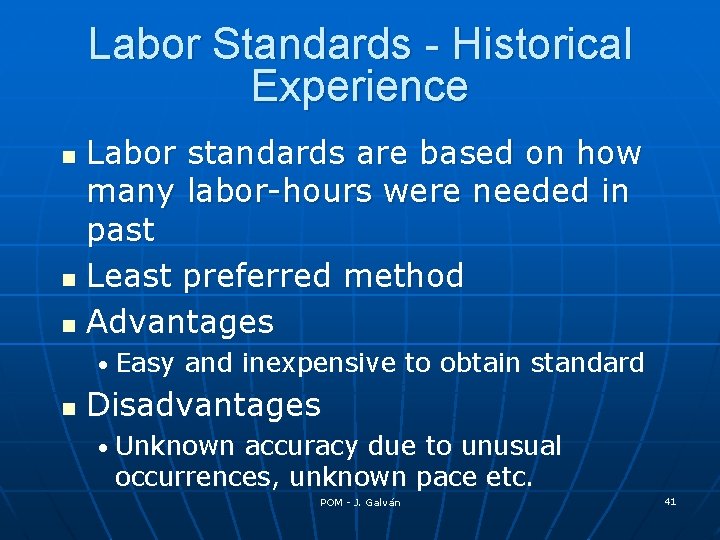
Labor Standards - Historical Experience Labor standards are based on how many labor-hours were needed in past n Least preferred method n Advantages n • Easy n and inexpensive to obtain standard Disadvantages • Unknown accuracy due to unusual occurrences, unknown pace etc. POM - J. Galván 41
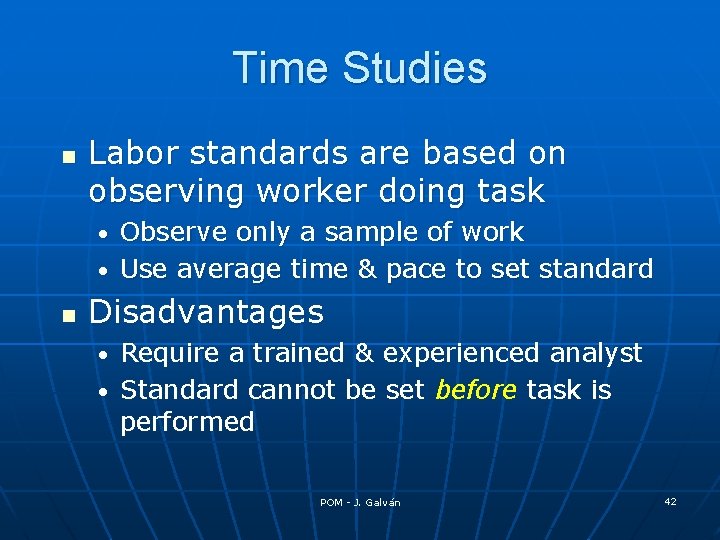
Time Studies n Labor standards are based on observing worker doing task Observe only a sample of work • Use average time & pace to set standard • n Disadvantages Require a trained & experienced analyst • Standard cannot be set before task is performed • POM - J. Galván 42
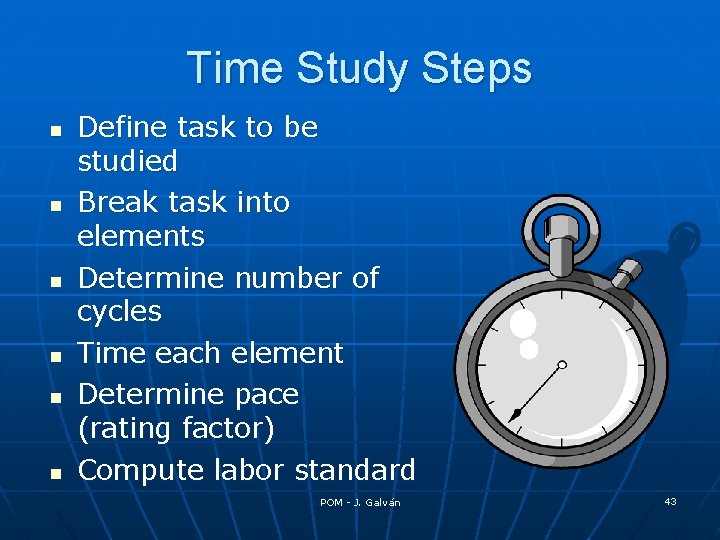
Time Study Steps n n n Define task to be studied Break task into elements Determine number of cycles Time each element Determine pace (rating factor) Compute labor standard POM - J. Galván 43
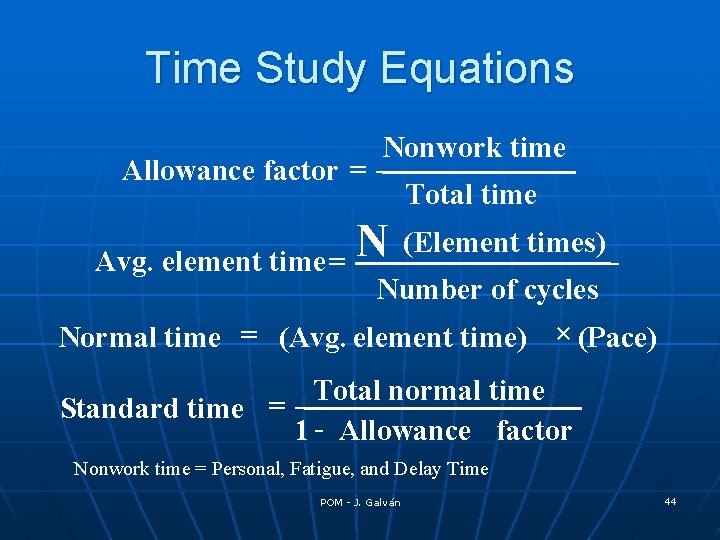
Time Study Equations Allowance factor = Nonwork time N Avg. element time = Total time (Element times) Number of cycles Normal time = (Avg. element time) × (Pace) Standard time = Total normal time 1 - Allowance factor Nonwork time = Personal, Fatigue, and Delay Time POM - J. Galván 44
Predetermined Time Standards n n Labor standards are set from times in published tables (e. g. , MTM Table) Procedure Divide manual work into basic elements • Look up basic element times in table; sum • n Advantages Times established in laboratory setting • Useful for planning tasks • Widely accepted by unions • POM - J. Galván 45
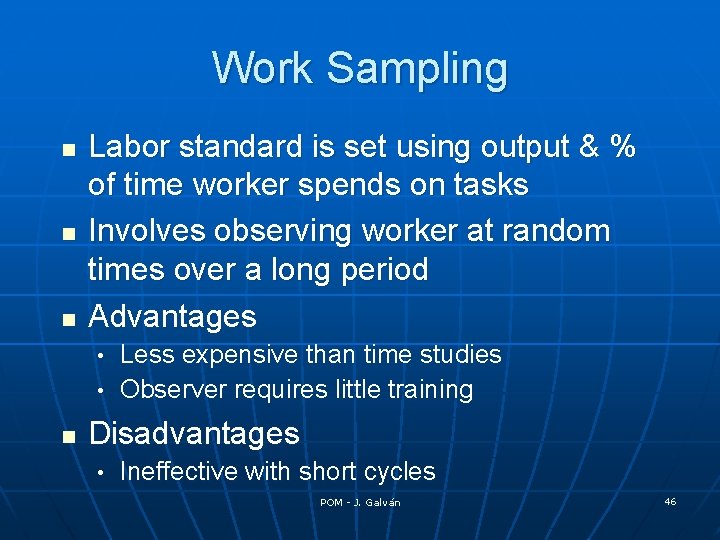
Work Sampling n n n Labor standard is set using output & % of time worker spends on tasks Involves observing worker at random times over a long period Advantages Less expensive than time studies • Observer requires little training • n Disadvantages • Ineffective with short cycles POM - J. Galván 46
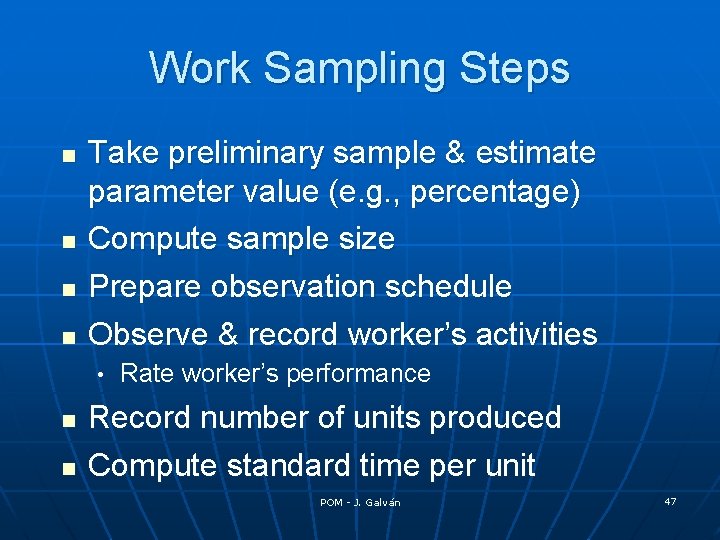
Work Sampling Steps n n Take preliminary sample & estimate parameter value (e. g. , percentage) Compute sample size Prepare observation schedule Observe & record worker’s activities • n n Rate worker’s performance Record number of units produced Compute standard time per unit POM - J. Galván 47
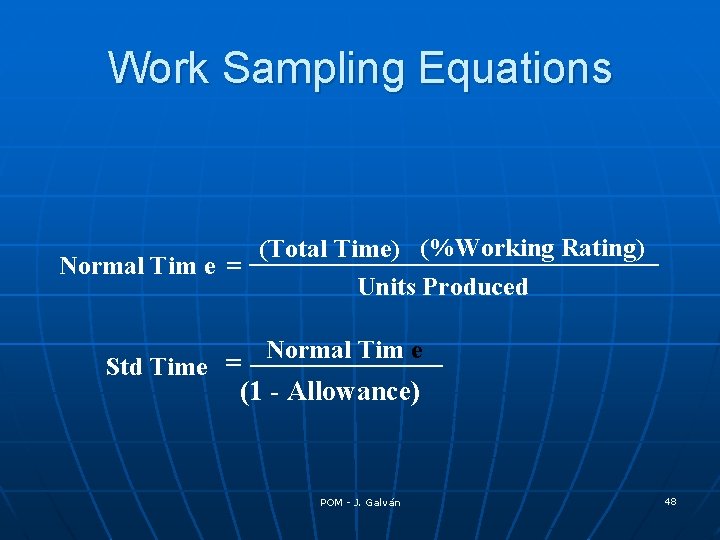
Work Sampling Equations (Total Time) (%Working Rating) Normal Tim e = Units Produced Std Time = Normal Tim e (1 - Allowance) POM - J. Galván 48
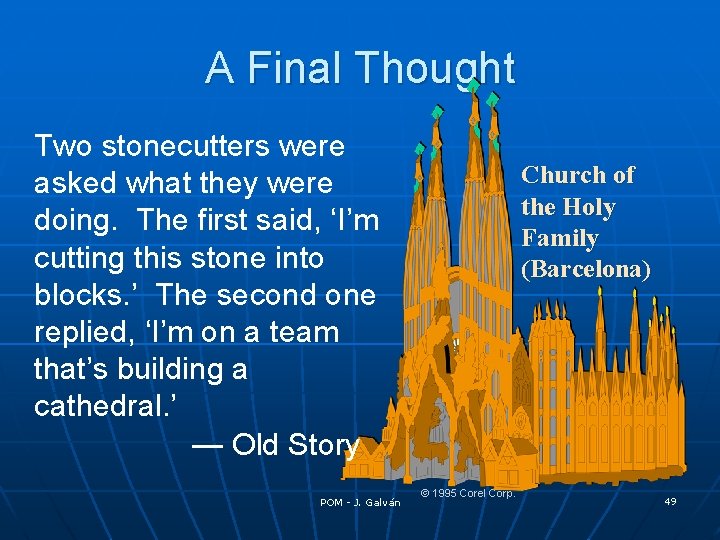
A Final Thought Two stonecutters were asked what they were doing. The first said, ‘I’m cutting this stone into blocks. ’ The second one replied, ‘I’m on a team that’s building a cathedral. ’ — Old Story POM - J. Galván Church of the Holy Family (Barcelona) © 1995 Corel Corp. 49