
Product Specifications Teaching materials to accompany Product Design



- Slides: 32
Product Specifications Teaching materials to accompany: Product Design and Development Chapter 6 Karl T. Ulrich and Steven D. Eppinger 5 th Edition, Irwin Mc. Graw-Hill, 2012.
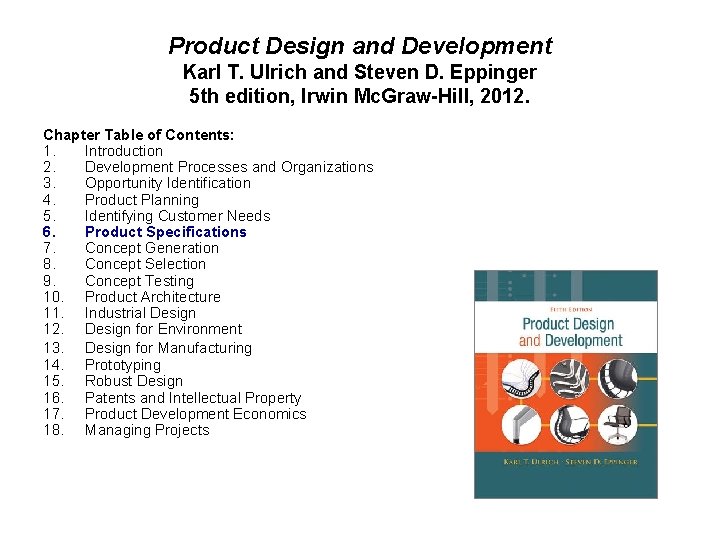
Product Design and Development Karl T. Ulrich and Steven D. Eppinger 5 th edition, Irwin Mc. Graw-Hill, 2012. Chapter Table of Contents: 1. Introduction 2. Development Processes and Organizations 3. Opportunity Identification 4. Product Planning 5. Identifying Customer Needs 6. Product Specifications 7. Concept Generation 8. Concept Selection 9. Concept Testing 10. Product Architecture 11. Industrial Design 12. Design for Environment 13. Design for Manufacturing 14. Prototyping 15. Robust Design 16. Patents and Intellectual Property 17. Product Development Economics 18. Managing Projects
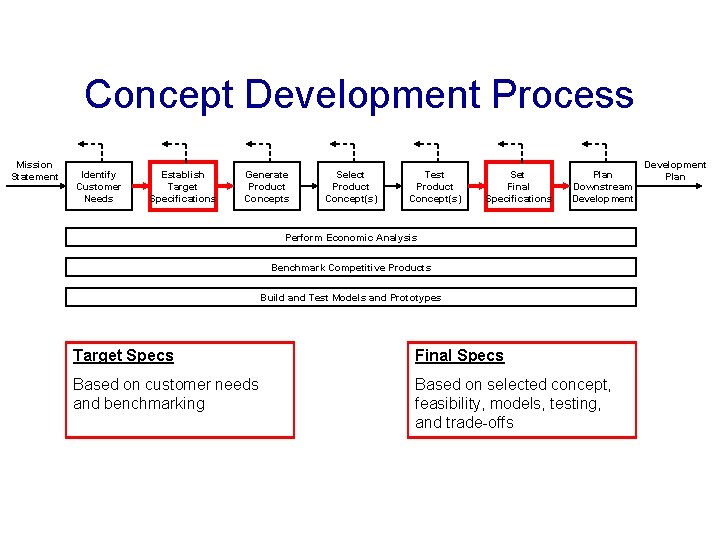
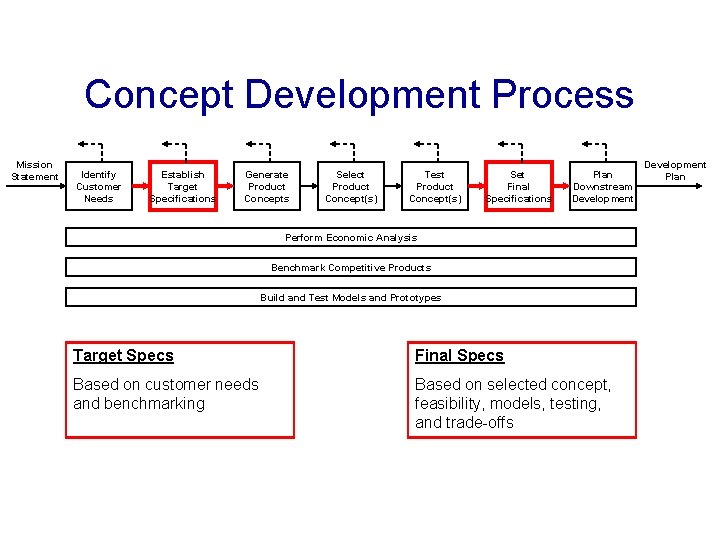
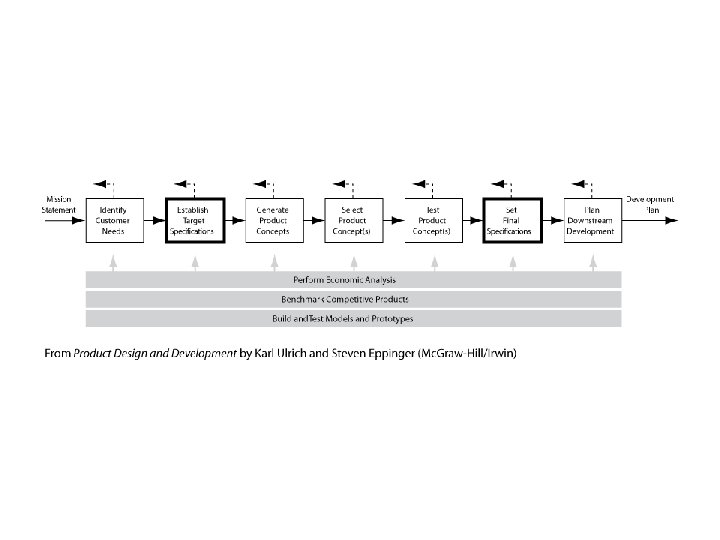
Concept Development Process Mission Statement Identify Customer Needs Establish Target Specifications Generate Product Concepts Select Product Concept(s) Test Product Concept(s) Set Final Specifications Plan Downstream Development Perform Economic Analysis Benchmark Competitive Products Build and Test Models and Prototypes Target Specs Final Specs Based on customer needs and benchmarking Based on selected concept, feasibility, models, testing, and trade-offs Development Plan
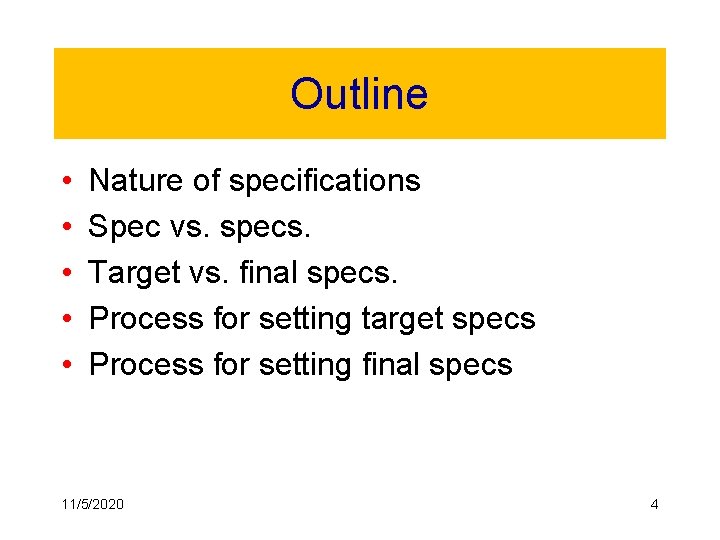
Outline • • • Nature of specifications Spec vs. specs. Target vs. final specs. Process for setting target specs Process for setting final specs 11/5/2020 4
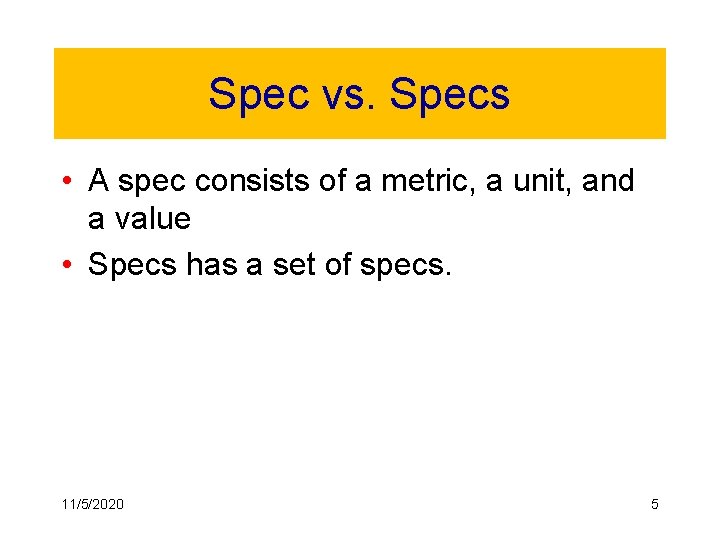
Spec vs. Specs • A spec consists of a metric, a unit, and a value • Specs has a set of specs. 11/5/2020 5
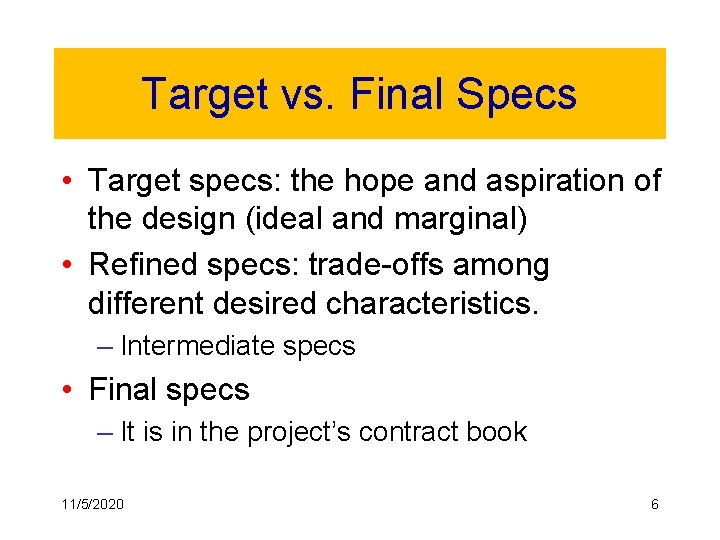
Target vs. Final Specs • Target specs: the hope and aspiration of the design (ideal and marginal) • Refined specs: trade-offs among different desired characteristics. – Intermediate specs • Final specs – It is in the project’s contract book 11/5/2020 6
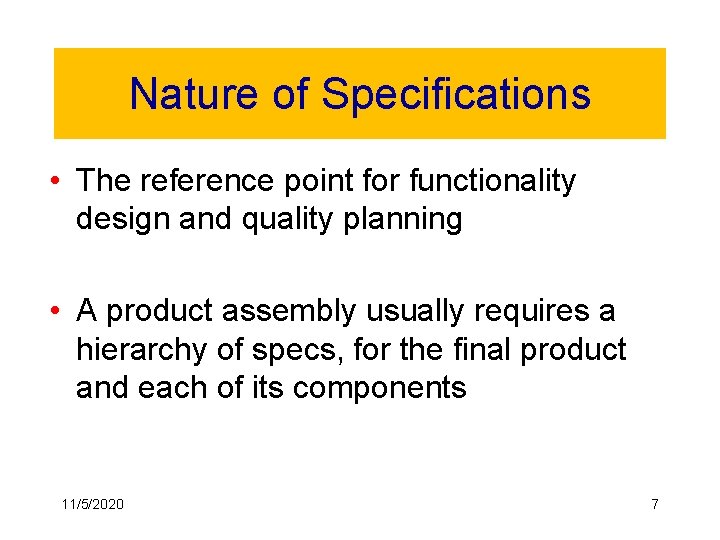
Nature of Specifications • The reference point for functionality design and quality planning • A product assembly usually requires a hierarchy of specs, for the final product and each of its components 11/5/2020 7
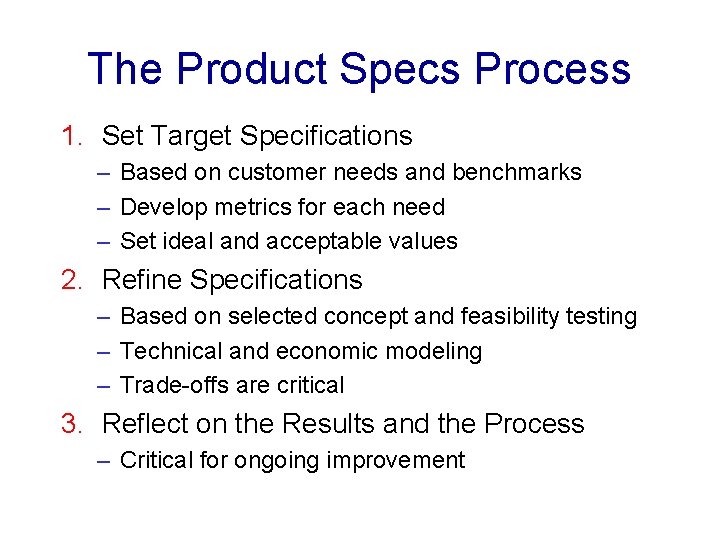
The Product Specs Process 1. Set Target Specifications – Based on customer needs and benchmarks – Develop metrics for each need – Set ideal and acceptable values 2. Refine Specifications – Based on selected concept and feasibility testing – Technical and economic modeling – Trade-offs are critical 3. Reflect on the Results and the Process – Critical for ongoing improvement
Procedure for establishing target specifications 1. Identify a list of metrics and measurement units that sufficiently address the needs 2. Collect the competitive benchmarking information 3. Set ideal and marginally acceptable target values for each metric (using at least, at most, between, exactly, etc. ) 4. Reflect on the results and the process 11/5/2020 9
Process for setting the final specifications 1. Develop technical models to assess technical feasibility. The input is design variable and the output is a measurement using a metric. 2. Develop a cost model of the product. 3. Refine the specifications, making tradeoffs, where necessary to form a competitive map. 4. “Flow down” the final overall specs to specs for each subsystem (component and part). 5. Reflect on the results to see v Whether the product is a winner, and/or v How much uncertainty there is in the technical and cost model, or v Whethere is a need to develop a better technical model. 11/5/2020 10
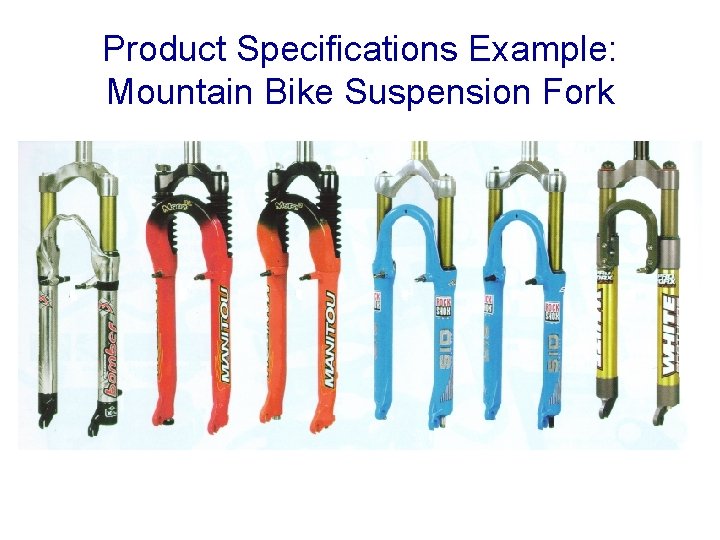
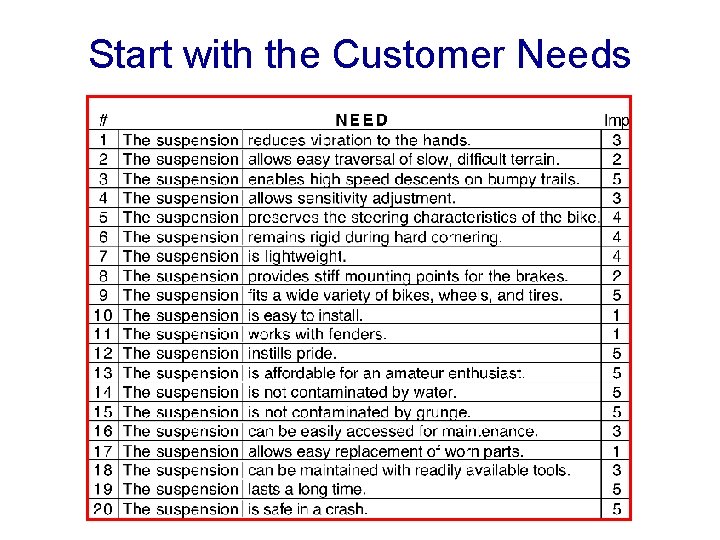
Product Specifications Example: Mountain Bike Suspension Fork
Start with the Customer Needs
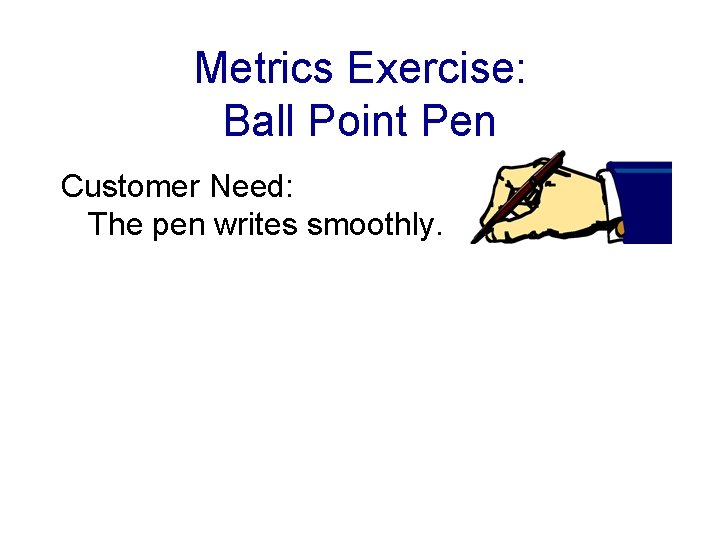
Metrics Exercise: Ball Point Pen Customer Need: The pen writes smoothly.
Establish Metrics and Units
Link Metrics to Needs
Benchmark on Customer Needs
Benchmark on Metrics
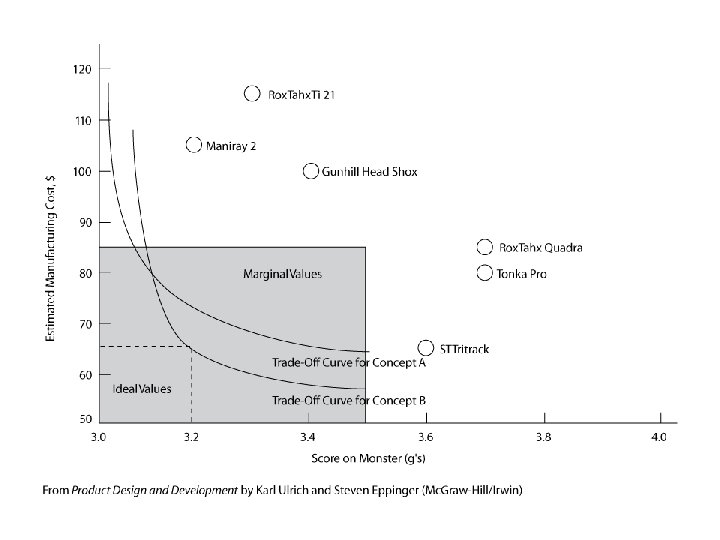
Assign Marginal and Ideal Values
Concept Development Process Mission Statement Identify Customer Needs Establish Target Specifications Generate Product Concepts Select Product Concept(s) Test Product Concept(s) Set Final Specifications Plan Downstream Development Perform Economic Analysis Benchmark Competitive Products Build and Test Models and Prototypes Target Specs Final Specs Based on customer needs and benchmarking Based on selected concept, feasibility, models, testing, and trade-offs Development Plan
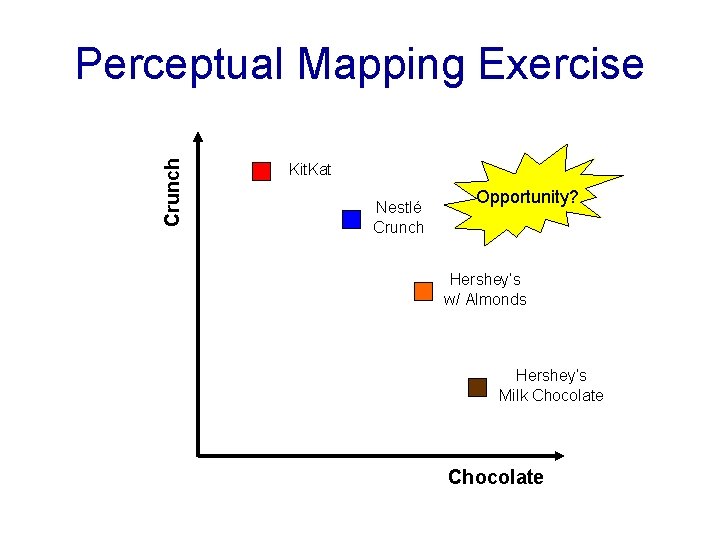
Crunch Perceptual Mapping Exercise Kit. Kat Nestlé Crunch Opportunity? Hershey’s w/ Almonds Hershey’s Milk Chocolate
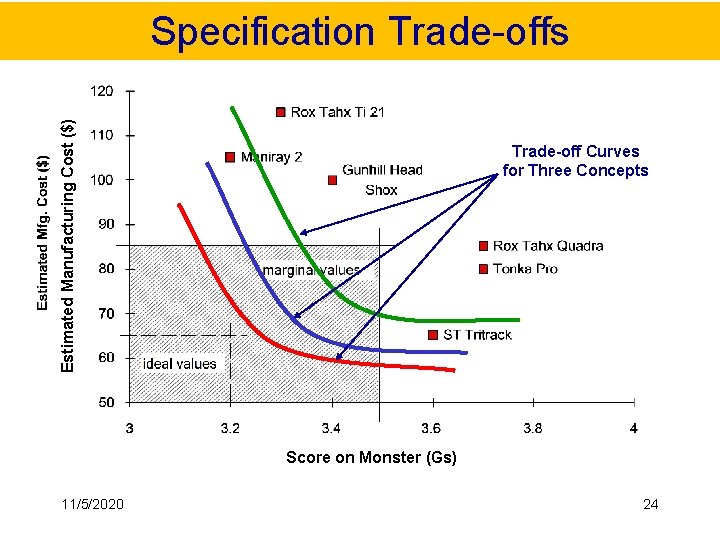
Estimated Manufacturing Cost ($) Specification Trade-offs Trade-off Curves for Three Concepts Score on Monster (Gs) 11/5/2020 24
Set Final Specifications
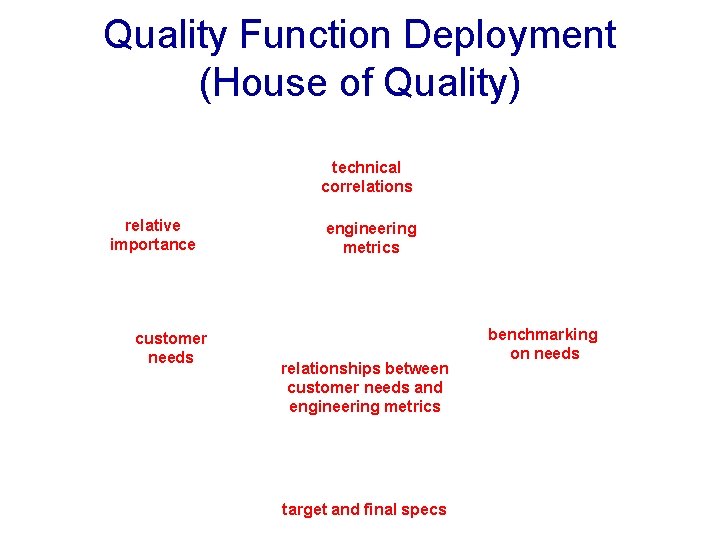
Quality Function Deployment (House of Quality) technical correlations relative importance customer needs engineering metrics relationships between customer needs and engineering metrics target and final specs benchmarking on needs
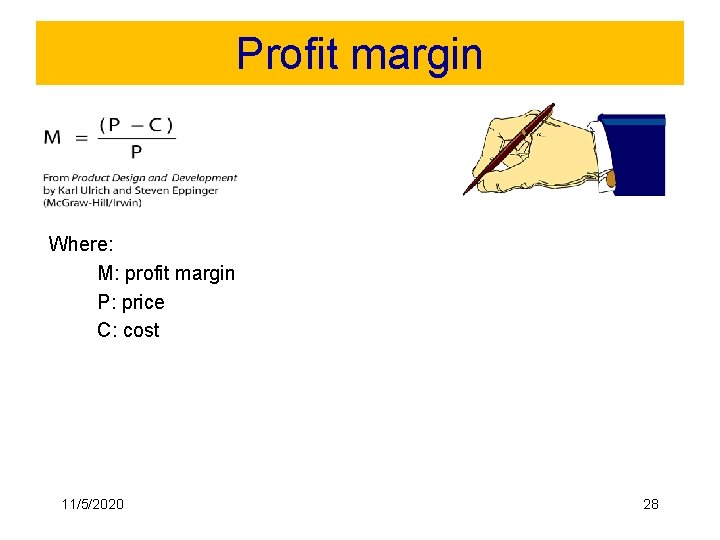
Profit margin Where: M: profit margin P: price C: cost 11/5/2020 28
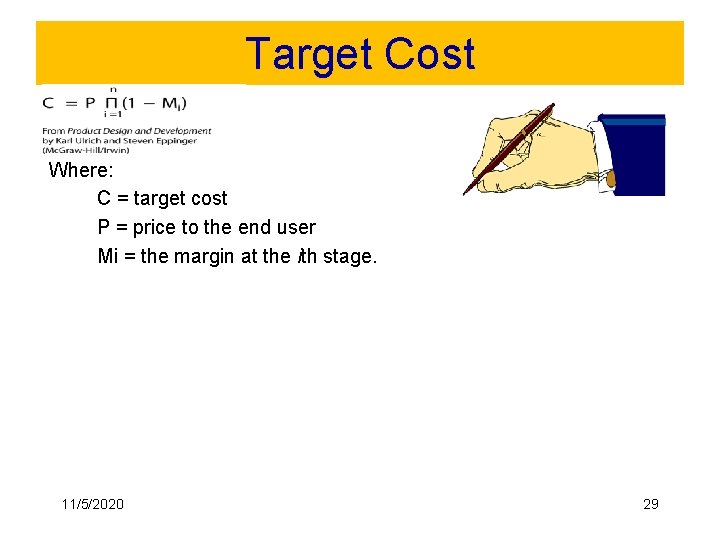
Target Cost Where: C = target cost P = price to the end user Mi = the margin at the ith stage. 11/5/2020 29
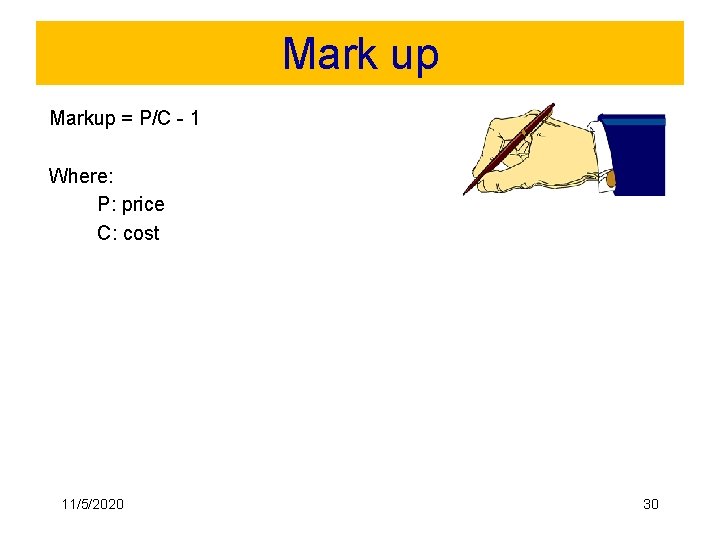
Mark up Markup = P/C - 1 Where: P: price C: cost 11/5/2020 30
Chapter 6 HW Metric Exercise: Ball Point Pen v Identify five possible metrics and the unit of measure for a customer need as stated below: The pen writes smoothly. 11/5/2020 32