
Product Reliability Measuring WWW KAASHIVINFOTECH COM Definitions Reliability
Product Reliability Measuring WWW. KAASHIVINFOTECH. COM
Definitions �Reliability - The ability of an item to perform a required function under stated conditions for a stated period of time. It is usually denoted as probability or as a success. �Failure – The termination of ability of an item to perform a required function. WWW. KAASHIVINFOTECH. COM
�Observed Failure Rate – For a stated period in life of an item, the ratio of the total number of failures in a sample to the cumulative of the time on that sample. The observed failure rate is associated with particular and stated time intervals(or summation of intervals) in the life of the item and under stated conditions. �Observed Mean Time Between Failures(MTBF) – For a stated period in the life of an item, the mean value of the length of time between consecutive failures computed as the ratio of the cumulative observed time to the number failures under stated conditions. WWW. KAASHIVINFOTECH. COM
�Observed mean time to failure (MTTF)- For a stated period in the life of an item, the ratio of the cumulative time for a sample to the total number of failure in the sample during the period under stated condition WWW. KAASHIVINFOTECH. COM
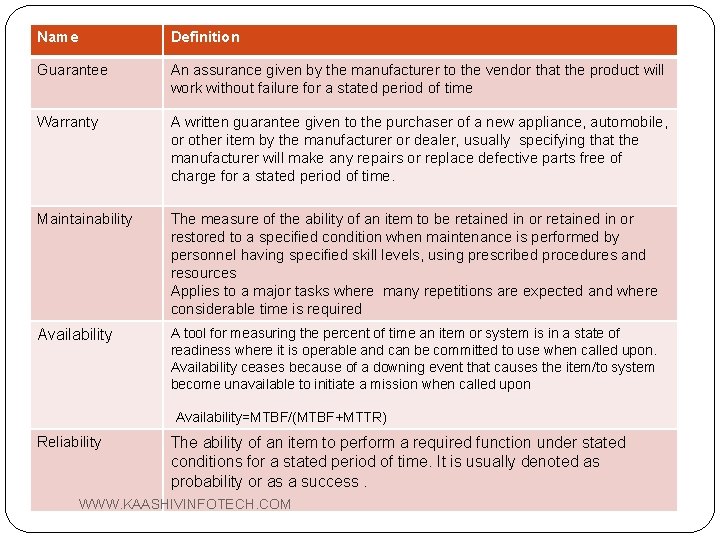
Name Definition Guarantee An assurance given by the manufacturer to the vendor that the product will work without failure for a stated period of time Warranty A written guarantee given to the purchaser of a new appliance, automobile, or other item by the manufacturer or dealer, usually specifying that the manufacturer will make any repairs or replace defective parts free of charge for a stated period of time. Maintainability The measure of the ability of an item to be retained in or restored to a specified condition when maintenance is performed by personnel having specified skill levels, using prescribed procedures and resources Applies to a major tasks where many repetitions are expected and where considerable time is required Availability A tool for measuring the percent of time an item or system is in a state of readiness where it is operable and can be committed to use when called upon. Availability ceases because of a downing event that causes the item/to system become unavailable to initiate a mission when called upon Availability=MTBF/(MTBF+MTTR) Reliability The ability of an item to perform a required function under stated conditions for a stated period of time. It is usually denoted as probability or as a success. WWW. KAASHIVINFOTECH. COM
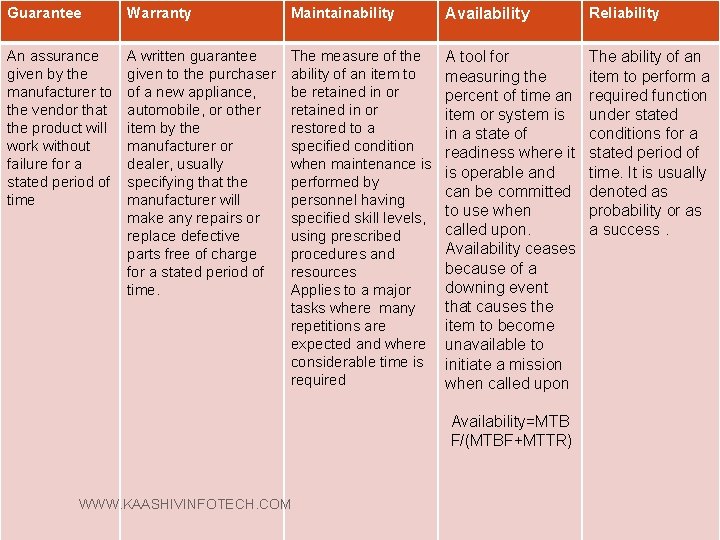
Guarantee Warranty Maintainability Availability Reliability An assurance given by the manufacturer to the vendor that the product will work without failure for a stated period of time A written guarantee given to the purchaser of a new appliance, automobile, or other item by the manufacturer or dealer, usually specifying that the manufacturer will make any repairs or replace defective parts free of charge for a stated period of time. The measure of the ability of an item to be retained in or restored to a specified condition when maintenance is performed by personnel having specified skill levels, using prescribed procedures and resources Applies to a major tasks where many repetitions are expected and where considerable time is required A tool for measuring the percent of time an item or system is in a state of readiness where it is operable and can be committed to use when called upon. Availability ceases because of a downing event that causes the item to become unavailable to initiate a mission when called upon The ability of an item to perform a required function under stated conditions for a stated period of time. It is usually denoted as probability or as a success. Availability=MTB F/(MTBF+MTTR) WWW. KAASHIVINFOTECH. COM
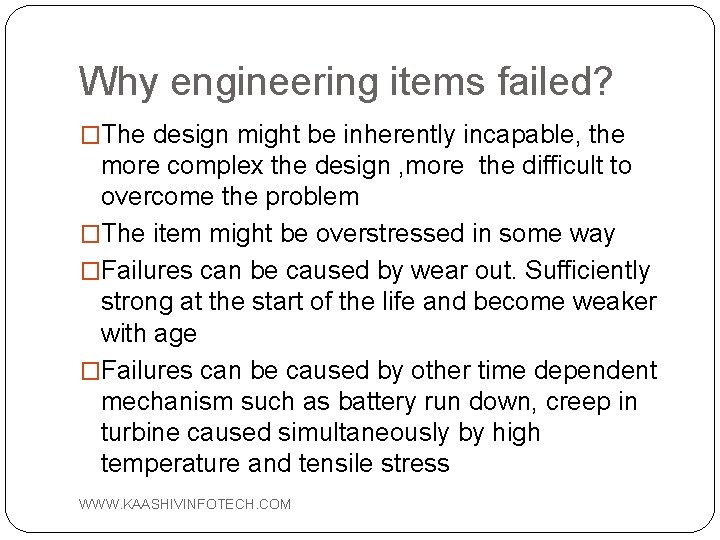
Why engineering items failed? �The design might be inherently incapable, the more complex the design , more the difficult to overcome the problem �The item might be overstressed in some way �Failures can be caused by wear out. Sufficiently strong at the start of the life and become weaker with age �Failures can be caused by other time dependent mechanism such as battery run down, creep in turbine caused simultaneously by high temperature and tensile stress WWW. KAASHIVINFOTECH. COM
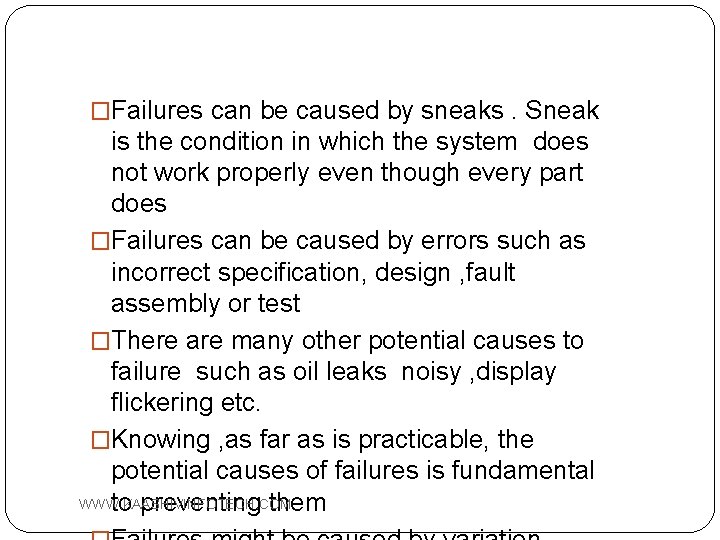
�Failures can be caused by sneaks. Sneak is the condition in which the system does not work properly even though every part does �Failures can be caused by errors such as incorrect specification, design , fault assembly or test �There are many other potential causes to failure such as oil leaks noisy , display flickering etc. �Knowing , as far as is practicable, the potential causes of failures is fundamental WWW. KAASHIVINFOTECH. COM to preventing them
What is reliability engineering �Manufacturers often suffer high costs of failure under warranty �Reliability is usually concerned with failures in the time domain. This distinction marks the difference between traditional quality control and reliability engineering �Whether failures occur or not and their times to occurrence can seldom be forecast accurately. reliability is therefore an aspect of engineering uncertainty �Whether an item will work for a particular period is a question which can be answered as a probability. WWW. KAASHIVINFOTECH. COM
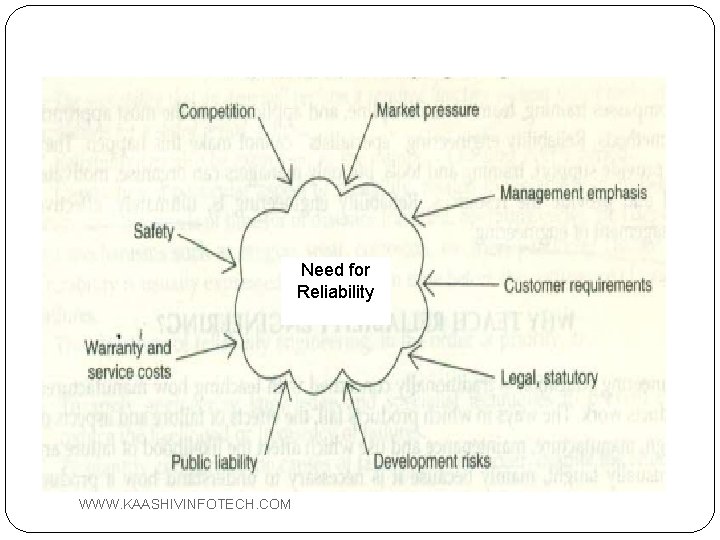
Need for Reliability WWW. KAASHIVINFOTECH. COM
Non-Repairable items � Reliability is the survival probability over the items expected life , or for a period during its life, when only one failure can occur � The instantaneous probability of the first and only failure is called hazard rate � MTTF , the expected life by which a certain percentage might have failed is used here. � The non repairable parts may be individual parts such as bulb, transistor or systems comprised of many parts such as spacecraft, microprocessor � When a part fails in a non repairable system, the system fails, hence the reliability is function of the time WWW. KAASHIVINFOTECH. COM to the first part failure
Repairable items �Reliability is the probability that the failure will not occur in the period of interest, when more than one failure can occur. �It can also be expressed as failure rate or the rate of occurrence of failures �Reliability is characterized by MTBF, but only under the particular condition of a constant failure rate �In a repairable system which contains a part type , the part will contribute by that amount to the system failure rate WWW. KAASHIVINFOTECH. COM
Bath tub curve �What: the concept is derived from the human life experience involving infant mortality, chances of failures, plus a wear out period of life since data for births and deaths is accumulated by government agencies. Most equipment lacks the birth/death recording by govt. and most nonhuman systems can be regenerated to live/die many times before relegation to the scrap heap WWW. KAASHIVINFOTECH. COM
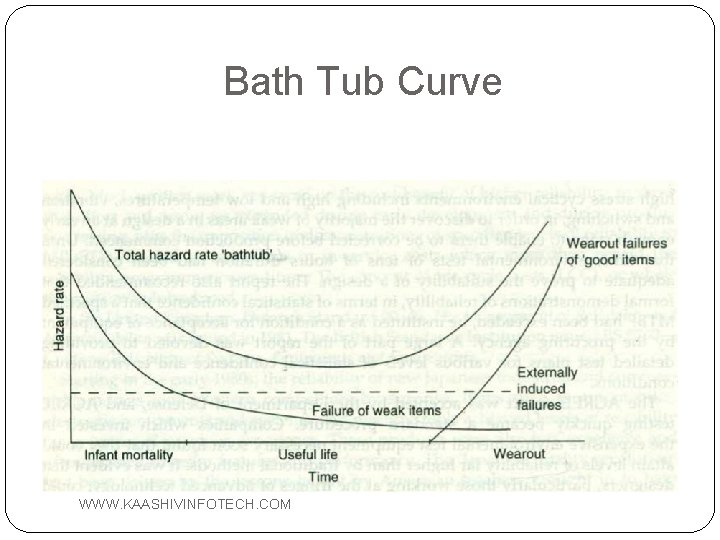
Bath Tub Curve WWW. KAASHIVINFOTECH. COM
�Why: failures rate are different for both people and equipment at different phase of operation and the medicine to be applied to both humans and equipment need to be considered for effectively treating the roots of the problem WWW. KAASHIVINFOTECH. COM
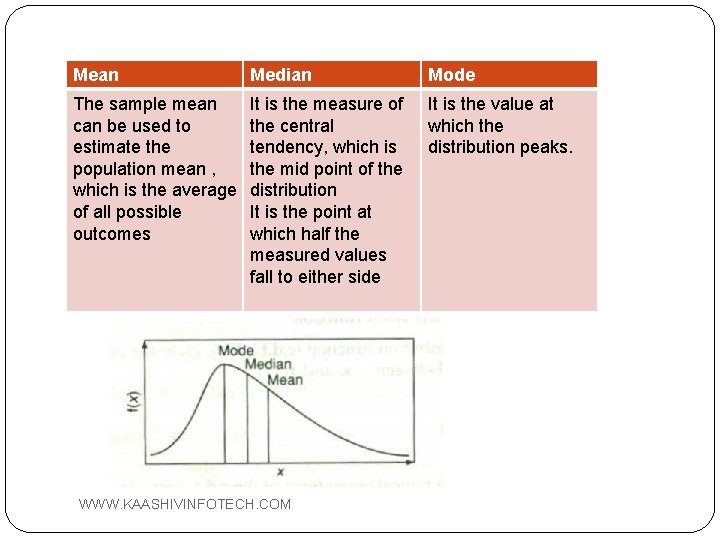
Mean Median Mode The sample mean can be used to estimate the population mean , which is the average of all possible outcomes It is the measure of the central tendency, which is the mid point of the distribution It is the point at which half the measured values fall to either side It is the value at which the distribution peaks. WWW. KAASHIVINFOTECH. COM
WWW. KAASHIVINFOTECH. COM
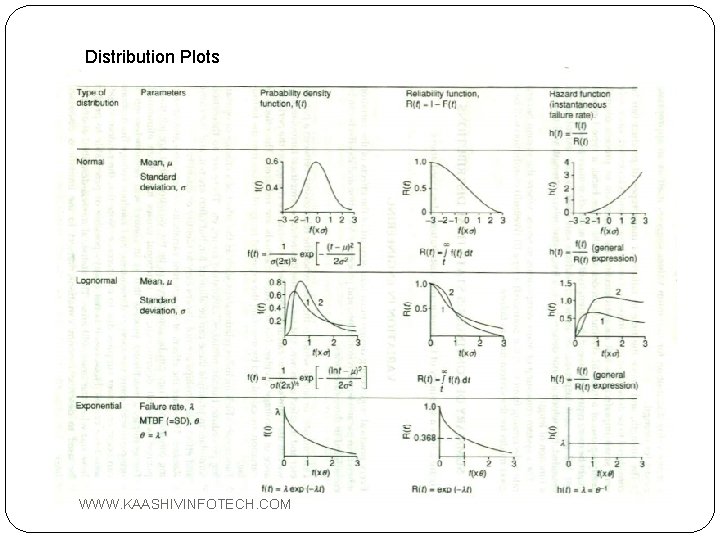
Distribution Plots WWW. KAASHIVINFOTECH. COM
WWW. KAASHIVINFOTECH. COM
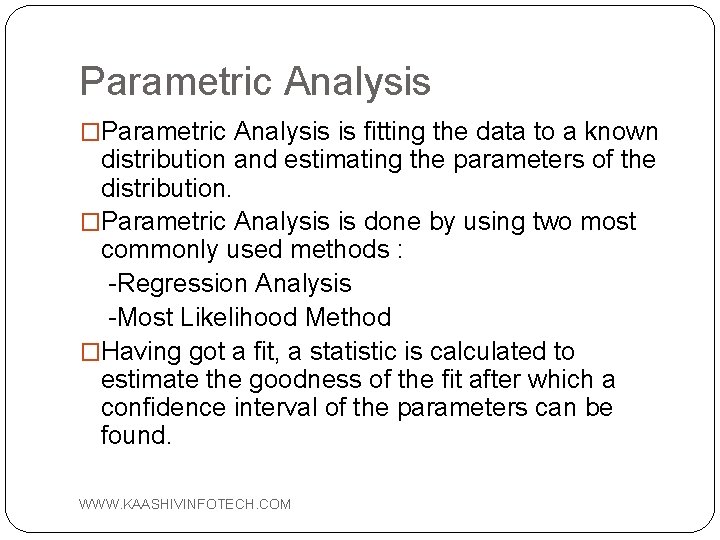
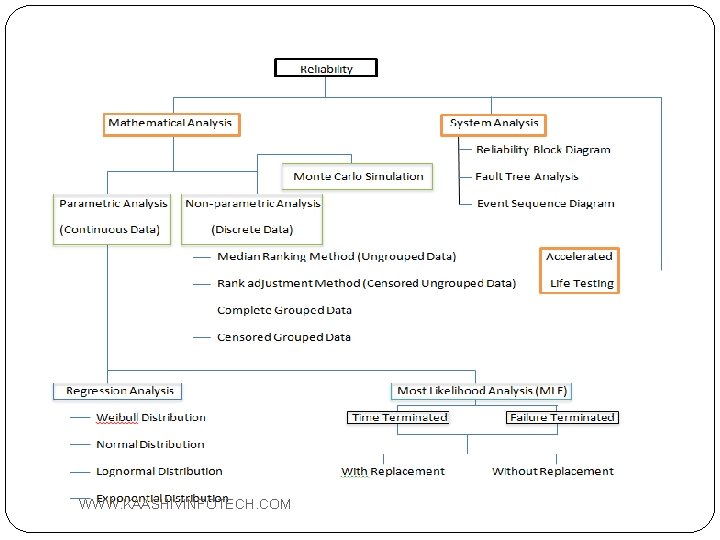
Parametric Analysis �Parametric Analysis is fitting the data to a known distribution and estimating the parameters of the distribution. �Parametric Analysis is done by using two most commonly used methods : -Regression Analysis -Most Likelihood Method �Having got a fit, a statistic is calculated to estimate the goodness of the fit after which a confidence interval of the parameters can be found. WWW. KAASHIVINFOTECH. COM
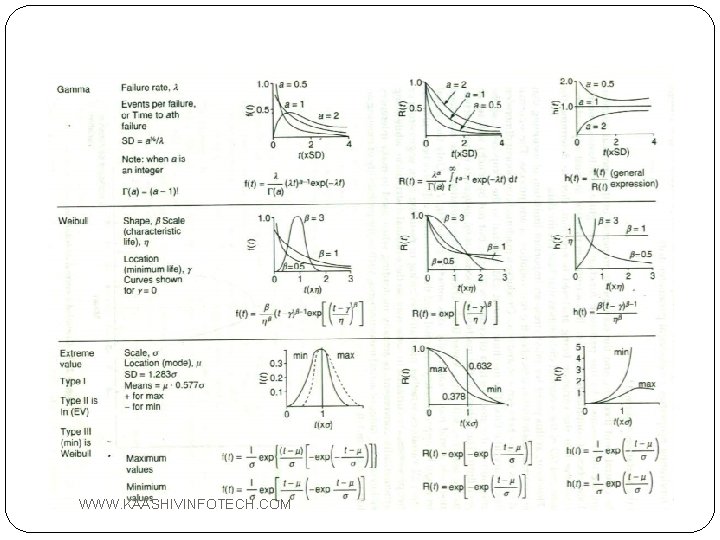
Regression Analysis �Most commonly used continuous distribution are - Weibull Distribution - Normal Distribution - Lognormal Distribution - Exponential Distribution �First we linearize the basic CDF by making the required transformation. From that we find parameters of the distribution. WWW. KAASHIVINFOTECH. COM
![Linearized Formulae for Weibull Distribution �Xi=ln(ti) �Yi=ln ln[1/( 1 -F(ti) )] where F(ti) is](http://slidetodoc.com/presentation_image_h2/1699123e5cf00925eed50c611a1f8013/image-22.jpg "Linearized Formulae for Weibull Distribution �Xi=ln(ti) �Yi=ln ln[1/( 1 -F(ti) )] where F(ti) is")
Linearized Formulae for Weibull Distribution �Xi=ln(ti) �Yi=ln ln[1/( 1 -F(ti) )] where F(ti) is Cumulative Failure Function �F(ti)= (i-0. 3)/(n+4) (For ith failure out of n components) �β= Slope �η = exp(-abs[intercept]/ β) WWW. KAASHIVINFOTECH. COM
�A straight line is fitted using the X and Y data points by minimizing the sum of squares of the distance of the data points from the fitted line. The distance can be in vertical or horizontal direction. �There is a correlation coefficient, referred to as r whose values varies from -1 to 1. The more the value of r^2 reaches 1 the more linear is the relation between X and Y. WWW. KAASHIVINFOTECH. COM
Most Likelihood Method(MLE) �It also helps in estimating the parameters of distribution. �It does that by defining a likelihood function which is function of parameters of the distribution. �The Likelihood function is maximized to find the parameters of the distribution. WWW. KAASHIVINFOTECH. COM
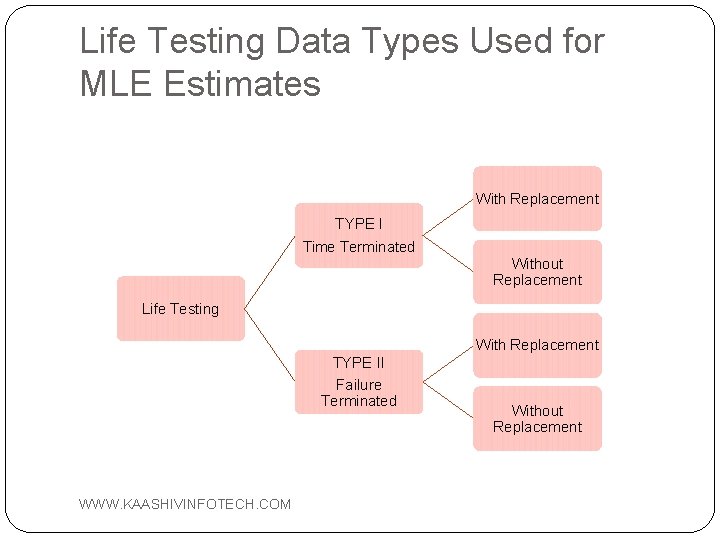
Life Testing Data Types Used for MLE Estimates With Replacement TYPE I Time Terminated Without Replacement Life Testing With Replacement TYPE II Failure Terminated WWW. KAASHIVINFOTECH. COM Without Replacement
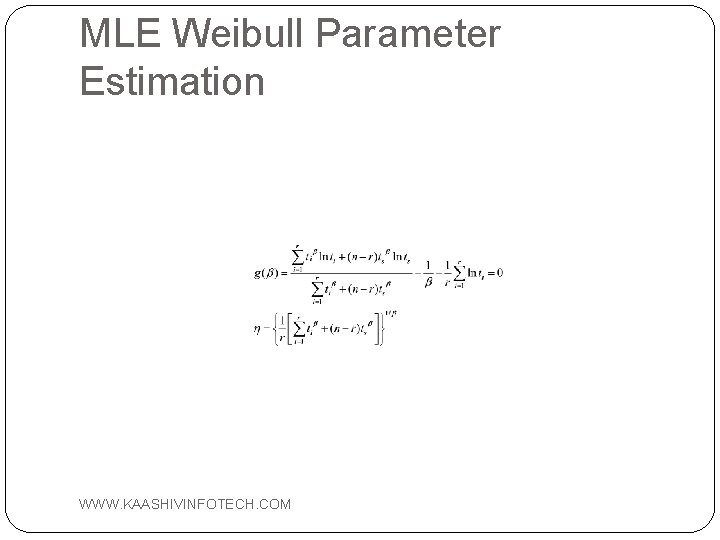
MLE Weibull Parameter Estimation WWW. KAASHIVINFOTECH. COM
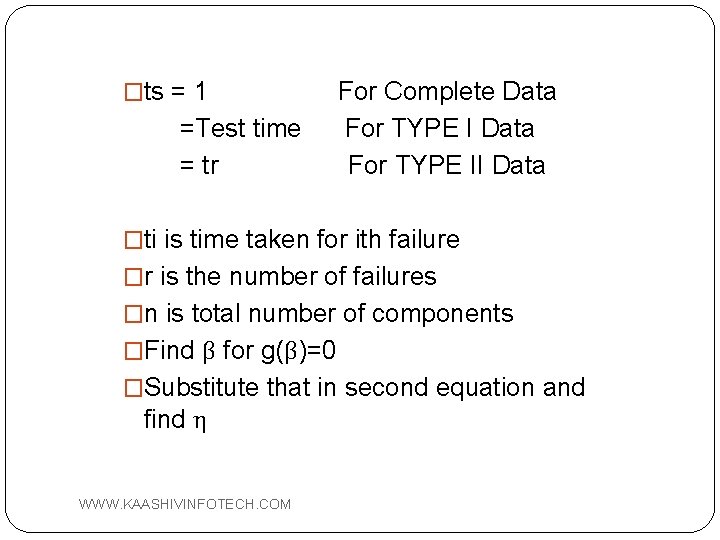
�ts = 1 =Test time = tr For Complete Data For TYPE II Data �ti is time taken for ith failure �r is the number of failures �n is total number of components �Find β for g(β)=0 �Substitute that in second equation and find η WWW. KAASHIVINFOTECH. COM
Goodness Of Fit (GOF) �r^2 value in the case of Regression analysis is used to find goodness of fit. �For MLE we use the following GOF statistic. • Chi-Square Method • Kolmogorov-Smirnov Test �Often data would fit many distribution. Hence we have to find GOF so as to find the perfect distribution. WWW. KAASHIVINFOTECH. COM
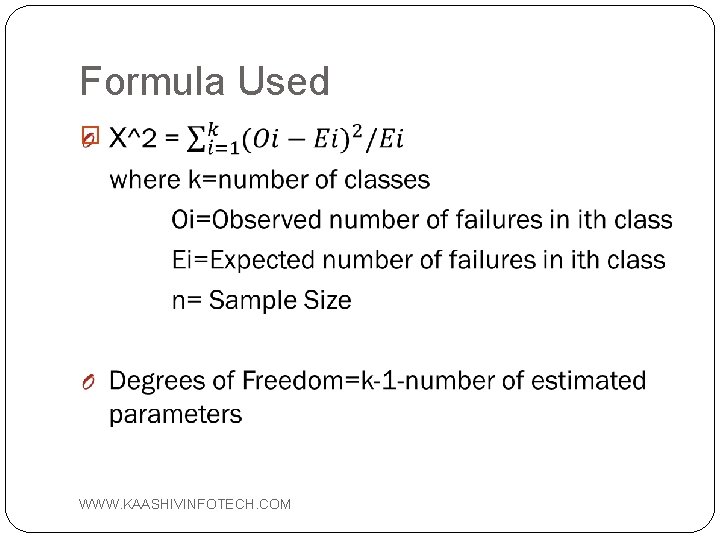
Chi Square Test �Applicable to all distributions having large sample size. �Applied to both discrete and continuous data. �The probabilities are based on null hypothesis WWW. KAASHIVINFOTECH. COM
Formula Used � WWW. KAASHIVINFOTECH. COM
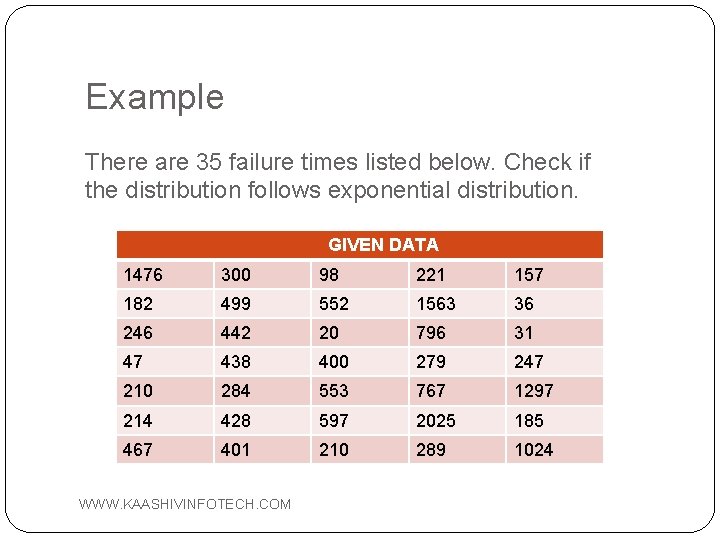
Example There are 35 failure times listed below. Check if the distribution follows exponential distribution. GIVEN DATA 1476 300 98 221 157 182 499 552 1563 36 246 442 20 796 31 47 438 400 279 247 210 284 553 767 1297 214 428 597 2025 185 467 401 210 289 1024 WWW. KAASHIVINFOTECH. COM
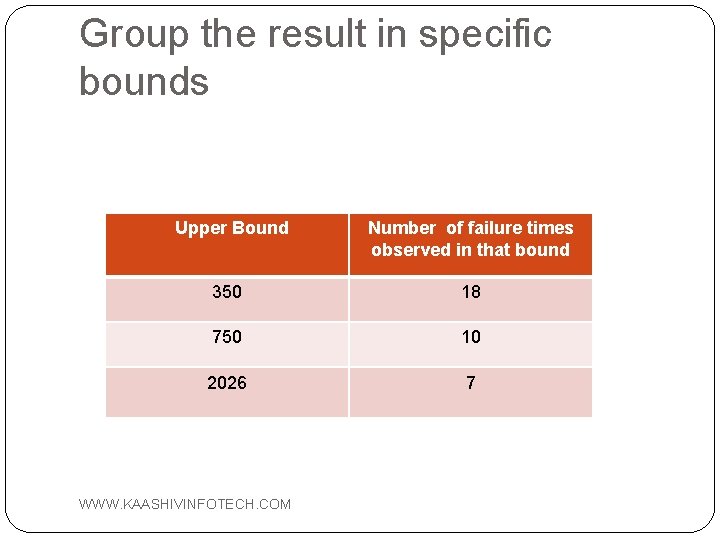
Group the result in specific bounds Upper Bound Number of failure times observed in that bound 350 18 750 10 2026 7 WWW. KAASHIVINFOTECH. COM
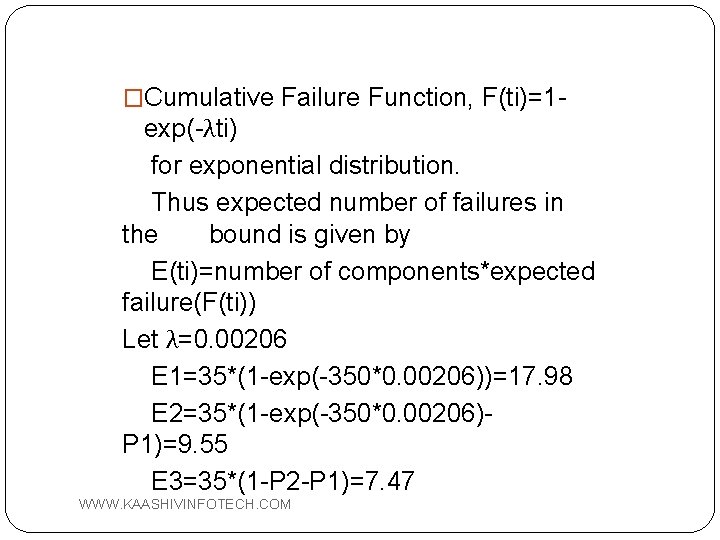
�Cumulative Failure Function, F(ti)=1 - exp(-λti) for exponential distribution. Thus expected number of failures in the bound is given by E(ti)=number of components*expected failure(F(ti)) Let λ=0. 00206 E 1=35*(1 -exp(-350*0. 00206))=17. 98 E 2=35*(1 -exp(-350*0. 00206)P 1)=9. 55 E 3=35*(1 -P 2 -P 1)=7. 47 WWW. KAASHIVINFOTECH. COM
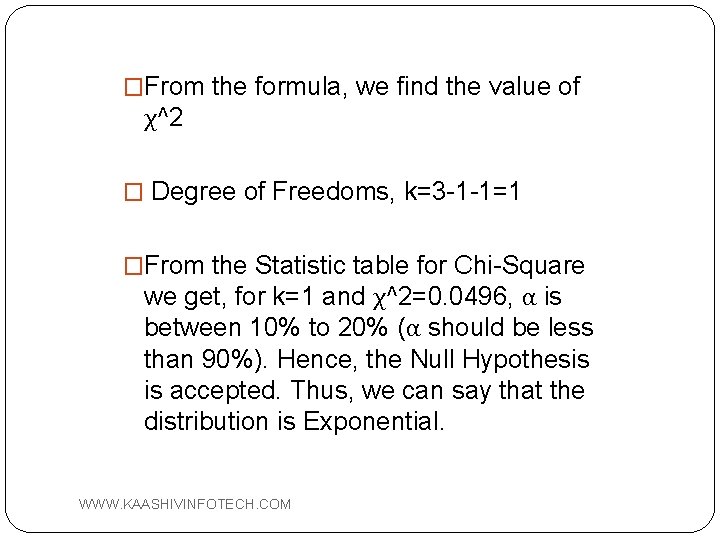
�From the formula, we find the value of χ^2 � Degree of Freedoms, k=3 -1 -1=1 �From the Statistic table for Chi-Square we get, for k=1 and χ^2=0. 0496, α is between 10% to 20% (α should be less than 90%). Hence, the Null Hypothesis is accepted. Thus, we can say that the distribution is Exponential. WWW. KAASHIVINFOTECH. COM
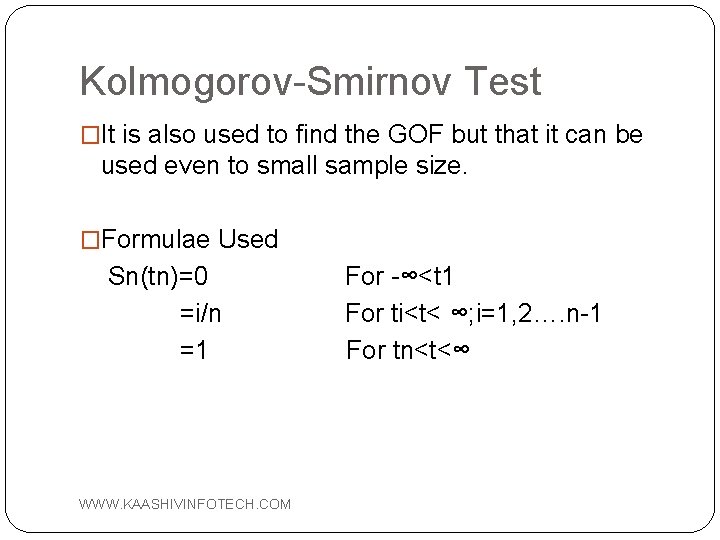
Kolmogorov-Smirnov Test �It is also used to find the GOF but that it can be used even to small sample size. �Formulae Used Sn(tn)=0 =i/n =1 WWW. KAASHIVINFOTECH. COM For -∞<t 1 For ti<t< ∞; i=1, 2…. n-1 For tn<t<∞
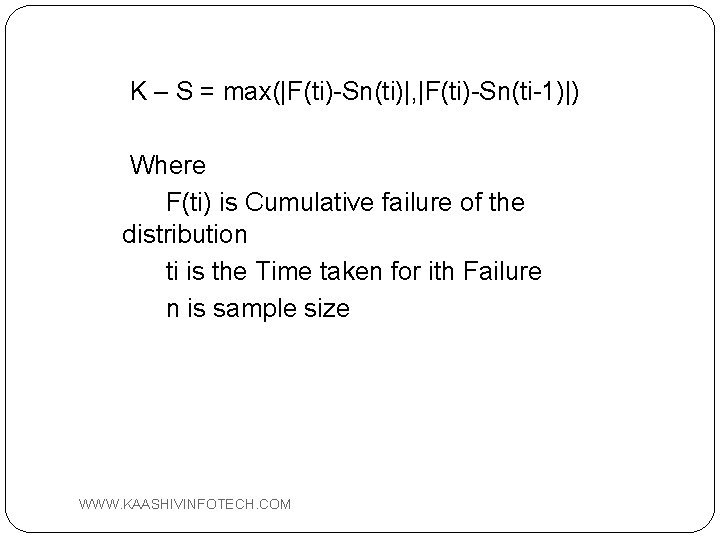
K – S = max(|F(ti)-Sn(ti)|, |F(ti)-Sn(ti-1)|) Where F(ti) is Cumulative failure of the distribution ti is the Time taken for ith Failure n is sample size WWW. KAASHIVINFOTECH. COM
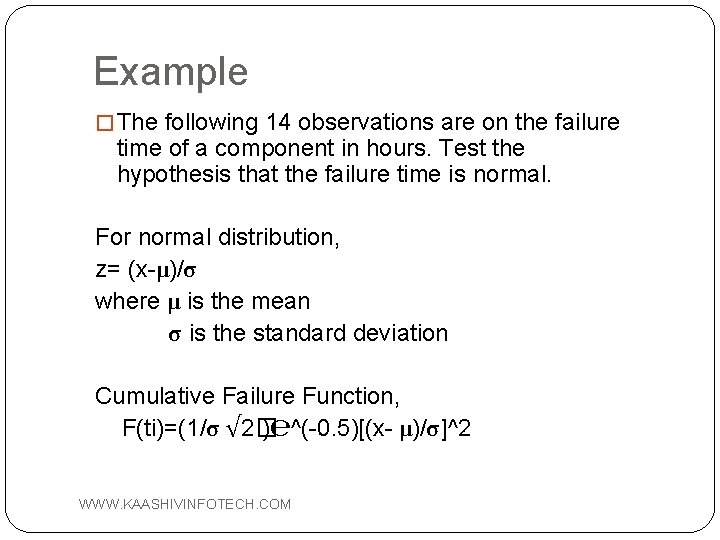
Example � The following 14 observations are on the failure time of a component in hours. Test the hypothesis that the failure time is normal. For normal distribution, z= (x-μ)/σ where μ is the mean σ is the standard deviation Cumulative Failure Function, F(ti)=(1/σ √ 2� )℮^(-0. 5)[(x- μ)/σ]^2 WWW. KAASHIVINFOTECH. COM
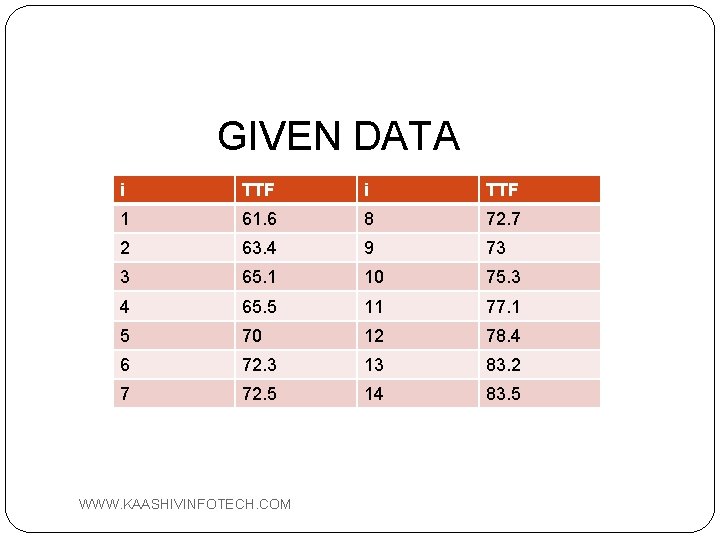
GIVEN DATA i TTF 1 61. 6 8 72. 7 2 63. 4 9 73 3 65. 1 10 75. 3 4 65. 5 11 77. 1 5 70 12 78. 4 6 72. 3 13 83. 2 7 72. 5 14 83. 5 WWW. KAASHIVINFOTECH. COM

Thank you WWW. KAASHIVINFOTECH. COM
- Slides: 39